
Smith R., Minton R. Calculus
Подождите немного. Документ загружается.

P1: OSO/OVY P2: OSO/OVY QC: OSO/OVY T1: OSO
MHDQ256-Ch02 MHDQ256-Smith-v1.cls December 8, 2010 18:21
LT (Late Transcendental)
CONFIRMING PAGES
2-57 SECTION 2.8
..
The Mean Value Theorem 163
This says that for every x sufficiently close to c,
f (x) − f (c)
x −c
> 0. (8.1)
In particular, for the case where the graph first rises, if x −c > 0 (i.e., x > c), this says that
f (x) − f (c) > 0or f (x) > f (c), which can’t happen for every x > c (with x sufficiently
close to c) if the graph has turned around at c and started to fall. From this, we conclude
that it can’t be true that f
(c) > 0. Similarly, we can show that it is not true that f
(c) < 0.
Therefore, f
(c) = 0, as desired. The case where the graph first falls is nearly identical.
y
x
c
(a, f(a))
(b, f(b))
f(c) 0
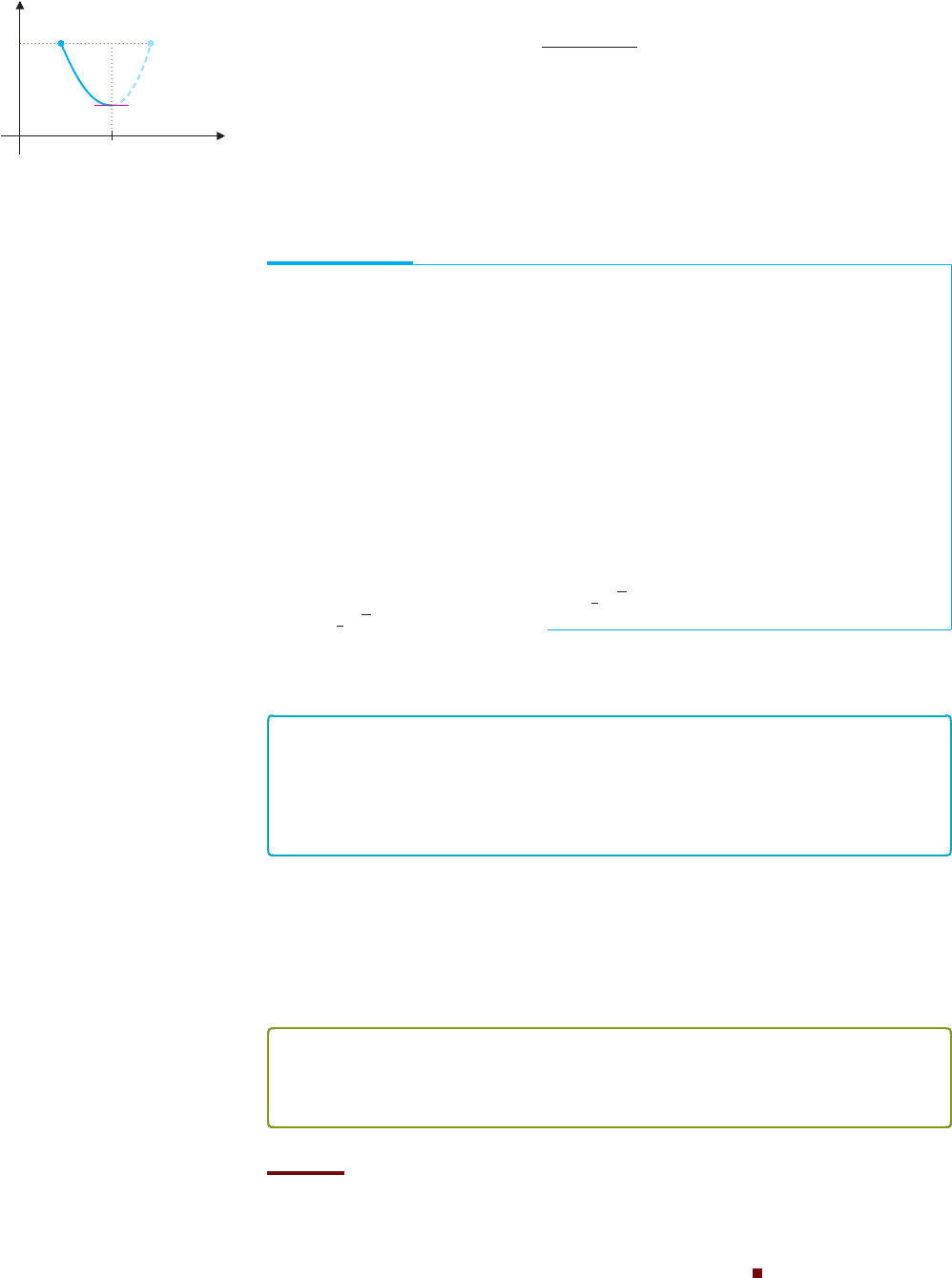
FIGURE 2.39b
Graph falls and then turns around to
rise back to where it started.
We now give an illustration of the conclusion of Rolle’s Theorem.
EXAMPLE 8.1 An Illustration of Rolle’s Theorem
Find a value of c satisfying the conclusion of Rolle’s Theorem for
f (x) = x
3
− 3x
2
+ 2x + 2
on the interval [0, 1].
Solution First, we verify that the hypotheses of the theorem are satisfied: f is
differentiable and continuous for all x [since f (x) is a polynomial and all polynomials
are continuous and differentiable everywhere]. Also, f (0) = f (1) = 2. We have
f
(x) = 3x
2
− 6x + 2.
We now look for values of c such that
f
(c) = 3c
2
− 6c + 2 = 0.
By the quadratic formula, we get c = 1 +
1
3
√
3 ≈ 1.5774 [not in the interval (0, 1)] and
c = 1 −
1
3
√
3 ≈ 0.42265 ∈ (0, 1).
REMARK 8.1
We want to emphasize that example 8.1 is merely an illustration of Rolle’s Theorem.
Finding the number(s) c satisfying the conclusion of Rolle’s Theorem is not the point
of our discussion. Rather, Rolle’s Theorem is of interest to us primarily because we
use it to prove one of the fundamental results of elementary calculus, the Mean Value
Theorem.
AlthoughRolle’sTheoremisasimpleresult,wecanuseittoderivenumerousproperties
of functions. For example, we are often interested in finding the zeros of a function f (that
is, solutions of the equation f (x) = 0). In practice, it is often difficult to determine how
many zeros a given function has. Rolle’s Theorem can be of help here.
THEOREM 8.2
If f is continuous on the interval [a, b], differentiable on the interval (a, b) and
f (x) = 0 has two solutions in [a, b], then f
(x) = 0 has at least one solution in (a, b).
PROOF
This is just a special case of Rolle’s Theorem. Identify the two zeros of f (x)asx = s and
x = t, where s < t. Since f (s) = f (t), Rolle’s Theorem guarantees that there is a number
c such that s < c < t (and hence a < c < b) where f
(c) = 0.
P1: OSO/OVY P2: OSO/OVY QC: OSO/OVY T1: OSO
MHDQ256-Ch02 MHDQ256-Smith-v1.cls December 8, 2010 18:21
LT (Late Transcendental)
CONFIRMING PAGES
164 CHAPTER 2
..
Differentiation 2-58
We can easily generalize the result of Theorem 8.2, as in the following theorem.
THEOREM 8.3
For any integer n > 0, if f is continuous on the interval [a, b] and differentiable on
the interval (a, b) and f (x) = 0 has n solutions in [a, b], then f
(x) = 0 has at least
(n − 1) solutions in (a, b).
PROOF
From Theorem 8.2, between every pair of solutions of f (x) = 0 is at least one solution of
f
(x) = 0. In this case, there are (n − 1) consecutive pairs of solutions of f (x) = 0 and so,
the result follows.
We can use Theorems 8.2 and 8.3 to investigate the number of zeros a given function
has. (Here, we consider only real zeros of a function and not complex zeros.)
EXAMPLE 8.2 Determining the Number of Zeros of a Function
Prove that x
3
+ 4x + 1 = 0 has exactly one solution.
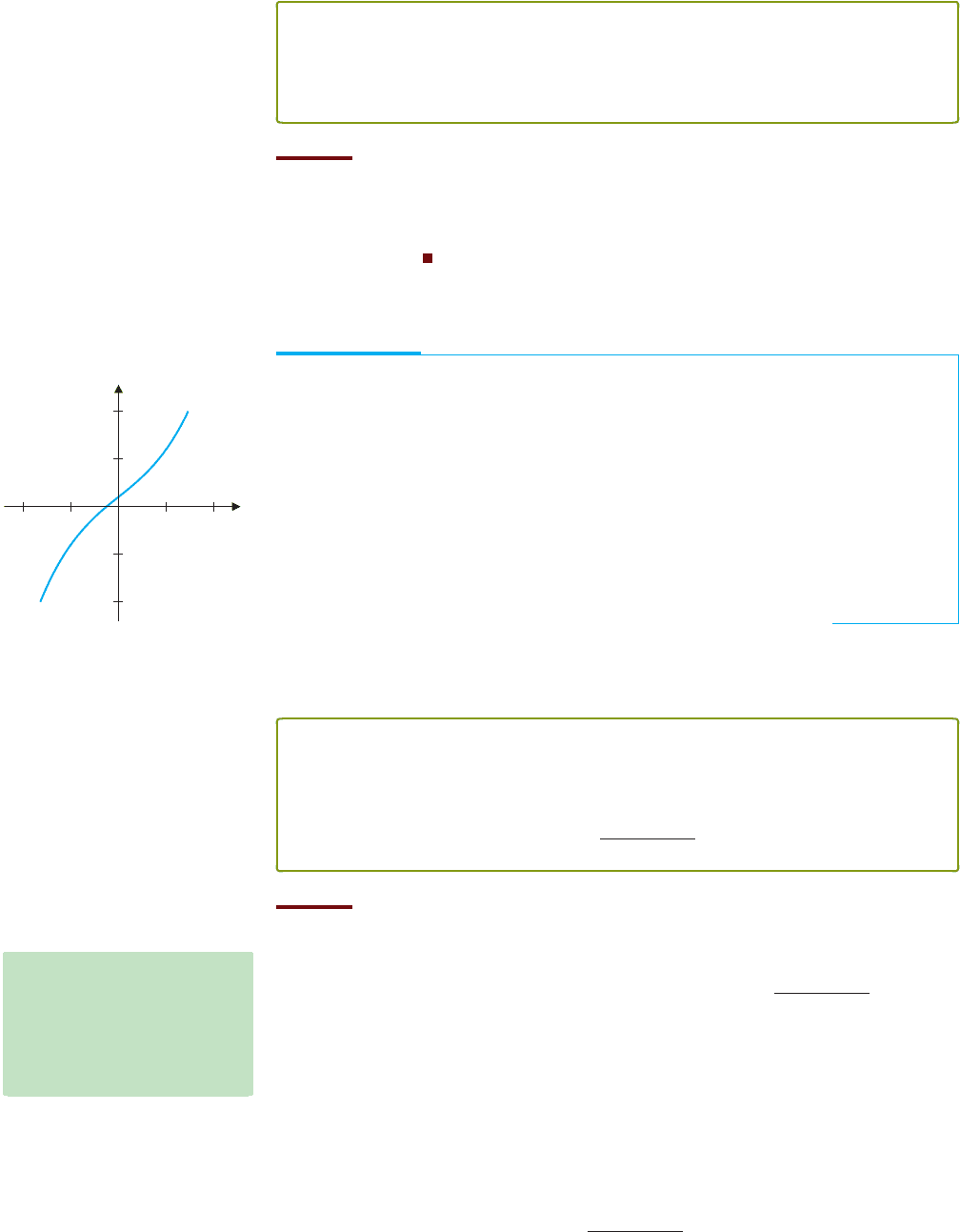
Solution Figure 2.40 makes the result seem reasonable, but how can we be sure there
are no other zeros outside of the displayed window? Notice that if f (x) = x
3
+ 4x + 1,
then the Intermediate Value Theorem guarantees one solution, since f (−1) =−4 < 0
and f (0) = 1 > 0. Further,
f
(x) = 3x
2
+ 4 > 0
y
x
10
5
5
10
2112
FIGURE 2.40
y = x
3
+ 4x + 1
for all x. By Theorem 8.2, if f (x) = 0 had two solutions, then f
(x) = 0 would have at
least one solution. However, since f
(x) = 0 for all x, it can’t be true that f (x) = 0 has
two (or more) solutions. Therefore, f (x) = 0 has exactly one solution.
Wenowgeneralize Rolle’s Theorem to one of the mostsignificant results of elementary
calculus.
THEOREM 8.4 (Mean Value Theorem)
Suppose that f is continuous on the interval [a, b] and differentiable on the interval
(a, b). Then there exists a number c ∈ (a, b) such that
f
(c) =
f (b) − f (a)
b −a
. (8.2)
PROOF
Note that the hypotheses are identical to those of Rolle’s Theorem, except that there is no
assumption about the values of f at the endpoints. The expression
f (b) − f (a)
b −a
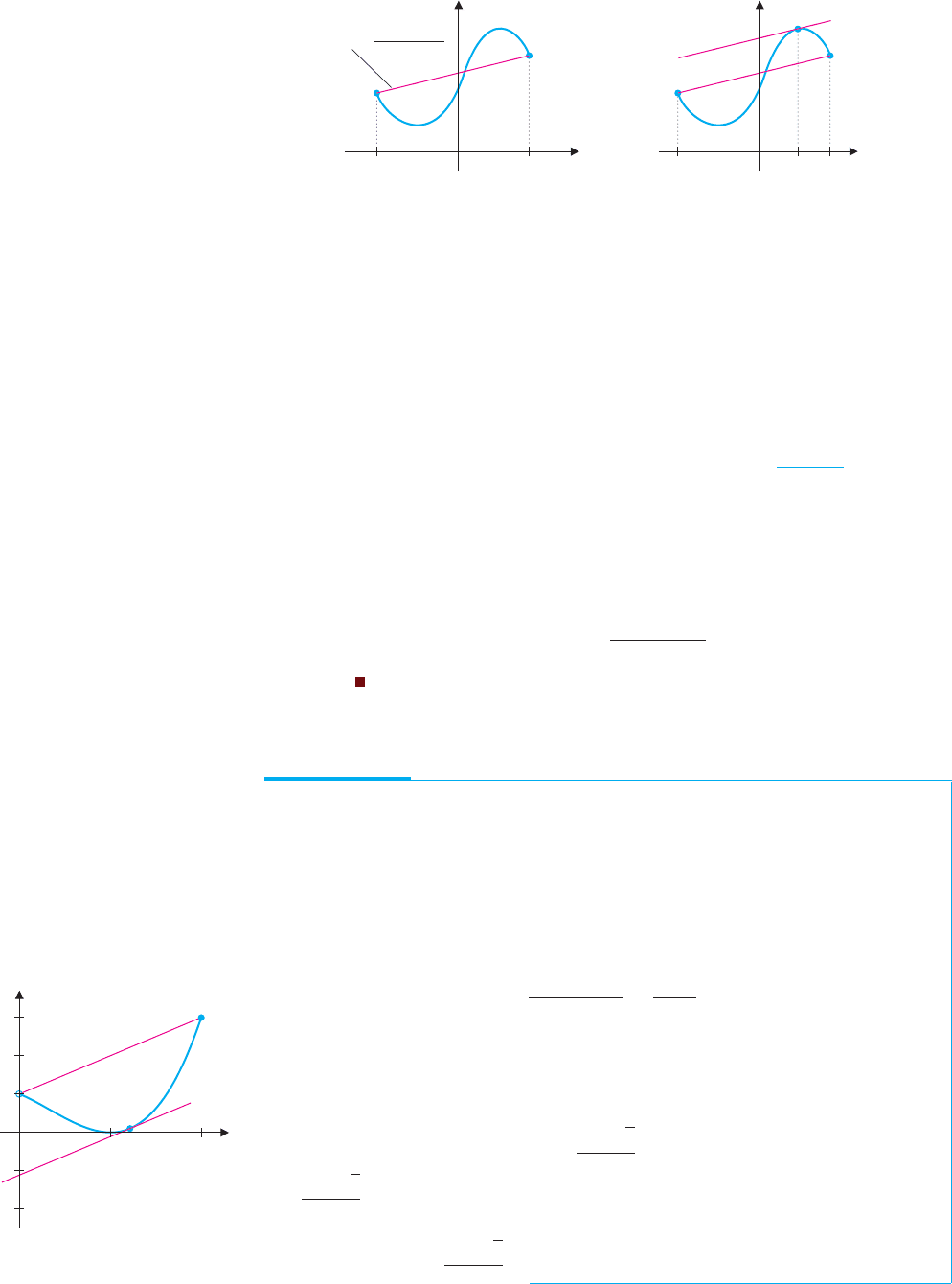
is the slope
of the secant line connecting the endpoints, (a, f (a)) and (b, f (b)).
NOTE
Note that in the special case
where f (a) = f (b), (8.2)
simplifies to the conclusion of
Rolle’s Theorem, that f
(c) = 0.
The theorem states that there is a line tangent to the curve at some point x = c in
(a, b) that has the same slope as (and hence, is parallel to) the secant line. (See Figures 2.41
and 2.42 on the following page.) If you tilt your head so that the line segment looks
horizontal, Figure 2.42 will look like a figure for Rolle’s Theorem (Figures 2.39a and
2.39b). The idea of the proof is to “tilt” the function and then apply Rolle’s Theorem.
The equation of the secant line through the endpoints is
y − f (a) = m(x −a),
where
m =
f (b) − f (a)
b −a
.
P1: OSO/OVY P2: OSO/OVY QC: OSO/OVY T1: OSO
MHDQ256-Ch02 MHDQ256-Smith-v1.cls December 8, 2010 18:21
LT (Late Transcendental)
CONFIRMING PAGES
2-59 SECTION 2.8
..
The Mean Value Theorem 165
y
x
y f(x)
ba
f(b) f(a)
b a
m
x
y f(x)
m f(c)
bca
y
FIGURE 2.41
Secant line
FIGURE 2.42
Mean Value Theorem
Define the “tilted” function g to be the difference between f and the function whose graph
is the secant line:
g(x) = f (x) − [m(x −a) + f (a)]. (8.3)
Note that g is continuous on [a, b] and differentiable on (a, b), since f is. Further,
g(a) = f (a) − [0 + f (a)] = 0
and
g(b) = f (b) − [m(b − a) + f (a)]
= f (b) − [ f (b) − f (a) + f (a)] = 0.
Since m =
f (b) − f (a)
b −a
.
Since g(a) = g(b), we have by Rolle’s Theorem that there exists a number c in the interval
(a, b) such that g
(c) = 0. Differentiating (8.3), we get
0 = g
(c) = f
(c) −m. (8.4)
Finally, solving (8.4) for f
(c) gives us
f
(c) = m =
f (b) − f (a)
b −a
,
as desired.
Before we demonstrate some of the power of the Mean Value Theorem, we first briefly
illustrate its conclusion.
y
x
2
1
1
2
3
21
FIGURE 2.43
Mean Value Theorem
EXAMPLE 8.3 An Illustration of the Mean Value Theorem
Find a value of c satisfying the conclusion of the Mean Value Theorem for
f (x) = x
3
− x
2
− x +1
on the interval [0, 2].
Solution Notice that f is continuous on [0, 2] and differentiable on (0, 2). The Mean
Value Theorem then says that there is a number c in (0, 2) for which
f
(c) =
f (2) − f (0)
2 − 0
=
3 − 1
2 − 0
= 1.
To find this number c,weset
f
(c) = 3c
2
− 2c − 1 = 1
or
3c
2
− 2c − 2 = 0.
From the quadratic formula, we get c =
1 ±
√
7
3
. In this case, only one of these,
c =
1 +
√
7
3
, is in the interval (0, 2). In Figure 2.43, we show the graphs of y = f (x),
the secant line joining the endpoints of the portion of the curve on the interval [0, 2] and
the tangent line at x =
1 +
√
7
3
.
P1: OSO/OVY P2: OSO/OVY QC: OSO/OVY T1: OSO
MHDQ256-Ch02 MHDQ256-Smith-v1.cls December 8, 2010 18:21
LT (Late Transcendental)
CONFIRMING PAGES
166 CHAPTER 2
..
Differentiation 2-60
The illustration in example 8.3, where we found the number c whose existence is
guaranteed by the Mean Value Theorem, is not the point of the theorem. In fact, these c’s
usually remain unknown. The significance of the Mean Value Theorem is that it relates a
difference of function values to the difference of the corresponding x-values, as in equation
(8.5) below.
Note that if we take the conclusion of the Mean Value Theorem (8.2) and multiply both
sides by the quantity (b −a), we get
f (b) − f (a) = f
(c)(b − a). (8.5)
As it turns out, many of the most important results in the calculus (including one known
as the Fundamental Theorem of Calculus) follow from the Mean Value Theorem. For now,
we derive a result essential to our work in Chapter 4. The question concerns how many
functions share the same derivative.
Recall that for any constant c,
d
dx
(c) = 0.
A question that you probably haven’t thought to ask is: Are there any other functions whose
derivative is zero? The answer is no, as we see in Theorem 8.5.
THEOREM 8.5
Suppose that f
(x) = 0 for all x in some open interval I. Then, f (x) is constant on I.
PROOF
Pick any two numbers, say a and b,inI , with a < b. Since f is differentiable in I and
(a, b) ⊂ I , f is continuous on [a, b] and differentiable on (a, b). By the Mean Value
Theorem, we know that for some number c ∈ (a, b) ⊂ I ,
f (b) − f (a)
b −a
= f
(c).
Since, f
(x) = 0 for all x ∈ I , f
(c) = 0 and it follows from (8.6) that
f (b) − f (a) = 0or f (b) = f (a).
Since a and b were arbitrary points in I, this says that f is constant on I, as desired.
A question closely related to Theorem 8.5 is the following. We know, for example, that
d
dx
(x
2
+ 2) = 2x,
but are there any other functions with the same derivative? You should quickly come up
with several. For instance, x
2
+ 3 and x
2
− 4 also have the derivative 2x. In fact,
d
dx
(x
2
+ c) = 2x,
for any constant c. Are there any other functions, though, with the derivative 2x? Corollary
8.1 says that there are no such functions.
COROLLARY 8.1
Suppose that g
(x) = f
(x) for all x in some open interval I. Then, for some
constant c,
g(x) = f (x) + c, for all x ∈ I.
y
x
y f(x)
y f(x) c
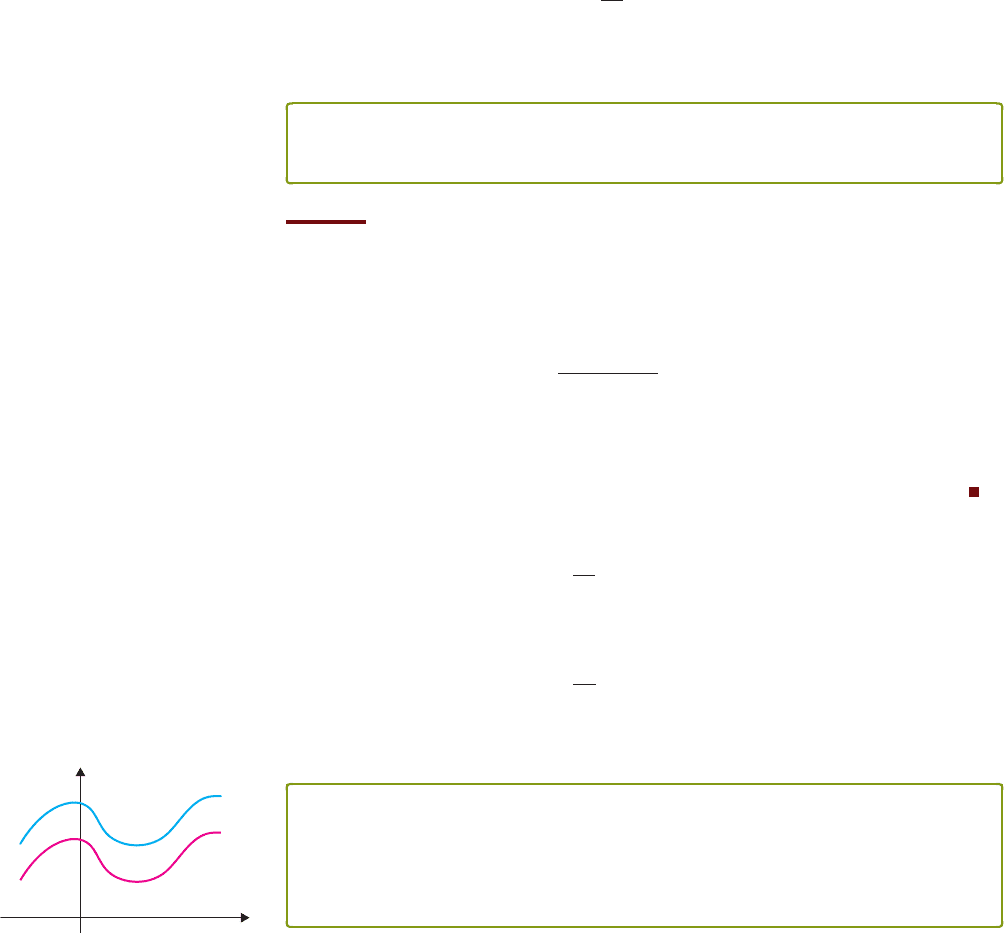
FIGURE 2.44
Parallel graphs
Note that Corollary 8.1 says that if two graphs have the same slope at every point on
an interval, then the graphs differ only by a vertical shift. (See Figure 2.44.)

P1: OSO/OVY P2: OSO/OVY QC: OSO/OVY T1: OSO
MHDQ256-Ch02 MHDQ256-Smith-v1.cls December 8, 2010 18:21
LT (Late Transcendental)
CONFIRMING PAGES
2-61 SECTION 2.8
..
The Mean Value Theorem 167
PROOF
Define h(x) = g(x) − f (x). Then
h
(x) = g
(x) − f
(x) = 0
for all x in I . From Theorem 8.5, h(x) = c, for some constant c. The result then follows
immediately from the definition of h(x).
We see in Chapter 4 that Corollary 8.1 has significant implications when we try to
reverse the process of differentiation (called antidifferentiation). We take a look ahead to
this in example 8.4.
EXAMPLE 8.4 Finding Every Function with a Given Derivative
Find all functions that have a derivative equal to 3x
2
+ 1.
Solution We first write down (from our experience with derivatives) one function
with the correct derivative: x
3
+ x. Then, Corollary 8.1 tells us that any other function
with the same derivative differs by at most a constant. So, every function whose
derivative equals 3x
2
+ 1 has the form x
3
+ x +c, for some constant c.
As our final example, we demonstrate how the Mean Value Theorem can be used to
establish a useful inequality.
EXAMPLE 8.5 Proving an Inequality for sin x
Prove that
|sin a|≤|a| for all a.
Solution First, note that f (x) = sin x is continuous and differentiable on any interval
and that for any a,
|sin a|=|sin a − sin 0|,
since sin0 = 0. From the Mean Value Theorem, we have that (for a = 0)
sina − sin 0
a − 0
= f
(c) = cosc, (8.6)
for some number c between a and 0. Notice that if we multiply both sides of (8.6) by a
and take absolute values, we get
|sin a|=|sin a − sin 0|=|cos c||a − 0|=|cos c||a|. (8.7)
But, |cos c|≤1, for all real numbers c and so, from (8.7), we have
|sin a|=|cos c||a|≤(1)|a|=|a|,
as desired.
BEYOND FORMULAS
The Mean Value Theorem is subtle, but its implications are far-reaching. Although
the illustration in Figure 2.42 makes the result seem obvious, the consequences of the
Mean Value Theorem, such as example 8.4, are powerful and not at all obvious. For
example, most of the rest of the calculus developed in this book depends on the Mean
Value Theorem either directly or indirectly. A thorough understanding of the theory
of calculus can lead you to important conclusions, particularly when the problems are
beyond what your intuition alone can handle. What other theorems have you learned
that continue to provide insight beyond their original context?

P1: OSO/OVY P2: OSO/OVY QC: OSO/OVY T1: OSO
MHDQ256-Ch02 MHDQ256-Smith-v1.cls December 8, 2010 18:21
LT (Late Transcendental)
CONFIRMING PAGES
168 CHAPTER 2
..
Differentiation 2-62
EXERCISES 2.8
WRITING EXERCISES
1. For both Rolle’s Theorem and the Mean Value Theorem, we
assume that f is continuous on the closed interval [a, b] and
differentiableon the open interval(a, b). If we assumethat f is
differentiable on [a, b], we do not have to mention continuity.
Explain why not. However, explain why this new assumption
wouldrule out f (x) = x
2/3
on[0, 1],forwhichtheMeanValue
Theorem does apply.
2. One of the results in this section is that if f
(x) = g
(x)onan
open interval I, then g(x) = f (x) + c on I for some constant
c. Explain this result graphically.
3. Explain the result of Corollary 8.1 in terms of position and
velocity functions. That is, if two objects have the same veloc-
ity functions, what can you say about the relative positions of
the two objects?
4. Rolle’s Theorem can be derived from the Mean Value
Theorem simply by setting f (a) = f (b). Given this, it may
seem odd that Rolle’s Theorem rates its own name and portion
of the book. To explain why we do this, discuss ways in which
Rolle’s Theorem is easier to understand than the Mean Value
Theorem.
In exercises 1–6, check the hypotheses of Rolle’s Theorem and
the Mean Value Theorem and find a value of c that makes the
appropriate conclusion true. Illustrate the conclusion with a
graph.
1. f (x) = x
2
+ 1, [−2, 2] 2. f (x) = x
2
+ 1, [0, 2]
3. f (x) = x
3
+ x
2
, [0, 1] 4. f (x) = x
3
+ x
2
, [−1, 1]
5. f (x) = sinx, [0,π/2] 6. f (x) = sin x, [−π, 0]
............................................................
7. Prove that x
3
+ 5x + 1 = 0 has exactly one solution.
8. Prove that x
3
+ 4x − 3 = 0 has exactly one solution.
9. Prove that x
4
+ 3x
2
− 2 = 0 has exactly two solutions.
10. Prove that x
4
+ 6x
2
− 1 = 0 has exactly two solutions.
11. Prove that x
3
+ ax +b = 0hasexactlyone solution for a > 0.
12. Prove that x
4
+ ax
2
− b = 0(a > 0, b > 0) has exactly two
solutions.
13. Prove that x
5
+ ax
3
+ bx +c = 0 has exactlyone solution for
a > 0, b > 0.
14. Prove that a third-degree (cubic) polynomial has at most three
zeros. (You may use the quadratic formula.)
............................................................
In exercises 15–22, find all functions g such that g
(x) f (x).
15. f (x) = x
2
16. f (x) = 9x
4
17. f (x) = 1/x
2
18. f (x) =
√
x
19. f (x) = sinx 20. f (x) = cos x
21. f (x) =
sin x
cos
2
x
22. f (x) = 2x(x
2
+ 4)
2
............................................................
23. Assume that f is a differentiable function such that
f (0) = f
(0) = 0 and f
(0) > 0. Argue that there exists a
positive constant a > 0 such that f (x) > 0 for all x in the
interval (0, a). Can anything be concluded about f (x) for
negative x’s?
24. Show that for any real numbers u and v,
|cosu − cos v|≤|u − v|.
25. Prove that |sin a| < |a|for all a = 0 and use the result to show
that the only solution to the equation sin x = x is x = 0. What
happens if you try to find all intersections with a graphing
calculator?
26. Prove that |x|≤|tan x| for |x| <
π
2
.
27. If f
(x) > 0forall x,provethat f (x)isanincreasingfunction:
that is, if a < b, then f (a) < f (b).
28. If f
(x) < 0 for all x, provethat f (x)isadecreasing function:
that is, if a < b, then f (a) > f (b).
............................................................
Inexercises29–36, determinewhether thefunction isincreasing,
decreasing or neither.
29. f (x) = x
3
+ 5x + 1 30. f (x) = x
5
+ 3x
3
− 1
31. f (x) =−x
3
− 3x + 1 32. f (x) = x
4
+ 2x
2
+ 1
33. f (x) = 1/x 34. f (x) =
x
x + 1
35. f (x) =
√
x + 1 36. f (x) =
x
√
x
2
+ 1
............................................................
37. Suppose that s(t) gives the position of an object at time t.Ifs
is differentiable on the interval [a, b], prove that at some time
t = c, the instantaneous velocity at t = c equals the average
velocity between times t = a and t = b.
38. Two runners start a race at time 0. At some time t = a, one
runner has pulled ahead, but the other runner has taken the lead
by time t = b. Prove that at some time t = c > 0, the runners
were going exactly the same speed.
39. If f and g are differentiable functions on the interval [a, b]
with f (a) = g(a) and f (b) = g(b), prove that at some point
in the interval [a, b], f and g have parallel tangent lines.
40. Prove that the result of exercise 39 still holds if the assump-
tions f (a) = g(a) and f (b) = g(b) are relaxed to requiring
f (b) − f (a) = g(b) − g(a).
41. For f (x) =
2x if x ≤ 0
2x − 4ifx > 0
show that f is continuous on
the interval (0, 2), differentiable on the interval (0, 2) and has
f (0) = f (2). Show that there does not exist a value of c such
that f
(c) = 0. Which hypothesis of Rolle’s Theorem is not
satisfied?
42. Assume that f is a differentiable function such that
f (0) = f
(0) = 0. Show by example that it is not necessar-
ily true that f (x) = 0 for all x. Find the flaw in the following
bogus “proof.” Using the Mean Value Theorem with a = x

P1: OSO/OVY P2: OSO/OVY QC: OSO/OVY T1: OSO
MHDQ256-Ch02 MHDQ256-Smith-v1.cls December 8, 2010 18:21
LT (Late Transcendental)
CONFIRMING PAGES
2-63 CHAPTER 2
..
Review Exercises 169
andb = 0, we have f
(c) =
f (x) − f (0)
x − 0
.Since f (0) = 0 and
f
(c) = 0, we have 0 =
f (x)
x
so that f (x) = 0.
EXPLORATORY EXERCISES
1. If you have an average velocity of 60 mph over 1 hour and
the speed limit is 65 mph, you are unable to prove that you
never exceeded the speed limit. What is the longest time inter-
val over which you can average 60 mph and still guarantee no
speeding? We can use the Mean Value Theorem to answer the
question after clearing up a couple of preliminary questions.
First, argue that we need to knowthe maximum acceleration of
a car and the maximum positive acceleration may differ from
themaximumnegativeacceleration.Basedonyour experience,
what is the fastest your car could accelerate (speed up)? What
is the fastest your car could decelerate (slow down)? Back up
your estimates with some real data (e.g., my car goes from 0
to 60 in 15 seconds). Call the larger number A (use units of
mph per second). Next, argue that if acceleration (the deriva-
tive of velocity) is constant, then the velocity function is linear.
Therefore, if the velocity varies from 55 mph to 65 mph at con-
stant acceleration, the average velocity will be 60 mph. Now,
apply the Mean Value Theorem to the velocity function v(t)on
a time interval [0, T ], where the velocity changes from 55 mph
to65mphatconstantacceleration A:thenv
(c) =
v(T ) −v(0)
T − 0
and A =
65 − 55
T − 0
. For how long is the guarantee good?
2. Suppose that a pollutant is dumped into a lake at the rate
of p
(t) = t
2
− t + 4 tons per month. The amount of pol-
lutant dumped into the lake in the first two months is
A = p(2) − p(0). Using c = 1 (the midpoint of the interval),
estimate A by applying the Mean Value Theorem to p(t)on
the interval [0, 2]. To get a better estimate, apply the Mean
Value Theorem to the intervals [0, 1/2], [1/2, 1], [1, 3/2] and
[3/2, 2]. If you have access to a CAS, get better estimates by
dividing the interval [0, 2] into more and more pieces and try
to conjecture the limit of the estimates.
3. A result known as the Cauchy Mean Value Theorem states
that if f and g are differentiable on the interval (a, b) and
continuous on [a, b], then there exists a number c with
a < c < b and[ f (b) − f (a)]g
(c) = [g(b) − g(a)] f
(c).Find
all flaws in the following invalid attempt to prove the result,
and then find a correct proof. Invalid attempt: The hypo-
theses of the Mean Value Theorem are satisfied by both
functions, so there exists a number c with a < c < b
and f
(c) =
f (b) − f (a)
b −a
and g
(c) =
g(b) − g(a)
b −a
. Then
b −a =
f (b) − f (a)
f
(c)
=
g(b) − g(a)
g
(c)
and thus
[ f (b) − f (a)]g
(c) = [g(b) − g(a)] f
(c).
Review Exercises
WRITING EXERCISES
The following list includes terms that are defined and theorems that
arestatedinthis chapter.Foreachterm or theorem, (1)givea precise
definition or statement, (2) state in general terms what it means and
(3) describe the types of problems with which it is associated.
Tangent line Velocity Average velocity
Derivative Power rule Acceleration
Product rule Quotient rule Chain rule
Implicit differentiation Mean Value Theorem Rolle’s Theorem
State the derivative of each function:
sin x, cos x, tan x, cot x, sec x, csc x
TRUE OR FALSE
State whether each statement is true or false and briefly explain
why. If the statement is false, try to “fix it” by modifying the given
statement to make a new statement that is true.
1. If a function is continuous at x = a, then it has a tangent line
at x = a.
2. The average velocity between t = a and t = b is the average
of the velocities at t = a and t = b.
3. The derivative of a function gives its slope.
4. Given the graph of f
(x), you can construct the graph of f (x).
5. The power rule gives the rule for computing the derivative of
any polynomial.
6. If a function is written as a quotient, use the quotient rule to
find its derivative.
7. The chain rule gives the derivative of the composition of two
functions. The order does not matter.
8. The slope of f (x) = sin4x is never larger than 1.
9. In implicit differentiation, you do not have to solve for y as a
function of x to find y
(x).
10. The Mean Value Theorem and Rolle’s Theorem are special
cases of each other.
11. The Mean Value Theorem can be used to show that for a fifth-
degree polynomial, f
(x) = 0 for at most four values of x.
P1: OSO/OVY P2: OSO/OVY QC: OSO/OVY T1: OSO
MHDQ256-Ch02 MHDQ256-Smith-v1.cls December 8, 2010 18:21
LT (Late Transcendental)
CONFIRMING PAGES
170 CHAPTER 2
..
Differentiation 2-64
Review Exercises
1. Estimate the value of f
(1) from the given data.
x 0 0.5 1 1.5 2
f (x) 2.0 2.6 3.0 3.4 4.0
2. List the points A, B, C and D in order of increasing slope of
the tangent line.
y
x
A
B
C
D
............................................................
In exercises 3–8, use the limit definition to find the indicated
derivative.
3. f
(2) for f (x) = x
2
− 2x
4. f
(1) for f (x) = 1 +
1
x
5. f
(1) for f (x) =
√
x 6. f
(0) for f (x) = x
3
− 2x
7. f
(x) for f (x) = x
3
+ x 8. f
(x) for f (x) =
3
x
............................................................
In exercises 9–14, find an equation of the tangent line.
9. y = x
4
− 2x + 1atx = 1 10. y = sin2x at x = 0
11. y = 3sin 2x at x = 0 12. y =
√
x
2
+ 1atx = 0
13. y − x
2
y
2
= x −1at(1, 1) 14. y
2
+x cos y = 4−x at (2, 0)
............................................................
Inexercises15–18, use the givenposition function to findvelocity
and acceleration.
15. s(t) =−16t
2
+ 40t + 10 16. s(t) =−9.8t
2
− 22t + 6
17. s(t) = 10 sin 4t 18. s(t) =
√
4t + 16 − 4
............................................................
19. In exercise 15, s(t) gives the height of a ball at time t. Find the
ball’s velocity at t = 1; is the ball going up or down? Find the
ball’s velocity at t = 2; is the ball going up or down?
20. In exercise 17, s(t) gives the position of a mass attached to a
spring at time t. Compare the velocities at t = 0 and t = π.Is
the mass moving in the same direction or opposite directions?
At which time is the mass moving faster?
............................................................
In exercises 21 and 22, compute the slopes of the secant lines be-
tween (a) x 1 and x 2, (b) x 1 and x 1.5, (c) x 1 and
x 1.1 and (d) estimate the slope of the tangent line at x 1.
21. f (x) =
√
x + 1 22. f (x) = cos(x/6)
............................................................
In exercises 23–46, find the derivative of the given function.
23. f (x) = x
4
− 3x
3
+ 2x − 1 24. f (x) = x
2/3
− 4x
2
+ 5
25. f (x) =
3
√
x
+
5
x
2
26. f (x) =
2 − 3x + x
2
√
x
27. f (t) = t
2
(t + 2)
3
28. f (t) = (t
2
+ 1)(t
3
− 3t + 2)
29. g(x) =
x
3x
2
− 1
30. g(x) =
3x
2
− 1
x
31. f (x) = x
2
sin x 32. f (x) = sin x
2
33. f (x) = tan
√
x 34. f (x) =
√
tan x
35. f (t) = t csc t 36. f (t) = sin3t cos4t
37. u(x) =
2
√
x
2
+ 2
38. u(x) =
√
x
5
3
39. f (x) = 3cos
√
4 − x
2
40. f (x) = sec
2
x + 1
41. f (x) =
√
sin4x 42. f (x) = cos
2
3x
43. f (x) =
x + 1
x − 1
2
44. f (x) =
6x
(x − 1)
2
45. u(x) = 4sin
2
(4 −
√
x) 46. f (x) =
x sin2x
√
x
2
+ 1
............................................................
In exercises 47 and 48, use the graph of y f (x) to sketch the
graph of y f
(x).
47.
y
x
1
1
2
3
211
48.
y
x
2
2
44 2
............................................................

P1: OSO/OVY P2: OSO/OVY QC: OSO/OVY T1: OSO
MHDQ256-Ch02 MHDQ256-Smith-v1.cls December 8, 2010 18:21
LT (Late Transcendental)
CONFIRMING PAGES
2-65 CHAPTER 2
..
Review Exercises 171
Review Exercises
In exercises 49–56, find the indicated derivative.
49. f
(x) for f (x) = x
4
− 3x
3
+ 2x
2
− x − 1
50. f
(x) for f (x) =
√
x + 1
51. f
(x) for f (x) = x cos(2x)
52. f
(x) for f (x) =
4
x + 1
53. f
(x) for f (x) = tan x
54. f
(4)
(x) for f (x) = x
6
− 3x
4
+ 2x
3
− 7x + 1
55. f
(26)
(x) for f (x) = sin 3x
56. f
(31)
(x) for f (x) =
1
x
............................................................
57. The position at time t of a spring moving vertically is given
by f (t) = 4 cos2t. Find the position of the spring when it
has (a) zero velocity, (b) maximum velocity and (c) minimum
velocity.
58. The position at time t of a spring moving vertically is given
by f (t) = cos7t sin3t. Find the velocity of the spring at any
time t.
............................................................
In exercises 59–62, find the derivative y
(x).
59. x
2
y − 3y
3
= x
2
+ 1
60. sin(xy) + x
2
= x − y
61.
y
x + 1
− 3y = tan x
62. x − 2y
2
= 3cos(x/y)
............................................................
63. If you have access to a CAS, sketch the graph in exercise 59.
Find the y-value corresponding to x = 0. Find the slope of the
tangent line to the curve at this point. Also, find y
(0).
64. If you have access to a CAS, sketch the graph in exercise 61.
Find the y-value corresponding to x = 0. Find the slope of the
tangent line to the curve at this point. Also, find y
(0).
............................................................
In exercises 65–68, find all points at which the tangent line to
the curve is (a) horizontal and (b) vertical.
65. y = x
3
− 6x
2
+ 1
66. y = x
2/3
67. x
2
y − 4y = x
2
68. y = x
4
− 2x
2
+ 3
............................................................
69. Prove that the equation x
3
+ 7x − 1 = 0 has exactly one
solution.
70. Prove that the equation x
5
+ 3x
3
− 2 = 0 has exactly one
solution.
71. Prove that |cos x − 1|≤|x| for all x.
72. Prove that x + x
3
/3 + 2x
5
/15 < tan x < x + x
3
/3 + 2x
5
/5
for 0 < x < 1.
73. If f (x) is differentiable at x = a, show that g(x) is continuous
at x = a where g(x) =
⎧
⎨
⎩
f (x) − f (a)
x −a
if x = a
f
(a)ifx = a
.
74. If f isdifferentiableatx = a and T (x) = f (a) + f
(a)(x −a)
is the tangent line to f (x)atx = a, prove that
f (x) − T (x) = e(x)(x − a) for some error function e(x) with
lim
x→a
e(x) = 0.
............................................................
In exercises 75 and 76, find a value of c as guaranteed by the
Mean Value Theorem.
75. f (x) = x
2
− 2x on the interval [0, 2]
76. f (x) = x
3
− x on the interval [0, 2]
............................................................
In exercises 77 and 78, find all functions g such that
g
(x) f (x).
77. f (x) = 3x
2
− cos x 78. f (x) = x
3
− sin2x
............................................................
79. A polynomial f (x) has a double root at x = a if (x − a)
2
is
a factor of f (x) but (x − a)
3
is not. The line through the point
(1, 2) with slope m has equation y = m(x −1) + 2. Find m
such that f (x) = x
3
+1−[m(x −1) +2] has a double root
at x = 1. Show that y = m(x −1) +2 is the tangent line to
y = x
3
+ 1 at the point (1, 2).
80. Repeat exercise 79 for f (x) = x
3
+ 2x and the point (2, 12).
81. A guitar string of length L, density p and tension T will vibrate
at the frequency f =
1
2L
T
p
. Compute the derivative
df
dT
,
where we think of T as the independent variable and treat p
and L as constants. Interpret this derivative in terms of a gui-
tarist tightening or loosening the string to “tune” it. Compute
the derivative
df
dL
and interpret it in terms of a guitarist playing
notes by pressing the string against a fret.
EXPLORATORY EXERCISES
1. Knowing where to aim a ball is an important skill in many
sports. If the ball doesn’t follow a straight path (because of
gravity or other factors), aiming can be a difficult task. When
throwing a baseball, for example, the player must take gravity
into account and aim higher than the target. Ignoring air resis-
tance and any lateral movement, the motion of a thrown ball
may be approximated by y =−
16
v
2
cos
2
θ
x
2
+ (tanθ)x. Here,
P1: OSO/OVY P2: OSO/OVY QC: OSO/OVY T1: OSO
MHDQ256-Ch02 MHDQ256-Smith-v1.cls December 8, 2010 18:21
LT (Late Transcendental)
CONFIRMING PAGES
172 CHAPTER 2
..
Differentiation 2-66
Review Exercises
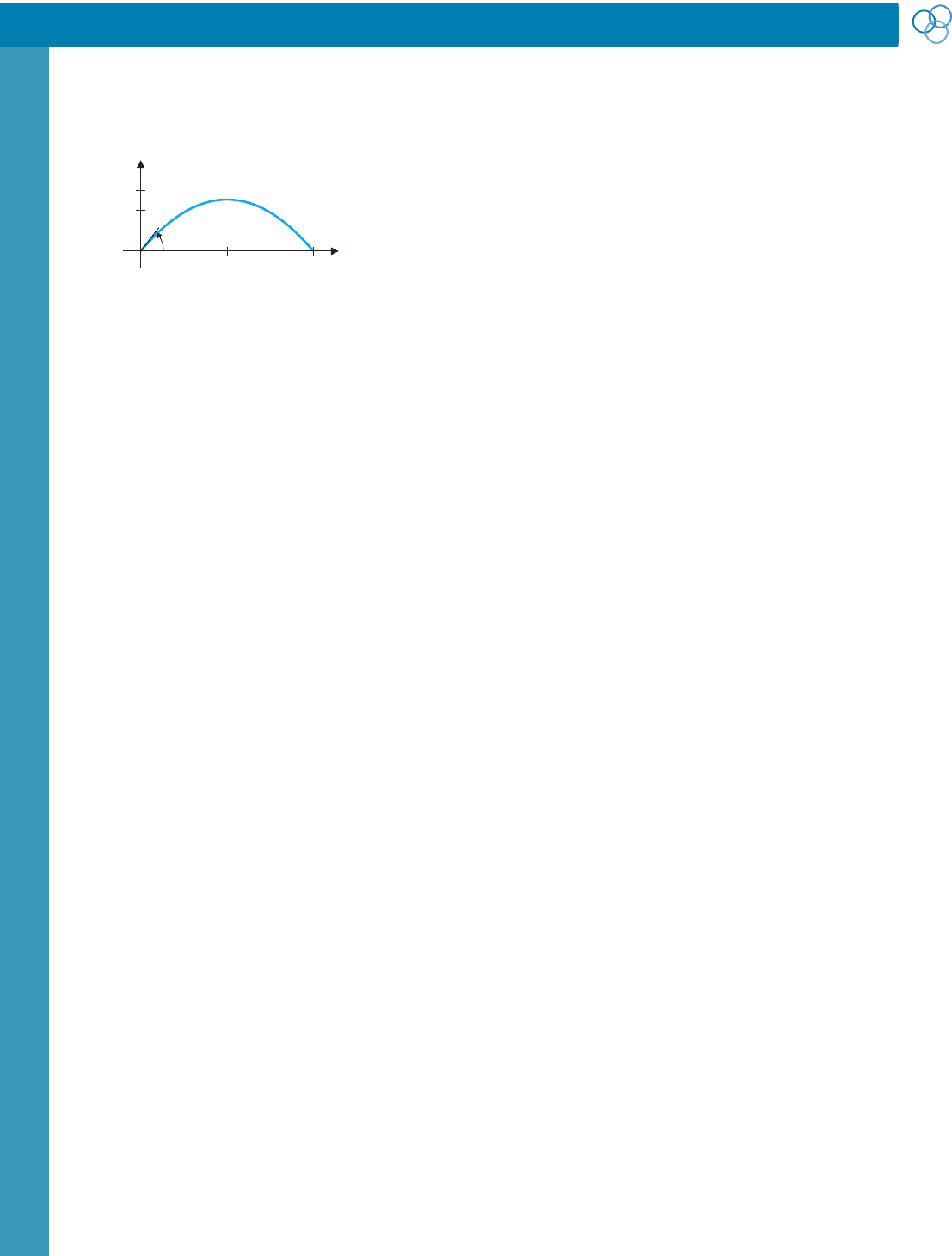
the ball is thrown from the position (0, 0) with initial speed
v ft/s at angle θ from the horizontal.
y
x
105
10
20
30
u
Given such a curve, we can compute the slope of the tangent
line at x = 0, but how can we compute the proper angle θ?
Show that if m is the slope of the tangent line at x = 0, then
tanθ = m. (Hint: Draw a triangle using the tangent line and
x-axis and recall that slope is rise over run.) Tangent is a good
name, isn’t it? Now, for some baseball problems. We will look
at how high players need to aim to make throws that are easy
to catch. Throwing height is also a good catching height. If L
(ft) is the length of the throw and we want the ball to arrive at
the same height as it is released (as shown in the figure), the
parabolacanbedeterminedfromthe followingrelationshipbe-
tween angle and velocity: sin2θ = 32L/v
2
. A third baseman
throwing at 130 ft/s (about 90 mph) must throw 120 ft to reach
first base. Find the angle of release (substitute L and v and, by
trial and error, find a value of θ that works), the slope of the
tangent line and the height at which the third baseman must
aim (that is, the height at which the ball would arrive if there
were no gravity). How much does this change for a soft throw
at 100 ft/s? How about for an outfielder’s throw of 300 feet at
130 ft/s? Most baseball players would deny that they are aim-
ing this high; what in their experience would make it difficult
for them to believe the calculations?