
Smith R., Minton R. Calculus
Подождите немного. Документ загружается.


P1: OSO/OVY P2: OSO/OVY QC: OSO/OVY T1: OSO
MHDQ256-Ch03 MHDQ256-Smith-v1.cls December 10, 2010 20:20
LT (Late Transcendental)
CONFIRMING PAGES
3-61 SECTION 3.6
..
Optimization 233
is 8 ft long. Find the minimum value of b such that the ladder
can turn the corner. (d) Solvepart (c) for a general a and ladder
length L.
36. Acompany’s revenuefor selling x (thousand) items is given by
R(x) =
35x − x
2
x
2
+ 35
. (a) Find the value of x that maximizes the
revenue and find the maximum revenue. (b) For any positive
constant c, find x to maximize R(x) =
cx − x
2
x
2
+ c
.
37. In t hours, a worker makes Q(t) =−t
3
+ 12t
2
+ 60t items.
Graph Q
(t) and explain why it can be interpreted as the effi-
ciency of the worker. (a) Find the time at which the worker’s
efficiency is a maximum. (b) Let T be the length of the work-
day. Suppose that the graph of Q(t) has a single inflection
point for 0 ≤ t ≤ T , called the point of diminishing returns.
Show that the worker’s efficiency is maximized at the point of
diminishing returns.
38. Suppose that group tickets to a concert are priced at $40 per
ticket if 20 tickets are ordered, but cost $1 per ticket less for
each extra ticket ordered, up to a maximum of 50 tickets. (For
example, if 22 tickets are ordered, the price is $38 per ticket.)
(a) Find the number of tickets that maximizes the total cost of
the tickets. (b) If management wanted the solution to part (a)
to be 50, how much should the price be discounted for extra
tickets ordered?
39. In sports where balls are thrown or hit, the ball often finishes
at a different height than it starts. Examples include a downhill
golfshotand a basketball shot. In thediagram,a ball isreleased
at an angle θ and finishes at an angle β above the horizontal
(for downhill trajectories, β would be negative). Neglectingair
resistance and spin, the horizontal range is given by
R =
2v
2
cos
2
θ
g
(tanθ −tan β)
if the initial velocity is v and g is the gravitational constant.
In the following cases, find θ to maximize R (treat v and g as
constants): (a) β = 10
◦
, (b) β = 0
◦
and (c) β =−10
◦
. Verify
that θ = 45
◦
+ β
◦
/2 maximizes the range.
u
b
40. A running track is to be built around a rectangular field, with
two straightaways and two semicircular curves at the ends,
as indicated in the figure. The length of the track is to be
400 meters. (a) Find the dimensions that will maximize the
area of the enclosed rectangle. (b) Show that equal lengths are
used on the straightaways and on the curves.
(c) Suppose that the goal in the construction of the running
track is to maximize the total enclosed area. Which portionsof
the problem change? Compare the solution in this case to the
solution in part (a).
41. The area enclosed by the ellipse
x
2
a
2
+
y
2
b
2
= 1 equals πab.
Find the maximum area of a rectangle inscribed in the ellipse
(that is, a rectangle with sides parallel to the x-axis and y-axis
and vertices on the ellipse). Show that the ratio of the maxi-
mum inscribed area to the area of the ellipse to the area of the
circumscribed rectangle is 1 :
π
2
:2.
42. Show that the maximum volume enclosed by a right circular
cylinder inscribed in a sphere equals
1
√
3
times the volume of
the sphere.
43. Find the maximum area of an isosceles triangle of given
perimeter p. [Hint:Use Heron’s formula for thearea of a trian-
gle of sides a, b and c: A =
√
s(s −a)(s −b)(s − c), where
s =
1
2
(a + b + c).]
EXPLORATORY EXERCISES
1. In a preliminary investigation of Kepler’s wine cask problem
(section 3.3), you showed that a height-to-diameter ratio (x/y)
of
√
2 for a cylindrical barrel will maximize the volume. (See
Figure a.) However, real wine casks are bowed out. Kepler ap-
proximates a cask with the straight-sided barrel in Figure b. It
canbeshown(wetoldyouKeplerwasgood!)thatthevolumeof
this barrel is V =
2
3
π[y
2
+ (w − y)
2
+ y(w − y)]
√
z
2
− w
2
.
Treatingw and z as constants,showthat V
(y) = 0ify = w/2.
Recall that such a critical point can correspond to a maximum
or minimum of V (y), or to something else (e.g., an inflection
point). To discoverwhat we havehere, redraw Figure b to scale
(show the correct relationship between 2y and w). In physical
terms (think about increasing and decreasing y), argue that this
criticalpointisneitheramaximumnor minimum. Interestingly
enough, such a nonextreme critical pointwould have a definite
advantage to the Austrian vintners. Their goal was to convert
themeasurement z intoanestimateofthevolume.Explainwhy
V
(y) = 0 means that small variations in y would convert to
small errors in the volume V .
z
2y
2x
FIGURE a
z w
2y
FIGURE b

P1: OSO/OVY P2: OSO/OVY QC: OSO/OVY T1: OSO
MHDQ256-Ch03 MHDQ256-Smith-v1.cls December 10, 2010 20:20
LT (Late Transcendental)
CONFIRMING PAGES
234 CHAPTER 3
..
Applications of Differentiation 3-62
3.7 RELATED RATES
In this section, we present a group of problems known as related rates problems. The
common thread in each problem is an equation relating two or more quantities that are all
changing with time. In each case, we will use the chain rule to find derivatives of all terms in
the equation (much as we did in section 2.7 with implicit differentiation).The differentiated
equation allows us to determine how different derivatives (rates) are related.
EXAMPLE 7.1 A Related Rates Problem
An oil tanker has an accident and oil pours out at the rate of 150 gallons per minute.
Suppose that the oil spreads onto the water in a circle at a thickness of
1
10
. (See
Figure 3.83.) Given that 1 ft
3
equals 7.5 gallons, determine the rate at which the radius
of the spill is increasing when the radius reaches 500 feet.
FIGURE 3.83
Oil spill
Solution Since the area of a circle of radius r is πr
2
, the volume of oil is given by
V = (depth)(area) =
1
120
πr
2
,
since the depth is
1
10
=
1
120
ft. Both volume and radius are functions of time, so
V (t) =
π
120
[r(t)]
2
.
Differentiating both sides of the equation with respect to t,weget
V
(t) =
π
120
2r(t)r
(t).
Thevolumeincreasesatarate of150gallons perminute,or
150
7.5
= 20ft
3
/min.Substituting
in V
(t) = 20 and r = 500, we have
20 =
π
120
2(500)r
(t).
Finally, solving for r
(t), we find that the radius is increasing at the rate of
2.4
π
≈ 0.76394 feet per minute.
y
x
10
FIGURE 3.84
Sliding ladder
Although the details change from problem to problem, the general pattern of solution
is the same for all related rates problems.Looking back, you should be able to identify each
of the following steps in example 7.1.
1. Make a simple sketch, if appropriate.
2. Set up an equation relating all of the relevant quantities.
3. Differentiate (implicitly) both sides of the equation with respect to time (t).
4. Substitute in values for all known quantities and derivatives.
5. Solve for the remaining rate.
EXAMPLE 7.2 A Sliding Ladder
A 10-foot ladder leans against the side of a building. If the top of the ladder begins to
slide down the wall at the rate of 2 ft/sec, how fast is the bottom of the ladder sliding
away from the wall when the top of the ladder is 8 feet off the ground?
Solution First, we make a sketch of the problem, as seen in Figure 3.84. We have
denoted the height of the top of the ladder as y and the distance from the wall to the
bottom of the ladder as x. Since the ladder is sliding down the wall at the rate of 2 ft/sec,

P1: OSO/OVY P2: OSO/OVY QC: OSO/OVY T1: OSO
MHDQ256-Ch03 MHDQ256-Smith-v1.cls December 10, 2010 20:20
LT (Late Transcendental)
CONFIRMING PAGES
3-63 SECTION 3.7
..
Related Rates 235
we must have that
dy
dt
=−2. (Note the minus sign here.) Observe that both x and y are
functions of time, t. By the Pythagorean Theorem, we have
[x(t)]
2
+ [y(t)]
2
= 100.
Differentiating both sides of this equation with respect to time gives us
0 =
d
dt
(100) =
d
dt
[x(t)]
2
+ [y(t)]
2
= 2x(t)x
(t) +2y(t)y
(t).
Solving for x
(t), we obtain
x
(t) =−
y(t)
x(t)
y
(t).
Since the height above ground of the top of the ladder at the point in question is 8 feet,
we have that y = 8 and from the Pythagorean Theorem, we get
100 = x
2
+ 8
2
,
so that x = 6. We now have that at the point in question,
x
(t) =−
y(t)
x(t)
y
(t) =−
8
6
(−2) =
8
3
.
So, the bottom of the ladder is sliding away from the building at the rate of
8
3
ft/sec.
EXAMPLE 7.3 Another Related Rates Problem
A car is traveling at 50 mph due south at a point
1
2
mile north of an intersection. A
police car is traveling at 40 mph due west at a point
1
4
mile east of the same intersection.
At that instant, the radar in the police car measures the rate at which the distance
between the two cars is changing. What does the radar gun register?
x
y
50
40
FIGURE 3.85
Cars approaching an
intersection
Solution First, we draw a sketch and denote the vertical distance of the first car from
the center of the intersection y and the horizontal distance of the police car x.
(See Figure 3.85.) Notice that at the moment in question (call it t = t
0
),
dx
dt
=−40,
since the police car is moving in the direction of the negative x-axis and
dy
dt
=−50,
since the police car is moving in the direction of the negative y-axis. From the
Pythagorean Theorem, the distance between the two cars is d =
x
2
+ y
2
. Since all
quantities are changing with time, we have
d(t) =
[x(t)]
2
+ [y(t)]
2
={[x(t)]
2
+ [y(t)]
2
}
1/2
.
Differentiating both sides with respect to t, we have by the chain rule that
d
(t) =
1
2
{[x(t)]
2
+ [y(t)]
2
}
−1/2
2[x(t)x
(t) + y(t)y
(t)]
=
x(t)x
(t) + y(t)y
(t)
[x(t)]
2
+ [y(t)]
2
.
Substituting in x(t
0
) =
1
4
, x
(t
0
) =−40, y(t
0
) =
1
2
and y
(t
0
) =−50, we have
d
(t
0
) =
1
4
(−40) +
1
2
(−50)
1
4
+
1
16
=
−140
√
5
≈−62.6,
so that the radar gun registers 62.6 mph. Note that this is a poor estimate of the car’s
actual speed. For this reason, police nearly always take radar measurements from a
stationary position.
P1: OSO/OVY P2: OSO/OVY QC: OSO/OVY T1: OSO
MHDQ256-Ch03 MHDQ256-Smith-v1.cls December 10, 2010 20:20
LT (Late Transcendental)
CONFIRMING PAGES
236 CHAPTER 3
..
Applications of Differentiation 3-64
In some problems, the variables are not related by a geometric formula, in which case
you will not need to follow the first two steps of our outline. In example 7.4, the third step
is complicated by the lack of a given value for one of the rates of change.
EXAMPLE 7.4 Estimating a Rate of Change in Economics
A small company estimates that when it spends x thousand dollars for advertising in a
year, its annual sales will be described by s = 60 −
120
√
9+x
thousand dollars. The four
most recent annual advertising totals are given in the following table.
Year 1 2 3 4
Dollars 14,500 16,000 18,000 20,000
Estimate the current (year 4) value of x
(t) and the current rate of change of sales.
Solution From the table, we see that the recent trend is for advertising to increase by
$2000 per year. A good estimate is then x
(4) ≈ 2. Starting with the sales equation
s(t) = 60 −
120
√
9 + x(t)
we use the chain rule to obtain
s
(t) = 60[9 + x(t)]
−3/2
x
(t).
Using our estimate that x
(4) ≈ 2 and since x(4) = 20, we get s
(4) ≈ 120(29)
−3/2
≈
0.768. Thus, sales are increasing at the rate of approximately $768 per year.
x
y
Path of plane
Observer
θ
600
FIGURE 3.86
Path of jet
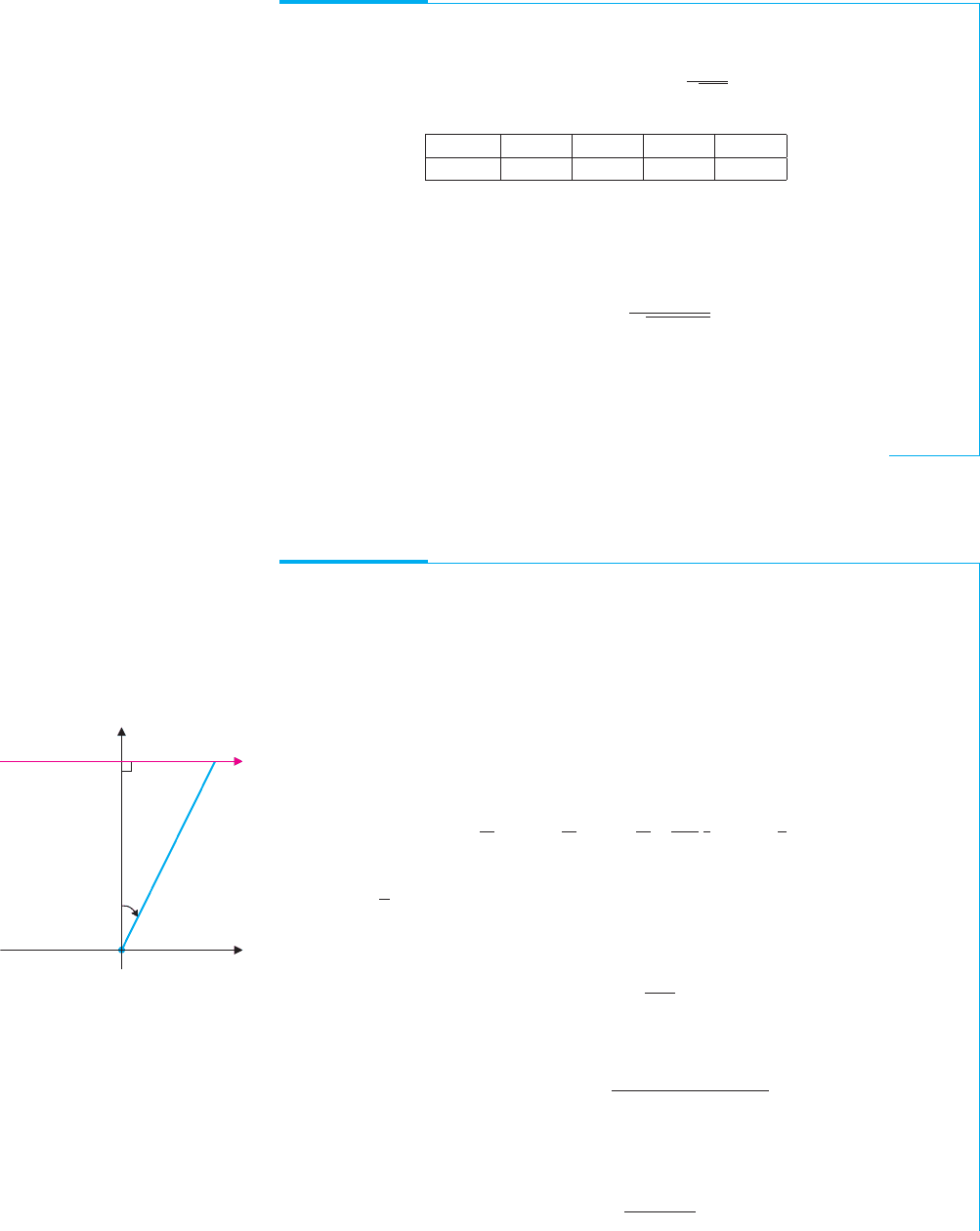
In Example 7.5, we examine the ability of the human visual system to track a fast-
moving object.
EXAMPLE 7.5 Tracking a Fast Jet
A spectator at an air show is trying to follow the flight of a jet. The jet follows a straight
path in front of the observer at 540 mph. At its closest approach, the jet passes 600 feet
in front of the person. Find the maximum rate of change of the angle between the
spectator’s line of sight and a line perpendicular to the flight path, as the jet flies by.
Solution Place the spectator at the origin (0, 0) and the jet’s path left to right on the
line y = 600, and call the angle between the positive y-axis and the line of sight θ. (See
Figure 3.86.) If we measure distance in feet and time in seconds, we first need to
convert the jet’s speed to feet per second. We have
540
mi
h
=
540
mi
h
5280
ft
mi
1
3600
h
s
= 792
ft
s
.
From basic trigonometry (see Figure 3.86), an equation relating the angle θ with x and
y is tan θ =
x
y
. Be careful with this; since we are measuring θ from the vertical, this
equation may not be what you expect. Since all quantities are changing with time, we
have
tanθ (t) =
x(t)
y(t)
.
Differentiating both sides with respect to time, we have
[sec
2
θ(t)]θ
(t) =
x
(t)y(t) − x(t)y
(t)
[y(t)]
2
.
With the jet moving left to right along the line y = 600, we have x
(t) = 792,
y(t) = 600 and y
(t) = 0. Substituting these quantities, we have
[sec
2
θ(t)]θ
(t) =
792(600)
600
2
= 1.32.
P1: OSO/OVY P2: OSO/OVY QC: OSO/OVY T1: OSO
MHDQ256-Ch03 MHDQ256-Smith-v1.cls December 10, 2010 20:20
LT (Late Transcendental)
CONFIRMING PAGES
3-65 SECTION 3.7
..
Related Rates 237
Solving for the rate of change θ
(t), we get
θ
(t) =
1.32
sec
2
θ(t)
= 1.32cos
2
θ(t).
Observe that the rate of change is a maximum when cos
2
θ(t) is a maximum. Since
the maximum of the cosine function is 1, the maximum value of cos
2
θ(t)is1,
occurring when θ = 0. We conclude that the maximum rate of angle change is
1.32 radians/second. This occurs when θ = 0, that is, when the jet reaches its closest
point to the observer. (Think about this; it should match your intuition!) Since humans
can track objects at up to about 3 radians/second, this means that we can visually
follow even a fast jet at a very small distance.
EXERCISES 3.7
WRITING EXERCISES
1. As you read examples 7.1–7.3, to what extent do you find the
pictures helpful? In particular, would it be clear what x and
y represent in example 7.3 without a sketch? Also, in exam-
ple 7.3 explain why the derivatives x
(t), y
(t) and d
(t) are all
negative. Does the sketch help in this explanation?
2. In example 7.4, the increase in advertising dollars from year 1
to year 2 was $1500. Explain why this amount is not especially
relevant to the approximation of s
(4).
1. Oil spills out of a tanker at the rate of 120 gallons per minute.
The oil spreads in a circle with a thickness of
1
4
. Given that
1ft
3
equals 7.5 gallons, determine the rate at which the radius
of the spill is increasing when the radius reaches (a) 100 ft
and (b) 200 ft. Explain why the rate decreases as the radius
increases.
2. Oil spills out of a tanker at the rate of 90 gallons per minute.
The oil spreads in a circle with a thickness of
1
8
. Determine
the rate at which the radius of the spill is increasing when the
radius reaches 100 feet.
3. Oil spills out of a tanker at the rate of g gallons per
minute. The oil spreads in a circle with a thickness of
1
4
.
(a) Given that the radius of the spill is increasing at a rate of
0.6 ft/min when the radius equals 100 feet, determine the value
of g. (b) If the thickness of the oil is doubled, how does the
rate of increase of the radius change?
4. Assume that the infected area of an injury is circular. (a) If the
radius of the infected area is 3 mm and growing at a rate of
1 mm/hr, at what rate is the infected area increasing? (b) Find
the rate of increase of the infected area when the radius reaches
6 mm. Explain in commonsense terms why this rate is larger
than that of part (a).
5. Suppose that a raindrop evaporates in such a way that it main-
tains a spherical shape. Given that the volume of a sphere of
radius r is V =
4
3
πr
3
and its surface area is A = 4πr
2
, if the
radius changes in time, showthat V
= Ar
. If the rate of evap-
oration (V
) is proportional to the surface area, show that the
radius changes at a constant rate.
6. Suppose a forest fire spreads in a circle with radius changing at
a rate of 5 feet per minute. When the radius reaches 200 feet,
at what rate is the area of the burning region increasing?
7. A 10-foot ladder leans against the side of a building as in ex-
ample 7.2. If the bottom of the ladder is pulled away from
the wall at the rate of 3 ft/s and the ladder remains in contact
with the wall, (a) find the rate at which the top of the ladder is
dropping when the bottom is 6 feet from the wall. (b) Find the
rate at which the angle between the ladder and the horizontal is
changing when the bottom ofthe ladder is 6 feet from thewall.
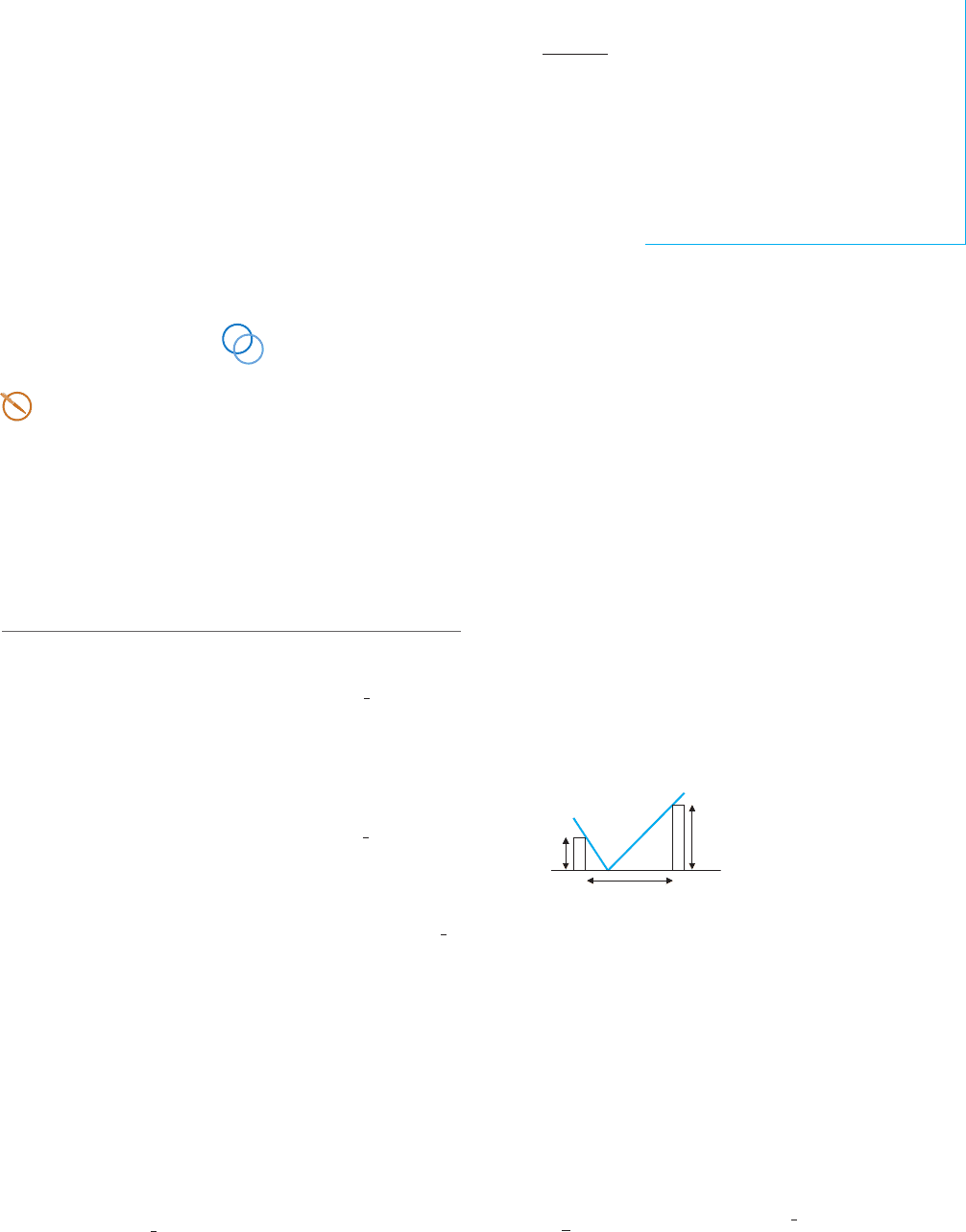
8. Two buildings of height 20 feet and 40 feet, respectively, are
60 feet apart. Suppose that the intensity of light at a point
between the buildings is proportional to the angle θ in the
figure. (a) If a person is moving from right to left at 4 ft/s, at
what rate is θ changing when the person is exactly halfway
between the two buildings? (b) Find the location at which the
angle θ is maximum.
20'
60'
40'
θ
9. A plane is located x = 40 miles (horizontally) away from an
airport at an altitude of h miles. Radar at the airport detects that
the distance s(t) between the plane and airport is changing at
the rate of s
(t) =−240 mph. (a) If the plane flies toward the
airport at the constant altitude h = 4, what is the speed |x
(t)|
of the airplane? (b) Repeat with a height of 6 miles. Based on
your answers, how important is it to know the actual height of
the airplane?
10. (a) Rework example 7.3 if the police car is not moving.
Does this make the radar gun’s measurement more accurate?
(b) Show that the radar gun of example 7.3 gives the correct
speed if the police car is located at the origin.
11. Show that the radar gun of example 7.3 gives the correct
speed if the police car is at x =
1
2
moving at a speed of
(
√
2 − 1) 50 mph.
12. Find a position and speed for which the radar gun of exam-
ple 7.3 has a slower reading than the actual speed.
P1: OSO/OVY P2: OSO/OVY QC: OSO/OVY T1: OSO
MHDQ256-Ch03 MHDQ256-Smith-v1.cls December 10, 2010 20:20
LT (Late Transcendental)
CONFIRMING PAGES
238 CHAPTER 3
..
Applications of Differentiation 3-66
13. For a small company spending $x thousand per year in adver-
tising, suppose that annual sales in thousands of dollars equal
s = 60 −
120
√
9+x
. The three most recent yearly advertising
figures are given in the table.
Year 0 1 2
Adver. 16,000 20,000 24,000
Estimate the value of x
(2) and the current (year 2) rate of
change of sales.
14. Suppose that the average yearly cost per item for producing
x items of a business product is
C(x) = 12 +
94
x
. The three
most recent yearly production figures are given in the table.
Year 0 1 2
Prod. (x) 8.2 8.8 9.4
Estimate the value of x
(2) and the current (year 2) rate of
change of the average cost.
15. Suppose that the average yearly cost per item for producing x
items of a business product is
C(x) = 10 +
100
x
. If the current
production is x = 10 and production is increasing at a rate
of 2 items per year, find the rate of change of the average
cost.
16. For a small company spending $x thousand per year in adver-
tising, suppose that annual sales in thousands of dollars equal
s = 80 −
40
√
4+x
. If the current advertising budget is x = 40
and the budget is increasing at a rate of $1500 per year, find
the rate of change of sales.
17. A baseball player stands 2 feet from home plate and watches
a pitch fly by. In the diagram, x is the distance from the ball
to home plate and θ is the angle indicating the direction of the
player’sgaze.(a)Findtherateθ
atwhichhiseyesmustmoveto
watch a fastball with x
(t) =−130 ft/s as it crosses home plate
at x = 0.(b)Humans canmaintainfocusonlywhen θ
≤ 3(see
Watts and Bahill’s book Keep Your Eye on the Ball). Find the
fastest pitch that you could actually watch cross home plate.
Plate
2
x
Playe
r
u
18. A camera tracks the launch of a vertically ascending space-
craft. The camera is located at ground level 2 miles from the
launchpad. (a) If the spacecraft is 3 miles up and traveling at
0.2 mile per second, at what rate is the camera angle (measured
from the horizontal) changing? (b) Repeat if the spacecraft is
1 mile up (assume the same velocity). Which rate is higher?
Explain in commonsense terms why it is larger.
APPLICATIONS
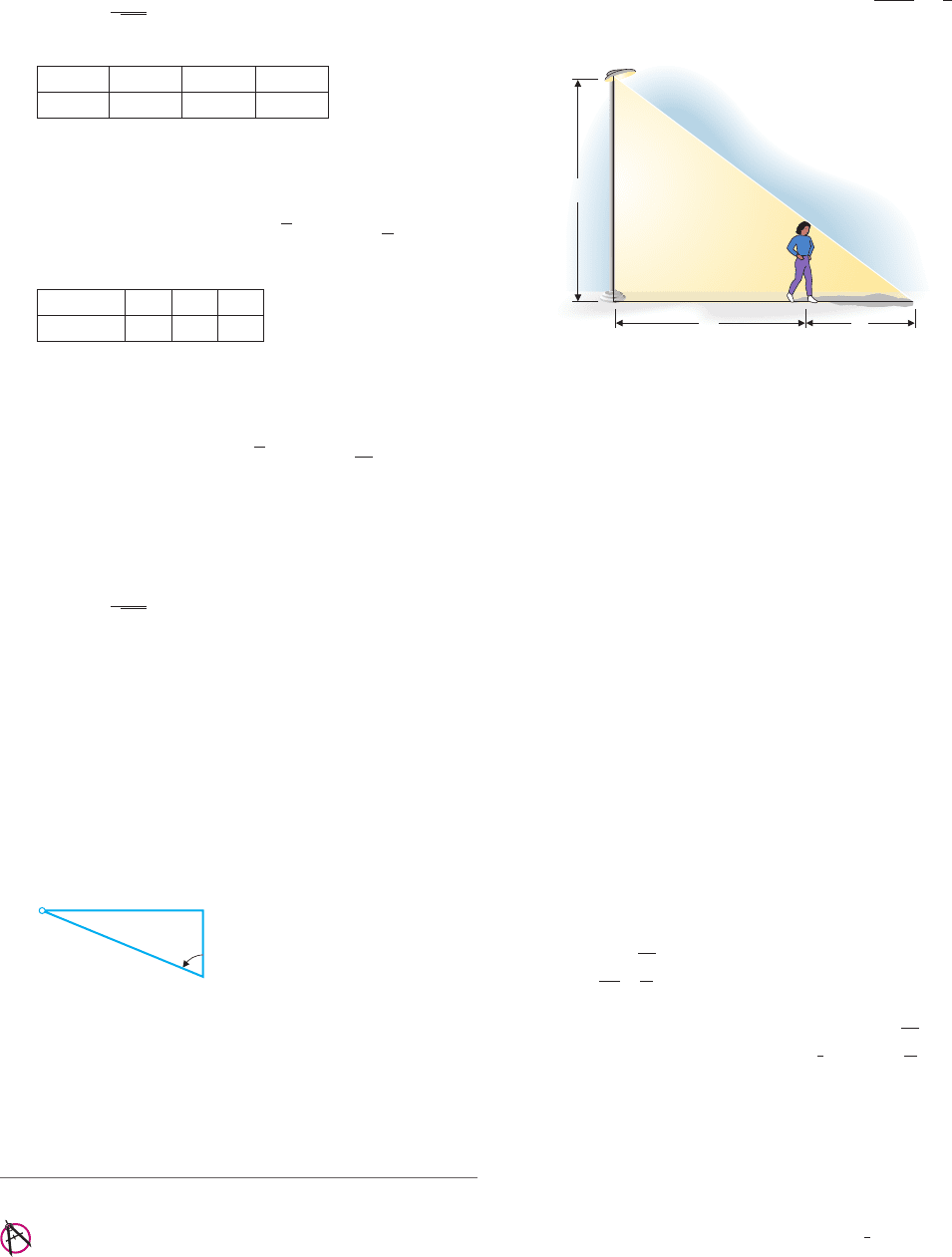
19. Suppose a 6-ft-tall person is 12 ft away from an 18-ft-tall
lamppost (see the figure). (a) If the person is moving away
from the lamppost at a rate of 2 ft/s, at what rate is the length
of the shadow changing?
Hint: Show that
x + s
18
=
s
6
.
18 ft
6 ft
xs
Exercise 19
(b) Repeat with the person 6 ft away from the lamppost and
walking toward the lamppost at a rate of 3 ft/s.
20. Boyle’s law for a gas at constant temperature is PV = c,
where P is pressure, V is volume and c is a constant. As-
sume that both P and V are functions of time. (a) Show
that P
(t)/V
(t) =−c/V
2
. (b) Solve for P as a function of
V . Treating V as an independent variable, compute P
(V ).
Compare P
(V ) and P
(t)/V
(t) from parts (a) and (b).
21. A dock is 6 feet above water. Suppose you stand on the edge
of the dock and pull a rope attached to a boat at the constant
rate of 2 ft/s. Assume that the boat remains at water level. At
what speed is the boat approaching the dock when it is 20 feet
from the dock? 10 feet from the dock? Isn’t it surprising that
the boat’s speed is not constant?
22. Sand is poured into a conical pile with the height of the pile
equalling the diameter of the pile. If the sand is poured at a
constant rate of 5 m
3
/s, at what rate is the height of the pile
increasing when the height is 2 meters?
23. The frequency at which a guitar string vibrates (which de-
termines the pitch of the note we hear) is related to the ten-
sion T to which the string is tightened, the density ρ of the
string and the effective length L of the string by the equation
f =
1
2L
T
ρ
. By running his finger along a string, a guitarist
can change L by changing the distance between the bridge
and his finger. Suppose that L =
1
2
ft and
T
ρ
= 220 ft/s
so that the units of f are Hertz (cycles per second). If the
guitarist’s hand slides so that L
(t) =−4, find f
(t). At this
rate, how long will it take to raise the pitch one octave (that is,
double f )?
24. Suppose that you are blowing up a balloon by adding air at
the rate of 1 ft
3
/s. If the balloon maintains a spherical shape,
the volume and radius are related by V =
4
3
πr
3
. Compare the
rate at which the radius is changing when r = 0.01 ft versus
when r = 0.1 ft. Discuss how this matches the experience of
a person blowing up a balloon.
P1: OSO/OVY P2: OSO/OVY QC: OSO/OVY T1: OSO
MHDQ256-Ch03 MHDQ256-Smith-v1.cls December 10, 2010 20:20
LT (Late Transcendental)
CONFIRMING PAGES
3-67 SECTION 3.8
..
Rates of Change in Economics and the Sciences 239
25. Water is being pumped into a spherical tank of radius 60 feet
at the constant rate of 10 ft
3
/s. (a) Find the rate at which the
radius of the top level of water in the tank changes when
the tank is half full. (b) Find the height at which the height
of the water in the tank changes at the same rate as the
radius.
26. Sand is dumped such that the shape of the sandpile remains
a cone with height equal to twice the radius. (a) If the sand is
dumped at the constant rate of 20 ft
3
/s, find the rate at which
the radius is increasing when the height reaches 6 feet. (b)
Repeat for a sandpile for which the edge of the sandpile forms
an angle of 45
◦
with the horizontal.
27. (a) If an object moves around a circle centered at the ori-
gin, show that x(t)x
(t) + y(t)y
(t) = 0. Conclude that if
x(t) = 0, then y
(t) = 0; also, if y(t) = 0, then x
(t) = 0.
Explain this graphically.
(b) If an object moves around the astroid x
2/3
+ y
2/3
= 1,
show that x(t)[y
(t)]
3
+ y(t)[x
(t)]
3
= 0. Conclude that if
x(t) = 0, then x
(t) = 0; also, if y(t) = 0, then y
(t) = 0.
Explain this graphically.
28. A light is located at the point (0, 100) and a small object is
dropped from the point (10, 64). Let x be the location of the
shadowoftheobjectonthex-axiswhentheobjectisatheighth.
Assuming that h
(t) =−8
√
64 − h(t),(a) find x
(t) when h =
0; (b) Find the heightat which the valueof |x
(t)|is maximum.
29. Elvis the dog stands on a shoreline at point (0, 0) m and starts
to chase a ball in the water at point (8, 4) m. He runs along
the positive x-axis with speed x
(t) = 6.4 m/s. Let d(t)bethe
distance between Elvis and the ball at time t. (a) Find the time
and location at which |d
(t)|=0.9 m/s, the rate at which Elvis
swims. (b) Show that the location is the same as the optimal
entry point found in exercise 23 of section 3.6.
EXPLORATORY EXERCISES
1. Vision hasprovedto be the biggestchallengefor buildingfunc-
tional robots. Robot vision can either be designed to mimic
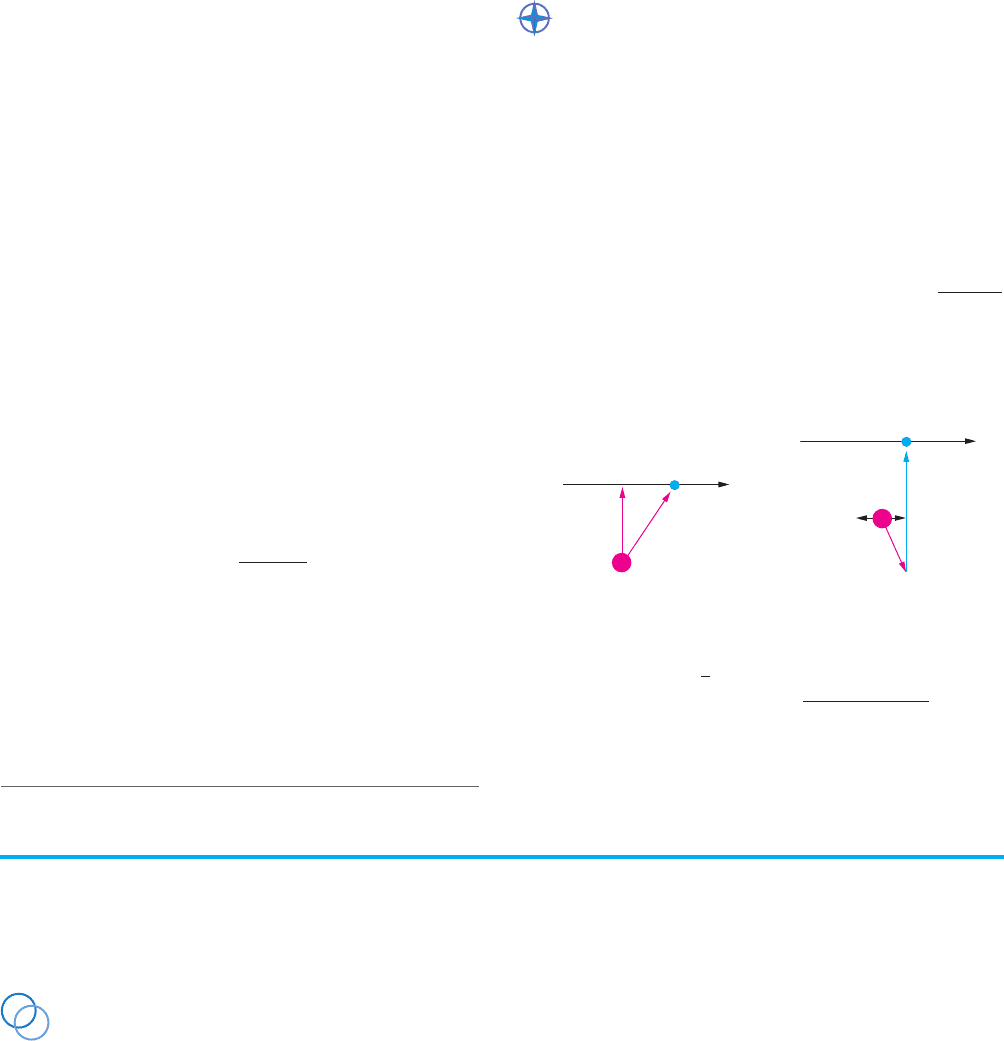
human vision or follow a different design. Two possibilities
are analyzed here. In the diagram below, a camera follows an
object directly from left to right. If the camera is at the origin,
the object moves with speed 1 m/s and the line of motion is at
y = c, find an expression for θ
as a function of the position
of the object. In the diagram to the right, the camera looks
downinto a parabolic mirrorand indirectly views the object. If
the mirror has polar coordinates (in this case, the angle θ
is measured from the horizontal) equation r =
1 − sin θ
2cos
2
θ
and x = r cosθ, find an expression for θ
as a function of
the position of the object. Compare values of θ
at x = 0 and
other x-values. If a large value of θ
causes the image to blur,
which camera system is better? Does the distance y = c affect
your preference?
θ
(x, y)
θ
(x, y)
2. A particle moves down a ramp subject only to the force of
gravity. Let y
0
be the maximum height of the particle. Then
conservation of energy gives
1
2
mv
2
+ mgy = mgy
0
.
(a) From the definition v(t) =
[x
(t)]
2
+ [y
(t)]
2
, conclude
that |y
(t)|≤|v(t)|.
(b) Show that |v
(t)|≤g.
(c) What shape must the ramp have to get equality in part (b)?
Briefly explain in physical terms why g is the maximum
value of |v
(t)|.
3.8 RATES OF CHANGE IN ECONOMICS AND THE SCIENCES
It has often been said that mathematics is the language of nature. Today, the concepts of
calculus are being applied in virtually every field of human endeavor. The applications in
this section represent but a small sampling of some elementary uses of the derivative.
Recall that the derivative of a function gives the instantaneous rate of change of that
function. So, when you see the wordrate, you should be thinking derivative. You can hardly
pick up a newspaper without finding reference to some rates (e.g., inflation rate, interest
rate, etc.). These can be thought of as derivatives. There are also many familiar quantities
that you might not recognize as rates of change. Our first example, which comes from
economics, is of this type.
In economics, the term marginal is used to indicate a rate. Thus, marginal cost is the
derivative of the cost function, marginal profit is the derivative of the profit function and
so on.

P1: OSO/OVY P2: OSO/OVY QC: OSO/OVY T1: OSO
MHDQ256-Ch03 MHDQ256-Smith-v1.cls December 10, 2010 20:20
LT (Late Transcendental)
CONFIRMING PAGES
240 CHAPTER 3
..
Applications of Differentiation 3-68
Suppose that you are manufacturing an item, where your start-up costs are $4000
and productions costs are $2 per item. The total cost of producing x items would then be
4000 + 2x. Of course, the assumption that the cost per item is constant is unrealistic. Effi-
cient mass-production techniques could reduce the cost per item, but machine maintenance,
labor, plant expansion and other factors could drive costs up as production (x) increases.
In example 8.1, a quadratic cost function is used to take into account some of these extra
factors.
When the cost per item is not constant, an important question for managers to answer
is how much it will cost to increase production. This is the idea behind marginal cost.
EXAMPLE 8.1 Analyzing the Marginal Cost of Producing
a Commercial Product
Suppose that
C(x) = 0.02x
2
+ 2x + 4000
is the total cost (in dollars) for a company to produce x units of a certain product.
Compute the marginal cost at x = 100 and compare this to the actual cost of producing
the 100th unit.
Solution The marginal cost function is the derivative of the cost function:
C
(x) = 0.04x +2
and so, the marginal cost at x = 100 is C
(100) = 4 + 2 = 6 dollars per unit. On the
other hand, the actual cost of producing item number 100 would be C(100) −C(99).
(Why?) We have
C(100) −C(99) = 200 +200 +4000 − (196.02 + 198 + 4000)
= 4400 −4394.02 = 5.98 dollars.
Note that this is very close to the marginal cost of $6. Also notice that the marginal cost
is easier to compute.
Another quantity that businesses use to analyze production is average cost. You can
easily remember the formula for average cost by thinking of an example. If it costs a
total of $120 to produce 12 items, then the average cost would be $10
$
120
12
per item. In
general, the total cost is given by C(x) and the number of items by x, so average cost is
defined by
C(x) =
C(x)
x
.
Business managers want to know the level of production that minimizes average cost.
EXAMPLE 8.2 Minimizing the Average Cost of Producing
a Commercial Product
Suppose that
C(x) = 0.02x
2
+ 2x + 4000
is the total cost (in dollars) for a company to produce x units of a certain product. Find
the production level x that minimizes the average cost.
Solution The average cost function is given by
C(x) =
0.02x
2
+ 2x + 4000
x
= 0.02x + 2 + 4000x
−1
.
P1: OSO/OVY P2: OSO/OVY QC: OSO/OVY T1: OSO
MHDQ256-Ch03 MHDQ256-Smith-v1.cls December 10, 2010 20:20
LT (Late Transcendental)
CONFIRMING PAGES
3-69 SECTION 3.8
..
Rates of Change in Economics and the Sciences 241
To minimize C(x), we start by finding critical numbers in the domain x > 0. We have
C
(x) = 0.02 −4000x
−2
= 0if
4000x
−2
= 0.02 or
4000
0.02
= x
2
.
Then x
2
= 200,000 or x =±
√
200,000 ≈±447. Since x > 0, the only relevant
critical number is at approximately x = 447. Further,
C
(x) < 0ifx < 447 and
C
(x) > 0ifx > 447, so this critical number is the location of the absolute minimum
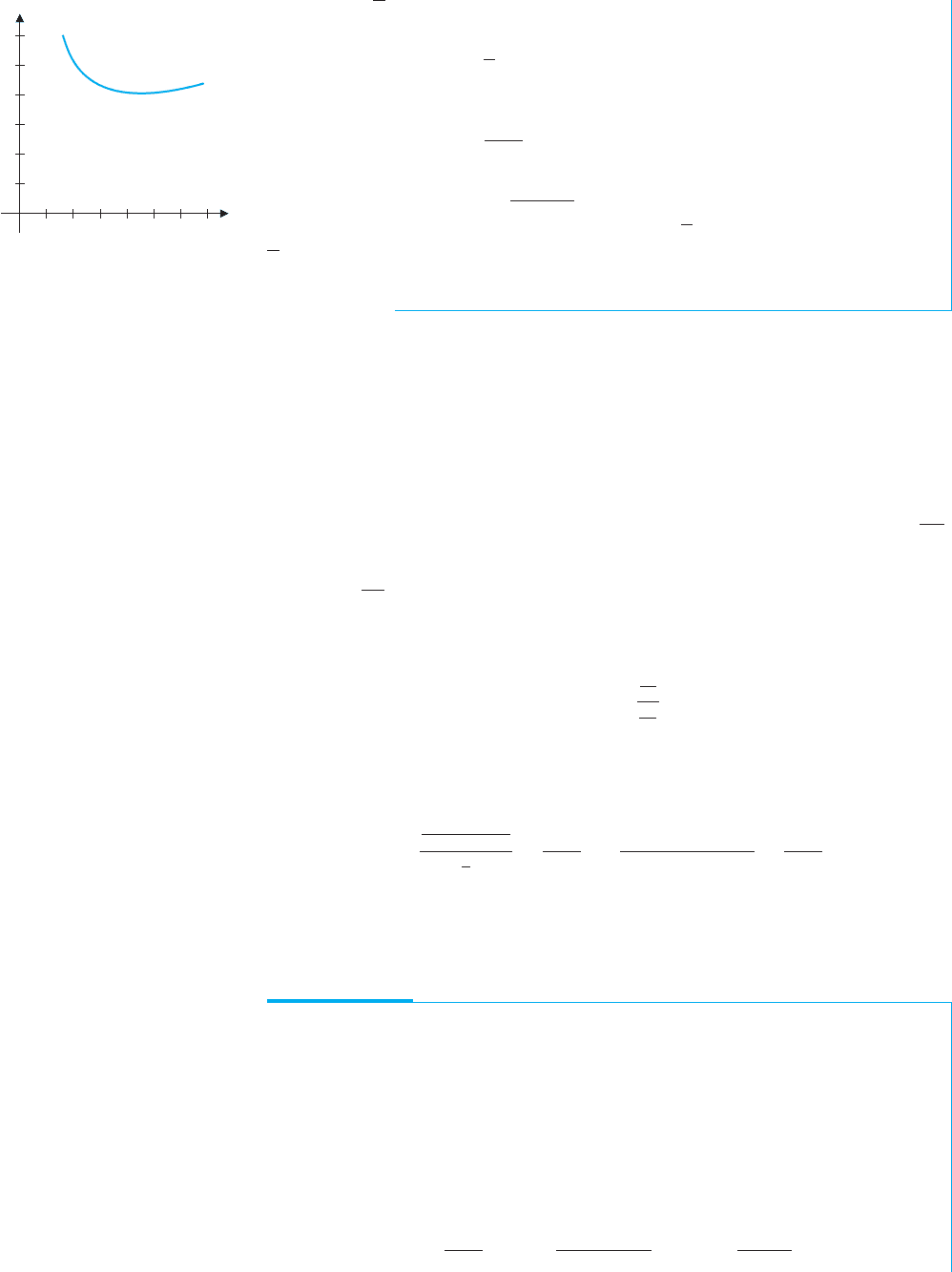
on the domain x > 0. A graph of the average cost function (see Figure 3.87) shows
the minimum.
y
x
200100 300 400 600500 700
5
10
20
15
25
30
FIGURE 3.87
Average cost function
Our third example also comes from economics. This time, we will explore the relation-
ship between price and demand. In most cases, a higher price will lower the demand for a
product. However, if sales do not decrease significantly, a company may increase revenue
despite a price increase. As we will see, an analysis of the elasticity of demand can give us
important information about revenue.
Suppose that the demand x for an item is a function of its price p. That is, x = f (p).
If the price changes by a small amount p, then the relative change in price equals
p
p
.
However, a change in price creates a change in demand x, with a relative change in
demand of
x
x
. Economists define the elasticity of demand at price p to be the relative
change in demand divided by the relative change in price for very small changes in price.
As calculus students, you can define the elasticity E as a limit:
E = lim
p→0
x
x
p
p
.
In the case where x is a function of p, we write p = (p + h) − p = h for some small h
and then x = f (p + h) − f (p). We then have
E = lim
h→0
f (p +h)− f (p)
f (p)
h
p
=
p
f (p)
lim
h→0
f (p + h) − f (p)
h
=
p
f (p)
f
(p),
assuming that f is differentiable. In example 8.3, we analyze elasticity of demand and
revenue. Recall that if x = f (p) items are sold at price p, then the revenue equals pf(p).
EXAMPLE 8.3 Computing Elasticity of Demand
and Changes in Revenue
Suppose that f (p) = 400(20 − p)
is the demand for an item at price p (in dollars) with p < 20. (a) Find the elasticity of
demand. (b) Find the range of prices for which E < −1. Compare this to the range of
prices for which revenue is a decreasing function of p.
Solution The elasticity of demand is given by
E =
p
f (p)
f
(p) =
p
400(20 − p)
(−400) =
p
p − 20
.
P1: OSO/OVY P2: OSO/OVY QC: OSO/OVY T1: OSO
MHDQ256-Ch03 MHDQ256-Smith-v1.cls December 10, 2010 20:20
LT (Late Transcendental)
CONFIRMING PAGES
242 CHAPTER 3
..
Applications of Differentiation 3-70
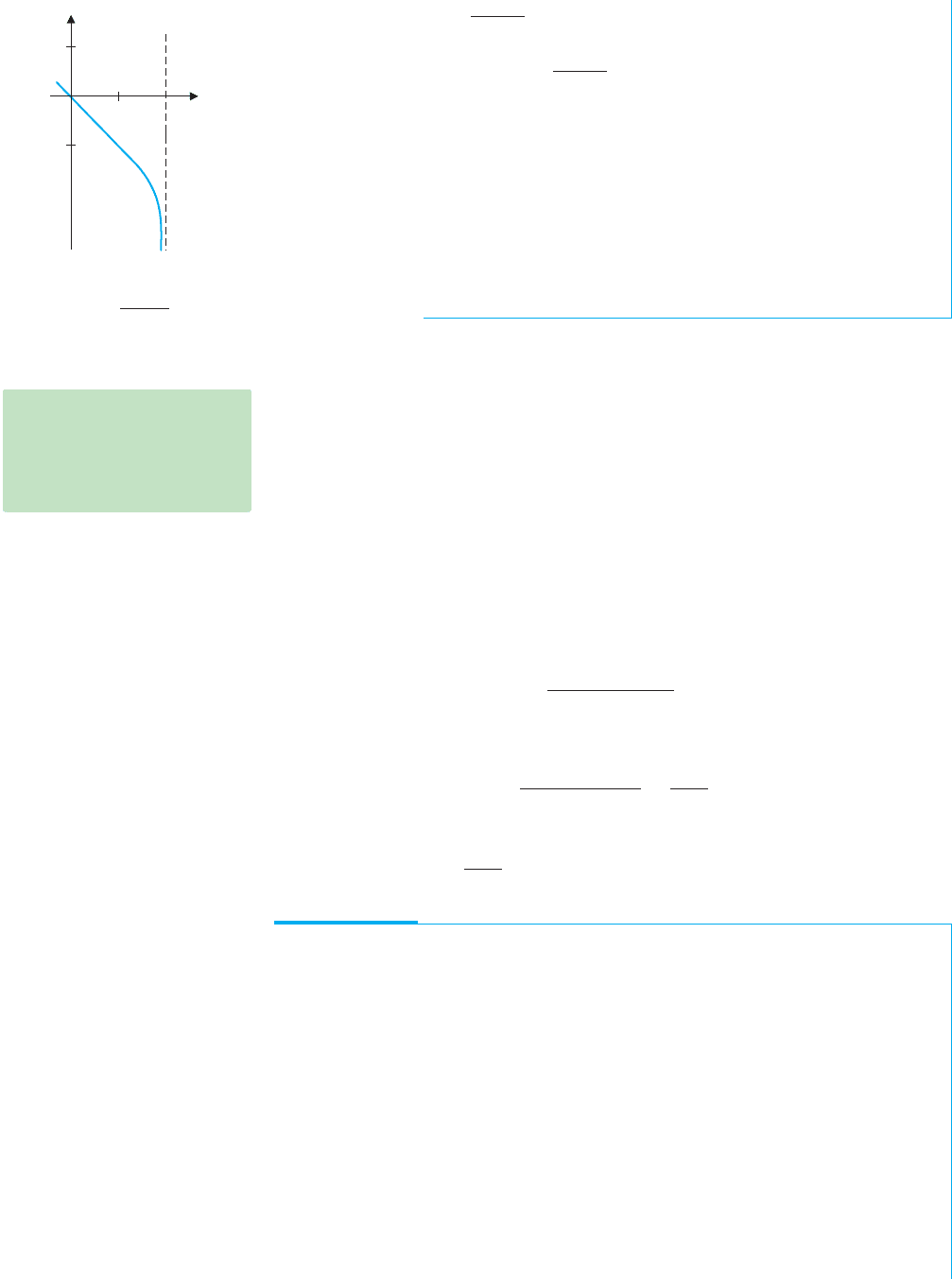
We show a graph of E =
p
p − 20
in Figure 3.88. Observe that E < −1if
p
p − 20
< −1
or
p > −(p − 20).
Since p − 20 < 0.
Solving this gives us
2p > 20
or
p > 10.
To analyze revenue, we compute R = pf(p) = p(8000 −400p) = 8000p −400p
2
.
Revenue decreases if R
(p) < 0. From R
(p) = 8000 −800p, we see that R
(p) = 0if
p = 10 and R
(p) < 0ifp > 10. Of course, this says that the revenue decreases if the
price exceeds 10.
p
E
1
1
10 20
FIGURE 3.88
E =
p
p − 20
NOTES
In some situations, elasticity is
defined as −E, so that demand is
elastic if E > 1.
Notice in example 8.3 that the prices for which E < −1 (in this case, we say that
the demand is elastic) correspond exactly to the prices for which an increase in price will
decrease revenue. In the exercises, we will find that this is not a coincidence.
The next example we offer comes from chemistry. It is very important for chemists to
have a handle on the rate at which a given reaction proceeds. Reaction rates give chemists
information about the nature of the chemical bonds being formed and broken, as well as
information about the type and quantity of product to expect. A simple situation is depicted
in the schematic
A + B −→ C,
which indicates that chemicals A and B (the reactants) combine to form chemical C (the
product).Let[C](t)denote the concentration (in molesper liter) of theproduct. The average
reaction rate between times t
1
and t
2
is
[C](t
2
) − [C](t
1
)
t
2
− t
1
.
The instantaneous reaction rate at any given time t
1
is then given by
lim
t→t
1
[C](t) − [C](t
1
)
t −t
1
=
d[C]
dt
(t
1
).
Depending on the details of the reaction, it is often possible to write down an equation
relating the reaction rate
d[C]
dt
to the concentrations of the reactants, [A] and [B].
EXAMPLE 8.4 Modeling the Rate of a Chemical Reaction
In an autocatalytic chemical reaction, the reactant and the product are the same. The
reaction continues until some saturation level is reached. From experimental evidence,
chemists know that the reaction rate is jointly proportional to the amount of the product
present and the difference between the saturation level and the amount of the product.
If the initial concentration of the chemical is 0 and the saturation level is 1
(corresponding to 100%), this means that the concentration x(t) of the chemical
satisfies the equation
x
(t) = rx(t)[1 − x(t)],
where r > 0 is a constant.
Find the concentration of chemical for which the reaction rate x
(t) is a maximum.
Solution To clarify the problem, we write the reaction rate as
f (x) = rx(1 − x).