
Smith R., Minton R. Calculus
Подождите немного. Документ загружается.

P1: OSO/OVY P2: OSO/OVY QC: OSO/OVY T1: OSO
MHDQ256-Ch03 MHDQ256-Smith-v1.cls December 10, 2010 20:20
LT (Late Transcendental)
CONFIRMING PAGES
3-71 SECTION 3.8
..
Rates of Change in Economics and the Sciences 243
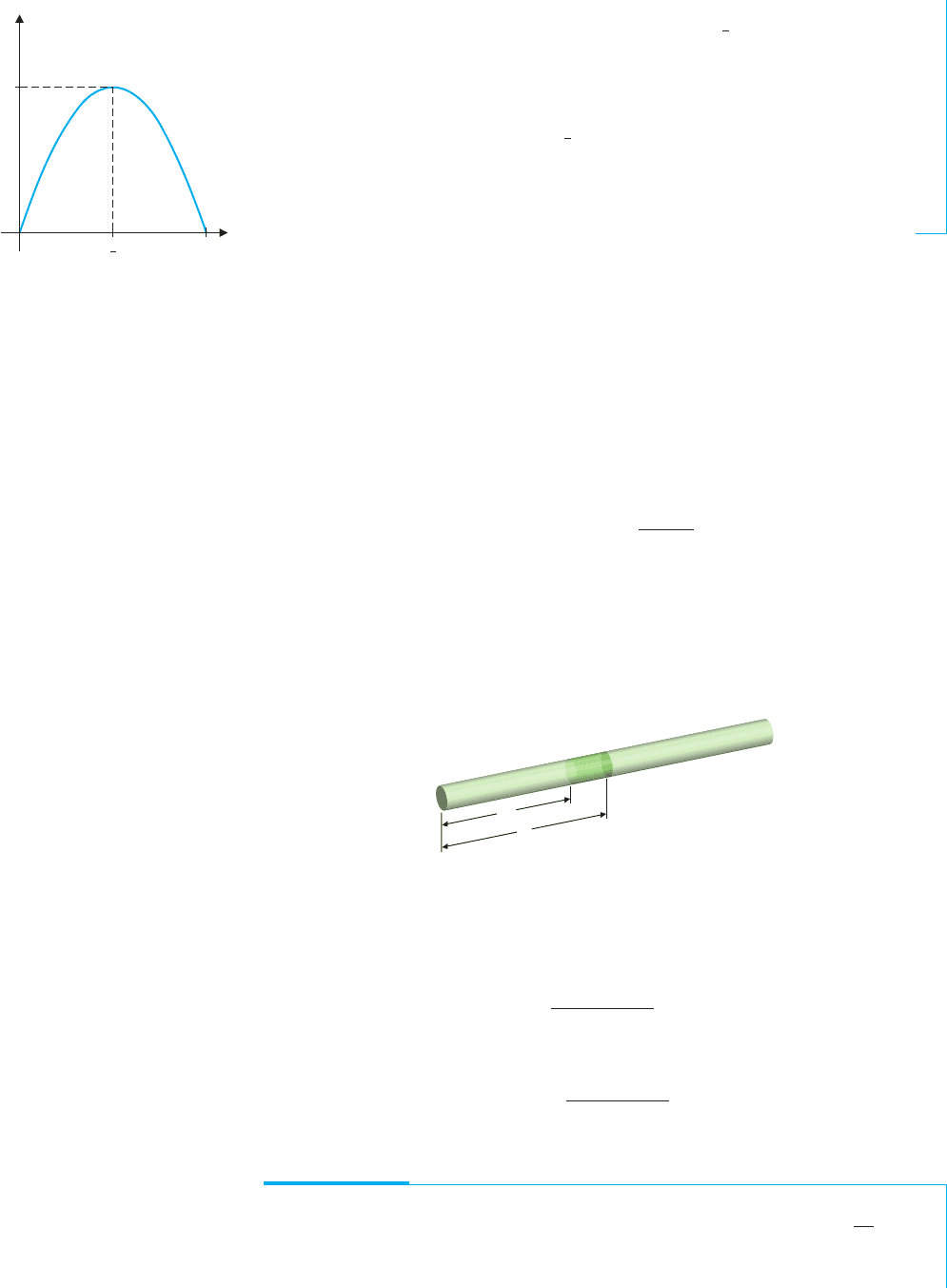
Our aim is then to find x ≥ 0 that maximizes f (x). From the graph of y = f (x) shown
in Figure 3.89, the maximum appears to occur at about x =
1
2
.Wehave
f
(x) = r(1)(1 − x) +rx(−1)
= r(1 − 2x)
and so, the only critical number is x =
1
2
. Notice that the graph of y = f (x)isa
parabola opening downward and hence, the critical number must correspond to the
absolute maximum. Although the mathematical problem here was easy to solve, the
result gives a chemist some precise information. At the time the reaction rate reaches a
maximum, the concentration of chemical equals exactly half of the saturation level.
y
x
1
2
1
r/4
FIGURE 3.89
y = rx(1 − x)
Calculus and elementary physics are quite closely connected historically. It should
come as no surprise, then, that physics provides us with such a large number of important
applications of the calculus. We have already explored the concepts of velocity and accel-
eration. Another important application in physics where the derivative plays a role involves
density. There are many different kinds of densities that we could consider. For example,
we could study population density (number of people per unit area) or color density (depth
of color per unit area) used in the study of radiographs. However, the most familiar type of
density is mass density (mass per unit volume). You probably already have some idea of
what we mean by this, but how would you define it? If an object of interest is made of some
homogeneous material (i.e., the mass of any portion of the object of a given volume is the
same), then the mass density is simply
mass density =
mass
volume
and this quantity is constant throughout the object. However, if the mass of a given volume
varies in different parts of the object, then this formula only calculates the average density
of the object. In example 8.5 we find a means of computing the mass density at a specific
point in a nonhomogeneous object.
Suppose that the function f (x) gives us the mass (in kilograms) of the first x meters
of a thin rod. (See Figure 3.90.)
x
1
x
FIGURE 3.90
A thin rod
The total mass between marks x and x
1
(x > x
1
) is given by [ f (x) − f (x
1
)] kg. The
average linear density (i.e., mass per unit length) between x and x
1
is then defined as
f (x) − f (x
1
)
x − x
1
.
Finally, the linear density at x = x
1
is defined as
ρ(x
1
) = lim
x→x
1
f (x) − f (x
1
)
x − x
1
= f
(x
1
), (8.1)
where we have recognized the alternative definition of derivative discussed in section 2.2.
EXAMPLE 8.5 Density of a Thin Rod
Suppose that the mass of the first x meters of a thin rod is given by f (x) =
√
2x.
Compute the linear density at x = 2 and at x = 8, and compare the densities at the two
points.
P1: OSO/OVY P2: OSO/OVY QC: OSO/OVY T1: OSO
MHDQ256-Ch03 MHDQ256-Smith-v1.cls December 10, 2010 20:20
LT (Late Transcendental)
CONFIRMING PAGES
244 CHAPTER 3
..
Applications of Differentiation 3-72
Solution From (8.1), we have
ρ(x) = f
(x) =
1
2
√
2x
(2) =
1
√
2x
.
Thus, ρ(2) = 1/
√
4 = 1/2 and ρ(8) = 1/
√
16 = 1/4. Notice that this says that the rod
is nonhomogeneous (i.e., the mass density in the rod is not constant). Specifically, we
have that the rod is less dense at x = 8 than at x = 2.
In section 2.1, we briefly explored the rate of growth of a population. Population
dynamics is an area of biology that makes extensive use of calculus. We examine population
models in some detail in sections 8.1 and 8.2. For now, we explore one aspect of a basic
model of population growth called the logistic equation. This states that if p(t) represents
population (measured as a fraction of the maximum sustainable population), then the rate
of change of the population satisfies the equation
p
(t) = rp(t)[1 − p(t)],
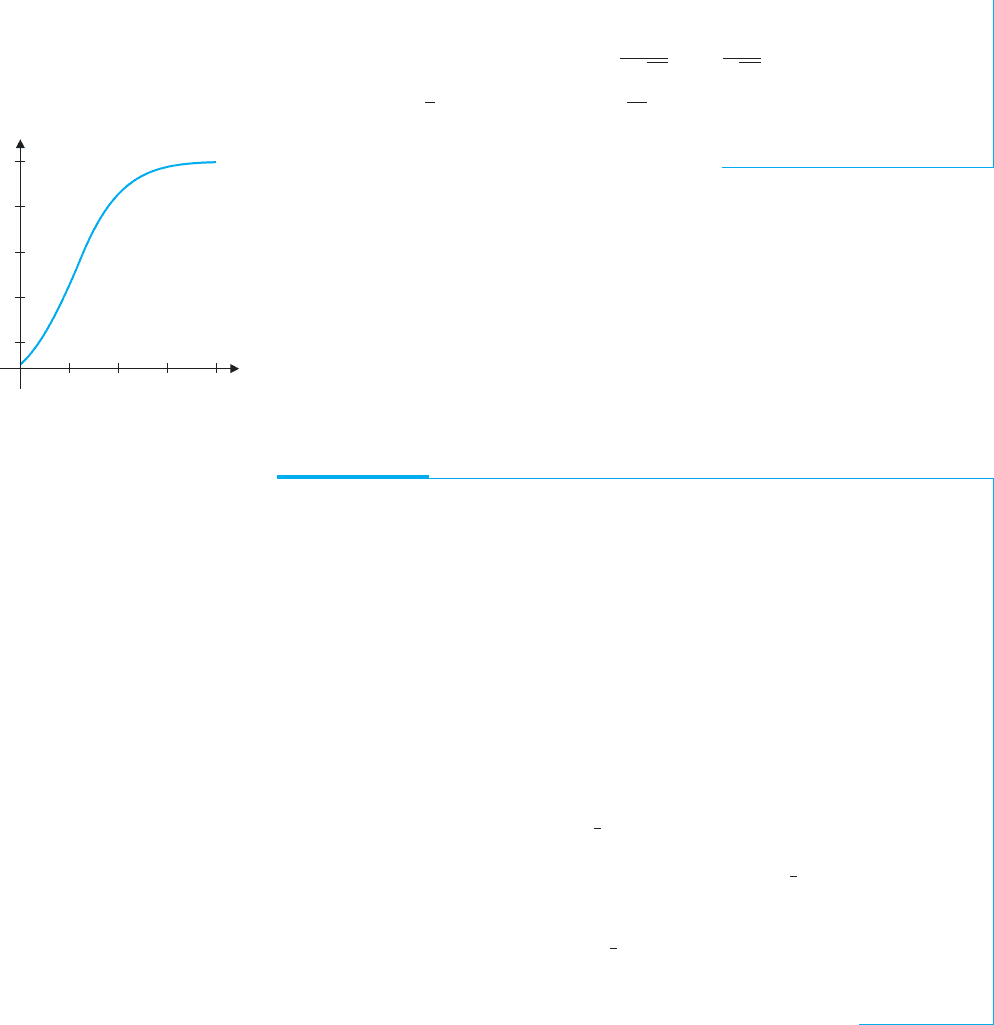
for some constantr.A typical solution [forr = 1 and p(0) = 0.05] is shownin Figure 3.91.
Although we won’t learn how to compute a solution until sections 8.1 and 8.2, we can
determine some of the mathematical properties that all solutions must possess.
p
t
2468
0.2
0.4
0.6
0.8
1
FIGURE 3.91
Logistic growth
EXAMPLE 8.6 Finding the Maximum Rate of Population Growth
Suppose that a population grows according to the equation p
(t) = 2p(t)[1 − p(t)] (the
logistic equation with r =2). Find the population for which the growth rate is a
maximum. Interpret this point graphically.
Solution To clarify the problem, we write the population growth rate as
f (p) = 2p(1 − p).
Our aim is then to find the population p ≥ 0 that maximizes f (p). We have
f
(p) = 2(1)(1 − p) + 2p(−1)
= 2(1 −2p)
and so, the only critical number is p =
1
2
. Notice that the graph of y = f (p)isa
parabola opening downward and hence, the critical number must correspond to the
absolute maximum. In Figure 3.91, observe that the height p =
1
2
corresponds to the
portion of the graph with maximum slope. Also, notice that this point is an inflection
point on the graph. We can verify this by noting that we solved the equation f
(p) = 0,
where f (p) equals p
(t). Therefore, p =
1
2
is the p-value corresponding to the solution
of p
(t) = 0. This fact can be of value to population biologists. If they are tracking a
population that reaches an inflection point, then (assuming that the logistic equation
gives an accurate model) the population will eventually double in size.
Notice the similarities between examples 8.4 and 8.6. One reason that mathematics
has such great value is that seemingly unrelated physical processes often have the same
mathematical description. Comparing examples 8.4 and 8.6, we learn that the underlying
mechanisms for autocatalytic reactions and population growth are identical.
We have now discussed examples of six rates of change drawn from economics and
the sciences. Add these to the applications that we have seen in previous sections and we
have an impressive list of applications of the derivative. Even so, we have barely begun to
scratch the surface. In any field where it is possible to quantify and analyze the properties
of a function, calculus and the derivative are powerful tools. This list includes at least some
aspect of nearly every major field of study. The continued study of calculus will give you
the ability to read (and understand) technical studies in a wide variety of fields and to see
(as we have in this section) the underlying unity that mathematics brings to a broad range
of human endeavors.

P1: OSO/OVY P2: OSO/OVY QC: OSO/OVY T1: OSO
MHDQ256-Ch03 MHDQ256-Smith-v1.cls December 10, 2010 20:20
LT (Late Transcendental)
CONFIRMING PAGES
3-73 SECTION 3.8
..
Rates of Change in Economics and the Sciences 245
EXERCISES 3.8
WRITING EXERCISES
1. The logistic equation x
(t) = x(t)[1 − x(t)] is used to model
many important phenomena (see examples 8.4 and 8.6). The
equation has two competing contributions to the rate of change
x
(t). The term x(t) by itself would mean that the larger x(t)
is, the faster the population grows. This is balanced by the
term 1 − x(t),which indicates that the closer x(t)gets to 1, the
slower the population growth is. With both terms, the model
has the property that for small x(t), slightly larger x(t) means
greater growth, but as x(t) approaches 1, the growth tails off.
Explain in terms of population growth and the concentration
of a chemical why the model is reasonable.
2. Corporate deficits and debt are frequently in the news, but the
terms are often confused with each other. To take an example,
suppose a company finishes a fiscal year owing $5000. That
is their debt. Suppose that in the following year the company
has revenuesof $106,000 and expenses of $109,000. The com-
pany’s deficit for theyearis$3000, and thecompany’s debt has
increased to $8000. Briefly explain why deficit can be thought
of as the derivative of debt.
1. If the cost of manufacturing x items is
C(x) = x
3
+ 20x
2
+ 90x + 15, find the marginal cost func-
tion and compare the marginal cost at x = 50 with the actual
cost of manufacturing the 50th item.
2. If the cost of manufacturing x items is
C(x) = x
4
+ 14x
2
+ 60x + 35, find the marginal cost func-
tion and compare the marginal cost at x = 50 with the actual
cost of manufacturing the 50th item.
3. If the cost of manufacturing x items is
C(x) = x
3
+ 21x
2
+ 110x + 20, find the marginal cost func-
tion and compare the marginal cost at x = 100 with the actual
cost of manufacturing the 100th item.
4. If the cost of manufacturing x items is
C(x) = x
3
+ 11x
2
+ 40x + 10, find the marginal cost func-
tion and compare the marginal cost at x = 100 with the actual
cost of manufacturing the 100th item.
5. Suppose the cost of manufacturing x items is
C(x) = x
3
− 30x
2
+ 300x + 100 dollars. Find the inflection
point and discuss the significance of this value in terms of the
cost of manufacturing.
6. A baseball team ownerhas determined that if tickets are priced
at $10, the average attendance at a game will be 27,000 and if
tickets are priced at $8, the average attendance will be 33,000.
Usingalinearmodel,wewouldthen estimate that ticketspriced
at $9 would produce an average attendance of 30,000. Discuss
whether you think the use of a linear model here is reasonable.
Then, using the linear model, determine the price at which the
revenue is maximized.
............................................................
In exercises 7–10, find the production level that minimizes the
average cost.
7. C(x) = 0.1x
2
+ 3x + 2000
8. C(x) = 0.2x
3
+ 4x + 4000
9. C(x) =
√
x
3
+ 9
10. C(x) =
√
x
3
+ 800
............................................................
11. (a) Let C(x) be the cost function and C(x) be the average cost
function. Suppose that C(x) = 0.01x
2
+ 40x + 3600. Show
that C
(100) < C(100) and show that increasing the produc-
tion (x) by 1 will decrease the average cost. (b) Show that
C
(1000) > C(1000) and show that increasing the production
(x) by 1 will increase the average cost. (c) Prove that average
cost is minimized at the x-value where C
(x) = C (x).
12. Let R(x) be the revenue and C(x) be the cost from manu-
facturing x items. Profit is defined as P(x) = R(x) − C(x).
(a) Show that at the value of x that maximizes profit, marginal
revenue equals marginal cost. (b) Find the maximum profit if
R(x) = 10x − 0.001x
2
dollarsandC(x) = 2x + 5000dollars.
............................................................
In exercises 13–16, find (a) the elasticity of demand and (b) the
range of prices for which the demand is elastic (E < −1).
13. f (p) = 200(30 − p) 14. f (p) = 200(20 − p)
15. f (p) = 100p(20 − p) 16. f (p) = 60p(10 − p)
............................................................
17. If the demand function f is differentiable, prove that
[pf(p)]
< 0 if and only if
p
f (p)
f
(p) < −1. (That is, rev-
enue decreases if and only if demand is elastic.)
18. The term income elasticity of demand is defined as the per-
centage change in quantity purchased divided by the percent-
age change in real income. If I represents income and Q(I)
is demand as a function of income, derive a formula for the
income elasticity of demand.
19. If the concentration of a chemical changes according to the
equation x
(t) = 2x(t)[4 − x(t)], (a) find the concentration
x(t) for which the reaction rate is a maximum; (b) find the
limiting concentration.
20. If the concentration of a chemical changes according to the
equation x
(t) = 0.5x(t)[5 − x(t)], (a) find the concentration
x(t) for which the reaction rate is a maximum; (b) find the
limiting concentration.
21. Mathematicians often study equations of the form
x
(t) = rx(t)[1 − x(t)], instead of the more complicated
x
(t) = cx(t)[K − x(t)], justifying the simplification with
the statement that the second equation “reduces to” the first
equation. Starting with y
(t) = cy(t)[K − y(t)], substitute
y(t) = Kx(t) and show that the equation reduces to the form
x
(t) = rx(t)[1 − x(t)]. How does the constant r relate to the
constants c and K ?
22. Suppose a chemical reaction follows the equation
x
(t) = cx(t)[K − x(t)]. Suppose that at time t = 4 the con-
centration is x(4) = 2 and the reaction rate is x
(4) = 3. At
time t = 6, suppose that the concentration is x(6) = 4 and the

P1: OSO/OVY P2: OSO/OVY QC: OSO/OVY T1: OSO
MHDQ256-Ch03 MHDQ256-Smith-v1.cls December 10, 2010 20:20
LT (Late Transcendental)
CONFIRMING PAGES
246 CHAPTER 3
..
Applications of Differentiation 3-74
reaction rate is x
(6) = 4. Find the values of c and K for this
chemical reaction.
23. In a general second-order chemical reaction, chemicals A and
B (the reactants) combine to form chemical C (the product).
If the initial concentrations of the reactants A and B are a
and b, respectively, then the concentration x(t) of the product
satisfies the equation x
(t) = [a − x(t)][b − x(t)]. What is the
rate of change of the product when x(t) = a? At this value,
is the concentration of the product increasing, decreasing or
staying the same? Assuming that a < b and there is no prod-
uctpresent when the reaction starts, explain why the maximum
concentration of product is x(t) = a.
24. The rate R of an enzymatic reaction is given by R =
rx
k + x
,
where k is the Michaelis constant and x is the substrate con-
centration. Determine whether there is a maximum rate of the
reaction.
25. In an adiabatic chemical process, there is no net change in
heat, so pressure and volume are related by an equation of the
formPV
1.4
= c,forsomepositiveconstantc.Find andinterpret
dV
dP
.
26. The relationship among the pressure P, volume V and temper-
ature T of a gas or liquid is given by van der Waals’ equation
P +
n
2
a
V
2
(V − nb) = nRT, for positive constants n, a, b and
R. For constant temperatures, find and interpret
dV
dP
.
............................................................
In exercises 27–30, the mass of the first x meters of a thin rod
is given by the function m(x) on the indicated interval. Find the
linear mass density function for the rod. Based on what you find,
briefly describe the composition of the rod.
27. m(x) = 4x − sin x grams for 0 ≤ x ≤ 6
28. m(x) = (x − 1)
3
+ 6x grams for 0 ≤ x ≤ 2
29. m(x) = 4x grams for 0 ≤ x ≤ 2
30. m(x) = 4x
2
grams for 0 ≤ x ≤ 2
............................................................
31. Supposethatapopulationgrowsaccording to the logisticequa-
tion p
(t) = 4p(t)[5 − p(t)]. Find the population at which the
population growth rate is a maximum.
32. Supposethatapopulationgrowsaccording to the logisticequa-
tion p
(t) = 2p(t)[7 −2p(t)]. Findthepopulationatwhichthe
population growth rate is a maximum.
APPLICATIONS
33. Suppose that the size of thepupil of an animal isgiven by f (x)
(mm), where x is the intensity of the light on the pupil. If
f (x) =
160x
−0.4
+ 90
4x
−0.4
+ 15
,
show that f (x) is a decreasing function. Interpret this result in
terms of the response of the pupil to light.
34. Suppose that the body temperature 1 hour after receiving
x mg of a drug is given by T (x) = 102 −
1
6
x
2
(1 − x/9) for
0 ≤ x ≤ 6. The absolute value of the derivative, |T
(x)|,isde-
fined as the sensitivity of the body to the drug dosage. Find
the dosage that maximizes sensitivity.
35. Referring to exercise 12, explain why a value of x for which
marginal revenue equals marginal cost does not necessarily
maximize profit.
36. Referring to exercise 12, explain why the conditions
R
(x
0
) = C
(x
0
)and R
(x
0
) < C
(x
0
)willguaranteethatprofit
is maximized at x
0
.
37. A fish swims at velocity v upstream from point A to point B,
against a current of speed c. Explain why we must have v>c.
The energy consumed by the fish is given by E =
kv
2
v −c
, for
some constant k > 1. Show that E has one critical number.
Does it represent a maximum or a minimum?
38. Thepowerrequiredfor abird tofly at speed v is proportional to
P =
1
v
+ cv
3
,forsomepositive constant c.Findv to minimize
the power.
39. A commuter exits her neighborhood by driving y miles at
r
1
mph, then turning onto a central road to drive x miles at
r
2
mph. Assume that the neighborhood has a fixed size, so that
xy = c for some number c. (a) Find x and y to minimize the
time spent driving. (b) Show that equal time is spent driving at
r
1
mph and at r
2
mph. This is a design principle for neighbor-
hoods and airports. (See Bejan’s Constructal Theory of Social
Dynamics.)
40. Suppose that the total cost of moving a barge a distance
p at speed v is C(v) = avp +b
p
v
, representing energy ex-
pended plus time. (a) Find v to minimize C(v). (b) Trav-
eling against a current of speed v
c
, the cost becomes
C(v) = ap
v
2
v −c
+ b
p
v −v
c
. Find v to minimize C(v). (Sug-
gested by Tim Pennings.)
EXPLORATORY EXERCISES
1. A simple model for the spread of fatal diseases such as AIDS
divides people into the categories of susceptible (but not ex-
posed), exposed (but not infected) and infected. The pro-
portions of people in each category at time t are denoted
S(t), E(t) and I (t),respectively. The general equations for this
model are
S
(t) = mI(t) −bS(t)I (t),
E
(t) = bS(t)I (t) − aE(t),
I
(t) = aE(t) −mI(t),
where m, b and a are positiveconstants. Notice that each equa-
tion gives the rate of change of one of the categories. Each rate
of change has both a positive and negative term. Explain why
the positive term represents people who are entering the cate-
gory and the negative term represents people who are leaving
the category. In the first equation, the term mI(t) represents
people who have died from the disease (the constant m is the
reciprocal of the life expectancy of someone with the disease).
This term is slightly artificial: the assumption is that the popu-
lation is constant, so that when one person dies, a baby is born

P1: OSO/OVY P2: OSO/OVY QC: OSO/OVY T1: OSO
MHDQ256-Ch03 MHDQ256-Smith-v1.cls December 10, 2010 20:20
LT (Late Transcendental)
CONFIRMING PAGES
3-75 CHAPTER 3
..
Review Exercises 247
whoisnotexposedorinfected.Thedynamics of the diseaseare
such that susceptible (healthy) people get infected by contact
with infected people. Explain why the number of contacts be-
tweensusceptible people and infected people is proportional to
S(t) and I (t). The term bS(t)I(t), then, represents susceptible
peoplewhohavebeen exposedbycontactwith infected people.
Explain why this same term shows up as a positive in the sec-
ond equation. Explain the rest of the remaining two equations
in this fashion. (Hint: The constant a represents the reciprocal
of the average latency period. In the case of AIDS, this would
behowlong it takes an HIV-positiveperson to actually develop
AIDS.)
2. Without knowing how to solve differential equations, we can
nonetheless deduce some important properties of the solutions
of differential equations. Consider the equation for an auto-
catalytic reaction x
(t) = x(t)[1 − x(t)]. Suppose x(0) lies be-
tween 0 and 1. Show that x
(0) is positive, by determining
the possible values of x(0)[1 − x(0)]. Explain why this in-
dicates that the value of x(t) will increase from x(0) and
will continue to increase as long as 0 < x(t) < 1. Explain
why if x(0) < 1 and x(t) > 1 for some t > 0, then it must
be true that x(t) = 1 for some t > 0. However, if x(t) = 1,
then x
(t) = 0 and the solution x(t) stays constant (equal to
1). Therefore, we can conjecture that lim
t→∞
x(t) = 1. Similarly,
show that if x(0) > 1, then x(t) decreases and we could again
conjecture that lim
t→∞
x(t) = 1. Changing equations, suppose
that x
(t) =−0.05x(t) + 2.Thisisa modelofanexperimentin
which a radioactive substance is decaying at the rate of 5% but
thesubstanceisbeingreplenishedatthe constant rate of 2. Find
the value of x(t) for which x
(t) = 0. Pick various starting val-
ues of x(0) less than and greater than the constant solution and
determine whether the solution x(t) will increase or decrease.
Based on these conclusions, conjecture the value of lim
t→∞
x(t),
thelimiting amount ofradioactive substance inthe experiment.
Review Exercises
WRITING EXERCISES
The following list includes terms that are defined and theorems
that are stated in this chapter. For each term or theorem, (1) give
a precise definition or statement, (2) state in general terms what
it means and (3) describe the types of problems with which it is
associated.
Linear approximation Newton’s method Critical number
Absolute extremum Local extremum First Derivative Test
Inflection points Concavity Second Derivative
Marginal cost Extreme Value Test
Fermat’s Theorem Theorem Related rates
TRUE OR FALSE
State whether each statement is true or false and briefly explain
why. If the statement is false, try to “fix it” by modifying the given
statement to make a new statement that is true.
1. Linear approximations give good approximations of function
values for x’s close to the point of tangency.
2. The closer the initial guess is to the solution, the faster
Newton’s method converges.
3. If there is a maximum of f (x)atx = a, then f
(a) = 0.
4. An absolute extremum must occur at either a critical number
or an endpoint.
5. If f
(x) > 0 for x < a and f
(x) < 0 for x > a, then f (a)is
a local maximum.
6. If f
(a) = 0, then y = f (x) has an inflection point at x = a.
7. If there is a vertical asymptote at x = a, then either
lim
x→a
+
f (x) =∞or lim
x→a
+
f (x) =−∞.
8. In a maximization problem, if f has only one critical number,
then it is the maximum.
9. If the population p(t) has a maximum growth rate at t = a,
then p
(a) = 0.
10. If f
(a) = 2 and g
(a) = 4, then
dg
df
= 2 and g is increasing
twice as fast as f .
In exercises 1 and 2, find the linear approximation to f (x)atx
0
.
1. f (x) = cos3x, x
0
= 0 2. f (x) =
√
x
2
+ 3, x
0
= 1
............................................................
In exercises 3 and 4, use a linear approximation to estimate the
quantity.
3.
3
√
7.96 4. sin 3
............................................................
In exercises 5 and 6, use Newton’s method to find an approxi-
mate root.
5. x
3
+ 5x − 1 = 0 6. x
3
= cos x
............................................................
7. Explain why Newton’s method fails on x
3
− 3x + 2 = 0 with
x
0
= 1.
8. Show that the approximation
1
(1 − x)
≈ 1 + x is valid for
“small” x.

P1: OSO/OVY P2: OSO/OVY QC: OSO/OVY T1: OSO
MHDQ256-Ch03 MHDQ256-Smith-v1.cls December 10, 2010 20:20
LT (Late Transcendental)
CONFIRMING PAGES
248 CHAPTER 3
..
Applications of Differentiation 3-76
Review Exercises
In exercises 9–16, do the following by hand. (a) Find all criti-
cal numbers, (b) identify all intervals of increase and decrease,
(c) determine whether each critical number represents a local
maximum, local minimum or neither, (d) determine all intervals
of concavity and (e) find all inflection points.
9. f (x) = x
3
+ 3x
2
− 9x 10. f (x) = x
4
− 4x + 1
11. f (x) = x
4
− 4x
3
+ 2 12. f (x) = x
3
− 3x
2
− 24x
13. f (x) =
x − 90
x
2
14. f (x) = (x
2
− 1)
2/3
15. f (x) =
x
x
2
+ 4
16. f (x) =
x
√
x
2
+ 2
............................................................
In exercises 17–20, find the absolute extrema of the given func-
tion on the indicated interval.
17. f (x) = x
3
+ 3x
2
− 9x on [0, 4]
18. f (x) =
√
x
3
− 3x
2
+ 2x on [−1, 3]
19. f (x) = x
4/5
on [−2, 3]
20. f (x) = x
1/3
− x
2/3
on [−1, 4]
............................................................
In exercises 21–24, find the x-coordinates of all local extrema.
21. f (x) = x
3
+ 4x
2
+ 2x 22. f (x) = x
4
− 3x
2
+ 2x
23. f (x) = x
5
− 2x
2
+ x 24. f (x) = x
5
+ 4x
2
− 4x
............................................................
25. Sketch a graph of a function with f (−1) = 2, f (1) =−2,
f
(x) < 0 for −2 < x < 2 and f
(x) > 0 for x < −2 and
x > 2.
26. Sketch a graph of a function with f
(x) > 0 for x = 0, f
(0)
undefined, f
(x) > 0 for x < 0 and f
(x) < 0 for x > 0.
............................................................
Inexercises27–36,sketchagraph of thefunctionand completely
discuss the graph.
27. f (x) = x
4
+ 4x
3
28. f (x) = x
4
+ 4x
2
29. f (x) = x
4
+ 4x 30. f (x) = x
4
− 4x
2
31. f (x) =
x
x
2
+ 1
32. f (x) =
x
x
2
− 1
33. f (x) =
x
2
x
2
+ 1
34. f (x) =
x
2
x
2
− 1
35. f (x) =
x
3
x
2
− 1
36. f (x) =
4
x
2
− 1
............................................................
37. Find the point on the graph of y = 2x
2
that is closest to (2, 1).
38. Show that the line through the two points of exercise 37 is
perpendicular to the tangent line to y = 2x
2
at (2, 1).
39. Acityis buildingahighwayfrompoint A topoint B,whichis 4
mileseastand6milessouthofpoint A.Thefirst4milessouthof
point A is swampland, where the cost of building the highway
is $6 million per mile. On dry land, the cost is $2 million per
mile.Findthepointontheboundaryofswamplandanddryland
towhich the highwayshouldbe builtto minimize the total cost.
40. In exercise 39, how much does the optimal point change if the
cost on dry land rises to $3 million per mile?
41. A soda can in the shape of a cylinder is to hold16 fluid ounces.
Find the dimensions of the can that minimize the surface area
of the can.
42. Suppose that C(x) = 0.02x
2
+ 4x + 1200 is the cost of manu-
facturing x items.Show that C
(x) > 0 and explain in business
terms why this has to be true. Showthat C
(x) > 0 and explain
why this indicates that the manufacturing process is not very
efficient.
43. Suppose that the mass of the first x meters of a thin rod is given
by m(x) = 20 + x
2
for 0 ≤ x ≤ 4. Find the density of the rod
and briefly describe the composition of the rod.
44. If the concentration x(t) of a chemical in a reaction changes
according to the equation x
(t) = 0.3x(t)[4 − x(t)], find the
concentration at which the reaction rate is a maximum.
45. The cost of manufacturing x items is given by
C(x) = 0.02x
2
+ 20x + 1800. Find the marginal cost func-
tion. Compare the marginal cost at x = 20 to the actual cost
of producing the 20th item.
46. For the cost function in exercise 45, find the value of x that
minimizes the average cost
C(x) = C(x)/x.
EXPLORATORY EXERCISES
1. Let n(t) be the number of photons in a laser field. One model
of the laser action is n
(t) = an(t) − b[n(t)]
2
, where a and
b are positive constants. If n(0) = a/b, what is n
(0)? Based
on this calculation, would n(t) increase, decrease or neither?
If n(0) > a/b,isn
(0) positive or negative? Based on this
calculation, would n(t) increase, decrease or neither? If
n(0) < a/b,isn
(0) positive or negative? Based on this cal-
culation, would n(t) increase, decrease or neither? Putting this
information together, conjecture the limit of n(t)ast →∞.
Repeat this analysis under the assumption that a < 0.
2. One way of numerically approximating a derivative is
by computing the slope of a secant line. For example,
f
(a) ≈
f (b) − f (a)
b −a
,ifb is close enough to a. In this ex-
ercise, we will develop an analogous approximation to the
second derivative. Instead of finding the secant line through
two points on the curve, we find the parabola through three
points on the curve. The second derivative of this approxi-
mating parabola will serve as an approximation of the second
derivative of the curve. The first step is messy, so we rec-
ommend using a CAS if one is available. Find a function

P1: OSO/OVY P2: OSO/OVY QC: OSO/OVY T1: OSO
MHDQ256-Ch03 MHDQ256-Smith-v1.cls December 10, 2010 20:20
LT (Late Transcendental)
CONFIRMING PAGES
3-77 CHAPTER 3
..
Review Exercises 249
Review Exercises
of the form g(x) = ax
2
+ bx +c such that g(x
1
) = y
1
,
g(x
2
) = y
2
and g(x
3
) = y
3
. Since g
(x) = 2a, you actu-
ally only need to find the constant a. The so-called sec-
ond difference approximation to f
(x) is the value of
g
(x) = 2a using the three points x
1
= x − x [y
1
= f (x
1
)],
x
2
= x [y
2
= f (x
2
)] and x
3
= x + x [y
3
= f (x
3
)]. Find the
second differencefor f (x) =
√
x + 4atx = 0 with x = 0.5,
x = 0.1 and x = 0.01. Compare to the exact value of the
second derivative, f
(0).
3. The technique of Picard iteration is very effective for es-
timating solutions of complicated equations. For equations
of the form f (x) = 0, start with an initial guess x
0
.For
g(x) = f (x) + x, compute the iterates x
1
= g(x
0
), x
2
= g(x
1
)
and so on. Show that this makes it so that if the iterates
repeat (i.e., g(x
n+1
) = g(x
n
)) at x
n
, then f (x
n
) = 0. Com-
pute iterates starting at x
0
=−1 for (a) f (x) = x
3
− x
2
+ 3,
(b) f (x) =−x
3
+ x
2
− 3 and (c) f (x) =−
x
3
11
+
x
2
11
−
3
11
.
To see what is going on, suppose that f (x
c
) = 0, x
0
< x
c
and
f (x
0
) < 0. Show that x
1
is farther from the solution x
c
than is
x
0
. Continue in this fashion and show that Picard iteration does
notconvergeto x
c
if f
(x
c
) > 0 [this explainsthe failure in part
(a)]. Investigate the effect of f
(x
c
) on the behavior of Picard
iteration and explain why the function in part (c) is better than
the function in part (b).
This page intentionally left blank
P1: OSO/OVY P2: OSO/OVY QC: OSO/OVY T1: OSO
MHDQ256-Ch04 MHDQ256-Smith-v1.cls December 13, 2010 21:23
LT (Late Transcendental)
CONFIRMING PAGES
CHAPTER
4
Integration
Inthemodernbusinessworld,companiesmustfindthemostcost-efficient
method of handling their inventory. One method is just-in-time inven-
tory, where new inventory arrives just as existing stock is running out.
As a simplified exampleof this, suppose that a heating oil company’s ter-
minal receives shipments of 8000 gallons of oil at a time and orders are
shippedout to customers ata constant rate of 1000gallons per day,where
each shipment of oil arrives just as the last gallon on hand is shipped out.
Inventory costs are determined based on the average number of gallons
held at the terminal. So, how would we calculate this average?
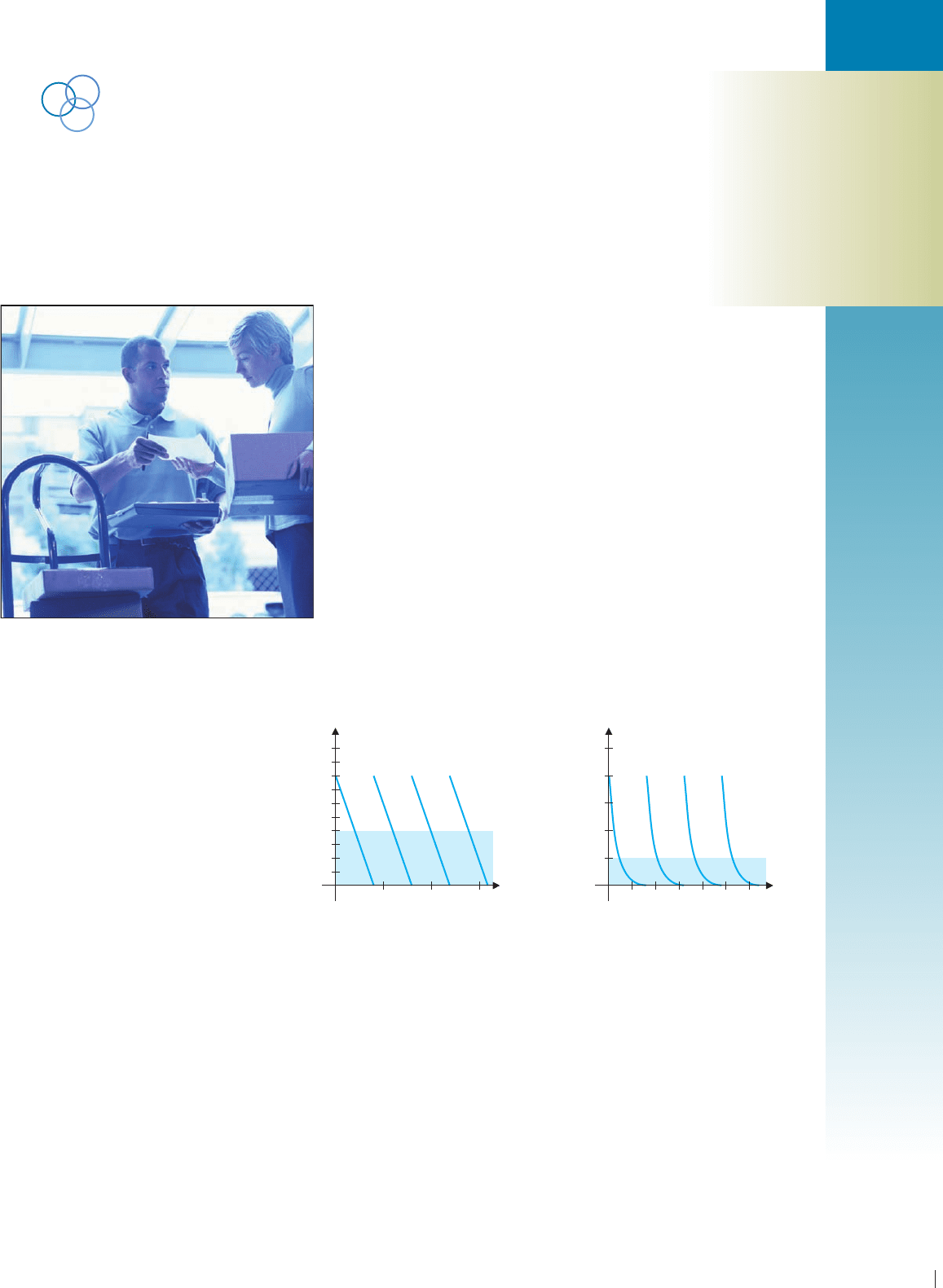
To translate this into a calculus problem, let f (t) represent the num-
ber of gallons of oil at the terminal at time t (days), where a shipment
arrives at time t = 0. In this case, f (0) = 8000. Further, for 0 < t < 8,
there is no oil coming in, but oil is leaving at the rate of 1000 gallons per
day. Since “rate” means derivative, we have f
(t) =−1000, for
0 < t < 8. This tells us that the graph of y = f (t) has slope −1000
until time t = 8, at which point another shipment arrives to refill the terminal, so
that f (8) = 8000. Continuing in this way, we generate the graph of f (t) shown
here at the left.
3020
y = f(t)
10
10,000
8000
9000
6000
7000
5000
2000
3000
4000
1000
t
y
3020
y = g(t)
10 25155
10,000
8000
6000
2000
4000
t
y
Since the inventory ranges from 0 gallons to 8000 gallons, you might guess
that the average inventory of oil is 4000 gallons. However, look at the graph at
the right, showing a different inventory function g(t), where the oil is not shipped
out at a constant rate. Although the inventory again ranges from 0 to 8000, the
drop in inventory is so rapid immediately following each delivery that the average
number of gallons on hand is well below 4000.
As we will see in this chapter, our usual way of averaging a set of numbers is
analogous to an area problem. Specifically, the average value of a function is the
height of the rectangle that has the same area as the area between the graph of the
function and the x-axis. For our original f (t), notice that 4000 appears to work
well, while for g(t), an average of 2000 appears to be better, as you can see in the
graphs.
251

P1: OSO/OVY P2: OSO/OVY QC: OSO/OVY T1: OSO
MHDQ256-Ch04 MHDQ256-Smith-v1.cls December 13, 2010 21:23
LT (Late Transcendental)
CONFIRMING PAGES
252 CHAPTER 4
..
Integration 4-2
Notice that we have introduced several new problems: finding a function from its
derivative, finding the average value of a function and finding the area under a curve. We
will explore these problems in this chapter.
4.1 ANTIDERIVATIVES
Calculus provides us with a powerful set of tools for understanding the world around us.
Initial designs of the space shuttle included aircraft engines to power its flight through the
atmosphere after reentry. In order to cut costs, the aircraft engines were scrapped and the
space shuttle became a huge glider. NASA engineers use the calculus to provide precise
answers to flight control problems. While we are not in a position to deal with the vast
complexities of a space shuttle flight, we can consider an idealized model.
NOTES
For a realistic model of a system
as complex as a space shuttle, we
must consider much more than the
simple concepts discussed here.
For a very interesting presentation
of this problem, see the article by
Long and Weiss in the February
1999 issue of The American
Mathematical Monthly.
As we often do with real-worldproblems, we begin with a physical principle(s) and use
thistoproduceamathematical model ofthephysicalsystem.Wethensolvethemathematical
problem and interpret the solution in terms of the physical problem.
Space shuttle Endeavor
If we consider only the vertical motion of an object falling toward the ground, the
physical principle governing the motion is Newton’s second law of motion:
Force = mass × acceleration or F = ma.
This says that the sum of all the forces acting on an object equals the product of its mass and
acceleration. Two forces that you might identify here are gravity pulling downward and air
drag pushing in the direction opposite the motion. From experimental evidence, we know
that the force due to air drag, F
d
, is proportional to the square of the speed of the object and
acts in the direction opposite the motion. So, for the case of a falling object,
F
d
= kv
2
,
for some constant k > 0.
The force due to gravity is simply the weight of the object, W =−mg, where the
gravitational constant g is approximately 32 ft/s
2
. (The minus sign indicates that the force
of gravity acts downward.) Putting this together, Newton’s second law of motion gives us
F = ma =−mg + kv
2
.
Recognizing that a = v
(t), we have
mv
(t) =−mg +kv
2
(t). (1.1)
Notice that equation (1.1) involves both the unknown function v(t) and its derivative v
(t).
Such an equation is called a differential equation. We discuss differential equations in
detail in Chapter 8. To get started now, we simplify the problem by assuming that gravity
is the only force acting on the object. Taking k = 0 in (1.1) gives us
mv
(t) =−mg or v
(t) =−g.
Now, let y(t) be the position function, giving the altitude of the object in feet t seconds after
the start of reentry. Since v(t) = y
(t) and a(t) = v
(t), we have
y
(t) =−32.
From this, we’d like to determine y(t). More generally, we need to find a way to undo
differentiation. That is, given a function, f , we’d like to find another function F such that
F
(x) = f (x). We call such a function F an antiderivative of f.