
Smith R., Minton R. Calculus
Подождите немного. Документ загружается.

P1: OSO/OVY P2: OSO/OVY QC: OSO/OVY T1: OSO
MHDQ256-Ch04 MHDQ256-Smith-v1.cls December 13, 2010 21:23
LT (Late Transcendental)
CONFIRMING PAGES
4-53 SECTION 4.7
..
Numerical Integration 303
Simpson’s Rule
ConsiderthefollowingalternativetotheTrapezoidalRule.First,constructaregularpartition
of the interval [a, b]:
a = x
0
< x
1
< x
2
< ···< x
n
= b,
where x
i
− x
i−1
=
b −a
n
= x,
x
x
i
x
i −1
x
i −2
y
y = f(x)
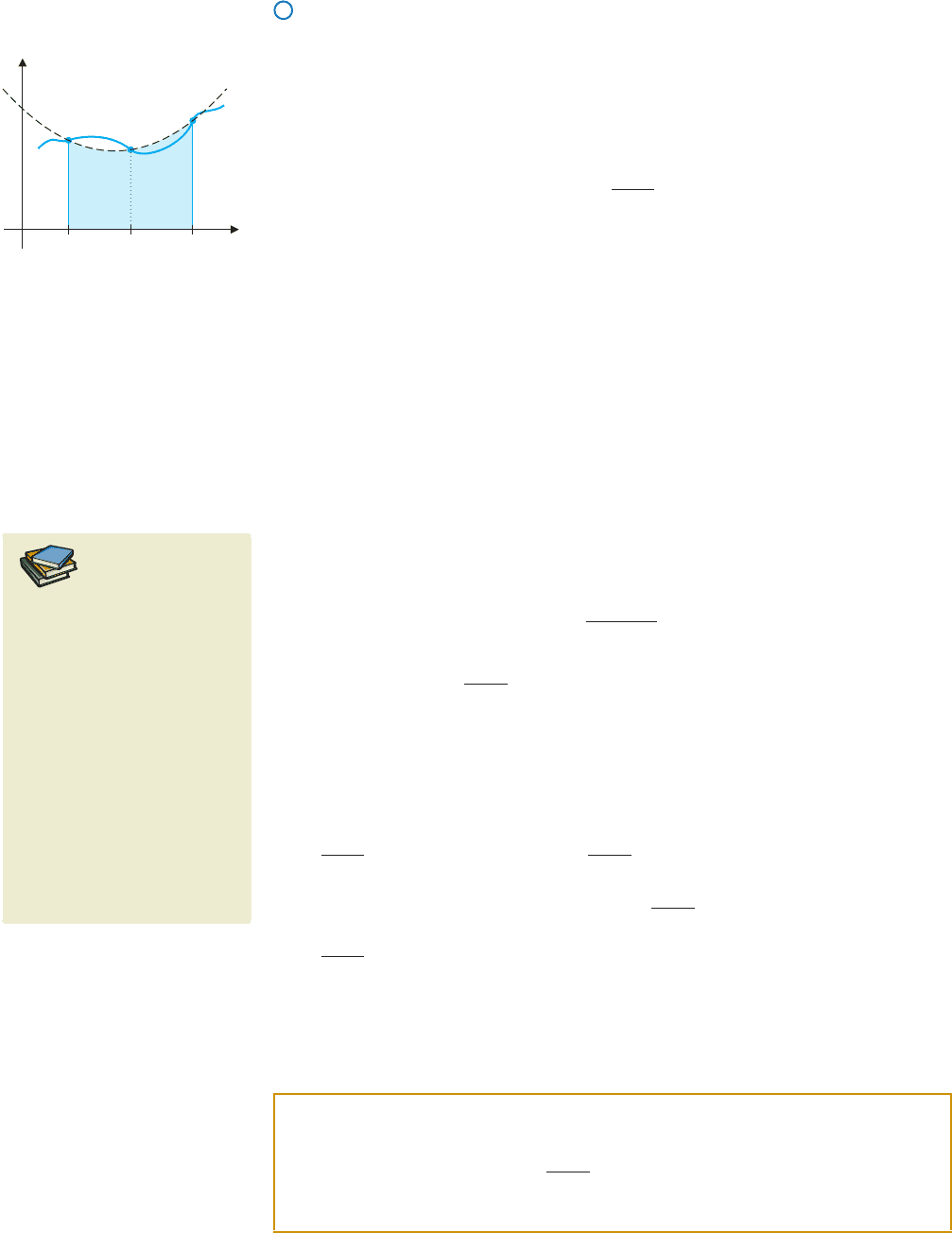
FIGURE 4.30
Simpson’s Rule
HISTORICAL
NOTES
Thomas Simpson (1710–1761)
An English mathematician who
popularized the numerical
method now known as Simpson’s
Rule. Trained as a weaver,
Simpson also earned a living as a
fortune-teller, as the editor of the
Ladies’ Diary and as a textbook
author. Simpson’s calculus
textbook (titled A New Treatise on
Fluxions, using Newton’s calculus
terminology) introduced many
mathematicians to Simpson’s
Rule, although the method had
been developed years earlier.
for each i = 1, 2,...,n and where n is an even number. Instead of connecting each pair
of points with a straight line segment (as we did with the Trapezoidal Rule), we connect
each set of three consecutive points, (x
i−2
, f (x
i−2
)), (x
i−1
, f (x
i−1
)) and (x
i
, f (x
i
)) for
i = 2, 4,...,n, with a parabola. (See Figure 4.30.) That is, we look for the quadratic
function p(x) whose graph passes through these three points, so that
p(x
i−2
) = f (x
i−2
), p(x
i−1
) = f (x
i−1
) and p(x
i
) = f (x
i
).
Using this to approximate the value of the integral of f on the interval [x
i−2
, x
i
], we have
x
i
x
i−2
f (x) dx ≈
x
i
x
i−2
p(x)dx.
Notice why we want to approximate f by a polynomial: polynomials are easy to integrate.
A straightforward though tedious computation (try this; your CAS may help) gives
x
i
x
i−2
f (x) dx ≈
x
i
x
i−2
p(x)dx =
x
i
− x
i−2
6
[ f (x
i−2
) + 4 f (x
i−1
) + f (x
i
)]
=
b −a
3n
[ f (x
i−2
) + 4 f (x
i−1
) + f (x
i
)].
Adding together the integrals over each subinterval [x
i−2
, x
i
], for i = 2, 4, 6,...,n, we get
b
a
f (x) dx
≈
b −a
3n
[ f (x
0
) + 4 f (x
1
) + f (x
2
)] +
b −a
3n
[ f (x
2
) + 4 f (x
3
) + f (x
4
)] +···
+
b −a
3n
[ f (x
n−2
) + 4 f (x
n−1
) + f (x
n
)]
=
b −a
3n
[ f (x
0
) + 4 f (x
1
) + 2 f (x
2
) + 4 f (x
3
) + 2 f (x
4
) +···+4 f (x
n−1
) + f (x
n
)].
Be sure to notice the pattern that the coefficientsfollow. We refer to this as the (n + 1)-point
Simpson’s Rule, S
n
( f ),
SIMPSON’S RULE
b
a
f (x) dx ≈ S
n
( f ) =
b −a
3n
[ f (x
0
) + 4 f (x
1
) + 2 f (x
2
) + 4 f (x
3
)
+ 2 f (x
4
) +···+4 f (x
n−1
) + f (x
n
)].
Next, we illustrate the use of Simpson’s Rule for a simple integral.

P1: OSO/OVY P2: OSO/OVY QC: OSO/OVY T1: OSO
MHDQ256-Ch04 MHDQ256-Smith-v1.cls December 13, 2010 21:23
LT (Late Transcendental)
CONFIRMING PAGES
304 CHAPTER 4
..
Integration 4-54
EXAMPLE 7.6 Using Simpson’s Rule
Approximate the value of
1
0
3x
2
dx using Simpson’s Rule with n = 4.
Solution We have
S
4
( f ) =
1 − 0
(3)(4)
f (0) +4 f
1
4
+ 2 f
1
2
+ 4 f
3
4
+ f (1)
= 1,
which is in fact, the exact value. Notice that this is far more accurate than the Midpoint
and Trapezoidal Rules and yet requires no more effort.
Recall that Simpson’s Rule computes the area beneath approximating parabolas. Given
this, it shouldn’t surprise you that Simpson’s Rule gives the exact area in example 7.6. As
you will discover in the exercises, Simpson’s Rule gives exact values of integrals for any
polynomial of degree 3 or less.
In example 7.7, we illustrate Simpson’s Rule for an integral that you do not know how
to compute exactly.
EXAMPLE 7.7 Using a Program for Simpson’s Rule
Compute Simpson’s Rule approximations with n = 4 (by hand), n = 8, 16, 32, 64 and
128 (using a program) for
2
0
√
x
2
+ 1 dx.
Solution For n = 4, we have
S
4
( f ) =
2 − 0
(3)(4)
f (0) +4 f
1
2
+ 2 f (1) + 4 f
3
2
+ f (2)
=
1
6
1 + 4
5
4
+ 2
√
2 + 4
13
4
+
√
5
≈ 2.95795560.
Using a program, you can easily obtain the values in the accompanying table. Based on
these calculations, we would expect 2.9578857 to be a very good approximation of
2
0
√
x
2
+ 1 dx.
n S
n
( f )
4 2.9579556
8 2.9578835
16 2.95788557
32 2.95788571
64 2.95788571
128 2.95788572
Since most graphs curve somewhat, you might expect the parabolas of Simpson’s Rule
to better track the curve than the line segments of the Trapezoidal Rule. As example 7.8
shows, Simpson’s Rule can be much more accurate than either the Midpoint Rule or the
Trapezoidal Rule.
EXAMPLE 7.8 Comparing the Midpoint, Trapezoidal
and Simpson’s Rules
Compute the Midpoint, Trapezoidal and Simpson’s Rule approximations of
1
0
4
x
2
+ 1
dx with n = 10, n = 20, n = 50 and n = 100. Compare to the exact
value of π.
Solution
n Midpoint Rule Trapezoidal Rule Simpson’s Rule
10 3.142425985 3.139925989 3.141592614
20 3.141800987 3.141175987 3.141592653
50 3.141625987 3.141525987 3.141592654
100 3.141600987 3.141575987 3.141592654
Compare these values to the exact value of π ≈ 3.141592654. Note that the
Midpoint Rule tends to be slightly closer to π than the Trapezoidal Rule, but neither is
as close with n = 100 as Simpson’s Rule is with n = 10.
P1: OSO/OVY P2: OSO/OVY QC: OSO/OVY T1: OSO
MHDQ256-Ch04 MHDQ256-Smith-v1.cls December 13, 2010 21:23
LT (Late Transcendental)
CONFIRMING PAGES
4-55 SECTION 4.7
..
Numerical Integration 305
REMARK 7.2
Notice that for a given value of n, the number of computations (and hence the effort)
required to produce the Midpoint, Trapezoidal and Simpson’s Rule approximations
are all roughly the same. So, example 7.8 gives an indication of how much more
efficient Simpson’s Rule is than the other two methods. This is particularly significant
when the function f is difficult to evaluate. For instance, in the case of experimental
data, each function value f (x) could be the result of an expensive and
time-consuming experiment.
In example 7.9, we revise our estimate of the area in Figure 4.27a, first examined in
example 7.4.
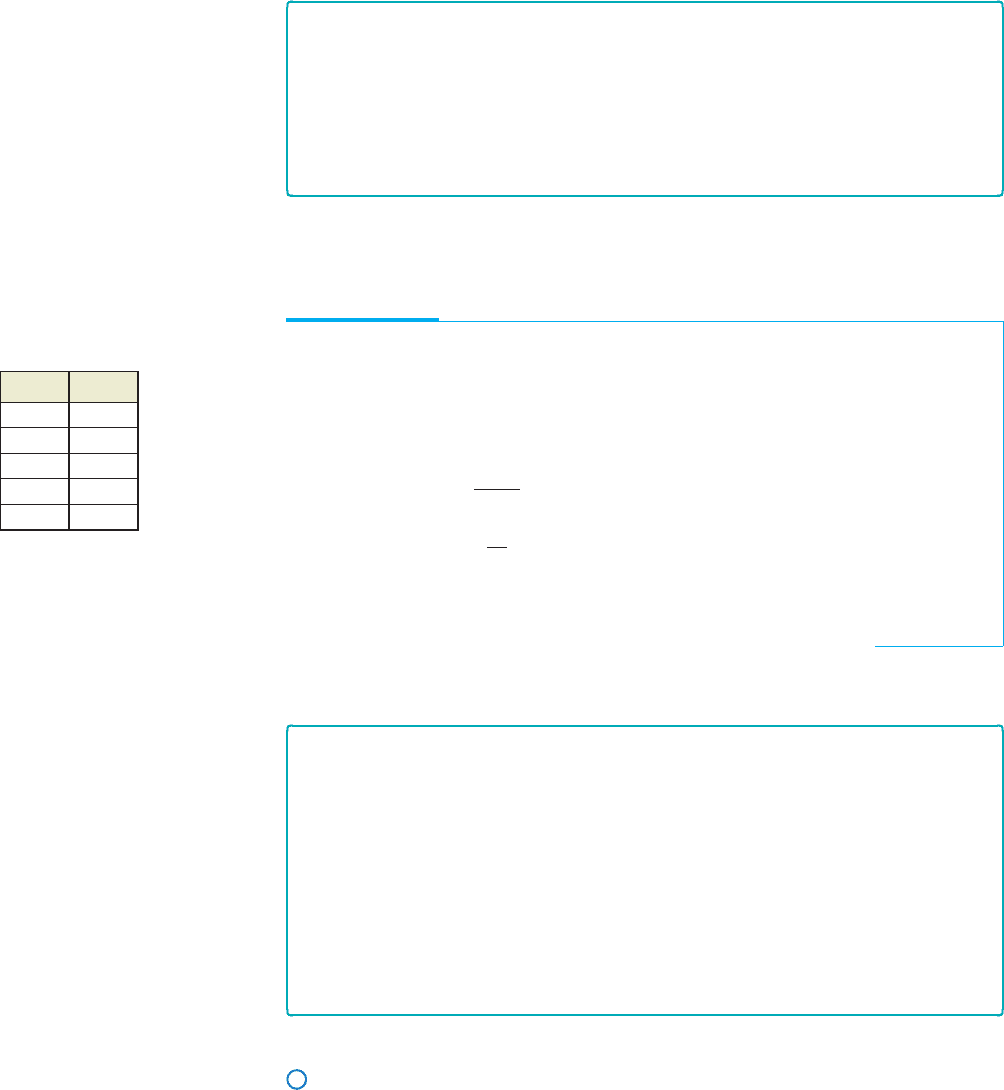
x f(x)
0.0 1.0
0.25 0.8
0.5 1.3
0.75 1.1
1.0 1.6
EXAMPLE 7.9 Using Simpson’s Rule with Data
Use Simpson’s Rule to estimate
1
0
f (x) dx, where the only information known about f
is given in the table of values shown in the margin.
Solution From Simpson’s Rule with n = 4, we have
1
0
f (x) dx ≈
1 − 0
(3)(4)
[ f (0) + 4 f (0.25) + 2 f (0.5) +4 f (0.75) + f (1)]
=
1
12
[1 + 4(0.8) + 2(1.3) + 4(1.1) + 1.6] ≈ 1.066667.
Since Simpson’s Rule is generally much more accurate than the Trapezoidal Rule (for
the same number of points), we expect that this approximation is more accurate than the
approximation of 1.125 found in example 7.4 via the Trapezoidal Rule.
REMARK 7.3
Most graphing calculators and computer algebra systems have very fast and accurate
programs for numerical approximation of definite integrals. Some ask you to specify
an error tolerance and then calculate a value accurate to within that tolerance. Most
calculators and CAS’s use adaptive quadrature routines, which automatically
calculate how many points are needed to obtain a desired accuracy. You should
feel comfortable using these programs. If the integral you are approximating is a
critical part of an important project, you can check your result by using Simpson’s
Rule, S
n
( f ), for a sequence of values of n. Of course, if all you know about a function
is its value at a fixed number of points, most calculator and CAS programs will not
help you, but the three methods discussed here will, as we saw in examples 7.4 and
7.9. We will pursue this idea further in the exercises.
Error Bounds for Numerical Integration
We have used examples where we know the value of an integral exactly to compare the
accuracy of our three numerical integration methods. However, in practice, where the value
of an integral is not known exactly, how do we determine how accurate a given numerical
estimate is? In Theorems 7.1 and 7.2, we give bounds on the error in our three numerical
integrationmethods. First, we introduce some notation. Let ET
n
represent the error in using
the (n + 1)-point Trapezoidal Rule to approximate
b
a
f (x) dx. That is,
ET
n
= exact − approximate =
b
a
f (x) dx − T
n
( f ).

P1: OSO/OVY P2: OSO/OVY QC: OSO/OVY T1: OSO
MHDQ256-Ch04 MHDQ256-Smith-v1.cls December 13, 2010 21:23
LT (Late Transcendental)
CONFIRMING PAGES
306 CHAPTER 4
..
Integration 4-56
Similarly, we denote the error in the Midpoint Rule and Simpson’s Rule by EM
n
and ES
n
,
respectively. We now have:
THEOREM 7.1
Suppose that f
is continuous on [a, b] and that | f
(x)|≤K , for all x in [a, b].
Then,
|ET
n
|≤K
(b −a)
3
12n
2
and
|EM
n
|≤K
(b −a)
3
24n
2
.
Notice that both of the estimates in Theorem 7.1 say that the error in using the indicated
numerical method is no larger (in absolute value) than the given bound. This says that if the
bound is small, so too will be the error. In particular, observe that the error bound for the
Midpoint Rule is half that for the Trapezoidal Rule. This doesn’t say that the actual error
in the Midpoint Rule will be half that of the Trapezoidal Rule, but it does explain why the
Midpoint Rule tends to be somewhat more accurate than the Trapezoidal Rule for the same
value of n. Also notice that the constant K depends on | f
(x)|. The larger | f
(x)| is, the
more the graph curves and consequently, the less accurate are the straight-line approxima-
tions of the Midpoint Rule and the Trapezoidal Rule. An error bound for Simpson’s Rule
follows.
THEOREM 7.2
Suppose that f
(4)
is continuous on [a, b] and that | f
(4)
(x)|≤L, for all x in [a, b].
Then,
|ES
n
|≤L
(b −a)
5
180n
4
.
The proofs of Theorems 7.1 and 7.2 are beyond the levelof this course and we refer the
interested reader to a text on numerical analysis. In comparing Theorems 7.1 and 7.2, notice
that the denominators of the error bounds for both the Trapezoidal Rule and the Midpoint
Rule contain a factor of n
2
, while the error bound for Simpson’s Rule contains a factor of
n
4
.Forn = 10, observe that n
2
= 100, while n
4
= 10,000. Since these powers of n are in
the denominators of the error bounds, this says that the error bound for Simpson’s Rule
tends to be much smaller than that of either the Trapezoidal Rule or the Midpoint Rule for
the same value of n. This accounts for the far greater accuracy we have seen with using
Simpson’s Rule over the other two methods. We illustrate the use of the error bounds in
example 7.10.
EXAMPLE 7.10 Finding a Bound on the Error in Numerical Integration
Find bounds on the error in using each of the Midpoint Rule, the Trapezoidal Rule and
Simpson’s Rule to approximate the value of the integral
3
1
1
x
dx, using n = 10.
Solution At this point you can’t use the Fundamental Theorem of Calculus, since you
don’t have an antiderivative of
1
x
. However, you can approximate this integral using
Trapezoidal, Midpoint or Simpson’s Rules. Here, f (x) = 1/x = x
−1
, so that
f
(x) =−x
−2
, f
(x) = 2x
−3
, f
(x) =−6x
−4
and f
(4)
(x) = 24x
−5
. This says that for
x ∈ [1, 3],
| f
(x)|=|2x
−3
|=
2
x
3
≤ 2.

P1: OSO/OVY P2: OSO/OVY QC: OSO/OVY T1: OSO
MHDQ256-Ch04 MHDQ256-Smith-v1.cls December 13, 2010 21:23
LT (Late Transcendental)
CONFIRMING PAGES
4-57 SECTION 4.7
..
Numerical Integration 307
From Theorem 7.1, we now have
|EM
10
|≤K
(b −a)
3
24n
2
= 2
(3 − 1)
3
24(10
2
)
≈ 0.006667.
Similarly, we have
|ET
10
|≤K
(b −a)
3
12n
2
= 2
(3 − 1)
3
12(10
2
)
≈ 0.013333.
Turning to Simpson’s Rule, for x ∈ [1, 3], we have S
10
( f ) ≈ 1.09866 and
| f
(4)
(x)|=|24x
−5
|=
24
x
5
≤ 24,
so that Theorem 7.2 now gives us
|ES
10
|≤L
(b −a)
5
180n
4
= 24
(3 − 1)
5
180(10
4
)
≈ 0.000427.
From example 7.10, we now know that the Simpson’s Rule approximation
S
10
( f ) ≈ 1.09866 is off by no more than about 0.000427. However, a more interesting
question is to determine the number of points needed to obtain a given accuracy. We ex-
plore this in example 7.11.
EXAMPLE 7.11 Determining the Number of Steps That Guarantee
a Given Accuracy
Determine the number of steps that will guarantee an accuracy of at least 10
−7
for using
each of Trapezoidal Rule and Simpson’s Rule to approximate
3
1
1
x
dx.
Solution From example 7.10, we know that | f
(x)|≤2 and | f
(4)
(x)|≤24, for all
x ∈ [1, 3]. So, from Theorem 7.1, we now have that
|ET
n
|≤K
(b −a)
3
12n
2
= 2
(3 − 1)
3
12n
2
=
4
3n
2
.
If we require the above bound on the error to be no larger than the required accuracy of
10
−7
,wehave
|ET
n
|≤
4
3n
2
≤ 10
−7
.
Solving this inequality for n
2
gives us
4
3
10
7
≤ n
2
and taking the square root of both sides yields
n ≥
4
3
10
7
≈ 3651.48.
So, any value of n ≥ 3652 will give the required accuracy. Similarly, for Simpson’s
Rule, we have
|ES
n
|≤L
(b −a)
5
180n
4
= 24
(3 − 1)
5
180n
4
.

P1: OSO/OVY P2: OSO/OVY QC: OSO/OVY T1: OSO
MHDQ256-Ch04 MHDQ256-Smith-v1.cls December 13, 2010 21:23
LT (Late Transcendental)
CONFIRMING PAGES
308 CHAPTER 4
..
Integration 4-58
Again, requiring that the error bound be no larger than 10
−7
gives us
|ES
n
|≤24
(3 − 1)
5
180n
4
≤ 10
−7
and solving for n
4
,wehave n
4
≥ 24
(3 − 1)
5
180
10
7
.
Upon taking fourth roots, we get
n ≥
4
24
(3 − 1)
5
180
10
7
≈ 80.8,
so that taking any value of n ≥ 82 will guarantee the required accuracy. (If you expected
us to say that n ≥ 81, keep in mind that Simpson’s Rule requires n to be even.)
In example 7.11, compare the number of steps required to guarantee 10
−7
accuracy
in Simpson’s Rule (82) to the number required to guarantee the same accuracy in the
Trapezoidal Rule (3652). Simpson’s Rule typically requires far fewer steps than either the
TrapezoidalRuleor the MidpointRuletoget the same accuracy.Finally,fromexample7.11,
observe that we now know that
3
1
1
x
dx ≈ S
82
≈ 1.0986123,
which is guaranteed (by Theorem 7.2) to be correct to within 10
−7
.
EXERCISES 4.7
WRITING EXERCISES
1. Ideally, approximation techniques should be both simple and
accurate. Howdo the numerical integrationmethods presented
in this section compare in terms of simplicity and accuracy?
Which criterion would be moreimportant if you were working
entirely by hand? Which method would you use? Which cri-
terion would be more important if you were using a very fast
computer? Which method would you use?
2. Suppose you were going to construct your own rule for ap-
proximateintegration.(Nameitafter yourself!) In thetext,new
methods were obtained both by choosing evaluation points for
Riemann sums (Midpoint Rule) and by geometric construction
(Trapezoidal Rule and Simpson’s Rule). Without working out
the details, explain how you would develop a very accurate but
simple rule.
3. Test your calculator or computer on
1
0
sin(1/x)dx. Discuss
what your options are when your technology does not imme-
diately return an accurate approximation. Based on a quick
sketch of y = sin (1/x), describe why a numerical integration
routine would have difficulty with this integral.
4. Explain why we did not use the Midpoint Rule in example 7.4.
In exercises 1–4, compute Midpoint, Trapezoidal and Simpson’s
Rule approximations by hand (leave your answer as a fraction)
for n 4.
1.
1
0
(x
2
+ 1)dx 2.
2
0
(x
2
+ 1)dx
3.
3
1
1
x
dx 4.
1
−1
(2x − x
2
)dx
............................................................
In exercises 5–8, approximate the given value using (a) Mid-
point Rule, (b) Trapezoidal Rule and (c) Simpson’s Rule with
n 4. Determine if each approximation is too small or too
large.
5. π =
1
0
4
1 + x
2
dx 6. π = 4
1
0
1 − x
2
dx
7. sin1 =
1
0
cos xdx 8. cos 2 =
2
0
1
2
− sin x
dx
............................................................
In exercises 9–12, use a computer or calculator to compute
the Midpoint, Trapezoidal and Simpson’s Rule approximations
P1: OSO/OVY P2: OSO/OVY QC: OSO/OVY T1: OSO
MHDQ256-Ch04 MHDQ256-Smith-v1.cls December 13, 2010 21:23
LT (Late Transcendental)
CONFIRMING PAGES
4-59 SECTION 4.7
..
Numerical Integration 309
with n 10, n 20 and n 50. Compare these values to the
approximation given by your calculator or computer.
9.
π
0
cos x
2
dx 10.
π/4
0
sinπ x
2
dx
11.
10
0
x
2
+ 1dx 12.
1
0
3
x
2
+ 1dx
............................................................
In exercises 13–16, compute the exact value and compute the
error (the difference between the approximation and the ex-
act value) in each of the Midpoint, Trapezoidal and Simp-
son’s Rule approximations using n 10, n 20, n 40 and
n 80.
13.
1
0
5x
4
dx 14.
2
1
1
√
x
dx
15.
π
0
cos xdx 16.
π/4
0
cos xdx
............................................................
17. Fill in the blanks with the most appropriate power of 2 (2, 4, 8
etc.). If you double n, the error in the Midpoint Rule is divided
by
. If you double n, the error in the Trapezoidal Rule
is divided by
. If you double n, the error in Simpson’s
Rule is divided by
.
18. Fill in the blanks with the most appropriate power of 2 (2, 4,
8 etc.). If you halve the interval length b −a, the error in the
Midpoint Rule is divided by
, the error in the Trape-
zoidal Rule is divided by
and the error in Simpson’s
Rule is divided by
.
............................................................
In exercises 19 and 20, use (a) Trapezoidal Rule and (b) Simp-
son’s Rule to estimate
2
0
f (x) dx from the given data.
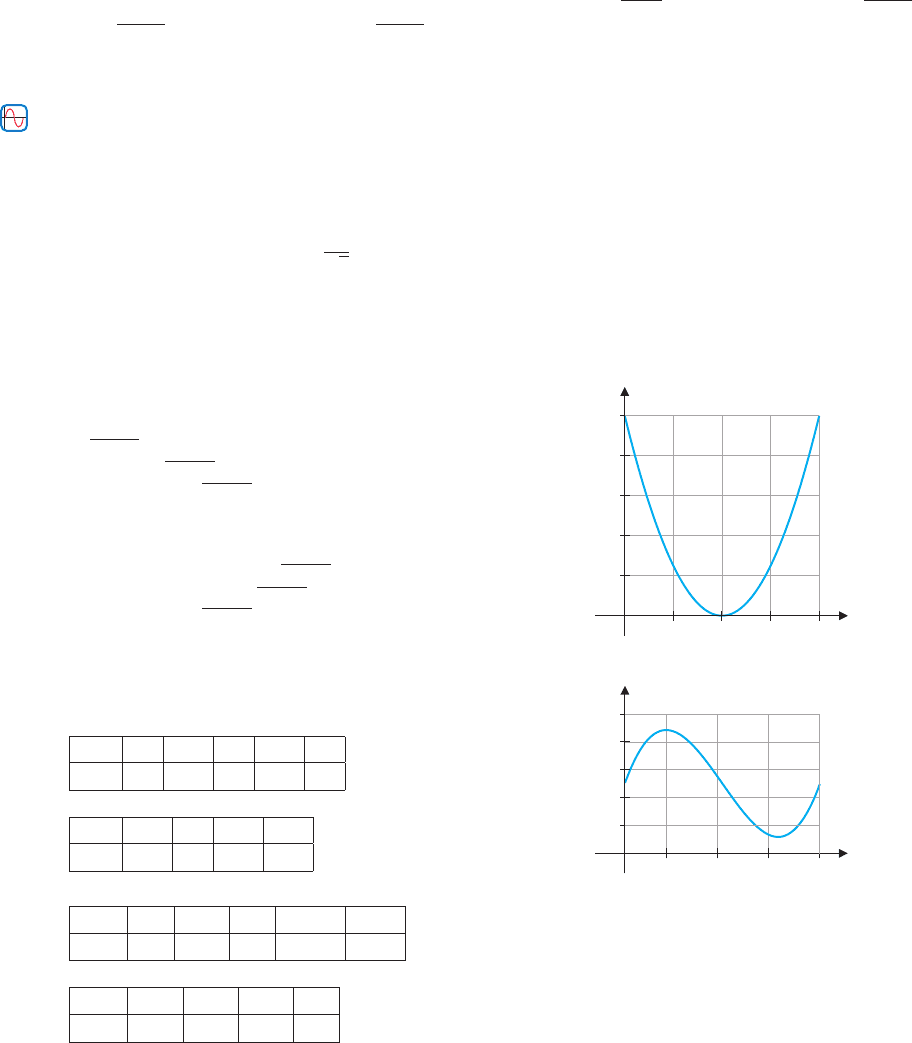
19.
x 0.0 0.25 0.5 0.75 1.0
f (x) 4.0 4.6 5.2 4.8 5.0
x 1.25 1.5 1.75 2.0
f (x) 4.6 4.4 3.8 4.0
20.
x 0.0 0.25 0.5 0.75 1.0
f (x) 1.0 0.6 0.2 −0.2 −0.4
x 1.25 1.5 1.75 2.0
f (x) 0.4 0.8 1.2 2.0
............................................................
21. For exercise 5, (a) find bounds on the errors made by (i) Mid-
point Rule and (ii) Trapezoidal Rule. (b) Find the number of
steps needed to guarantee an accuracy of 10
−7
for (i) Midpoint
Rule and (ii) Trapezoidal Rule.
22. For exercise 7, (a) find bounds on the errors made by each
method. (b) Find the number of steps needed to guarantee an
accuracy of 10
−7
.
In exercises 23–26, determine the number of steps to guaran-
tee an accuracy of 10
−6
using (a) the Trapezoidal Rule, (b) the
Midpoint Rule and (c) Simpson’s Rule.
23.
2
1
1
x + 1
dx 24.
2
0
1
x
2
+ 1
dx
25.
2
1
cos x
2
dx 26.
2
1
x sin xdx
............................................................
27. For each rule in exercise 13, compute the error bound and
compare it to the actual error.
28. For each rule in exercise 15, compute the error bound and
compare it to the actual error.
............................................................
In exercises 29 and 30, use the graph to estimate (a) Rie-
mann sum with left-endpoint evaluation, (b) Midpoint Rule,
(c) Trapezoidal Rule and (d) Simpson’s Rule approximations
with n 4of
2
0
f (x) dx.
29.
y
x
0.2
0.4
0.6
0.8
1.0
0.5
1.0 1.5 2.0
30.
x
y
0.2
0.4
0.6
0.8
1.0
2.0
1.51.00.5
............................................................
In exercises 31–36, use the given information about f (x) and its
derivatives to determine whether (a) the Midpoint Rule would
be exact, underestimate or overestimate the integral (or there’s
not enough information to tell). Repeat for (b) Trapezoidal Rule
and (c) Simpson’s Rule.
31. f
(x) > 0, f
(x) > 0 32. f
(x) > 0, f
(x) < 0
33. f
(x) < 0, f
(x) > 0 34. f
(x) < 0, f
(x) < 0
35. f
(x) = 4, f
(x) > 0 36. f
(x) = 0, f
(x) > 0
............................................................
37. Suppose that R
L
and R
R
are the Riemann sum approxima-
tions of
b
a
f (x) dx using left- and right-endpoint evaluation
rules, respectively, for some n > 0. Show that the trapezoidal
approximation T
n
is equal to (R
L
+ R
R
)/2.
P1: OSO/OVY P2: OSO/OVY QC: OSO/OVY T1: OSO
MHDQ256-Ch04 MHDQ256-Smith-v1.cls December 13, 2010 21:23
LT (Late Transcendental)
CONFIRMING PAGES
310 CHAPTER 4
..
Integration 4-60
38. Prove the following formula, which is basic to
Simpson’s Rule. If f (x) = Ax
2
+ Bx + C, then
h
−h
f (x) dx =
h
3
[ f (−h) +4 f (0) + f (h)].
39. A commonly used type of numerical integration algorithm is
called Gaussian quadrature. For an integral on the inter-
val [−1, 1], a simple Gaussian quadrature approximation is
1
−1
f (x) dx ≈ f
−1
√
3
+ f
1
√
3
. Show that, like Simpson’s
Rule, this Gaussian quadrature gives the exact value of the
integrals of the power functions x, x
2
and x
3
.
40. Referring to exercise 39, compare the Simpson’s Rule (n = 2)
and Gaussian quadrature approximations of
1
−1
π cos
π x
2
dx
to the exact value.
41. Explain why Simpson’s Rule can’t be used to approxi-
mate
π
0
sin x
x
dx. Find L = lim
x→0
sin x
x
and argue that if
f (x) =
sin x
x
if x = 0
L if x = 0
then
π
0
f (x) dx =
π
0
sin x
x
dx.
Use an appropriate numerical method to conjecture that
π
0
sin x
x
dx ≈ 1.18
π
2
.
42. As in exercise 41, approximate
π/2
−π/2
sin x
x
dx.
43. In most of the calculations that you have done, it is true
that the Trapezoidal Rule and Midpoint Rule are on oppo-
site sides of the exact integral (i.e., one is too large, the other
too small). Also, you may have noticed that the Trapezoidal
Rule tends to be about twice as far from the exact value as
the Midpoint Rule. Given this, explain why the linear com-
bination
1
3
T
n
+
2
3
M
n
should give a good estimate of the inte-
gral. (Here, T
n
represents the Trapezoidal Rule approximation
using n partitions and M
n
the corresponding Midpoint Rule
approximation.)
44. Show that the approximation rule
1
3
T
n
+
2
3
M
n
in exercise 43 is
identical to Simpson’s Rule.
45. For f (x) =
x
2
2x
2
− 2x + 1
, show that f (x) + f (1 − x) = 1
for 0 ≤ x ≤ 1. Show that this implies that the Trapezoidal
Rule approximation of
1
0
f (x) dx equals
1
2
for any n. This is,
in fact, the exact value of the integral. (For more information,
see M. A. Khan’s article in the January 2008 College Mathe-
matics Journal.)
46. Show that the Trapezoidal Rule approximation of
n
0
x
n
dx is
too large (if n > 1). Conclude that
1
n
+ 2
n
+ 3
n
+···+n
n
> n
n
3n + 1
2n + 2
.
APPLICATIONS
In exercises 47 and 48, the velocity of an object at various times
is given. Use the data to estimate the distance traveled.
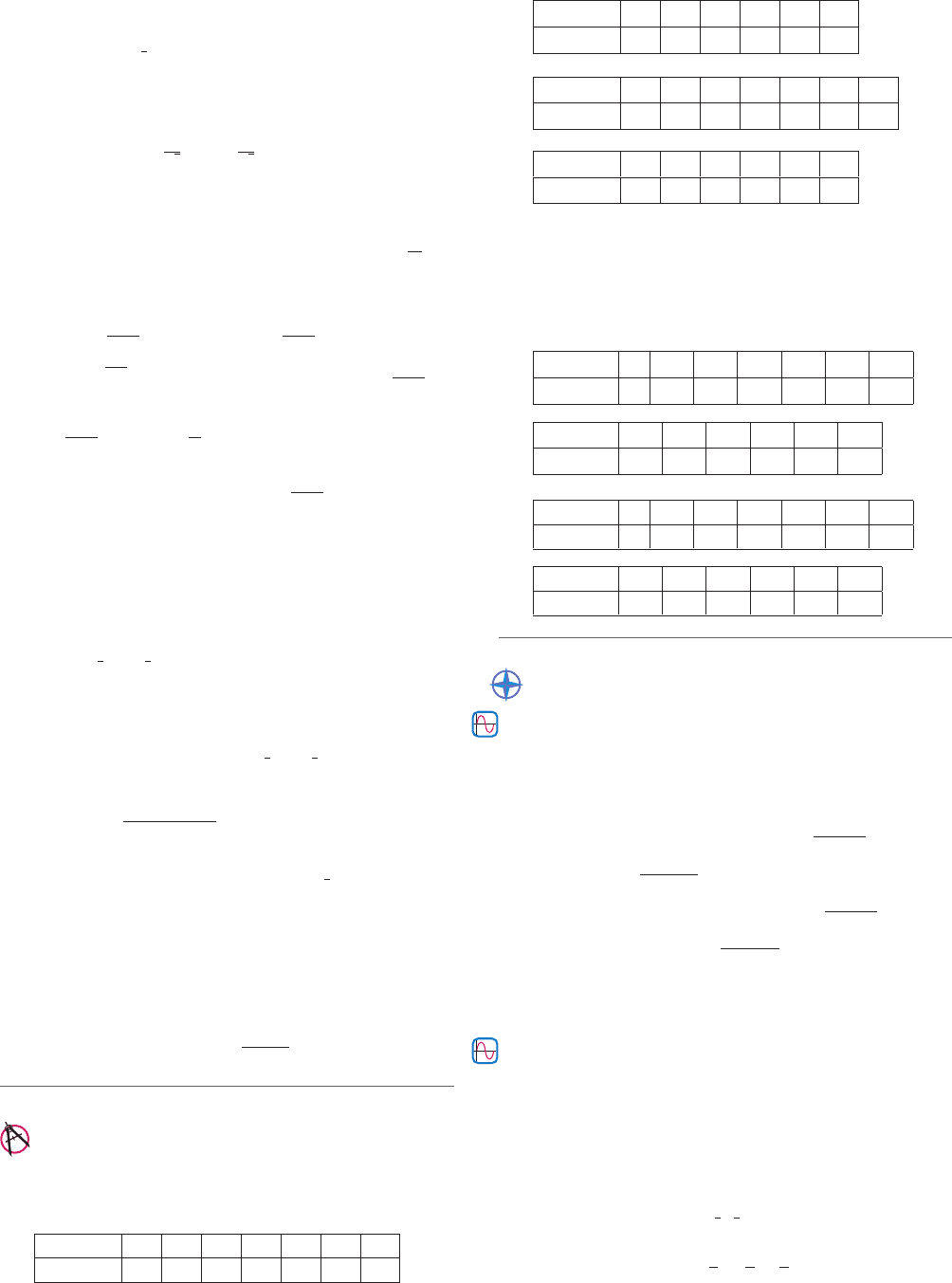
47.
t (s) 0 1 2 3 4 5 6
v(t) (ft/s) 40 42 40 44 48 50 46
t (s) 7 8 9 10 11 12
v(t) (ft/s) 46 42 44 40 42 42
48.
t (s) 0 2 4 6 8 10 12
v(t) (ft/s) 26 30 28 30 28 32 30
t (s) 14 16 18 20 22 24
v(t) (ft/s) 33 31 28 30 32 32
............................................................
In exercises 49 and 50, the data come from a pneumotacho-
graph, which measures air flow through the throat (in liters per
second). The integral of the air flow equals the volume of air
exhaled. Estimate this volume.
49.
t (s) 0 0.2 0.4 0.6 0.8 1.0 1.2
f (t) (l/s) 0 0.2 0.4 1.0 1.6 2.0 2.2
t (s) 1.4 1.6 1.8 2.0 2.2 2.4
f (t) (l/s) 2.0 1.6 1.2 0.6 0.2 0
50.
t (s) 0 0.2 0.4 0.6 0.8 1.0 1.2
f (t) (l/s) 0 0.1 0.4 0.8 1.4 1.8 2.0
t (s) 1.4 1.6 1.8 2.0 2.2 2.4
f (t) (l/s) 2.0 1.6 1.0 0.6 0.2 0
EXPLORATORY EXERCISES
1. Compute the Trapezoidal Rule approximations T
4
, T
8
and T
16
of
1
0
3x
2
dx, and compute the error for each. Verify that when
the step size is cut in half, the error is divided by four. When
such patterns emerge, they can be taken advantage of using
extrapolation. Given that (T
4
− I ) = 4(T
8
− I ), where I = 1
is the exact integral, show that I = T
8
+
T
8
− T
4
3
. Also, show
that I = T
16
+
T
16
− T
8
3
. In general, we have the approxima-
tions (T
4
− I ) ≈ 4(T
8
− I ) and I ≈ T
8
+
T
8
− T
4
3
. Then the
extrapolation E
2n
= T
2n
+
T
2n
− T
n
3
is closer to the exact in-
tegral than either of the individual Trapezoidal Rule approxi-
mationsT
2n
andT
n
.Showthat,infact, E
2n
equalstheSimpson’s
Rule approximation for 2n.
2. The geometric construction of Simpson’s Rule makes it clear
that Simpson’s Rule will compute integrals such as
1
0
3x
2
dx
exactly. Briefly explain why. Now, compute Simpson’s Rule
with n = 2 for
1
0
4x
3
dx. Simpson’s Rule also computes inte-
grals of cubics exactly. In this exercise, we see why a method
that uses parabolas can compute integrals of cubics exactly. To
see howSimpson’s Rule works on
1
0
4x
3
dx, we need todeter-
mine the actual parabola being used. The parabola must pass
through the points (0, 0), (
1
2
,
1
2
) and (1, 4). Find the quadratic
function y = ax
2
+ bx +c that accomplishes this. (Hint: Ex-
plainwhy0 = 0 + 0 +c,
1
2
=
a
4
+
b
2
+ c and4 = a + b + c,

P1: OSO/OVY P2: OSO/OVY QC: OSO/OVY T1: OSO
MHDQ256-Ch04 MHDQ256-Smith-v1.cls December 13, 2010 21:23
LT (Late Transcendental)
CONFIRMING PAGES
4-61 CHAPTER 4
..
Review Exercises 311
and then solvefor a, b and c.) Graph this parabola and y = 4x
3
on the same axes, carefully choosing the graphing window
so that you can see what is happening on the interval [0, 1].
Whereisthe vertexoftheparabola?Howdotheintegralsofthe
parabola and cubic compare on the subinterval [0,
1
2
]?[
1
2
, 1]?
Why does Simpson’s Rule compute the integral exactly?
Review Exercises
WRITING EXERCISES
The following list includes terms that are defined and theorems that
arestatedinthis chapter.Foreachterm or theorem, (1)givea precise
definition or statement, (2) state in general terms what it means and
(3) describe the types of problems with which it is associated.
Area Average value Indefinite integral
Signed area Integration by substitution Simpson’s Rule
Midpoint Rule Trapezoidal Rule
Integral Mean Fundamental Theorem
Value Theorem of Calculus
Riemann sum Definite integral
TRUE OR FALSE
State whether each statement is true or false, and briefly explain
why. If the statement is false, try to “fix it” by modifying the given
statement to make a new statement that is true.
1. The Midpoint Rule always gives better approximations than
left-endpoint evaluation.
2. The larger n is, the better is the Riemann sum approximation.
3. All piecewise continuous functions are integrable.
4. The definite integral of velocity gives the total distance
traveled.
5. There are some elementary functions that do not have an
antiderivative.
6. To evaluate a definite integral, you can use any antiderivative.
7. A substitution is not correct unless the derivative term du is
present in the original integrand.
8. With Simpson’s Rule, if n is doubled, the error is reduced by a
factor of 16.
In exercises 1–20, find the antiderivative.
1.
(4x
2
− 3)dx 2.
(x − 3x
5
)dx
3.
4
√
x
dx 4.
4
x
2
dx
5.
2sin4xdx 6.
3sec
2
xdx
7.
[x − cos(4x)] dx 8.
3
√
xdx
9.
x
2
+ 4x
x
dx 10.
x
(x
2
+ 4)
2
dx
11.
x(1 −1/x) dx 12.
(sin x + cos x)
2
dx
13.
x
x
2
+ 4dx 14.
x(x
2
+ 4)dx
15.
6x
2
cos x
3
dx 16.
4x sec x
2
tan x
2
dx
17.
sin(1/x)
x
2
dx 18.
csc
2
√
x
√
x
dx
19.
tan x sec
2
xdx 20.
√
3x + 1 dx
............................................................
21. Findafunction f (x)satisfying f
(x) = 3x
2
+ 1and f (0) = 2.
22. Find a function f (x) satisfying f
(x) =
√
2x and f (0) = 3.
23. Determine the position function if the velocity is
v(t) =−32t + 10 and the initial position is s(0) = 2.
24. Determine the position function if the acceleration is a(t) = 6
with initial velocity v(0) = 10 and initial position s(0) = 0.
25. Write out all terms and compute
6
i=1
(i
2
+ 3i).
26. Translate into summation notation and compute: the sum of
the squares of the first 12 positive integers.
............................................................
In exercises 27 and 28, use summation rules to compute
the sum.
27.
100
i=1
(i
2
− 1) 28.
100
i=1
(i
2
+ 2i)
............................................................
29. Compute the sum
1
n
3
n
i=1
(i
2
−i) and the limit of the sum as n
approaches ∞.
30. For f (x) = x
2
− 2x on the interval [0, 2], list the evaluation
points for the Midpoint Rule with n = 4, sketch the func-
tion and approximating rectangles and evaluate the Riemann
sum.

P1: OSO/OVY P2: OSO/OVY QC: OSO/OVY T1: OSO
MHDQ256-Ch04 MHDQ256-Smith-v1.cls December 13, 2010 21:23
LT (Late Transcendental)
CONFIRMING PAGES
312 CHAPTER 4
..
Integration 4-62
Review Exercises
In exercises 31–34, approximate the area under the curve using
n rectangles and the given evaluation rule.
31. y = x
2
on [0, 2], n = 8, midpoint evaluation
32. y = x
2
on [−1, 1], n = 8, right-endpoint evaluation
33. y =
√
x + 1on[0, 3], n = 8, midpoint evaluation
34. y =
1
x + 1
on [0, 1], n = 8, left-endpoint evaluation
............................................................
In exercises 35 and 36, use the given function values to esti-
mate the areaunder the curveusing (a) left-endpoint evaluation,
(b) right-endpoint evaluation, (c) Trapezoidal Rule and
(d) Simpson’s Rule.
35.
x 0.0 0.2 0.4 0.6 0.8 1.0 1.2 1.4 1.6
f (x) 1.0 1.4 1.6 2.0 2.2 2.4 2.0 1.6 1.4
36.
x 1.0 1.4 1.8 2.2 2.6 3.0 3.4 3.8 4.2
f (x) 4.0 3.4 3.6 3.0 2.6 2.4 3.0 3.6 3.4
............................................................
37. In exercises 35 and 36, which of the four area estimates would
you expect to be the most accurate? Briefly explain.
38. If f (x) ispositive and concave up, will the Midpoint Rule give
an overestimate or underestimate of the actual area? Will the
Trapezoidal Rule give an overestimate or underestimate of the
actual area?
............................................................
In exercises 39 and 40, evaluate the integral by computing the
limit of Riemann sums.
39.
1
0
2x
2
dx 40.
2
0
(x
2
+ 1)dx
............................................................
In exercises 41 and 42, write the total area as an integral or sum
of integrals and then evaluate it.
41. The area above the x-axis and below y = 3x − x
2
42. The area between the x-axis and y = x
3
− 3x
2
+ 2x,
0 ≤ x ≤ 2
............................................................
In exercises 43 and 44, use the velocity function to compute the
distance traveled in the given time interval.
43. v(t) = 40 − 10t, [1, 2]
44. v(t) =
20
√
1 + t
, [0, 3]
............................................................
In exercises45 and 46, compute the average value of the function
on the interval.
45. f (x) = cosx, [0,π/2] 46. f (x) = 4x − x
2
, [0, 4]
............................................................
In exercises 47–58, evaluate the integral.
47.
2
0
(x
2
− 2)dx 48.
1
−1
(x
3
− 2x)dx
49.
π/2
0
sin2xdx 50.
π/4
0
sec
2
xdx
51.
10
0
(1 −
√
t)dt 52.
1
0
t sint
2
dt
53.
2
0
x
2
(x
3
− 1)
3
dx 54.
2
1
(
√
x + 1)
3
√
x
dx
55.
2
0
x
x
2
+ 4dx 56.
2
0
x(x
2
+ 1)dx
57.
2
1
(x + 1/x)
2
dx 58.
π
−π
cos(x/2)dx
............................................................
In exercises 59 and 60, find the derivative.
59. f (x) =
x
2
(sint
2
− 2)dt 60. f (x) =
x
2
0
t
2
+ 1dt
............................................................
Inexercises61and 62,computethe (a)Midpoint Rule, (b)Trape-
zoidal Rule and (c) Simpson’s Rule approximations with n 4
by hand.
61.
1
0
x
2
+ 4dx 62.
2
0
1
x + 1
dx
............................................................
63. Repeat exercise 61 using a computer or calculator and n = 20;
n = 40.
64. Repeat exercise 62 using a computer or calculator and n = 20;
n = 40.
EXPLORATORY EXERCISES
1. Suppose that f (t) is the rate of occurrence of some event (e.g.,
the birth of an animal or the lighting of a firefly). Then the
average rate of occurrence R over a time interval [0, T ]is
R =
1
T
T
0
f (t)dt. We will assume that the function f (t)is
periodic with period T. [That is, f (t + T ) = f (t) for all t.]
Perfect asynchrony means that the event is equally likely to
occurat alltimes. Arguethatthis corresponds to a constant rate
function f (t) = c and find the value of c (in terms of R and T).