
Smith R., Minton R. Calculus
Подождите немного. Документ загружается.

P1: PIC/OVY P2: OSO/OVY QC: OSO/OVY T1: OSO
MHDQ256-Ch05 MHDQ256-Smith-v1.cls December 14, 2010 20:15
LT (Late Transcendental)
CONFIRMING PAGES
5-9 SECTION 5.1
..
Area Between Curves 323
y
x
A
1
A
2
A
3
4
2
y x
2
y 2x
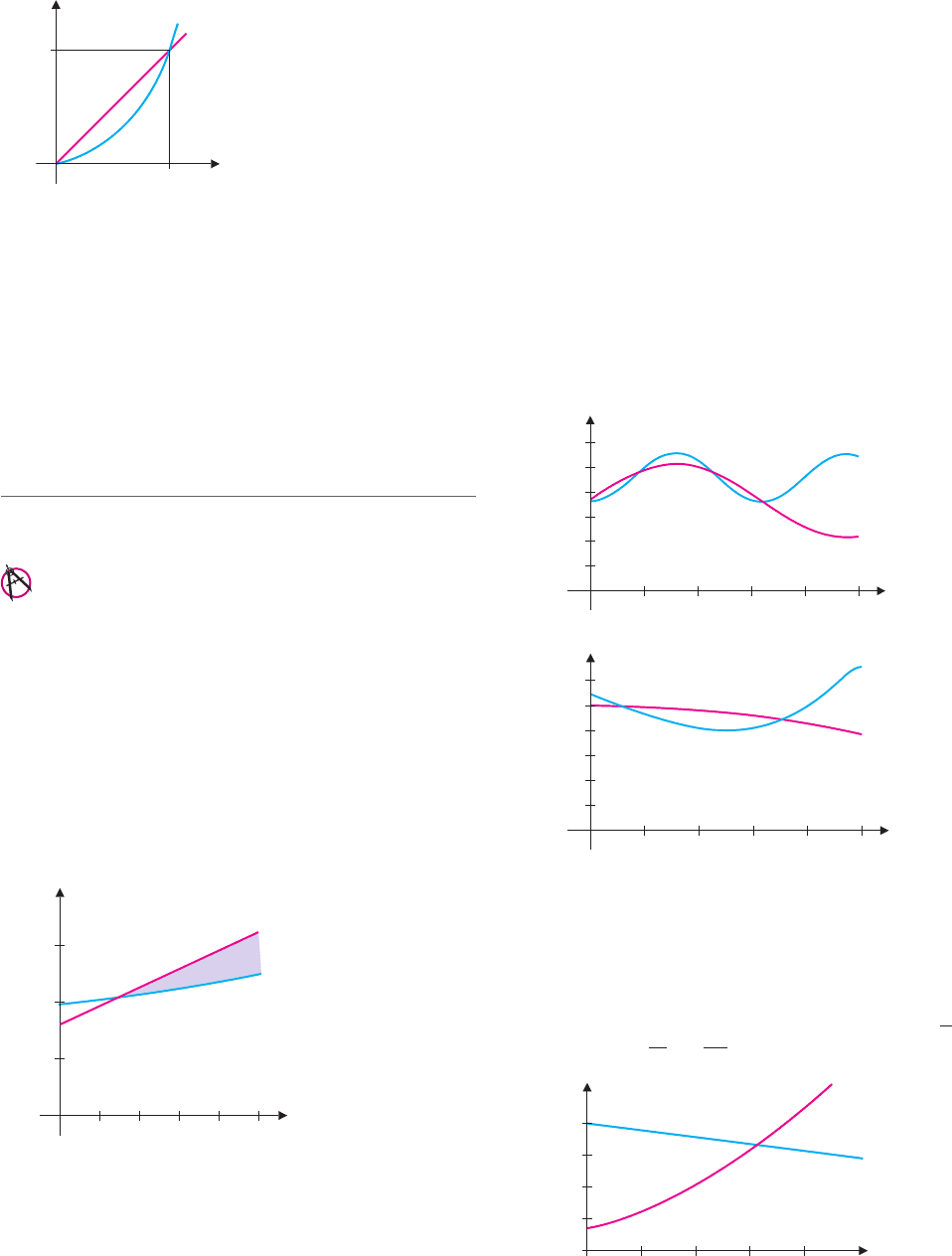
36. Give an integral equal to each area.
(a) A
2
+ A
3
(b) A
1
+ A
2
(c) A
1
(d) A
3
37. Let f (t) be the area between y = sin
2
x and y = 1 for
0 ≤ x ≤ t. Find all critical numbers, local extrema and inflec-
tion points for f (t), t ≥ 0.
38. Let g be a continuous function defined for x ≥ 0 with
|g(x)|≤1 for x ≥ 0. Let f (t) be the area between y = g(x)
and y = 1 for 0 ≤ x ≤ t.Ifg has a local maximum at x = a,
does f have a critical number at a? An inflection point at a?
What if there is a local minimum at x = a?
APPLICATIONS
39. Suppose that a country’s oil consumption for the years 1970–
1974 was approximately equal to f (t) = 16.1+1.4t million
barrels per year, where t = 0 corresponds to 1970. Following
an oil shortage in 1974, the country’s consumption changed
and was better modeled by g(t)=19.7+0.5t million barrels
per year, t ≥ 4. Show that f (4)=g(4) and explain what this
number represents. Compute the area between f (t) and g(t)
for 4 ≤ t ≤ 10.Use this number to estimate the number of bar-
rels of oil saved by the reduced oil consumption from 1974 to
1980.
y
t
y f(t)
y g(t)
10
20
30
10
8642
(1970) (1980)
40. Suppose that a nation’s fuelwood consumption is given by
76 + 3.2t m
3
/yr and new tree growth is 50 −2.4t m
3
/yr.
Compute and interpret the area between the curves for
0 ≤ t ≤ 10.
41. Suppose that the birthrate for a certain population is
b(t) = 2 +0.1t million people per year and the death rate for
the same population is d(t) = 2 + 0.06t million people per
year. Show that b(t) ≥ d(t) for t ≥ 0 and explain why the area
betweenthecurvesrepresentstheincrease in population. Com-
pute the increase in population for 0 ≤ t ≤ 10.
42. Suppose that the birthrate for a population is b(t) = 2 + 0.1t
million people per year and the death rate for the same
population is d(t) = 3 +0.05t million people per year. Find
the intersection T of the curves. Interpret the area between
the curves for 0 ≤ t ≤ T and the area between the curves
for T ≤ t ≤ 30. Compute the net change in population for
0 ≤ t ≤ 30.
............................................................
In exercises 43 and 44, the graph shows the rate of flow of water
in gallons per hour into and out of a tank. Assuming that the
tank starts with 400 gallons, estimate the amount of water in the
tank at hours 1, 2, 3, 4 and 5 and sketch a graph of the amount
of water in the tank.
43.
t
1234
y
20
5
40
60
80
100
120
In
Out
44.
Out
In
t
1234
y
20
5
40
60
80
100
120
............................................................
45. The graph shows the supply and demand curves for a prod-
uct. The point of intersection (q
∗
, p
∗
) gives the equilibrium
quantity and equilibrium price for the product. The consumer
surplus is defined to be CS =
q
∗
0
D(q)dq − p
∗
q
∗
. Shade in
the area of the graph that represents the consumer surplus,
and compute this in the case where D(q) = 10 −
1
40
q and
S(q) = 2 +
1
120
q +
1
1200
q
2
.
q
250
50
75 100
p
2.5
5
7.5
10
0
D(q)
S(q)
46. Repeat exercise 45 for the producer surplus defined by
PS = p
∗
q
∗
−
q∗
0
S(q)dq.
P1: PIC/OVY P2: OSO/OVY QC: OSO/OVY T1: OSO
MHDQ256-Ch05 MHDQ256-Smith-v1.cls December 14, 2010 20:15
LT (Late Transcendental)
CONFIRMING PAGES
324 CHAPTER 5
..
Applications of the Definite Integral 5-10
47. Let C
(x) be the marginal cost of producing x thousand copies
of an item and let R
(x) be the marginal revenue from the sale
of that item, with graphs as shown.Assume that R
(x) = C
(x)
at x = 2 and x = 5. Interpret the area between the curves for
each interval: (a) 0 ≤ x ≤ 2, (b) 2 ≤ x ≤ 5, (c) 0 ≤ x ≤ 5 and
(d) 5 ≤ x ≤ 6.
C'(x)
R'(x)
x
1234567
y
10
20
30
40
50
60
48. Abasicprinciple ofeconomicsisthatprofitis maximizedwhen
marginalcostequalsmarginalrevenue.At whichintersectionis
profitmaximizedin exercise47?Explainyouranswer.In terms
of profit, what does the other intersection point represent?
EXPLORATORY EXERCISES
1. Find the area between y = x
2
and y = mx for any constant
m > 0. Without doing further calculations, use this area to
find the area between y =
√
x and y = mx.
2. For x > 0, let f (x) be the area between y = 1 and y = sin
2
t
for 0 ≤ t ≤ x. Without calculating f (x), find as many rela-
tionships as possible between the graphical features (zeros,
extrema, inflection points) of y = f (x) and the graphical fea-
tures of y = sin
2
x.
5.2 VOLUME: SLICING, DISKS AND WASHERS
As we shall see throughout this chapter, the integral is an amazingly versatile tool. In this
section, we use integrals to compute the volume of a three-dimensional solid. We begin
with a simple problem.
When designing a building, architects must perform numerous detailed calculations.
For instance, in order to analyze a building’s heating and cooling systems, engineers must
calculate the volume of air being processed.
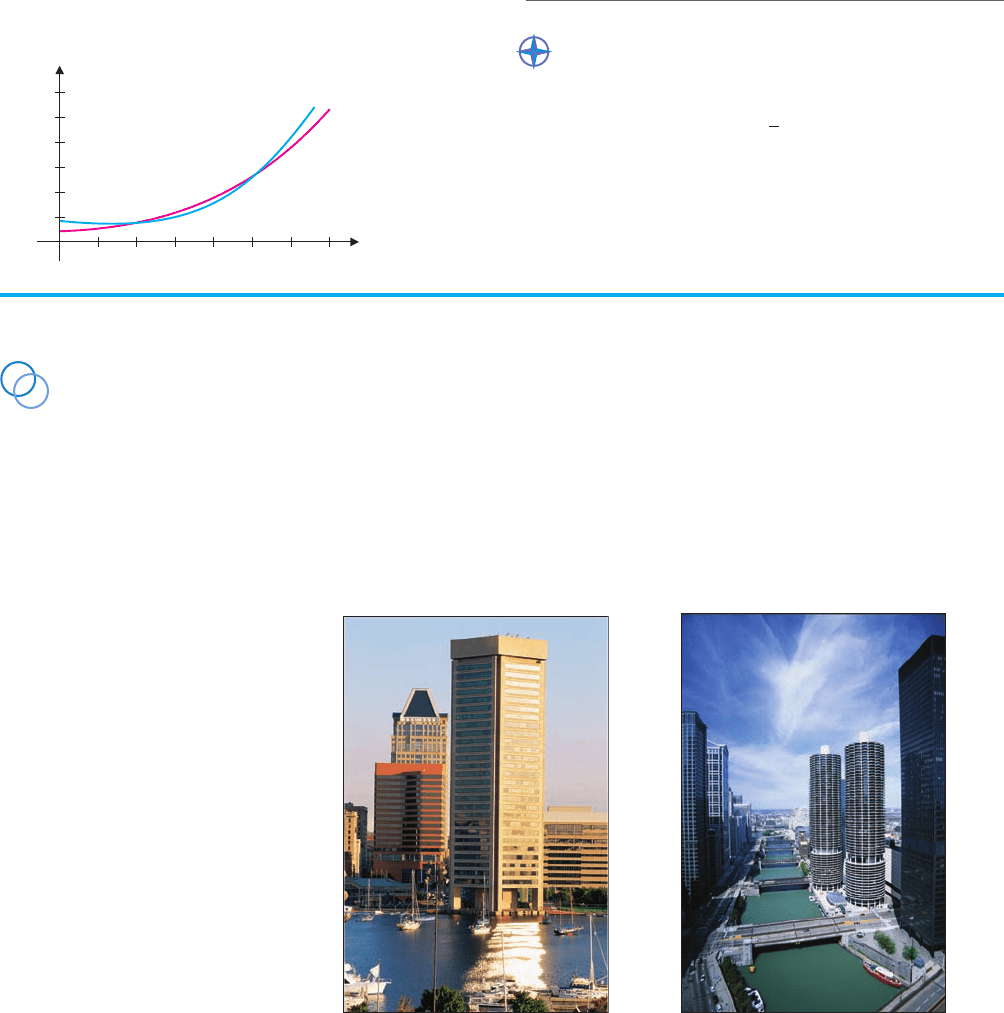
FIGURE 5.12a FIGURE 5.12b
There are probably only a few solids whose volume you know how to compute. For
instance, the building shown in Figure5.12a is essentially a rectangular box, whose volume
is given by lwh, where l is the length, w is the width and h is the height. The right circular
cylinders seen in the buildings in Figure 5.12b have volume given by πr
2
h, where h is the
height and r is the radius of the circular cross section. Notice in each case that the build-
ing has a familiar cross section (a rectangle in Figure 5.12a and a circle in Figure 5.12b)
that is extendedvertically. We call any such solid a cylinder (any solid whose cross sections
P1: PIC/OVY P2: OSO/OVY QC: OSO/OVY T1: OSO
MHDQ256-Ch05 MHDQ256-Smith-v1.cls December 14, 2010 20:15
LT (Late Transcendental)
CONFIRMING PAGES
5-11 SECTION 5.2
..
Volume: Slicing, Disks and Washers 325
perpendicular to some axis running through the solid are all the same). There is a connec-
tion between the volume formulas for these two cylinders. The volume of a right circular
cylinder is
V = (πr
2
)
cross-sectional area
×
h
height
,
while the volume of a box is
V = (length ×width)
cross-sectional area
× height.
In general, the volume of any cylinder is found by
V = (cross-sectional area) ×(height).
HISTORICAL
NOTES
Archimedes (ca. 287–212 B.C.)
A Greek mathematician and
scientist who was among
the first to derive formulas for
volumes and areas. Archimedes
is known for discovering the
basic laws of hydrostatics (he
reportedly leapt from his bathtub,
shouting “Eureka!’’and ran into
the streets to share his discovery)
and levers (“Give me a place to
stand on and I can move the
earth.’’). An ingenious engineer,
his catapults, grappling cranes
and reflecting mirrors terrorized
a massive Roman army that
eventually conquered his
hometown of Syracuse.
Archimedes was especially proud
of his proof that the volume of a
sphere inscribed in a cylinder is
2/3 of the volume of the cylinder
(see exercises 31–34), and
requested that this be inscribed
on his tombstone. Many of his
techniques were very similar to
those that we use in calculus
today, but many of his writings
were lost in the Middle Ages. The
amazing story of the recent
discovery of his book The Method
is told in the book The Archimedes
Codex, by Netz and Noel.
Volumes by Slicing
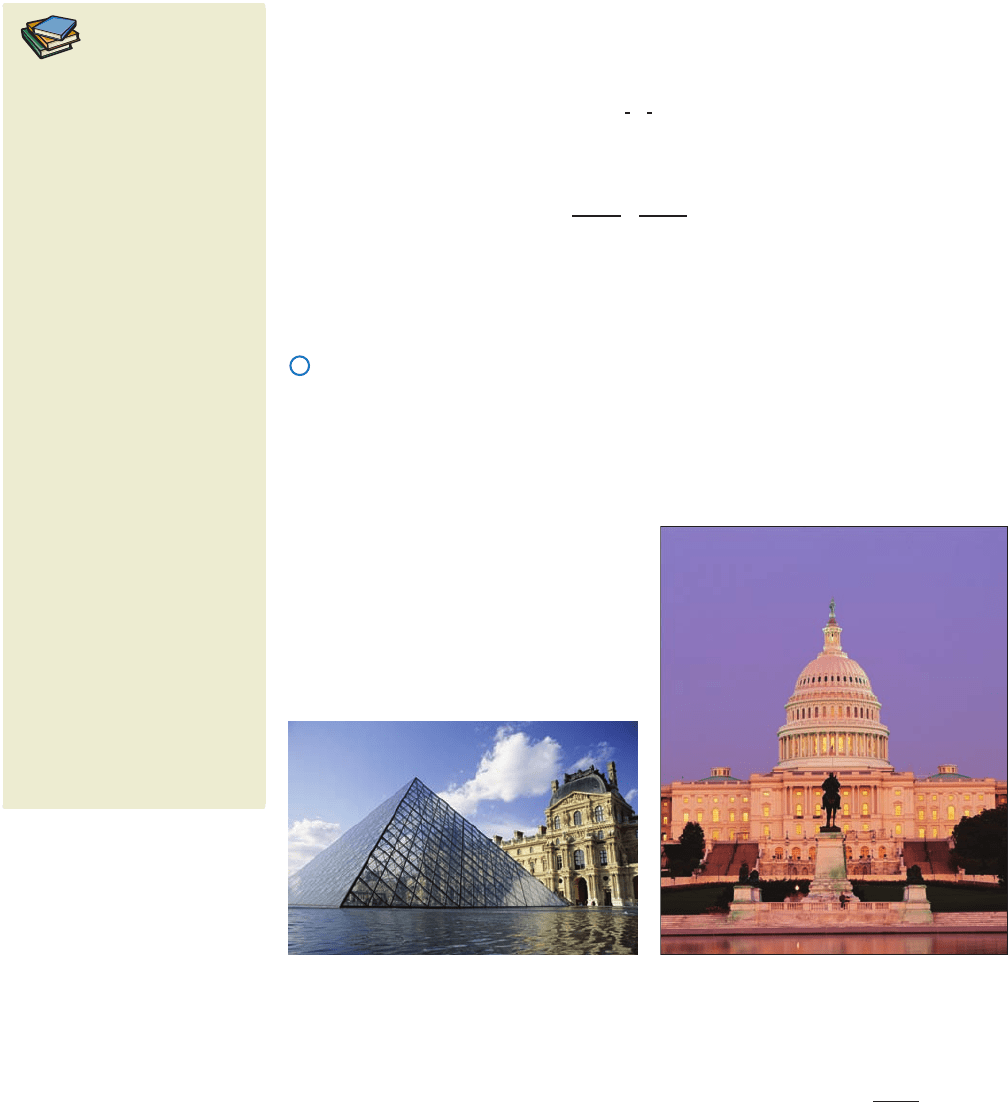
Even relatively simple solids, such as pyramids and domes, do not have constant cross-
sectional area, as seen in Figures 5.13a and 5.13b. To find the volume in such a case, we
take the approach we’ve used a number of times now: first approximate the volume and
then improve the approximation.
FIGURE 5.13a
Pyramid Entrance to the Louvre Museum in Paris
FIGURE 5.13b
U.S. Capitol Building
More generally, for a solid that extends from x = a to x = b, we start by partitioning
the interval [a, b]onthex-axis into n subintervals, each of width x =
b −a
n
. As usual,
we denote x
0
= a, x
1
= a + x and so on, so that
x
i
= a + ix, for i = 0, 1, 2,...,n.
We then slice the solid perpendicular to the x-axis at each of the (n − 1) points
x
1
, x
2
,...,x
n−1
. (See Figure 5.14a on the following page.) Notice that if n is large, then
each slice of the solid will be thin with nearly constant cross-sectional area. Suppose that
the area of the cross section corresponding to any particular value of x is given by A(x).
Observe that the slice between x = x
i−1
and x = x
i
is nearly a cylinder. (See Figure 5.14b.)
So, for any point c
i
in the interval [x
i−1
, x
i
], the area of the cross sections on that interval
are all approximately A(c
i
). The volume V
i
of the ith slice is then approximately the volume
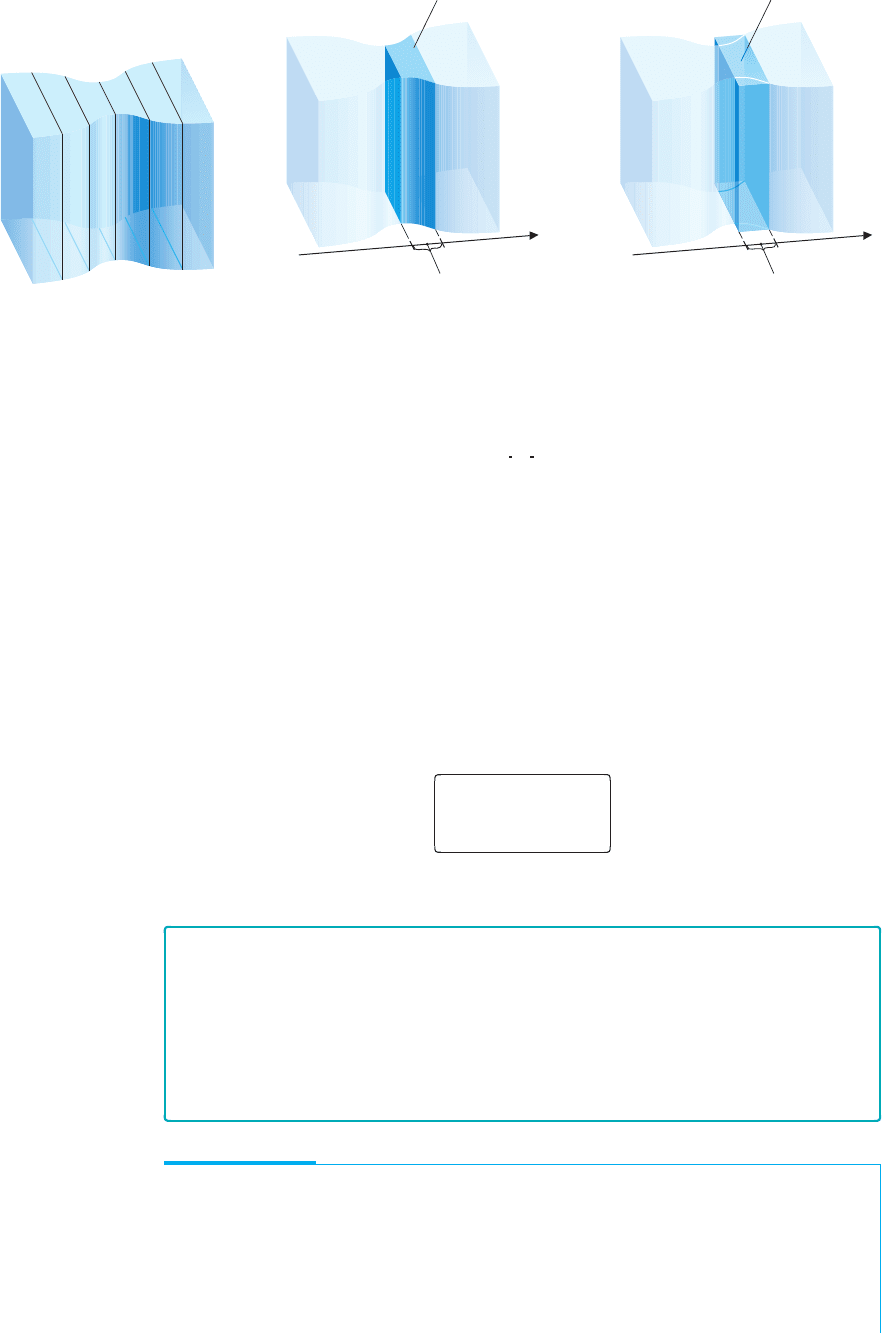
P1: PIC/OVY P2: OSO/OVY QC: OSO/OVY T1: OSO
MHDQ256-Ch05 MHDQ256-Smith-v1.cls December 14, 2010 20:15
LT (Late Transcendental)
CONFIRMING PAGES
326 CHAPTER 5
..
Applications of the Definite Integral 5-12
x
x
i 1
x
i
x
i th slice of solid
x
x
i1
x
i
x
i th approximating cylinder
FIGURE 5.14a
Sliced solid
FIGURE 5.14b
ith slice of solid
FIGURE 5.14c
ith approximating cylinder
of the cylinder lying along the interval [x
i−1
, x
i
], with constant cross-sectional area A(c
i
)
(see Figure 5.14c), so that
V
i
≈ A(c
i
)
cross-sectional area
x
width
.
Repeating this process for each of the n slices, we find that the total volume V of the
solid is approximately
V ≈
n
i=1
A(c
i
)x.
Notice that as the number of slices increases, the volume approximation should improve
and we get the exact volume by computing the limit
V = lim
n→∞
n
i=1
A(c
i
)x,
assuming the limit exists. You should recognize this limit as the definite integral
V =
b
a
A(x)dx. (2.1)
Volume of a solid with
cross-sectional area A(x)
REMARK 2.1
We use the same process followed here to derive many important formulas. In each
case, we divide an object into n smaller pieces, approximate the quantity of interest
for each of the small pieces, sum the approximations and then take a limit, ultimately
recognizing that we have derived a definite integral. For this reason, it is essential that
you understand the concept behind formula (2.1). Memorization will not do this for
you. However, if you understand how the various pieces of this puzzle fit together,
then the rest of this chapter should fall into place for you nicely.
EXAMPLE 2.1 Computing Volume from Cross-Sectional Areas
The Pyramid Arena in Memphis has a square base of side approximately 600 feet and
a height of approximately 320 feet. Find the volume of the pyramid with these
measurements.
Solution Since the pyramid has square horizontal cross sections, we need only find a
formula for the size of the square at each height. Let x represent the height above the
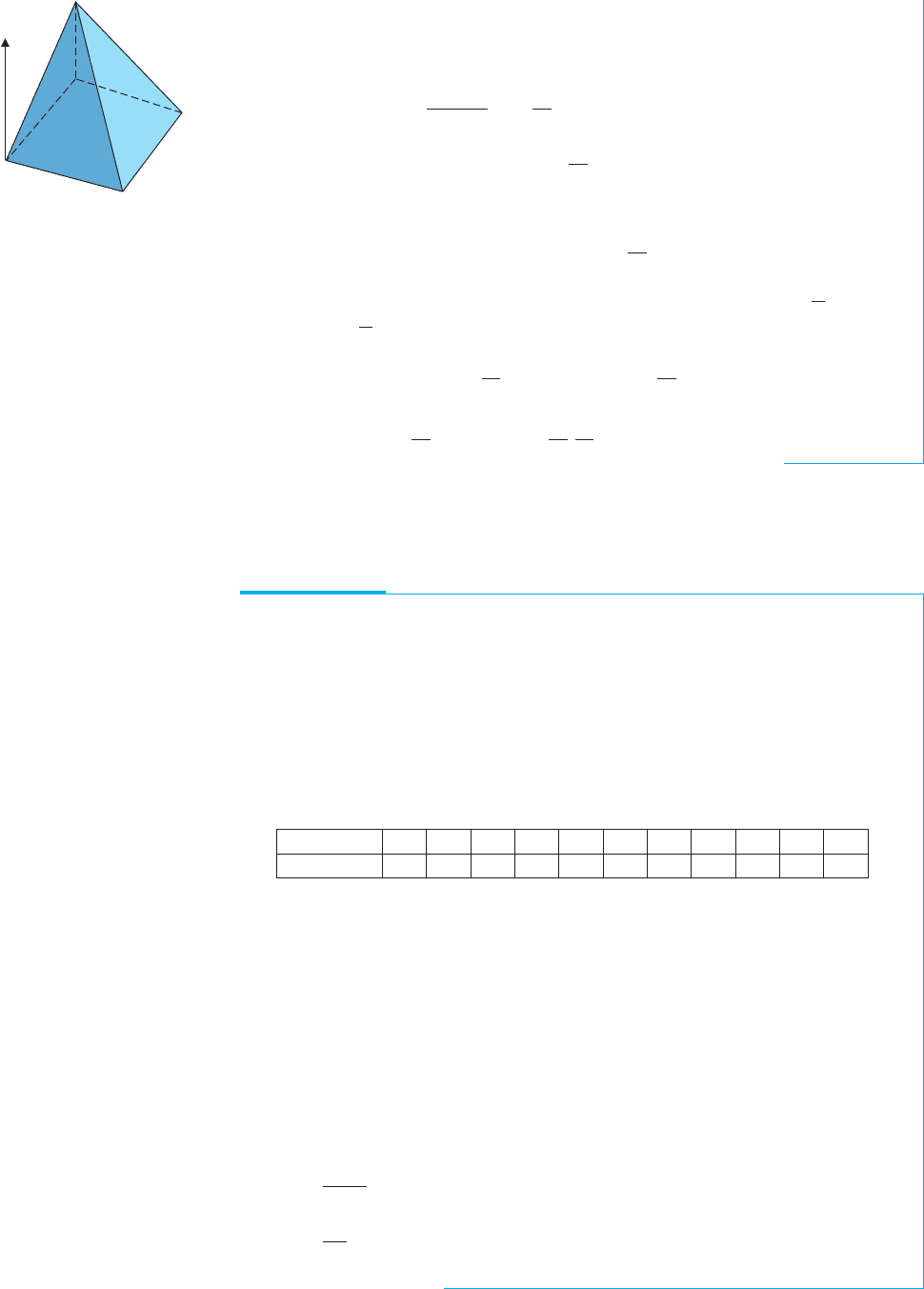
P1: PIC/OVY P2: OSO/OVY QC: OSO/OVY T1: OSO
MHDQ256-Ch05 MHDQ256-Smith-v1.cls December 14, 2010 20:15
LT (Late Transcendental)
CONFIRMING PAGES
5-13 SECTION 5.2
..
Volume: Slicing, Disks and Washers 327
ground. At x = 0, the cross section is a square of side 600 feet. At x = 320, the cross
section can be thought of as a square of side 0 feet. If f (x) represents the side length of
the square cross section at height x, we know that f (0) = 600, f (320) = 0 and f (x)
must be a linear function. (Think about this; the sides of the pyramid do not curve.) The
slope of the line is m =
600 − 0
0 − 320
=−
15
8
and we use the y-intercept of 600 to get
f (x) =−
15
8
x +600.
The cross-sectional area is simply the square of f (x), so that from (2.1), we have
V =
320
0
A(x)dx =
320
0
−
15
8
x +600
2
dx.
Observe that we can evaluate this integral by substitution, by taking u =−
15
8
x +600,
so that du =−
15
8
dx. This gives us
V =
320
0
−
15
8
x +600
2
dx =−
8
15
0
600
u
2
du
=
8
15
600
0
u
2
du =
8
15
u
3
3
600
0
= 38,400,000ft
3
.
In many important applications,the cross-sectional area is not known exactly, but must
be approximated using measurements. In such cases, we can approximate the volume using
numerical integration.
x
A Pyramid
EXAMPLE 2.2 Estimating Volume from Cross-Sectional Data
In medical imaging, such as CT (computerized tomography) and MRI (magnetic
resonance imaging) processes, numerous measurements are taken and processed by a
computer to construct a three-dimensional image of the tissue the physician wishes to
study. The process is similar to the slicing process we have used to find the volume of a
solid. In this case, however, mathematical representations of various slices of the tissue
are combined to produce a three-dimensional image that physicians view to determine
the health of the tissue. Suppose that an MRI scan indicates that the cross-sectional
areas of adjacent slices of a tumor are given by the values in the table.
x (cm) 0 0.1 0.2 0.3 0.4 0.5 0.6 0.7 0.8 0.9 1.0
A(x) (cm
2
) 0.0 0.1 0.4 0.3 0.6 0.9 1.2 0.8 0.6 0.2 0.1
Estimate the volume of the tumor.
Solution To find the volume of the tumor, we would compute [following (2.1)]
V =
1
0
A(x)dx,
except that we only know A(x) at a finite number of points. Although we can’t compute
this exactly, we can use Simpson’s Rule with x = 0.1 to estimate the value of this
integral:
V =
1
0
A(x) dx
≈
b −a
3n
A(0) +4A(0.1) +2A(0.2) +4A(0.3) + 2A(0.4) + 4A(0.5)
+2A(0.6) +4A(0.7) +2A(0.8) +4A(0.9) + A(1)
=
0.1
3
(0 + 0.4 + 0.8 + 1.2 + 1.2 + 3.6 + 2.4 + 3.2 +1.2 +0.8 +0.1)
≈ 0.49667 cm
3
.
P1: PIC/OVY P2: OSO/OVY QC: OSO/OVY T1: OSO
MHDQ256-Ch05 MHDQ256-Smith-v1.cls December 14, 2010 20:15
LT (Late Transcendental)
CONFIRMING PAGES
328 CHAPTER 5
..
Applications of the Definite Integral 5-14
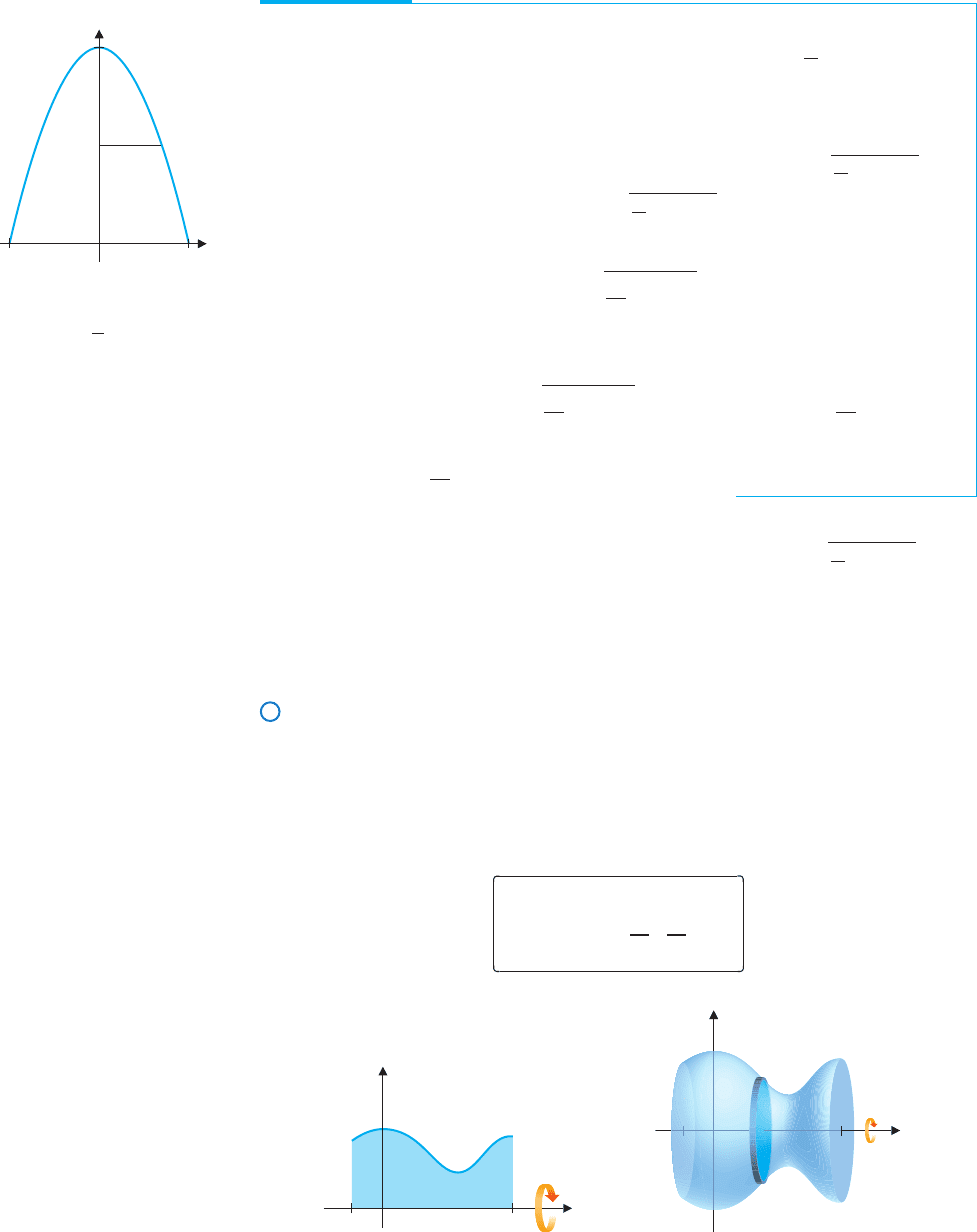
We now turn to the problem of finding the volume of the dome in Figure 5.13b. Since
the horizontal cross sections are circles, we need only to determine the radius of each circle.
y
x
90
4545
FIGURE 5.15
y =−
2
45
x
2
+ 90.
EXAMPLE 2.3 Computing the Volume of a Dome
Suppose that a dome has circular cross sections, with outline y =−
2
45
x
2
+ 90, for
−45 ≤ x ≤ 45. (In units of feet, this gives dimensions similar to the Capitol dome in
Figure 5.13b. A graph is shown in Figure 5.15.) Find the volume of the dome.
Solution As seen in Figure 5.15, the circular cross sections occur at each value of y,
with 0 ≤ y ≤ 90. For a given y, the radius extends from x = 0tox =
45
2
(90 − y). The
radius for this value of y is given by r(y) =
45
2
(90 − y), so that the cross-sectional
areas are given by
A(y) = π
45
2
(90 − y)
2
,
for 0 ≤ y ≤ 90. The volume is then given by
V =
90
0
A(y) dy =
90
0
π
45
2
(90 − y)
2
dy =
90
0
π
2025 −
45
2
y
dy
= π
2025y −
45
4
y
2
90
0
= 91,125π ≈ 286,278ft
3
.
Observe that an alternative way of stating the problem in example 2.3 is to say: Find
the volume formed by revolving the region bounded by the curve x =
45
2
(90 − y) and the
y-axis, for 0 ≤ y ≤ 90, about the y-axis.
Example 2.3 can be generalized to the method of disks used to compute the volume of
a solid formed by revolving a two-dimensional region about a vertical or horizontal line.
We consider this general method next.
The Method of Disks
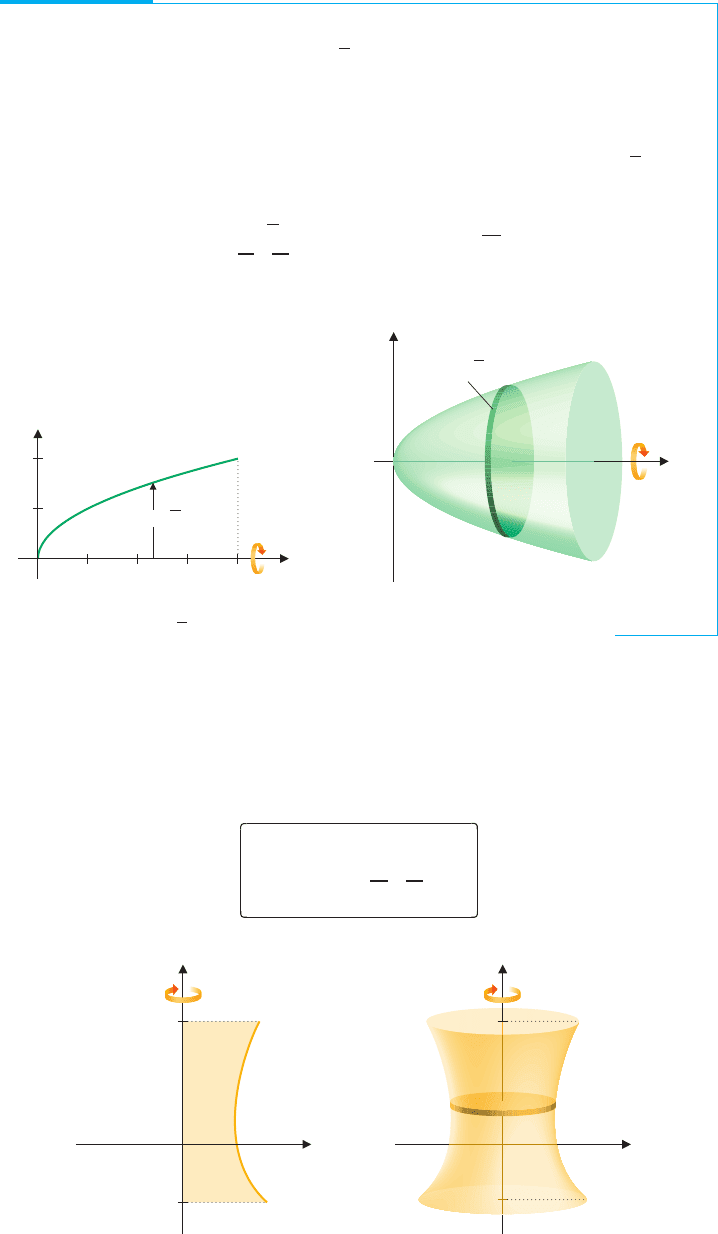
Supposethat f (x) ≥ 0and f iscontinuousontheinterval[a, b].Taketheregionbounded by
thecurve y = f (x)and the x-axis, for a ≤ x ≤ b,and revolveit about the x-axis, generating
a solid. (See Figures 5.16a and 5.16b.) We can find the volume of this solid by slicing it
perpendiculartothex-axisandrecognizingthateachcrosssectionisa circular disk of radius
r = f (x). (See Figure 5.16b.) From (2.1), we then have that the volume of the solid is
Volume of a solid of revolution
(Method of disks)
V =
b
a
π[ f (x)]
2
cross-sectional area = πr
2
dx. (2.2)
x
ba
y
y f(x)
y f(x)
x
y
a b
FIGURE 5.16a
y = f (x) ≥ 0
FIGURE 5.16b
Solid of revolution
P1: PIC/OVY P2: OSO/OVY QC: OSO/OVY T1: OSO
MHDQ256-Ch05 MHDQ256-Smith-v1.cls December 14, 2010 20:15
LT (Late Transcendental)
CONFIRMING PAGES
5-15 SECTION 5.2
..
Volume: Slicing, Disks and Washers 329
Since the cross sections of such a solid of revolution are all disks, we refer to this method
of finding volume as the method of disks.
EXAMPLE 2.4 Using the Method of Disks to Compute Volume
Revolve the region under the curve y =
√
x on the interval [0, 4] about the x-axis and
find the volume of the resulting solid of revolution.
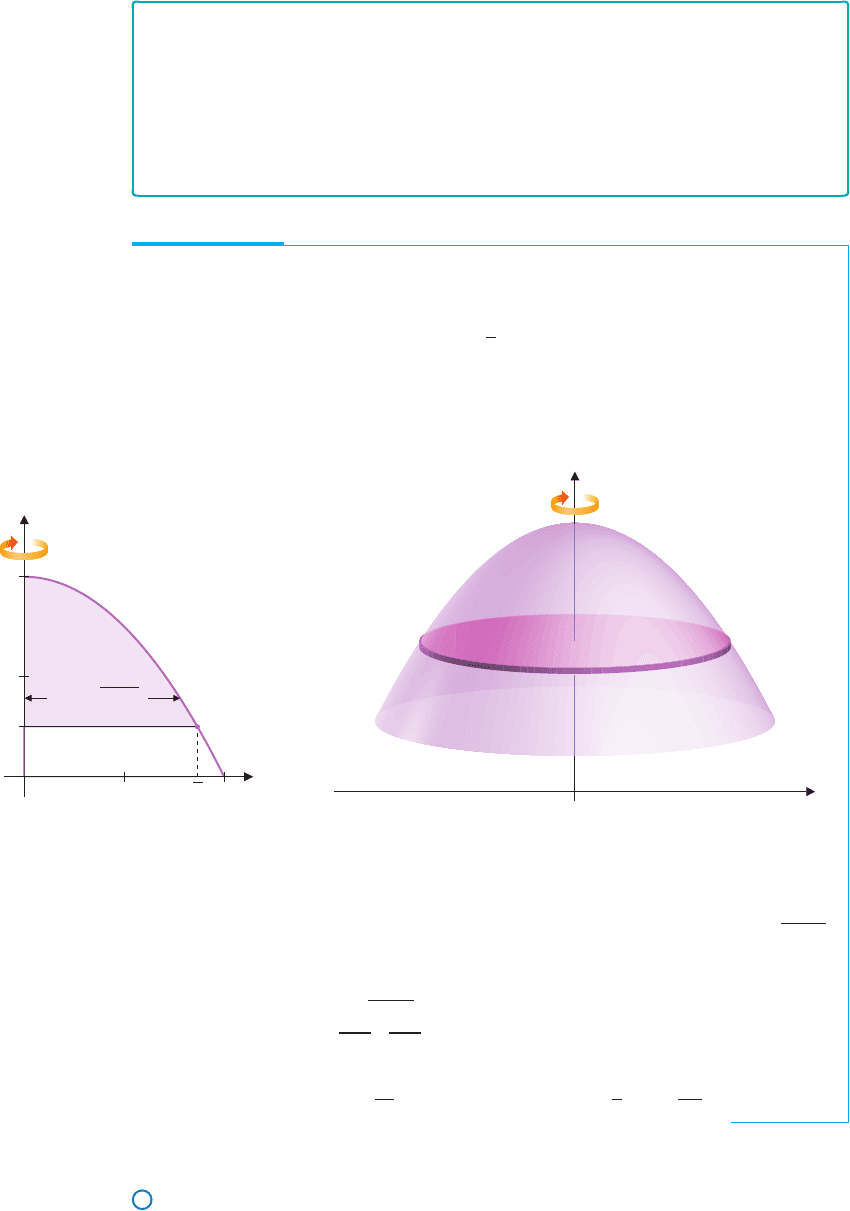
Solution It’s critical to draw a picture of the region and the solid of revolution, so
that you get a clear idea of the radii of the circular cross sections. You can see from
Figures 5.17a and 5.17b that the radius of each cross section is given by r =
√
x.
From (2.2), we then get the volume:
V =
4
0
π
√
x
2
cross-sectional area = πr
2
dx = π
4
0
xdx= π
x
2
2
4
0
= 8π.
y
x
1
2
4
321
r x
y
x
r x
FIGURE 5.17a
y =
√
x
FIGURE 5.17b
Solid of revolution
In a similar way, suppose that g(y) ≥ 0 and g is continuous on the interval [c, d].
Then, revolving the region bounded by the curve x = g(y) and the y-axis, for c ≤ y ≤ d,
about the y-axis generates a solid. (See Figures 5.18a and 5.18b.) Once again, notice from
Figure 5.18b that the cross sections of the resulting solid of revolution are circular disks
of radius r = g(y). All that has changed here is that we have interchanged the roles of the
variables x and y. The volume of the solid is then given by
V =
d
c
π[g(y)]
2
cross-sectional area = πr
2
dy. (2.3)
Volume of a solid of revolution
(Method of disks)
y
x
d
c
x g(y)
x g(y)
y
x
d
c
FIGURE 5.18a
Revolve about the y-axis
FIGURE 5.18b
Solid of revolution
P1: PIC/OVY P2: OSO/OVY QC: OSO/OVY T1: OSO
MHDQ256-Ch05 MHDQ256-Smith-v1.cls December 14, 2010 20:15
LT (Late Transcendental)
CONFIRMING PAGES
330 CHAPTER 5
..
Applications of the Definite Integral 5-16
REMARK 2.2
When using the method of disks, the variable of integration depends solely on the axis
about which you revolve the two-dimensional region: revolving about the x-axis
requires integration with respect to x, while revolving about the y-axis requires
integration with respect to y. This is easily determined by looking at a sketch of the
solid. Don’t make the mistake of simply looking for what you can plug in where. This
is a recipe for disaster, for the rest of this chapter will require you to make similar
choices, each based on distinctive requirements of the problem at hand.
EXAMPLE 2.5 Using the Method of Disks with y as the
Independent Variable
Find the volume of the solid resulting from revolving the region bounded by the curves
y = 4 − x
2
and y = 1 from x = 0tox =
√
3 about the y-axis.
Solution You will find a graph of the curve in Figure 5.19a and of the solid in
Figure 5.19b.
y
x
2
1
4
1
2√3
x
4 y
x
y
y 4 x
2
FIGURE 5.19a
y = 4 − x
2
FIGURE 5.19b
Solid of revolution
Notice from Figures 5.19a and 5.19b that the radius of any of the circular cross
sectionsisgivenbyx.So,wemustsolvetheequation y = 4 − x
2
forx,togetx =
√
4 − y.
Since the surface extends from y = 1toy = 4, the volume is given by (2.3) to be
V =
4
1
π
4 − y
2
πr
2
dy =
4
1
π(4 − y) dy
= π
4y −
y
2
2
4
1
= π
(16 − 8) −
4 −
1
2
=
9π
2
.
The Method of Washers
One complication that occurs in computing volumes is that the solid may have a cavity or
“hole” in it. Another occurs when a region is revolved about a line other than the x-axis
or the y-axis. Neither case will present you with any significant difficulties, if you look
carefully at the figures. We illustrate these ideas in examples 2.6 and 2.7.
P1: PIC/OVY P2: OSO/OVY QC: OSO/OVY T1: OSO
MHDQ256-Ch05 MHDQ256-Smith-v1.cls December 14, 2010 20:15
LT (Late Transcendental)
CONFIRMING PAGES
5-17 SECTION 5.2
..
Volume: Slicing, Disks and Washers 331
EXAMPLE 2.6 Computing Volumes of Solids with and Without Cavities
Let R be the region bounded by the graphs of y =
1
4
x
2
, x = 0 and y = 1. Compute the
volume of the solid formed by revolving R about (a) the y-axis, (b) the x-axis and (c) the
line y = 2.
Solution (a) The region R is shown in Figure 5.20a and the solid formed by revolving
it about the y-axis is shown in Figure 5.20b. Notice that this part of the problem is
similar to example 2.5.
y
x
1
R
2
x 4y
y
x
x 4y
FIGURE 5.20a
x =
√
4y
FIGURE 5.20b
Solid of revolution
Outer radius:
y 1
Inner radius:
y
y
x
1
R
2
x
2
4
FIGURE 5.21a
y =
1
4
x
2
y
1
1
2
x
Washer-shaped
cross sections
FIGURE 5.21b
Solid with cavity
From (2.3), the volume is given by
V =
1
0
π
4y
2
πr
2
dy = π
4
2
y
2
1
0
= 2π.
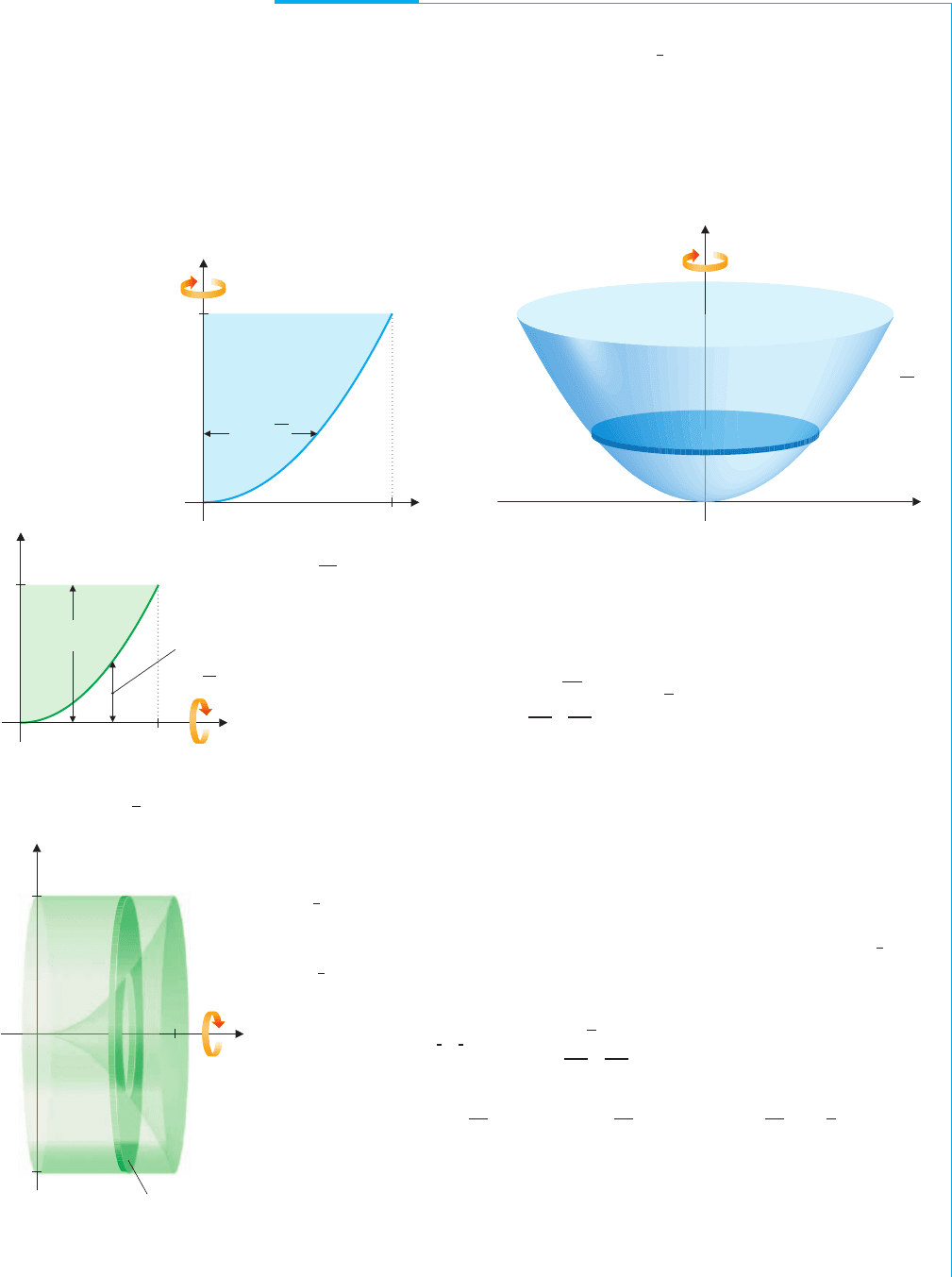
(b) Revolving the region R about the x-axis produces a cavity in the middle of the solid.
See Figure 5.21a for a graph of the region R and Figure 5.21b for a sketch of the solid.
Our strategy is to compute the volume of the outside of the object (as if it were solid)
and then subtract the volume of the cavity. Before diving into a computation, be sure to
visualize the geometry behind this. Here, the outside surface of the solid is formed by
revolving the line y = 1 about the x-axis. The cavity is formed by revolving the curve
y =
1
4
x
2
about the x-axis. Look carefully at Figures 5.21a and 5.21b and make certain
that you see this. The outer radius, r
O
, is the distance from the x-axis to the line y = 1,
or r
O
= 1. The inner radius, r
I
, is the distance from the x-axis to the curve y =
1
4
x
2
,or
r
I
=
1
4
x
2
. Applying (2.2) twice, we see that the volume is given by
V =
2
0
π(1)
2
π (outer radius)
2
dx −
2
0
π
1
4
x
2
2
π (inner radius)
2
dx
= π
2
0
1 −
x
4
16
dx = π
x −
1
80
x
5
2
0
= π
2 −
32
80
=
8
5
π.
(c) Revolving the region R about the line y = 2 produces a washer-like solid with a
cylindrical hole in the middle. The region R is shown in Figure 5.22a and the solid is
shown in Figure 5.22b (on the following page).
The volume is computed in the same way as in part (b), by subtracting the volume
of the cavity from the volume of the outside solid. From Figures 5.22a and 5.22b, notice
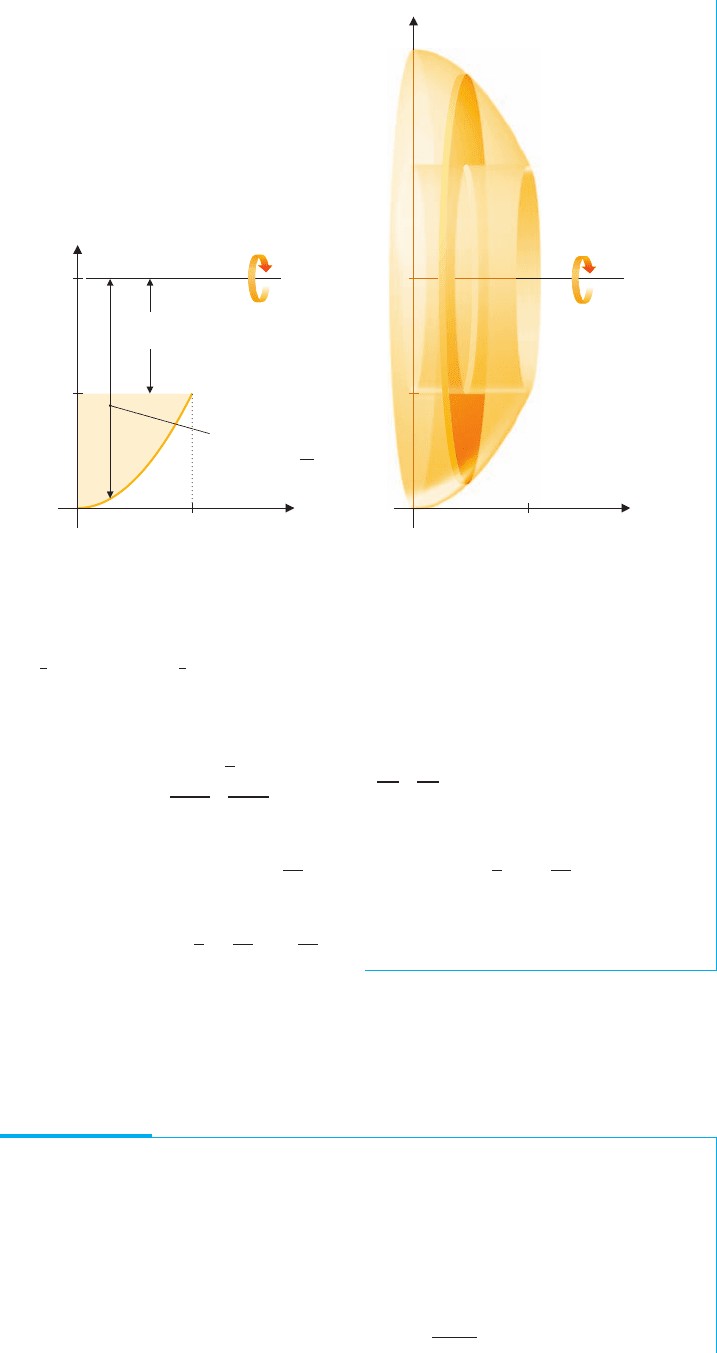
P1: PIC/OVY P2: OSO/OVY QC: OSO/OVY T1: OSO
MHDQ256-Ch05 MHDQ256-Smith-v1.cls December 14, 2010 20:15
LT (Late Transcendental)
CONFIRMING PAGES
332 CHAPTER 5
..
Applications of the Definite Integral 5-18
Outer radius:
2 y 2
Inner radius:
y 2 1 1
y
x
R
1
2
2
y 2
x
2
4
y 2
y
x
1
2
2
FIGURE 5.22a
Revolve about y = 2
FIGURE 5.22b
Solid of revolution
that the radius of the outer surface is the distance from the line y = 2 to the curve
y =
1
4
x
2
or r
O
= 2 −
1
4
x
2
. The radius of the inner hole is the distance from the line
y = 2 to the line y = 1orr
I
= 2 − 1 = 1. From (2.2), the volume is given by
V =
2
0
π
2 −
1
4
x
2
2
π(outer radius)
2
dx −
2
0
π(2 − 1)
2
π(inner radius)
2
dx
= π
2
0
4 − x
2
+
x
4
16
− 1
dx = π
3x −
1
3
x
3
+
1
80
x
5
2
0
= π
6 −
8
3
+
32
80
=
56
15
π.
In parts (b) and (c) of example 2.6, the volume was computed by subtracting an inner
volume from an outer volume in order to compensate for a cavity inside the solid. This
technique is a slight generalization of the method of disks and is referred to as the method
of washers, since the cross sections of the solids look like washers.
EXAMPLE 2.7 Revolving a Region About Different Lines
Let R be the region bounded by y = 4 − x
2
and y = 0. Find the volume of the solids
obtained by revolving R about each of the following: (a) the y-axis, (b) the line y =−3,
(c) the line y = 7 and (d) the line x = 3.
Solution For part (a), we draw the region R in Figure 5.23a and the solid of revolution
in Figure 5.23b.
From Figure 5.23b, notice that each cross section of the solid is a circular disk,
whose radius is simply x. Solving for x,wegetx =
√
4 − y, where we have selected x