
Smith R., Minton R. Calculus
Подождите немного. Документ загружается.

P1: OSO/OVY P2: OSO/OVY QC: OSO/OVY T1: OSO
MHDQ256-Ch04 MHDQ256-Smith-v1.cls December 13, 2010 21:23
LT (Late Transcendental)
CONFIRMING PAGES
4-63 CHAPTER 4
..
Review Exercises 313
Review Exercises
Perfect synchrony means that the event occurs only once ev-
ery period (e.g., the fireflies all light at the same time, or all
babies are born simultaneously). We will see what the rate
function f (t) looks like in this case. First, define the degree
of synchrony to be
area under f and above R
RT
. Show that if
f (t) is constant, then the degree of synchrony is 0. Then graph
and find the degree of synchrony for the following functions
(assuming T > 2):
f
1
(t) =
⎧
⎪
⎨
⎪
⎩
(RT)(t −
T
2
) + RT if
T
2
− 1 ≤ t ≤
T
2
(−RT)(t −
T
2
) + RT if
T
2
≤ t ≤
T
2
+ 1
0 otherwise
f
2
(t) =
⎧
⎪
⎨
⎪
⎩
(4RT)(t −
T
2
) + 2RT if
T
2
−
1
2
≤ t ≤
T
2
(−4RT)(t −
T
2
) + 2RT if
T
2
≤ t ≤
T
2
+
1
2
0 otherwise
f
3
(t) =
⎧
⎪
⎨
⎪
⎩
(9RT)(t −
T
2
) + 3RT if
T
2
−
1
3
≤ t ≤
T
2
(−9RT)(t −
T
2
) + 3RT if
T
2
≤ t ≤
T
2
+
1
3
0 otherwise
What would you conjecture as the limit of the degrees of
synchrony of f
n
(t)asn →∞? The “function” that f
n
(t)
approaches as n →∞ is called an impulse function of
strength RT. Discuss the appropriateness of this name.
2. The Omega function is used for risk/reward analysis of fi-
nancial investments. Suppose that f (x) is a function defined
on the interval (A, B) that gives the distribution of returns
on an investment. (This means that
b
a
f (x) dx is the prob-
ability that the investment returns between $a and $b.) Let
F(x) =
x
A
f (t)dt be the cumulative distribution function
for returns.
Then (r) =
B
r
[1 − F(x)] dx
r
A
F(x) dx
is the Omega function for
the investment.
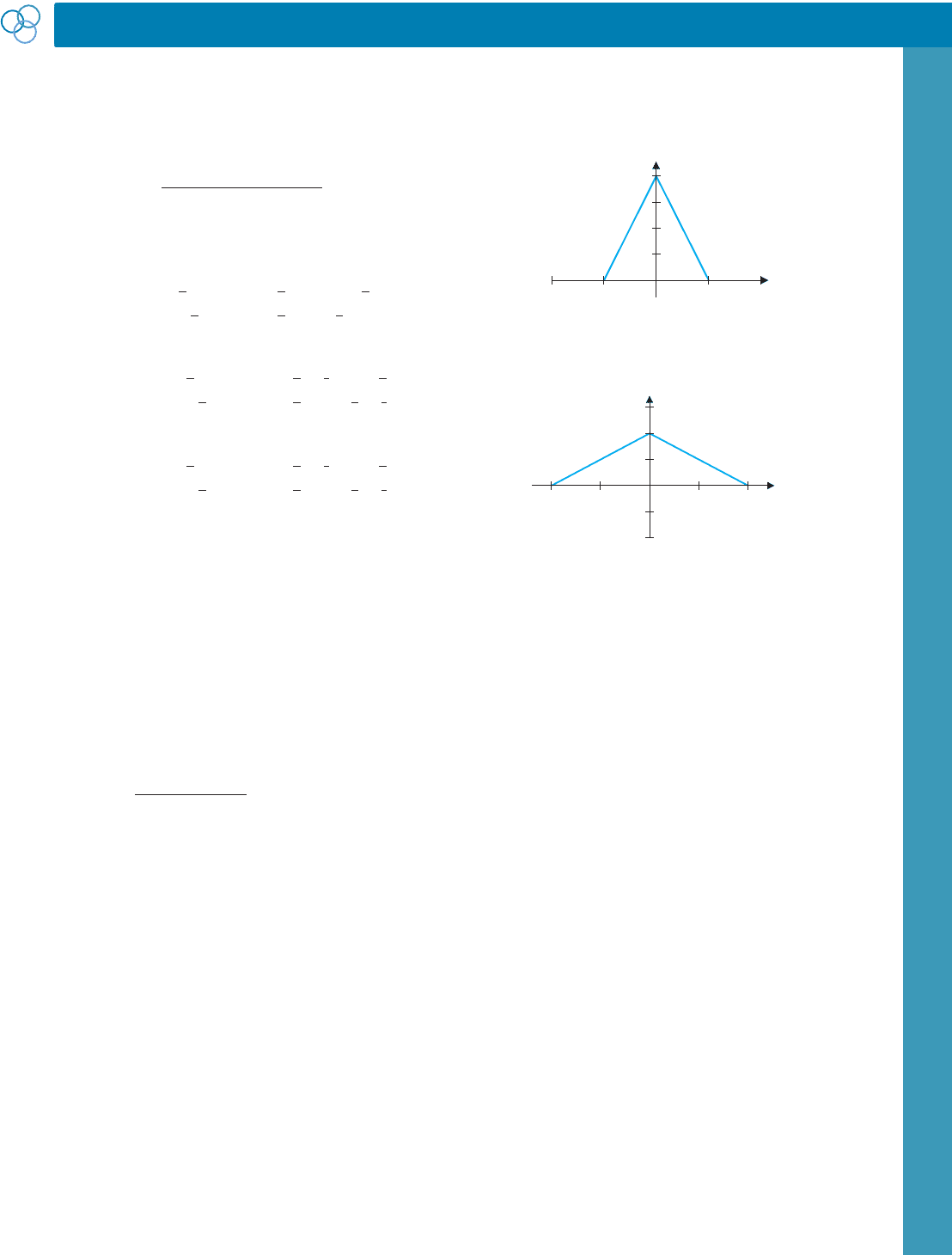
(a) For the distribution f
1
(x) shown, compute the cumulative
distribution function F
1
(x).
x
y
2102 1
0.75
1
0.25
0.5
y = f
1
(x)
(b) Repeat part (a) for the distribution f
2
(x) shown.
x
y
105010 5
0.15
0.05
0.05
0.1
0.1
y = f
2
(x)
(c) Compute
1
(r) for the distribution f
1
(x). Note that
1
(r)
willbeundefined(∞) forr ≤−1 and
1
(r) = 0forr ≥ 1.
(d) Compute
2
(r) for the distribution f
2
(x). Note that
2
(r)
will be undefined (∞) for r ≤−10 and
2
(r) = 0 for
r ≥ 10.
(e) Even though the means (average values) are the same, in-
vestmentswith distributions f
1
(x)and f
2
(x)are not equiv-
alent. Use the graphs of f
1
(x) and f
2
(x) to explain why
f
2
(x) corresponds to a riskier investment than f
1
(x).
(f) Show that
2
(r) >
1
(r) for r > 0 and
2
(r) <
1
(r) for
r < 0. In general, the larger (r) is, the better the invest-
ment is. Explain this in terms of this example.
This page intentionally left blank
P1: PIC/OVY P2: OSO/OVY QC: OSO/OVY T1: OSO
MHDQ256-Ch05 MHDQ256-Smith-v1.cls December 14, 2010 20:15
LT (Late Transcendental)
CONFIRMING PAGES
CHAPTER
5
Applications of the
Definite Integral
Athletes who can jump high are often said to have “springs in their legs.”
It turns out that tendons and the arches in your feet act very much like
springs, storing and releasing energy. For example, your Achilles tendon
stretches as you stride when walking and contracts as your foot hits the
ground. Much like a spring that is stretched and then released, the tendon
storesenergyduring the stretchingphaseandreleases itwhencontracting.
Physiologists measure the efficiency of the springlike action of ten-
dons by computing the percentage of energy released during contraction
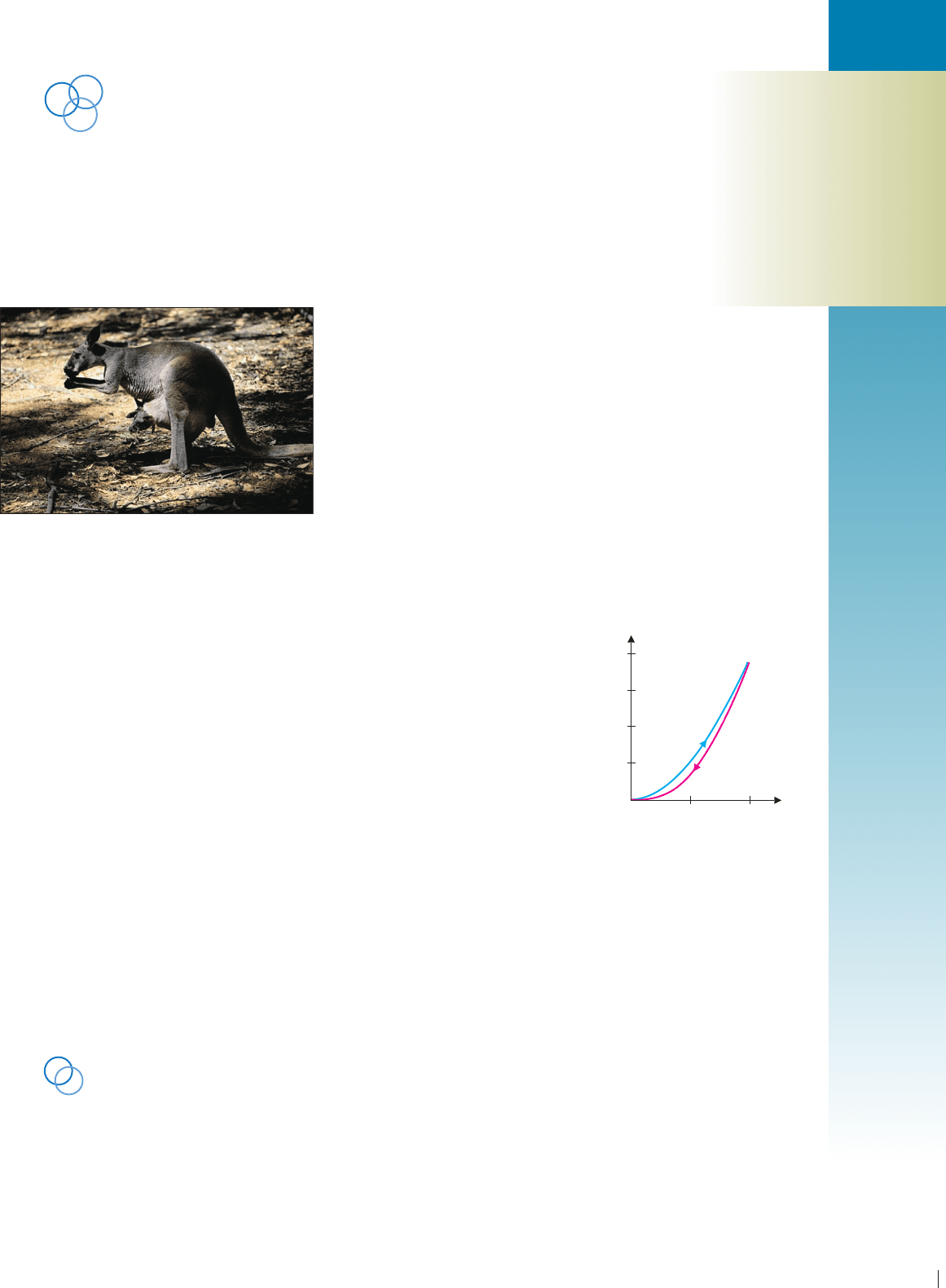
relative to the energy stored during the stretch. The stress-strain curve
presented here shows force as a function of stretch during stretch (top
curve) and recoil (bottom curve) for a human arch. (Figure reprinted with per-
mission from Exploring Biomechanics by R. McNeill Alexander.) If no energy is
lost, the two curves are identical. The area between the curves is a measure of the
energy lost.
y
x
210
2
4
Actuator displacement
(millimeters)
Force (kilonewtons)
The corresponding curve for a kangaroo
(see Alexander) shows almost no area be-
tween the curves.The efficiency of the kanga-
roo’s legs means that very little energy is re-
quired to hop. In fact, biologist Terry Dawson
found in treadmill tests that the faster kanga-
roos run, the less energy they burn (up to the
test limit of 20 mph). The same principle ap-
plies to human athletes, in that the more the
Achilles tendons stretch, the more efficient
the running process becomes. For this rea-
son, athletes spend considerable time stretch-
ing and strengthening their Achilles tendons.
This chapter demonstrates the versatility of the integral by exploring numer-
ous applications. We start with calculations of the area between two curves. The
integral can be viewed from a variety of perspectives: graphical (areas), numerical
(Riemann sum approximations) and symbolic (the Fundamental Theorem of Cal-
culus). As you study each new application, pay close attention to how we develop
the integral(s) measuring the quantity of interest.
5.1 AREA BETWEEN CURVES
We initially developed the definite integral (in Chapter 4) to compute the area
under a curve. In particular, let f be a continuous function defined on [a, b], where
f (x) ≥ 0on[a, b].Tofindthe area underthecurve y = f (x) ontheinterval[a, b],
315
P1: PIC/OVY P2: OSO/OVY QC: OSO/OVY T1: OSO
MHDQ256-Ch05 MHDQ256-Smith-v1.cls December 14, 2010 20:15
LT (Late Transcendental)
CONFIRMING PAGES
316 CHAPTER 5
..
Applications of the Definite Integral 5-2
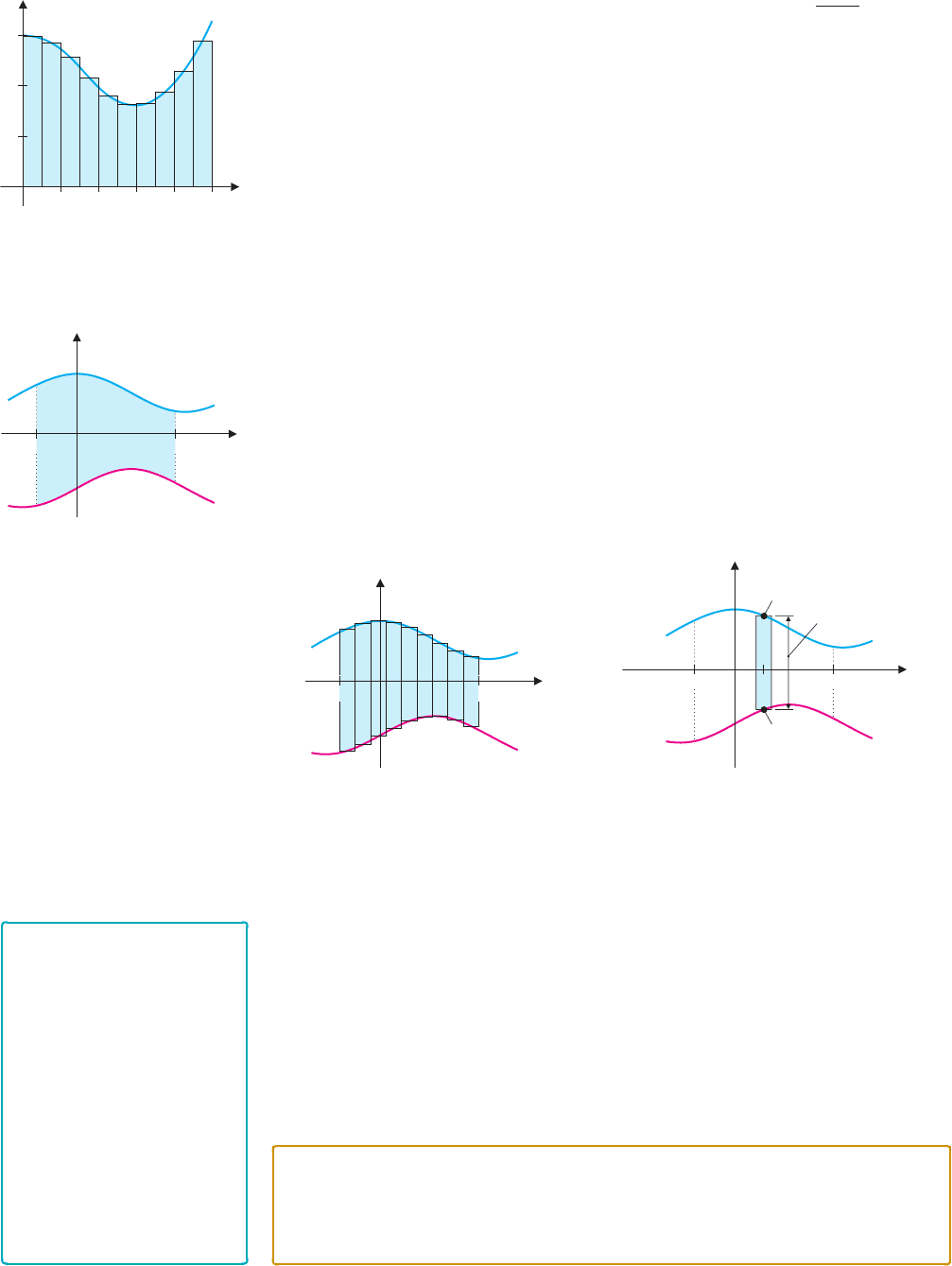
we begin by partitioning [a, b] into n subintervals of equal width, x =
b −a
n
. The points
in the partition are then x
0
= a, x
1
= x
0
+ x, x
2
= x
1
+ x and so on. That is,
x
i
= a + ix, for i = 0, 1, 2,...,n.
y
x
1
2
3
1
2 3 4 5
FIGURE 5.1
Approximation of area
y f(x)
y g(x)
x
y
ab
FIGURE 5.2
Area between two curves
On each subinterval [x
i−1
, x
i
], we construct a rectangle of height f (c
i
), for some
c
i
∈ [x
i−1
, x
i
], as indicated in Figure 5.1 and take the sum of the areas of the n rectan-
gles as an approximation of the area A under the curve:
A ≈
n
i=1
f (c
i
)x.
As we take more and more rectangles, this sum approaches the exact area, which is
A = lim
n→∞
n
i=1
f (c
i
)x =
b
a
f (x) dx.
We now extend this notion to find the area bounded between the two curves y = f (x)
and y = g(x) on the interval [a, b] (see Figure 5.2), where f and g are continuous and
f (x) ≥ g(x)on[a, b]. We first use rectangles to approximate the area. In this case, on each
subinterval[x
i−1
, x
i
], construct a rectangle, stretching from the lowercurve y = g(x)tothe
upper curve y = f (x), as shown in Figure 5.3a. Referring to Figure 5.3b, the ith rectangle
has height h
i
= f (c
i
) − g(c
i
), for some c
i
∈ [x
i−1
, x
i
].
y f(x)
y g(x)
x
y
ab
y f(x)
h
i
f(c
i
) g(c
i
)
(c
i
, f(c
i
))
(c
i
, g(c
i
))
y g(x)
x
y
a c
i
b
FIGURE 5.3a
Approximate area
FIGURE 5.3b
Area of ith rectangle
So, the area of the ith rectangle is
Area = length × width = h
i
x = [ f (c
i
) − g(c
i
)]x.
The total area is then approximately equal to the sum of the areas of the n indicated
rectangles,
A ≈
n
i=1
[ f (c
i
) − g(c
i
)]x.
Finally, observe that if the limit as n →∞exists, we will get the exact area, which we
recognize as a definite integral:
REMARK 1.1
Formula (1.1) is valid only
when f (x) ≥ g(x)onthe
interval [a, b]. In general, the
area between y = f (x) and
y = g(x) for a ≤ x ≤ b is
given by
b
a
| f (x) − g(x)|dx.
Notice that to evaluate this
integral, you must evaluate
d
c
[ f (x) − g(x)] dx on
all subintervals where
f (x) ≥ g(x), then evaluate
d
c
[g(x) − f (x)] dx on all
subintervals where g(x) ≥ f (x)
and finally, add the integrals
together.
AREA BETWEEN TWO CURVES
A = lim
n→∞
n
i=1
[ f (c
i
) − g(c
i
)]x =
b
a
[ f (x) − g(x)] dx. (1.1)
P1: PIC/OVY P2: OSO/OVY QC: OSO/OVY T1: OSO
MHDQ256-Ch05 MHDQ256-Smith-v1.cls December 14, 2010 20:15
LT (Late Transcendental)
CONFIRMING PAGES
5-3 SECTION 5.1
..
Area Between Curves 317
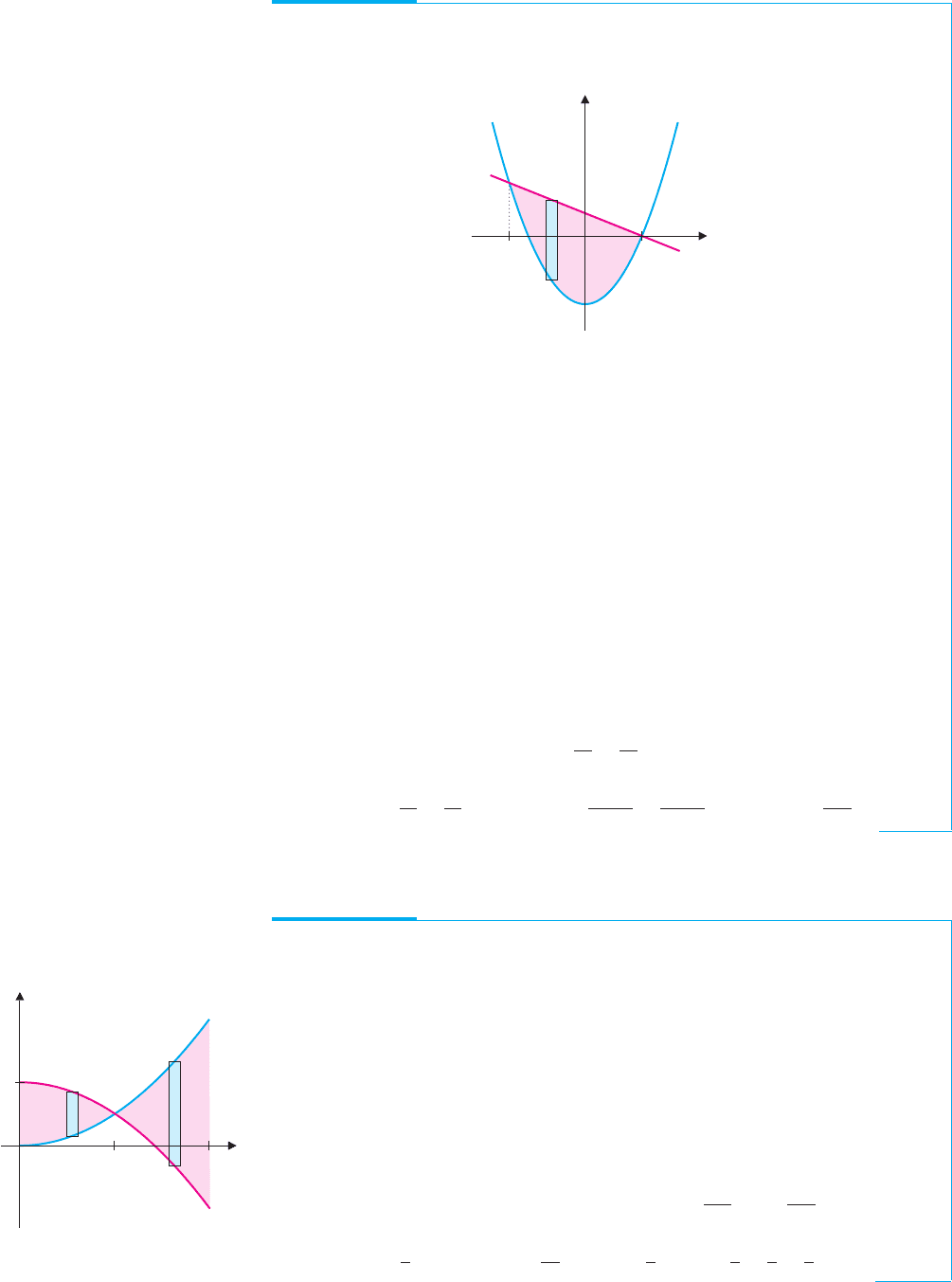
EXAMPLE 1.1 Finding the Area Between Two Curves
Find the area bounded by the graphs of y = 3 − x and y = x
2
− 9. (See Figure 5.4.)
y 3 x
y x
2
9
y
x
34
FIGURE 5.4
y = 3 − x and y = x
2
− 9
Solution Notice that the limits of integration will correspond to the x-coordinates of
the points of intersection of the two curves. Setting the two functions equal, we have
3 − x = x
2
− 9or0= x
2
+ x −12 = (x −3)(x +4).
Thus, the curves intersect at x =−4 and x = 3. Take note that the upper boundary of
the region is formed by y = 3 − x and the lower boundary is formed by y = x
2
− 9.
So, for each fixed value of x, the height of a rectangle (such as the one indicated in
Figure 5.4) is
h(x) = (3 − x) − (x
2
− 9).
From (1.1), the area between the curves is then
A =
3
−4
[(3 − x) − (x
2
− 9)] dx
=
3
−4
(−x
2
− x +12) =
−
x
3
3
−
x
2
2
+ 12x
3
−4
=
−
3
3
3
−
3
2
2
+ 12(3)
−
−
(−4)
3
3
−
(−4)
2
2
+ 12(−4)
=
343
6
.
Sometimes, the upper or lower boundary is not defined by a single function, as in the
following case of intersecting graphs.
y
x
y 2 x
2
y x
2
21
2
FIGURE 5.5
y = x
2
and y = 2 − x
2
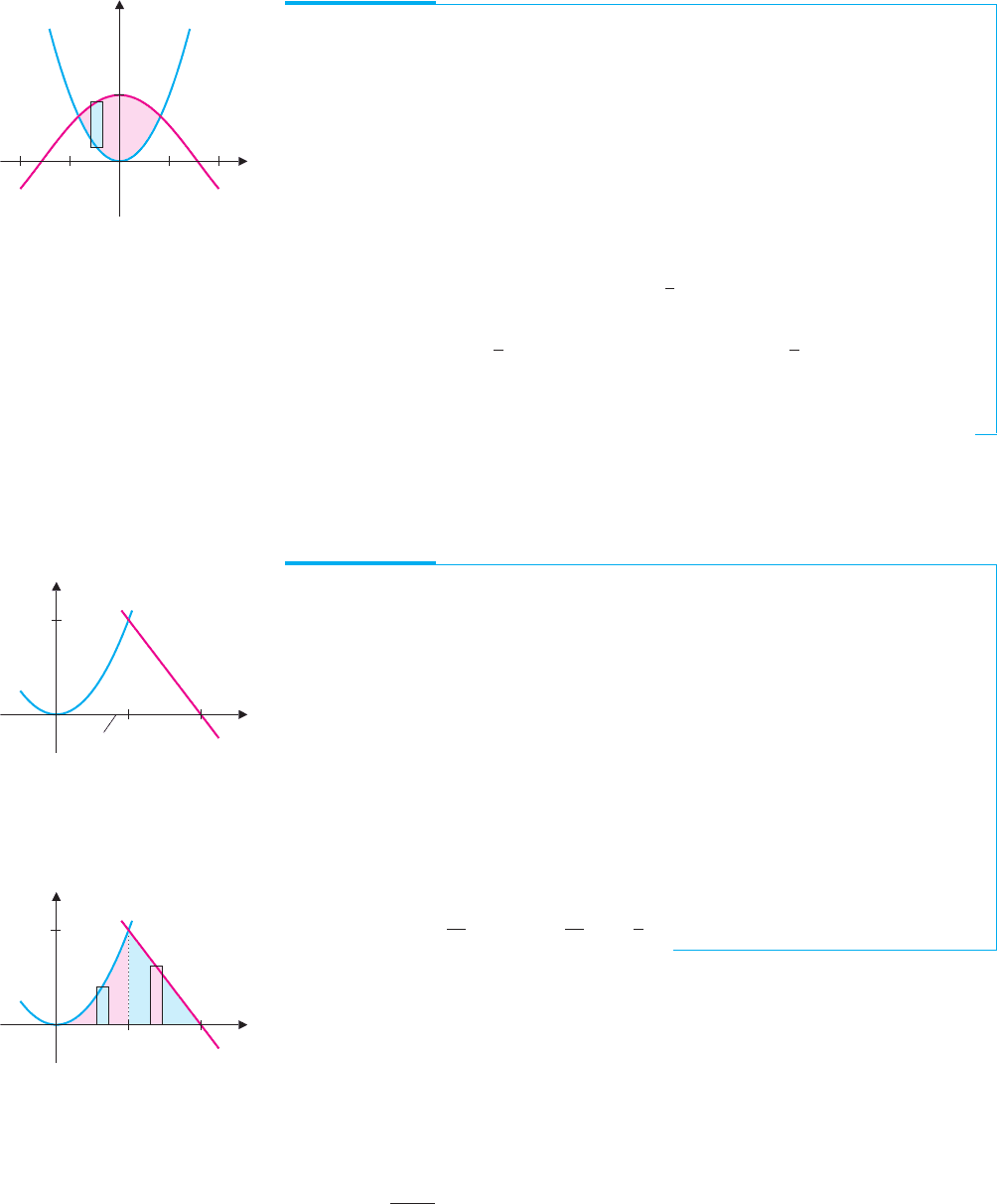
EXAMPLE 1.2 Finding the Area Between Two Curves That Cross
Find the area bounded by the graphs of y = x
2
and y = 2 − x
2
for 0 ≤ x ≤ 2.
Solution Notice from Figure 5.5 that since the two curves intersect in the middle
of the interval, we will need to compute two integrals, one on the interval where
2 − x
2
≥ x
2
and one on the interval where x
2
≥ 2 − x
2
. To find the point of intersection,
we solve x
2
= 2 − x
2
, so that 2x
2
= 2orx
2
= 1orx =±1. Since x =−1 is outside
the interval of interest, the only intersection of note is at x = 1. From (1.1), the area is
A =
1
0
[(2 − x
2
) − x
2
]dx +
2
1
[x
2
− (2 − x
2
)]dx
=
1
0
(2 − 2x
2
)dx +
2
1
(2x
2
− 2) dx =
2x −
2x
3
3
1
0
+
2x
3
3
− 2x
2
1
=
2 −
2
3
− (0 −0) +
16
3
− 4
−
2
3
− 2
=
4
3
+
4
3
+
4
3
= 4.
P1: PIC/OVY P2: OSO/OVY QC: OSO/OVY T1: OSO
MHDQ256-Ch05 MHDQ256-Smith-v1.cls December 14, 2010 20:15
LT (Late Transcendental)
CONFIRMING PAGES
318 CHAPTER 5
..
Applications of the Definite Integral 5-4
In example 1.3, the intersection points must be approximated numerically.
y x
2
y cos x
2
1
1
12
y
x
FIGURE 5.6
y = cos x and y = x
2
y
x
21
1
y 2 x
y 0
y x
2
FIGURE 5.7a
y = x
2
and y = 2 − x
EXAMPLE 1.3 A Case Where the Intersection Points Are Known
Only Approximately
Find the area bounded by the graphs of y = cos x and y = x
2
.
Solution The graph of y = cos x and y = x
2
in Figure 5.6 indicates intersections at
about x =−1 and x = 1, where cos x = x
2
. However, this equation cannot be solved
exactly. Instead, we use a rootfinding method to find the approximate solutions
x =±0.824132. [For instance, you can use Newton’s method to find values of x for
which f (x) = cos x − x
2
= 0.] From the graph, we can see that between these two
x-values, cosx ≥ x
2
and so, the desired area is given by
A ≈
0.824132
−0.824132
(cos x − x
2
)dx =
sin x −
1
3
x
3
0.824132
−0.824132
= sin 0.824132 −
1
3
(0.824132)
3
−
sin(−0.824132) −
1
3
(−0.824132)
3
≈ 1.09475.
Notethatwehaveapproximatedboththelimitsofintegrationandthe final calculations.
Findingthe area of some regionsmayrequirebreakingtheregionup into several pieces,
each having different upper and/or lower boundaries.
EXAMPLE 1.4 The Area of a Region Determined by Three Curves
Find the area bounded by the graphs of y = x
2
, y = 2 − x and y = 0.
Solution A sketch of the three defining curves is shown in Figure 5.7a. Notice that the
top boundary of the region is the curve y = x
2
on the first portion of the interval and the
line y = 2 − x on the second portion. To determine the point of intersection, we solve
2 − x = x
2
or 0 = x
2
+ x −2 = (x +2)(x −1).
Since x =−2 is to the left of the y-axis, the intersection we seek occurs at x = 1. We
then break the region into two pieces, as shown in Figure 5.7b and find the area of each
separately. The total area is then
A = A
1
+ A
2
=
1
0
(x
2
− 0) dx +
2
1
[(2 − x) − 0]dx
=
x
3
3
1
0
+
2x −
x
2
2
2
1
=
5
6
.
1
1
y
x
2
y 2 x
y x
2
A
1
A
2
FIGURE 5.7b
y = x
2
and y = 2 − x
Although it was certainly not difficult to break up the region in example 1.4 into
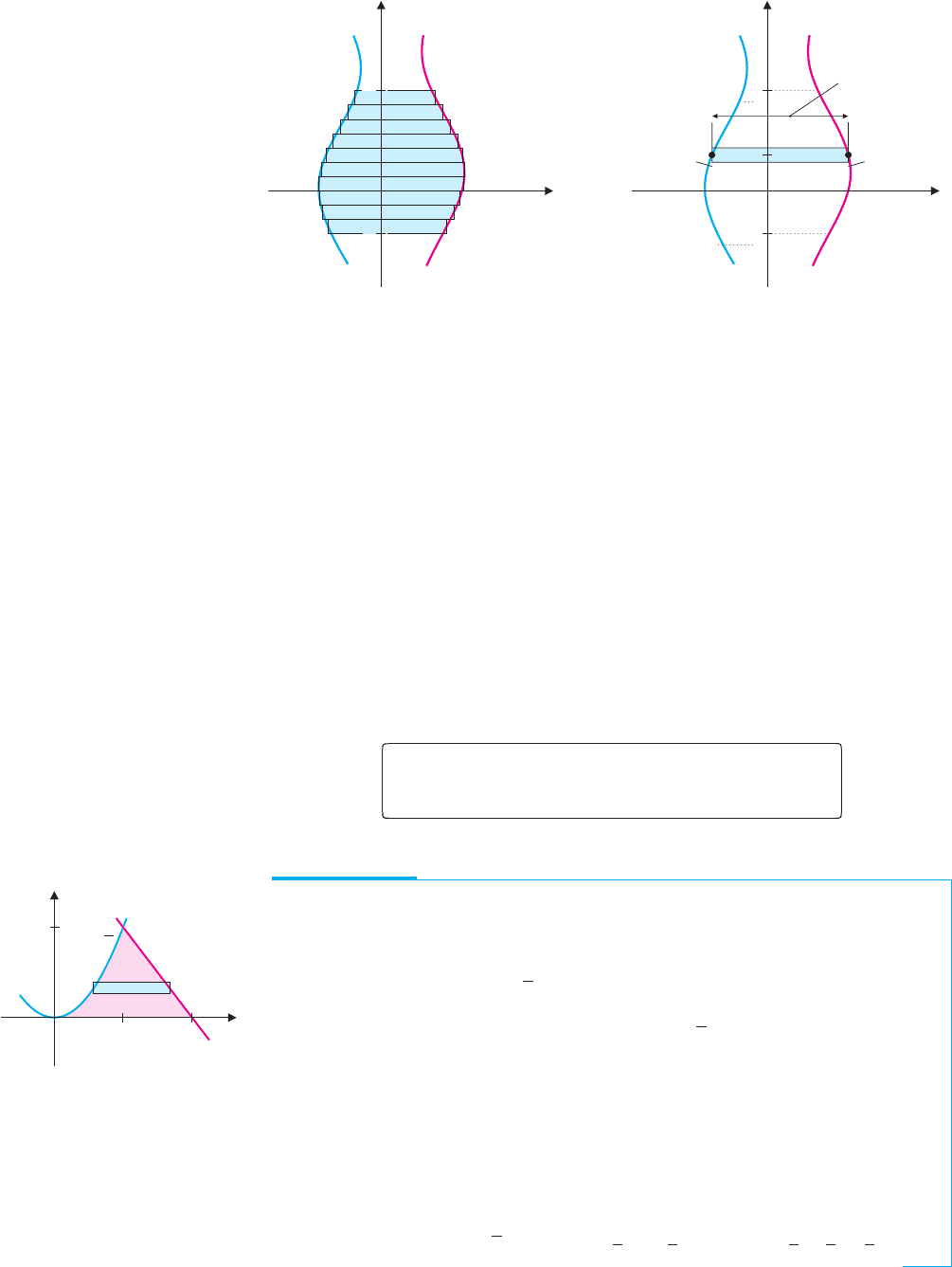
two pieces, we want to suggest an alternative that will prove to be surprisingly useful.
Notice that if you turn the page sideways, Figure 5.7a will look like a region with a single
curve determining each of the upper and lower boundaries. Of course, by turning the page
sideways, you are essentially reversing the roles of x and y.
More generally, for two continuous functions, f and g, where f (y) ≥ g(y) for all y
on the interval c ≤ y ≤ d, to find the area bounded between the two curves x = f (y)
and x = g(y), we first partition the interval [c, d] into n equal subintervals, each of
width y =
d − c
n
. (See Figure 5.8a.) We denote the points in the partition by y
0
= c,
y
1
= y
0
+ y, y
2
= y
1
+ y and so on. That is,
y
i
= c +iy, for i = 0, 1, 2,...,n.
P1: PIC/OVY P2: OSO/OVY QC: OSO/OVY T1: OSO
MHDQ256-Ch05 MHDQ256-Smith-v1.cls December 14, 2010 20:15
LT (Late Transcendental)
CONFIRMING PAGES
5-5 SECTION 5.1
..
Area Between Curves 319
x f(y)
x g(y)
y
c
d
x
(g(c
i
), c
i
)(f(c
i
), c
i
)
w
i
f(c
i
) g(c
i
)
x f(y)
x g(y)
y
c
d
x
c
i
FIGURE 5.8a
Area between x = g(y) and x = f (y)
FIGURE 5.8b
Area of ith rectangle
On each subinterval [y
i−1
, y
i
] (for i = 1, 2,...,n), we then construct a rectangle of width
w
i
= [ f (c
i
) − g(c
i
)], for some c
i
∈ [y
i−1
, y
i
], as shown in Figure 5.8b. The area of the ith
rectangle is given by
Area = length × width = [ f (c
i
) − g(c
i
)]y.
The total area between the two curves is then given approximately by
A ≈
n
i=1
[ f (c
i
) − g(c
i
)]y.
We get the exact area by taking the limit as n →∞and recognizing the limit as a definite
integral. We have
A = lim
n→∞
n
i=1
[ f (c
i
) − g(c
i
)]y =
d
c
[ f (y) − g(y)]dy. (1.2)
Area between two curves
y
x
1
2
1
x y
x 2 y
FIGURE 5.9
y = x
2
and y = 2 − x
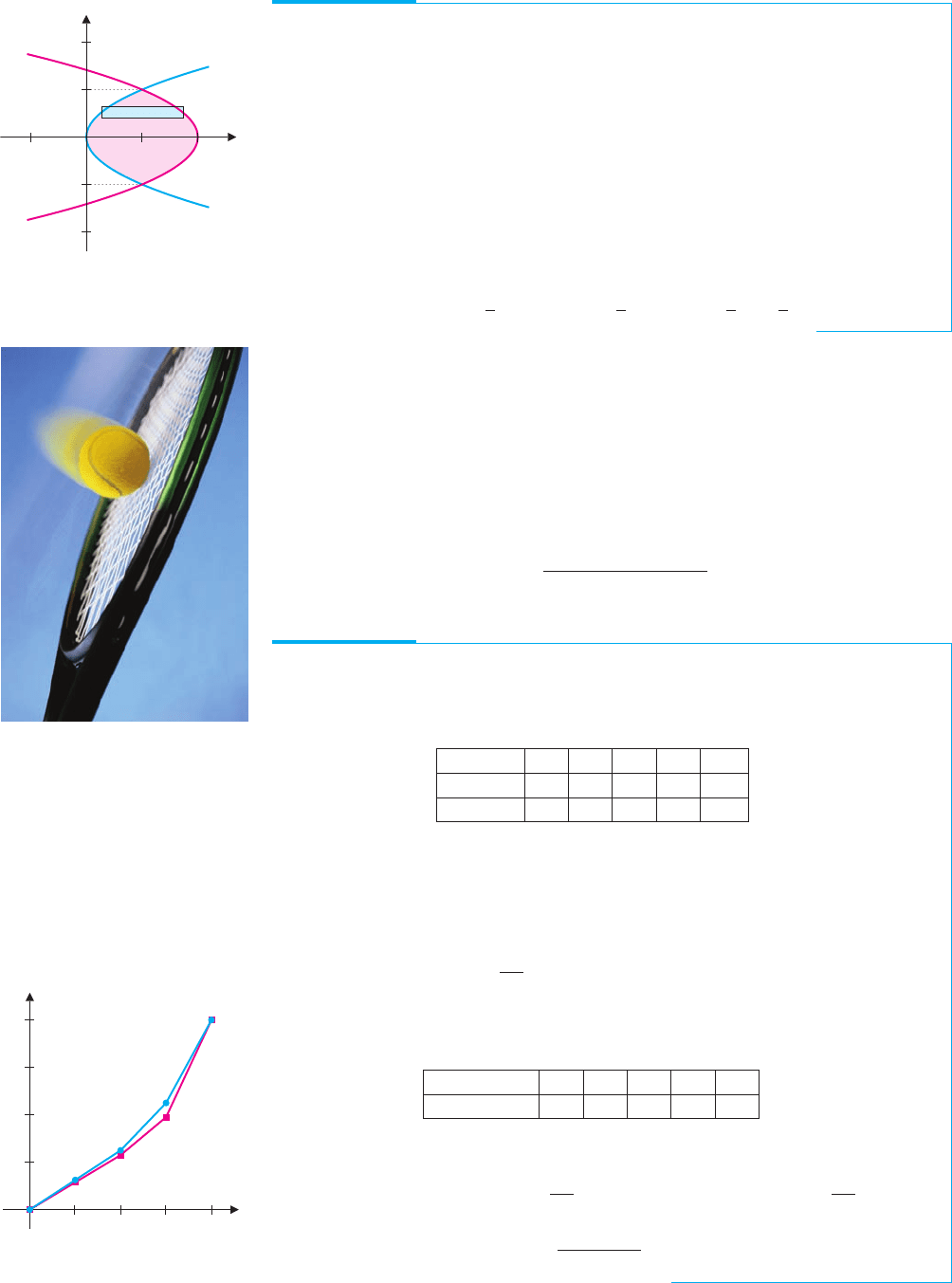
EXAMPLE 1.5 An Area Computed by Integrating with Respect to y
Repeat example 1.4, but integrate with respect to y instead.
Solution From Figure 5.9, notice that the left-hand boundary of the region is formed
by the graph of y = x
2
or x =
√
y (since only the right half of the parabola forms the
left boundary). The right-hand boundary of the region is formed by the line y = 2 − x
or x = 2 − y. These boundary curves intersect where
√
y = 2 − y; squaring both sides
gives us
y = (2 − y)
2
= 4 − 4y + y
2
or 0 = y
2
− 5y + 4 = (y − 1)(y − 4).
So, the curves intersect at y = 1 and y = 4. From Figure 5.9, it is clear that y = 1isthe
solution we need. (What does the solution y = 4 correspond to?) From (1.2), the area is
given by
A =
1
0
[(2 − y) −
√
y] dy =
2y −
1
2
y
2
−
2
3
y
3/2
1
0
= 2 −
1
2
−
2
3
=
5
6
.
P1: PIC/OVY P2: OSO/OVY QC: OSO/OVY T1: OSO
MHDQ256-Ch05 MHDQ256-Smith-v1.cls December 14, 2010 20:15
LT (Late Transcendental)
CONFIRMING PAGES
320 CHAPTER 5
..
Applications of the Definite Integral 5-6
y
x
x 2 y
2
x y
2
2
1
1
1
2
1 2
FIGURE 5.10
x = y
2
and x = 2 − y
2
EXAMPLE 1.6 The Area of a Region Bounded by Functions of y
Find the area bounded by the graphs of x = y
2
and x = 2 − y
2
.
Solution From Figure 5.10, observe that it’s easiest to compute this area by
integrating with respect to y, since integrating with respect to x would require us to
break the region into two pieces. The two intersections of the curves occur where
y
2
= 2 − y
2
,ory
2
= 1, so that y =±1. On the interval [−1, 1], notice that
2 − y
2
≥ y
2
(since the curve x = 2 − y
2
stays to the right of the curve x = y
2
). So,
from (1.2), the area is given by
A =
1
−1
[(2 − y
2
) − y
2
]dy =
1
−1
(2 − 2y
2
)dy
=
2y −
2
3
y
3
1
−1
=
2 −
2
3
−
−2 +
2
3
=
8
3
.
In collisions between a tennis racket and ball, the ball changes shape, first compressing
and then expanding. Let x represent how far the ball is compressed, where 0 ≤ x ≤ m and
let f (x) represent the force exerted on the ball by the racket. Then, the energy transferred
is proportional to the area under the curve y = f (x). Suppose that f
c
(x) is the force during
compression of the ball and f
e
(x) is the force during expansion of the ball. Energy is
transferred to the ball during compression and transferred away from the ball during
expansion, so that the energy lost by the ball in the collision (due to friction) is proportional
to
m
0
[ f
c
(x) − f
e
(x)]dx. The percentage of energy lost in the collision is then given by
100
m
0
[ f
c
(x) − f
e
(x)]dx
m
0
f
c
(x)dx
.
y
x
40
80
120
160
0.40.30.2
f
e
(x)
f
c
(x)
0.1
FIGURE 5.11
Force exerted on a tennis ball
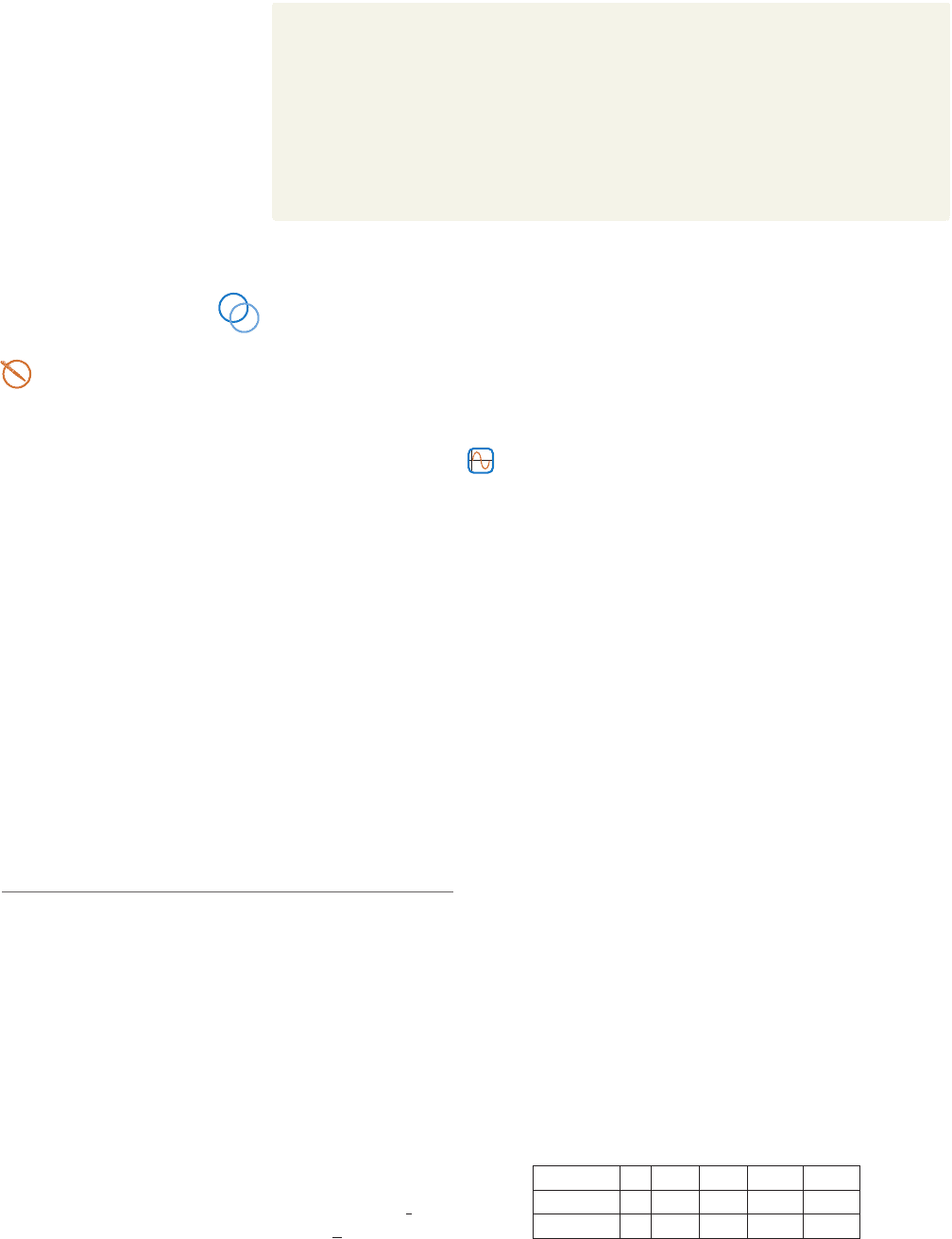
EXAMPLE 1.7 Estimating the Energy Lost by a Tennis Ball
Suppose that test measurements provide the following data on the collision of a tennis
ball with a racket. Estimate the percentage of energy lost in the collision.
x (in.) 0.0 0.1 0.2 0.3 0.4
f
c
(x) (lb) 0 25 50 90 160
f
e
(x) (lb) 0 23 46 78 160
Solution The data are plotted in Figure 5.11, connected by line segments.
We need to estimate the area between the curves and the area under the top curve.
Since we don’t have a formula for either function, we must use a numerical method
such as Simpson’s Rule. For
0.4
0
f
c
(x) dx,weget
0.4
0
f
c
(x) dx ≈
0.1
3
[0 + 4(25) + 2(50) + 4(90) + 160] = 24.
To use Simpson’s Rule to approximate
0.4
0
[ f
c
(x) − f
e
(x)]dx, we need a table of
function values for f
c
(x) − f
e
(x). Subtraction gives us
x 0.0 0.1 0.2 0.3 0.4
f
c
(x) − f
e
(x) 0 2 4 12 0
from which Simpson’s Rule gives us
0.4
0
[ f
c
(x) − f
e
(x)]dx ≈
0.1
3
[0 + 4(2) + 2(4) + 4(12) + 0] =
6.4
3
.
The percentage of energy lost is then
100(6.4/3)
24
≈ 8.9%. With over 90% of its energy
retained in the collision, this is a lively tennis ball.
P1: PIC/OVY P2: OSO/OVY QC: OSO/OVY T1: OSO
MHDQ256-Ch05 MHDQ256-Smith-v1.cls December 14, 2010 20:15
LT (Late Transcendental)
CONFIRMING PAGES
5-7 SECTION 5.1
..
Area Between Curves 321
BEYOND FORMULAS
In example 1.5, we viewed the given graphs as functions of y and set up the area as an
integral of y. This idea indicates the direction that much of the rest of the course takes.
The derivative and integral remain the two most important tools, but we diversify our
options for working with them, often by changing variables. The flexible thinking that
this promotes is key in calculus, as well as in other areas of mathematics and science.
We develop some general techniques and often the first task in solving an application
problem is to make the technique fit the problem at hand.
EXERCISES 5.1
WRITING EXERCISES
1. Suppose the functions f and g satisfy f (x) ≥ g(x) ≥ 0 for
all x in the interval [a, b]. Explain in terms of the areas
A
1
=
b
a
f (x) dx and A
2
=
b
a
g(x)dx why the area be-
tween the curves y = f (x) and y = g(x)isgivenby
b
a
| f (x) − g(x)|dx.
2. Suppose the functions f and g satisfy f (x) ≤ g(x) ≤ 0 for
all x in the interval [a, b]. Explain in terms of the areas
A
1
=
b
a
f (x) dx and A
2
=
b
a
g(x)dx why the area be-
tween the curves y = f (x) and y = g(x)isgivenby
b
a
| f (x) − g(x)|dx.
3. Suppose that the speeds of racing cars A and B are v
A
(t)
and v
B
(t) mph, respectively. If v
A
(t) ≥ v
B
(t) for all t,
v
A
(0) = v
B
(0) and the race lasts from t = 0tot = 2 hours,
explain why car A will win the race by
2
0
[v
A
(t) −v
B
(t)]dt
miles.
4. Suppose that the speeds of racing cars A and B are v
A
(t)
and v
B
(t) mph, respectively. If v
A
(t) ≥ v
B
(t) for 0 ≤ t ≤ 0.5
and 1.1 ≤ t ≤ 1.6 and v
B
(t) ≥ v
A
(t) for 0.5 ≤ t ≤ 1.1 and
1.6 ≤ t ≤ 2, describe the difference between
2
0
|v
A
(t) −v
B
(t)|dt and
2
0
[v
A
(t) −v
B
(t)]dt. Which inte-
gral will tell you which car wins the race?
In exercises 1–4, find the area between the curves on the given
interval.
1. y = x
3
, y = x
2
− 1, 1 ≤ x ≤ 3
2. y = cos x, y = x
2
+ 2, 0 ≤ x ≤ 2
3. y = x
4
, y = x −1, −2 ≤ x ≤ 0
4. y = sin x, y = x
2
, 1 ≤ x ≤ 4
............................................................
In exercises 5–12, sketch and find the area of the region deter-
mined by the intersections of the curves.
5. y = x
2
− 1, y = 7 − x
2
6. y = x
2
− 1, y =
1
2
x
2
7. y = x
3
, y = 3x + 2 8. y =
√
x, y = x
2
9. y = 2 − x
2
, y =|x| 10. y = x
2
− 2, y =|x|
11. y = x
2
− 6, y = x
12. y = sin x(0 ≤ x ≤ 2π), y = cos x
............................................................
In exercises 13–16, sketch and estimate the area determined by
the intersections of the curves.
13. y = x
4
, y = 2 + x 14. y = x
4
, y = 1 − x
15. y = sin x, y = x
2
16. y = cos x, y = x
4
............................................................
In exercises 17–22, sketch and find the area of the region
bounded by the given curves. Choose the variable of integra-
tion so that the area is written as a single integral. Verify your
answers to exercises 19–22 with a basic geometric area formula.
17. y = x, y = 2 − x, y = 0
18. y = x, y = 2, y = 6 − x, y = 0
19. x = y, x =−y, x = 1
20. x = 3y, x = 2 + y
2
21. y = 2x(x > 0), y = 3 − x
2
, x = 0
22. x = y
2
, x = 4
............................................................
23. Incollisionsbetweenaballandastrikingobject(e.g.,abaseball
bat or tennis racket), the ball changes shape, first compressing
and then expanding. If x represents the change in diameter
of the ball (e.g., in inches) for 0 ≤ x ≤ m and f (x) represents
the force between the ball and striking object (e.g., in pounds),
then the area under the curve y = f (x) is proportional to the
energy transferred. Suppose that f
c
(x) is the force during
compression and f
e
(x) is the force during expansion.
Explain why
m
0
[ f
c
(x) − f
e
(x)]dx is proportional to the
energy lost by the ball (due to friction) and thus
m
0
[ f
c
(x) − f
e
(x)]dx/
m
0
f
c
(x)dx is the proportion of energy
lost in the collision. For a baseball and bat, reasonable values
are shown (see Adair’s book The Physics of Baseball):
x (in.) 0 0.1 0.2 0.3 0.4
f
c
(x) (lb) 0 250 600 1200 1750
f
e
(x) (lb) 0 10 100 270 1750
Use Simpson’s Rule to estimate the proportion of energy re-
tained by the baseball.
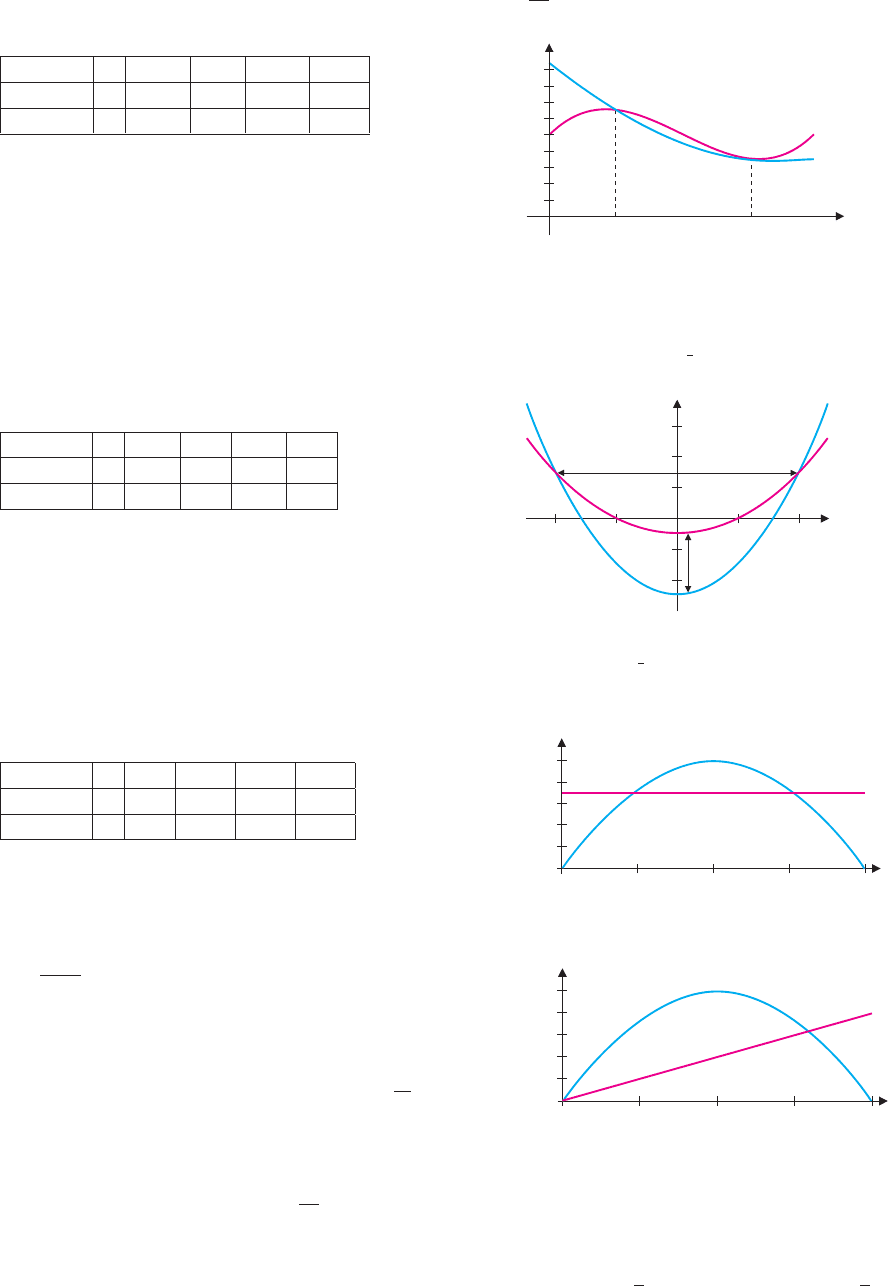
P1: PIC/OVY P2: OSO/OVY QC: OSO/OVY T1: OSO
MHDQ256-Ch05 MHDQ256-Smith-v1.cls December 14, 2010 20:15
LT (Late Transcendental)
CONFIRMING PAGES
322 CHAPTER 5
..
Applications of the Definite Integral 5-8
24. Using the same notation as in exercise 23, values for the force
f
c
(x) during compression and force f
e
(x) during expansion of
a golf ball are given by
x (in.) 0 0.045 0.09 0.135 0.18
f
c
(x) (lb) 0 200 500 1000 1800
f
e
(x) (lb) 0 125 350 700 1800
Use Simpson’s Rule to estimate the proportion of energy re-
tained by the golf ball.
25. Muchlikethecompressionandexpansionof a balldiscussedin
exercises 23 and 24, the forceexertedby a tendon as a function
of its extension determines the loss of energy. (See the chapter
introduction.) Suppose that x is the extension of the tendon,
f
s
(x) is the force during stretching of the tendon and f
r
(x)is
the force during recoil of the tendon. The data given are for a
hind leg tendon of a wallaby (see Alexander’s book Exploring
Biomechanics):
x (mm) 0 0.75 1.5 2.25 3.0
f
s
(x) (N) 0 110 250 450 700
f
r
(x) (N) 0 100 230 410 700
Use Simpson’s Rule to estimate the proportion of energy re-
turned by the tendon.
26. The arch of a human foot acts like a spring during walking
and jumping, storing energy as the foot stretches (i.e., the arch
flattens) and returning energy as the foot recoils. In the data,
x is the vertical displacement of the arch, f
s
(x) is the force on
the foot during stretching and f
r
(x) is the force during recoil
(see Alexander’s book Exploring Biomechanics):
x (mm) 0 2.0 4.0 6.0 8.0
f
s
(x) (N) 0 300 1000 1800 3500
f
r
(x) (N) 0 150 700 1300 3500
Use Simpson’s Rule to estimate the proportion of energy re-
turned by the arch.
27. The average value of a function f (x) on the interval [a, b]is
A =
1
b −a
b
a
f (x) dx. Computethe averagevalue of f (x) = x
2
on [0, 3] and show that the area above y = A and
below y = f (x) equals the area below y = A and
above y = f (x).
28. Find t such that the area between y = 2x and y =
3
x
2
for
1 ≤ x ≤ t equals 7.
29. Suppose that the parabola y = ax
2
+ bx +c and the line
y = mx + n intersect at x = A and x = B with A < B. Show
that the area between the curves equals
|a|
6
(B − A)
3
. (Hint:
Use A and B to rewrite the integrand and then integrate.)
30. Suppose that the cubic y = ax
3
+ bx
2
+ cx +d and the
parabola y = kx
2
+ mx + n intersect at x = A and x = B
with B repeated (that is, the curves are tangent at B; see
the figure). Show that the area between the curves equals
|a|
12
(B − A)
4
.
x
y
4
BA
2
6
8
10
12
14
18
16
31. Consider two parabolas, each of which has its vertex at x = 0,
but with different concavities. Let h be the difference in
y-coordinates of the vertices and let w be the difference in
the x-coordinates of the intersection points. Show that the area
between the curves is
2
3
hw.
x
y
h
w
32. Show that for any constant m, the area between y = 2 − x
2
and y = mx is
1
6
(m
2
+ 8)
3/2
. Find the minimum such area.
33. For y = x − x
2
as shown, find the value of L such that A
1
= A
2
.
x
0 0.25 0.5 0.75 1
y
0.05
0.1
0.15
0.2
0.25
A
1
A
2
y L
34. For y = x − x
2
and y = kx as shown, find k suchthat A
1
= A
2
.
x
0 0.25 0.5 0.75 1
y
0.05
0.1
0.15
0.2
0.25
A
1
A
2
y kx
35. In terms of A
1
, A
2
and A
3
in the figure on the following page,
identify the area given by each integral.
(a)
2
0
(2x − x
2
)dx (b)
2
0
(4 − x
2
)dx
(c)
4
0
(2 −
√
y)dy (d)
4
0
(
√
y − y/2)dy