
Smith R., Minton R. Calculus
Подождите немного. Документ загружается.

P1: PIC/OVY P2: OSO/OVY QC: OSO/OVY T1: OSO
MHDQ256-Ch05 MHDQ256-Smith-v1.cls December 14, 2010 20:15
LT (Late Transcendental)
CONFIRMING PAGES
5-19 SECTION 5.2
..
Volume: Slicing, Disks and Washers 333
y
x
4
2
2
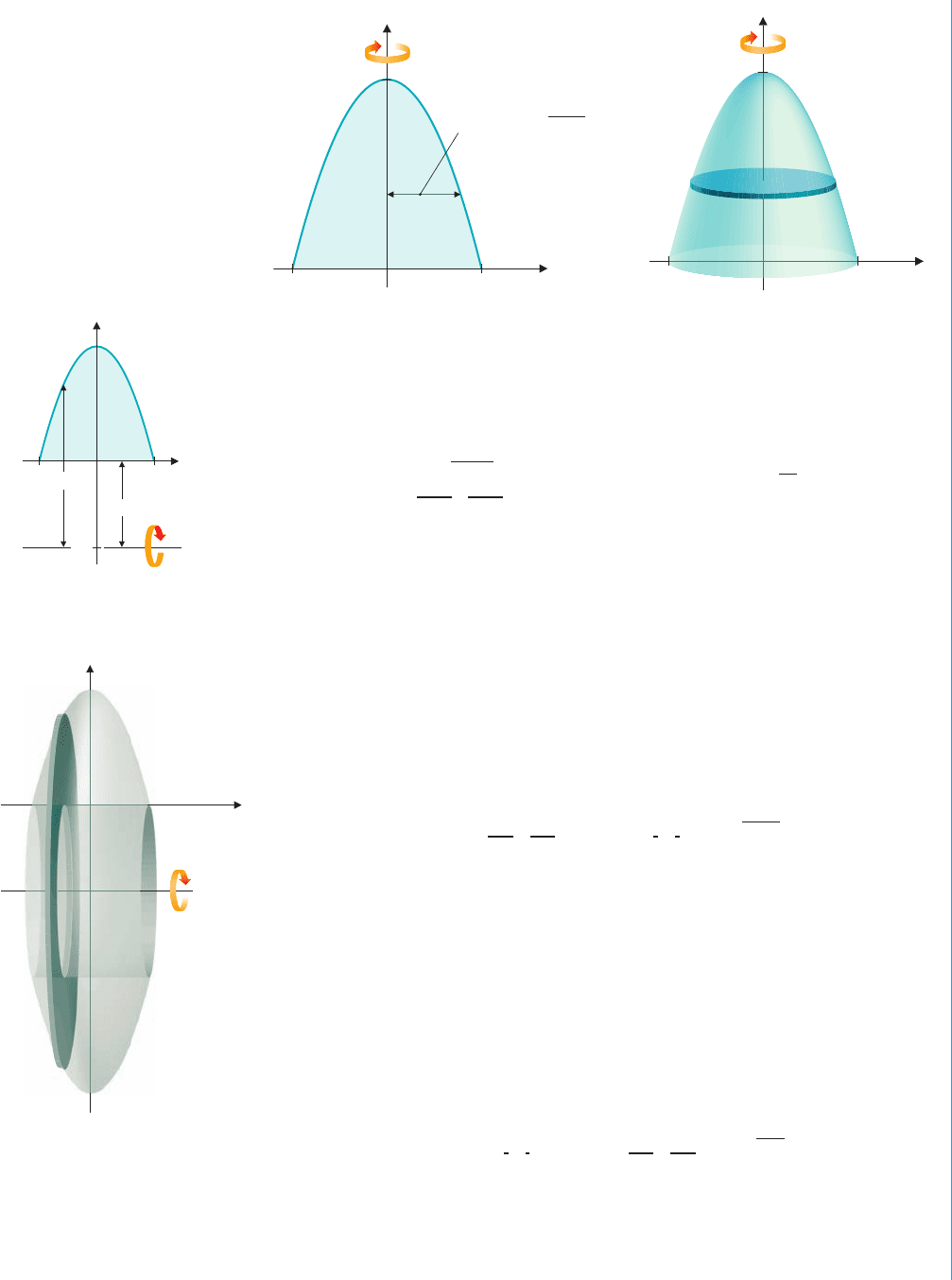
Radius x 4 y
R
y
x
4
2
2
FIGURE 5.23a
Revolve about y-axis
FIGURE 5.23b
Solid of revolution
to be positive, since in this context, x represents a distance. From (2.3), the volume of
the solid of revolution is given by
V =
4
0
π
4 − y
2
π(radius)
2
dy = π
4
0
(4 − y)dy = π
4y −
y
2
2
4
0
= 8π.
For part (b), we have sketched the region R in Figure 5.24a and the solid of
revolution in Figure 5.24b. Notice from Figure 5.24b that the cross sections of the solid
are shaped like washers and the outer radius r
O
is the distance from the curve
y = 4 − x
2
to the axis of revolution y =−3. That is,
r
O
= y − (−3) = (4 − x
2
) − (−3) = 7 − x
2
,
while the inner radius is the distance from the x-axis to the line y =−3. That is,
r
I
= 0 − (−3) = 3.
From (2.2), the volume is
V =
2
−2
π(7 − x
2
)
2
π(outer radius)
2
dx −
2
−2
π(3)
2
π(inner radius)
2
dx =
1472
15
π,
where we have left the details of the computation as an exercise.
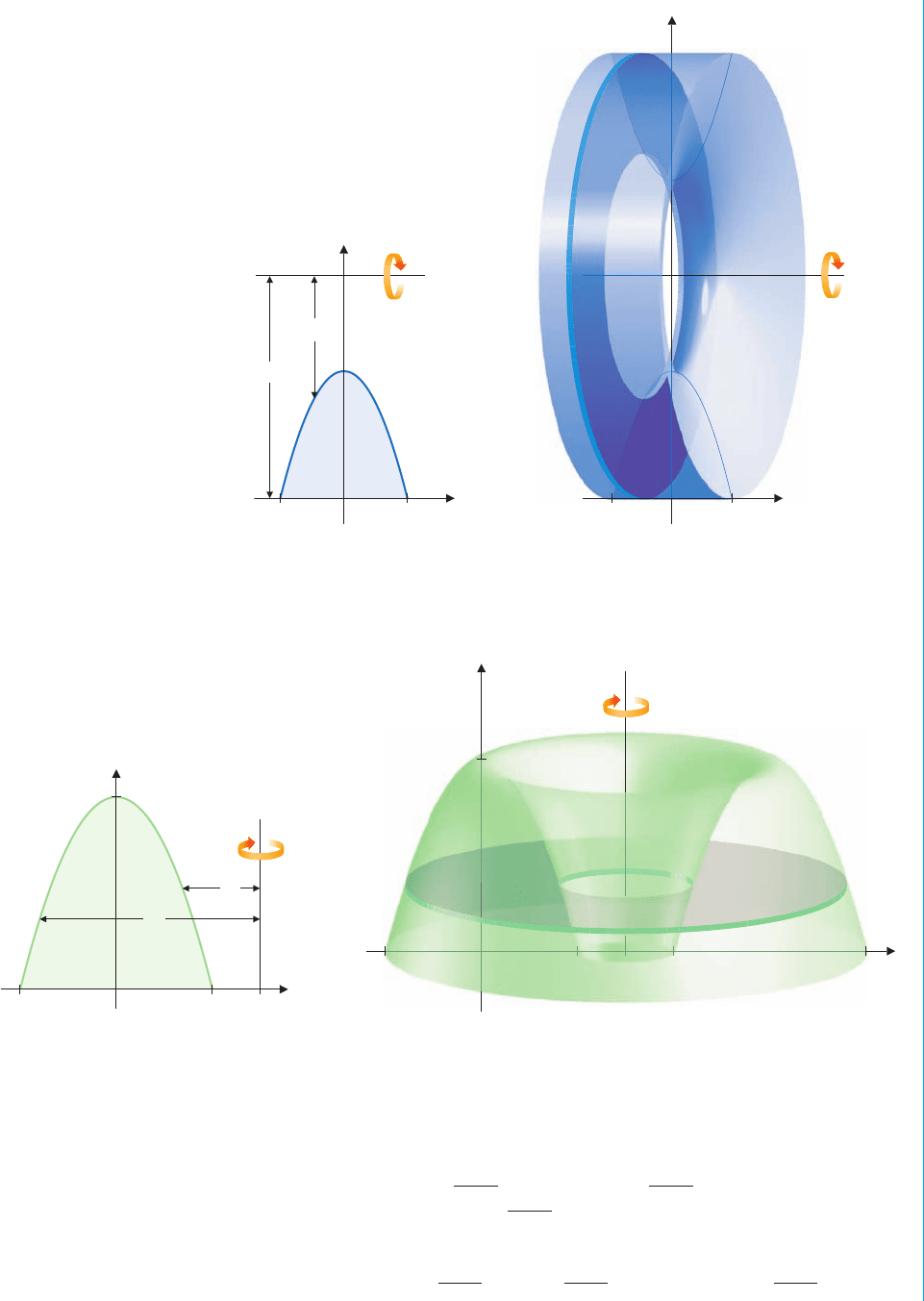
Part (c) (revolving about the line y = 7) is very similar to part (b). You can see the
region R in Figure 5.25a and the solid in Figure 5.25b (on the following page).
y
x
3
22
R
r
O
r
I
y 3
FIGURE 5.24a
Revolve about y =−3
y
x
y 3
FIGURE 5.24b
Solid of revolution
The cross sections of the solid are again shaped like washers, but this time, the
outer radius is the distance from the line y = 7tothex-axis; that is, r
O
= 7. The inner
radius is the distance from the line y = 7 to the curve y = 4 − x
2
,
r
I
= 7 − (4 − x
2
) = 3 + x
2
.
From (2.2), the volume of the solid is then
V =
2
−2
π(7)
2
π(outer radius)
2
dx −
2
−2
π(3 + x
2
)
2
π(inner radius)
2
dx =
576
5
π,
where we again leave the details of the calculation as an exercise.
Finally, for part (d) (revolving about the line x = 3), we show the region R in
Figure 5.26a and the solid of revolution in Figure 5.26b (on the following page). In this
case, the cross sections of the solid are washers, but the inner and outer radii are a bit
P1: PIC/OVY P2: OSO/OVY QC: OSO/OVY T1: OSO
MHDQ256-Ch05 MHDQ256-Smith-v1.cls December 14, 2010 20:15
LT (Late Transcendental)
CONFIRMING PAGES
334 CHAPTER 5
..
Applications of the Definite Integral 5-20
y 7
r
O
r
I
y
x
22
R
y 7
y
2 2
x
FIGURE 5.25a
Revolve about y = 7
FIGURE 5.25b
Solid of revolution
r
I
y
x
2 32
4
x 3
r
O
R
y
x
2 4832
4
x 3
FIGURE 5.26a
Revolve about x = 3
FIGURE 5.26b
Solid of revolution
trickier to determine than in the previous parts. The outer radius is the distance between
the line x = 3 and the left half of the parabola, while the inner radius is the distance
between the line x = 3 and the right half of the parabola. The parabola is given by
y = 4 − x
2
, so that x =±
4 − y. Notice that x =
4 − y corresponds to the right
half of the parabola, while x =−
4 − y describes the left half of the parabola. This
gives us
r
O
= 3 −
−
4 − y
= 3 +
4 − y and r
I
= 3 −
4 − y.
P1: PIC/OVY P2: OSO/OVY QC: OSO/OVY T1: OSO
MHDQ256-Ch05 MHDQ256-Smith-v1.cls December 14, 2010 20:15
LT (Late Transcendental)
CONFIRMING PAGES
5-21 SECTION 5.2
..
Volume: Slicing, Disks and Washers 335
Consequently, we get the volume
V =
4
0
π
3 +
4 − y
2
π(outer radius)
2
dy −
4
0
π
3 −
4 − y
2
π(inner radius)
2
dy = 64π,
where we leave the details of this rather messy calculation to you. In section 5.3, we
present an alternative method for finding the volume of a solid of revolution that, for the
present problem, will produce much simpler integrals.
REMARK 2.3
You will be most successful in finding volumes of solids of revolution if you draw
reasonable figures and label them carefully. Don’t simply look for what to plug in
where. You only need to keep in mind how to find the area of a cross section of the
solid. Integration does the rest.
EXERCISES 5.2
WRITING EXERCISES
1. Discuss the relationships (e.g., perpendicular or parallel) to the
x-axis and y-axis of the disks in examples 2.4 and 2.5. Explain
how this relationship enables you to correctly determine the
variable of integration.
2. The methods of disks and washers were developed separately
in the text, but each is a special case of the general volume
formula. Discuss the advantages of learning separate formu-
las versus deriving each example separately from the general
formula. For example, would you prefer to learn the extra for-
mulas or have to work each problem from basic principles?
How many formulas is too many to learn?
3. To find the area of a triangle of the form in section 5.1, ex-
plain why you would use y-integration. In this section, would
it be easier to compute the volume of the solid formed by re-
volving this triangle about the x-axis or y-axis? Explain your
preference.
4. In part (a) of example 2.7, Figure 5.23a extends from
x =−
√
4 − y to x =
√
4 − y, but we used
√
4 − y as the ra-
dius. Explain why this is the correct radius and not 2
√
4 − y.
In exercises 1–4, find the volume of the solid with cross-sectional
area A(x).
1. A(x) = x + 2, −1 ≤ x ≤ 3
2. A(x) = 10 +6x
2
, 0 ≤ x ≤ 10
3. A(x) = π(4 − x)
2
, 0 ≤ x ≤ 2
4. A(x) = 2(x +1)
2
, 1 ≤ x ≤ 4
............................................................
In exercises 5–12, set up an integral and compute the volume.
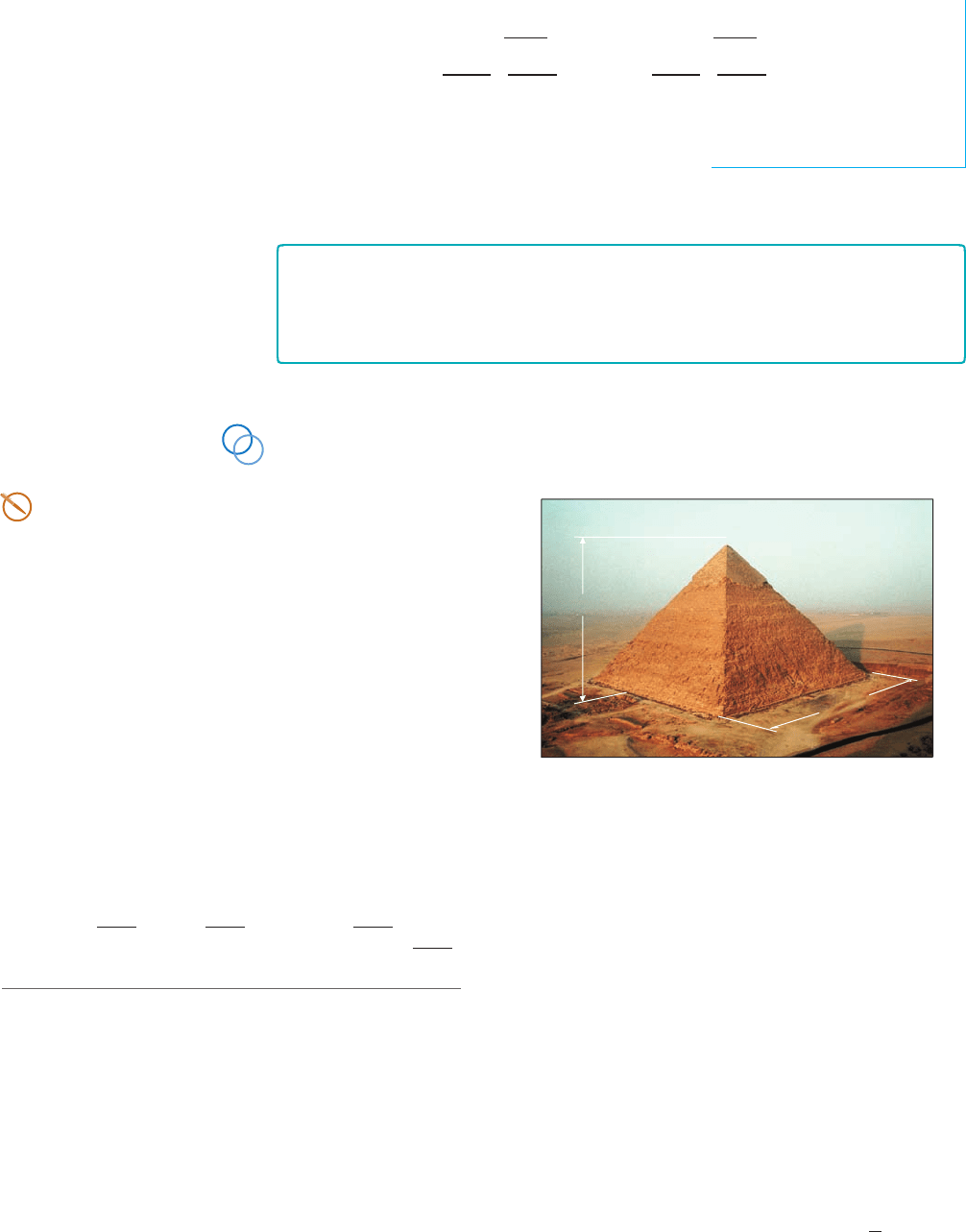
5. (a) The great pyramid at Gizeh is 500 feet high, rising from
a square base of side 750 feet. Compute its volume using
integration.
750 feet
500 feet
(b) Suppose that instead of completing a pyramid, the builders
at Gizeh had stopped at height 250 feet (with a square
plateau top of side 375 feet). Compute the volume of this
structure. Explain why the volume is greater than half the
volume of the pyramid in part (a).
6. Find the volume of a pyramid of height 160 feet that has
a square base of side 300 feet. These dimensions are half
those of the pyramid in example 2.1. How does the volume
compare?
7. A church steeple is 30 feet tall with square cross sections. The
square at the base has side 3 feet, the square at the top has side
6 inches and the side varies linearly in between. Compute the
volume.
8. A house attic has rectangular cross sections parallel to the
ground and triangular cross sections perpendicular to the
ground. The rectangle is 30 feet by 60 feet at the bottom of
the attic and the triangles have base 30 feet and height 10 feet.
Compute the volume of the attic.
9. The outline of a dome is given by y = 60 −
x
2
60
for −60 ≤
x ≤ 60(unitsoffeet),with circular cross-sectionsperpendicu-
larto the y-axis. Find its volume. (Hint: To mimic example2.3,
turn the graph sideways, or treat it like example 2.5.)
P1: PIC/OVY P2: OSO/OVY QC: OSO/OVY T1: OSO
MHDQ256-Ch05 MHDQ256-Smith-v1.cls December 14, 2010 20:15
LT (Late Transcendental)
CONFIRMING PAGES
336 CHAPTER 5
..
Applications of the Definite Integral 5-22
10. A dome “twice as big” as that of exercise 9 has outline
y = 120 −
x
2
120
for −120 ≤ x ≤ 120 (units of feet). Find its
volume.
11. A pottery jar has circular cross sections of radius
4 + sin
x
2
inches for 0 ≤ x ≤ 2π. Sketch a picture of the jar
and compute its volume.
12. A pottery jar has circular cross sections of radius
4 − sin
x
2
inches for 0 ≤ x ≤ 2π. Sketch a picture of the jar
and compute its volume.
............................................................
13. SupposeanMRIscanindicatesthatcross-sectionalareasofad-
jacent slices of a tumor are as given in the table. Use Simpson’s
Rule to estimate the volume.
x (cm) 0.0 0.1 0.2 0.3 0.4 0.5
A(x) (cm
2
) 0.0 0.1 0.2 0.4 0.6 0.4
x (cm) 0.6 0.7 0.8 0.9 1.0
A(x) (cm
2
) 0.3 0.2 0.2 0.1 0.0
14. SupposeanMRIscanindicatesthatcross-sectionalareasofad-
jacent slices of a tumor are as given in the table. Use Simpson’s
Rule to estimate the volume.
x (cm) 0.0 0.2 0.4 0.6 0.8 1.0 1.2
A(x) (cm
2
) 0.0 0.2 0.3 0.2 0.4 0.2 0.0
15. Estimate the volume from the cross-sectional areas.
x (ft) 0.0 0.5 1.0 1.5 2.0
A(x) (ft
2
) 1.0 1.2 1.4 1.3 1.2
16. Estimate the volume from the cross-sectional areas.
x (m) 0.0 0.1 0.2 0.3 0.4
A(x)(m
2
) 2.0 1.8 1.7 1.6 1.8
x (m) 0.5 0.6 0.7 0.8
A(x)(m
2
) 2.0 2.1 2.2 2.4
............................................................
In exercises 17–20, compute the volume of the solid formed by
revolving the given region about the given line.
17. Region bounded by y = 2 − x, y = 0 and x = 0 about (a) the
x-axis; (b) y = 3
18. Region bounded by y = x
2
, y = 4 − x
2
about (a) the x-axis;
(b) y = 4
19. Region bounded by y =
√
x, y = 2 and x = 0 about (a) the
y-axis; (b) x = 4
20. Region bounded by y = x
2
and x = y
2
about (a) the y-axis;
(b) x = 1
............................................................
In exercises 21–24, a solid is formed by revolving the given re-
gion about the given line. Compute the volume exactly if possible
and estimate if necessary.
21. Region bounded by y =
√
x + 4, x = 0, x = 2 and y = 0
about (a) the y-axis; (b) y =−2
22. Regionboundedby y = sec x, y = 0, x =−π/4and x = π/4
about (a) y = 1; (b) the x-axis
23. Region bounded by y =
x
x
2
+2
, the x-axis and x = 1 about
(a) the x-axis; (b) y = 3
24. Region bounded by y = cosx and y = x
2
about (a) the x-axis;
(b) y =−1
............................................................
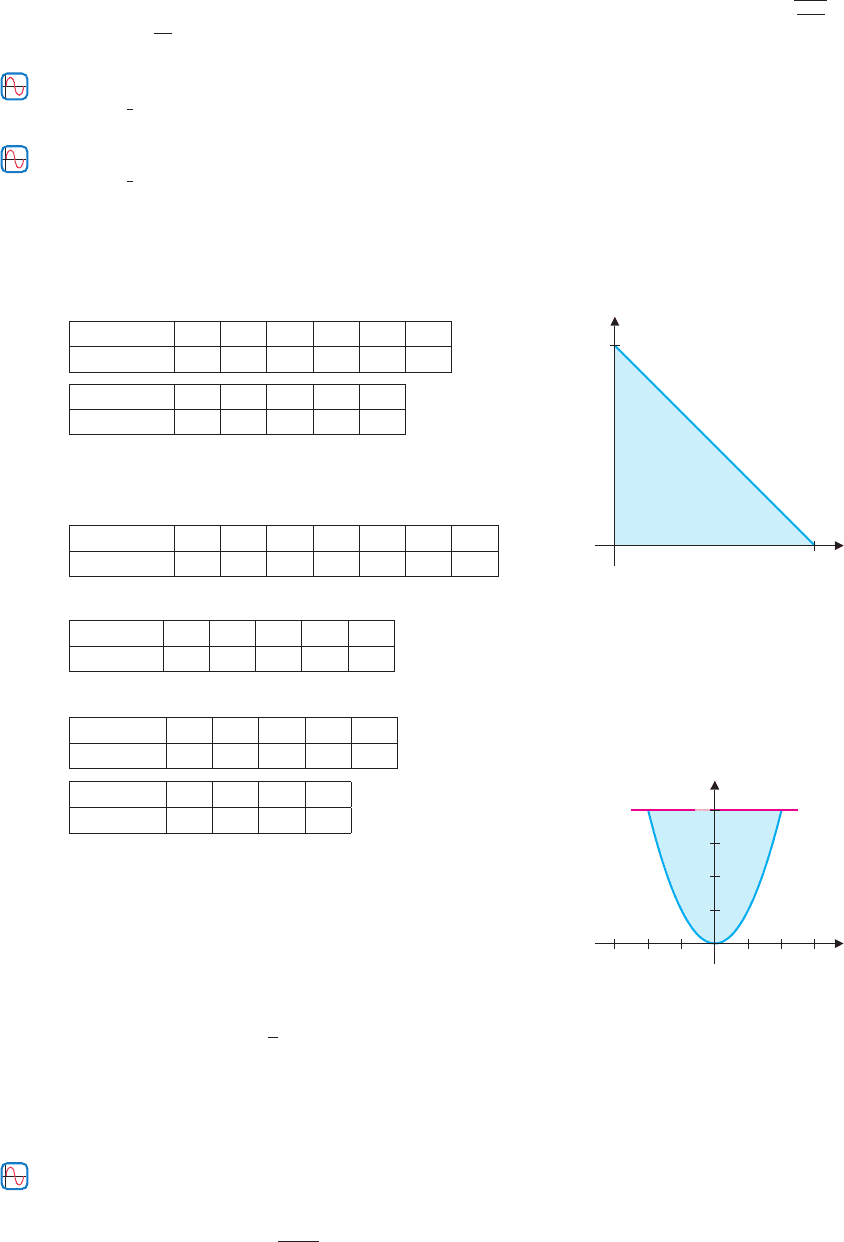
25. Let R be the region bounded by y = 4 − 2x, the x-axis and the
y-axis. Compute the volume of the solid formed by revolving
R about the given line.
(a) the y-axis (b) the x-axis (c) y = 4
(d) y =−4 (e) x = 2(f)x =−2
y
x
4
2
R
26. Let R be the region bounded by y = x
2
and y = 4. Compute
the volume of the solid formed by revolving R about the given
line.
(a) y = 4 (b) the y-axis (c) y = 6
(d) y =−2 (e) x = 2(f)x =−4
y
x
1
2
3
4
2
1123 3
R
27. Let R be the region bounded by y = x
2
, y = 0 and x = 1.
Compute the volume of the solid formed by revolving R about
the given line.
(a) the y-axis (b) the x-axis (c) x = 1
(d) y = 1 (e) x =−1(f)y =−1
28. Let R be the region bounded by y = x, y =−x and x = 1.
Compute the volume of the solid formed by revolving R about
the given line.
(a) the x-axis (b) the y-axis
(c) y = 1 (d) y =−1
29. Let R be the region bounded by y = ax
2
, y = h and the y-axis
(where a and h are positive constants). Compute the volume
of the solid formed by revolving this region about the y-axis.
P1: PIC/OVY P2: OSO/OVY QC: OSO/OVY T1: OSO
MHDQ256-Ch05 MHDQ256-Smith-v1.cls December 14, 2010 20:15
LT (Late Transcendental)
CONFIRMING PAGES
5-23 SECTION 5.3
..
Volume: Slicing, Disks and Washers 337
Show that your answer equals half the volume of a cylinder of
height h and radius
√
h/a. Sketch a picture to illustrate this.
30. Use the result of exercise 29 to immediately write down the
volume of the solid formed by revolving the region bounded
by y = ax
2
, x =
√
h/a and the x-axis about the y-axis.
31. Suppose that the square consisting of all points (x, y) with
−1 ≤ x ≤ 1 and −1 ≤ y ≤ 1 is revolved about the y-axis.
Show that the volume of the resulting solid is 2π.
32. Suppose that the circle x
2
+ y
2
= 1 is revolved about the
y-axis. Show that the volume of the resulting solid is
4
3
π.
33. Suppose that the triangle with vertices (−1, −1), (0, 1) and
(1, −1) is revolved about the y-axis. Show that the volume of
the resulting solid is
2
3
π.
34. Sketch the square, circle and triangle of exercises 31–33 on
the same axes. Show that the relative volumes of the revolved
regions (cylinder, sphere and cone, respectively) are 3:2:1.
35. Verify the formula for the volume of a sphere by revolving the
circle x
2
+ y
2
= r
2
about the y-axis.
36. Verify the formula for the volume of a cone by revolving the
line segment y =−
h
r
x + h, 0 ≤ x ≤ r, about the y-axis.
37. Let A be a right circular cylinder with radius 3 and height 5.
Let B be the tilted circular cylinder with radius 3 and height 5.
Determine whether A and B enclose the same volume.
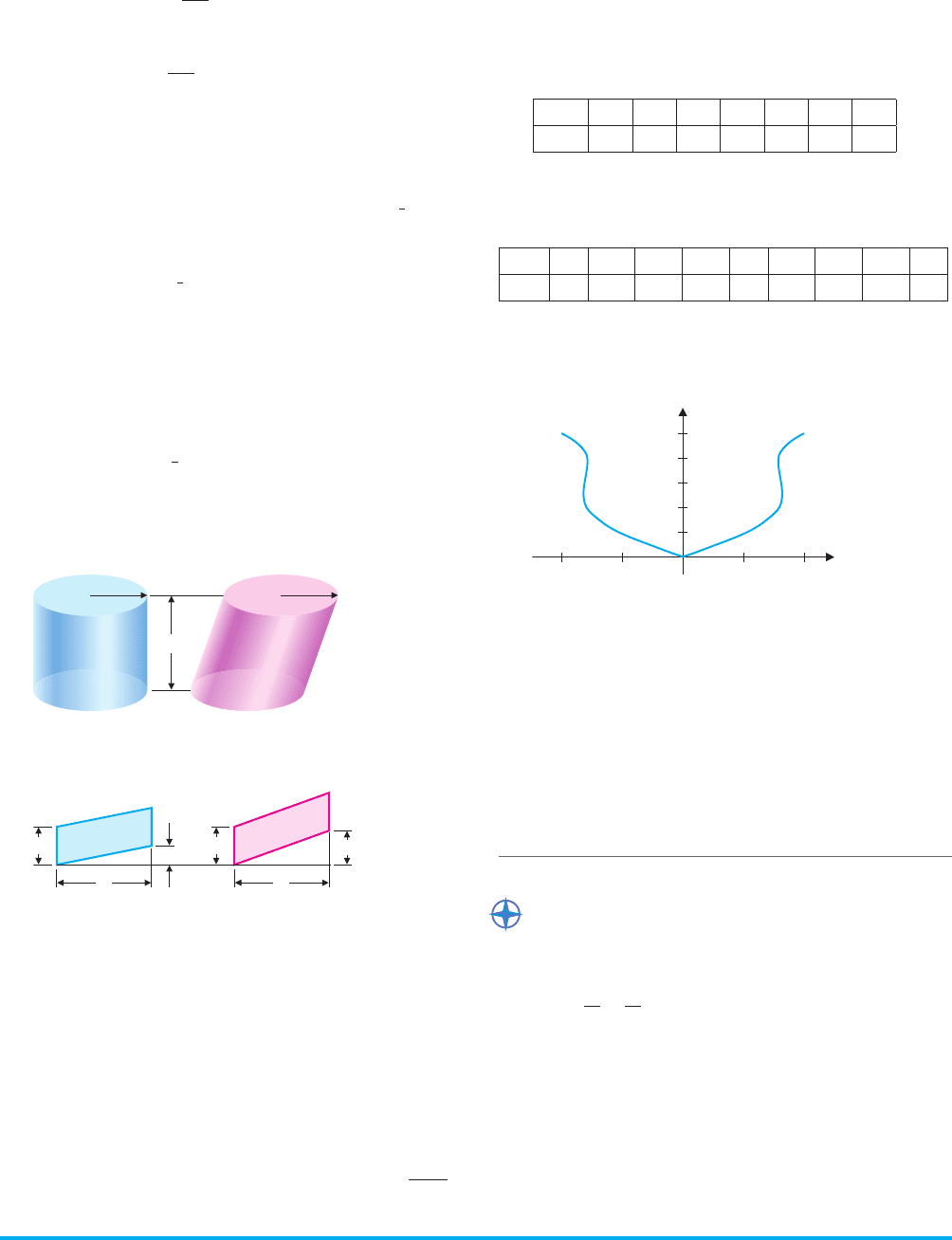
5
33
38. Determine whether the two indicated parallelograms have the
samearea.(Exercises37and38illustrateCavalieri’sTheorem.)
5 5
2 2
2
1
39. The base of a solid V is the circle x
2
+ y
2
= 1. Find the vol-
ume if V has (a) square cross sections and (b) semicircular
cross sections perpendicular to the x-axis.
40. The base of a solid V is the triangle with vertices (−1, 0), (0, 1)
and (1, 0). Find the volume if V has (a) square cross sec-
tions and (b) semicircular cross sections perpendicular to the
x-axis.
41. The base of a solid V is the region bounded by y = x
2
and
y = 2 − x
2
. Find the volume if V has (a) square cross sections,
(b)semicircularcross sections and(c)equilateral triangle cross
sections perpendicular to the x-axis.
42. The base of a solid V is the region bounded by y =
√
x − 1,
x = 2 and y = 0. Find the volume if V has (a) square cross
sections, (b) semicircular cross sections and (c) equilateral tri-
angle cross sections perpendicular to the x-axis.
43. Usethegiventable of valuesto estimate thevolumeofthesolid
formed by revolving y = f (x), 0 ≤ x ≤ 3, about the x-axis.
x 0 0.5 1.0 1.5 2.0 2.5 3.0
f (x) 2.0 1.2 0.9 0.4 1.0 1.4 1.6
44. Usethegiventable of valuesto estimate thevolumeofthesolid
formed by revolving y = f (x), 0 ≤ x ≤ 2, about the x-axis.
x 0 0.25 0.50 0.75 1.0 1.25 1.50 1.75 2.0
f (x) 4.0 3.6 3.4 3.2 3.5 3.8 4.2 4.6 5.0
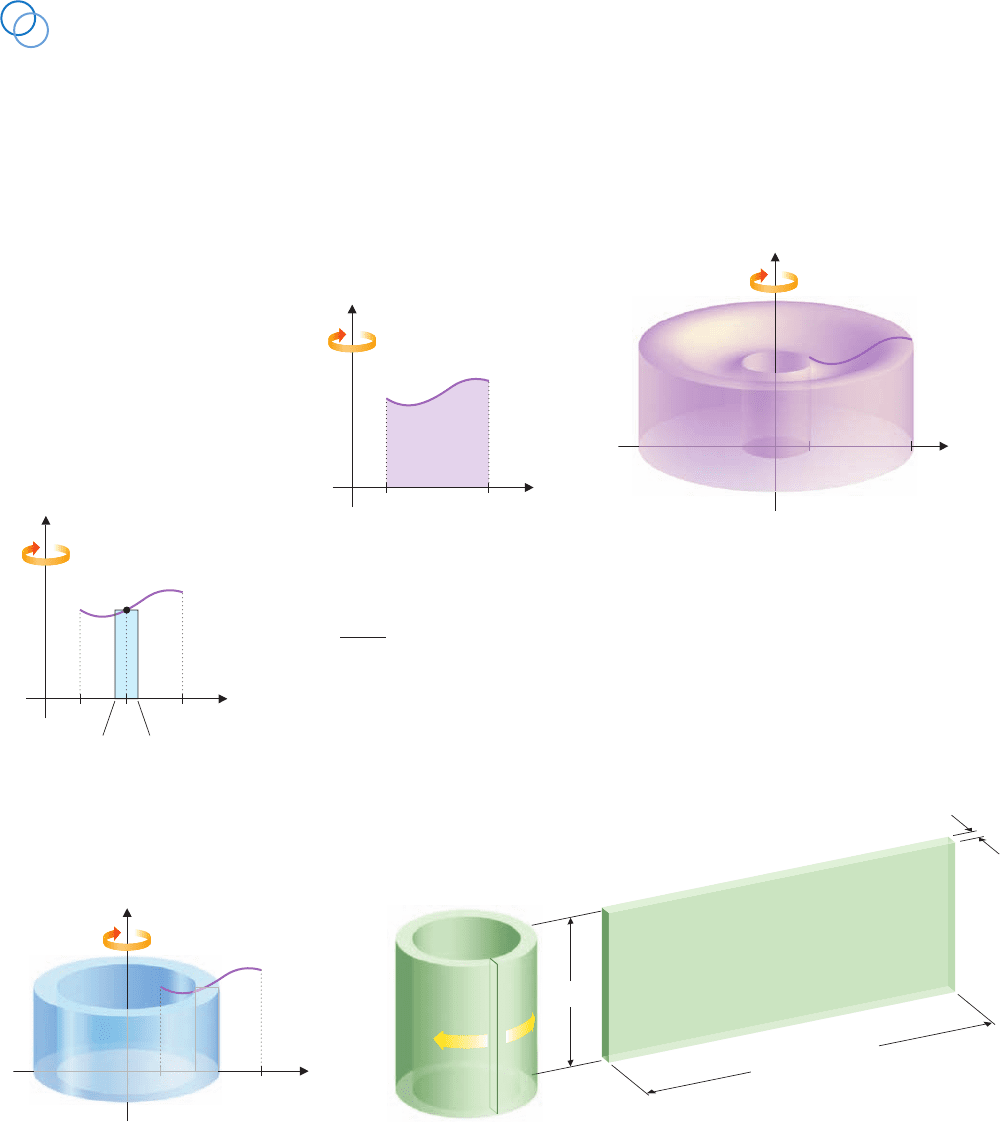
45. Water is poured at a constant rate into the vase with outline as
shown and circular cross sections. Sketch a graph showing the
height of the water in the vase as a function of time.
1
2
3
4
5
x
424 2
y
46. Sketch a graph of the rate of flow versus time if you poured
water into the vase of exercise 45 in such a way that the height
of the water in the vase increased at a constant rate.
47. Find the volume of theintersection of two spheres, one formed
by revolving x
2
+ y
2
= 1 about the y-axis, the other formed
by revolving (x − 1)
2
+ y
2
= 1 about x = 1.
48. Let S be the sphere formed by revolving x
2
+ y
2
= 4 about
the y-axis, and C the cylinder formed by revolving x = 1,
−4 ≤ y ≤ 4, about the y-axis. Find the volume of the inter-
section of S and C.
EXPLORATORY EXERCISES
1. Generalize the result of exercise 34 to any rectangle. That is,
sketch the rectangle with −a ≤ x ≤ a and −b ≤ y ≤ b, the
ellipse
x
2
a
2
+
y
2
b
2
= 1 and the triangle with vertices (−a, −b),
(0, b) and (a, −b). Show that the relative volumes of the solid
formed by revolving these regions about the y-axis are 3:2:1.
2. Take the circle (x − 2)
2
+ y
2
= 1 and revolve it about the
y-axis. The resulting donut-shaped solid is called a torus.
Compute its volume. Show that the volume equals the area
of the circle times the distance travelled by the center of the
circle. This is an example of Pappus’ Theorem, dating from
the fourth century
B.C. Verify that the result also holds for the
triangle in exercise 25, parts (c) and (d).
P1: PIC/OVY P2: OSO/OVY QC: OSO/OVY T1: OSO
MHDQ256-Ch05 MHDQ256-Smith-v1.cls December 14, 2010 20:15
LT (Late Transcendental)
CONFIRMING PAGES
338 CHAPTER 5
..
Applications of the Definite Integral 5-24
5.3 VOLUMES BY CYLINDRICAL SHELLS
In this section, we present an alternative to the method of washers discussed in section 5.2.
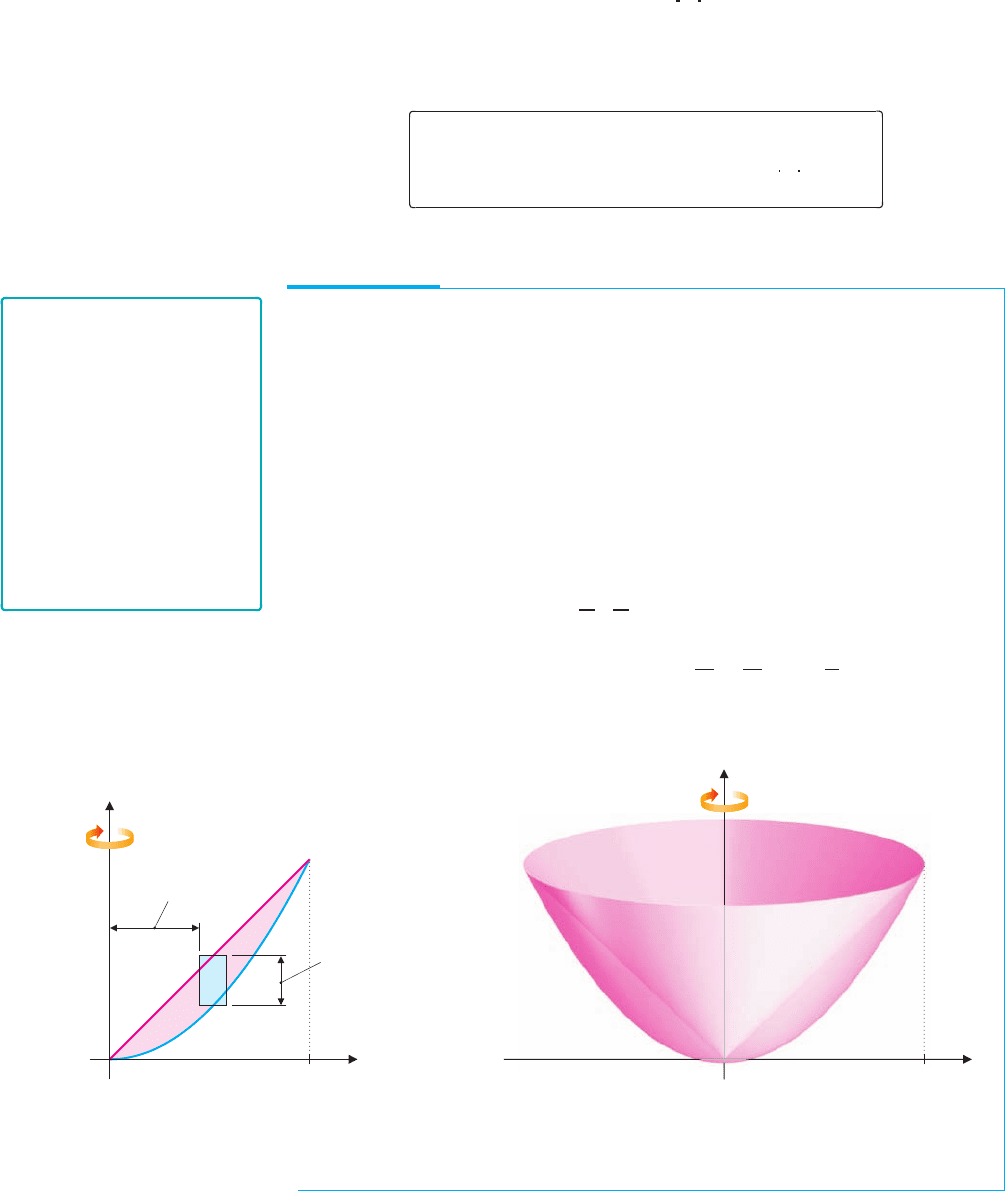
Let R denote the region bounded by the graph of y = f (x) and the x-axis on the interval
[a, b], where 0 < a < b and f (x) ≥ 0on[a, b]. (See Figure 5.27a.) If we revolve this
region about the y-axis, we get the solid shown in Figure 5.27b. Finding the volume of this
solid by the method of washers is awkward, since we would need to break up the region
into several pieces.
y
x
b
y f(x)
R
a
y
x
ba
FIGURE 5.27a
Revolve about y-axis
FIGURE 5.27b
Solid of revolution
y
x
bc
i
y f(x)
a
x
i
x
i 1
FIGURE 5.28
ith rectangle
Alternatively, we partition the interval [a, b] into n subintervals of equal width
x =
b −a
n
. On each subinterval [x
i−1
, x
i
], pick a point c
i
and construct the rectangle
of height f (c
i
) as indicated in Figure 5.28. Revolving this rectangle about the y-axis forms
a thin cylindrical shell (i.e., a hollow cylinder, like a pipe), as in Figure 5.29a.
To find the volume of this thin cylindrical shell, imagine cutting the cylinder from top
to bottom and then flattening out the shell. After doing this, you should have essentially a
thin rectangular sheet, as seen in Figure 5.29b.
y
x
ba
Circumference of
cylindrical shell
Height
Thickness
FIGURE 5.29a
Cylindrical shell
FIGURE 5.29b
Flattened cylindrical shell
Notice that the length of such a thin sheet corresponds to the circumference of the
cylindrical shell, which is 2π · radius ≈ 2πc
i
. So, the volume V
i
of the ith cylindrical shell
is approximately
V
i
≈ length ×width ×height
= (2π ×radius) ×thickness ×height
≈ (2π c
i
)xf(c
i
).
P1: PIC/OVY P2: OSO/OVY QC: OSO/OVY T1: OSO
MHDQ256-Ch05 MHDQ256-Smith-v1.cls December 14, 2010 20:15
LT (Late Transcendental)
CONFIRMING PAGES
5-25 SECTION 5.3
..
Volumes by Cylindrical Shells 339
The total volume V of the solid can then be approximated by the sum of the volumes of the
n cylindrical shells:
V ≈
n
i=1
2π c
i
radius
f (c
i
)
height
x
thickness
.
As we have done many times now, we can get the exact volume of the solid by taking the
limit as n →∞and recognizing the resulting definite integral. We have
V = lim
n→∞
n
i=1
2πc
i
f (c
i
)x =
b
a
2π x
radius
f (x)
height
dx
thickness
. (3.1)
For obvious reasons, we call this the method of cylindrical shells.
Volume of a solid of revolution
(cylindrical shells)
REMARK 3.1
Do not rely on simply
memorizing formula (3.1). You
must strive to understand the
meaning of the components. It’s
simple to do if you just think of
how they correspond to the
volume of a cylindrical shell:
2π(radius) (height) (thickness).
If you think of volumes in this
way, you will have no difficulty
with the method of cylindrical
shells.
EXAMPLE 3.1 Using the Method of Cylindrical Shells
Use the method of cylindrical shells to find the volume of the solid formed by revolving
the region bounded by the graphs of y = x and y = x
2
in the first quadrant about the
y-axis.
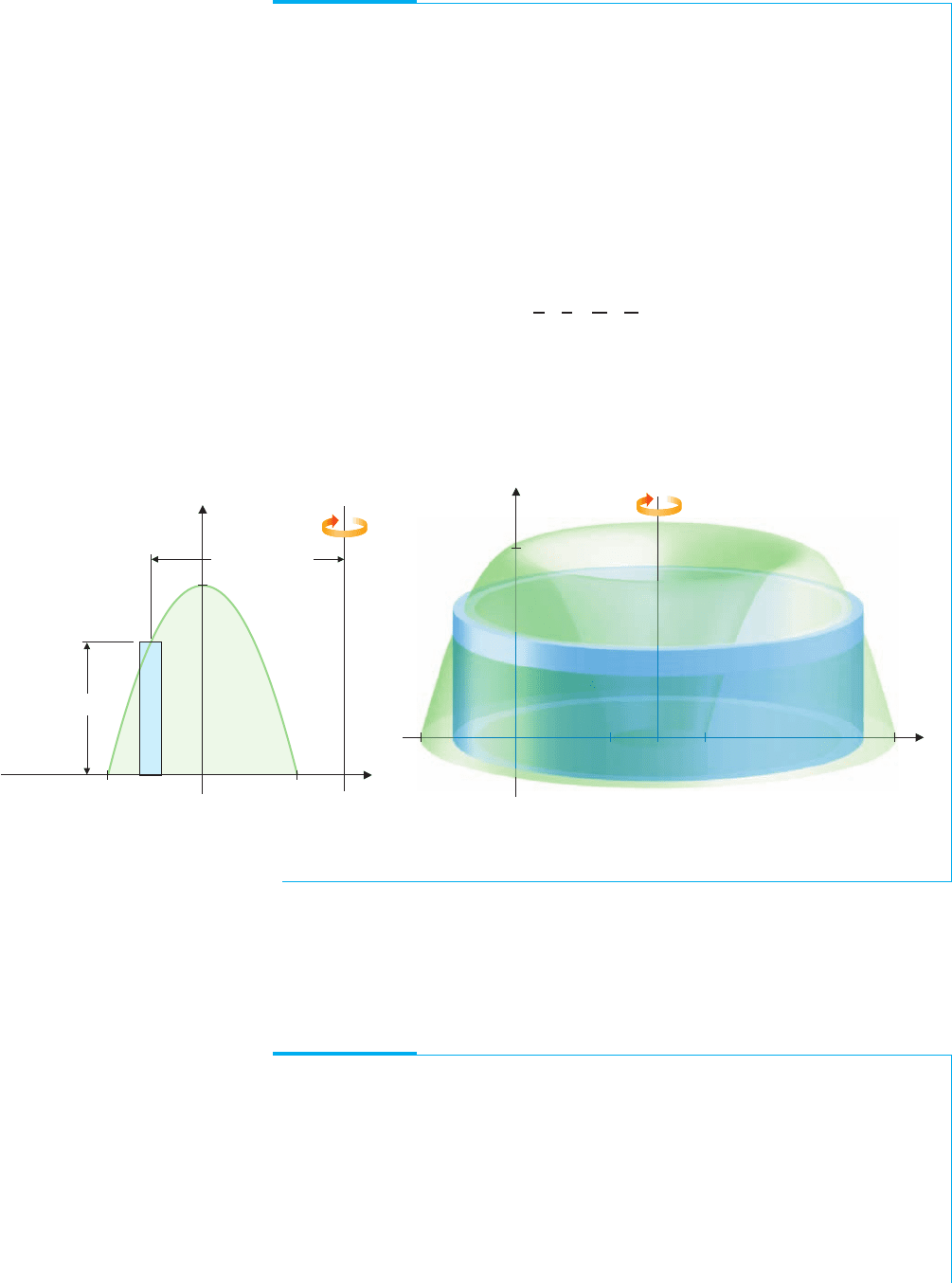
Solution From Figure 5.30a, notice that the region has an upper boundary of y = x
and a lower boundary of y = x
2
and runs from x = 0tox = 1. Here, we have drawn a
sample rectangle that generates a cylindrical shell. The resulting solid of revolution
can be seen in Figure 5.30b. We can write down an integral for the volume by
analyzing the various components of the solid in Figures 5.30a and 5.30b. From (3.1),
we have
V =
1
0
2π x
radius
(x − x
2
)
height
dx
thickness
= 2π
1
0
(x
2
− x
3
)dx = 2π
x
3
3
−
x
4
4
1
0
=
π
6
.
Radius x
y
x
1
Height x x
2
y
x
1
FIGURE 5.30a
Sample rectangle generating
a cylindrical shell
FIGURE 5.30b
Solid of revolution
We can now generalize this method to solve the problem in example 2.7 part (d) in a
much simpler fashion.
P1: PIC/OVY P2: OSO/OVY QC: OSO/OVY T1: OSO
MHDQ256-Ch05 MHDQ256-Smith-v1.cls December 14, 2010 20:15
LT (Late Transcendental)
CONFIRMING PAGES
340 CHAPTER 5
..
Applications of the Definite Integral 5-26
EXAMPLE 3.2 A Volume Where Shells Are Simpler Than Washers
Find the volume of the solid formed by revolving the region bounded by the graph of
y = 4 − x
2
and the x-axis about the line x = 3.
Solution Look carefully at Figure 5.31a, where we have drawn a sample rectangle
that generates a cylindrical shell, and at the solid shown in Figure 5.31b. Notice that the
radius of a cylindrical shell is the distance from the line x = 3 to the shell:
r = 3 − x.
This gives us the volume
V =
2
−2
2π (3 − x)
radius
(4 − x
2
)
height
dx
thickness
= 2π
2
−2
(x
3
− 3x
2
− 4x + 12) dx = 64π,
where the routine details of the calculation of the integral are left to the reader.
Radius 3 x
Height 4 x
2
y
4
x 3
x
22
2
y
x
2 483
4
x 3
FIGURE 5.31a
Typical rectangle generating a cylindrical shell
FIGURE 5.31b
Solid of revolution
Your first step in a volume calculation should be to analyze the geometry of the solid
to decide whether it’s easier to integrate with respect to x or y. Note that for a given solid,
the variable of integration in the method of cylindrical shells is exactly opposite that of the
method of washers. So, your choice of integration variable will determine which method
you use.
EXAMPLE 3.3 Computing Volumes Using Shells and Washers
Let R be the region bounded by the graphs of y = x, y = 2 − x and y = 0. Compute
the volume of the solid formed by revolving R about the lines (a) y = 2, (b) y =−1 and
(c) x = 3.
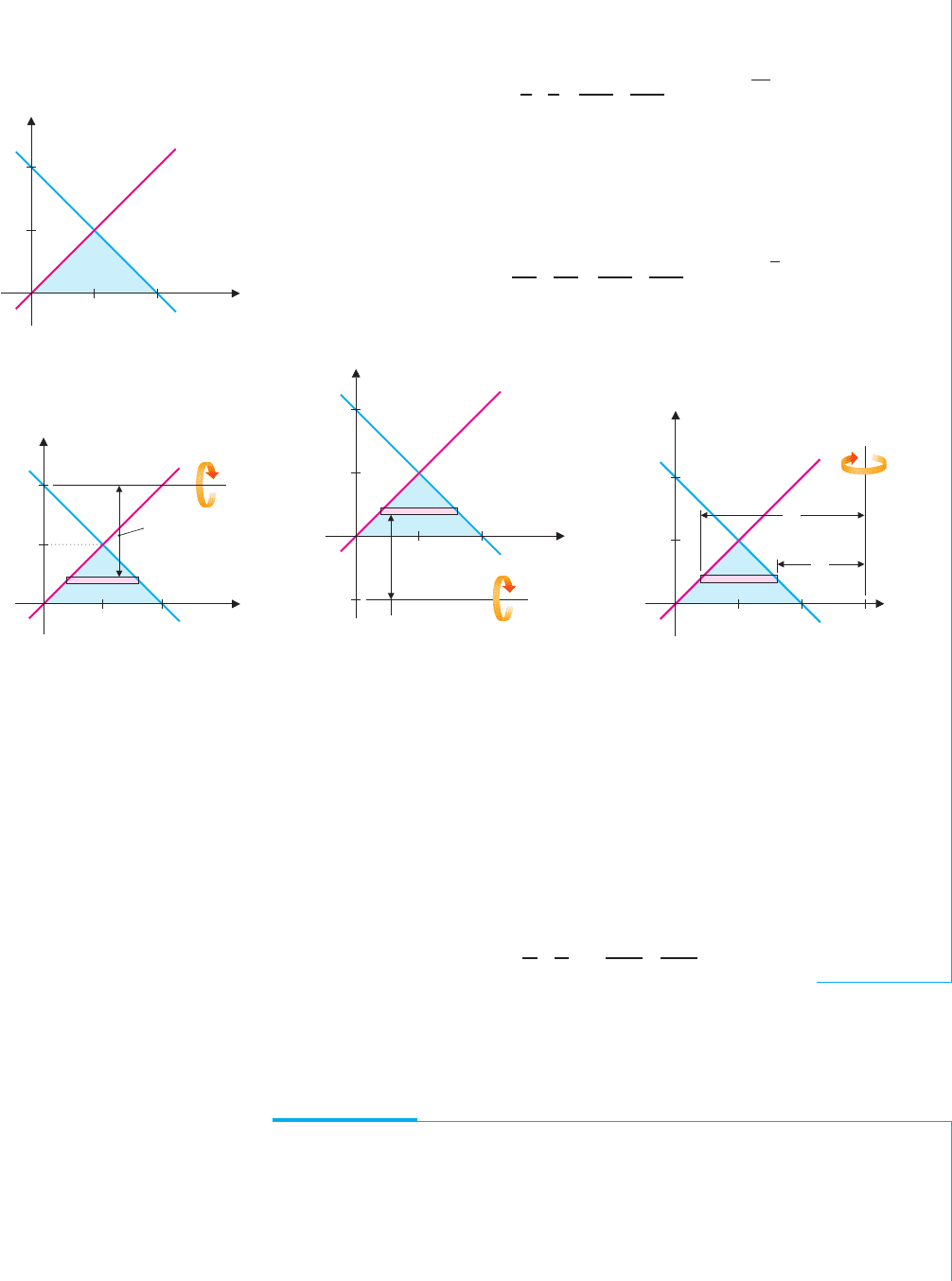
Solution The region R is shown in Figure 5.32a. The geometry of the region suggests
that we should consider y as the variable of integration. Look carefully at the
differences among the following three volumes.
(a) Revolving R about the line y = 2, observe that the radius of a cylindrical shell is
the distance from the line y = 2 to the shell: r = 2 − y, for 0 ≤ y ≤ 1. (See Figure 5.32b.)
P1: PIC/OVY P2: OSO/OVY QC: OSO/OVY T1: OSO
MHDQ256-Ch05 MHDQ256-Smith-v1.cls December 14, 2010 20:15
LT (Late Transcendental)
CONFIRMING PAGES
5-27 SECTION 5.3
..
Volumes by Cylindrical Shells 341
The height is the difference in the x-values on the two curves: solving for x,wehave
x = y and x = 2 − y. Following (3.1), we get the volume
V =
1
0
2π (2 − y)
radius
[(2 − y) − y]
height
dy
thickness
=
10
3
π,
where we leave the routine details of the calculation to you.
y x
y 2 x
y
x
2
1
21
R
FIGURE 5.32a
y = x and y = 2 − x
x y
y 2
x 2 y
Radius 2 y
y
x
2
1
2
1
FIGURE 5.32b
Revolve about y = 2
(b) Revolving R about the line y =−1, notice that the height of the cylindrical
shells is the same as in part (a), but the radius r is the distance from the line y =−1to
the shell: r = y − (−1) = y + 1. (See Figure 5.32c.) This gives us the volume
V =
1
0
2π [y − (−1)]
radius
[(2 − y) − y]
height
dy
thickness
=
8
3
π.
Radius y (1)
y
x
2
1
2
1
y 1
1
r
I
3 (2 y)
r
O
3 y
r
O
r
I
y
x
2
1
2 31
x 3
FIGURE 5.32c
Revolve about y =−1
FIGURE 5.32d
Revolve about x = 3
(c) Finally, revolving R about the line x = 3, notice that to find the volume using
cylindrical shells, we would need to break the calculation into two pieces, since the
height of the cylindrical shells would be different for x ∈ [0, 1] than for x ∈ [1, 2].
(Think about this some.) On the other hand, this is done easily by the method of
washers. Observe that the outer radius is the distance from the line x = 3 to the line
x = y: r
O
= 3 − y, while the inner radius is the distance from the line x = 3 to the line
x = 2 − y: r
I
= 3 − (2 − y). (See Figure 5.32d.) This gives us the volume
V =
1
0
π
⎧
⎪
⎨
⎪
⎩
(3 − y)
2
outer radius
2
−[3 −(2 − y)]
2
inner radius
2
⎫
⎪
⎬
⎪
⎭
dy = 4π.
Once again, you should note the importance of sketching and carefully labeling the
region.Doingsowillmakeitmucheasiertocorrectlysetuptheintegral.Finally,dowhatever
it takes to evaluate the integral. If you don’t know how to evaluate it, you can try your CAS
or approximate it numerically (e.g., by Simpson’s Rule).
EXAMPLE 3.4 Approximating Volumes Using Shells and Washers
Let R be the region bounded by the graphs of y = cos x and y = x
2
. Compute the
volume of the solid formed by revolving R about the lines (a) x = 2 and (b) y = 2.
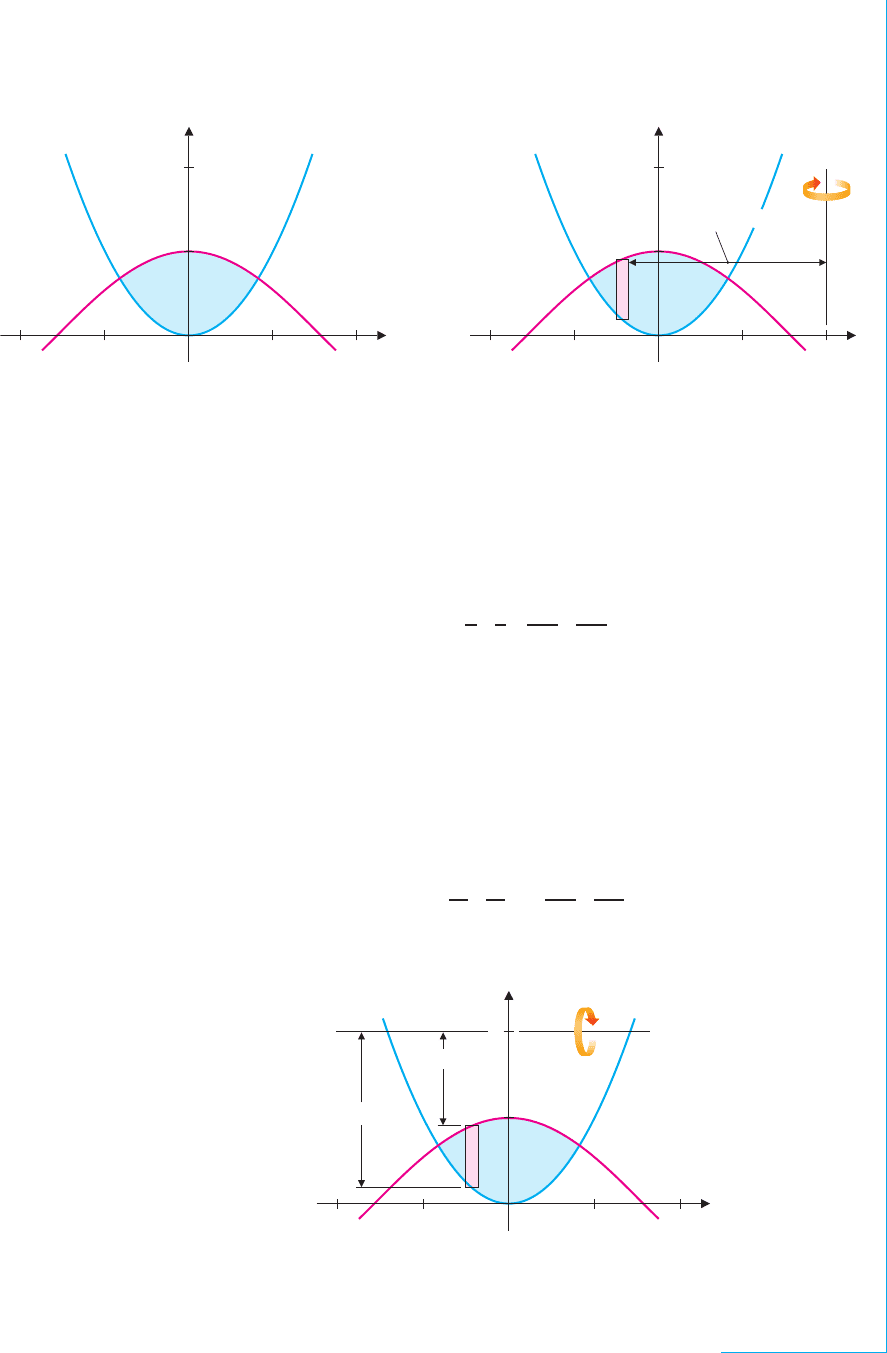
Solution First, we sketch the region R. (See Figure 5.33a on the following page.)
Since the top and bottom of R are each defined by a curve of the form y = f (x), we will
want to integrate with respect to x. We next look for the points of intersection of the two
P1: PIC/OVY P2: OSO/OVY QC: OSO/OVY T1: OSO
MHDQ256-Ch05 MHDQ256-Smith-v1.cls December 14, 2010 20:15
LT (Late Transcendental)
CONFIRMING PAGES
342 CHAPTER 5
..
Applications of the Definite Integral 5-28
curves, by solving the equation cos x = x
2
. Since we can’t solve this exactly, we must
use an approximate method (e.g., Newton’s method) to obtain the approximate
intersections at x =±0.824132.
y
x
y x
2
y cos x
R
2
2
112
1
y
x
y x
2
x 2
y cos x
R
2
2
112
1
Radius 2 x
FIGURE 5.33a
y = cos x, y = x
2
FIGURE 5.33b
Revolve about x = 2
(a) If we revolve the region about the line x = 2, we should use cylindrical shells.
(See Figure 5.33b.) In this case, observe that the radius r of a cylindrical shell is the
distance from the line x = 2 to the shell: r = 2 − x, while the height of a shell is
cos x − x
2
. We get the volume
V ≈
0.824132
−0.824132
2π (2 − x)
radius
(cos x − x
2
)
height
dx ≈ 13.757,
where we have approximated the value of the integral numerically. (We will see how to
find an antiderivative for this integrand in Chapter 7.)
(b) If we revolve the region about the line y = 2 (see Figure 5.33c), we use the
method of washers. In this case, observe that the outer radius of a washer is the distance
from the line y = 2 to the curve y = x
2
: r
O
= 2 − x
2
, while the inner radius is the
distance from the line y = 2 to the curve y = cos x: r
I
= 2 − cos x. (Again, see
Figure 5.33c.) This gives us the volume
V ≈
0.824132
−0.824132
π
!
(2 − x
2
)
2
outer radius
2
−(2 −cos x)
2
inner radius
2
"
dx ≈ 10.08,
y
x
y x
2
y 2
y cos x
R
2
2
112
1
r
I
2 cos x
r
O
2 x
2
FIGURE 5.33c
Revolve about y = 2
where we have approximated the value of the integral numerically.