
Smith R., Minton R. Calculus
Подождите немного. Документ загружается.

P1: PIC/OVY P2: OSO/OVY QC: OSO/OVY T1: OSO
MHDQ256-Ch05 MHDQ256-Smith-v1.cls December 14, 2010 20:15
LT (Late Transcendental)
CONFIRMING PAGES
5-29 SECTION 5.3
..
Volumes by Cylindrical Shells 343
We close this section with a summary of strategies for computing volumes of solids of
revolution.
VOLUME OF A SOLID OF REVOLUTION
r
Sketch the region to be revolved and the axis of revolution.
r
Determine the variable of integration (x if the region has a well-defined top and
bottom, y if the region has well-defined left and right boundaries).
r
Based on the axis of revolution and the variable of integration, determine
the method (disks or washers for x-integration about a horizontal axis or
y-integration about a vertical axis, shells for x-integration about a vertical axis or
y-integration about a horizontal axis).
r
Label your picture with the inner and outer radii for disks or washers; label the
radius and height for cylindrical shells.
r
Set up the integral(s) and evaluate.
EXERCISES 5.3
WRITING EXERCISES
1. Explain why the methodof cylindrical shells producesan inte-
gral with x as the variable of integration when revolving about
a vertical axis. (Describewhere the shells are and which direc-
tion to move in to go from shell to shell.)
2. Explain why the method of cylindrical shells has the same
form whether or not the solid has a hole or cavity. That is,
there is no need for separate methods analogous to disks and
washers.
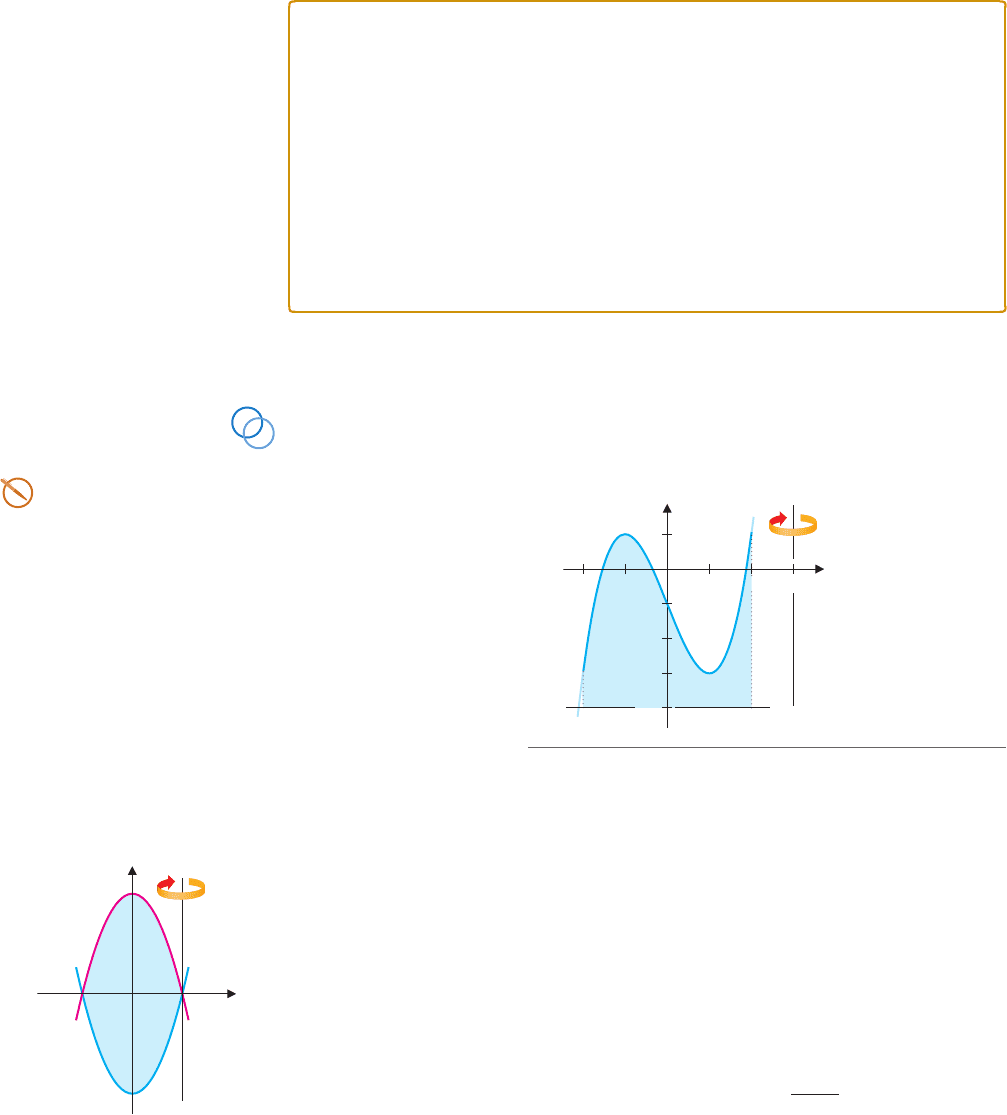
3. Suppose that the region bounded by y = x
2
− 4 and
y = 4 − x
2
is revolved about the line x = 2. Carefully explain
which method (disks, washers or shells) would be easiest to
use to compute the volume.
x 2
y
x
4. Suppose that the region bounded by y = x
3
− 3x − 1 and
y =−4, −2 ≤ x ≤ 2, is revolved about x = 3. Explain what
would be necessary to compute the volume using the
method of washers and what would be necessary to use the
method of cylindrical shells. Which method would you prefer
and why?
y
1 2312
3
4
2
1
1
x
In exercises 1–8, sketch the region, draw in a typical shell,
identify the radius and height of each shell and compute the
volume.
1. The region bounded by y = x
2
and the x-axis, −1 ≤ x ≤ 1,
revolved about x = 2
2. The region bounded by y = x
2
and the x-axis, −1 ≤ x ≤ 1,
revolved about x =−2
3. The region bounded by y = x, y =−x and x = 1 revolved
about the y-axis
4. The region bounded by y = x, y =−x and x = 1 revolved
about x = 1
5. The region bounded by y =
√
x
2
+ 1 and y = 0, 0 ≤ x ≤ 4
revolved about x = 0.
6. The region bounded by y = x
2
and y = 0, −1 ≤ x ≤ 1,
revolved about x = 2
7. The region bounded by x
2
+ y
2
= 1 revolved about y = 2
8. The region bounded by x
2
+ y
2
= 2y revolved about y = 4
............................................................

P1: PIC/OVY P2: OSO/OVY QC: OSO/OVY T1: OSO
MHDQ256-Ch05 MHDQ256-Smith-v1.cls December 14, 2010 20:15
LT (Late Transcendental)
CONFIRMING PAGES
344 CHAPTER 5
..
Applications of the Definite Integral 5-30
In exercises 9–16, use cylindrical shells to compute the volume.
9. Theregionbounded by y = x
2
and y = 2 − x
2
,revolvedabout
x =−2
10. Theregionbounded by y = x
2
and y = 2 − x
2
,revolvedabout
x = 2
11. The region bounded by x = y
2
and x = 4 revolved about
y =−2
12. The region bounded by x = y
2
and x = 4 revolved about y = 2
13. The region bounded by y = x and y = x
2
− 2 revolved about
x = 2
14. The region bounded by y = x and y = x
2
− 2 revolved about
x = 3
15. Theregionboundedby x = (y − 1)
2
and x = 9 revolvedabout
y = 5
16. Theregionboundedby x = (y − 1)
2
and x = 9 revolvedabout
y =−3
............................................................
In exercises 17–26, use the best method available to find each
volume.
17. The region bounded by y = 4 − x, y = 4 and y = x revolved
about
(a) the x-axis (b) the y-axis (c) x = 4 (d) y = 4
18. The region bounded by y = x + 2, y =−x − 2 and x = 0
revolved about
(a) y =−2 (b) x =−2 (c) the y-axis (d) the x-axis
19. The region bounded by y = x and y = x
2
− 6 revolved about
(a) x = 3 (b) y = 3 (c) x =−3 (d) y =−6
20. The region bounded by x = y
2
and x = 2 + y revolvedabout
(a) x =−1 (b) y =−1 (c) x =−2 (d) y =−2
21. The region bounded by y = x
2
(x ≥ 0), y = 2 − x and x = 0
revolved about
(a) the x-axis (b) the y-axis (c) x = 1 (d) y = 2
22. The region bounded by y = 2 − x
2
, y = x (x > 0) and the
y-axis revolved about
(a) the x-axis (b) the y-axis (c) x =−1 (d) y =−1
23. The region to the right of x = y
2
and to the left of y = 2 − x
and y = x − 2 revolved about
(a) the x-axis (b) the y-axis
24. The region bounded by y = x
2
+ x, y = 2 − x and the x-axis
(in the first quadrant) revolved about
(a) the x-axis (b) the y-axis
25. The region bounded by y = cos x and y = x
4
revolved about
(a) x = 2 (b) y = 2 (c) the x-axis (d) the y-axis
26. The region bounded by y = sin x and y = x
2
revolved about
(a) y = 1 (b) x = 1 (c) the y-axis (d) the x-axis
............................................................
In exercises 27–30, the integral represents the volume of a solid.
Sketch the region and axis of revolution that produce the solid.
27.
1
0
π[(
√
y)
2
− y
2
]dy 28.
2
0
π(4 − y
2
)
2
dy
29.
1
0
2π x(x − x
2
)dx 30.
2
0
2π(4 − y)(y + y)dy
............................................................
31. Use a method similar to our derivation of equation (3.1)
to derive the following fact about a circle of radius R.
Area = π R
2
=
R
0
c(r) dr, where c(r) = 2πr is the circum-
ference of a circle of radius r.
32. You have probably noticed that the circumference of a circle
(2πr) equals the derivative with respect to r of the area of
the circle (πr
2
). Use exercise 33 to explain why this is not a
coincidence.
APPLICATIONS
33. A jewelry bead is formed by drilling a
1
2
-cm radius hole from
the center of a 1-cm radius sphere. Explain why the volume is
given by
1
1/2
4π x
√
1 − x
2
dx. Evaluate this integral or com-
pute the volume in some easier way.
34. Find the size of the hole in exercise 33 such that exactly half
the volume is removed.
35. An anthill is in the shape formed by revolving the region
bounded by y = 1 − x
2
and the x-axis about the y-axis. A re-
searcher removes a cylindrical core from the center of the hill.
What should the radius be to give the researcher 10% of the
dirt?
36. The outline of a rugby ball has the shape of
x
2
30
+
y
2
16
= 1. The
ball itself is the revolution of this ellipse about the x-axis. Find
the volume of the ball.
EXPLORATORY EXERCISES
1. From a sphere of radius R, a hole of radius r is drilled out of
the center. Compute the volume removed in terms of R and r.
Compute the length L of the hole in terms of R and r. Rewrite
the volume in terms of L. Is it reasonable to say that the volume
removed depends on L and not on R?
2. In each case, sketch the solid and find the volume formed
by revolving the region about (i) the x-axis and (ii) the
y-axis. Compute the volume exactly if possible and es-
timate numerically if necessary. (a) Region bounded by
y = sec x
√
tan x + 1, y = 0, x =−
π
4
and x =
π
4
. (b) Region
bounded by x =
y
2
+ 1, x = 0, y =−1 and y = 1. (c) Re-
gion bounded by y =
sin x
x
, y = 0, x = π and x = 0. (d) Re-
gion bounded by y = x
3
− 3x
2
+ 2x and y = 0. (e) Region
bounded by y = cos(x
2
) and y = (x − 1)
2
.
P1: PIC/OVY P2: OSO/OVY QC: OSO/OVY T1: OSO
MHDQ256-Ch05 MHDQ256-Smith-v1.cls December 14, 2010 20:15
LT (Late Transcendental)
CONFIRMING PAGES
5-31 SECTION 5.4
..
Arc Length and Surface Area 345
5.4 ARC LENGTH AND SURFACE AREA
In this section, we compute the length of a curvein two dimensions and the area of a surface
in three dimensions. As always, pay particular attention to the derivations.
y
x
0.5
1
d q f
p
FIGURE 5.34a
y = sin x
Arc Length
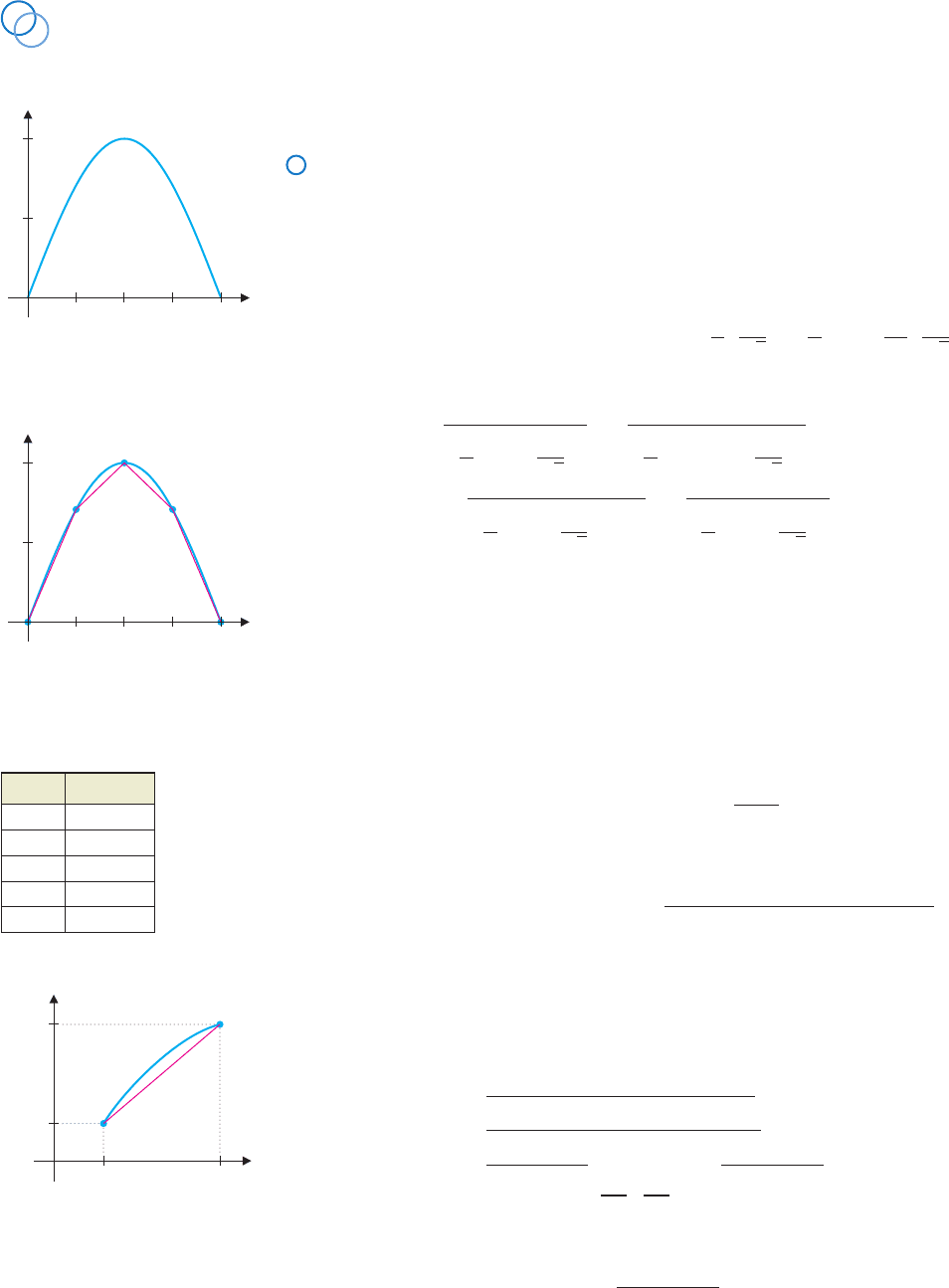
How could we find the length of the portion of the sine curve shown in Figure 5.34a? (We
call the length of a curve its arc length.) If the curve were actually a piece of string, you
could straighten out the string and then measure its length with a ruler. With this in mind,
we begin with an approximation.
We first approximate the curve with several line segments joined together. In Figure
5.34b, the line segments connect the points (0, 0),
π
4
,
1
√
2
,
π
2
, 1
,
3π
4
,
1
√
2
and
(π, 0) on the curve y = sin x. An approximation of the arc length s of the curve is given by
the sum of the lengths of these line segments:
n Length
8 3.8125
16 3.8183
32 3.8197
64 3.8201
128 3.8202
s ≈
#
π
4
2
+
1
√
2
2
+
#
π
4
2
+
1 −
1
√
2
2
+
#
π
4
2
+
1
√
2
− 1
2
+
#
π
4
2
+
1
√
2
2
≈ 3.79.
You might notice that this estimate is too small. (Why is that?) We will improve our
approximation by using more than four line segments. In the table at left, we show estimates
of the length of the curve using n line segments for larger values of n. As you would expect,
the approximation of length will get closer to the actual length of the curve, as the number
of line segments increases. This general idea should sound familiar.
We develop this notion further now for the more general problem of finding the arc
length of the curve y = f (x) on the interval [a, b]. Here, we’ll assume that f is con-
tinuous on [a, b] and differentiable on (a, b). (Where have you seen hypotheses like
these before?) As usual, we begin by partitioning the interval [a, b] into n equal pieces:
a = x
0
< x
1
< ···< x
n
= b, where x
i
− x
i−1
= x =
b −a
n
, for each i = 1, 2,...,n.
y
x
0.5
1
d q f
p
FIGURE 5.34b
Four line segments approximating
y = sin x
y
x
x
i1
x
i
s
i
f(x
i1
)
f(x
i
)
FIGURE 5.35
Straight-line approximation
of arc length
Between each pair of adjacent points on the curve, (x
i−1
, f (x
i−1
)) and (x
i
, f (x
i
)), we
approximate the arc length s
i
by the straight-line distance between the two points. (See Fig-
ure 5.35.) From the usual distance formula, we have
s
i
≈ d{(x
i−1
, f (x
i−1
)), (x
i
, f (x
i
))}=
(x
i
− x
i−1
)
2
+ [ f (x
i
) − f (x
i−1
)]
2
.
Since f is continuous on all of [a, b] and differentiable on (a, b), f is also continuous on
the subinterval [x
i−1
, x
i
] and is differentiable on (x
i−1
, x
i
). By the Mean Value Theorem,
we then have
f (x
i
) − f (x
i−1
) = f
(c
i
)(x
i
− x
i−1
),
for some number c
i
∈ (x
i−1
, x
i
). This gives us the approximation
s
i
≈
(x
i
− x
i−1
)
2
+ [ f (x
i
) − f (x
i−1
)]
2
=
(x
i
− x
i−1
)
2
+ [ f
(c
i
)(x
i
− x
i−1
)]
2
=
1 + [ f
(c
i
)]
2
(x
i
− x
i−1
)
x
=
1 + [ f
(c
i
)]
2
x.
Adding together the lengths of these n line segments, we get an approximation of the total
arc length,
s ≈
n
i=1
1 + [ f
(c
i
)]
2
x.
P1: PIC/OVY P2: OSO/OVY QC: OSO/OVY T1: OSO
MHDQ256-Ch05 MHDQ256-Smith-v1.cls December 14, 2010 20:15
LT (Late Transcendental)
CONFIRMING PAGES
346 CHAPTER 5
..
Applications of the Definite Integral 5-32
Notice that as n gets larger, this approximation should approach the exact arc length, that is,
s = lim
n→∞
n
i=1
1 + [ f
(c
i
)]
2
x.
You should recognize this as the limit of a Riemann sum for
1 + [ f
(x)]
2
, so that the arc
length is given exactly by the definite integral:
s =
b
a
1 + [ f
(x)]
2
dx, (4.1)
Arc length of y = f (x)
on the interval [a, b]
whenever the limit exists.
REMARK 4.1
The formula for arc length is
very simple. Unfortunately,
very few functions produce arc
length integrals that can be
evaluated exactly. You should
expect to use a numerical
integration method on your
calculator or computer to
compute most arc lengths.
EXAMPLE 4.1 Using the Arc Length Formula
Find the arc length of the portion of the curve y = sin x with 0 ≤ x ≤ π. (We estimated
this as 3.79 in our introductory example.)
Solution From (4.1), the arc length is
s =
π
0
1 + (cos x)
2
dx.
Try to find an antiderivative of
√
1 + cos
2
x, but don’t try for too long. (The best our
CAS can do is
√
2 EllipticE[x,
1
2
], which doesn’t seem especially helpful.) Using a
numerical integration method, the arc length is
s =
π
0
1 + (cos x)
2
dx ≈ 3.8202.
Even for very simple curves, evaluating the arc length integral exactly can be quite
challenging.
EXAMPLE 4.2 Estimating an Arc Length
Find the arc length of the portion of the curve y = x
2
with 0 ≤ x ≤ 1.
Solution Using the arc length formula (4.1), we get
s =
1
0
1 + (2x)
2
dx =
1
0
1 + 4x
2
dx ≈ 1.4789,
where we have again evaluated the integral numerically. (In this case, you can find an
antiderivative using a technique developed in section 6.3 and evaluate the integral
exactly as
1
4
ln
√
5 + 2
+
√
5/2.)
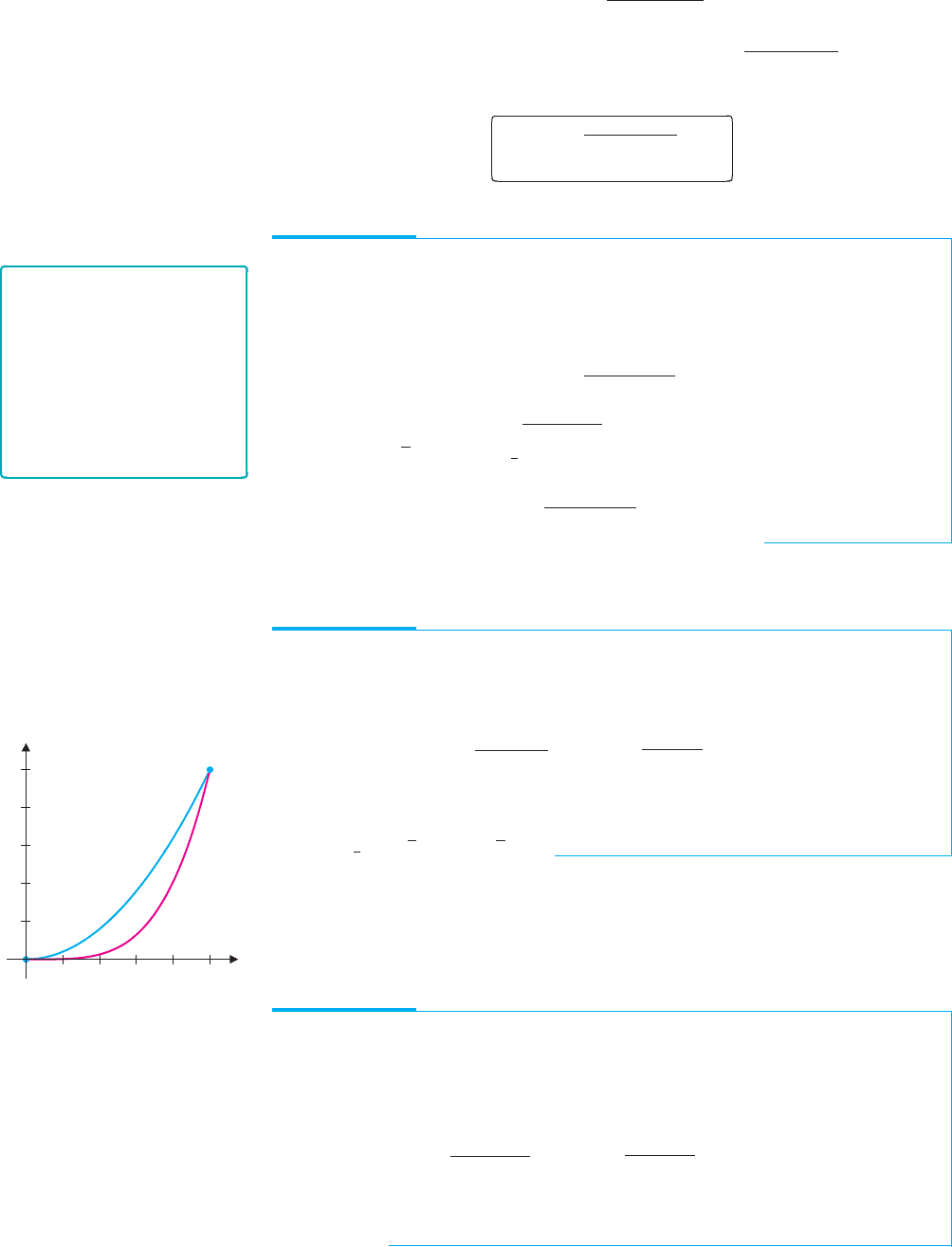
The graphs of y = x
2
and y = x
4
look surprisingly similar on the interval [0, 1]. (See
Figure 5.36.) They both connect the points (0, 0) and (1, 1), are increasing and are concave
up. If you graph them simultaneously, you will note that y = x
4
starts out flatter and then
becomes steeper from about x = 0.7 on. (Try proving that this is true!) Arc length gives us
one way to quantify the difference between the two graphs.
0.2 0.4 0.6 0.8 1.0
0.2
0.4
0.6
0.8
1.0
y
x
y x
2
y x
4
FIGURE 5.36
y = x
2
and y = x
4
EXAMPLE 4.3 A Comparison of Arc Lengths of Power Functions
Find the arc length of the portion of the curve y = x
4
with 0 ≤ x ≤ 1 and compare to the
arc length of the portion of the curve y = x
2
on the same interval.
Solution From (4.1), the arc length for y = x
4
is given by
1
0
1 + (4x
3
)
2
dx =
1
0
1 + 16x
6
dx ≈ 1.6002.
Notice that this arc length is about 8% larger than that of y = x
2
, as found in
example 4.2.
P1: PIC/OVY P2: OSO/OVY QC: OSO/OVY T1: OSO
MHDQ256-Ch05 MHDQ256-Smith-v1.cls December 14, 2010 20:15
LT (Late Transcendental)
CONFIRMING PAGES
5-33 SECTION 5.4
..
Arc Length and Surface Area 347
In the exercises, you will be asked to explore the trend in the lengths of the portion
of the curves y = x
6
, y = x
8
and so on, on the interval [0, 1]. Can you guess now what
happens to the arc length of the portion of y = x
n
, on the interval [0, 1], as n →∞?
Everydayusageofwordssuchaslength canbeambiguousandmisleading.Forinstance,
the length of a frisbee throw usually refers to the horizontal distance covered, not to the arc
length of the frisbee’s flight path. On the other hand, suppose you need to hang a banner
between two poles that are 20 feet apart. In this case, you’ll need more than 20 feet of rope,
since the length of rope required is determined by the arc length, rather than the horizontal
distance.
EXAMPLE 4.4 Computing the Length of a Rope
Suppose that a banner is to be hung from a rope taped to a wall in the shape of
y =
1
20
x
2
+ 10, −10 ≤ x ≤ 10, as seen in Figure 5.37. How long is the rope?
Solution From (4.1), the arc length of the curve is given by
S =
10
−10
#
1 +
1
10
x
2
dx
=
10
−10
1 +
1
100
x
2
dx
=
1
10
10
−10
x
2
+ 100 dx
≈ 22.956 feet,
which corresponds to the horizontal distance of 20 feet plus about 3 feet of slack.
y
x
105510
5
15
20
FIGURE 5.37
y =
1
20
x
2
+ 10
y
x
1
1
2
y x 1
Circular cross
sections
FIGURE 5.38
Surface of revolution
Surface Area
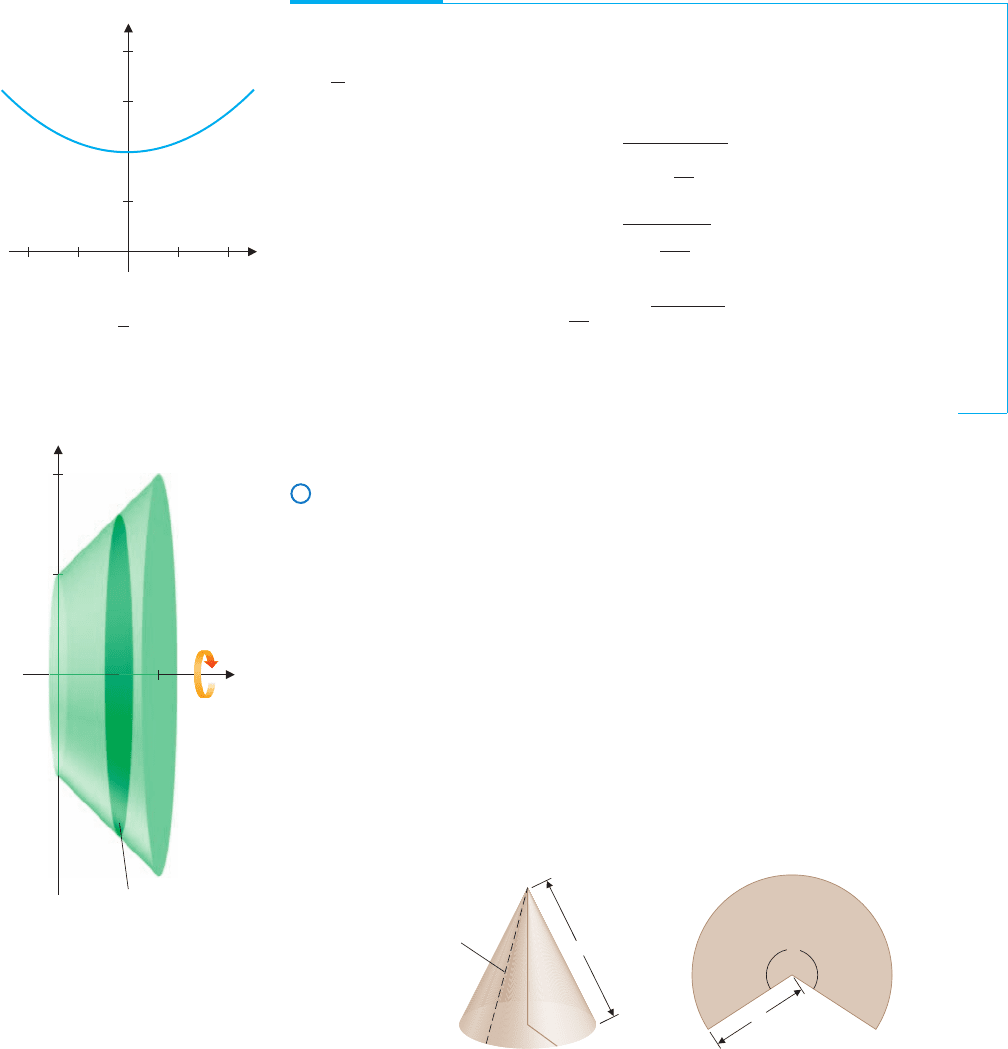
In sections 5.2 and 5.3, we saw how to compute the volume of a solid formed by revolving
a two-dimensional region about a fixed axis. In addition, we often want to determine the
area of the surface that is generated by the revolution. For instance, when revolving the
line y = x + 1, for 0 ≤ x ≤ 1, about the x-axis, the surface generated is the bottom portion
of a right circular cone whose top is cut off by a plane parallel to the base, as shown in
Figure 5.38.
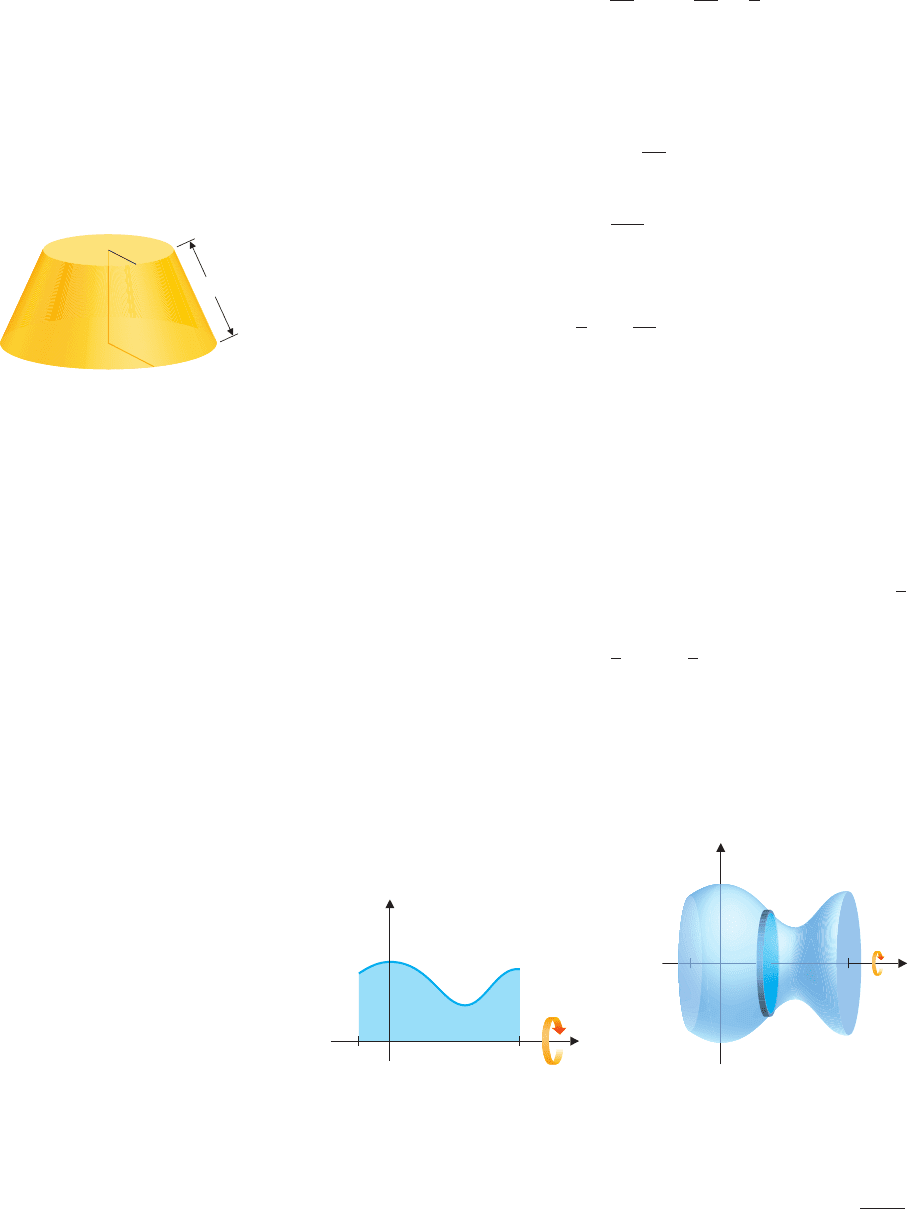
We first pause to find the curved surface area of a right circular cone. In Figure 5.39a,
we show a right circular cone of base radius r and slant height l. (As you’ll see later, it is
more convenient in this context to specify the slant height than the altitude.) If we cut the
cone along a seam and flatten it out, we get the circular sector shownin Figure 5.39b.Notice
that the curved surface area of the cone is the same as the area A of the circular sector. This
is the area of a circle of radius l multiplied by the fraction of the circle included: θ out
Cut along
a seam
r
l
l
u
FIGURE 5.39a
Right circular cone
FIGURE 5.39b
Flattened cone
P1: PIC/OVY P2: OSO/OVY QC: OSO/OVY T1: OSO
MHDQ256-Ch05 MHDQ256-Smith-v1.cls December 14, 2010 20:15
LT (Late Transcendental)
CONFIRMING PAGES
348 CHAPTER 5
..
Applications of the Definite Integral 5-34
of a possible 2π radians, or
A = π(radius)
2
θ
2π
= πl
2
θ
2π
=
θ
2
l
2
. (4.2)
The only problem with this is that we don’t know θ . However, notice that by the way we
constructed the sector (i.e., by flattening the cone), the circumference of the sector is the
same as the circumference of the base of the cone. That is,
2πr = 2πl
θ
2π
= lθ.
Dividing by l gives us θ =
2πr
l
.
From (4.2), the curved surface area of the cone is then
A =
θ
2
l
2
=
πr
l
l
2
= πrl.
L
r
1
r
2
FIGURE 5.40
Frustum of a cone
Recall that we were originally interested in finding the surface area of only a portion of
a right circular cone. (Look back at Figure 5.38.) For the frustum of a cone shown in
Figure 5.40, the curved surface area is given by
A = π(r
1
+r
2
)L.
You can verify this by subtracting the curved surface area of two cones, where you must
use similar triangles to find the height of the larger cone from which the frustum is cut. We
leave the details of this as an exercise.
Returning to the original problem of revolving the line y = x + 1 on the interval [0, 1]
about the x-axis (seen in Figure 5.38), we have r
1
= 1, r
2
= 2 and L =
√
2 (from the
Pythagorean Theorem). The curved surface area is then
A = π(1 + 2)
√
2 = 3π
√
2 ≈ 13.329.
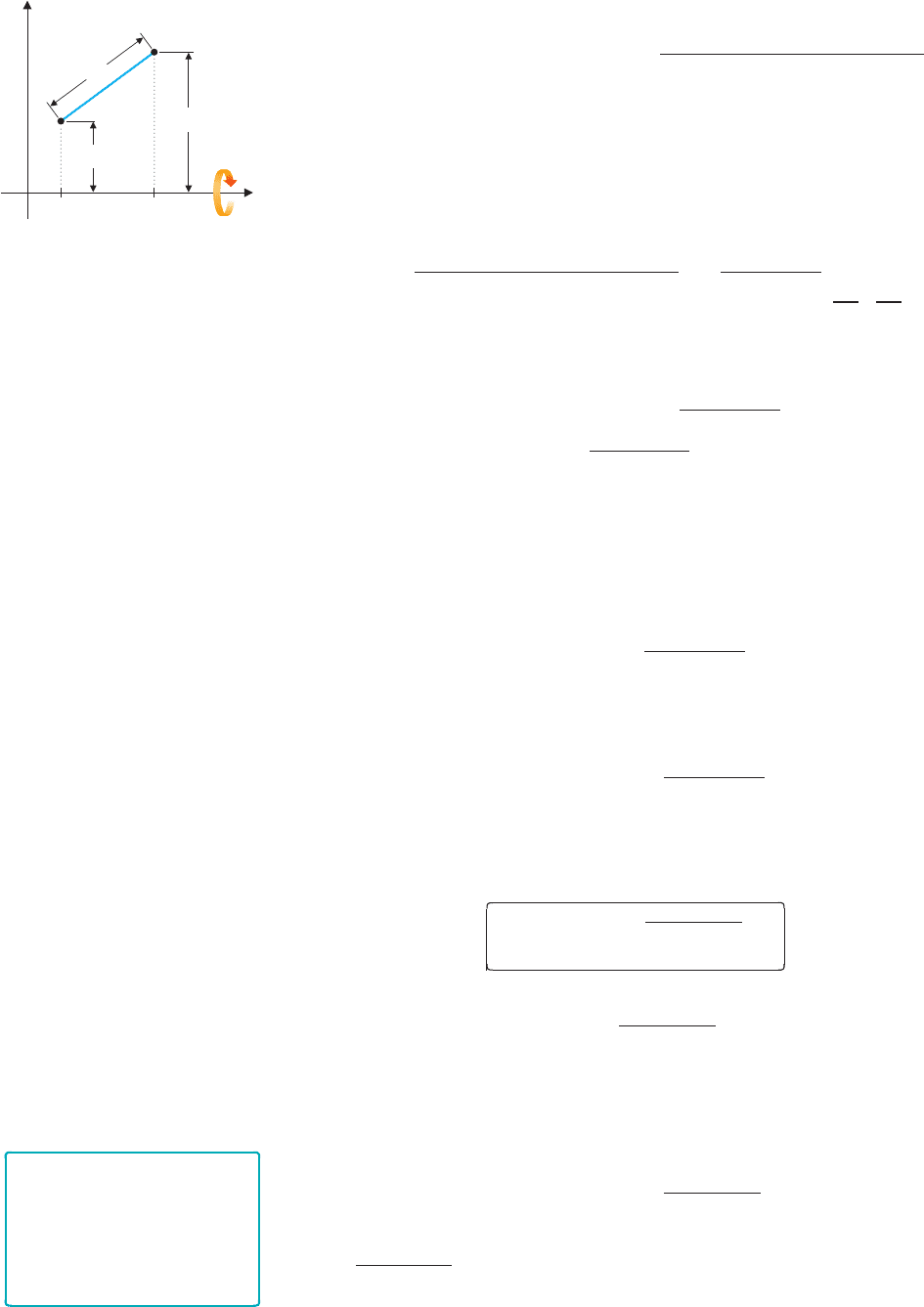
Forthegeneralproblemoffindingthecurvedsurfaceareaofasurfaceofrevolution,consider
the case where f (x) ≥ 0 and where f is continuous on the interval [a, b] and differentiable
on (a, b). If we revolve the graph of y = f (x) about the x-axis on the interval [a, b] (see
Figure 5.41a), we get the surface of revolution seen in Figure 5.41b.
x
ba
y
y f(x)
y f(x)
x
y
a b
FIGURE 5.41a
Revolve about x-axis
FIGURE 5.41b
Surface of revolution
As we have done many times now, we first partition the interval [a, b] into n pieces
of equal size: a = x
0
< x
1
< ···< x
n
= b, where x
i
− x
i−1
= x =
b −a
n
, for each
i = 1, 2,...,n. On each subinterval[x
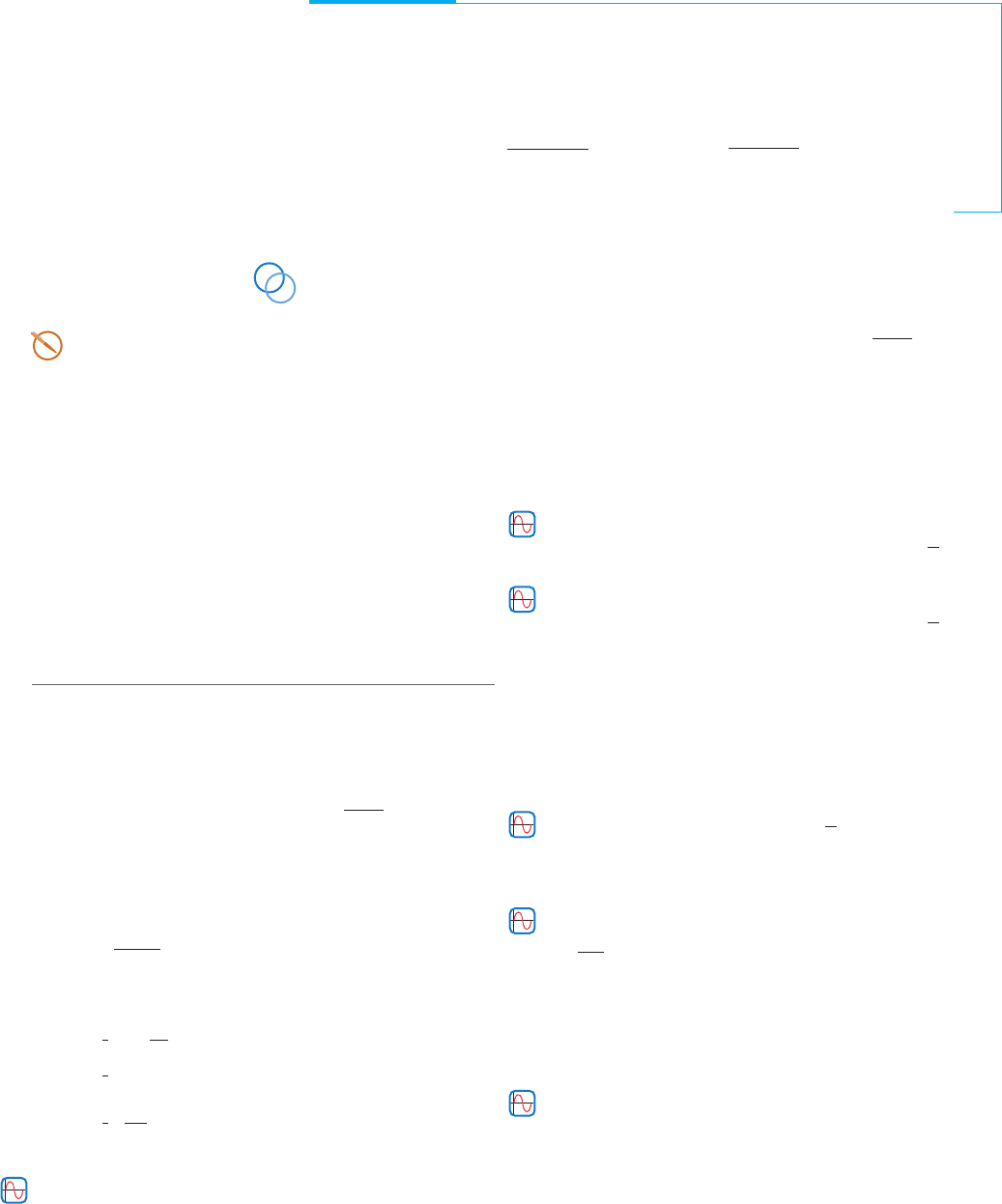
i−1
, x
i
],we canapproximate the curvebythestraight
line segment joining the points (x
i−1
, f (x
i−1
)) and (x
i
, f (x
i
)), as in Figure 5.42. Notice that
revolving this line segment around the x-axis generates the frustum of a cone. The surface
P1: PIC/OVY P2: OSO/OVY QC: OSO/OVY T1: OSO
MHDQ256-Ch05 MHDQ256-Smith-v1.cls December 14, 2010 20:15
LT (Late Transcendental)
CONFIRMING PAGES
5-35 SECTION 5.4
..
Arc Length and Surface Area 349
area of this frustum will give us an approximation to the actual surface area on the interval
[x
i−1
, x
i
]. First, observe that the slant height of this frustum is
L
i
= d{(x
i−1
, f (x
i−1
)), (x
i
, f (x
i
))}=
(x
i
− x
i−1
)
2
+ [ f (x
i
) − f (x
i−1
)]
2
,
from the usual distance formula. Because of our assumptions on f, we can apply the Mean
Value Theorem, to obtain
f (x
i
) − f (x
i−1
) = f
(c
i
)(x
i
− x
i−1
),
for some number c
i
∈ (x
i−1
, x
i
). This gives us
L
i
=
(x
i
− x
i−1
)
2
+ [ f (x
i
) − f (x
i−1
)]
2
=
1 + [ f
(c
i
)]
2
(x
i
− x
i−1
)
x
.
f(x
i
)
f(x
i1
)
x
y
L
i
x
i
x
i1
FIGURE 5.42
Revolve about x-axis
The surface area S
i
of that portion of the surface on the interval [x
i−1
, x
i
] is approximately
the surface area of the frustum of the cone,
S
i
≈ π [ f (x
i
) + f (x
i−1
)]
1 + [ f
(c
i
)]
2
x
≈ 2π f (c
i
)
1 + [ f
(c
i
)]
2
x,
since if x is small, f (x
i
) + f (x
i−1
) ≈ 2 f (c
i
).
Repeatingthis argumentfor each subinterval[x
i−1
, x
i
], i = 1, 2,...,n,gives us an approx-
imation to the total surface area S,
S ≈
n
i=1
2π f (c
i
)
1 + [ f
(c
i
)]
2
x.
As n gets larger, this approximation approaches the actual surface area,
S = lim
n→∞
n
i=1
2π f (c
i
)
1 + [ f
(c
i
)]
2
x.
Recognizing this as the limit of a Riemann sum gives us the integral
S =
b
a
2π f (x)
1 + [ f
(x)]
2
dx, (4.3)
Surface area of a solid of revolution
whenever the integral exists.
REMARK 4.2
There are exceptionally few
functions f for which the
integral in (4.3) can be
computed exactly. Don’t worry;
we have numerical integration
for just such occasions.
You should notice that the factor of
1 + [ f
(x)]
2
dx in the integrand in (4.3) corre-
sponds to the arc length of a small section of the curve y = f (x), while the factor 2π f (x)
corresponds to the circumference of the solid of revolution. This should make sense to
you, as follows. For any small segment of the curve, if we approximate the surface area by
revolving a small segment of the curve of radius f (x) around the x-axis, the surface area
generated is simply the surface area of a cylinder,
S = 2πrh = 2π f (x)
1 + [ f
(x)]
2
dx,
since the radius of such a small cylindrical segment is f (x) and the height of the cylinder
is h =
1 + [ f
(x)]
2
dx. It is far better to think about the surface area formula in this way
than to simply memorize the formula.
P1: PIC/OVY P2: OSO/OVY QC: OSO/OVY T1: OSO
MHDQ256-Ch05 MHDQ256-Smith-v1.cls December 14, 2010 20:15
LT (Late Transcendental)
CONFIRMING PAGES
350 CHAPTER 5
..
Applications of the Definite Integral 5-36
EXAMPLE 4.5 Computing Surface Area
Find the surface area of the surface generated by revolving y = x
4
, for 0 ≤ x ≤ 1, about
the x-axis.
Solution Using the surface area formula (4.3), we have
S =
1
0
2π x
4
1 + (4x
3
)
2
dx =
1
0
2π x
4
1 + 16x
6
dx ≈ 3.4365,
where we have used a numerical method to approximate the value of the integral.
EXERCISES 5.4
WRITING EXERCISES
1. Explain in words how the arc length integral is derived from
the lengths of the approximating secant line segments.
2. Explain why the sum of the lengths of the line segments
in Figure 5.34b is less than the arc length of the curve in
Figure 5.34a.
3. Discuss whether the arc length integral is more accurately
called a formula or a definition (i.e., can you precisely define
the length of a curve without using the integral?).
4. Suppose you graph the trapezoid bounded by y = x + 1, y =
−x − 1, x = 0 and x = 1, cut it out and roll it up. Explain
why you would not get Figure 5.38. (Hint: Compare areas and
carefully consider Figures 5.39a and 5.39b.)
In exercises 1–4, approximate the length of the curve using n
secant lines for n 2; n 4.
1. y = x
2
, 0 ≤ x ≤ 1 2. y = x
4
, 0 ≤ x ≤ 1
3. y = cos x, 0 ≤ x ≤ π 4. y =
√
x + 3, 1 ≤ x ≤ 3
............................................................
In exercises 5–10, compute the arc length exactly.
5. y = 2x + 1, 0 ≤ x ≤ 2
6. y =
√
1 − x
2
, −1 ≤ x ≤ 1
7. y = 4x
3/2
+ 1, 1 ≤ x ≤ 2
8. y =
1
8
x
4
+
1
4x
2
, −2 ≤ x ≤−1
9. y =
1
3
x
3/2
− x
1/2
, 1 ≤ x ≤ 4
10. y =
3
4
x
4/3
2
− x
2/3
, 1 ≤ x ≤ 8
............................................................
In exercises 11–18, set up the integral for arc length and then
approximate the integral with a numerical method.
11. y = x
3
, −1 ≤ x ≤ 1 12. y = x
3
, −2 ≤ x ≤ 2
13. y = 2x − x
2
, 0 ≤ x ≤ 2 14. y = tan x, 0 ≤ x ≤ π/4
15. y = cos x, 0 ≤ x ≤ π 16. y =
√
x + 3, 1 ≤ x ≤ 3
17. y =
x
0
u sin udu, 0 ≤ x ≤ π
18. y =
x
0
u
2
sinudu, 0 ≤ x ≤ π
............................................................
19. A banner is to be hung along an arch between two poles
20 feet apart. If the arch is in the shape of y =
1
10
x
2
+ 20,
−10 ≤ x ≤ 10, compute the length of the banner.
20. A banner is to be hung along an arch between two poles
60 feet apart. If the arch is in the shape of y =
1
90
x
2
+ 30,
−30 ≤ x ≤ 30, compute the length of the banner.
21. In example 4.4, compute the “sag” in the banner—that is, the
difference between the y-values in the middle (x = 0) and at
the poles (x = 10). Given this, is the arc length calculation
surprising?
22. Sketch and compute the length of the astroid defined by
x
2/3
+ y
2/3
= 1.
23. Afootballpuntfollowsthepath y =
1
15
x(60 − x)yards.Sketch
a graph. How far did the punt go horizontally? How high did
it go? Compute the arc length. If the ball was in the air for
4 seconds, what was the ball’s average velocity?
24. A baseball outfielder’s throw follows the path y =
1
300
x(100 − x) yards. Sketch a graph. How far did the ball
go horizontally? How high did it go? Compute the arc length.
Explainwhy the baseball player would wanta small arc length,
while the football player in exercise 23 would want a large arc
length.
............................................................
In exercises 25–30, set up the integral for the surface area of
the surface of revolution and approximate the integral with a
numerical method.
25. y = x
2
, 0 ≤ x ≤ 1, revolved about the x-axis
26. y = sin x, 0 ≤ x ≤ π, revolved about the x-axis
27. y = 2x − x
2
, 0 ≤ x ≤ 2, revolved about the x-axis
28. y = x
3
− 4x, −2 ≤ x ≤ 0, revolved about the x-axis
P1: PIC/OVY P2: OSO/OVY QC: OSO/OVY T1: OSO
MHDQ256-Ch05 MHDQ256-Smith-v1.cls December 14, 2010 20:15
LT (Late Transcendental)
CONFIRMING PAGES
5-37 SECTION 5.4
..
Arc Length and Surface Area 351
29. y = cos x, 0 ≤ x ≤ π/2, revolved about the x-axis
30. y =
√
x, 1 ≤ x ≤ 2, revolved about the x-axis
............................................................
31. For y = x
6
, y = x
8
and y = x
10
, compute the arc length for
0 ≤ x ≤ 1. Using results from examples 4.2 and 4.3, identify
the pattern forthe length of y = x
n
, 0 ≤ x ≤ 1, as n increases.
Conjecture the limit as n →∞.
32. (a) To help understand the result of exercise 31, determine
lim
n→∞
x
n
for each x such that 0 ≤ x < 1. Compute the length
ofthis limiting curve. Connecting this curve to the endpoint
(1, 1), what is the total length?
(b) Prove that y = x
4
is flatter than y = x
2
for 0 < x <
1/2
and steeper for x >
1/2. Compare the flatness and steep-
ness of y = x
6
and y = x
4
.
............................................................
In exercises 33 and 34, compute the arc length L
1
of the curve
and the length L
2
of the secant line connecting the endpoints of
the curve. Compute the ratio L
2
/L
1
; the closer this number is
to 1, the straighter the curve is.
33. (a) y = sin x, −
π
6
≤ x ≤
π
6
(b) −
π
2
≤ x ≤
π
2
34. (a) y = x
2
, 3 ≤ x ≤ 5 (b) −5 ≤ x ≤−3
............................................................
35. (a) Suppose that the square consisting of all (x, y) with
−1≤x ≤1 and −1 ≤ y ≤ 1 is revolved about the y-axis.
Compute the surface area. (b) Suppose that the circle
x
2
+ y
2
= 1 is revolved about the y-axis. Compute the sur-
face area. (c) Suppose that the triangle with vertices (−1, −1),
(0, 1) and (1, −1) is revolved about the y-axis. Compute the
surface area. (d) Sketch the square, circle and triangle of ex-
ercises 42–44 on the same axes. Show that the relative surface
areas of the solids of revolution (cylinder, sphere and cone,
respectively) are 3:2:τ, where τ is the golden mean defined
by τ =
1 +
√
5
2
.
36. (a) The elliptic integral of the second kind is defined
by EllipticE(φ,m) =
φ
0
1 − m sin
2
udu. Referring to
example 4.1, many CASs report
√
2EllipticE(x,
1
2
)as
an antiderivative of
√
1 + cos
2
x. Verify that this is an
antiderivative.
(b) Many CASs report the antiderivative
√
1 + 16x
6
dx =
1
4
x
1 + 16x
6
+
3/4
√
1 + 16x
6
dx.
Verify that this is an antiderivative.
37. Two people walk along different paths starting at the origin,
such that they have the same positive x-coordinate at each
time. One follows the positive x-axis and the other follows
y =
2
3
x
3/2
. Find the point at which one person has walked
twice as far as the other. (Suggested by Tim Pennings.)
38. Let f (t)bethedistancewalkedalong y =
2
3
x
3/2
for0 ≤ x ≤ t.
Compute f
(t) and use it to determine the point at which the
ratio of the speeds of the walkers in exercise 37 equals 2.
EXPLORATORY EXERCISES
1. In this exercise, you will explore a famous paradox (often
called Gabriel’s horn). Suppose that the curve y = 1/x, for
1 ≤ x ≤ R (where R is a large positive constant), is revolved
about the x-axis. Compute the enclosed volume and the sur-
faceareaoftheresulting surface. (In both cases,antiderivatives
can be found, although you may need help from your CAS to
get the surface area.) Determine the limit of the volume and
surface area as R →∞. Now for the paradox. Based on your
answers, you should have a solid with finite volume, but infi-
nite surface area. Thus, the three-dimensional solid could be
completely filled with a finite amount of paint but the outside
surface could never be completely painted.
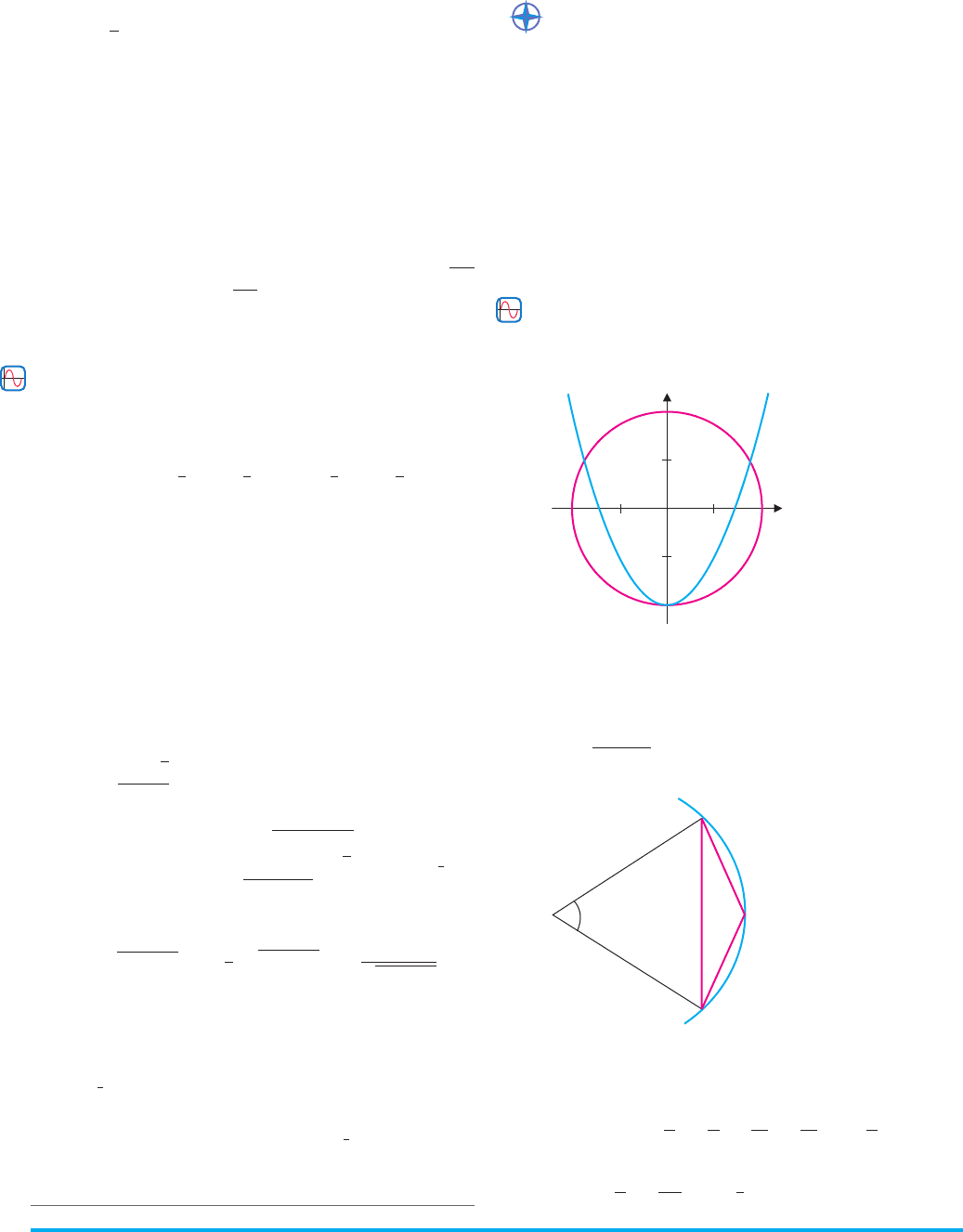
2. Let C be the portion of the parabola y = ax
2
− 1 inside the
circle x
2
+ y
2
= 1.
10.5
x
y
0.5
0.5
1
1
0.5
1
Find the value of a > 0 that maximizes the arc length of C.
3. The figure shows an arc of a circle subtended by an angle θ,
with a chord of length L and two chords of length s. Show that
2s =
L
cos(θ/4)
.
s
s
L
θ
Start with a quarter-circle and use this formula repeatedly to
derive the infinite product
cos
π
4
cos
π
8
cos
π
16
cos
π
32
···=
2
π
where the left-hand side represents
lim
n→∞
(cos
π
2
n
cos
π
2
n−1
···cos
π
4
).
P1: PIC/OVY P2: OSO/OVY QC: OSO/OVY T1: OSO
MHDQ256-Ch05 MHDQ256-Smith-v1.cls December 14, 2010 20:15
LT (Late Transcendental)
CONFIRMING PAGES
352 CHAPTER 5
..
Applications of the Definite Integral 5-38
5.5 PROJECTILE MOTION
In sections 2.1, 2.3 and 4.1, we discussed aspects of the motion of an object moving in a
straight line path (rectilinear motion). We saw that if we know a function describing the
position of an object at any time t, then we can determine its velocity and acceleration
by differentiation. A much more important problem is to go backward, that is, to find the
position and velocity of an object, given its acceleration. Mathematically, this means that,
starting with the derivative of a function, we must find the original function. Now that we
have integration at our disposal, we can accomplish this with ease.
You may already be familiar with Newton’s second law of motion, which says that
F = ma,
where F is the sum of the forces acting on an object, m is the mass of the object and a is
the acceleration of the object.
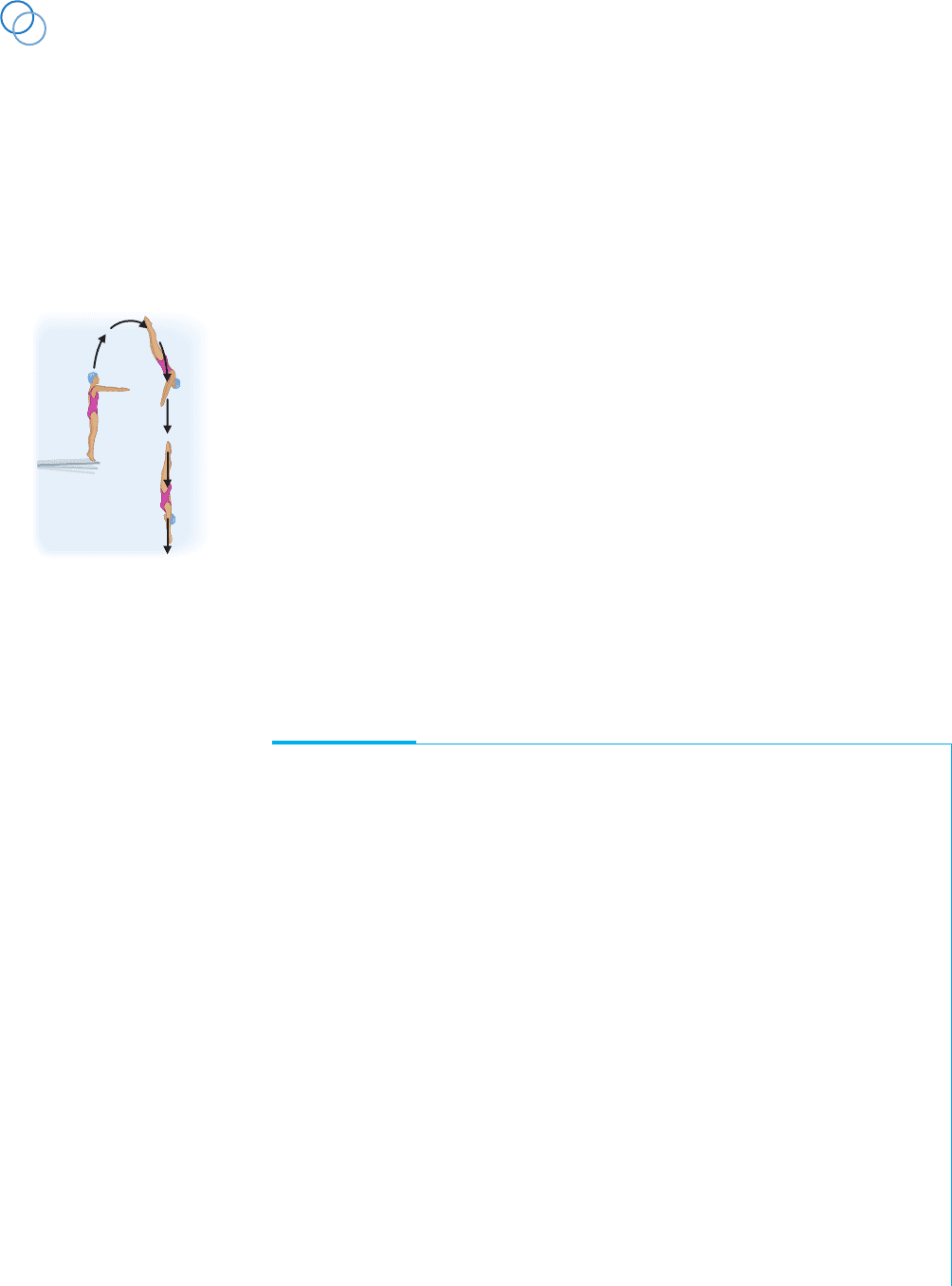
Start by imagining that you are diving. The primary force acting on you throughout
the dive is gravity. The force due to gravity is your own weight, which is related to mass by
W = mg, where g is the gravitational constant. (Common approximations of g, accurate
near sea level, are 32 ft/s
2
and 9.8 m/s
2
.) To keep the problem simple mathematically, we
will ignore any other forces, such as air resistance.
Let h(t) represent your height above the water t seconds after starting your dive. Then
the force due to gravity is F =−mg, where the minus sign indicates that the force is acting
downward, in the negative direction. From our earlier work, we know that the acceleration
is a(t) = h
(t). Newton’s second law then gives us −mg = mh
(t)or
h
(t) =−g.
Notice that the position function of any object (regardless of its mass) subject to gravity
and no other forces will satisfy the same equation. The only differences from situation to
situation are the initial conditions (the initial velocity and initial position) and the questions
being asked.
EXAMPLE 5.1 Finding the Velocity of a Diver at Impact
If a diving board is 15 feet above the surface of the water and a diver starts with initial
velocity 8 ft/s (in the upward direction), what is the diver’s velocity at impact (assuming
no air resistance)?
Solution If the height (in feet) at time t is given by h(t), Newton’s second law gives
us h
(t) =−32. Since the diver starts 15 feet above the water with initial velocity of
8 ft/s, we have the initial conditions h(0) = 15 and h
(0) = 8. Finding h(t) now takes
little more than elementary integration. We have
h
(t) dt =
−32dt
or
h
(t) =−32t + c.
From the initial velocity, we have
8 = h
(0) =−32(0) + c = c,
so that c = 8 and the velocity at any time t is given by
h
(t) =−32t + 8.
To find the velocity at impact, you first need to find the time of impact. Notice that the
diver will hit the water when h(t) = 0 (i.e., when the height above the water is 0).