
Smith R., Minton R. Calculus
Подождите немного. Документ загружается.

P1: PIC/OVY P2: OSO/OVY QC: OSO/OVY T1: OSO
MHDQ256-Ch05 MHDQ256-Smith-v1.cls December 14, 2010 20:15
LT (Late Transcendental)
CONFIRMING PAGES
5-49 SECTION 5.6
..
Applications of Integration to Physics and Engineering 363
EXAMPLE 6.3 Computing the Work Required to Pump Water
Out of a Tank
A spherical tank of radius 10 feet is filled with water. Find the work done in pumping all
of the water out through the top of the tank.
Solution The basic formula W = Fd does not directly apply here, for several reasons.
The most obvious of these is that the distance traveled by the water in each part of the
tank is different, as the water toward the bottom of the tank must be pumped all the way
to the top, while the water near the top of the tank must be pumped only a short distance.
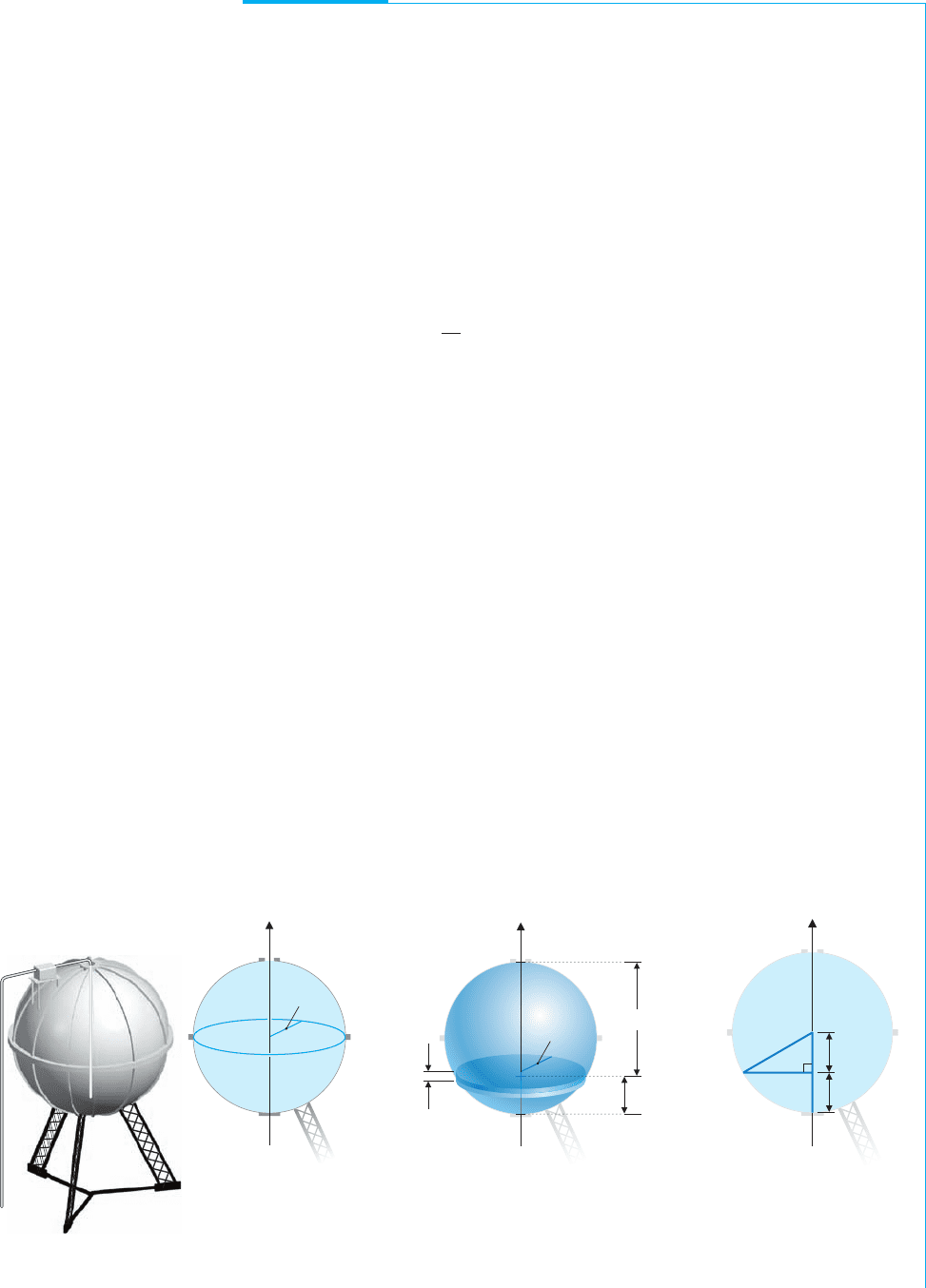
Let x represent distance as measured from the bottom of the tank, as in Figure 5.50a.
The entire tank corresponds to the interval 0 ≤ x ≤ 20, which we partition into
0 = x
0
< x
1
< ···< x
n
= 20,
where x
i
− x
i−1
= x =
20
n
, for each i = 1, 2,...,n. This partitions the tank into n
thin layers, each corresponding to an interval [x
i−1
, x
i
]. (See Figure 5.50b.) You can
think of the water in the layer corresponding to [x
i−1
, x
i
] as being approximately
cylindrical, of height x. This layer must be pumped a distance of approximately
20 − c
i
, for some c
i
∈ [x
i−1
, x
i
]. Notice from Figure 5.50b that the radius of the ith
layer depends on the value of x. From Figure 5.50c (where we show a cross section of
the tank), the radius r
i
corresponding to a depth of x = c
i
is the base of a right triangle
with hypotenuse 10 and height |10 − c
i
|. From the Pythagorean Theorem, we
now have
(10 − c
i
)
2
+r
2
i
= 10
2
.
Solving this for r
2
i
,wehave
r
2
i
= 10
2
− (10 −c
i
)
2
= 100 −
100 − 20c
i
+ c
2
i
= 20c
i
− c
2
i
.
The force F
i
required to move the ith layer is then simply the force exerted on the
water by gravity (i.e., its weight). Since the weight density of water is 62.4 lb/ft
3
,we
now have
F
i
≈ (Volume of cylindrical slice) (weight of water per unit volume)
=
πr
2
i
h
(62.4 lb/ft
3
)
= 62.4π
20c
i
− c
2
i
x.
x 20
x 10
x 0
10
x
20 c
i
x
c
i
r
i
x
10 c
i
10
x
r
i
c
i
FIGURE 5.50a
Spherical tank
FIGURE 5.50b
The ith slice of water
FIGURE 5.50c
Cross section of tank

P1: PIC/OVY P2: OSO/OVY QC: OSO/OVY T1: OSO
MHDQ256-Ch05 MHDQ256-Smith-v1.cls December 14, 2010 20:15
LT (Late Transcendental)
CONFIRMING PAGES
364 CHAPTER 5
..
Applications of the Definite Integral 5-50
The work required to pump out the ith slice is then given approximately by
W
i
≈ (Force) (distance)
= 62.4π
20c
i
− c
2
i
x(20 −c
i
)
= 62.4π c
i
(20 − c
i
)
2
x.
The work required to pump out all of the water is then the sum of the work required for
each of the n slices:
W ≈
n
i=1
62.4πc
i
(20 − c
i
)
2
x.
Finally, taking the limit as n →∞gives the exact work, which you should recognize as
a definite integral:
W = lim
n→∞
n
i=1
62.4πc
i
(20 − c
i
)
2
x =
20
0
62.4π x(20 − x)
2
dx
= 62.4π
20
0
(400x − 40x
2
+ x
3
) dx
= 62.4π
400
x
2
2
− 40
x
3
3
+
x
4
4
20
0
= 62.4π
40,000
3
≈ 2.61 × 10
6
(foot-pounds).
Impulse is a physical quantity closely related to work. Instead of relating force and
distance to account for changes in energy, impulse relates force and time to account for
changes in velocity. First, suppose that a constant force F is applied to an object from time
t = 0 to time t = T. If the position of the object at time t is given by x(t), then Newton’s
second law says that F = ma = mx
(t). Integrating this equation once with respect to t
gives us
T
0
Fdt = m
T
0
x
(t) dt,
or
F(T − 0) = m[x
(T ) − x
(0)].
Recall that x
(t) is the velocity v(t), so that
FT = m[v(T ) −v(0)]
or FT = mv, where v = v(T ) −v(0) is the change in velocity. The quantity FT is called
the impulse, mv(t)isthemomentum at time t and the equation relating the impulse to the
change in velocity is called the impulse-momentum equation.
Just as we extended the concept of work to include nonconstant forces, we must
generalize the notion of impulse. Think about this and try to guess what the definition
should be.
We define the impulse J of a force F(t) applied over the time interval [a, b]tobe
J =
b
a
F(t)dt.
Impulse
We leave the derivation of this as an exercise. The impulse-momentum equation likewise
generalizes to:
J = m[v(b) − v(a)].
Impulse-momentum equation
P1: PIC/OVY P2: OSO/OVY QC: OSO/OVY T1: OSO
MHDQ256-Ch05 MHDQ256-Smith-v1.cls December 14, 2010 20:15
LT (Late Transcendental)
CONFIRMING PAGES
5-51 SECTION 5.6
..
Applications of Integration to Physics and Engineering 365
EXAMPLE 6.4 Estimating the Impulse for a Baseball
Suppose that a baseball traveling at 130 ft/s (about 90 mph) collides with a bat. The
following data (adapted from The Physics of Baseball by Robert Adair) shows the force
exerted by the bat on the ball at 0.0001-second intervals.
t (s) 0 0.0001 0.0002 0.0003 0.0004 0.0005 0.0006 0.0007
F(t) (lb) 0 1250 4250 7500 9000 5500 1250 0
Estimate the impulse of the bat on the ball and (using m = 0.01 slug) the speed of the
ball after impact.
Solution In this case, the impulse J is given by
0.0007
0
F(t)dt. Since we’re given only
a fixed number of measurements of F(t), the best we can do is approximate the integral
numerically (e.g., using Simpson’s Rule). Recall that Simpson’s Rule requires an even
number n of subintervals, which means that you need an odd number n +1 of points in
the partition. Using n = 8 and adding a 0 function value at t = 0.0008 (why is it fair to
do this?), Simpson’s Rule gives us
J ≈ [0 +4(1250) +2(4250) +4(7500) + 2(9000) + 4(5500)
+2(1250) +4(0) +0]
0.0001
3
≈ 2.867.
In this case, the impulse-momentum equation J = m v becomes 2.867 = 0.01v or
v = 286.7 ft/s. Since the ball started out with a speed of 130 ft/s in one direction and it
ended up moving in the opposite direction, the speed after impact is 156.7 ft/s.
d
1
m
1
m
2
d
2
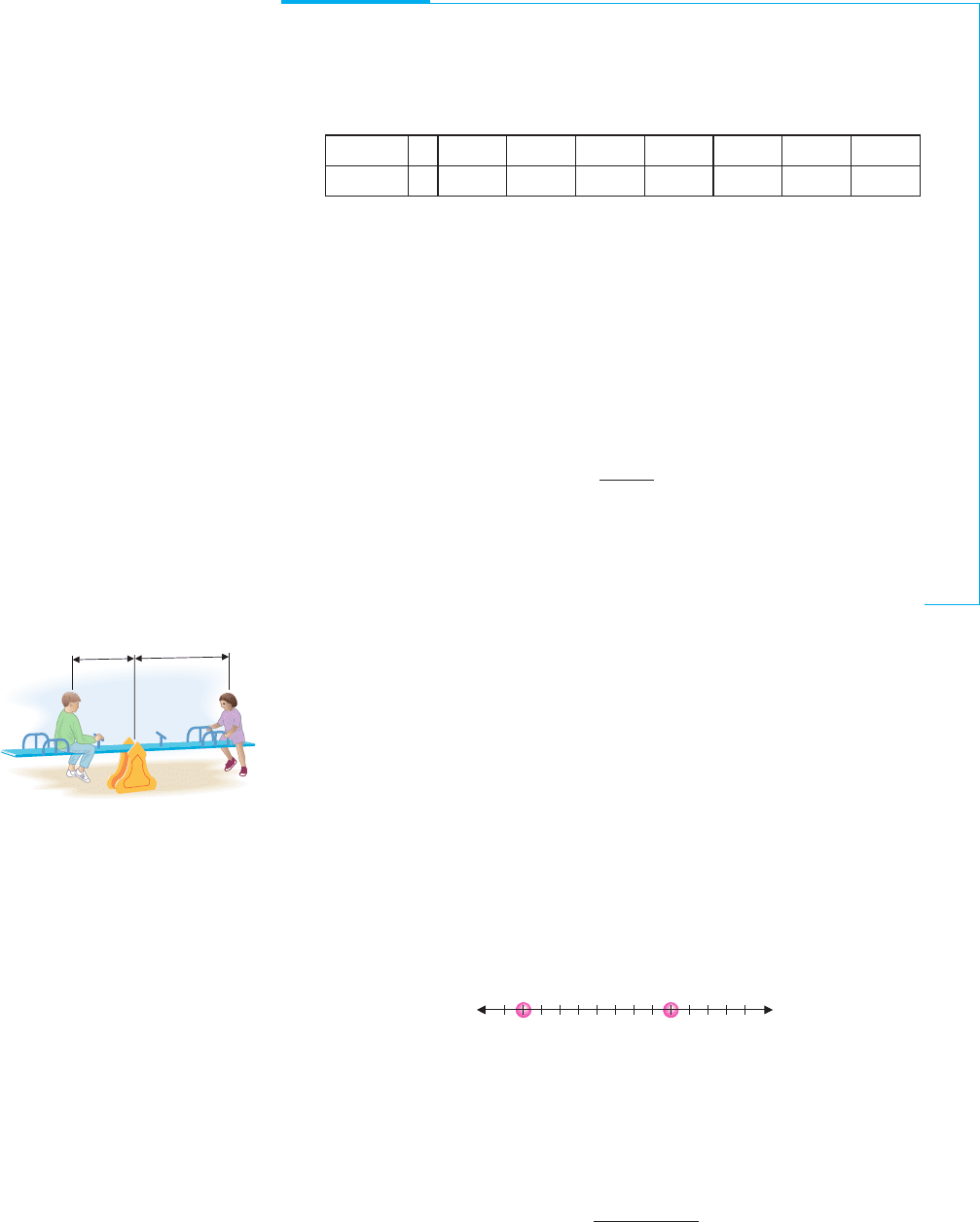
FIGURE 5.51a
Balancing two masses
Consider two children on a playground seesaw (or teeter-totter). Suppose that the child
on the left in Figure 5.51a is heavier (i.e., has larger mass) than the child on the right. If
the children sit an equal distance from the pivot point, you know what will happen: the left
side will be pulled down. However, the children can balance each other if the heavier child
moves closer to the pivot point. That is, the balance is determined both by weight (force)
and distance from the pivot point. If the children have masses m
1
and m
2
and are sitting at
distances d
1
and d
2
, respectively, from the pivot point, then they balance each other if and
only if
m
1
d
1
= m
2
d
2
. (6.3)
Turningthe problem around slightly,suppose there are two objects, of mass m
1
and m
2
,
locatedat x
1
and x
2
,respectively, with x
1
< x
2
.We consider the objects to be point-masses.
That is, each is treated as a single point, with all of the mass concentrated at that point. (See
Figure 5.51b.)
x
m
1
m
2
x
1
x
2
FIGURE 5.51b
Two point-masses
We want to find the center of mass
¯
x, that is, the location at which we could place the
pivot of a seesaw and have the objects balance. From the balance equation (6.3), we’ll need
m
1
(
¯
x − x
1
) = m
2
(x
2
−
¯
x). Solving this equation for
¯
x gives us
¯
x =
m
1
x
1
+ m
2
x
2
m
1
+ m
2
.
Notice that the denominator in this equation is the total mass of the “system” (i.e., the total
mass of the two objects). The numerator of this expression is called the first moment of
the system.

P1: PIC/OVY P2: OSO/OVY QC: OSO/OVY T1: OSO
MHDQ256-Ch05 MHDQ256-Smith-v1.cls December 14, 2010 20:15
LT (Late Transcendental)
CONFIRMING PAGES
366 CHAPTER 5
..
Applications of the Definite Integral 5-52
More generally, for a system of n masses m
1
, m
2
,...,m
n
, located at x = x
1
,
x
2
,...,x
n
, respectively, the center of mass
¯
x is given by the first moment divided by
the total mass, that is,
¯
x =
m
1
x
1
+ m
2
x
2
+···+m
n
x
n
m
1
+ m
2
+···+m
n
.
Center of mass
Now, suppose that we wish to find the mass and center of mass of an object of variable
density ρ(x) (measured in units of mass per unit length) that extends from x = a to x = b.
Note that if the density is a constant ρ, the mass of the object is simply given by
m = ρ L, where L = b − a is the length of the object. On the other hand, if the density
varies throughout the object, we can approximate the mass by partitioning the interval
[a, b] into n pieces of equal width x =
b −a
n
. On each subinterval [x
i−1
, x
i
], the mass
is approximately ρ(c
i
)x, where c
i
is a point in the subinterval. The total mass is then
approximately
m ≈
n
i=1
ρ(c
i
)x.
You should recognize this as a Riemann sum, which approaches the total mass as n →∞,
m = lim
n→∞
n
i=1
ρ(c
i
)x =
b
a
ρ(x) dx. (6.4)
Mass
EXAMPLE 6.5 Computing the Mass of a Baseball Bat
A 30-inch baseball bat can be represented approximately by an object extending from
x = 0tox = 30 inches, with density ρ(x) =
1
46
+
x
690
2
slugs per inch. This model
of the density function takes into account the fact that a baseball bat is similar to an
elongated cone. Find the mass of the object.
Solution From (6.4), the mass is given by
m =
30
0
1
46
+
x
690
2
dx
=
690
3
1
46
+
x
690
3
30
0
=
690
3
&
1
46
+
30
690
3
−
1
46
3
'
≈ 6.144 ×10
−2
slug.
To compute the weight (in ounces), multiply the mass by 32 · 16. The bat weighs
roughly 31.5 ounces.
To compute the first moment for an object of nonconstant density ρ(x) extending
from x = a to x = b, we again partition the interval into n equal pieces. From our earlier
argument, for each i = 1, 2,...,n, the mass of the ith slice of the object is approximately
ρ(c
i
)x, for any choice of c
i
∈ [x
i−1
, x
i
]. We then represent the ith slice of the object with
a particle of mass m
i
= ρ(c
i
)x located at x = c
i
. We can now think of the original object
as having been approximated by n distinct point-masses, as indicated in Figure 5.52.
x
m
1
m
4
c
1
m
2
c
2
m
3
c
3
c
4
m
5
c
5
m
6
c
6
FIGURE 5.52
Six point-masses
P1: PIC/OVY P2: OSO/OVY QC: OSO/OVY T1: OSO
MHDQ256-Ch05 MHDQ256-Smith-v1.cls December 14, 2010 20:15
LT (Late Transcendental)
CONFIRMING PAGES
5-53 SECTION 5.6
..
Applications of Integration to Physics and Engineering 367
Notice that the first moment M
n
of this approximate system is
M
n
= [ρ(c
1
)x]c
1
+ [ρ(c
2
)x]c
2
+···+[ρ(c
n
)x]c
n
= [c
1
ρ(c
1
) + c
2
ρ(c
2
) +···+c
n
ρ(c
n
)]x =
n
i=1
c
i
ρ(c
i
)x.
Taking the limit as n →∞, the sum approaches the first moment
M = lim
n→∞
n
i=1
c
i
ρ(c
i
)x =
b
a
xρ(x) dx. (6.5)
First moment
The center of mass of the object is then given by
¯
x =
M
m
=
b
a
xρ(x)dx
b
a
ρ(x)dx
. (6.6)
Center of mass
EXAMPLE 6.6 Finding the Center of Mass (Sweet Spot)
of a Baseball Bat
Find the center of mass of the baseball bat from example 6.5.
Solution From (6.5), the first moment is given by
M =
30
0
x
1
46
+
x
690
2
dx =
x
2
4232
+
x
3
47,610
+
x
4
1,904,400
30
0
≈ 1.205.
Recall that we had already found the mass to be m ≈ 6.144 ×10
−2
slug and so, from
(6.6), the center of mass of the bat is
¯
x =
M
m
≈
1.205
6.144 × 10
−2
≈ 19.6 inches.
Note that for a baseball bat, the center of mass is one candidate for the so-called “sweet
spot” of the bat, the best place to hit the ball.
For our final application of integration in this section, we consider hydrostatic force.
Imagine a dam holding back a lake full of water. What force must the dam withstand?
As usual, we solve a simpler problem first. If you have a flat rectangular plate oriented
horizontally underwater, notice that the force exerted on the plate by the water (the hydro-
static force) is simply the weight of the water lying above the plate. This is the product of
the volume of the water lying above the plate and the weight density of water (62.4 lb/ft
3
).
If the area of the plate is A ft
2
and it lies d ft below the surface (see Figure 5.53), then the
force on the plate is
F = 62.4Ad.
Hoover Dam
Depth d
A
FIGURE 5.53
A plate of area A submerged
to depth d
According to Pascal’s Principle, the pressure at a given depth d in a fluid is the same in all
directions. This says that if a flat plate is submerged in a fluid, then the pressure on one side
of the plate at any given point is ρ · d, where ρ is the weight density of the fluid and d is the
depth. In particular, this says that it’s irrelevant whether the plate is submerged vertically,
horizontally or otherwise. (See Figure 5.54.)
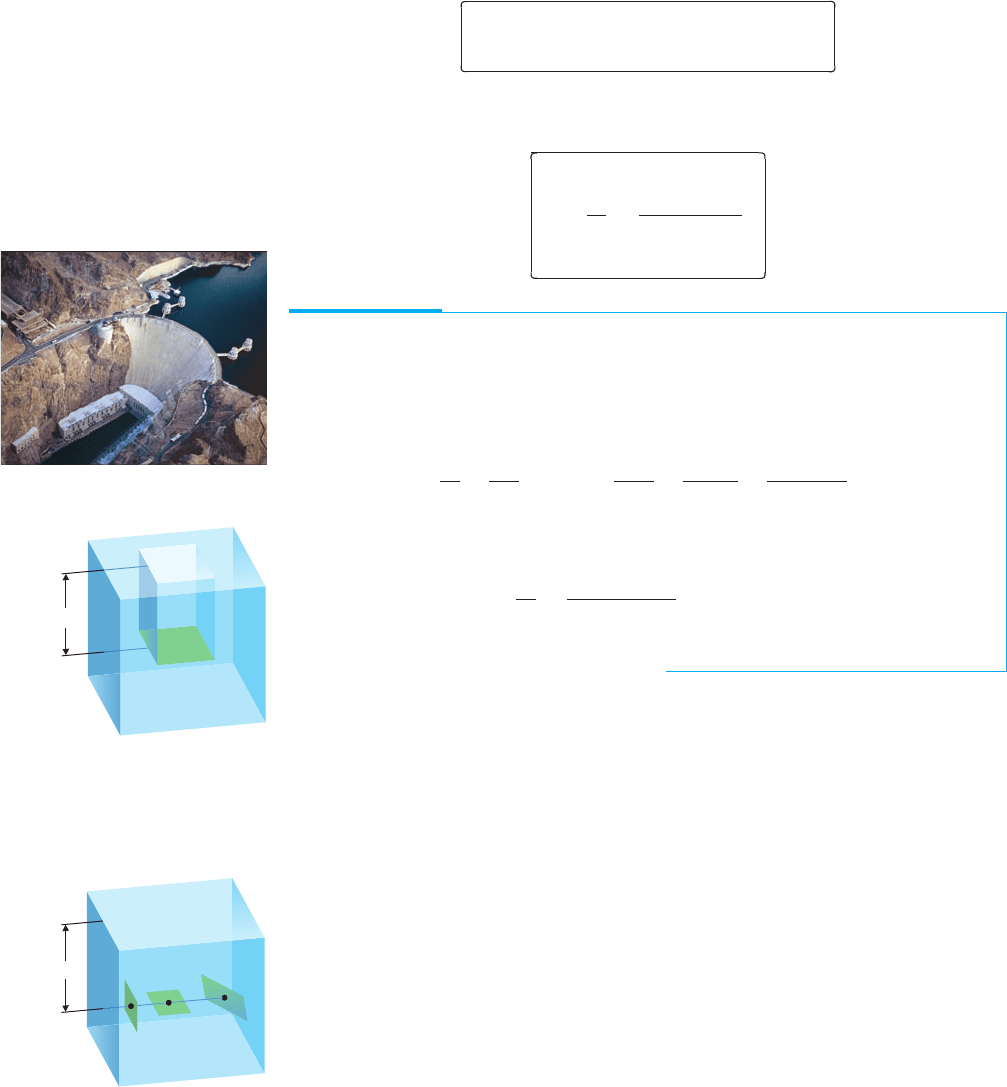
Consider now a vertically oriented wall (a dam) holding back a lake. It is convenient to
orientthex-axisverticallywith x = 0locatedatthesurfaceofthewaterandthebottomofthe
wall at x = a > 0. (See Figure 5.55 on the following page.) In this way, x measures the
depth of a section of the dam. Suppose w(x) is the width of the wall at depth x (where all
distances are measured in feet).
a
b
c
Depth d
FIGURE 5.54
Pressure at a given depth is the
same, regardless of the orientation
P1: PIC/OVY P2: OSO/OVY QC: OSO/OVY T1: OSO
MHDQ256-Ch05 MHDQ256-Smith-v1.cls December 14, 2010 20:15
LT (Late Transcendental)
CONFIRMING PAGES
368 CHAPTER 5
..
Applications of the Definite Integral 5-54
x
y
a
w (c
i
)
x
i
x
x
i1
FIGURE 5.55
Force acting on a dam
Partitiontheinterval[0, a]inton subintervalsofequalwidthx =
a
n
.Thishastheeffect
of slicing the dam into n slices, each of width x. For each i = 1, 2,...,n, observe that
the area of the ith slice is approximately w(c
i
)x, where c
i
is some point in the subinterval
[x
i−1
, x
i
]. Further, the depth at every point on this slice is approximately c
i
. We can then
approximate the force F
i
acting on this slice of the dam by the weight of the water lying
above a plate the size of this portion but which is oriented horizontally:
F
i
≈ 62.4
weight density
w(c
i
)
length
x
width
c
i
depth
= 62.4c
i
w(c
i
)x.
Addingtogethertheforcesactingoneachslice,thetotalforce F onthedamisapproximately
F ≈
n
i=1
62.4c
i
w(c
i
)x.
Recognizing this as a Riemann sum and taking the limit as n →∞, we obtain the total
hydrostatic force on the dam,
F = lim
n→∞
n
i=1
62.4c
i
w(c
i
)x =
a
0
62.4xw(x) dx. (6.7)
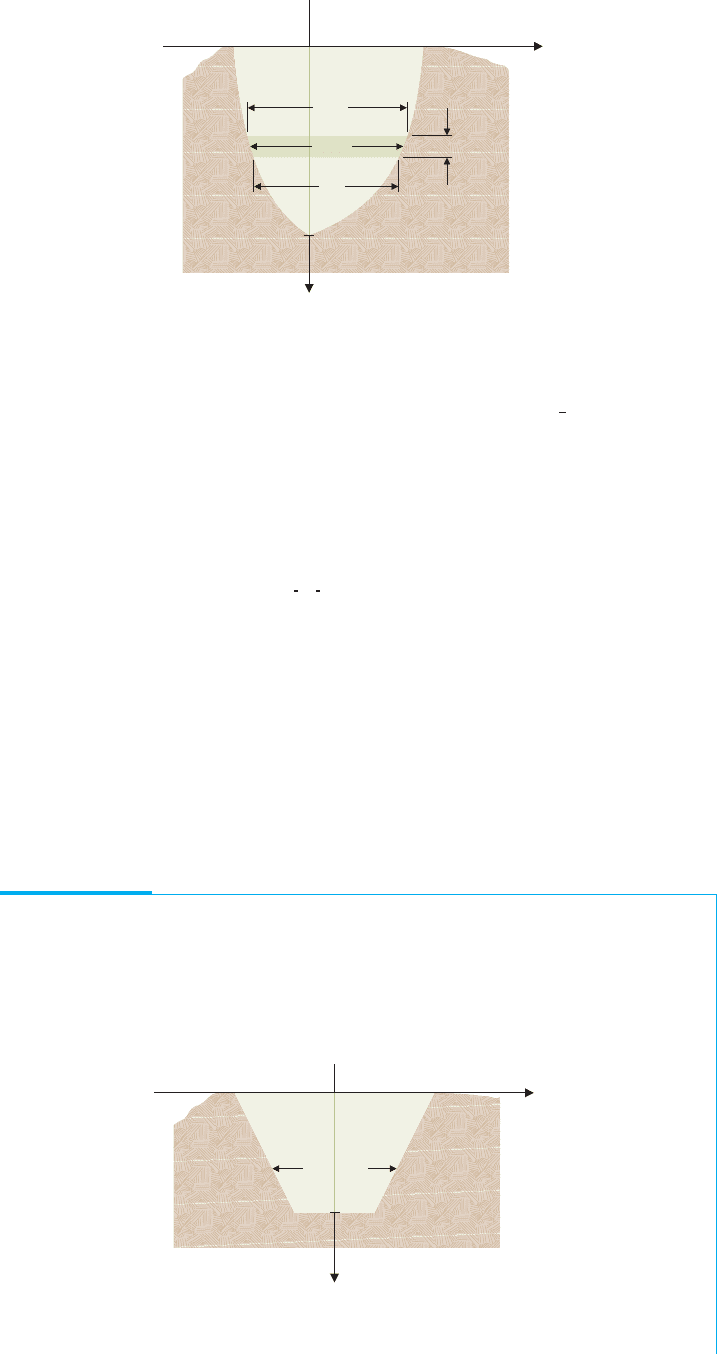
EXAMPLE 6.7 Finding the Hydrostatic Force on a Dam
A dam is shaped like a trapezoid with height 60 feet. The width at the top is 100 feet
and the width at the bottom is 40 feet. (See Figure 5.56.) Find the maximum hydrostatic
force that the dam will need to withstand. Find the hydrostatic force if a drought lowers
the water level by 10 feet.
x
100 x
60
y
FIGURE 5.56
Trapezoidal dam

P1: PIC/OVY P2: OSO/OVY QC: OSO/OVY T1: OSO
MHDQ256-Ch05 MHDQ256-Smith-v1.cls December 14, 2010 20:15
LT (Late Transcendental)
CONFIRMING PAGES
5-55 SECTION 5.6
..
Applications of Integration to Physics and Engineering 369
Solution Notice that the width function is a linear function of depth with w(0) = 100
and w(60) = 40. The slope is then
60
−60
=−1 and so, w(x) = 100 − x. From (6.7), the
hydrostatic force is then
F =
60
0
62.4
weight density
x
depth
(100 − x)
width
dx
= 3120x
2
− 62.4
x
3
3
60
0
= 6,739,200 lb.
If the water level dropped 10 feet, the width of the dam at the water level would be
90 feet. Lowering the origin by 10 feet, the new width function satisfies w(0) = 90
and w(50) = 40. The slope is still −1 and so, the width is given by w(x) = 90 − x.
From (6.7), the hydrostatic force is now
F =
50
0
62.4
weight density
x
depth
(90 − x)
width
dx
= 2808x
2
− 62.4
x
3
3
50
0
= 4,420,000 lb.
Notice that this represents a reduction in force of over 34%.
EXERCISES 5.6
WRITING EXERCISES
1. For each of work, impulse and the first moment: identify the
quantities in the definition (e.g., force and distance) and the
calculations for which it is used (e.g., change in velocity).
2. The center of mass is not always the location at which half the
mass is on one side and half the mass is on the other side. Give
an example where more than half the mass is on one side (see
examples 6.5 and 6.6) and explain why the object balances at
the center of mass.
3. People who play catch have a seemingly instinctive method
of pulling their hand back as they catch the ball. To catch a
ball, you must apply an impulse equal to the mass times ve-
locity of the ball. By pulling your hand back, you increase
the amount of time in which you decelerate the ball. Use the
impulse-momentum equation to explain why this reduces the
average force on your hand.
4. A tennis ball comes toward you at 100 mph. After you hit the
ball, it is moving away from you at 100 mph. Work measures
changes in energy. Explain why work has been done by the
tennis racket on the ball even though the ball has the same
speed before and after the hit.
1. A force of 5 pounds stretches a spring 4 inches. Find the work
donein stretchingthisspring6inchesbeyonditsnatural length.
2. A force of 10 pounds stretches a spring 2 inches. Find the work
donein stretchingthisspring3inchesbeyonditsnatural length.
3. A weightlifter lifts 250 pounds a distance of 20 inches. Find
the work done (as measured in foot-pounds).
4. A wrestler lifts his 300-pound opponent overhead, a height of
6 feet. Find the work done (as measured in foot-pounds).
5. A rocket full of fuel weighs 10,000 pounds at launch. After
launch, the rocket gains altitude and loses weight as the fuel
burns. Assume that the rocket loses 1 pound of fuel for every
15 feet of altitude gained. Explain why the work done raising the
rockettoanaltitudeof30,000feetis
30,000
0
(10,000 − x/15)dx
and compute the integral.
6. Referring to exercise 5, suppose that a rocket weighs
8000 pounds at launch and loses 1 pound of fuel for every
10 feet of altitude gained. Find the work needed to raise the
rocket to a height of 10,000 feet.
7. A 40-foot chain weighs 1000 pounds and is hauled up to the
deck of a boat. The chain is oriented vertically and the top
of the chain starts 30 feet below the deck. Compute the work
done.
8. A bucket is lifted a distance of 80 feet at the rate of 4 ft/s. The
bucket initially contains 100 pounds of sand but leaks at a rate
of 2 lb/s. Compute the work done.
9. (a) Suppose that a car engine exerts a force of 800x(1 − x)
pounds when the car is at position x miles, 0 ≤ x ≤ 1.
Compute the work done. (b) Horsepower measures the rate
of work done as a function of time. Explain why this is not
equal to 800x(1 − x). If the car takes 80 seconds to travel the
mile, compute the average horsepower (1 hp = 550 ft-lb/s).
10. (a) A water tower is spherical in shape with radius 50 feet,
extending from 200 feet to 300 feet above ground. Compute
the work done in fillingthe tank fromthe ground. (b) Compute
the work done in filling the tank halfway.
11. A right circular cylinder of radius 1 m and height 3 m is filled
with water. Compute the work done pumping all of the water
out the top of the cylinder if (a)the cylinder stands upright (the
circular cross sections are parallel to the ground) and (b) the
P1: PIC/OVY P2: OSO/OVY QC: OSO/OVY T1: OSO
MHDQ256-Ch05 MHDQ256-Smith-v1.cls December 14, 2010 20:15
LT (Late Transcendental)
CONFIRMING PAGES
370 CHAPTER 5
..
Applications of the Definite Integral 5-56
cylinder is on its side (the circular cross sections are perpen-
dicular to the ground).
12. A water tank is in the shape of a right circular cone of altitude
10 feet and base radius 5 feet, with its vertex at the ground.
(Think of an ice cream cone with its point facing down.) If the
tank is full, find the work done in pumping all of the water out
the top of the tank.
13. Twolaborers share the job of digging a rectangular hole 10 feet
deep. The dirt from the hole is cleared away by other laborers.
Assuming a constant density of dirt, how deep should the first
worker dig to do half the work? Explain why 5 feet is not the
answer.
14. A trough is to be dug 6 feet deep. Cross sections have the
shape
and are 2 feet wide at the bottom and 5 feet wide at
the top. Find the depth at which half the work has been done.
15. In example 6.4, suppose that the baseball was traveling at
100 ft/s. The force exerted by the bat on the ball would change
to the values in the table. Estimate the impulse and the speed
of the ball after impact.
t (s) 0 0.0001 0.0002 0.0003 0.0004
F (lb) 0 1000 2100 4000 5000
t (s) 0.0005 0.0006 0.0007 0.0008
F (lb) 5200 2500 1000 0
16. A crash test isperformed on a vehicle. The force of the wall on
the front bumper is shown in the table. Estimate the impulse
and the speed of the vehicle (use m = 200 slugs).
t (s) 0 0.1 0.2 0.3 0.4 0.5 0.6
F (lb) 0 8000 16,000 24,000 15,000 9000 0
17. A thrust-time curve f (t) =
66t
t
2
+9
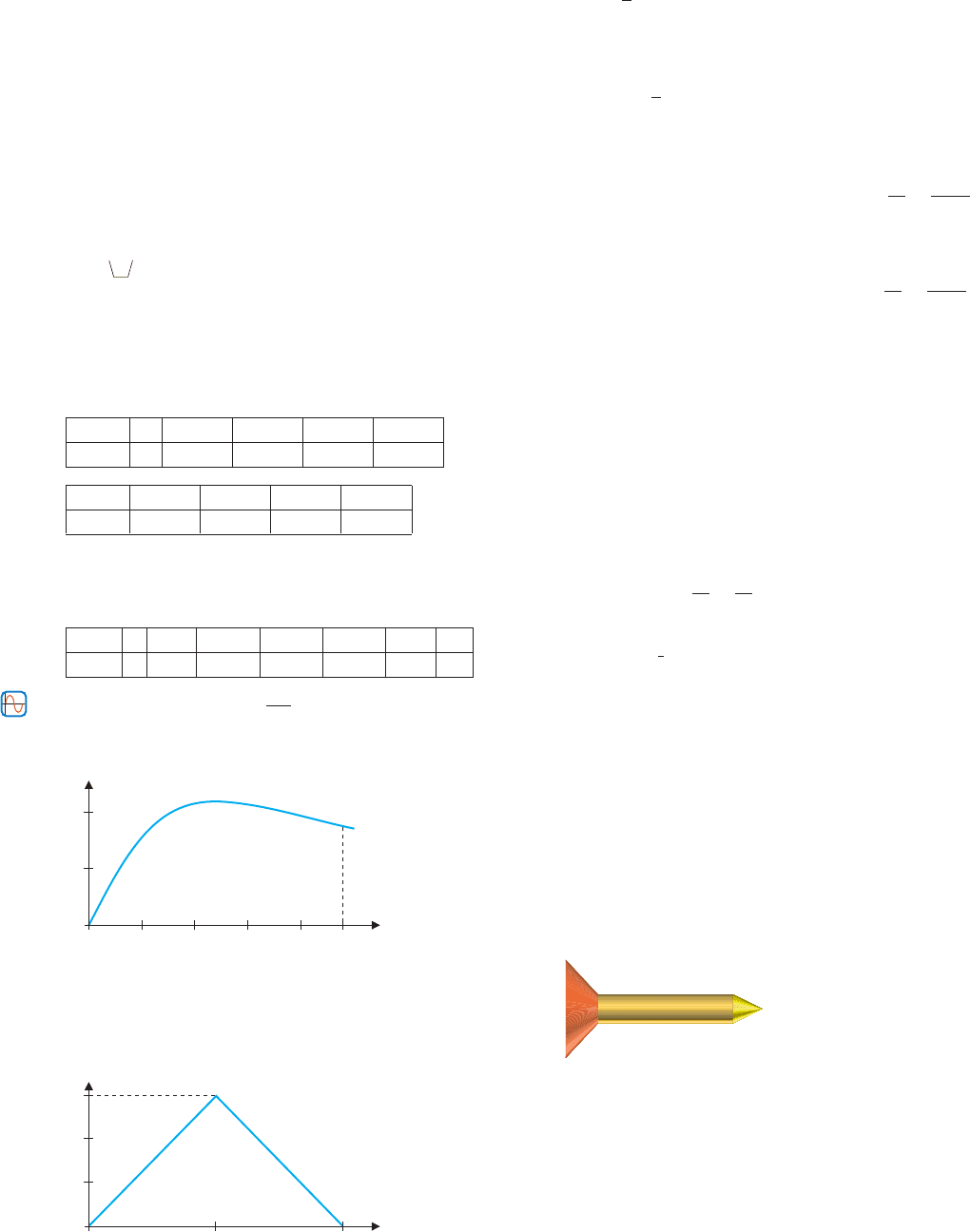
for a model rocket is shown.
Compute the maximum thrust. Estimate the impulse.
t
y
5
60 1.25 2.5 3.75 5
10
18. A thrust-time curve for a model rocket is shown. Compute the
impulse. Comparing your answer to exercise 17, which rocket
would reach a higher altitude?
t
y
5
603
15
10
19. Compute the mass and center of mass of an object with density
ρ(x) =
x
6
+ 2kg/m, 0 ≤ x ≤ 6. Briefly explainin terms of the
density function why the center of mass is not at x = 3.
20. Compute the mass and center of mass of an object with density
ρ(x) = 3 −
x
6
kg/m,0 ≤ x ≤ 6. Briefly explainin terms of the
density function why the center of mass is not at x = 3.
21. Compute the weight in ounces of an object extending from
x =−3tox = 27 with density ρ(x) =
1
46
+
x + 3
690
2
slugs/in.
22. Compute the weight in ounces of an object extending from
x = 0tox = 32 with density ρ(x) =
1
46
+
x + 3
690
2
slugs/in.
23. Compute the center of mass of the object in exercise 21. This
object models the baseball bat of example 6.5 “choked up”
(held 3 inches up the handle). Compare the masses and centers
of mass of the two bats.
24. Compute the center of mass of the object in exercise 22. This
object models a baseball bat that is 2 inches longer than the
bat of example 6.5. Compare the masses and centers of mass
of the two bats.
25. Compute the mass and weight in ounces and center of mass
of an object extending from x = 0tox = 30 with density
ρ(x) = 0.00468
3
16
+
x
60
slugs/in.
26. The object in exercise 25 models an aluminum baseball bat
(hollow and
1
4
inch thick). Compare the mass and center of
mass to the wooden bat ofexample 6.5. Baseball experts claim
that it is easier to hit an inside pitch (small x value) with an
aluminum bat. Explain why your calculations indicate that this
is true.
27. The accompanying figure shows the outline of a model rocket.
Assume that the vertical scale is 3 units high and the horizontal
scale is 6 units wide. Use basic geometry to compute the area
of each of the three regions of the rocket outline. Assuming a
constantdensityρ,locatethex-coordinateofthecenterofmass
of each region. [Hint: The first region can be thought of as ex-
tending from x = 0tox = 1 with density ρ(3 −2x). The third
region extends from x = 5tox = 6 with density ρ(6 − x).]
28. For the model rocket in exercise 27, replace the rocket with
3 particles, one for each region. Assume that the mass of each
particle equals the area of the region and the location of the
particle on the x-axis equals the center of mass of the region.
Find the center of mass of the 3-particle system. [Rockets are
designed with bottom fins large enough that the center of mass
is shifted near the bottom (or, in the figure here, left) of the
rocket. This improves the flight stability of the rocket.]
P1: PIC/OVY P2: OSO/OVY QC: OSO/OVY T1: OSO
MHDQ256-Ch05 MHDQ256-Smith-v1.cls December 14, 2010 20:15
LT (Late Transcendental)
CONFIRMING PAGES
5-57 SECTION 5.6
..
Applications of Integration to Physics and Engineering 371
In exercises 29–32, find the centroid of each region. The centroid
is the center of mass of a region with constant density. (Hint:
Modify (6.6) to find the y-coordinate
y.)
29. The triangle with vertices (0, 0), (4, 0) and (4, 6)
30. The rhombus with vertices (0, 0), (3, 4), (8, 4) and (5, 0)
31. The region bounded by y = 4 − x
2
and y = 0
32. The region bounded by y = x, y =−x and x = 4
............................................................
33. A dam is in the shape of a trapezoid with height 60 feet. The
width at the top is 40 feet and the width at the bottom is
100 feet. Find the maximum hydrostatic force the wall would
need to withstand. Explain why the force is so much greater
than the force in example 6.7.
34. Find the maximum hydrostatic force in exercise33 if a drought
lowers the water level by 10 feet.
35. An underwater viewing window is installed at an aquarium.
The window is circular with radius 5 feet. The center of the
window is 40 feet below the surface of the water. Find the
hydrostatic force on the window.
36. An underwater viewing window is rectangular with width
40 feet. The window extends from the surface of the water to
a depth of 10 feet. Find the hydrostatic force on the window.
37. The camera’s window on a robotic submarine is circular with
radius3inches.Howmuchhydrostaticforcewouldthewindow
need to withstand to descend to a depth of 1000 feet?
38. A diver wears a watch to a depth of 60 feet. The face of the
watchis circular with a radius of 1 inch. Howmuch hydrostatic
force will the face need to withstand if the watch is to keep on
ticking? Give answers using the following two assumptions:
(a) the watch is vertical with its top at 60 feet; (b) the watch is
horizontal at 60 feet.
39. Given that power is the product of force and velocity, compute
the horsepower needed to lift a 100-ton object such as a blue
whale at 20 mph (1 hp = 550 ft-lb/s). (Note that blue whales
swim so efficiently that they can maintain this speed with an
output of 60–70 hp.)
40. For a constant force F exerted over a length of time t, impulse
isdefined by F · t.For a variableforce F(t), derive the impulse
formula J =
b
a
F(t)dt.
41. The first moment of a solid ofdensity ρ(x)is
b
a
xρ(x)dx. The
second moment about the y-axis, defined by
b
a
x
2
ρ(x) dx,
is also important in applications. The larger this number
is, the more difficult it is to rotate the solid about the
y-axis. Compute the second moments of the baseball bats
in example 6.5 and exercise 21. Choking up on a bat makes
it easier to swing (and control). Compute the percentage
by which the second moment is reduced by choking up
3 inches.
42. Occasionally, baseball players illegally “cork” their bats by
drilling out a portion of wood from the end of the bats and fill-
ing the hole with a light substance such as cork.The advantage
of this procedure is that the second moment is significantly
reduced. To model this, take the bat of example 6.5 and change
the density to
ρ(x) =
⎧
⎪
⎪
⎪
⎨
⎪
⎪
⎪
⎩
1
46
+
x
690
2
if 0 ≤ x ≤ 28
1
92
+
x
690
2
if 28 < x ≤ 30,
representing a hole of radius
1
4
and length 2
. Compute the
mass and second moment of the corked bat and compare to
the original bat.
43. The second moment (see exercise 41) of a disk of den-
sity ρ in the shape of the ellipse
x
2
a
2
+
y
2
b
2
= 1 is given by
a
−a
2ρbx
2
1−
x
2
a
2
dx. Use your CAS to evaluate this integral.
44. Use the result from exercise 43 to show that the sec-
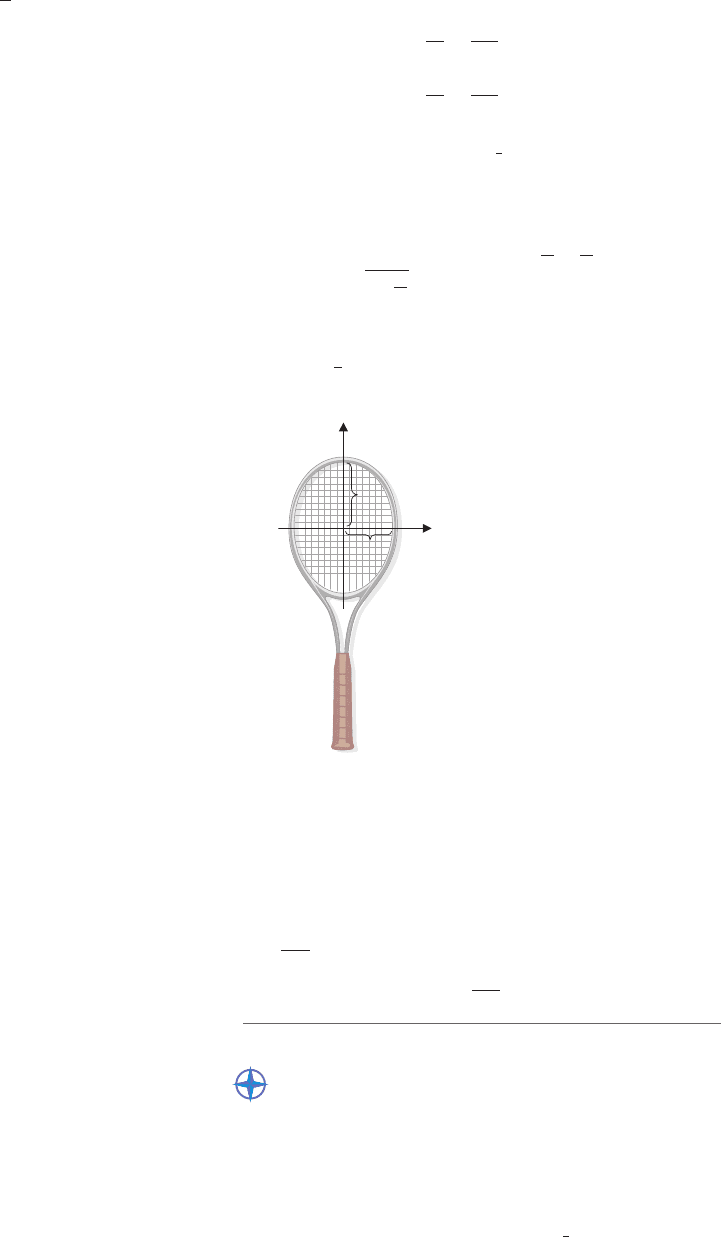
ond moment of the tennis racket head in the diagram is
M = ρ
π
4
[ba
3
− (b −w)(a − w)
3
].
y
b
a
x
aw
bw
45. For tennis rackets, a large second moment (see exercises 43
and 44) means less twisting of the racket on off-center shots.
Compare the second moment of a wooden racket (a = 9,
b = 12,w = 0.5),amidsizeracket(a = 10, b = 13,w = 0.5)
and an oversized racket (a = 11, b = 14,w = 0.5).
46. Let M be the second moment found in exercise 44. Show that
dM
da
> 0 and conclude that larger rackets have larger second
moments. Also, show that
dM
dw
> 0 and interpret this result.
EXPLORATORY EXERCISES
1. As equipment has improved, heights cleared in the pole vault
have increased. A crude estimate of the maximum pole vault
possible can be derived from conservation of energy princi-
ples. Assume that the maximum speed a pole-vaultercould run
carrying a long pole is 25 mph. Convert this speed to ft/s. The
kinetic energy of this vaulter would be
1
2
mv
2
. (Leave m as an
unknown for the time being.) This initial kinetic energy would
equal the potential energy at the top of the vault minus what-
ever energy is absorbed by the pole (which we will ignore).
P1: PIC/OVY P2: OSO/OVY QC: OSO/OVY T1: OSO
MHDQ256-Ch05 MHDQ256-Smith-v1.cls December 14, 2010 20:15
LT (Late Transcendental)
CONFIRMING PAGES
372 CHAPTER 5
..
Applications of the Definite Integral 5-58
Set the potential energy, 32mh, equal to the kineticenergy and
solve for h. This represents the maximum amount the vaulter’s
center of mass could be raised. Add 3 feet for the height of
the vaulter’s center of mass and you have an estimate of the
maximumvaultpossible. Comparethis to SergeiBubka’s 1994
world record vault of 20
1
3
4
.
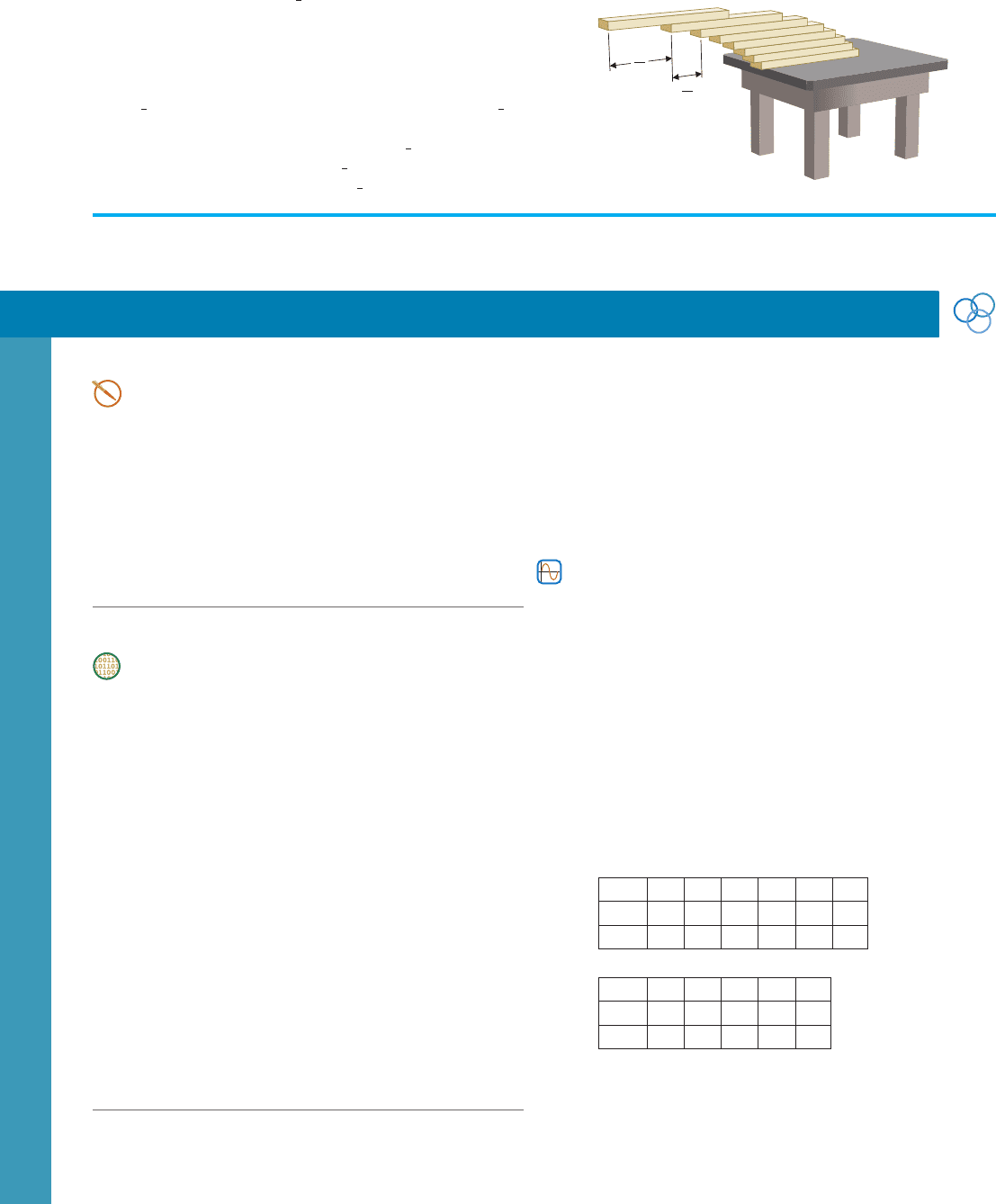
2. An object will remain on a table as long as the center of mass
of the object lies over the table. For example, a board of length
1 will balance if half the board hangs overthe edge of the table.
Show that two homogeneous boards of length 1 will balance
if
1
4
of the first board hangs over the edge of the table and
1
2
of
the second board hangs over the edge of the first board. Show
that three boards of length 1 will balance if
1
6
of the first board
hangs over the edge of the table,
1
4
of the second board hangs
over the edge of the first board and
1
2
of the third board hangs
over the edge of the second board. Generalize this to a pro-
cedure for balancing n boards. How many boards are needed
so that the last board hangs completely over the edge of the
table?
L
2
L
4
. . .
Review Exercises
WRITING EXERCISES
The following list includes terms that are defined and theorems that
arestatedinthis chapter.Foreachterm or theorem, (1)givea precise
definition or statement, (2) state in general terms what it means and
(3) describe the types of problems with which it is associated.
Volume by slicing Volume by disks Volume by washers
Volume by shells Arc length Surface area
Newton’s second law Work Impulse
Center of mass
TRUE OR FALSE
State whether each statement is true or false and briefly explain
why. If the statement is false, try to “fix it” by modifying the given
statement to a new statement that is true.
1. The area between f and g is given by
b
a
[
f (x) − g(x)
]
dx.
2. The method of disks is a special case of volume by slicing.
3. For a given region, the methods of disks and shells will always
use different variables of integration.
4. A Riemann sum for arc length always gives an approximation
that is too large.
5. For most functions, the integral for arc length can be evaluated
exactly.
6. The only force on a projectile is gravity.
7. For two-dimensional projectile motion, you can always solve
for x(t) and y(t) independently.
8. The more you move an object, the more work you have done.
In exercises 1–8, find the indicated area exactly if possible (esti-
mate if necessary).
1. The area between y = x
2
+ 2 and y = sin x for 0 ≤ x ≤ π
2. The area between y = sin x and y = cosx for 0 ≤ x ≤ π/2
3. The area between y = x
3
and y = 2x
2
− x
4. The area between y = x
2
− 3 and y =−x
2
+ 5
5. The area between y = x
2
− 2 and y = 2 − x
2
6. The area between x = y
2
and y = 1 − x
7. The area of the region bounded by y = x
2
, y = 2 − x and
y = 0
8. The area of the region bounded by y = x
2
, y = 0 and x = 2
............................................................
9. A town has a population of 10,000 with a birthrate of 10 + 2t
people per year and a death rate of 4 +t people per year. Com-
pute the town’s population after 6 years.
10. From the given data, estimate the area between the curves for
0 ≤ x ≤ 2.
x 0.0 0.2 0.4 0.6 0.8 1.0
f (x) 3.2 3.6 3.8 3.7 3.2 3.4
g(x) 1.2 1.5 1.6 2.2 2.0 2.4
x 1.2 1.4 1.6 1.8 2.0
f (x) 3.0 2.8 2.4 2.9 3.4
g(x) 2.2 2.1 2.3 2.8 2.4
11. Find the volume of the solid with cross-sectional area
A(x) = π(3 + x)
2
for 0 ≤ x ≤ 2.