
Smith R., Minton R. Calculus
Подождите немного. Документ загружается.


P1: PIC/OVY P2: OSO/OVY QC: OSO/OVY T1: OSO
MHDQ256-Ch05 MHDQ256-Smith-v1.cls December 14, 2010 20:15
LT (Late Transcendental)
CONFIRMING PAGES
5-39 SECTION 5.5
..
Projectile Motion 353
Integrating the velocity function gives us the height function:
h
(t) dt =
(−32t +8)dt
or
h(t) =−16t
2
+ 8t + c.
From the initial height, we have
15 = h(0) =−16(0)
2
+ 8(0) +c = c,
so that c = 15 and the height above the water at any time t is given by
h(t) =−16t
2
+ 8t + 15.
Impact then occurs when
0 = h(t) =−16t
2
+ 8t + 15
=−(4t + 3)(4t − 5),
so that t =
5
4
is the time of impact. (Ignore the extraneous solution t =−
3
4
.) When
t =
5
4
, the velocity is h
5
4
=−32
5
4
+ 8 =−32 ft/s (impact velocity). To put this in
more familiar units of velocity, multiply by 3600/5280 to convert to miles per hour. In
this case, the impact velocity is about 22 mph. (You probably don’t want to come down
in the wrong position at that speed!)
In example 5.1, the negative sign of the velocity indicated that the diver was coming
down. In many situations, both upward and downward motions are important.
TODAY IN
MATHEMATICS
Vladimir Arnold (1937– )
A Russian mathematician with
important contributions to
numerous areas of mathematics,
both in research and popular
exposition. The esteem in which
he is held by his colleagues can be
measured by the international
conference known as “Arnoldfest’’
held in Toronto in honor of his
60th birthday. Many of his books
are widely used today, including a
collection of challenges titled
Arnold’s Problems. A review of this
book states that “Arnold did not
consider mathematics a game
with deductive reasoning and
symbols, but a part of natural
science (especially of physics),
i.e., an experimental science.’’
EXAMPLE 5.2 An Equation for the Vertical Motion of a Ball
A ball is propelled straight upward from the ground with initial velocity 64 ft/s.
Ignoring air resistance, find an equation for the height of the ball at any time t. Also,
determine the maximum height and the amount of time the ball spends in the air.
Solution With gravity as the only force, the height h(t) satisfies h
(t) =−32. The
initial conditions are h
(0) = 64 and h(0) = 0. We then have
h
(t) dt =
−32dt
or
h
(t) =−32t + c.
From the initial velocity, we have
64 = h
(0) =−32(0) + c = c
and so,
h
(t) = 64 −32t.
Integrating one more time gives us
h
(t) dt =
(64 − 32t) dt
or h(t) = 64t − 16t
2
+ c.
From the initial height we have
0 = h(0) = 64(0) −16(0)
2
+ c = c,
and so,
h(t) = 64t − 16t
2
.
Since the height function is quadratic, its maximum occurs at the one time when
h
(t) = 0. [You should also consider the physics of the situation: what happens
physically when h
(t) = 0?] Solving 64 −32t = 0givest = 2 (the time at the
P1: PIC/OVY P2: OSO/OVY QC: OSO/OVY T1: OSO
MHDQ256-Ch05 MHDQ256-Smith-v1.cls December 14, 2010 20:15
LT (Late Transcendental)
CONFIRMING PAGES
354 CHAPTER 5
..
Applications of the Definite Integral 5-40
maximum height) and the corresponding height is h(2) = 64(2) −16(2)
2
= 64 feet.
Again, the ball lands when h(t) = 0. Solving
0 = h(t) = 64t − 16t
2
= 16t(4 −t)
gives t = 0 (launch time) and t = 4 (landing time). The time of flight is thus
4 seconds.
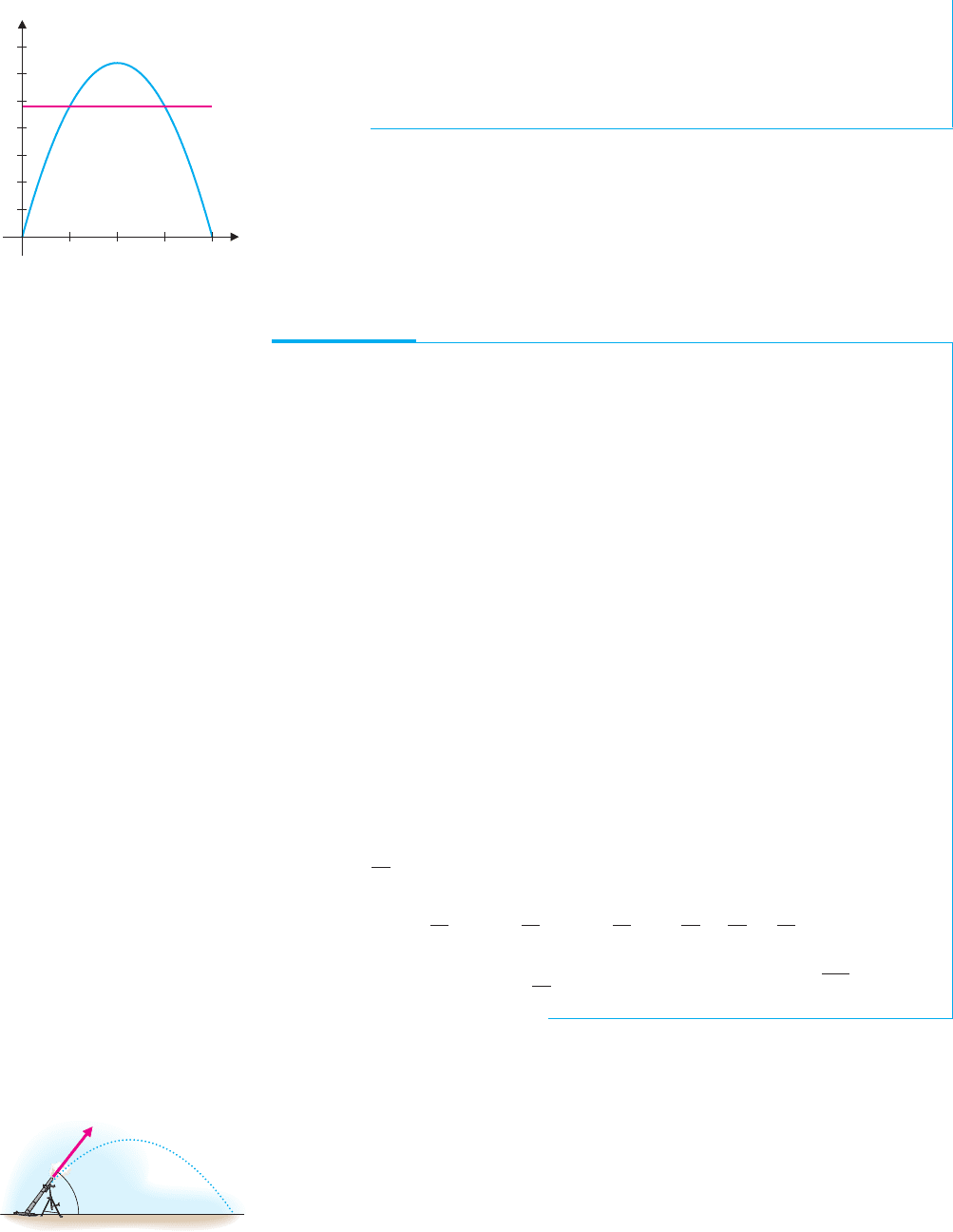
You can observe an interesting property of projectile motion by graphing the height
function from example 5.2 along with the line y = 48. (See Figure 5.43.) Notice that the
graphs intersect at t = 1 and t = 3. Further, the time interval [1, 3] corresponds to exactly
half the time spent in the air. Notice that this says that the ball stays in the top one-fourth of
its height for half of its time in the air. You may have marveled at how some athletes jump
so high that they seem to “hang in the air.” As this calculation suggests, all objects tend to
hang in the air.
Height
t
1 2 3 4
20
40
60
FIGURE 5.43
Height of the ball at time t
EXAMPLE 5.3 Finding the Initial Velocity Required to Reach
a Certain Height
It has been reported that former basketball star Michael Jordan had a vertical leap of
54
. Ignoring air resistance, what is the initial velocity required to jump this high?
Solution Once again, Newton’s second law leads us to the equation h
(t) =−32 for
the height h(t). We call the initial velocity v
0
, so that h
(0) = v
0
and look for the value
of v
0
that will give a maximum altitude of 54
. As before, we integrate to get
h
(t) =−32t + c.
Using the initial velocity, we get
v
0
= h
(0) =−32(0) + c = c.
This gives us the velocity function
h
(t) = v
0
− 32t.
Integrating once again and using the initial position h(0) = 0, we get
h(t) = v
0
t −16t
2
.
The maximum height occurs when h
(t) = 0. (Why?) Setting
0 = h
(t) = v
0
− 32t,
gives us t =
v
0
32
. The height at this time (i.e., the maximum altitude) is then
h
v
0
32
= v
0
v
0
32
− 16
v
0
32
2
=
v
2
0
32
−
v
2
0
64
=
v
2
0
64
.
So, a jump of 54
= 4.5
requires
v
2
0
64
= 4.5orv
2
0
= 288, so that v
0
=
√
288 ≈ 17 ft/s
(equivalent to roughly 11.6 mph).
u
v
0
FIGURE 5.44a
Path of projectile
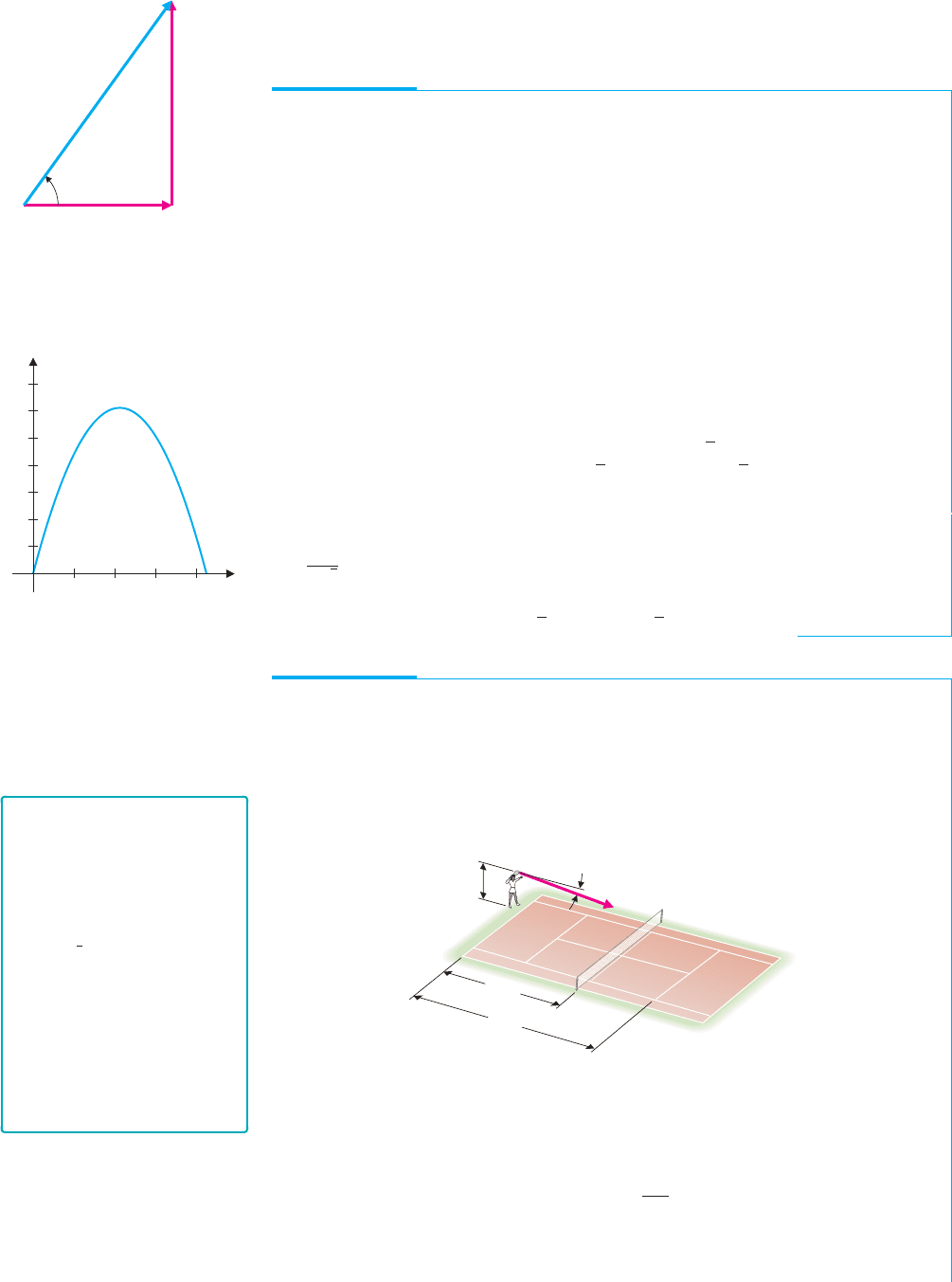
So far, we have only considered projectiles moving vertically. In practice, we must also
consider movement in the horizontal direction. Ignoring air resistance, these calculations
are also relatively straightforward. The idea is to apply Newton’s second law separately
to the horizontal and vertical components of the motion. If y(t) represents the vertical
position, then we have y
(t) =−g, as before. Ignoring air resistance, there are no forces
acting horizontally on the projectile. So, if x(t) represents the horizontal position, Newton’s
second law gives us x
(t) = 0.
The initial conditions are slightly more complicated here. In general, we want to con-
sider projectiles that are launched with an initial speed v
0
at an angle θ from the horizontal.
Figure 5.44a shows a projectile fired with θ>0. Notice that an initial angle of θ<0 would
mean a downward initial velocity.
P1: PIC/OVY P2: OSO/OVY QC: OSO/OVY T1: OSO
MHDQ256-Ch05 MHDQ256-Smith-v1.cls December 14, 2010 20:15
LT (Late Transcendental)
CONFIRMING PAGES
5-41 SECTION 5.5
..
Projectile Motion 355
As shown in Figure 5.44b, the initial velocity can be separated into horizontal and
verticalcomponents. From elementary trigonometry, thehorizontal component of theinitial
velocity is v
x
= v
0
cosθ and the vertical component is v
y
= v
0
sinθ .
v
0
sin u
v
0
cos u
v
0
u
FIGURE 5.44b
Vertical and horizontal
components of velocity
y
x
200 400 600 800
40
80
120
FIGURE 5.45
Path of ball
EXAMPLE 5.4 The Motion of a Projectile in Two Dimensions
An object is launched at angle θ = π/6 from the horizontal with initial speed
v
0
= 98 m/s. Determine the time of flight and the (horizontal) range of the projectile.
Solution Starting with the vertical component of the motion (and again ignoring air
resistance), we have y
(t) =−9.8 (since the initial speed is given in terms of meters per
second). Referring to Figure 5.44b, notice that the vertical component of the initial
velocity is y
(0) = 98sinπ/6 = 49 and the initial altitude is y(0) = 0. A pair of simple
integrations gives us the velocity function y
(t) =−9.8t + 49 and the position function
y(t) =−4.9t
2
+ 49t. The object hits the ground when y(t) = 0 (i.e., when its height
above the ground is 0). Solving
0 = y(t) =−4.9t
2
+ 49t = 49t(1 − 0.1t)
gives t = 0 (launch time) and t = 10 (landing time). The time of flight is then
10 seconds. The horizontal component of motion is determined from the equation
x
(t) = 0 with initial velocity x
(0) = 98cosπ/6 = 49
√
3 and initial position
x(0) = 0. Integration gives us x
(t) = 49
√
3 and x(t) = (49
√
3)t. In Figure 5.45, we
plot the path of the ball. [You can do this using the parametric plot mode on your
graphing calculator or CAS, by entering equations for x(t) and y(t) and setting the
range of t-values to be 0 ≤ t ≤ 10. Alternatively, you can easily solve for t,toget
t =
1
49
√
3
x, to see that the curve is simply a parabola.] The horizontal range is then the
value of x(t)att = 10 (the landing time),
x(10) = (49
√
3)(10) = 490
√
3 ≈ 849 meters.
REMARK 5.1
You should resist the temptation
to reduce this section to a few
memorized formulas. It is true
that if you ignore air resistance,
the vertical component of posi-
tion will always turn out to be
y(t)=−
1
2
gt
2
+(v
0
sinθ)t +y(0).
However, your understanding of
the process and your chances of
finding the correct answer will
improve dramatically if you
start each problem with
Newton’s second law and work
through the integrations (which
are not difficult).
EXAMPLE 5.5 The Motion of a Tennis Serve
Venus Williams has one of the fastest serves in women’s tennis. Suppose that she hits a
serve from a height of 10 feet at an initial speed of 120 mph and at an angle of 7
◦
below
the horizontal. The serve is “in” if the ball clears a 3
-high net that is 39
away and hits
the ground in front of the service line 60
away. (We illustrate this situation in
Figure 5.46.) Determine whether the serve is in or out.
3 ft
7º
60 ft
39 ft
10 ft
FIGURE 5.46
Height of tennis serve
Solution As in example 5.4, we start with the vertical motion of the ball. Since
distance is given in feet, the equation of motion is y
(t) =−32. The initial speed must
be converted to feet per second: 120 mph = 120
5280
3600
ft/s = 176 ft/s. The vertical
component of the initial velocity is then y
(0) = 176sin(−7
◦
) ≈−21.45 ft/s.
Integration then gives us
y
(t) =−32t − 21.45.

P1: PIC/OVY P2: OSO/OVY QC: OSO/OVY T1: OSO
MHDQ256-Ch05 MHDQ256-Smith-v1.cls December 15, 2010 14:55
LT (Late Transcendental)
CONFIRMING PAGES
356 CHAPTER 5
..
Applications of the Definite Integral 5-42
The initial height is y(0) = 10 ft, so another integration gives us
y(t) =−16t
2
− 21.45t + 10.
The horizontal component of motion is determined from x
(t) = 0, with initial velocity
x
(0) = 176cos(−7
◦
) ≈ 174.69 ft/s and initial position x(0) = 0. Integrations give us
x
(t) = 174.69 ft/s and x(t) = 174.69t ft. Summarizing, we have
x(t) = 174.69t,
y(t) =−16t
2
− 21.45t + 10.
For the ball to clear the net, y must be at least 3 when x = 39. We have x(t) = 39 when
174.69t = 39 or t ≈ 0.2233. At this time, y(0.2233) ≈ 4.4, showing that the ball is
high enough to clear the net. The second requirement is that we need to have x ≤ 60
when the ball lands (y = 0). We have y(t) = 0 when −16t
2
− 21.45t + 10 = 0. From
the quadratic formula, we get t ≈−1.7 and t ≈ 0.3662. Ignoring the negative solution,
we compute x(0.3662) ≈ 63.97, so that the serve lands nearly 4 feet beyond the service
line. The serve is not in.
One reason you should start each problem with Newton’s second law is so that you
pause to consider the forces that are (and are not) being considered. For example, we have
thus far ignored air resistance, as a simplification of reality. Some calculations using such
simplified equations are reasonably accurate. Others, such as in example 5.6, are not.
EXAMPLE 5.6 An Example Where Air Resistance Can’t
Be Ignored
Suppose a raindrop falls from a cloud 3000 feet above the ground. Ignoring air
resistance, how fast would the raindrop be falling when it hits the ground?
Solution If the height of the raindrop at time t is given by y(t), Newton’s second law
of motion tells us that y
(t) =−32. Further, we have the initial velocity y
(0) = 0
(since the drop falls—as opposed to being thrown down) and the initial altitude
y(0) = 3000. Integrating and using the initial conditions gives us y
(t) =−32t and
y(t) = 3000 −16t
2
. The raindrop hits the ground when y(t) = 0. Setting
0 = y(t) = 3000 −16t
2
gives us t =
3000/16 ≈ 13.693 seconds. The velocity at this time is then
y
(
3000/16) =−32
3000/16 ≈−438.18ft/s.
This corresponds to nearly 300 mph! Fortunately, air resistance does play a significant
role in the fall of a raindrop, which has an actual landing speed of about 10 mph.
FIGURE 5.47
Cross section of a wing
The obvious lesson from example 5.6 is that it is not always reasonable to ignore air
resistance. Some of the mathematical tools needed to more fully analyze projectile motion
with air resistance are developed in Chapter 8.
The air resistance (more precisely, air drag) that slows the raindrop down is only one
of the ways in which air can affect the motion of an object. The Magnus force, produced
by the spinning of an object or lack of symmetry in the shape of an object, can cause the
object to change directions and curve. Perhaps the most common example of a Magnus
force occurs on an airplane. One side of an airplane wing is curved and the other side is
comparatively flat. (See Figure 5.47.) The lack of symmetry causes the air to move over the
top of the wing faster than it moves over the bottom. This produces a Magnus force in the
upward direction (lift), lifting the airplane into the air.
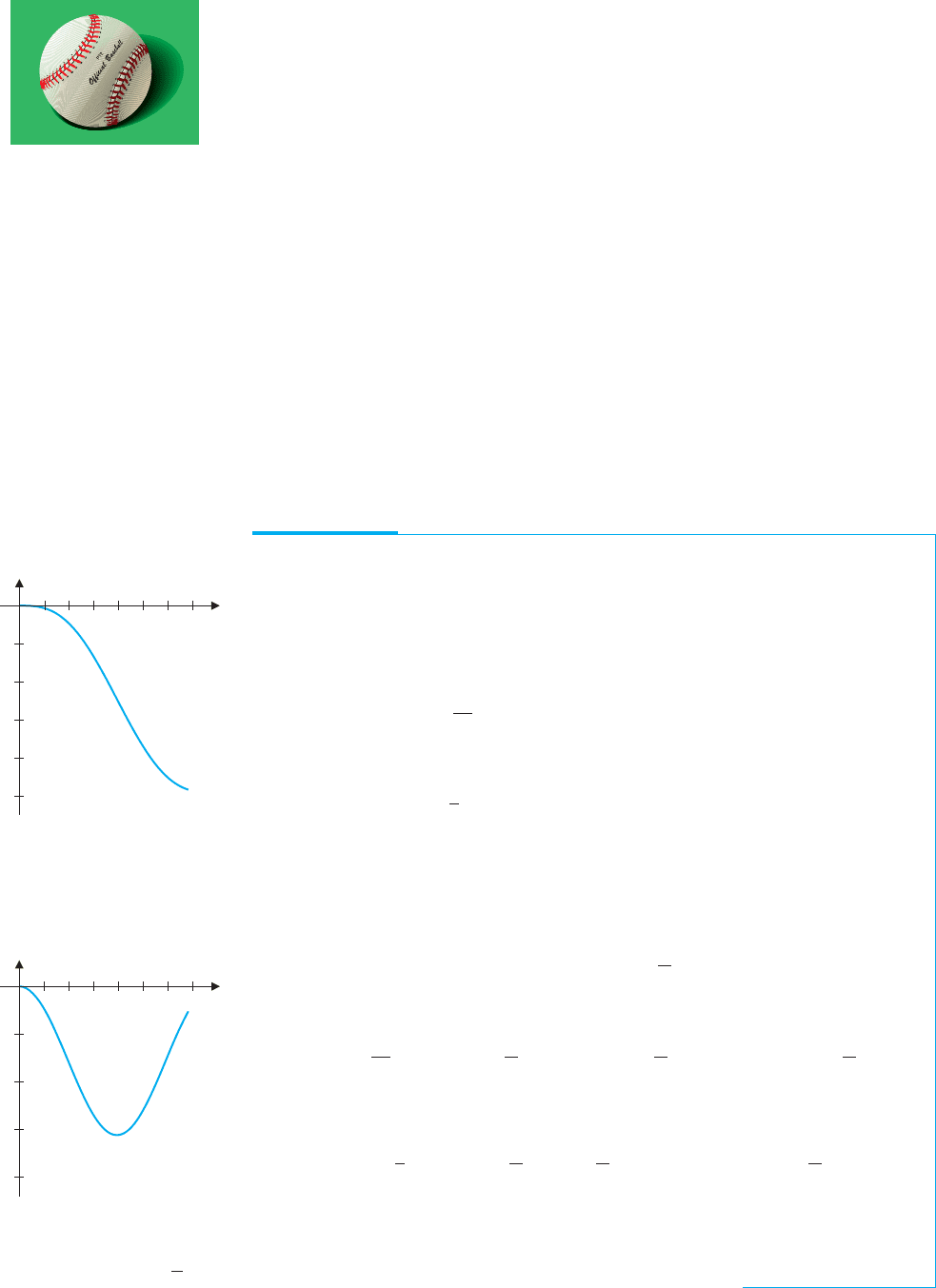
A more down-to-earth example of a Magnus force occurs in an unusual baseball pitch
called the knuckleball. To throw this pitch, the pitcher grips the ball with his fingertips and
throws the ball with as little spin as possible. Baseball players claim that the knuckleball
“dances around” unpredictably and is exceptionally hard to hit or catch. There still is no
P1: PIC/OVY P2: OSO/OVY QC: OSO/OVY T1: OSO
MHDQ256-Ch05 MHDQ256-Smith-v1.cls December 14, 2010 20:15
LT (Late Transcendental)
CONFIRMING PAGES
5-43 SECTION 5.5
..
Projectile Motion 357
completeagreementon why the knuckleball movesso much, butwe will present one current
theory due to physicists Robert Watts and Terry Bahill.
Regulation baseball,
showing stitching
The cover of the baseball is sewn on with stitches that are raised up slightly from the
rest of the ball. These curved stitches act much like an airplane wing, creating a Magnus
force that affects the ball. The direction of the Magnus force depends on the exact ori-
entation of the ball’s stitches. Measurements by Watts and Bahill indicate that the lateral
force (left/right from the pitcher’s perspective) is approximately F
m
=−0.1sin(4θ ) lb,
where θ is the angle (in radians) of the ball’s position rotated from a particular starting
position.
Since gravity does not affect the lateral motion of the ball, the only force acting on the
ball laterally is the Magnus force. Newton’s second law applied to the lateral motion of the
knuckleball gives mx
(t) =−0.1 sin(4θ). The mass of a baseball is about 0.01 slug. (Slugs
are the units of measurement of mass in the English system. To get the more familiar weight
in pounds, simply multiply the mass by g = 32.)Wenowhave
x
(t) =−10 sin(4θ).
If the ball is spinning at the rate of ω radians per second, then 4θ = 4ωt + θ
0
, where the
initial angle θ
0
depends on where the pitcher grips the ball. We then have
x
(t) =−10 sin(4ωt +θ
0
), (5.1)
with initial conditions x
(0) = 0 and x(0) = 0. For a typical knuckleball speed of 60 mph,
it takes about 0.68 second for the pitch to reach home plate.
EXAMPLE 5.7 An Equation for the Motion of a Knuckleball
For a spin rate of ω = 2 radians per second and θ
0
= 0, find an equation for the lateral
motion of the knuckleball and graph it for 0 ≤ t ≤ 0.68. Repeat this for θ
0
= π/2.
x
t
0.60.40.2
1
0.8
0.6
0.4
0.2
FIGURE 5.48a
Lateral motion of a knuckleball
for θ
0
= 0
Solution For θ
0
= 0, Newton’s second law gives us x
(t) =−10 sin 8t, from (5.1).
Integrating this and using the initial condition x
(0) = 0 gives us
x
(t) =−
10
8
[−cos 8t − (−cos 0)] = 1.25(cos8t − 1).
Integrating once again and using the second initial condition x(0) = 0, we get
x(t) = 1.25
1
8
(sin8t − 0) − 1.25t = 0.15625sin 8t − 1.25t.
A graph of this function shows the lateral motion of the ball. (See Figure 5.48a.) The
graph shows the path of the pitch as it would look viewed from above. Notice that after
starting out straight, this pitch breaks nearly a foot away from the center of home plate!
For the case where θ
0
= π/2, we have from (5.1) that
x
(t) =−10 sin
8t +
π
2
.
Integrating this and using the first initial condition gives us
x
(t) =−
10
8
$
−cos
8t +
π
2
−
!
−cos
0 +
π
2
"%
= 1.25cos
8t +
π
2
.
x
t
0.60.40.2
0.4
0.3
0.2
0.1
FIGURE 5.48b
Lateral motion of a
knuckleball for θ
0
=
π
2
Integrating a second time yields
x(t) = 1.25
1
8
!
sin
8t +
π
2
− sin
π
2
"
= 0.15625
!
sin
8t +
π
2
− 1
"
.
A graph of the lateral motion in this case is shown in Figure 5.48b. Notice that this pitch
breaks nearly 4 inches to the pitcher’s right and then curves back over the plate for a
strike! You can see that, in theory, the knuckleball is very sensitive to spin and initial
position and can be very difficult to hit when thrown properly.

P1: PIC/OVY P2: OSO/OVY QC: OSO/OVY T1: OSO
MHDQ256-Ch05 MHDQ256-Smith-v1.cls December 14, 2010 20:15
LT (Late Transcendental)
CONFIRMING PAGES
358 CHAPTER 5
..
Applications of the Definite Integral 5-44
EXERCISES 5.5
WRITING EXERCISES
1. In example 5.6, the assumption that air resistance can be
ignored is obviously invalid. Discuss the validity of this
assumption in examples 5.1 and 5.3.
2. In the discussion preceding example 5.3, we showed that
Michael Jordan (and any other human) spends half of his air-
time in the top one-fourth of the height. Compare his velocities
at various points in the jump to explain why relatively more
time is spent at the top than at the bottom.
3. In example 5.4, we derived separate equations for the hori-
zontal and vertical components of position. To discover one
consequence of this separation, consider the following situ-
ation. Two people are standing next to each other with arms
raised to the same height. One person fires a bullet horizontally
from a gun. At the same time, the other person drops a bullet.
Explain why (ignoring air resistance) the bullets will hit the
ground at the same time.
4. For the falling raindrop in example 5.6, a more accurate model
would be y
(t) =−32 + f (t),where f (t)represents the force
due to air resistance (divided by the mass). If v(t) is the down-
ward velocity of the raindrop, explain why this equation is
equivalentto v
(t) = 32 − f (t). Explain in physical terms why
the larger v(t) is, the larger f (t) is. Thus, a model such as
f (t) = v(t)or f (t) = [v(t)]
2
would be reasonable. (In most
situations, it turns out that [v(t)]
2
matches the experimental
data better.)
In exercises 1–4, identify the initial conditions y(0) and y
(0).
1. An object is dropped from a height of 80 feet.
2. An object is dropped from a height of 100 feet.
3. An object is released from a height of 60 feet with an upward
velocity of 10 ft/s.
4. An object is released froma height of 20feet with a downward
velocity of 4 ft/s.
............................................................
In exercises 5–16, ignore air resistance.
5. A diver drops from 30 feet above the water (about the height
of an Olympic platform dive). What is the diver’s velocity at
impact?
6. A diver drops from 120 feet above the water (about the height
of divers at the Acapulco Cliff Diving competition). What is
the diver’s velocity at impact?
7. Compare the impact velocities of objects falling from 30 feet
(exercise 5), 120 feet (exercise 6) and 3000 feet (example 5.6).
If height is increased by a factor of h, by what factor does the
impact velocity increase?
8. The Washington Monument is 555 feet, 5
1
8
inches high. In a
famous experiment, a baseball was dropped from the top of the
monument to see if a player could catch it. How fast would the
ball be going?
9. A certain not-so-wily coyote discovers that he just stepped off
the edge of a cliff. Four seconds later, he hits the ground in a
puff of dust. How high in meters was the cliff?
10. A large boulder dislodged by the falling coyote in exercise 9
falls for 3 seconds before landing on the coyote. How far in
meters did the boulder fall? What was its velocity in m/s when
it flattened the coyote?
11. The coyote’s next scheme involves launching himself into the
air with an Acme catapult. If the coyote is propelled vertically
from the ground with initial velocity 19.6 m/s, find an equation
for the height of the coyote at any time t. Find his maximum
height, the amount of time spent in the air and his velocity
when he smacks back into the catapult.
12. On the rebound, the coyote in exercise 11 is propelled to a
height of 78.4 m. What is the initial velocity required to reach
this height?
13. One of the authors has a vertical “jump” of 20 inches. What is
the initial velocity required to jump this high? How does this
compare to Michael Jordan’s velocity, found in example 5.3?
14. If the author underwent an exercise program and increased his
initial velocity by 10%, by what percentage would he increase
his vertical jump?
15. (a) Show that an object dropped from a height of H feet will
hit the ground at time T =
1
4
√
H seconds with impact veloc-
ity V =−8
√
H ft/s. (b) Show that an object propelled from
the ground with initial velocity v
0
ft/s will reach a maximum
height of v
2
0
/64 ft.
16. The coefficient of restitution of a ball measures how “lively”
the bounce is. By definition, the coefficient equals
v
2
v
1
, where
v
1
is the (downward) speed of the ball when it hits the ground
and v
2
is the (upward) launch speed after it hits the ground.
If a ball is dropped from a height of H feet and rebounds to a
height of cH for some constant c with 0 < c < 1, compute its
coefficient of restitution.
............................................................
In exercises 17–26, sketch the parametric graphs as in exam-
ple 5.4 to indicate the flight path.
17. An object is launched at angle θ = π/3 radians from the hor-
izontal with an initial speed of 98 m/s. Determine the time of
flight and the horizontal range. Compare to example 5.4.
98 m/s
u
18. Find the time of flight and horizontal range of an object
launched at angle 30
◦
with initial speed 40 m/s. Repeat with
an angle of 60
◦
.
19. Repeat example 5.5 with an initial angle of 6
◦
. By trial and
error, find the smallest and largest angles for which the serve
will be in.
P1: PIC/OVY P2: OSO/OVY QC: OSO/OVY T1: OSO
MHDQ256-Ch05 MHDQ256-Smith-v1.cls December 14, 2010 20:15
LT (Late Transcendental)
CONFIRMING PAGES
5-45 SECTION 5.5
..
Projectile Motion 359
20. Repeat example 5.5 with an initial speed of 170 ft/s. By trial
and error, find the smallest and largest initial speeds for which
the serve will be in.
21. A baseball pitcher releases the ball horizontally from a height
of 6 ft with an initial speed of 130 ft/s. Find the height of the
ball when it reaches home plate 60 feet away. (Hint: Determine
the time of flight from the x-equation, then use the y-equation
to determine the height.)
6 ft
130 ft/s
x 0 x 60
22. Repeat exercise 21 with an initial speed of 80 ft/s. (Hint:
Carefully interpret the negative answer.)
23. A baseball player throwsa ball toward first base 120 feet away.
The ball is released from aheight of 5 feet withan initial speed
of 120 ft/s at an angle of 5
◦
above the horizontal. Find the
height of the ball when it reaches first base.
24. By trial and error, find the angle at which the ball in exercise
23 will reach first base at the catchable height of 5 feet. At
this angle, how far above the first baseman’s head would the
thrower be aiming?
25. A daredevil plans to jump over 25 cars. If the cars are all
compact cars with a width of 5 feet and the ramp angle is 30
◦
,
determine the initial velocity required to complete the jump
successfully. Repeat with a takeoff angle of 45
◦
. In spite of the
reduced initial velocity requirement, why might the daredevil
prefer an angle of 30
◦
to 45
◦
?
26. A plane at an altitude of 256 feet wants to drop supplies to a
specific location on the ground. If the plane has a horizontal
velocity of 100 ft/s, how far away from the target should the
plane release the supplies in order to hit the target location?
(Hint: Use the y-equation to determine the time of flight, then
use the x-equation to determine howfar the supplies will drift.)
............................................................
27. Consider a knuckleball (see example 5.7) with lateral motion
satisfying the initial value problem x
(t) =−25sin(4ωt +θ
0
),
x
(0) = x(0) = 0. With ω = 1, find an equation for x(t) and
graph the solution for 0 ≤ t ≤ 0.68 with (a) θ
0
= 0 and (b)
θ
0
= π/2.
28. Repeat exercise 27 for θ
0
= π/4 and (a) ω = 2 and (b) ω = 1.
29. Forthe Olympic diver in exercise 5, what would be the average
angular velocity (measured in radians per second) necessary
to complete 2
1
2
somersaults?
30. In the Flying Zucchini Circus’ human cannonball act, a per-
former is shot out of a cannon from a height of 10 feet at an
angle of 45
◦
with an initial speed of 160 ft/s. If the safety net
stands 5 feet above the ground, how far should the safety net
be placed from the cannon? If the safety net can withstand an
impact velocity of only 160 ft/s, will the Flying Zucchini land
safely or come down squash?
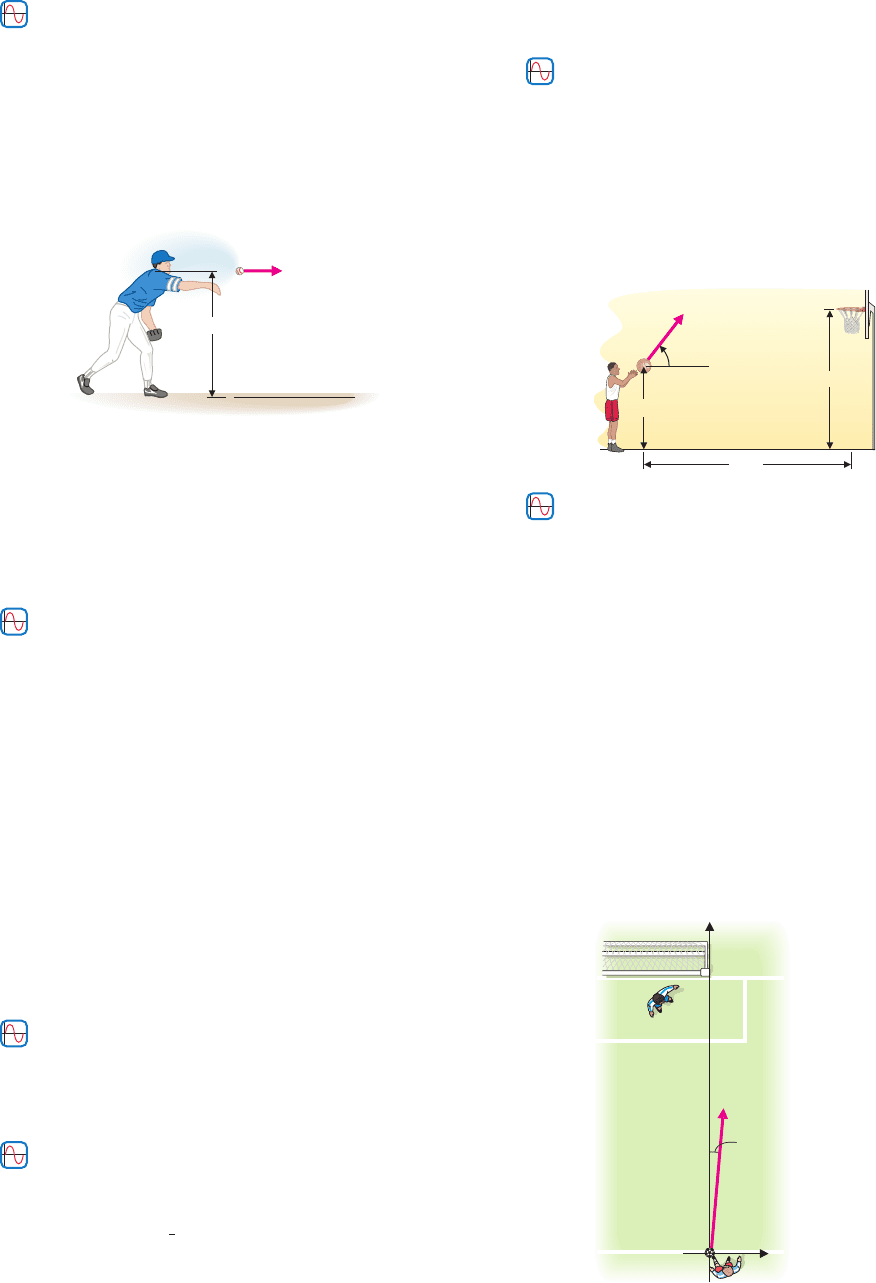
31. In a basketball free throw, a ball is shot from a height of
h feet toward a basket 10 feet above the ground at a horizontal
distance of 15 feet. If h = 6,θ = 52
◦
and v
0
= 25 ft/s, show
that the free throw is good. Since the basket is larger than the
ball, a free throw has a margin of error of several inches. If any
shot that passes through height 10 ft with 14.65 ≤ x ≤ 15.35
is good, show that, for the given initial speed v
0
, the margin
of error is 48
◦
≤ θ ≤ 57
◦
. Sketch parametric graphs to show
several of these free throws.
v
0
u
15 ft
10 ft
h
32. A basketball is shot from a height of 8 feet at a horizontal dis-
tance of 15 feet from the basket. The initial speed is 27 ft/s and
the initial angle is 30
◦
above the horizontal. The basket is at a
height of 10 feet and extends from x = 14.25
to x = 15.75
.
(a) Show that the center of the ball goes through the basket.
(b) Determine the minimum distance between the center of
the ball and the front rim at (14.25, 10), and the back rim at
(15.75, 10). (c) Given that the ball has diameter 9
, conclude
that the ball hits the rim. (Suggested by Howard Penn.)
33. Soccer player Roberto Carlos of Brazil is known for his curv-
ing kicks. Suppose that he has a free kick from 30 yards out.
Orienting the x- and y-axes as shown in the figure, suppose
the kick has initial speed 100 ft/s at an angle of 5
◦
from the
positive y-axis. Assume that the only force on the ball is a
Magnus force to the left caused by the spinning of the ball.
(a) With x
(t) =−20 and y
(t) = 0, determine whether the
ball goes in the goal at y = 90 and −24 ≤ x ≤ 0.
x
u
y
(b) A wall of players is lined up 10 yards away, extending
from x =−10 to x = 1. Determine whether the kick goes
around the wall.
P1: PIC/OVY P2: OSO/OVY QC: OSO/OVY T1: OSO
MHDQ256-Ch05 MHDQ256-Smith-v1.cls December 14, 2010 20:15
LT (Late Transcendental)
CONFIRMING PAGES
360 CHAPTER 5
..
Applications of the Definite Integral 5-46
34. To train astronauts to operate in a weightless environment,
NASA sends them up in a special plane (nicknamed the Vomit
Comet). To allow the passengers to experience weightlessness,
the vertical acceleration of the plane must exactly match the
acceleration due to gravity. If y
(t) is the vertical acceleration
of the plane, then y
(t) =−g. Show that, for a constant hor-
izontal velocity, the plane follows a parabolic path. NASA’s
planeflies parabolic paths of approximately 2500 feetin height
(2500 feet up and 2500 down). The time to complete such a
path is the amount of weightless time for the passengers.
Compute this time.
............................................................
In exercises 35–40, we explore two aspects of juggling. More
information can be found in The Mathematics of Juggling by
Burkard Polster.
35. Professional jugglers generally agree that 10 is the maximum
number of balls that a human being can successfully maintain.
To get an idea why, suppose that it takes
1
2
second to catch and
toss a ball. (In other words, using both hands, the juggler can
process 4 balls per second.) To juggle 10 balls, each ball would
need to be in the air for 2.5 seconds. Neglecting air resistance,
how high would the ball have to be tossed to stay in the air this
long? How much higher would the balls need to be tossed to
juggle 11 balls?
36. Another aspect of juggling balls is accuracy. A ball juggled
from the right hand to the left hand must travel the correct
horizontal distance to be catchable. Suppose that a ball is
tossed with initial horizontal velocity v
0x
and initial vertical
velocity v
0y
. Assume that the ball is caught at the height from
which it is thrown. Show that the horizontal distance traveled
is w =
v
0x
v
0y
16
feet. (Hint: This is a basic projectile problem,
like example 5.4.)
37. Referring to exercise 36, suppose that a ball is tossed at an an-
gle of α from the vertical. Show that tanα =
v
0x
v
0y
. Combining
this result with exercises 15 and 36, show that w = 4h tanα,
where h is the maximum height of the toss.
38. Find a linear approximation for tan x at x = 0. Use this ap-
proximation and exercise 37 to show that α ≈
w
4h
.Ifan
angle of α produces a distance of w and an angle of α +α
produces a distance of w +w, show that α ≈
w
4h
.
39. Suppose that w is the difference between the idealhorizontal
distance for a toss and the actual horizontal distance of a toss.
For the average juggler, an error of w = 1 foot is manage-
able. Let α be the corresponding error in the angle of toss. If
h is the height needed to juggle 10 balls (see exercise 35), find
the maximum error in tossing angle.
40. Repeat exercise 39 using the height needed to juggle 11 balls.
How much more accurate does the juggler need to be to juggle
11 balls?
............................................................
41. Astronaut Alan Shepard modified some of his lunar equipment
and became the only person to hit a golf ball on the Moon.
Assume that the ball was hit with speed 60 ft/s at an angle of
25
◦
above the horizontal. Assuming no air resistance, find the
distance the ball would have traveled on Earth. Then find how
far it would travel on the Moon, where there really is no air
resistance (use g = 5.2 ft/s
2
). The gravitational force of the
Moon is about one-sixth that of Earth. A simple guess might
be that a golf ball would travel six times as high and six times
as far on the Moon compared to on Earth. Determine whether
this is correct.
42. Suppose that a firefighter holds a water hose at slope m and
the water exits the hose with speed v ft/s. Show that the water
follows the path y =−16
1 + m
2
v
2
x
2
− mx. If the fire-
fighter stands 20 feet from a wall, for a given speed v, what is
the maximum height on the wall that the water can reach?
43. Suppose a target is dropped vertically at a horizontal distance
of 20 feet from you. If you fire a paint ball horizontally and
directly at the target when it’s dropped, show that you will hit
it (assuming no air resistance and assuming that the paint ball
reaches the target before either hits the ground).
44. An object is dropped from a height of 100 feet. Another object
directly below the first is launched vertically from the ground
with initial velocity 40 ft/s. Determine when and how high up
the objects collide.
45. How fast is a vert skateboarder like Tony Hawk going at the
bottom of a ramp? Ignoring friction and air resistance, the
answer comes from conservation of energy, which states that
the kinetic energy
1
2
mv
2
plus the potential energy mgy remains
constant. Assume that the energy at the top of a trick at height
H is all potential energy and the energy at the bottom of the
ramp is all kinetic energy. (a) Find the speed at the bottom as a
function of H. (b) Compute the speed if H = 16 feet. (c) Find
the speed halfway down (y = 8). (d) If the ramp has the
shape y = x
2
for −4 ≤ x ≤ 4, find the horizontal and vertical
components of speed halfway at y = 8.
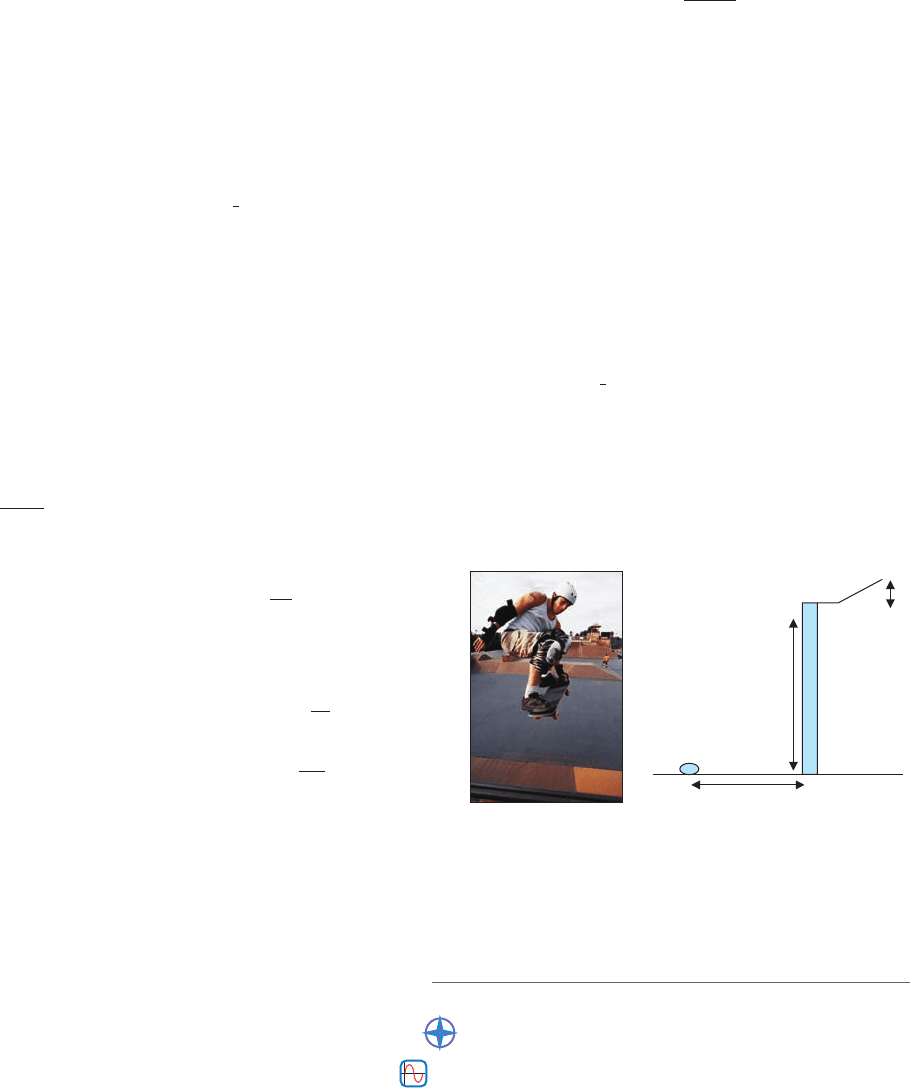
30'
h
'
10'
Exercise 45 Exercise 46
46. A science class builds a ramp to roll a bowling ball out of a
window that is 30 feet above the ground. Their goal is for the
ball to land on a watermelon that is 10 feet from the building.
Assuming no friction or air resistance, determine how high the
ramp should be to smash the watermelon.
EXPLORATORY EXERCISES
1. In the text and exercises 27 and 28, we discussed the dif-
ferential equation x
(t) =−25 sin(4ωt + θ
0
) for the lateral
motion of a knuckleball. Integrate and apply the initial con-
ditions x
(0) = 0 and x(0) = 0 to derive the general equation

P1: PIC/OVY P2: OSO/OVY QC: OSO/OVY T1: OSO
MHDQ256-Ch05 MHDQ256-Smith-v1.cls December 14, 2010 20:15
LT (Late Transcendental)
CONFIRMING PAGES
5-47 SECTION 5.6
..
Applications of Integration to Physics and Engineering 361
x(t)=
25
16ω
2
sin(4ωt + θ
0
) −
25
4ω
cosθ
0
t −
25
16ω
2
sinθ
0
.If
you have access to three-dimensional graphics, graph x(t,ω)
for θ
0
= 0 with 0 ≤ t ≤ 0.68 and 0.01 ≤ ω ≤ 10. (Note:
Some plotters will have trouble with ω = 0.) Repeat with
θ
0
= π/4,θ
0
= π/2 and two choices of your own for θ
0
.A
pitcher wants the ball to move as much as possible back and
forth but end up near home plate (x = 0). Based on these
criteria, pick the combinations of θ
0
and ω that produce the
four best pitches. Graph these pitches in two dimensions with
x = x(t) as in Figures 5.48a and 5.48b.
2. Although we have commented on some inadequacies of the
gravity-onlymodel ofprojectile motion, we havenotpresented
anyalternatives. Such models tend to be somewhatmore math-
ematically complex. One way to explore these models is in-
troduced in exploratory exercise 2 in section 4.1. A different
method is presented in this exercise. For a falling object like a
raindrop, the two primary forces are gravity and air drag. Typi-
cally,airdragisproportional tothesquareofthe velocity.Com-
bining this with Newton’s second law of motion (F = ma),
we have ma = cv
2
− mg. The velocity v(t), in feet per sec-
ond, satisfies the equation v
(t) = k[v(t)]
2
− 32, for k = c/m.
Suppose that v(0) = 0. Explain why v(t) will decrease and
become negative, for t > 0. As v decreases, explain why v
(t)
approaches0.Thevalueofv(t)forwhichv
(t) = 0 is calledthe
terminal velocity, denoted v
T
. Explain why lim
t→∞
v(t) = v
T
.
Show that v
T
=
√
32/k.Fork = 2, find v
T
. As discussed
in example 5.6, the terminal velocity of a raindrop is about
10 mph, or about 14.6 ft/s. Find the value of k for a raindrop.
3. The goal in the old computer game called “Gorillas” is to
enter a speed and angle to launch an explosive banana to try
to hit a gorilla at some other location. Suppose that you are
located at the origin and the gorilla is at (40, 20). (a) Find two
speed/angle combinations that will hit the gorilla. (b) Estimate
the smallest speed that can be used to hit the target. (c) Repeat
parts (a) and (b) if there is a building in the way that occupies
20 ≤ x ≤ 30 and 0 ≤ y ≤ 30.
5.6 APPLICATIONS OF INTEGRATION TO PHYSICS
AND ENGINEERING
In this section, we explore several applications of integration in physics. In each case, we
will define a basic concept and then use the definite integral to generalize the concept to
solve a broader range of problems.
Imagine that you are at the bottom of a snow-covered hill with a sled. To get a good
ride, you want to push the sled as far up the hill as you can. A physicist would say that the
higher up you are, the more potential energy you have. Sliding down the hill converts the
potential energy into kinetic energy. (This is the fun part!) But pushing the sled up the hill
requires you to do some work: you must exert a force over a long distance.
Our first task is to quantify work. Certainly, if you push twice the weight (i.e., exert
twice the force), you’re doing twice the work. Further, if you push the sled twice as far,
you’ve done twice the work. In view of these observations, for any constant force F applied
over a distance d, we define the work W as
W = Fd.
Weextendthis notionof work to the caseof a nonconstant force F(x)applied on the interval
[a, b]asfollows.First,wepartitiontheinterval[a, b]inton equalsubintervals,eachofwidth
x =
b −a
n
and consider the work done on each subinterval. If x is small and F is con-
tinuous,then the force F(x)applied on the subinterval [x
i−1
, x
i
]can be approximated by the
constant force F(c
i
) for some point c
i
∈ [x
i−1
, x
i
]. The work done moving the object along
thesubintervalisthenapproximately F(c
i
)x.ThetotalworkW doneisthenapproximately
W ≈
n
i=1
F(c
i
)x.

P1: PIC/OVY P2: OSO/OVY QC: OSO/OVY T1: OSO
MHDQ256-Ch05 MHDQ256-Smith-v1.cls December 14, 2010 20:15
LT (Late Transcendental)
CONFIRMING PAGES
362 CHAPTER 5
..
Applications of the Definite Integral 5-48
Youshould recognize this as a Riemann sum, which, as n gets larger, approaches the actual work,
Work
W = lim
n→∞
n
i=1
F(c
i
)x =
b
a
F(x)dx. (6.1)
We take (6.1) as our definition of work.
You’ve probably noticed that the farther a spring is compressed (or stretched) from
its natural length, the more force is required to further compress (or stretch) the spring.
According to Hooke’s Law, the force required to maintain a spring in a given position is
proportional to the distance it’s compressed (or stretched). That is, if x is the distance a
spring is compressed (or stretched) from its natural length, the force F(x) exerted by the
spring is given by
F(x) = kx, (6.2)
for some constant k (the spring constant).
EXAMPLE 6.1 Computing the Work Done Stretching a Spring
A force of 3 pounds stretches a spring
1
4
foot from its natural length. (See Figure 5.49.)
Find the work done in stretching the spring 6 inches beyond its natural length.
Solution First, we determine the value of the spring constant. From Hooke’s Law
(6.2), we have that
3 = F
1
4
= k
1
4
,
so that k = 12 and F(x) = 12x. From (6.1), the work done in stretching the spring
6 inches (1/2 foot) is then
W =
1/2
0
F(x) dx =
1/2
0
12xdx=
3
2
foot-pounds.
In this case, notice that stretching the spring transfers potential energy to the spring. (If
the spring is later released, it springs back toward its natural length, converting the
potential energy to kinetic energy.)
FIGURE 5.49
Stretched spring
EXAMPLE 6.2 Computing the Work Done by a Weightlifter
A weightlifter lifts a 200-pound barbell a distance of 3 feet. How much work was done?
Also, determine the work done by the weightlifter if the weight is raised 4 feet above the
ground and then lowered back into place.
Solution Since the force (the weight) is constant here, we simply have
W = Fd = 200 × 3 = 600 foot-pounds.
It may seem strange, but if the weightlifter lifts the same weight 4 feet from the ground
and then lowers it back into place, then since the barbell ends up in the same place as it
started, the net distance covered is zero and the work done is zero. Of course, it would
feel like work to the weightlifter, but as we have defined it, work accounts for the energy
change in the object. Since the barbell has the same kinetic and potential energy that it
started with, the total work done on it is zero.
In example 6.3, both the force and the distance are nonconstant. This presents some
unique challenges and we’ll need to first approximate the work and then recognize the
definite integral that this approximation process generates.