
Smith R., Minton R. Calculus
Подождите немного. Документ загружается.

P1: OSO/OVY P2: OSO/OVY QC: OSO/OVY T1: OSO
MHDQ256-Ch08 MHDQ256-Smith-v1.cls December 16, 2010 21:19
LT (Late Transcendental)
CONFIRMING PAGES
8-3 SECTION 8.1
..
Modeling with Differential Equations 493
growth, determine the number of cells present at any time t (measured in minutes) and
find the doubling time.
Solution Exponential growth means that
y
(t) = ky(t)
and hence, from (1.4), y(t) = Ae
kt
, (1.5)
where A and k are constants to be determined. If we set the starting time as t = 0, we
have
y(0) = 100. (1.6)
Equation (1.6) is called an initial condition. Setting t = 0 in (1.5), we now have
100 = y(0) = Ae
0
= A
and hence, y(t) = 100 e
kt
.
We can use the second observation to determine the value of the growth constant k.
We have
450 = y(60) = 100e
60k
.
Dividing both sides by 100 and taking the natural logarithm of both sides, we have
ln4.5 = lne
60k
= 60k,
so that k =
ln4.5
60
≈ 0.02507.
We now have a formula representing the number of cells present at any time t:
y(t) = 100e
kt
= 100exp
ln4.5
60
t
.
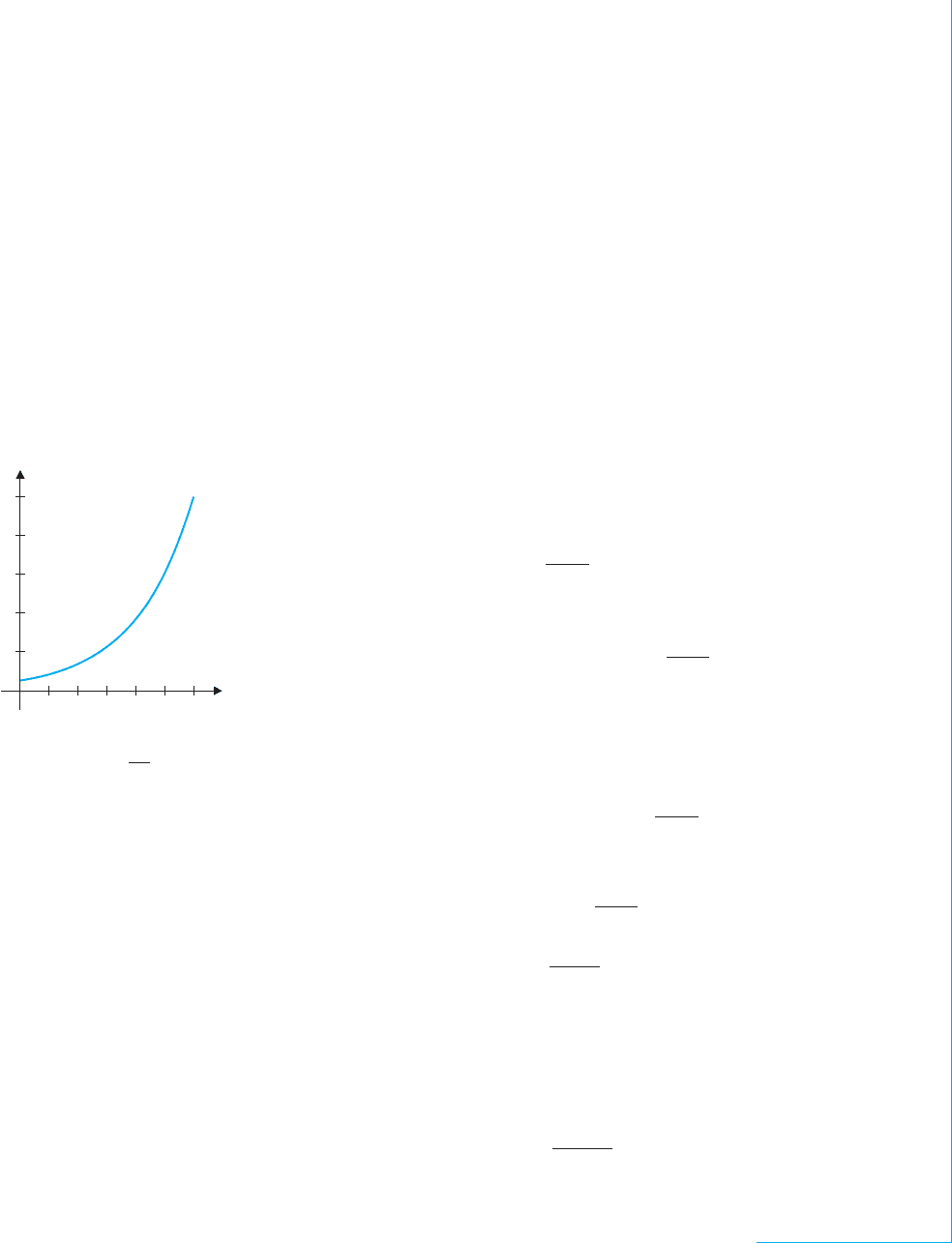
See Figure 8.2 for a graph of the projected bacterial growth over the first 120 minutes.
One further question of interest to microbiologists is the doubling time, that is, the time
it takes for the number of cells to double. We can find this by solving for the time t for
which y(t) = 2y(0) = 200. We have
200 = y(t) = 100 exp
ln4.5
60
t
.
Dividing both sides by 100 and taking logarithms, we obtain
ln2 =
ln4.5
60
t,
so that t =
60ln 2
ln4.5
≈ 27.65.
So, the doubling time for this culture of Streptococcus A is about 28 minutes. The
doubling time for a bacterium depends on the specific strain of bacteria, as well as the
quality and quantity of the food supply, the temperature and other environmental
factors. However, it is not dependent on the initial population. Here, you can easily
check that the population reaches 400 at time
t =
120ln 2
ln4.5
≈ 55.3
(exactly double the time it took to reach 200).
That is, the initial population of 100 doubles to 200 in approximately 28 minutes
and it doubles again (to 400) in another 28 minutes and so on.
y
t
400
800
1200
1600
2000
20 40 60 80 100 120
FIGURE 8.2
y = 100 e
ln4.5
60
t
Numerous physical phenomena satisfy exponentialgrowthor decay laws.For instance,
experiments have shown that the rate at which a radioactive element decays is directly
P1: OSO/OVY P2: OSO/OVY QC: OSO/OVY T1: OSO
MHDQ256-Ch08 MHDQ256-Smith-v1.cls December 16, 2010 21:19
LT (Late Transcendental)
CONFIRMING PAGES
494 CHAPTER 8
..
First-Order Differential Equations 8-4
proportionaltotheamountpresent.(Recallthatradioactiveelementsarechemicallyunstable
elements that gradually decay into other, more stable elements.) Let y(t) be the amount
(mass) of a radioactive element present at time t. Then, we have that the rate of change (rate
of decay) of y(t) satisfies
y
(t) = ky(t). (1.7)
Note that (1.7) is precisely the same differential equation as (1.1), encountered in example
1.1 for the growth of bacteria and hence, from (1.4), we have that
y(t) = Ae
kt
,
for some constants A and k (here, the decay constant) to be determined.
It is common to discuss the decay rate of a radioactive element in terms of its half-life,
the time required for half of the initial quantity to decay into other elements. For instance,
scientists have calculated that the half-life of carbon-14 (
14
C) is approximately 5730 years.
That is, if you have 2 grams of
14
C today and you come back in 5730 years, you will
have approximately 1 gram of
14
C remaining. It is this long half-life and the fact that living
creaturescontinuallytakein
14
Cthatmake
14
Cmeasurementsusefulfor radiocarbon dating.
(See the exercise set for more on this important application.)
EXAMPLE 1.2 Radioactive Decay
If you have 50 grams of
14
C today, how much will be left in 100 years?
Solution Let y(t) be the mass (in grams) of
14
C present at time t. Then, we have
y
(t) = ky(t)
and as we have already seen,
y(t) = Ae
kt
.
The initial condition is y(0) = 50, so that
50 = y(0) = Ae
0
= A
and
y(t) = 50e
kt
.
To find the decay constant k, we use the half-life:
25 = y(5730) = 50e
5730k
.
Dividing both sides by 50 and taking logarithms gives us
ln
1
2
= lne
5730k
= 5730k,
so that
k =
ln
1
2
5730
≈−1.20968 ×10
−4
.
A graph of the mass of
14
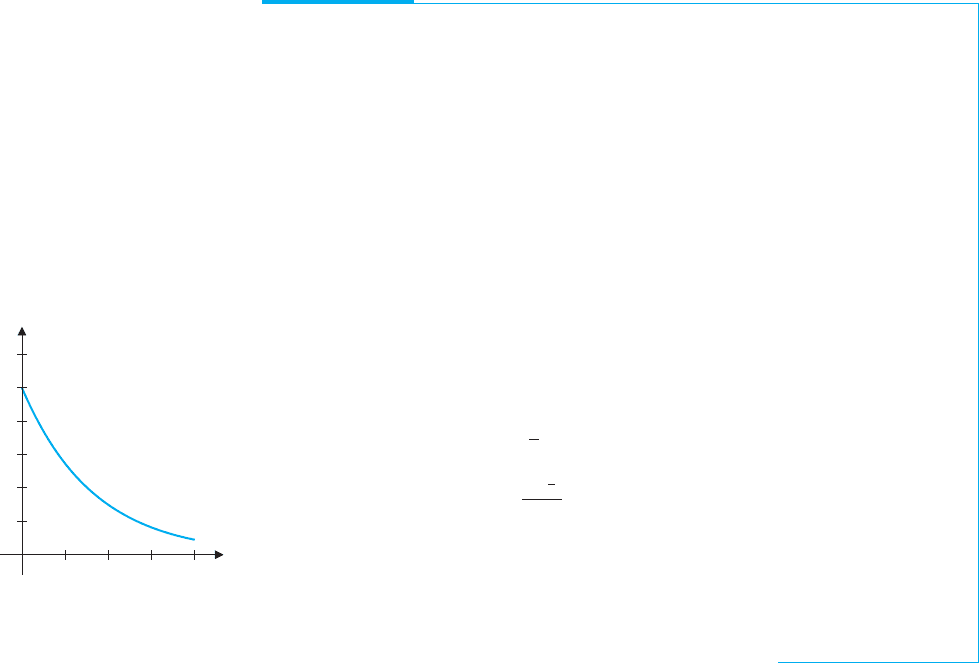
C as a function of time is seen in Figure 8.3. Notice the
extremely large timescale shown. This should give you an idea of the incredibly slow
rate of decay of
14
C. Finally, notice that if we start with 50 grams, then the amount left
after 100 years is
y(100) = 50e
100k
≈ 49.3988 grams.
t
Time (thousands of years)
10
20
30
40
50
60
5 101520
y
Grams of
14
C
FIGURE 8.3
Decay of
14
C
A mathematically similar physical principle is Newton’s Law of Cooling. If you
introduce a hot object into cool surroundings (or equivalently, a cold object into warm
surroundings), the rate at which the object cools (or warms) is not proportional to
its temperature, but rather, to the difference in temperature between the object and its
surroundings. Symbolically, if we let y(t) be the temperature of the object at time t and let
T
a
be the temperature of the surroundings (the ambient temperature, which we assume to
be constant), we have the differential equation
y
(t) = k[y(t) − T
a
]. (1.8)

P1: OSO/OVY P2: OSO/OVY QC: OSO/OVY T1: OSO
MHDQ256-Ch08 MHDQ256-Smith-v1.cls December 16, 2010 21:19
LT (Late Transcendental)
CONFIRMING PAGES
8-5 SECTION 8.1
..
Modeling with Differential Equations 495
Noticethat (1.8)isnot thesameas thedifferentialequationdescribing exponentialgrowthor
decay. (Compare these; what’s the difference?) Even so, we can approach finding a solution
in the same way. In the case of cooling, we assume that
T
a
< y(t).
(Why is it fair to assume this?) If we divide both sides of equation (1.8) by y(t) − T
a
and
then integrate both sides, we obtain
y
(t)
y(t) − T
a
dt =
kdt= kt + c
1
. (1.9)
Notice that we can evaluate the integral on the left-hand side by making the substitution
u = y(t) − T
a
, so that du = y
(t) dt. Thus, we have
y
(t)
y(t) − T
a
dt =
1
u
du = ln|u|+c
2
= ln|y(t) − T
a
|+c
2
= ln [y(t) − T
a
] + c
2
,
since y(t) − T
a
> 0. From (1.9), we now have
ln[y(t) − T
a
] + c
2
= kt + c
1
or ln[y(t) − T
a
] = kt + c,
where we have combined the two constants of integration. Taking exponentials of both
sides, we obtain
y(t) − T
a
= e
kt+c
= e
kt
e
c
.
Finally, for convenience, we write A = e
c
, to obtain
y(t) = Ae
kt
+ T
a
,
where A and k are constants to be determined.
We illustrate Newton’s Law of Cooling in example 1.3.
EXAMPLE 1.3 Newton’s Law of Cooling for a Cup of Coffee
A cup of fast-food coffee is 180
◦
F when freshly poured. After 2 minutes in a room
at 70
◦
F, the coffee has cooled to 165
◦
F. Find the temperature at any time t and find the
time at which the coffee has cooled to 120
◦
F.
Solution Letting y(t) be the temperature of the coffee at time t,wehave
y
(t) = k[y(t) − 70].
Proceeding as above, we obtain
y(t) = Ae
kt
+ 70.
Observe that the initial condition here is the initial temperature, y(0) = 180. This
gives us
180 = y(0) = Ae
0
+ 70 = A + 70,
so that A = 110 and y(t) = 110 e
kt
+ 70.
We can now use the second measured temperature to solve for the constant k.Wehave
165 = y(2) = 110e
2k
+ 70.
Subtracting 70 from both sides and dividing by 110, we have
e
2k
=
165 − 70
110
=
95
110
.
Taking logarithms of both sides yields
2k = ln
95
110
P1: OSO/OVY P2: OSO/OVY QC: OSO/OVY T1: OSO
MHDQ256-Ch08 MHDQ256-Smith-v1.cls December 16, 2010 21:19
LT (Late Transcendental)
CONFIRMING PAGES
496 CHAPTER 8
..
First-Order Differential Equations 8-6
and hence,
k =
1
2
ln
95
110
≈−0.0733017.
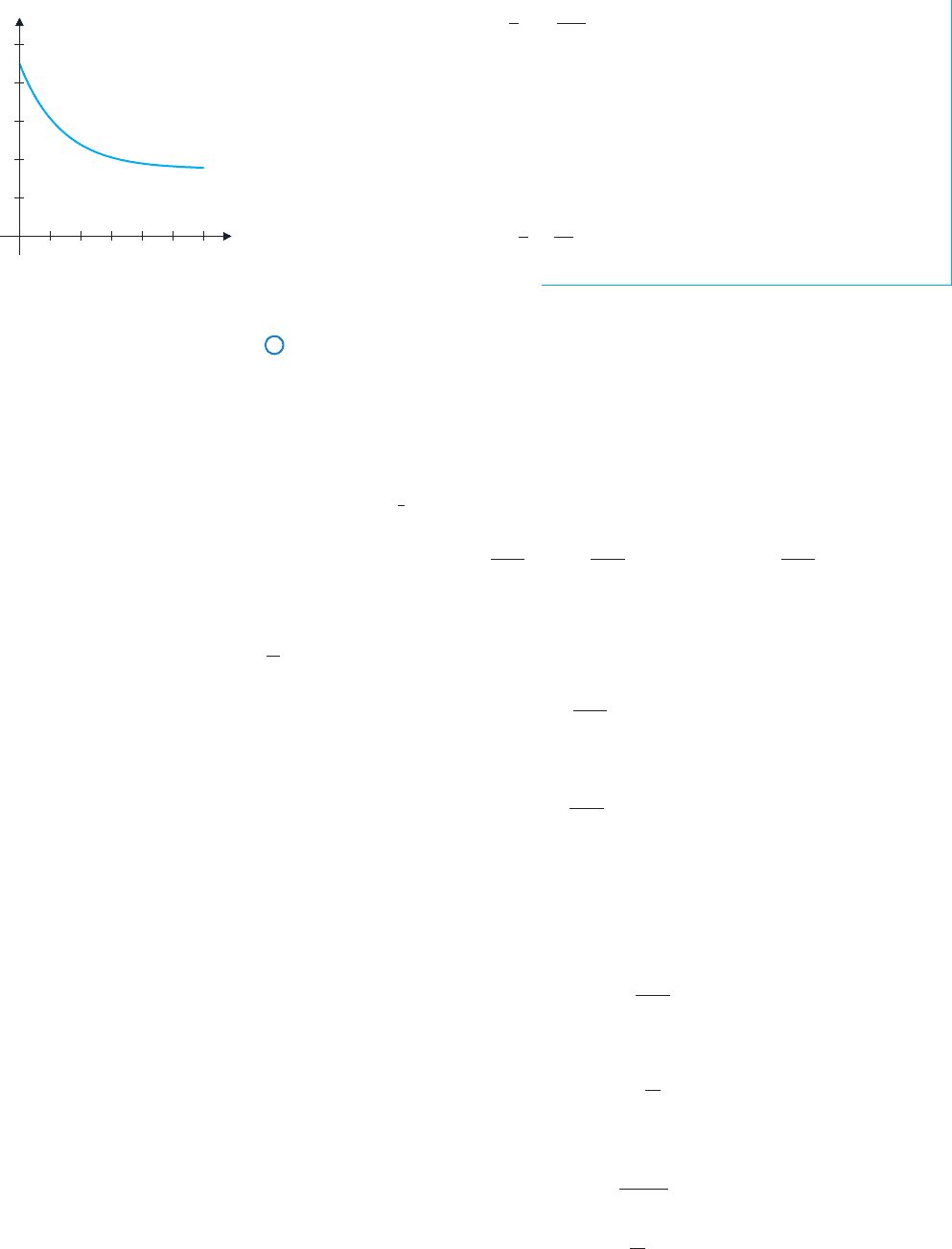
A graph of the projected temperature against time is shown in Figure 8.4. From
Figure 8.4, you might observe that the temperature appears to have fallen to 120
◦
F after
about 10 minutes. We can solve this symbolically by finding the time t for which
120 = y(t) = 110 e
kt
+ 70.
It is not hard to solve this to obtain
t =
1
k
ln
5
11
≈ 10.76 minutes.
The details are left as an exercise.
y
40
80
120
160
200
10 20 30 40 50 60
t
FIGURE 8.4
Temperature of coffee
Compound Interest
If a bank agrees to pay you 8% (annual) interest on your investment of $10,000, then at the
end of a year, you will have
$10,000 + (0.08)$10,000 = $10,000(1 +0.08) = $10,800.
On the other hand, if the bank agrees to pay you interest twice a year at the same 8% annual
rate, you receive
8
2
% interest twice each year. At the end of the year, you will have
$10,000
1 +
0.08
2
1 +
0.08
2
= $10,000
1 +
0.08
2
2
= $10,816.
Continuing in this fashion, notice that paying (compounding) interest monthly would pay
8
12
% each month (period), resulting in a balance of
$10,000
1 +
0.08
12
12
≈ $10,830.00.
Further, if interest is compounded daily, you would end up with
$10,000
1 +
0.08
365
365
≈ $10,832.78.
It should be evident that the more often interest is compounded, the greater the interest
will be. A reasonable question to ask is whether there is a limit to how much interest can
accrue on a given investment at a given interest rate. If n is the number of times per year
that interest is compounded, we wish to calculate the annual percentage yield (APY) under
continuous compounding,
APY = lim
n→∞
1 +
0.08
n
n
− 1.
To determine this limit, you must recall (see Chapter 0) that
e = lim
m→∞
1 +
1
m
m
.
Notice that if we make the change of variable n = 0.08m, then we have
APY = lim
m→∞
1 +
0.08
0.08m
0.08m
− 1
=
lim
m→∞
1 +
1
m
m
0.08
− 1
= e
0.08
− 1 ≈ 0.083287.

P1: OSO/OVY P2: OSO/OVY QC: OSO/OVY T1: OSO
MHDQ256-Ch08 MHDQ256-Smith-v1.cls December 16, 2010 21:19
LT (Late Transcendental)
CONFIRMING PAGES
8-7 SECTION 8.1
..
Modeling with Differential Equations 497
Under continuous compounding, you would thus earn approximately 8.3% or
$10,000(e
0.08
− 1) ≈ $832.87
ininterest,leavingyourinvestmentwithatotalvalueof$10,832.87.Moregenerally,suppose
that you invest $P at an annual interest rate r, compounded n times per year. Then the value
of your investment after t years is
$P
1 +
r
n
nt
.
Under continuous compounding (i.e., taking the limit as n →∞), this becomes
$Pe
rt
. (1.10)
Alternatively, if y(t) is the value of your investment after t years, with continuous
compounding, the rate of change of y(t) is proportional to y(t). That is,
y
(t) = ry(t),
where r is the annual interest rate. From (1.4), we have
y(t) = Ae
rt
.
For an initial investment of $P,wehave
$P = y(0) = Ae
0
= A,
so that
y(t) = $Pe
rt
,
which is the same as (1.10).
EXAMPLE 1.4 Comparing Forms of Compounding Interest
If you invest $7000 at an annual interest rate of 5.75%, compare the value of your
investment after 5 years under various forms of compounding.
Solution With annual compounding, the value is
$7000
1 +
0.0575
1
5
≈ $9257.63.
With monthly compounding, this becomes
$7000
1 +
0.0575
12
12(5)
≈ $9325.23.
With daily compounding, this yields
$7000
1 +
0.0575
365
365(5)
≈ $9331.42.
Finally, with continuous compounding, the value is
$7000e
0.0575(5)
≈ $9331.63.
The mathematics used to describe the compounding of interest also applies to accounts
that are decreasing in value.
EXAMPLE 1.5 Depreciation of Assets
(a) Suppose that the value of a $10,000 asset decreases continuously at a constant rate
of 24% per year. Find its worth after 10 years; after 20 years. (b) Compare these values
to a $10,000 asset that is depreciated to no value in 20 years using linear depreciation.
Solution The value v(t) of any quantity that is changing at a constant rate r satisfies
v
= rv. Here, r =−0.24, so that
v(t) = Ae
−0.24t
.
P1: OSO/OVY P2: OSO/OVY QC: OSO/OVY T1: OSO
MHDQ256-Ch08 MHDQ256-Smith-v1.cls December 16, 2010 21:19
LT (Late Transcendental)
CONFIRMING PAGES
498 CHAPTER 8
..
First-Order Differential Equations 8-8
Since the value of the asset is initially 10,000, we have
10,000 = v(0) = Ae
0
= A.
We now have v(t) = 10,000 e
−0.24t
.
At time t = 10, the value of the asset is then
$10,000e
−0.24(10)
≈ $907.18
and at time t = 20, the value has decreased to
$10,000e
−0.24(20)
≈ $82.30.
For part (b), linear depreciation means we use a linear function v(t) = mt +b for the
value of the asset. We start with v(0) = 10,000 and end at v(20) = 0. From
v(0) = 10,000 we get b = 10,000 and using the points (0,10,000) and (20,0), we
compute the slope m =
10,000
−20
=−500. We then have
v(t) =−500t + 10,000.
At time t = 10,v(10) = $5000. Notice that this is considerably more than the
approximately $900 that exponential depreciation gave us. By time t = 20, however,
the linear depreciation value of $0 is less than the exponential depreciation value of
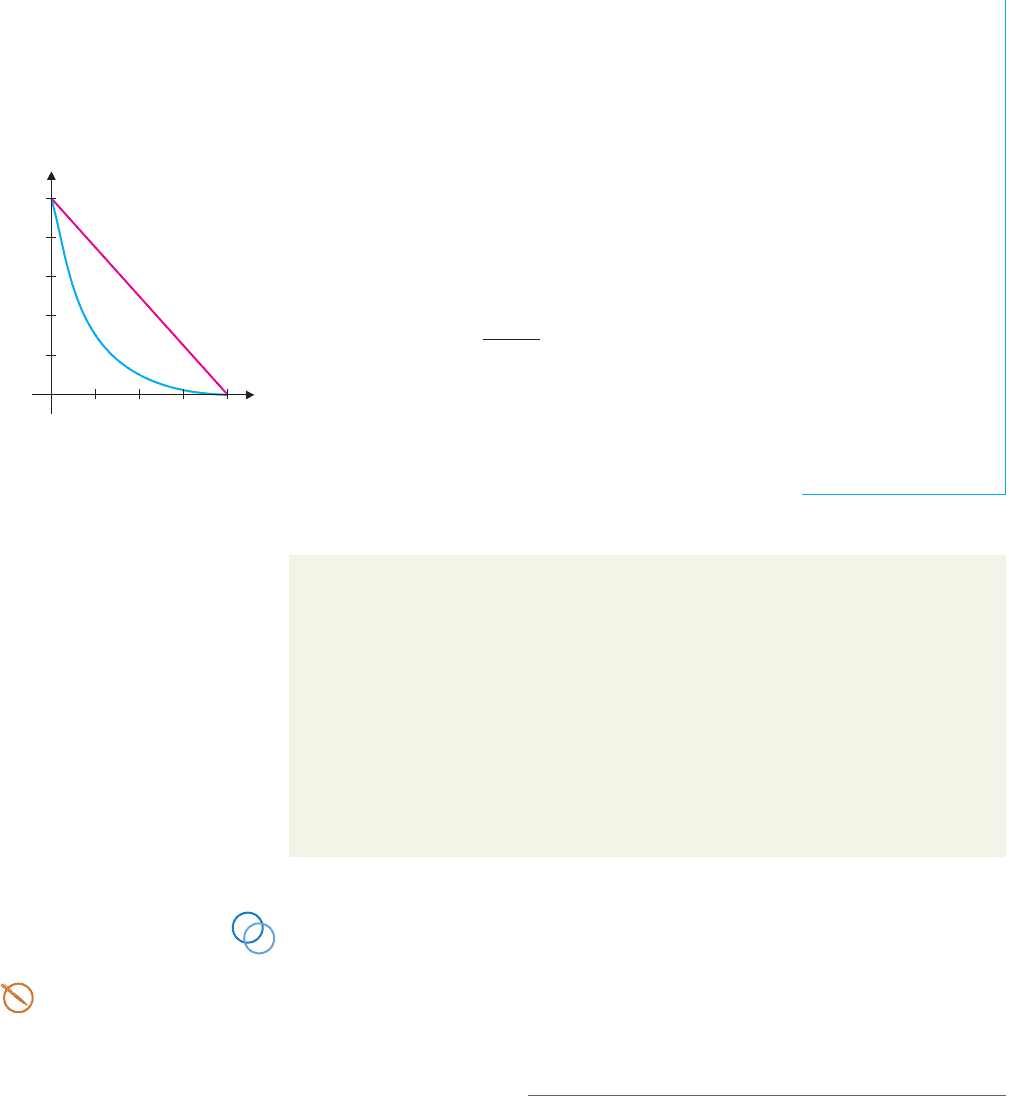
$82.30. The graphs in Figure 8.5 illustrate these comparisons.
y
x
2000
4000
6000
8000
10,000
5101520
FIGURE 8.5
Linear versus exponential
depreciation
BEYOND FORMULAS
Withabasicunderstanding of differentialequations, you can model a diversecollection
of physical phenomena arising in economics, science and engineering. Understanding
the assumptions that go into the model allows you to interpret the meaning of the solu-
tion in the context of the original problem. Moreover, part ofthe power of mathematics
lies in its generality. In this case, a given differential equation may model a collection
of vastly different phenomena. In this sense, knowing a little bit of mathematics goes
a long way. Having solved for doubling time in example 1.1, if you are told that the
value of an investment or the size of a tumor is modeled by the same equation, you do
not need to re-solve any equations to find the doubling times for the investment or the
size of the tumor.
EXERCISES 8.1
WRITING EXERCISES
1. Alinearfunctionischaracterizedbyconstantslope.Ifapopula-
tionshowedaconstantnumericalincreaseyearbyyear,explain
why the population could be represented by a linear function.
If the population showed a constant percentage increase in-
stead, explain why the population could be represented by an
exponential function.
2. If a population has a constant birthrate and a constant death
rate (smaller than the birthrate), describe what the population
wouldlooklike overtime. In theUnited States,is thedeath rate
increasing, decreasing or staying the same? Given this, why is
there concern about reducing the birthrate?
3. Explain, in monetary terms, why for a given interest rate the
more times the interest is compounded the more money is in
the account at the end of a year.
4. In the growth and decay examples, the constant A turned out to
be equal to the initial value. In the cooling examples, the con-
stant A did not equal the initial value. Explain why the cooling
example worked differently.
In exercises 1–8, find the solution of the given differential equa-
tion satisfying the indicated initial condition.
1. y
= 4y, y(0) = 2 2. y
= 3y, y(0) =−2
3. y
=−3y, y(0) = 5 4. y
=−2y, y(0) =−6
5. y
= 2y, y(1) = 2 6. y
=−y, y(1) = 2
7. y
= y − 50, y(0) = 70 8. y
=−0.1y − 10, y(0) = 80
............................................................

P1: OSO/OVY P2: OSO/OVY QC: OSO/OVY T1: OSO
MHDQ256-Ch08 MHDQ256-Smith-v1.cls December 16, 2010 21:19
LT (Late Transcendental)
CONFIRMING PAGES
8-9 SECTION 8.1
..
Modeling with Differential Equations 499
Exercises 9–14 involve exponential growth.
9. Suppose a bacterial culture initially has 400 cells. After 1 hour,
the population has increased to 800. (a) Quickly determine the
population after 3 hours. (b) Find an equation for the popu-
lation at any time. (c) What will the population be after 3.5
hours?
10. Supposeabacterialcultureinitiallyhas100cells.After2hours,
the population has increased to 400. (a) Quickly find the pop-
ulation after 6 hours. (b) Find an equation for the population
at any time. (c) What will the population be after 7 hours?
11. Supposeabacterialculturedoublesinpopulationevery4hours.
If the population is initially 100, (a) quickly determine when
the population will reach 400. (b) Find an equation for the
population at any time. (c) Determine when the population
will reach 6000.
12. Suppose a bacterial culture triples in population every 5 hours.
If the population is initially 200, (a) quickly determine when
the population will reach 5400. (b) Find an equation for the
population at any time. (c) Determine when the population
will reach 20,000.
13. Suppose that a population of E. coli doubles every 20 minutes.
A treatment of the infection removes90% of the E. coli present
and is timed to accomplish the following. The population
starts at size 10
8
, grows for T minutes, the treatment is
applied and the population returns to size 10
8
. Find the
time T.
14. Research by Meadows, Meadows, Randers and Behrens indi-
cates that the Earth has 3.2 ×10
9
acres of arable land avail-
able. The world population of 1950 required 10
9
acres to sus-
tain it, and the population of 1980 required 2 ×10
9
acres. If
the required acreage grows at a constant percentage rate, in
what year will the population reach the maximum sustainable
size?
............................................................
15. Suppose some quantity is increasing exponentially (e.g., the
number of cells in a bacterial culture) with growthrate r. Show
that the doubling time is
ln2
r
.
16. Suppose some quantity is decaying exponentially with decay
constant r. Show that the half-life is −
ln2
r
. What is the dif-
ference between the half-life here and the doubling time in
exercise 15?
Exercises 17–22 involve exponential decay.
17. Strontium-90 is a dangerous radioactive isotope. Because of
its similarity to calcium, it is easily absorbed into human
bones. The half-life of strontium-90 is 28 years. If a certain
amount is absorbed into the bones due to exposure to a nu-
clearexplosion,whatpercentagewillremainafter(a)84years?
(b) 100 years?
18. Thehalf-lifeofuranium
235
Uisapproximately0.7 ×10
9
years.
If 50 grams are buried at a nuclear waste site, how much will
remain after (a) 100 years? (b) 1000 years?
19. The half-life of morphine in the human bloodstream is 3
hours. If initially there is 0.4 mg of morphine in the blood-
stream, find an equation for the amount in the bloodstream
at any time. When does the amount drop below (a) 0.1 mg?
(b) 0.01 mg?
20. Repeat exercise 19 if the half-life is 2.8 hours.
21. Scientists dating a fossil estimate that 20% of the original
amount of carbon-14 is present. Recalling that the half-life
is 5730 years, approximately how old is the fossil?
22. If a fossil is 1 million years old, what percentage of its original
carbon-14 should remain?
............................................................
Exercises 23–28 involve Newton’s Law of Cooling.
23. A bowlof porridge at 200
◦
F (too hot) is placed in a 70
◦
F room.
One minute later the porridge has cooled to 180
◦
F. When will
the temperature be 120
◦
F (just right)?
24. A smaller bowl of porridge served at 200
◦
F cools to 160
◦
Fin
1 minute. What temperature (too cold) will this porridge be
when the bowl of exercise 23 has reached 120
◦
F (just right)?
25. A cold drink is poured out at 50
◦
F. After 2 minutes of sitting
ina70
◦
F room, its temperature has risen to 56
◦
F. (a) Find the
drink’s temperature at anytimet. (b) Whatwill the temperature
be after 10 minutes? (c) When will the drink have warmed to
66
◦
F?
26. Twenty minutes after being served a cup of fast-food coffee,
it is still too hot to drink at 160
◦
F. Two minutes later, the tem-
perature has dropped to 158
◦
F. Your friend, whose coffee is
also too hot to drink, speculates that since the temperature is
dropping an average of 1 degree per minute, it was served
at 180
◦
F. (a) Explain what is wrong with this logic. (b) Was
the actual serving temperature hotter or cooler than 180
◦
F?
(c) Find the actual serving temperature if room temperature
is 68
◦
F.
27. At 10:07
P.M. you find a secret agent murdered. Next to him
is a martini that got shaken before the secret agent could stir
it. Room temperature is 70
◦
F. The martini warms from 60
◦
F
to 61
◦
F in the 2 minutes from 10:07 P.M. to 10:09 P.M. If the
secret agent’s martinis are always served at 40
◦
F, what was the
time of death?
28. Forthe cup of coffee in example1.3, suppose that the goal is to
havethecoffeecoolto120
◦
Fin 5minutes.Atwhattemperature
should the coffee be served?
............................................................
Exercises 29–32 involve compound interest.
29. If you invest $1000 at an annual interest rate of 8%, compare
the value of the investment after 1 year under the following
forms of compounding: annual, monthly, daily, continuous.
30. Repeat exercise29 for the valueof the investmentafter 5 years.
31. PersonAinvests$10,000in 1990 and personBinvests$20,000
in 2000. (a) If both receive 12% interest (compounded contin-
uously), what are the values of the investments in 2010? (b)
Repeat for an interest rate of 4%. (c) Determine the interest
rate such that person A ends up exactly even with person B.
(Hint: You want person A to have $20,000 in 2000.)
P1: OSO/OVY P2: OSO/OVY QC: OSO/OVY T1: OSO
MHDQ256-Ch08 MHDQ256-Smith-v1.cls December 16, 2010 21:19
LT (Late Transcendental)
CONFIRMING PAGES
500 CHAPTER 8
..
First-Order Differential Equations 8-10
32. One of the authors bought a set of basketball trading cards in
1985 for $34. In 1995, the “book price” for this set was $9800.
(a) Assuming a constant percentage return on this investment,
find an equation for the worth of the set at time t years (where
t = 0 corresponds to 1985). (b) At this rate of return, what
would the set have been worth in 2005? (c) The author also
bought a set of baseball cards in 1985, costing $22. In 1995,
this set was worth $32. At this rate of return, what would the
set have been worth in 2005?
............................................................
33. Suppose that the value of a $40,000 asset decreases at a con-
stant percentage rate of 10%. Find its worth after (a) 10 years
and (b) 20 years. Compare these values to a $40,000 asset that
is depreciated to no value in 20 years using linear depreciation.
34. Suppose that the value of a $400,000 asset decreases (depreci-
ates) at a constant percentage rate of 40%. Find its worth after
(a) 5 years and (b) 10 years. Compare these values to a $40,000
asset that is depreciated to no value in 10 years using linear
depreciation.
Exercises 35–38 involve tax rates.
35. In 1975, income between $16,000 and $20,000 was taxed at
28%.In 1988, income between$16,000 and $20,000wastaxed
at 15%. This makes it seem as if taxes went down considerably
between 1975 and 1988. Taking inflation into account, briefly
explain why this is not a valid comparison.
36. To make the comparison in exercise 35 a little fairer, note that
income above $30,000 was taxed at 28% in 1988 and assume
that inflation averaged 5.5% between 1975 and 1988. Adjust
$16,000 for inflation by computing its value after increasing
continuously at 5.5% for 13 years. Based on this calculation,
how do the tax rates compare?
37. Supposetheincome taxstructureisasfollows:thefirst$30,000
is taxed at 15%, the remainder is taxed at 28%. Compute the
tax T
1
on an income of $40,000. Now, suppose that inflation
is 5% and you receive a cost of living (5%) raise to $42,000.
Compute the tax T
2
on this income. To compare the taxes, you
should adjust the tax T
1
for inflation (add 5%).
38. In exercise 37, the tax code stayed the same, but (adjusted for
inflation) the tax owed did not stay the same. Briefly explain
why this happened. What could be done to make the tax owed
remain constant?
............................................................
39. Using the bacterial population data at the beginning of this
section, define x to be time and y to be the natural logarithm
of the population. Plot the data points (x, y) and comment on
how close the data are to being linear. Take two representative
points and find an equation of the line through the two points.
Then find the population function p(x) = e
y(x)
.
40. (a) As in exercise 39, find an exponential model for the popu-
lation data (0, 10), (1, 15), (2, 22), (3, 33) and (4, 49). (b) Find
an exponential model for the population data (0, 20), (1, 16),
(2, 13), (3, 11) and (4, 9).
41. Usethe method of exercise39 to fitan exponential model to the
following data representing percentage of the U.S. population
classified as living on rural farms (data from the U.S. Census
Bureau).
Year 1960 1970 1980 1990
% Pop. Farm 7.5 5.2 2.5 1.6
42. Usethe method of exercise39 to fitan exponential model to the
following data representing percentage of the U.S. population
classified as living in urban areas (data from the U.S. Census
Bureau).
Year 1960 1970 1980 1990
% Pop. Urban 69.9 73.5 73.7 75.2
43. Show that for any constant c, y = x −
1
2
+ ce
−2x
is a solution
of the differential equation y
+ 2y = 2x.
44. Show that for any constant c, y =
√
3x
2
+ c is a solution of
the differential equation y
= 3x/y.
APPLICATIONS
45. An Internet site reports that the antidepressant drug amitripty-
line has a half-life in humans of 31–46 hours. For a dosage of
150 mg, compare the amountsleft in the bloodstream after one
dayfor a person for whom the half-life is 31 hours versusa per-
sonforwhomthe half-life is 46hours.Isthisalargedifference?
46. It is reported that Prozac
®
has a half-life of 2to 3 daysbut may
be found in your system for several weeks after you stop taking
it. What percentage of the original dosage would remain after
2 weeks if the half-life is 2 days? How much would remain if
the half-life is 3 days?
47. Theantibioticertapenemhas a half-lifeof4hours in thehuman
bloodstream. The dosage is 1 gm per day. Find and graph the
amount in the bloodstream t hours after taking it (0 ≤ t ≤ 24).
48. Compare your answer to exercise 47 with a similar drug that
is taken with a dosage of 1 gm four times a day and has a
half-life of 1 hour. (Note that you will have to do four separate
calculations here.)
49. A bank offers to sell a bank note that will reach a maturity
value of $10,000 in 10 years. How much should you pay for it
now if you wish to receive an 8% return on your investment?
(Note: This is called the present value of the bank note.) Show
that in general, the present valueof an itemworth $P in t years
with constant interest rate r is given by $Pe
−rt
.
50. Suppose that the value of a piece of land t years from now is
$40,000e
2
√
t
. Given 6% annual inflation, find t that maximizes
the present value of your investment: $40,000e
2
√
t−0.06t
.
51. Suppose that a business has an income stream of $P(t) per
year. The present value at interest rate r of this income for the
next T years is
T
0
P(t)e
−rt
dt. Compare the present values at
5% for three people with the following salaries for 3 years:
A: P(t) = 60,000; B: P(t) = 60,000 + 3000t; and
C: P(t) = 60,000e
0.05t
.

P1: OSO/OVY P2: OSO/OVY QC: OSO/OVY T1: OSO
MHDQ256-Ch08 MHDQ256-Smith-v1.cls December 16, 2010 21:19
LT (Late Transcendental)
CONFIRMING PAGES
8-11 SECTION 8.2
..
Separable Differential Equations 501
52. The future value of an income stream after T years at interest
rate r is given by
T
0
P(t)e
r(T −t)
dt. Calculate the future value
for cases A, B and C in exercise 51. Briefly describe the dif-
ference between what present value and future value measure.
53. If you win a “million dollar” lottery, would you be better off
getting your money in four annual installments of $280,000
or in one lump sum of $1 million? (a) Assume 8% interest
and payments made at the beginning of the year. Repeat with
(b) 6% and (c) 10% interest.
54. The “Rule of 72” is used by many investorsto quickly estimate
howfastaninvestmentwilldoubleinvalue.Forexample,at8%
the rule suggests that the doubling time will be about
72
8
= 9
years. Calculate the actual doubling time. Explain why a
“Rule of 69” would be more accurate. Give at least one reason
why the number 72 is used instead.
EXPLORATORY EXERCISES
1. The amount of carbon-14 in the atmosphere is largely deter-
mined by cosmic ray bombardment. Living organisms main-
tain a constant level of carbon-14 through exchanges with
the environment. At death, the organism no longer takes in
carbon-14,sothe carbon-14 level decreases with the5730-year
half-life. Scientists can measure the rate of disintegration of
carbon-14. (You might visualize a Geiger counter.) If y(t)is
the amount of carbon-14 remaining at time t, the rate of change
is y
(t) = ky(t). We assume that therate ofdisintegrationat the
time of death is the same as it is now for living organisms, and
call this ky(0). The ratio of disintegration rates is y(t)/y(0).
In particular, suppose that ky(t) =−2.4 (disintegrations per
minute) and ky(0) =−6.7 (disintegrations per minute). Solve
for t. Now, suppose the assumption of constant carbon-14 lev-
els is wrong. If ky(0) is decreased by 5%, by what percentage
does the estimate of the time t change? If ky(t) is decreased by
5%, by what percentage does the estimate of the time change?
Roughly, how do errorsin the measurements translate to errors
in the estimate of the time?
2. Three confused hunting dogs start at the vertices of an equi-
lateral triangle of side 1. Each dog runs with a constant speed
aimed directly at the dog that is positioned clockwise from it.
The chase stops when the dogs meet in the middle (having
grabbed each other by their tails). How far does each dog run?
[Hints: Represent the position ofeach dog inpolar coordinates
(r,θ) with the center of the triangle at the origin. By symme-
try, each dog has the same r-value, and if one dog has angle
θ, then it is aimed at the dog with angle θ −
2π
3
. (a) Set up a
differential equation for the motion of one dog and show that
there is a solution if r
(θ) =
√
3r. Use the arc length formula
L =
θ
2
θ
1
[r
(θ)]
2
+ [r(θ)]
2
dθ.] (b) To generalize, suppose
that there are n dogs starting at the vertices of a regular n-gon
of side s.Ifα is the interior angle from the center of the n-gon
to adjacent vertices, show that the distance run by each dog
equals
s
1 − cos α
. What happens to the distance as n increases
without bound? Explain this in terms of the paths of the dogs.
8.2 SEPARABLE DIFFERENTIAL EQUATIONS
In section 8.1, we solved two different differential equations:
y
(t) = ky(t) and y
(t) = k[y(t) − T
a
],
using essentially the same method. These are both examples of separable differential equa-
tions.Wewillexaminethis typeofequation at some length inthissection. First, we consider
the more general first-order ordinary differential equation
y
= f (x, y). (2.1)
Here, the derivative y
of some unknown function y(x) is given as a function f of both x
and y. Our objective is to find some function y(x)(asolution) that satisfies equation (2.1)
on some interval, I . The equation is first-order, since it involves only the first derivative of
the unknown function. We will consider the case where the x’s and y’s can be separated.
We call equation (2.1) separable if we can separate the variables, i.e., if we can rewrite it
in the form
g(y)y
= h(x),
where all of the x’s are on one side of the equation and all of the y’s are on the other side.
NOTES
Do not be distracted by the letter
used for the independent variable.
We frequently use the independent
variable x, as in equation (2.1).
Whenever the independent
variable represents time, we use t
as the independent variable, in
order to reinforce this connection,
as we did in example 1.2. There,
the equation describing
radioactive decay was given as
y
(t) = ky(t).
EXAMPLE 2.1 A Separable Differential Equation
Determine whether the differential equation
y
= xy
2
− 2xy
is separable.

P1: OSO/OVY P2: OSO/OVY QC: OSO/OVY T1: OSO
MHDQ256-Ch08 MHDQ256-Smith-v1.cls December 16, 2010 21:19
LT (Late Transcendental)
CONFIRMING PAGES
502 CHAPTER 8
..
First-Order Differential Equations 8-12
Solution Notice that this equation is separable, since we can rewrite it as
y
= x(y
2
− 2y)
and then divide by (y
2
− 2y) (assuming this is not zero), to obtain
1
y
2
− 2y
y
= x.
EXAMPLE 2.2 An Equation That Is Not Separable
The equation y
= xy
2
− 2x
2
y
is not separable, as there is no way to separate the x’s and the y’s. (Try this for
yourself!)
Essentially, the x’s and y’s must be separated by multiplication or division in order for
a differential equation to be separable. Notice that in example 2.2, you can factor to get
y
= xy(y − 2x), but the subtraction y − 2x keeps this equation from being separable.
Separable differential equations are of interest because there is a very simple means of
solving them. Notice that if we integrate both sides of
g(y)y
(x) = h(x)
with respect to x,weget
g(y)y
(x)dx =
h(x)dx. (2.2)
Since dy = y
(x)dx, the integral on the left-hand side of (2.2) becomes
g(y) y
(x)dx
dy
=
g(y) dy.
Consequently, from (2.2), we have
g(y) dy =
h(x)dx.
So, provided we can evaluate both of these integrals, we have an equation relating x and y,
which no longer involves y
.
EXAMPLE 2.3 Solving a Separable Equation
Solve the differential equation
y
=
x
2
+ 7x + 3
y
2
.
Solution Separating variables, observe that we have
y
2
y
= x
2
+ 7x + 3.
Integrating both sides with respect to x, we obtain
y
2
y
(x)dx =
(x
2
+ 7x + 3) dx
or
y
2
dy =
(x
2
+ 7x + 3) dx.
Performing the indicated integrations yields
y
3
3
=
x
3
3
+ 7
x
2
2
+ 3x + c,
where we have combined the two constants of integration into one on the right-hand
side.