
Smith R., Minton R. Calculus
Подождите немного. Документ загружается.

P1: OSO/OVY P2: OSO/OVY QC: OSO/OVY T1: OSO
MHDQ256-Ch12 MHDQ256-Smith-v1.cls December 27, 2010 20:38
LT (Late Transcendental)
CONFIRMING PAGES
12-45 SECTION 12.5
..
Tangent and Normal Vectors 793
From (5.9), we have that the normal component of acceleration is
a
N
=
a(t)
2
− a
2
T
=
2
2
−
16t
2
5 + 4t
2
=
4(5 + 4t
2
) − 16t
2
5 + 4t
2
=
√
20
√
5 + 4t
2
.
Think about computing a
N
from its definition in (5.7) and notice how much simpler it
was to use (5.9). Further, at t = 1, we have
a
T
=
4
3
and a
N
=
√
20
3
.
Finally, from (5.7), the curvature is
κ =
a
N
ds
dt
2
=
√
20
√
5 + 4t
2
1
√
5 + 4t
2
2
=
√
20
(5 + 4t
2
)
3/2
.
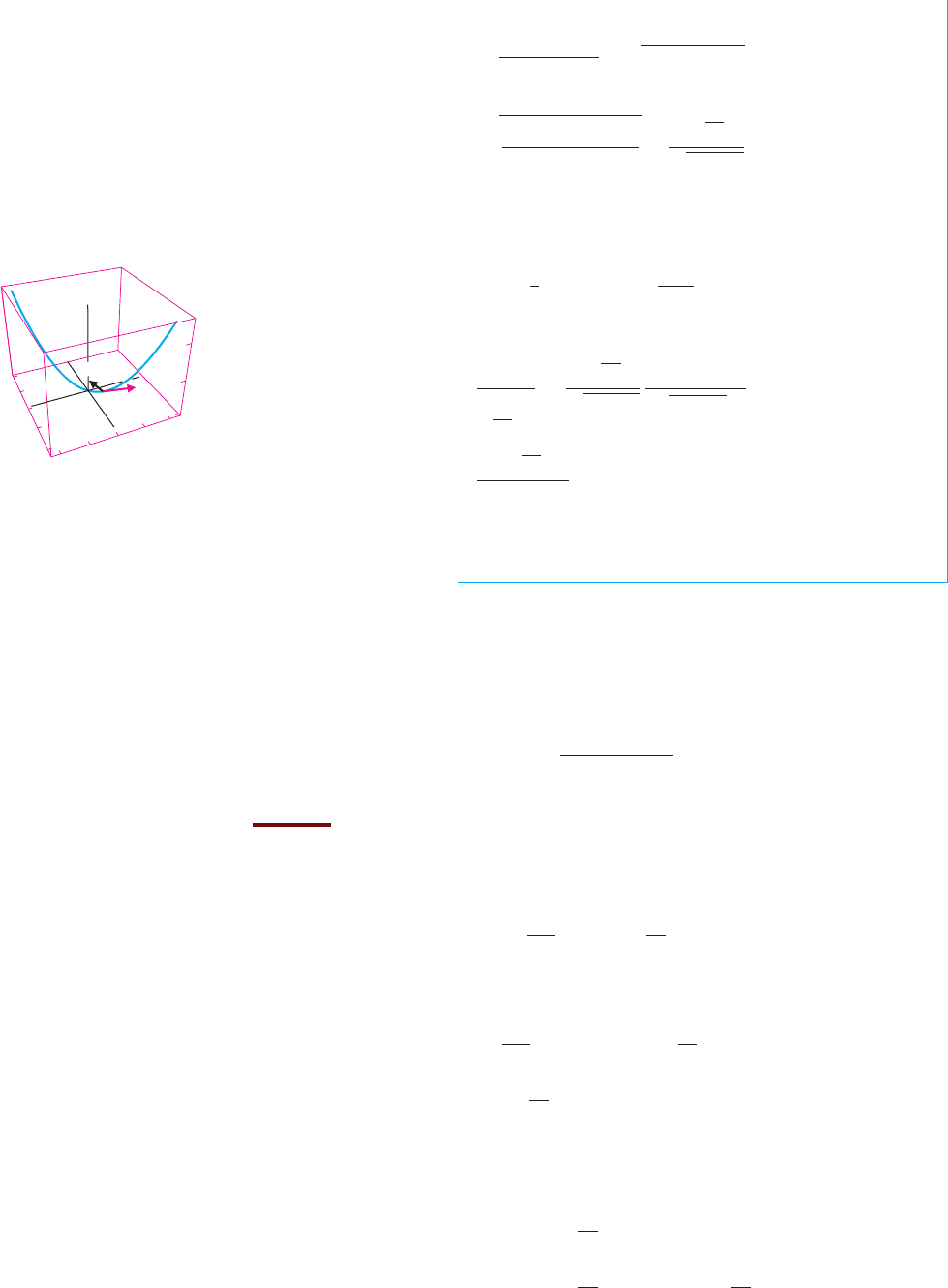
Notice how easy it was to compute the curvature in this way. In Figure 12.34, we show a
plot of the curve traced out by r(t), along with the tangential and normal components
of acceleration at t = 1.
0
0
5
5 5
5
10
10
x
y
z
20
10
0
a
T
T(t)
a
N
N(t)
FIGURE 12.34
Tangential and normal components
of acceleration at t = 1
Equation (5.6) has a wealth of applications. Among many others, it provides us with a
relatively simple proof of Theorem 4.1, which we had deferred until now. You may recall
that the result says that the curvature of a path traced out by the vector-valued function r(t)
is given by
κ =
r
(t) ×r
(t)
r
(t)
3
. (5.10)
PROOF
From (5.6), we have
a(t) =
d
2
s
dt
2
T(t) +κ
ds
dt
2
N(t).
Taking the cross product of both sides of this equation with T(t) gives us
T(t) ×a(t) =
d
2
s
dt
2
T(t) ×T(t) + κ
ds
dt
2
T(t) ×N(t)
= κ
ds
dt
2
T(t) ×N(t),
since the cross product of any vector with itself is the zero vector. Taking the magnitude of
both sides and recognizing that T(t) ×N(t) = B(t), we get
T(t) ×a(t)=κ
ds
dt
2
T(t) ×N(t)
= κ
ds
dt
2
B(t)=κ
ds
dt
2
,

P1: OSO/OVY P2: OSO/OVY QC: OSO/OVY T1: OSO
MHDQ256-Ch12 MHDQ256-Smith-v1.cls December 27, 2010 20:38
LT (Late Transcendental)
CONFIRMING PAGES
794 CHAPTER 12
..
Vector-Valued Functions 12-46
since the binormal vector B(t) is a unit vector. Recalling that T(t) =
r
(t)
r
(t)
, a(t) = r
(t)
and
ds
dt
=r
(t) gives us
r
(t) ×r
(t)
r
(t)
= κr
(t)
2
.
Solving this for κ leaves us with (5.10), as desired.
Kepler’s Laws
We are now in a position to present one of the most profound discoveries ever made by
humankind. For hundreds of years, people believed that the Sun, the other stars and the
planets all revolved around the Earth. The year 1543 saw the publication of the astronomer
Copernicus’ theory that the Earth and other planets, in fact, revolved around the Sun. Sixty
years later, based on an exhaustive analysis of a massive number of astronomical observa-
tions, the German astronomer Johannes Keplerformulated three laws that he reasoned must
be followed by every planet. We present these now.
KEPLER’S LAWS OF PLANETARY MOTION
1. Each planet follows an elliptical orbit, with the Sun at one focus.
2. The line segment joining the Sun to a planet sweeps outequal areasinequaltimes.
3. If T is the time required for a given planet to make one orbit of the Sun and if the
length of the major axis of its elliptical orbit is 2a, then T
2
= ka
3
, for some
constant k (i.e., T
2
is proportional to a
3
).
Kepler’s analysis of the data changed our perception of our place in the universe. While
Kepler’s work was empirical in nature, Newton’s approach to the same problem was not. In
1687, in his book Principia Mathematica, Newton showed how to use hiscalculus to derive
Kepler’s three laws from two of Newton’s laws: his second law of motion and his law of
universal gravitation. You should not underestimate the significance of this achievement.
With this work, Newton shed light on some of the fundamental physical laws that govern
our universe.
HISTORICAL
NOTES
Johannes Kepler (1571–1630)
German astronomer and
mathematician whose discoveries
revolutionized Western science.
Kepler’s remarkable mathematical
ability and energy produced
connections among many areas of
research. A study of observations
of the moon led to work in
optics that included the first
fundamentally correct description
of the operation of the human
eye. Kepler’s model of the solar
system used an ingenious nesting
of the five Platonic solids to
describe the orbits of the six
known planets. (Kepler invented
the term “satellite’’ to describe
the moon, which his system
demoted from planetary status.)
A study of the wine casks opened
at his wedding led Kepler to
compute volumes of solids of
revolution, inventing techniques
that were vital to the subsequent
development of calculus.
In order to simplify our analysis, we consider a solar system consisting of one sun and
one planet. This is a reasonable assumption, since the gravitational attraction of the sun is
far greater than that of any other body (planet, moon, comet, etc.), owing to the sun’s far
greater mass. (As it turns out, the gravitational attraction of other bodies does havean effect.
In fact, it was an observation of the irregularities in the orbit of Uranus that led astronomers
to hypothesize the existence of Neptune before it had ever been observed in a telescope.)
We assume that the center of mass of the sun is located at the origin and that the center
of mass of the planet is located at the terminal point of the vector-valued function r(t). The
velocityvectorfor theplanetisthenv(t) = r
(t), with the accelerationgivenbya(t) = r
(t).
From Newton’s second law of motion, we have that the net (gravitational) force F(t) acting
on the planet is
F(t) = ma(t),
where m is the mass of the planet. From Newton’s law of universalgravitation, we have that
if M is the mass of the sun, then the gravitational attraction between the two bodies satisfies
F(t) =−
GmM
r(t)
2
r(t)
r(t)
,
where G is the universal gravitational constant.
1
We have written F(t) in this form so that
you can see that at each point, the gravitational attraction acts in the direction opposite the
1
If we measure mass in kilograms, force in newtons and distance in meters, G is given approximately by
G ≈ 6.672 ×10
−11
Nm
2
/kg
2
.
P1: OSO/OVY P2: OSO/OVY QC: OSO/OVY T1: OSO
MHDQ256-Ch12 MHDQ256-Smith-v1.cls December 27, 2010 20:38
LT (Late Transcendental)
CONFIRMING PAGES
12-47 SECTION 12.5
..
Tangent and Normal Vectors 795
position vector r(t). Further,the gravitational attraction is jointly proportional to the masses
of the sun and the planet and inversely proportional to the square of the distance between
the sun and the planet. For simplicity, we will let r =r and not explicitly indicate the
t-variable. Taking u(t) =
r(t)
r(t)
(a unit vector in the direction of r(t)), we can then write
Newton’s laws as simply
F = ma and F =−
GmM
r
2
u.
We begin by demonstrating that the orbit of a planet lies in a plane. Equating the two
expressions above for F and canceling out the common factor of m,wehave
a =−
GM
r
2
u. (5.11)
Notice that this says that the acceleration a always points in the opposite direction from r,
so that the force of gravity accelerates the planet toward the sun at all times. Since a and r
are parallel, we have that
r × a = 0. (5.12)
Next, from the product rule [Theorem 2.3 (v)], we have
d
dt
(r × v) =
dr
dt
× v +r ×
dv
dt
= v ×v +r ×a = 0,
in view of (5.12) and since v × v = 0. Integrating both sides of this expression gives us
r × v = c, (5.13)
for some constant vector c. This says that for each t, r(t)is orthogonal to the constant vector
c. In particular, then, the terminal point of r(t) (and consequently, the orbit of the planet)
lies in the plane orthogonal to the vector c and containing the origin.
Now that we have established that a planet’s orbit lies in a plane, we are in a position
to prove Kepler’s first law. For the sake of simplicity, we assume that the plane containing
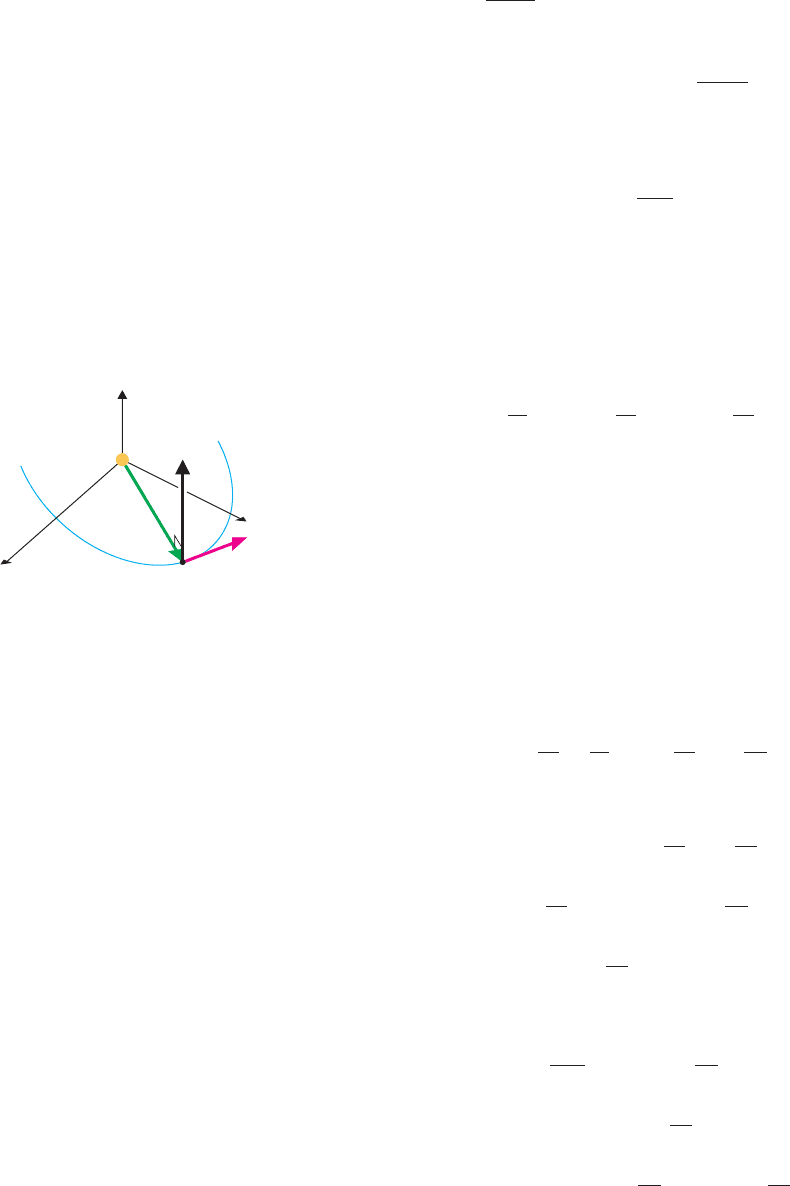
the orbit is the xy-plane, so that c is parallel to the z-axis. (See Figure 12.35.) Now, observe
that since r = ru, we have by the product rule [Theorem 2.3 (iii)] that
y
x
z
O (sun)
c
r(t)
v(t)
Planet
FIGURE 12.35
Position and velocity vectors for
planetary motion
v =
dr
dt
=
d
dt
(ru) =
dr
dt
u + r
du
dt
.
Substituting this into (5.13), and replacing r by r u,wehave
c = r × v = ru ×
dr
dt
u + r
du
dt
= r
dr
dt
(u × u) +r
2
u ×
du
dt
= r
2
u ×
du
dt
,
since u × u = 0. Together with (5.11), this gives us
a × c =−
GM
r
2
u × r
2
u ×
du
dt
=−GMu ×
u ×
du
dt
=−GM
u ·
du
dt
u − (u · u)
du
dt
, (5.14)
where we have rewritten the vector triple product using Theorem 4.3 (vi) in Chapter 11.
There are two other things to note here. First, since u is a unit vector, u · u =u
2
= 1.
P1: OSO/OVY P2: OSO/OVY QC: OSO/OVY T1: OSO
MHDQ256-Ch12 MHDQ256-Smith-v1.cls December 27, 2010 20:38
LT (Late Transcendental)
CONFIRMING PAGES
796 CHAPTER 12
..
Vector-Valued Functions 12-48
Further, from Theorem 2.4, since u is a vector-valued function of constant magnitude,
u ·
du
dt
= 0. Consequently, (5.14) simplifies to
a × c = GM
du
dt
=
d
dt
(GMu),
since G and M are constants. Observe that using the definition of a, we can write
a × c =
dv
dt
× c =
d
dt
(v × c),
since c is a constant vector. Equating these last two expressions for a × c gives us
d
dt
(v × c) =
d
dt
(GMu).
Integrating both sides gives us
v × c = GMu +b, (5.15)
for some constant vector b. Now, note that v ×c must be orthogonal to c and so, v ×c must
lie in the xy-plane. (Recall that we had chosen the orientation of the xy-plane so that c was
a vector orthogonal to the plane. This says further that every vector orthogonal to c must
lie in the xy-plane.) From (5.15), since u and v × c lie in the xy-plane, b must also lie in the
same plane. (Think about why this must be so.) Next, align the x-axis so that the positive
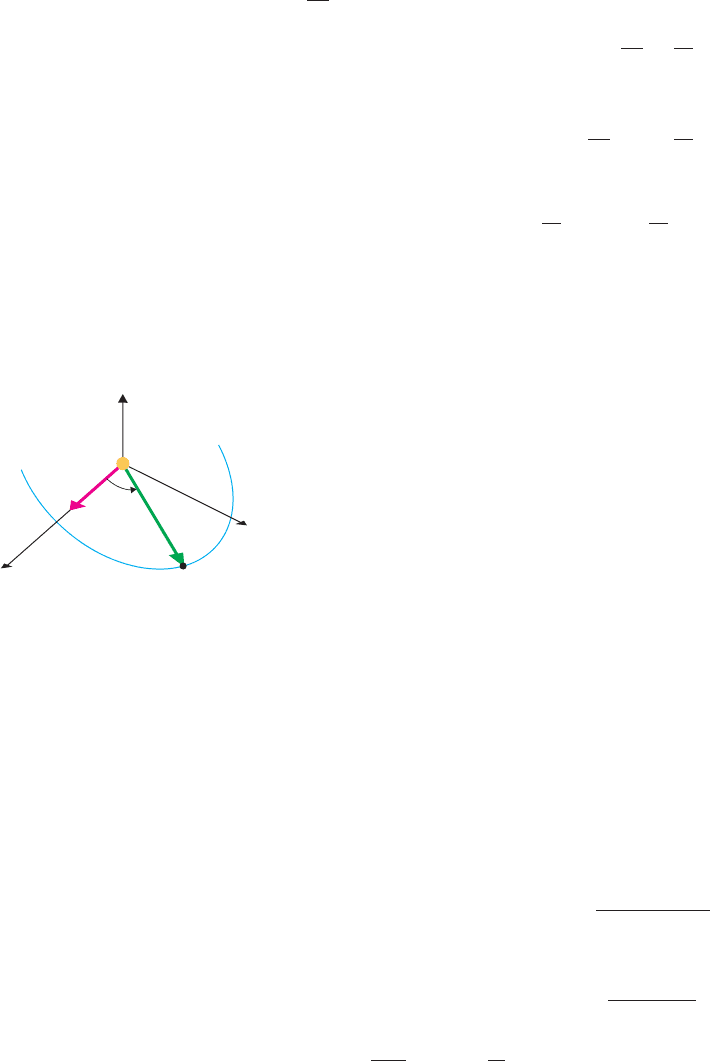
x-axis points in the same direction as b. (See Figure 12.36.) Also, let θ be the angle from
the positive x-axis to r(t), so that (r,θ) are polar coordinatesfor the endpoint of the position
vector r(t), as indicated in Figure 12.36.
y
x
z
O (sun)
r(t)
(r, u)
u
b
FIGURE 12.36
Polar coordinates for the position of
the planet
Next, let b =b and c =c. Then, from (5.13), we have
c
2
= c · c = (r ×v) ·c = r · (v × c),
where we have rewritten the scalar triple product using Theorem 4.3 (v) in Chapter 11.
Putting this together with (5.15), and writing r = ru,weget
c
2
= r ·(v ×c) = ru · (GMu +b)
= rGMu ·u +ru · b. (5.16)
Since u is a unit vector, u ·u =u
2
= 1 and by Theorem 3.2 in Chapter 11,
u · b =ubcos θ = b cos θ,
where θ is the angle between b and u (i.e., the angle between the positive x-axis and r).
Together with (5.16), this gives us
c
2
= rGM +rbcosθ = r(GM + b cos θ ).
Solving this for r gives us r =
c
2
GM + b cosθ
.
Dividing numerator and denominator by GM reduces this to
r =
ed
1 + e cosθ
, (5.17)
where e =
b
GM
and d =
c
2
b
. Recall from Theorem 7.2 in Chapter 10 that (5.17) is a polar
equation for a conic section with focus at the origin and eccentricity e. Finally, since the
orbit of a planet is a closed curve, this must be the equation of an ellipse, since the other
conic sections (parabolas and hyperbolas) are not closed curves. We have now proved that
(assuming one sun and one planet and no other celestial bodies), the orbit of a planet is an
ellipse with one focus located at the center of mass of the sun.
You may be thinking what a long derivation this was. (We haven’t been keeping score,
but it was probably one of the longest derivations of anything in this book.) Take a moment,
though, to realize the enormity of what we have done. Thanks to the genius of Newton and
his second law of motion and his law of universal gravitation, we have in only a few pages
used the calculus to settle one of the most profound questions of our existence: How do the

P1: OSO/OVY P2: OSO/OVY QC: OSO/OVY T1: OSO
MHDQ256-Ch12 MHDQ256-Smith-v1.cls December 27, 2010 20:38
LT (Late Transcendental)
CONFIRMING PAGES
12-49 SECTION 12.5
..
Tangent and Normal Vectors 797
mechanics of a solar system work? Through the power of reason and the use of considerable
calculus,wehavefoundananswerthatisconsistent with the observedmotion of the planets,
first postulated by Kepler. This magnificent achievement came more than 300 years ago
and was one of the earliest (and most profound) success stories for the calculus. Since that
time, the calculus has proven to be an invaluable tool for countless engineers, physicists,
mathematicians and others.
EXERCISES 12.5
WRITING EXERCISES
1. Suppose that you are driving a car, going slightly uphill as the
road curves to the left. Describe the directions of the unit tan-
gent,principalunitnormalandbinormalvectors.Whatchanges
if the road curves to the right?
2. If the components of r(t) are linear functions, explain why
you can’t compute the principal unit normal vector. Describe
graphically why it is impossible to define a single direction for
the principal unit normal.
3. Previously, you have approximated curves with the graphs of
Taylor polynomials. Discuss possible circumstances in which
the osculating circle would be a better or worse approximation
of a curve than the graph of a polynomial.
4. Suppose that you are flying in a fighter jet and an enemy jet
is headed straight at you from behind with acceleration vec-
tor parallel to your principal unit normal vector. Discuss how
much danger you are in and what maneuver(s) you mightwant
to make to avoid danger.
In exercises 1–8, find the unit tangent and principal unit normal
vectors at the given points.
1. r(t) =t, t
2
at t = 0, t = 1
2. r(t) =t, t
3
at t =−1, t = 1
3. r(t) =cos 2t, sin2t at t = 0, t =
π
4
4. r(t) =2 cos t, 3sint at t = 0, t =
π
4
5. r(t) =cos 2t, t, sin2t at t = 0, t =
π
2
6. r(t) =cos t, sint, sint at t = 0, t =
π
2
7. r(t) =t, t
2
− 1, t at t = 0, t = 1
8. r(t) =t, t, 3sin 2t at t = 0, t =−π
............................................................
In exercises 9–12, find the osculating circle at the given points.
9. r(t) =t, t
2
at t = 0
10. r(t) =t, t
3
at t = 1
11. r(t) =2 cos t, 3sint at t = 0
12. r(t) =2 cos t, 3sint at t =
π
2
............................................................
In exercises 13–16, find the tangential and normal components
of acceleration for the given position functions at the given
points.
13. r(t) =8t, 16t − 16t
2
at t = 0, t = 1
14. r(t) =cos 2t, sin2t at t = 0, t =
π
2
15. r(t) =cos 2t, t
2
, sin2t at t = 0, t =
π
4
16. r(t) =2 cos t, 3sint, t
2
at t = 0, t =
π
4
............................................................
17. In exercise 15, determine whether the speed of the object is
increasing or decreasing at the given points.
18. In exercise 16, determine whether the speed of the object is
increasing or decreasing at the given points.
19. For the circular helix traced out by r(t) =a cost, a sint, bt,
find the tangential and normal components of acceleration.
20. For the path traced out by r(t) =2, t − sin t, 1 −cost, find
the tangential and normal components of acceleration.
............................................................
In exercises 21–24, find the binormal vector B(t) T(t) × N(t)
at t 0 and t 1. Also, sketch the curve traced out by r(t) and
the vectors T, N and B at these points.
21. r(t) =t, 2t, t
2
22. r(t) =t, 2t, t
3
23. r(t) =4 cos π t, 4sinπt, t
24. r(t) =3 cos 2π t, t, sin2πt
............................................................
In exercises 25–28, label the statement as true (i.e., always true)
or false and explain your answer.
25. T ·
dT
ds
= 0 26. T ·B = 0
27.
d
ds
(T · T) = 0 28. T · (N × B) = 1
............................................................
29. The friction force required to keep a car from skidding on
a curve is given by F
s
(t) = ma
N
N(t). Find the friction force
neededto keep acar ofmass m = 100(slugs) from skiddingif
(a) r(t) =100cosπt, 100 sin πt
(b) r(t) =200cosπt, 200 sin πt
(c) r(t) =100cos2πt, 100 sin 2πt
30. (a) How does the required friction force change when the
radius of a turn is doubled? (b) How does the required friction
force change when the speed of a car on a curve is doubled?

P1: OSO/OVY P2: OSO/OVY QC: OSO/OVY T1: OSO
MHDQ256-Ch12 MHDQ256-Smith-v1.cls December 27, 2010 20:38
LT (Late Transcendental)
CONFIRMING PAGES
798 CHAPTER 12
..
Vector-Valued Functions 12-50
31. Compare the radii of the osculating circles for y = cos x at
x = 0 and x =
π
4
. Compute the concavity of the curve at these
points and use this information to explain why one circle is
larger than the other.
32. Compare the osculating circles for y = cos x at x = 0 and
x = π. Compute the concavity of the curve at these points and
use this information to help explain why the circles have the
same radius.
33. For y = x
2
, show that each center of curvature lies on the
curve traced out by r(t) =−4t
3
,
1
2
+ 3t
2
. Graph this curve.
Graph y = x
2
and the circle of curvature at x = 1 on the same
axes. Is the circle tangent to y = x
2
?
34. For y = x
3
(x > 0), show that each center of curvature lies
on the graph of
x
2
−
9x
5
2
,
1
6x
+
5x
3
2
. Graph this curve. Graph
y = x
3
and the circle of curvature at x = 1 on the same axes.
Is the circle tangent to y = x
3
?
35. For r = e
aθ
, show that
N = (a
2
+ 1)
−1/2
−a sin θ − cosθ,a cosθ − sinθ.
36. For r = e
aθ
, a > 0, show that the radius of curvature is
e
aθ
√
a
2
+ 1. Show that each center of curvature lies on the
curve traced out by ae
at
−sint, cost and graph the curve.
37. In this exercise, we prove Kepler’s second law. Denote the
(two-dimensional) path of the planet in polar coordinates by
r = (r cosθ)i + (r sinθ)j. Show that r × v = r
2
dθ
dt
k. Con-
clude that r
2
dθ
dt
=r × v. Recall that in polar coordi-
nates, the area swept out by the curve r = r(θ ) is given by
A =
b
a
1
2
r
2
dθ and show that
dA
dt
=
1
2
r
2
dθ
dt
. From
dA
dt
=
1
2
r × v, conclude that equal areas are swept out
in equal times.
38. In this exercise, we prove Kepler’s third law. Recall that the
area of the ellipse
x
2
a
2
+
y
2
b
2
= 1isπab. From exercise 37, the
rate at which area is swept out is given by
dA
dt
=
1
2
r × v.
Conclude that the period of the orbit is T =
πab
1
2
r × v
and
so, T
2
=
4π
2
a
2
b
2
r × v
2
. Use (5.17) to show that the minimum
value of r is r
min
=
ed
1 + e
and that the maximum value of r is
r
max
=
ed
1 − e
. Explain why 2a = r
min
+r
max
and use this
to show that a =
ed
1 − e
2
. Given that 1 −e
2
=
b
2
a
2
, show
that
b
2
a
= ed. From e =
b
GM
and d =
c
2
b
, show that
ed =
r × v
2
GM
. It then follows that
b
2
a
=
r × v
2
GM
. Finally,
show that T
2
= ka
3
, where the constant k =
4π
2
GM
does not
depend on the specific orbit of the planet.
39. (a) Show that
dB
ds
is orthogonal to T. (b) Show that
dB
ds
is
orthogonal to B.
40. Use the result of exercise 39 to show that
dB
ds
=−τ N, for
some scalar τ .(τ is called the torsion, which measures how
much a curve twists.) Also, show that τ =−
dB
ds
· N.
41. Show that the torsion for the curve traced out by
r(t) =f (t), g(t), k is zero for any constant k. (In general,
the torsion is zero for any curve that lies in a single plane.)
42. The following three formulas (called the Frenet-Serret for-
mulas) are of great significance in the field of differential
geometry:
(a)
dT
ds
= κN [equation (5.2)]
(b)
dB
ds
=−τ N (see exercise 40)
(c)
dN
ds
=−κT +τ B
Use the fact that N = B × T and the product rule [Theorem
2.3 (v)] to establish (c).
43. Use the Frenet-Serret formulas (see exercise 42) to establish
each of the following formulas:
(a) r
(t) = s
(t)T +κ[s
(t)]
2
N
(b) r
(t) ×r
(t) = κ[s
(t)]
3
B
(c) r
(t) ={s
(t) −κ
2
[s
(t)]
3
}T +{3κs
(t)s
(t)
+κ
(t)[s
(t)]
2
}N + κτ[s
(t)]
3
B
(d) τ =
[r
(t) ×r
(t)] ·r
(t)
r
(t) ×r
(t)
2
44. Show that the torsion for the helix traced out by
r(t) =a cost, a sint, bt is given by τ =
b
a
2
+ b
2
. [Hint:
See exercise 43 (d).]
APPLICATIONS
45. Suppose that ina stadium “wave” 500 people per second stand
and cheer. Argue that in most arenas, the wave would not have
a constant angular velocity but that it would satisfy Kepler’s
second law.
46. Suppose that one indoor stadium is similar in shape but 50%
larger than another indoor stadium. Compare the periods of
the waves under the assumption of exercise 45. Compare the
periods of the orbits of Earth and Mars.
EXPLORATORY EXERCISES
1. In this exercise, we explore some ramifications of the pre-
cise form of Newton’s law of universal gravitation. Suppose
that the gravitational force between objects is F =−
GMm
r
n
u,
for some positive integer n ≥ 1 (the actual law has n = 2).
Show that the path of the planet would still be planar and that
Kepler’s second law still holds. Also, show that the circular
orbit r =r cos kt, r sinkt(where r is a constant) satisfiesthe
equation F = ma and hence, is a potential path for the orbit.

P1: OSO/OVY P2: OSO/OVY QC: OSO/OVY T1: OSO
MHDQ256-Ch12 MHDQ256-Smith-v1.cls December 27, 2010 20:38
LT (Late Transcendental)
CONFIRMING PAGES
12-51 SECTION 12.6
..
Parametric Surfaces 799
For this path, find the relationship between the period of the
orbit and the radius of the orbit.
2. In this exercise, you will find the locations of three of the
five Lagrange points. These are equilibrium solutions of the
“restricted three-body problem” in which a large body S of
mass M
1
is orbited by a smaller body E of mass M
2
< M
1
.
A third object H of very small mass m orbits S such that the
relative positions of S, E and H remain constant. Place S at the
origin, E at (1, 0) and H at (x, 0) as shown.
x0
SHE
c 1
Assume that H and E have circular orbits about the cen-
ter of mass (c, 0). Show that the gravitational force on H
is F =−
GM
1
m
x
2
+
GM
2
m
(1 − x)
2
. As shown in example 3.3,
for circular motion F =−mω
2
(x − c), where ω is the an-
gular velocity of H. Analyzing the orbit of E, show that
GM
1
M
2
= M
2
ω
2
(1 − c). In particular, explain why E has
the same angular velocity ω. Combining the three equations,
showthat
1
x
2
−
k
(1 − x)
2
=
x − c
1 − c
,wherek =
M
2
M
1
.Giventhat
c =
M
2
M
1
+ M
2
, show that
(1 + k)x
5
− (3k + 2)x
4
+ (3k + 1)x
3
− x
2
+ 2x − 1 = 0.
For the Sun-Earth system with k = 0.000002, estimate x, the
location of the L
1
Lagrange point and the location of NASA’s
SOHO solar observatory satellite. Then derive and estimate
solutions for the L
2
Lagrange point with x > 1 and L
3
with
x < 0.
12.6 PARAMETRIC SURFACES
Throughout this chapter, we have emphasized the connection between vector-valued
functions and parametric equations. In this section, we extend the notion of parametric
equations to those with two independent parameters. This also means that we will be
working with simple cases of functions of two variables, which are developed in more
detail in Chapter 13. We will make use of parametric surfaces throughout the remainder of
the book.
We have already seen the helix defined by the parametric equations x = cost,
y = sint and z = t. This curve winds around the cylinder x
2
+ y
2
= 1. To obtain para-
metric equations that describe the entire cylinder, take x = cos t and y = sint, so that
x
2
+ y
2
= cos
2
t +sin
2
t = 1.
So, any point (x, y, z) with x and y defined in this way will lie on the cylinder. To describe
the entire cylinder (i.e., every point on the cylinder), we must allow z to be any real number,
not just z = t. In other words, z needs to be independent of x and y. Assigning z its own
parameter will accomplish this. Using the parameters u and v, we have the parametric
equations
x = cosu, y = sinu and z = v
for the cylinder. In general, parametric equations with two independent parameters corre-
spond to a three-dimensional surface. Examples 6.1 through 6.3 explore some basic but
important surfaces.
EXAMPLE 6.1 Graphing a Parametric Surface
Identify and sketch a graph of the surface defined by the parametric equations
x = 2cosu sin v, y = 2sinu sinv and z = 2cos v.
Solution Given the cosine and sine terms in both parameters, you should be expecting
a surface with circular cross sections. Notice that we can eliminate the u parameter, by
observing that
x
2
+ y
2
= (2 cosu sin v)
2
+ (2 sinu sinv)
2
= 4cos
2
u sin
2
v + 4sin
2
u sin
2
v
= 4(cos
2
u + sin
2
u) sin
2
v = 4 sin
2
v.
P1: OSO/OVY P2: OSO/OVY QC: OSO/OVY T1: OSO
MHDQ256-Ch12 MHDQ256-Smith-v1.cls December 27, 2010 20:38
LT (Late Transcendental)
CONFIRMING PAGES
800 CHAPTER 12
..
Vector-Valued Functions 12-52
So, for each fixed value of z (which also means a fixed value for v), x
2
+ y
2
is
constant. That is, cross sections of the surface parallel to the xy-plane are circular, with
radius |2sin v|. Similarly, we also have circular cross sections parallel to either of the
other two coordinate planes. Of course, one surface that you’ve seen that has circular
cross sections in all directions is a sphere. To determine that the given parametric
equations represent a sphere, observe that
x
2
+ y
2
+ z
2
= 4 cos
2
u sin
2
v + 4sin
2
u sin
2
v + 4cos
2
v
= 4 (cos
2
u + sin
2
u) sin
2
v + 4cos
2
v
= 4 sin
2
v + 4cos
2
v = 4.
You should recognize x
2
+ y
2
+ z
2
= 4 as an equation of the sphere centered at the
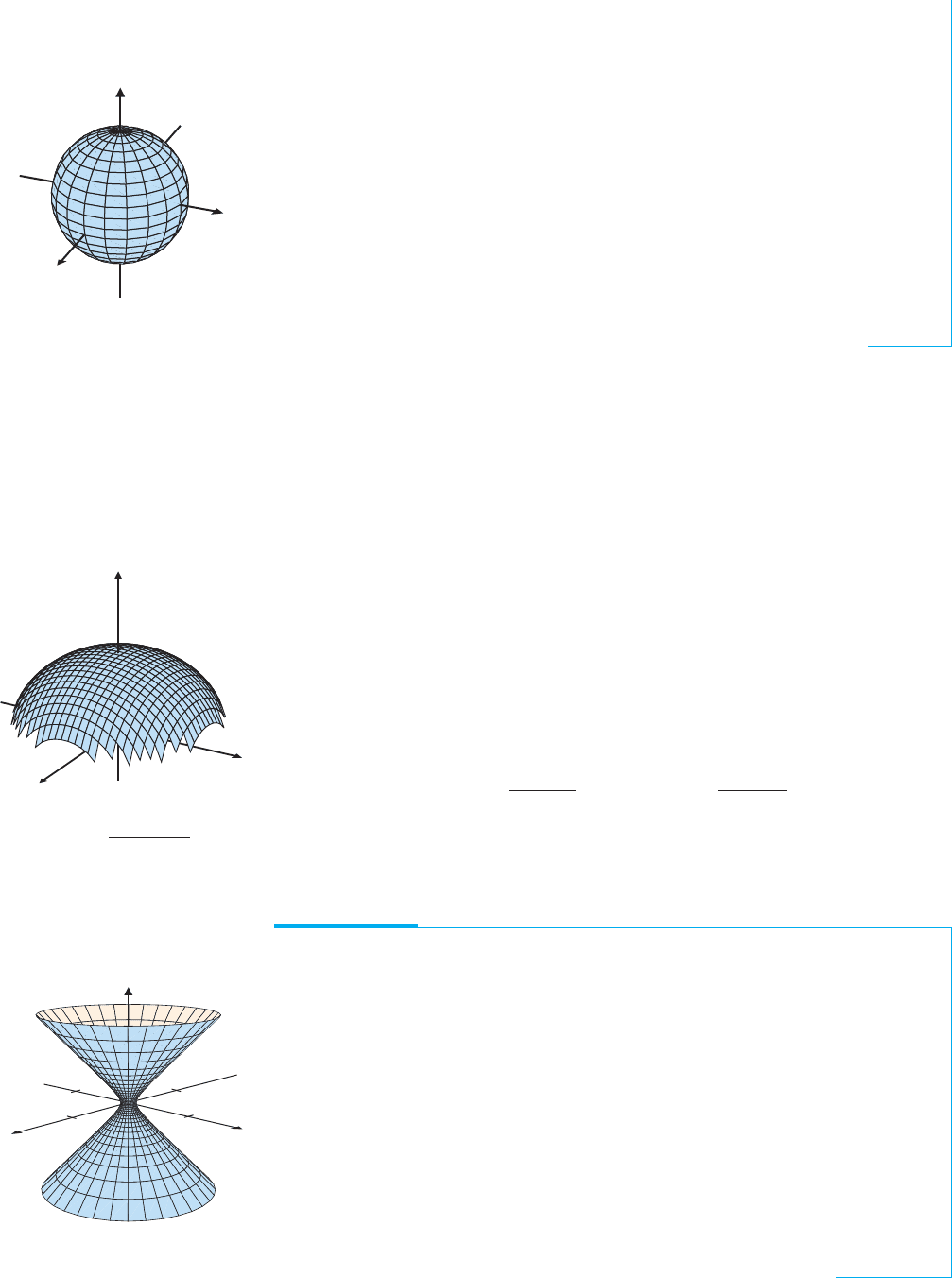
origin with radius 2. A computer-generated sketch is shown in Figure 12.37.
x
y
z
FIGURE 12.37
x
2
+ y
2
+ z
2
= 4
Thereare several important pointsto makeabout example6.1. First, we did not actually
demonstrate that the surface defined by the given parametric equations is the entire sphere.
Rather, we showed that points lying on the parametric surface were also on the sphere. In
other words, the parametric surface is (at least) part of the sphere. In the exercises, we will
supply the missing steps to this puzzle, showing that the parametric equations from example
6.1 do, in fact, describe the entire sphere. In this instance,the equations are a special case of
something called spherical coordinates, which we will introduce in Chapter 14. Next, as
with parametric equations of curves, there are other parametric equations representing the
same sphere. Finally, to repeat a point made in section 11.6, parametric equations can be
used to produce many interesting graphs. Notice the smooth contours and clearly defined
circular cross sections in Figure 12.37, compared with the jagged graph in Figure 12.38.
Figure 12.38 is a computer-generated graph of z =
4 − x
2
− y
2
, which should be the top
half of the sphere.
x
y
z
FIGURE 12.38
z =
4 − x
2
− y
2
For parametric equations of hyperboloids and hyperbolic paraboloids, it is convenient
to use the hyperbolic functions cosh x and sinh x. Recall that
cosh x =
e
x
+ e
−x
2
and sinh x =
e
x
− e
−x
2
.
A little algebra shows that cosh
2
x −sinh
2
x = 1, which is an identity needed in exam-
ple 6.2.
EXAMPLE 6.2 Graphing a Parametric Surface
Sketch the surface defined parametrically by x = 2cosu cosh v, y = 2sin u coshv and
z = 2sinh v, 0 ≤ u ≤ 2π and −∞ <v<∞.
Solution A sketch such as the one we show in Figure 12.39 can be obtained from a
computer algebra system.
z
y
x
10
10
10
FIGURE 12.39
x
2
+ y
2
− z
2
= 4
Notice that this looks like a hyperboloid of one sheet wrapped around the z-axis. To
verify that this is correct, observe that
x
2
+ y
2
− z
2
= 4 cos
2
u cosh
2
v + 4sin
2
u cosh
2
v − 4sinh
2
v
= 4 (cos
2
u + sin
2
u) cosh
2
v − 4sinh
2
v
= 4 cosh
2
v − 4sinh
2
v = 4,
where we have used the identities cos
2
u + sin
2
u = 1 and cosh
2
v − sinh
2
v = 1. Recall
that the graph of x
2
+ y
2
− z
2
= 4 is indeed a hyperboloid of one sheet.
P1: OSO/OVY P2: OSO/OVY QC: OSO/OVY T1: OSO
MHDQ256-Ch12 MHDQ256-Smith-v1.cls December 27, 2010 20:38
LT (Late Transcendental)
CONFIRMING PAGES
12-53 SECTION 12.6
..
Parametric Surfaces 801
Most of the time when we use parametric representations of surfaces, the task is the
opposite of that in example 6.2. That is, given a particular surface, we may need to find
a convenient parametric representation of the surface. Example 6.2 gives us an important
clue for working example 6.3.
EXAMPLE 6.3 Finding a Parametric Representation
of a Hyperbolic Paraboloid
Find parametric equations for the hyperbolic paraboloid z = x
2
− y
2
.
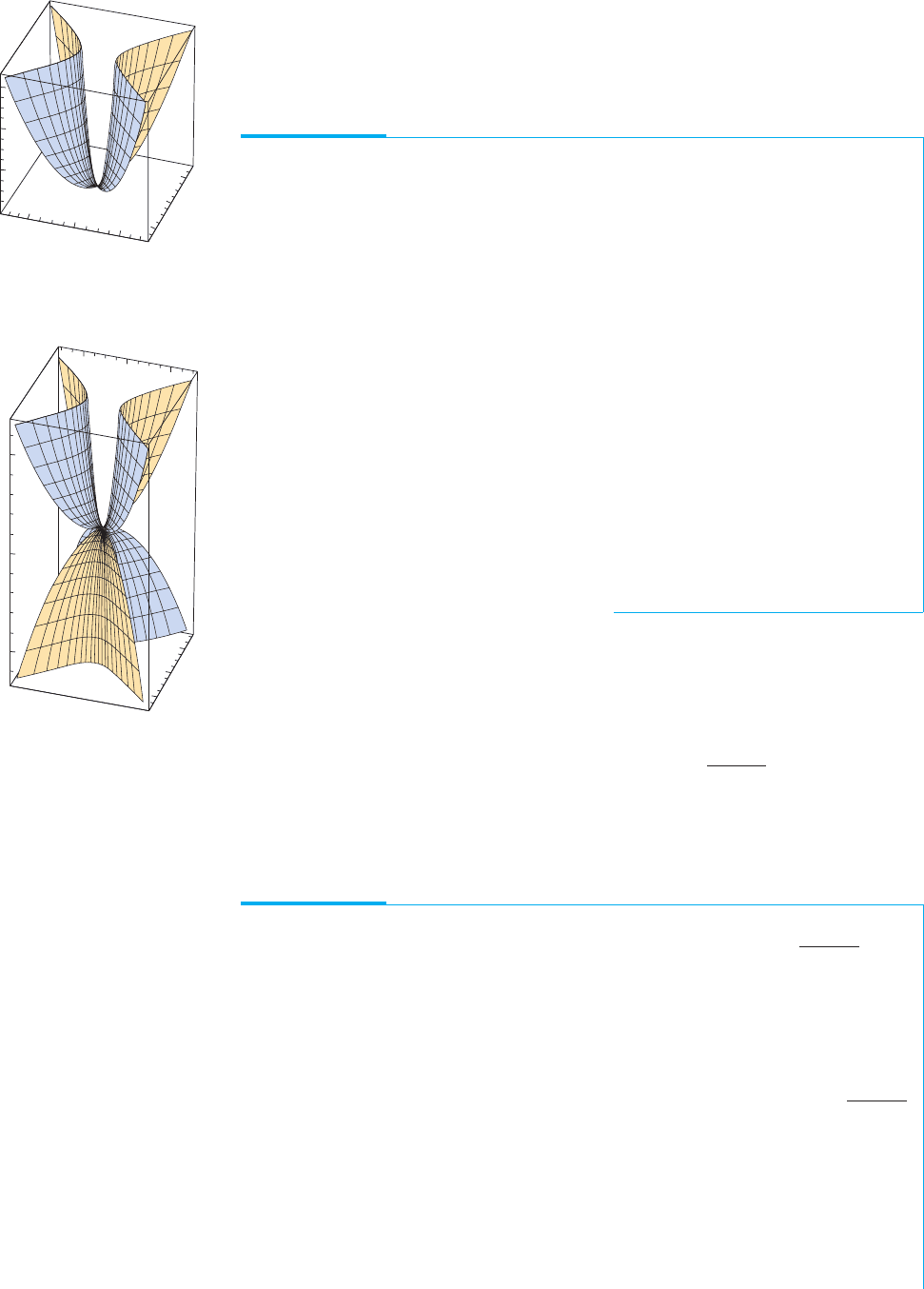
0
20
20
20
−20
−20
0
0
40
60
FIGURE 12.40
Top half of the surface
−50
−20
−20
0
20
20
0
0
50
FIGURE 12.41
z = x
2
− y
2
Solution It helps to understand the surface with which we are working. Observe that
for any value of k, the trace in the plane z = k is a hyperbola. The spread of the
hyperbola depends on whether |k| is large or small. To get hyperbolas in x and y,wecan
start with x = coshu and y = sinh u. To enlarge or shrink the hyperbola, we can
multiply coshu and sinhu by a constant. We now have x = v cosh u and y = v sinhu.
To get z = x
2
− y
2
, simply compute
x
2
− y
2
= v
2
cosh
2
u − v
2
sinh
2
u = v
2
(cosh
2
u − sinh
2
u) = v
2
,
since cosh
2
u − sinh
2
u = 1. This gives us the parametric equations
x = v cosh u, y = v sinh u and z = v
2
.
A graph of the parametric equations is shown in Figure 12.40. However, notice that this
is only the top half of the surface, since z = v
2
≥ 0. To get the bottom half of the
surface, we set x = v sinhu and y = v coshu so that z = x
2
− y
2
=−v
2
≤ 0.
Figure 12.41 shows both halves of the surface.
In many cases, the parametric equations that we use are determined by the geometry
of the surface. In particular, in two dimensions, certain curves (especially circles) are more
easily described in polar coordinates than in rectangular coordinates. Recall that the polar
coordinates r and θ are related to x and y by
x = r cosθ, y = r sinθ and r =
x
2
+ y
2
.
So, the equation for the circle x
2
+ y
2
= 4 can be written in polar coordinates simply as
r = 2.
EXAMPLE 6.4 Finding Parametric Representations of Surfaces
Find a parametric representation of each surface: (a) the portion of z =
x
2
+ y
2
inside x
2
+ y
2
= 4 and (b) the portion of z = 9 − x
2
− y
2
above the xy-plane with
y ≥ 0.
Solution For part (a), a graph indicating the cone and the cylinder is shown in Figure
12.42a (on the following page). Notice that the equations for both surfaces include the
term x
2
+ y
2
and x and y appear only in this combination. This suggests the use of polar
coordinates. Taking x = r cosθ and y = r sinθ , the equation of the cone z =
x
2
+ y
2
becomes z = r and the equation of the cylinder x
2
+ y
2
= 4 becomes r = 2. Since the
surface in question is that portion of the cone lying inside the cylinder, every point on
the surface lies on the cone. So, every point on the surface satisfies
x = r cosθ, y = r sinθ and z = r. Observe that the cylinder cuts off the cone,
something like a cookie cutter. Instead of all r-values being possible, the cylinder limits
us to r ≤ 2. (Think about why this is so.) A parametric representation for (a) is then
x = r cosθ, y = r sinθ and z = r, for 0 ≤ r ≤ 2 and 0 ≤ θ ≤ 2π.
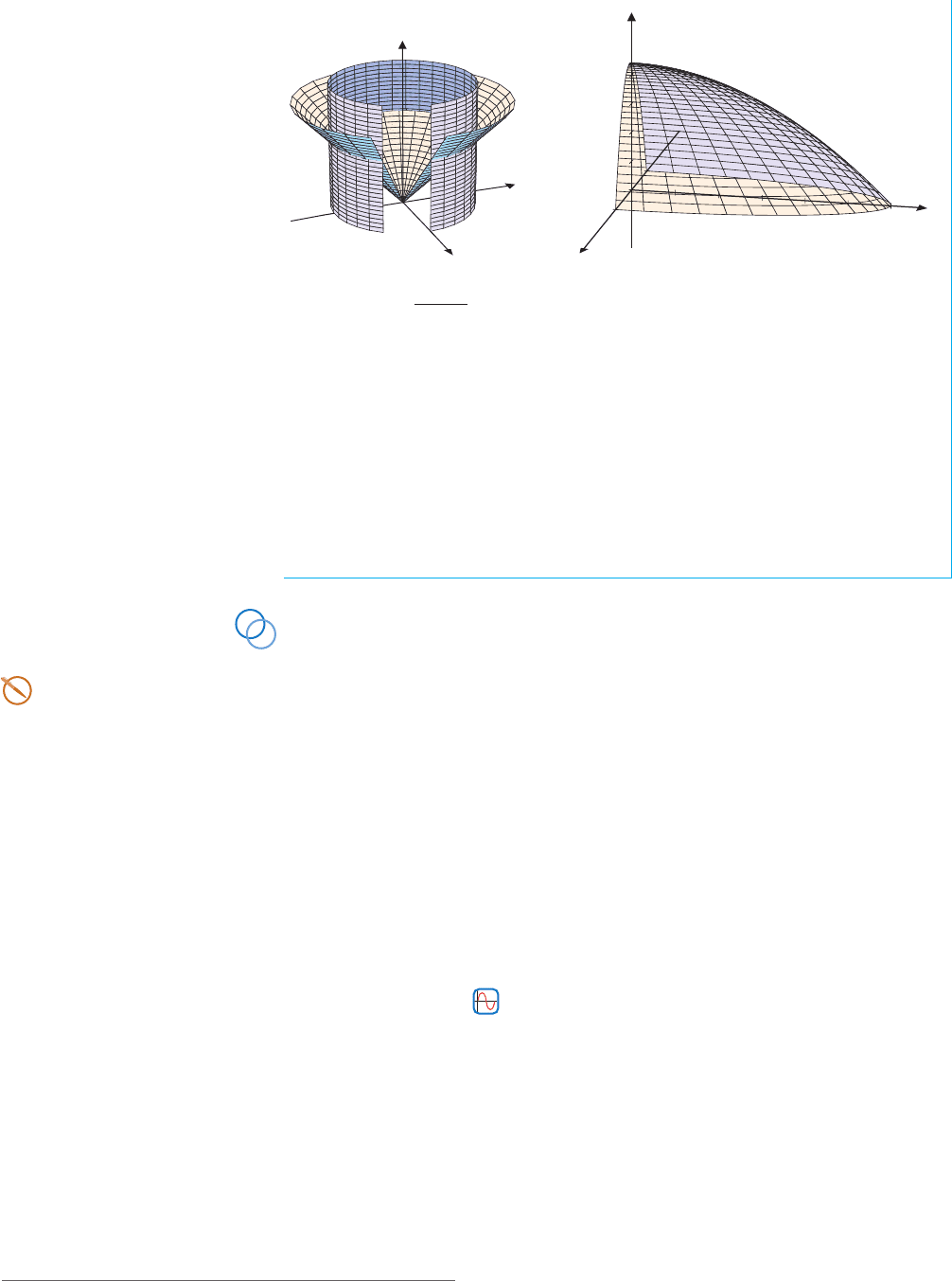
P1: OSO/OVY P2: OSO/OVY QC: OSO/OVY T1: OSO
MHDQ256-Ch12 MHDQ256-Smith-v1.cls December 27, 2010 20:38
LT (Late Transcendental)
CONFIRMING PAGES
802 CHAPTER 12
..
Vector-Valued Functions 12-54
z
y
x
x
y
z
0.5 1
2
0
3
3
4
6
8
1.5
2
2.5
3
FIGURE 12.42a FIGURE 12.42b
Portion of z =
x
2
+ y
2
inside Portion of z = 9 − x
2
− y
2
above
x
2
+ y
2
= 4 the xy-plane, with y ≥ 0
For part (b), a graph is shown in Figure 12.42b. Again, the presence of the term
x
2
+ y
2
in the defining equation suggests polar coordinates. Taking x = r cosθ and
y = r sinθ , the equation of the paraboloid becomes
z = 9 − (x
2
+ y
2
) = 9 −r
2
.
To stay above the xy-plane, we need z > 0or9−r
2
> 0or|r| < 3. Choosing positive
r-values, we have 0 ≤ r < 3. Then y ≥ 0, if sinθ ≥ 0. One choice of θ that gives this is
0 ≤ θ ≤ π . A parametric representation for the surface is then
x = r cosθ, y = r sinθ and z = 9 −r
2
, for 0 ≤ r < 3 and 0 ≤ θ ≤ π.
EXERCISES 12.6
WRITING EXERCISES
1. Suppose that a surface has parametric equations x = f (u),
y = g(u) and z = h(v). Explain why the surface must be a
cylinder. If the range of h consists of all real numbers, discuss
whether or not the parametric equations x = f (u), y = g(u)
and z = v would describe the same surface.
2. In this exercise, we explore why parametric equations with
two parameters typically graph as surfaces. If x = f (u,v),
y = g(u,v) and z = h(u,v), substitute in a constant v = v
1
andletC
1
bethecurvewithparametricequationsx = f (u,v
1
),
y = g(u,v
1
) and z = h(u,v
1
). For a different constant v
2
,
let C
2
be the curve with parametric equations x = f (u,v
2
),
y = g(u,v
2
) and z = h(u,v
2
). Sketch what C
1
and C
2
might
look like if v
1
and v
2
are close together. Then fill in what
you would expect other curves would look like for v-values
between v
1
and v
2
. Discuss whether you are generating a
surface.
3. To show that two parameters do not always produce a surface,
sketch the curve with x = u +v, y = u + v and z = u + v.
Discuss the special feature of these equations that enables us
to replace the parameters u and v with a single parameter t.
4. The graph of x = f (t) and y = g(t) is typically a curve in
two dimensions. The graph of x = f (u,v), y = g(u,v) and
z = h(u,v) is typically a surface in three dimensions. Discuss
what the graph of x = f (r, s, t), y = g(r, s, t), z = h(r, s, t)
and w = d(r, s, t) would look like.
In exercises 1–8, sketch a graph of the parametric surface by
hand.
1. x = u, y = v, z = u
2
+ 2v
2
2. x = u, y = v, z = 4 − u
2
− v
2
3. r = u cosv i + u sinv j +u
2
k
4. r = u cosv i + u sinv j +u k
5. x = 2sinu cosv, y = 2sinu sinv, z = 2cosu
6. x = v sinh u, y = 4v
2
, z = v coshu
7. r =2cosu sinhv, 2sinu sinhv, 2 cosh v
8. r =sinhv, cosu coshv, sinu coshv
............................................................
In exercises 9–16, sketch a graph of the parametric surface.
9. x = u, y = sinu cosv, z = sinu sinv
10. x = cosu cosv, y = u, z = cos u sinv
11. x = u cosv, y = u sin v, z = v
12. x = 2sinhu, y = v, z = 2 cosh u
13. x = (6 +2cos v) cos u, y = (6 + 2 cos v) sin u, z = 2sinv
14. x = (−2 +4cos v) cos u, y = (−2 + 4 cos v) sin u,
z = 4 sin v
15. r = 2cosv cosu i + 2 cos v sinu j + 5sin v k
16. r = 5cosv cosu i + 5 cos v sinu j + 2sin v k
............................................................