
Smith R., Minton R. Calculus
Подождите немного. Документ загружается.

P1: OSO/OVY P2: OSO/OVY QC: OSO/OVY T1: OSO
MHDQ256-Ch12 MHDQ256-Smith-v1.cls December 30, 2010 19:29
LT (Late Transcendental)
CONFIRMING PAGES
12-35 SECTION 12.4
..
Curvature 783
Notice that the result of example 4.4 is consistent with your intuition. First, observe
that you should be able to drive a car around a circular track while holding the steering
wheel in a fixed position. (That is, the curvature should be constant.) Further, the smaller
that the radius of a circular track is, the sharper you will need to turn (that is, the larger the
curvature). On the other hand, on a circular track of very large radius, it would seem as if
you were driving fairly straight (i.e., the curvature will be close to 0).
You probably noticed that computing the curvature of the curves in examples 4.3 and
4.4 was just the slightest bit tedious. We simplify this process somewhat with the result of
Theorem 4.1.
THEOREM 4.1
The curvature of the smooth curve traced out by the vector-valued function r(t)is
given by
κ =
r
(t) ×r
(t)
r
(t)
3
. (4.7)
The proof of Theorem 4.1 is rather long and involved and so, we omit it at this time, in
the interest of brevity. We return to this in section 12.5, where the proof becomes a simple
consequence of another result.
x
y
z
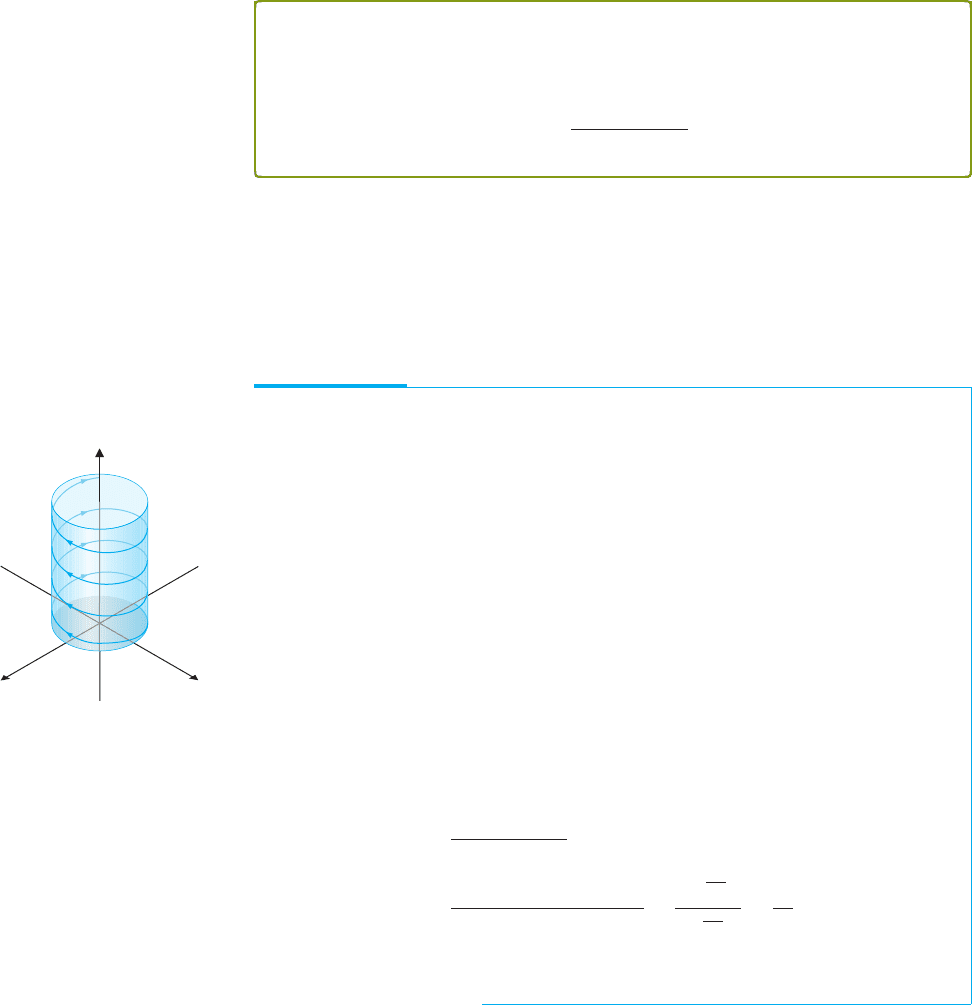
FIGURE 12.22
Circular helix
Notice that it is a relatively simple matter to use (4.7) to compute the curvature for
nearly any three-dimensional curve.
EXAMPLE 4.5 Finding the Curvature of a Helix
Find the curvature of the helix traced out by r(t) =2sin t, 2cost, 4t.
Solution A graph of the helix is indicated in Figure 12.22. We have
r
(t) =2 cost, −2sint, 4
and r
(t) =−2sint, −2cost, 0.
Now, r
(t) ×r
(t) =2cost, −2sin t, 4×−2sint, −2cos t, 0
=
ijk
2cos t −2 sint 4
−2sin t −2 cost 0
=8cost, −8sin t, −4 cos
2
t −4sin
2
t
=8cost, −8sin t, −4.
From (4.7), we get that the curvature is
κ =
r
(t) ×r
(t)
r
(t)
3
=
8cos t, −8 sint, −4
2cos t, −2 sint, 4
3
=
√
80
√
20
3
=
1
10
.
Note that this says that the helix has a constant curvature, as you should suspect from
the graph in Figure 12.22.
In the case of a plane curve that is the graph of a function, y = f (x), we can derive a
particularly simple formula for the curvature. Notice that such a curve is traced out by the
vector-valued function r(t) =t, f (t), 0, where the third component is 0, since the curve

P1: OSO/OVY P2: OSO/OVY QC: OSO/OVY T1: OSO
MHDQ256-Ch12 MHDQ256-Smith-v1.cls December 27, 2010 20:38
LT (Late Transcendental)
CONFIRMING PAGES
784 CHAPTER 12
..
Vector-Valued Functions 12-36
liescompletely in the xy-plane. Further,r
(t) =1, f
(t), 0and r
(t) =0, f
(t), 0. From
(4.7), we have
κ =
r
(t) ×r
(t)
r
(t)
3
=
1, f
(t), 0×0, f
(t), 0
1, f
(t), 0
3
=
| f
(t)|
{1 + [ f
(t)]
2
}
3/2
,
where we have left the calculation of the cross product as a simple exercise. Since the
parameter t = x, we can write the curvature as
Curvature for the plane
curve y = f (x)
κ =
| f
(x)|
{1 + [ f
(x)]
2
}
3/2
. (4.8)
EXAMPLE 4.6 Finding the Curvature of a Parabola
Find the curvature of the parabola y = ax
2
+ bx +c. Also, find the limiting value of the
curvature as x →∞.
Solution Taking f (x) = ax
2
+ bx +c, we have that f
(x) = 2ax + b and
f
(x) = 2a. From (4.8), we have that
κ =
|2a|
[1 + (2ax + b)
2
]
3/2
.
Taking the limit as x →∞,wehave
lim
x→∞
κ = lim
x→∞
|2a|
[1 + (2ax + b)
2
]
3/2
= 0.
In other words, as x →∞, the parabola straightens out, which you’ve likely observed
in the graphs of parabolas. It is a straightforward exercise to show that the maximum
curvature occurs at the vertex of the parabola (x =−b/2a).
BEYOND FORMULAS
You can think of curvature as being loosely related to concavity, although there are
importantdifferences.Thepreciserelationshipfor curvesof the form y = f (x)isgiven
in equation (4.8). Curvature applies to curves in any dimension, whereas concavity
applies only to two dimensions. More importantly, curvature measures the amount of
curving as you move along the curve, regardless of where the curve goes. Concavity
measures curving as you move along the x-axis, not the curve,and thus requires that the
curvecorrespondtoafunction f (x).Giventhegeneralityofthecurvaturemeasurement,
the formulas derived in this section are actually remarkably simple.
EXERCISES 12.4
WRITING EXERCISES
1. Explain what it means for a curve to have zero curvature (a) at
a point and (b) on an interval of t-values.
2. Some tangent lines approximate a curve well over a fairly
lengthy interval while some stay close to a curve for only very
short intervals. If the curvature at x = a is large, would you
expect the tangent line at x = a to approximate the curve well
over a lengthy interval or only a short interval? What if the
curvature is small? Explain.
3. Discuss the relationship between curvature and concavity for
a function y = f (x).
4. Explain why the curvature κ =
1
10
of the helix in example 4.5
is less than the curvature of the circle 2sint, 2 cos t in two
dimensions.
P1: OSO/OVY P2: OSO/OVY QC: OSO/OVY T1: OSO
MHDQ256-Ch12 MHDQ256-Smith-v1.cls December 27, 2010 20:38
LT (Late Transcendental)
CONFIRMING PAGES
12-37 SECTION 12.4
..
Curvature 785
In exercises1–6, find an arclength parameterization of the given
two-dimensional curve and give the corresponding vector equa-
tion of the curve.
1. The circle of radius 2 centered at the origin
2. The circle of radius 5 centered at the origin
3. The line segment from the origin to the point (3, 4)
4. The line segment from (1, 2) to the point (5, −2)
5. r(t) =t
2
, t
3
, t ≥ 0
6. r(t) =t, cosh t, t ≥ 0
............................................................
In exercises 7–14, find the unit tangent vector to the curve at the
indicated points.
7. r(t) =3t, t
2
, t = 0, t =−1, t = 1
8. r(t) =2t
3
,
√
t, t = 1, t = 2, t = 3
9. r(t) =3 cos t, 2sint, t = 0, t =−
π
2
, t =
π
2
10. r(t) =4 sin t, 2cost, t =−π, t = 0, t = π
11. r(t) =3t, cos 2t, sin2t, t = 0, t =−π, t = π
12. r(t) =t cos t, t sin t, 4t, t =−
π
4
, t = 0, t =
π
4
13. r(t) =e
2t
cost, e
2t
sint, t = 0, t = 1, t = k
14. r(t) =t − sin t, 1 − cost, t = 0, t =
π
2
, t = k
............................................................
15. Sketchthecurveinexercise9alongwiththevectorsr(0), T(0),
r
π
2
and T
π
2
.
16. Sketch the curve in exercise 10 along with the vectors
r(0), T(0), r
π
2
and T
π
2
.
17. Sketch the curve in exercise 11 along with the vectors
r(0), T(0), r(π) and T(π).
18. Sketch the curve in exercise 12 along with the vectors r(0),
T(0), r(1) and T(1).
In exercises 19–26, find the curvature at the given point.
19. r(t) =e
−2t
, 2t, 4, t = 0
20. r(t) =2, sin π t, lnt, t = 1
21. r(t) =t, sin 2t, 3t, t = 0
22. r(t) =t, t
2
+ t − 1, t, t = 0
23. f (x) = 3x
2
− 1, x = 1 24. f (x) = x
3
+ 2x − 1, x = 2
25. f (x) = sinx, x =
π
2
26. f (x) = e
−3x
, x = 0
............................................................
27. For f (x) = sin x, show that the curvature is the same at x =
π
2
and x =
3π
2
. Use the graph of y = sin x to predict whether the
curvature would be larger or smaller at x = π.
28. For f (x) = e
−3x
, show that the curvature is larger at x = 0
than at x = 2. Use the graph of y = e
−3x
to predict whether
the curvature would be larger or smaller at x = 4.
In exercises 29–32, sketch the curve and compute the curvature
at the indicated points.
29. r(t) =2 cos 2t, 2sin2t, 3t, t = 0, t =
π
2
30. r(t) =cos 2t, 2sin2t, 4t, t =
π
6
, t =
π
3
31. r(t) =t, t, t
2
− 1, t = 0, t = 2
32. r(t) =2t − 1, t + 2, t − 3, t = 0, t = 2
............................................................
In exercises 33–36, sketch the curve and find any points of max-
imum or minimum curvature.
33. r(t) =2 cos t, 3sint 34. r(t) =4 cos t, 3sint
35. y = x
3
− 4 36. y = sin x
............................................................
In exercises 37–40, graph the curvature function κ(x) and find
the limit of the curvature as x → ∞.
37. y = e
2x
38. y = e
−2x
39. y = x
3
− 3x 40. y =
√
x
............................................................
41. Explain the answers to exercises 37–40 graphically.
42. Find the curvature of the circular helix a cos t, a sint, bt.
............................................................
In exercises 43–46, label as true or false and explain.
43. At a relative extremum of y = f (x), the curvature is either a
minimum or maximum.
44. At an inflection point of y = f (x), the curvature is zero.
45. The curvature of the two-dimensional curve y = f (x)is
the same as the curvature of the three-dimensional curve
r(t) =t, f (t), c for any constant c.
46. The curvature of the two-dimensional curve y = f (x)is
the same as the curvature of the three-dimensional curve
r(t) =t, f (t), t.
............................................................
In exercises 47 and 48, ifκ
A
, κ
B
and κ
C
represent thecurvatureat
points A, B and C, respectively, put κ
A
, κ
B
and κ
C
in increasing
order.
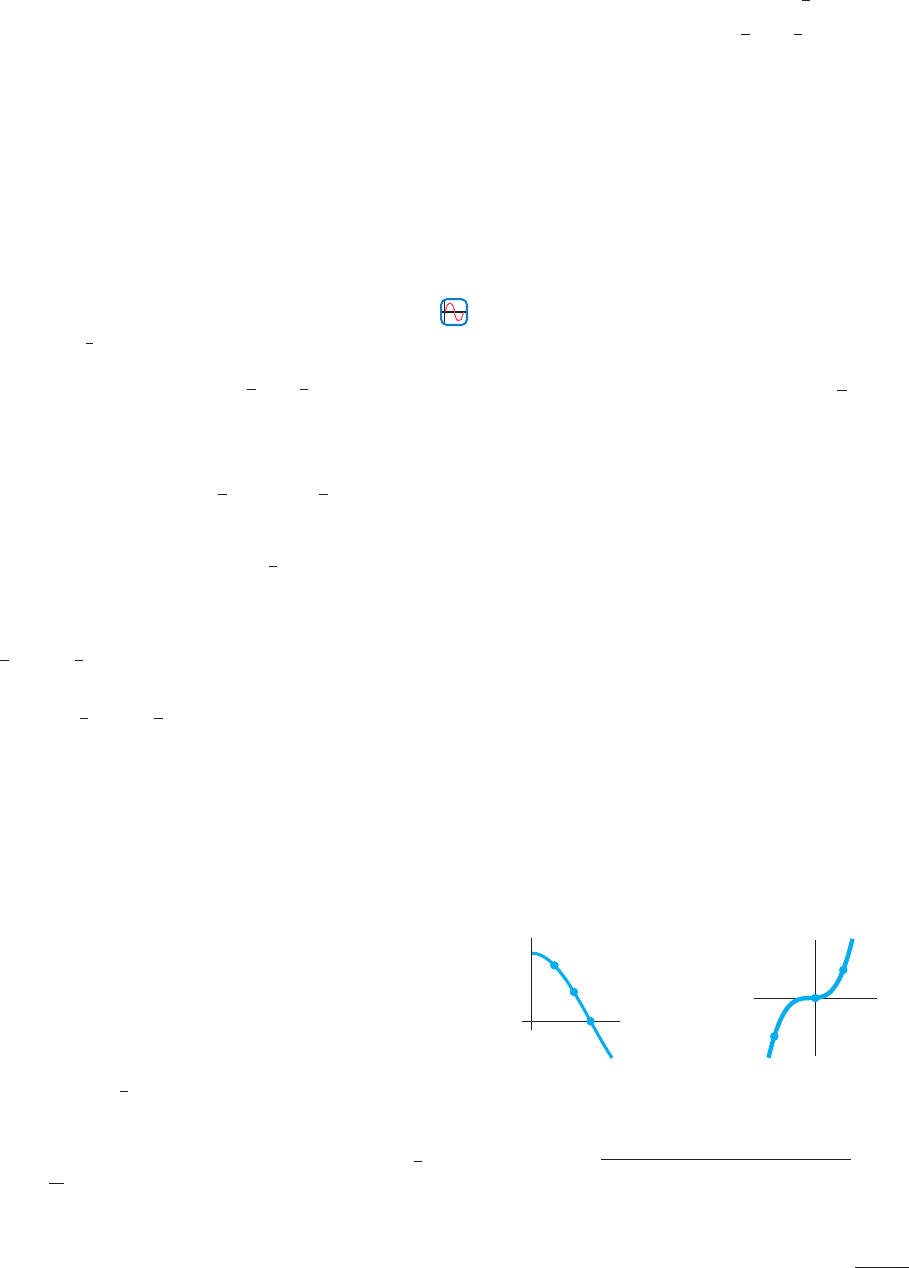
47. 48.
B
A
C
A
B
C
............................................................
49. Show that the curvature of the polar curve r = f (θ)is
κ =
|2[ f
(θ)]
2
− f (θ) f
(θ) +[ f (θ)]
2
|
{[ f
(θ)]
2
+ [ f (θ)]
2
}
3/2
,
unless f (θ
0
) and f
(θ
0
) are both zero.
50. If f (θ
0
) = 0 and f
(θ
0
) = 0, show that the curvature of the
polar curve r = f (θ)atθ = θ
0
is given by κ =
2
| f
(θ
0
)|
.

P1: OSO/OVY P2: OSO/OVY QC: OSO/OVY T1: OSO
MHDQ256-Ch12 MHDQ256-Smith-v1.cls December 27, 2010 20:38
LT (Late Transcendental)
CONFIRMING PAGES
786 CHAPTER 12
..
Vector-Valued Functions 12-38
In exercises 51–54, use exercises 49 and 50 to find the curvature
of the polar curve at the indicated points.
51. r = sin3θ,θ = 0,θ =
π
6
52. r = 3 +2cosθ,θ = 0,θ =
π
2
53. r = 3e
2θ
,θ = 0,θ = 1
54. r = 1 −2sinθ,θ = 0,θ =
π
2
............................................................
55. Find the curvature of the helix traced out by r(t) =
2sint, 2cost, 0.4tand compare to the resultof example 4.5.
56. Find the limit as n → 0 of the curvature of r(t) =
2sint, 2cost, nt for n > 0. Explain this result graphically.
57. Thecycloid is a curve with parametric equations x = t − sin t,
y = 1 −cos t. (a) Show that the curvature of the cycloid
equals
1
√
8y
, for y = 0. (b) Show that κ(t) =
1
4sin(t/2)
.
58. Find the curvature of r(t) =cosh t, sinht, 2. Find the limit
of the curvature as t →∞. Use a property of hyperbolas to
explain this result.
59. For the logarithmic spiral r = ae
bθ
, show that the curvature
equals κ =
e
−bθ
|a|
√
1 + b
2
. Show that as b → 0, the spiral ap-
proaches a circle.
EXPLORATORY EXERCISES
1. In this exercise, we explore an unusual two-
dimensional parametric curve sometimes known as
the Cornu spiral. Define the vector-valued function
r(t) =
t
0
cos
πu
2
2
du,
t
0
sin
πu
2
2
du
. Use a graphing
utility to sketch the graph of r(t) for −π ≤ t ≤ π. Compute
the arc length of the curve from t = 0tot = c and compute
the curvature at t = c. What is the remarkable property that
you find?
2. Assume that f (x) has three continuous derivatives. Prove
that at a local minimum of y = f (x),κ = f
(x) and
κ
(x) = f
(x). Prove that at a local maximum of
y = f (x),κ =−f
(x) and κ
(x) =−f
(x).
12.5 TANGENT AND NORMAL VECTORS
Up to this point, we have used a single frame of reference for all of our work with vectors,
writing all vectors in terms of the standard unit basis vectors i, j and k. However, other
choices are often more convenient. For instance, for describing the forces acting on an
aircraft in flight, a much better frame of reference would be one that moves along with
the aircraft. In this section, we construct such a moving reference frame and see how
it immediately provides useful information regarding the forces acting on an object in
motion.
Consider an object moving along a smooth curve traced out by the vector-valued
function r(t) =f (t), g(t), h(t). To define a reference frame that moves with the object,
we will need to have (at each point on the curve) three mutually orthogonal unit vectors,
one of which should point in the direction of motion (i.e., in the direction of the orientation
of the curve). In section 12.4, we defined the unit tangent vector T(t)by
T(t) =
r
(t)
r
(t)
.
Further, recall from Theorem 2.4 that since T(t) is a unit vector (and consequently has the
constant magnitude of 1), T(t) must be orthogonal to T
(t) for each t. So, a second unit
vector in our moving frame of reference is given by the following.
DEFINITION 5.1
The principal unit normal vector N(t) is a unit vector having the same direction as
T
(t) and is defined by
N(t) =
T
(t)
T
(t)
, (5.1)
provided that T
(t) = 0.
P1: OSO/OVY P2: OSO/OVY QC: OSO/OVY T1: OSO
MHDQ256-Ch12 MHDQ256-Smith-v1.cls December 27, 2010 20:38
LT (Late Transcendental)
CONFIRMING PAGES
12-39 SECTION 12.5
..
Tangent and Normal Vectors 787
Knowing that N(t) is orthogonal to T(t) does not quite give us the direction of N(t).
After all, in three dimensions, there are infinitely many directions that are orthogonal to
T(t). (In two dimensions, there are only two possible directions.) We can clarify this with
the following observation.
Recall that from (4.5), we have that
ds
dt
=r
(t) > 0. (This followed from the defini-
tion of the arc length parameter in (4.1).) In particular, this says that
ds
dt
=
ds
dt
. From the
chain rule, we have
T
(t) =
dT
dt
=
dT
ds
ds
dt
.
This gives us N(t) =
T
(t)
T
(t)
=
dT
ds
ds
dt
dT
ds
ds
dt
=
dT
ds
dT
ds
or equivalently, N(t) =
1
κ
dT
ds
, (5.2)
where we have used the definition of curvature in (4.3), κ =
dT
ds
.
Although (5.2) is not particularly useful as a formula for computing N(t) (why not?),
we can use it to interpret the meaningof N(t). Since κ>0, in order for (5.2)to make sense,
N(t) will have the same direction as
dT
ds
. Since
dT
ds
is the instantaneous rate of change of
the unit tangent vector with respect to arc length,
dT
ds
(and consequently N, also) points in
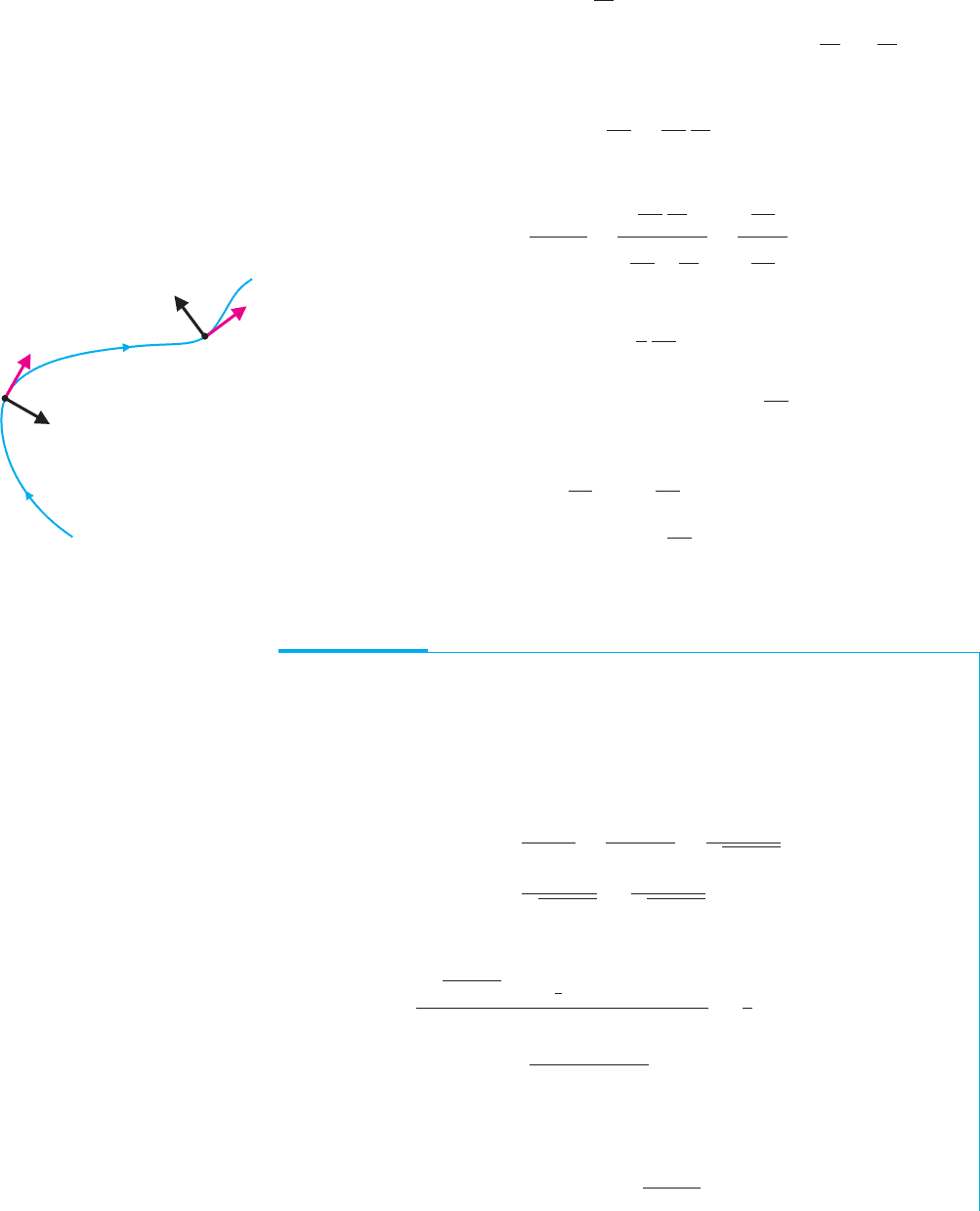
the direction in which T is turning as arc length increases. That is, N(t) will always point
to the concave side of the curve. (See Figure 12.23.)
EXAMPLE 5.1 Finding Unit Tangent and Principal
Unit Normal Vectors
Find the unit tangent and principal unit normal vectors to the curve defined by
r(t) =t
2
, t.
T
T
N
N
FIGURE 12.23
Principal unit normal vectors
Solution Notice that r
(t) =2t, 1 and so from (4.2), we have
T(t) =
r
(t)
r
(t)
=
2t, 1
2t, 1
=
2t, 1
√
4t
2
+ 1
=
2t
√
4t
2
+ 1
i +
1
√
4t
2
+ 1
j.
Using the quotient rule, we have
T
(t) =
2
√
4t
2
+ 1 −2t
1
2
(4t
2
+ 1)
−1/2
(8t)
4t
2
+ 1
i −
1
2
(4t
2
+ 1)
−3/2
(8t)j
= 2(4t
2
+ 1)
−1/2
(4t
2
+ 1) −4t
2
4t
2
+ 1
i − (4t
2
+ 1)
−3/2
(4t)j
= 2(4t
2
+ 1)
−3/2
1, −2t.
Further, T
(t)=2(4t
2
+ 1)
−3/2
1, −2t
= 2(4t
2
+ 1)
−3/2
1 + 4t
2
= 2(4t
2
+ 1)
−1
.
P1: OSO/OVY P2: OSO/OVY QC: OSO/OVY T1: OSO
MHDQ256-Ch12 MHDQ256-Smith-v1.cls December 27, 2010 20:38
LT (Late Transcendental)
CONFIRMING PAGES
788 CHAPTER 12
..
Vector-Valued Functions 12-40
From (5.1), the principal unit normal is then
N(t) =
T
(t)
T
(t)
=
2(4t
2
+ 1)
−3/2
1, −2t
2(4t
2
+ 1)
−1
= (4t
2
+ 1)
−1/2
1, −2t.
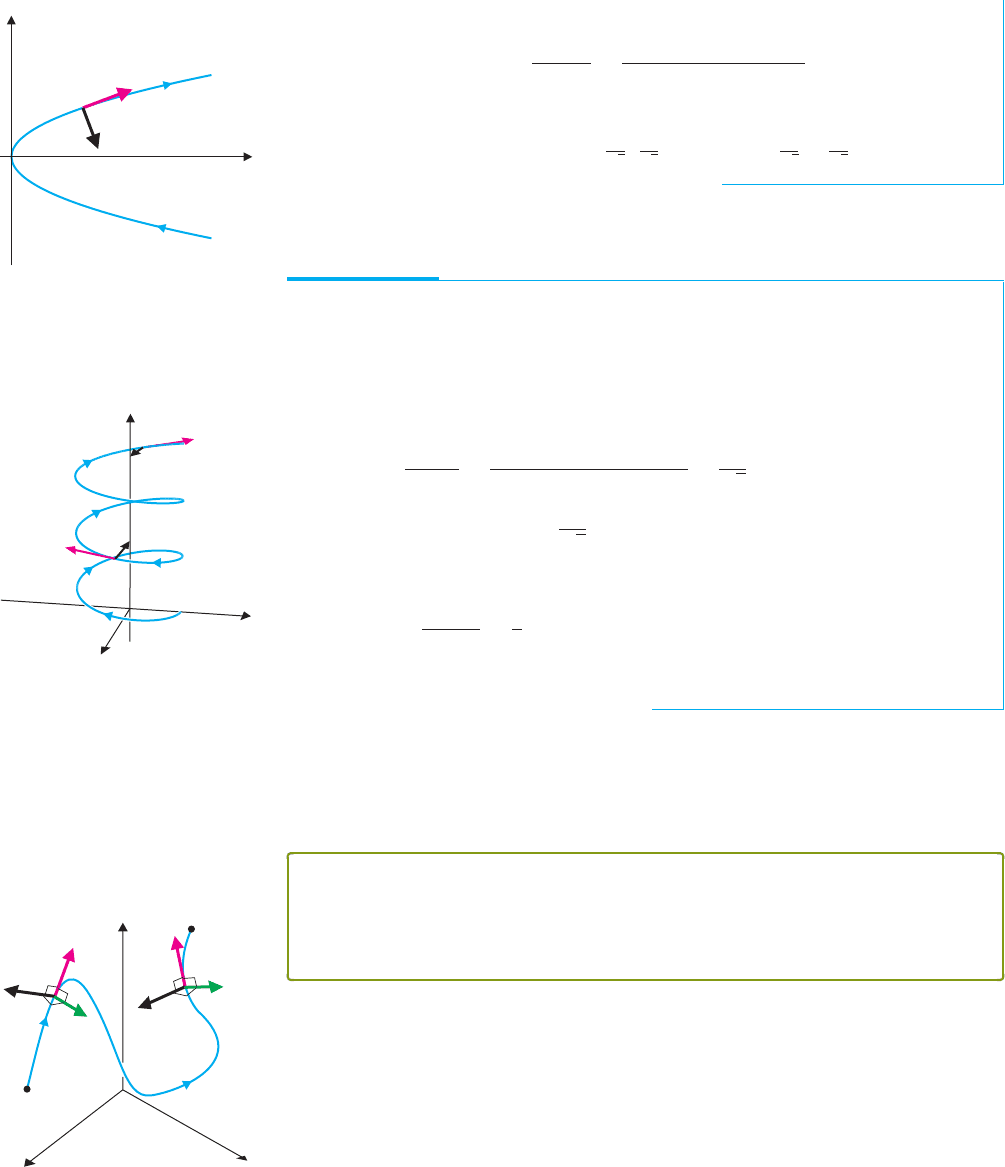
In particular, for t = 1, we get T(1) =
2
√
5
,
1
√
5
and N(1) =
1
√
5
, −
2
√
5
. We sketch the
curve and these two sample vectors in Figure 12.24.
T(1)
N(1)
x
y
FIGURE 12.24
Unit tangent and principal unit
normal vectors
The calculations are similar in three dimensions, as we illustrate in example 5.2.
EXAMPLE 5.2 Finding Unit Tangent and Principal Unit Normal Vectors
Find the unit tangent and principal unit normal vectors to the curve determined by
r(t) =sin 2t, cos2t, t.
Solution First, observe that r
(t) =2 cos 2t, −2sin2t, 1 and so, we have from
(4.2) that
T(t) =
r
(t)
r
(t)
=
2cos 2t, −2 sin2t, 1
2cos 2t, −2 sin2t, 1
=
1
√
5
2cos 2t, −2 sin2t, 1.
This gives us T
(t) =
1
√
5
−4sin 2t, −4 cos2t, 0
and so, from (5.1), the principal unit normal is
N(t) =
T
(t)
T
(t)
=
1
4
−4sin 2t, −4 cos2t, 0=−sin 2t, −cos 2t, 0.
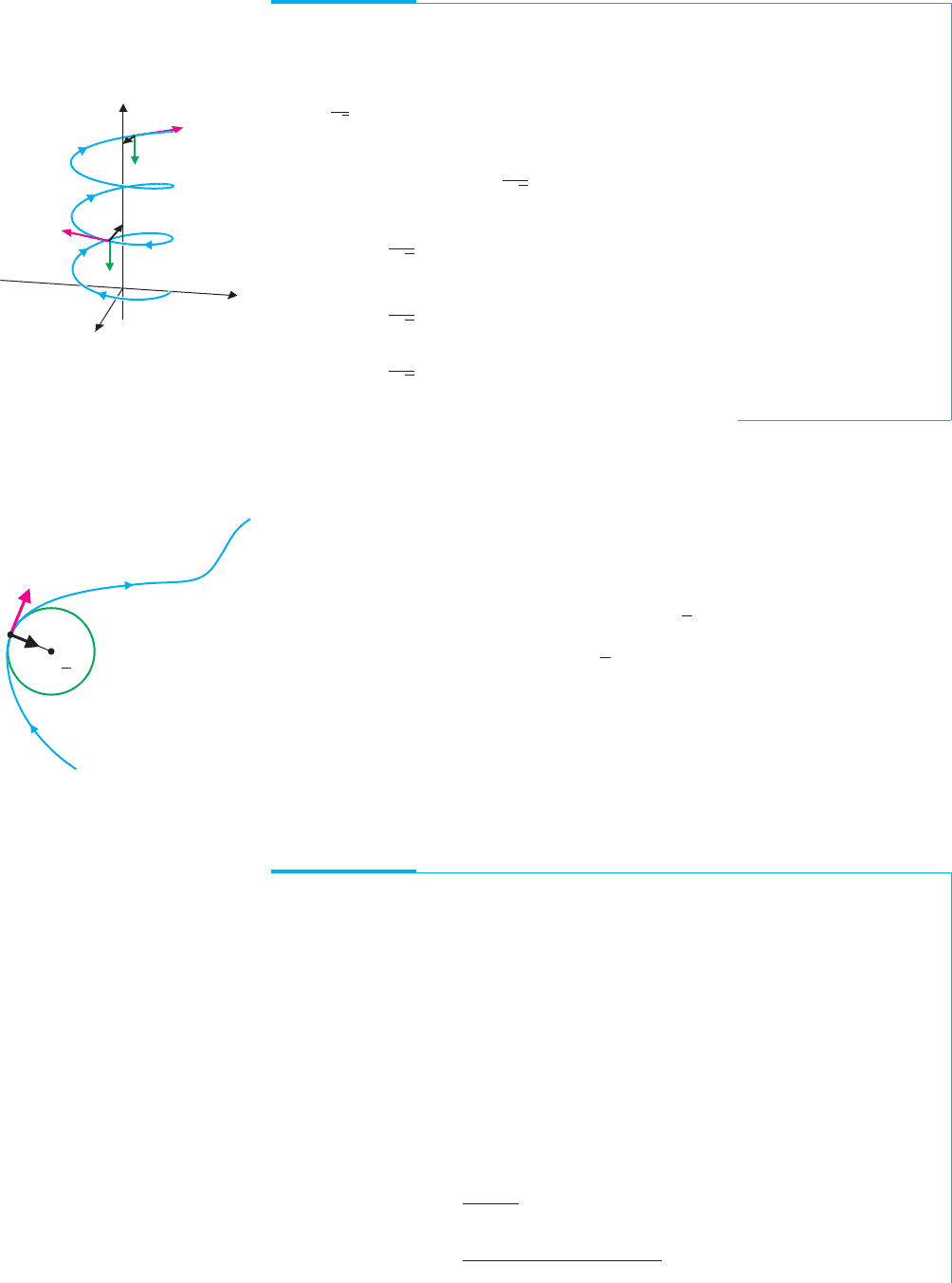
Notice that the curve here is a circular helix and that at each point, N(t) points straight
back toward the z-axis. (See Figure 12.25.)
To get a third unit vector orthogonal to both T(t) and N(t), we simply take their cross
product.
DEFINITION 5.2
We define the binormal vector B(t)tobe
B(t) = T(t) × N(t).
Notice that by definition, B(t) is orthogonal to both T(t) and N(t) and by Theorem 4.4
in Chapter 11, its magnitude is given by
B(t)=T(t) ×N(t)=T(t)N(t)sinθ,
where θ is the angle between T(t) and N(t). However, since T(t) and N(t) are both unit
vectors, T(t)=N(t)=1. Further, T(t) and N(t) are orthogonal, so that sinθ = 1
and consequently, B(t)=1, too. This triple of three unit vectors T(t), N(t) and B(t)
forms a frame of reference, called the TNB frame (or the moving trihedral), that moves
along the curve defined by r(t). (See Figure 12.26.) This has particular importance in
a branch of mathematics called differential geometry and is used in the navigation of
spacecraft.
y
x
z
O
N
N
T
T
FIGURE 12.25
Unit tangent and principal unit
normal vectors
y
x
z
O
T(t)
T(t)
B(t)
B(t)
N(t)
N(t)
C
FIGURE 12.26
The TNB frame
As you can see, the definition of the binormal vector is certainly straightforward. We
illustrate this now for the curve from example 5.2.
P1: OSO/OVY P2: OSO/OVY QC: OSO/OVY T1: OSO
MHDQ256-Ch12 MHDQ256-Smith-v1.cls December 27, 2010 20:38
LT (Late Transcendental)
CONFIRMING PAGES
12-41 SECTION 12.5
..
Tangent and Normal Vectors 789
EXAMPLE 5.3 Finding the Binormal Vector
Find the binormal vector B(t) for the curve traced out by r(t) =sin2t, cos2t, t.
Solution Recall from example 5.2 that the unit tangent vector is given by
T(t) =
1
√
5
2cos 2t, −2 sin2t, 1 and the principal unit normal vector is given by
N(t) =−sin2t, −cos 2t, 0. The binormal vector is then
B(t) = T(t) × N(t) =
1
√
5
2cos 2t, −2 sin2t, 1×−sin2t, −cos2t, 0
=
1
√
5
ijk
2cos 2t −2 sin2t 1
−sin2t −cos2t 0
=
1
√
5
[i(cos2t) − j(sin2t) + k(−2 cos
2
2t −2sin
2
2t)]
=
1
√
5
cos2t, −sin2t, −2.
We illustrate the TNB frame for this curve in Figure 12.27.
y
x
z
O
N
B
B
N
T
T
FIGURE 12.27
The TNB frame for
r(t) =sin 2t, cos2t, t
For each point on a curve, the plane passing through that point and determined by N(t)
and B(t) is called the normal plane. Accordingly, the normal plane to a curve at a given
point contains all of the lines that are orthogonal to the tangent vector at that point. For each
point on a curve, the plane determined by T(t) and N(t) is called the osculating plane. For
a two-dimensional curve, the osculating plane is simply the plane containing the curve.
T
N
P
r
1
k
FIGURE 12.28
Osculating circle
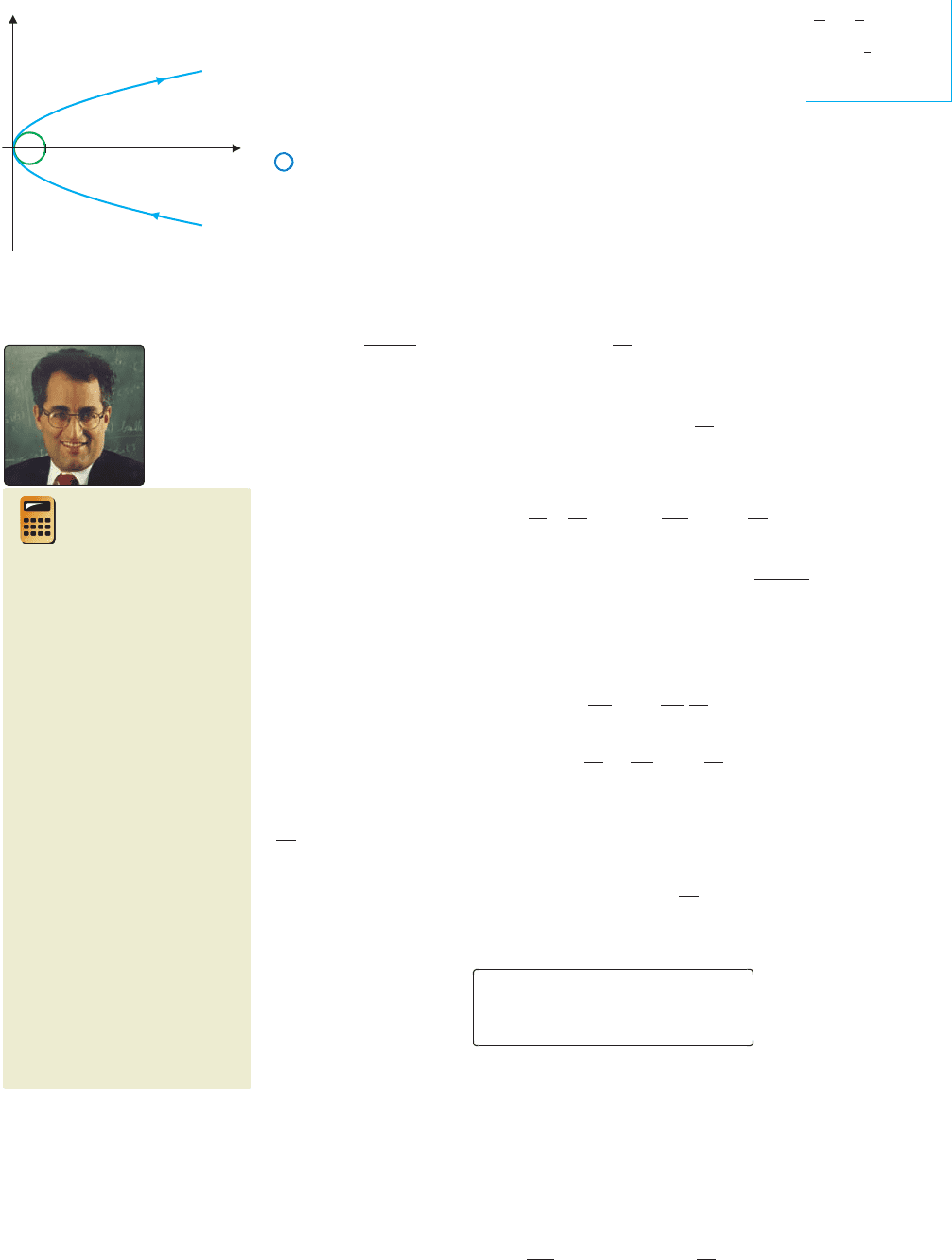
For a given value of t, say t = t
0
, if the curvature κ of the curve at the point P corre-
sponding to t
0
is nonzero, then the circle of radius ρ =
1
κ
lying completely in the osculating
plane and whose center lies a distance of
1
κ
from P along the normal N(t) is called the
osculating circle (or the circle of curvature). Recall from example 4.4 that the curvature
of a circle is the reciprocal of its radius. This says that the osculating circle has the same
tangent and curvature at P as the curve. Further, since the normal vector always points to
the concave side of the curve, the osculating circle lies on the concave side of the curve.
In this sense, then, the osculating circle is the circle that “best fits” the curve at the point
P. (See Figure 12.28.) The radius of the osculating circle is called the radius of curvature
and the center of the circle is called the center of curvature.
EXAMPLE 5.4 Finding the Osculating Circle
Find the osculating circle for the parabola defined by r(t) =t
2
, t at t = 0.
Solution In example 5.1, we found that the unit tangent vector is
T(t) = (4t
2
+ 1)
−1/2
2t, 1,
T
(t) = 2(4t
2
+ 1)
−3/2
1, −2t
and the principal unit normal is
N(t) = (4t
2
+ 1)
−1/2
1, −2t.
So, from (4.6), the curvature is given by
κ(t) =
T
(t)
r
(t)
=
2(4t
2
+ 1)
−3/2
(1 + 4t
2
)
1/2
(4t
2
+ 1)
1/2
= 2(4t
2
+ 1)
−3/2
.
P1: OSO/OVY P2: OSO/OVY QC: OSO/OVY T1: OSO
MHDQ256-Ch12 MHDQ256-Smith-v1.cls December 27, 2010 20:38
LT (Late Transcendental)
CONFIRMING PAGES
790 CHAPTER 12
..
Vector-Valued Functions 12-42
We now have κ(0) = 2, so that the radius of curvature for t = 0isρ =
1
κ
=
1
2
. Further,
N(0) =1, 0 and r(0) =0, 0, so that the center of curvature is located ρ =
1
2
unit
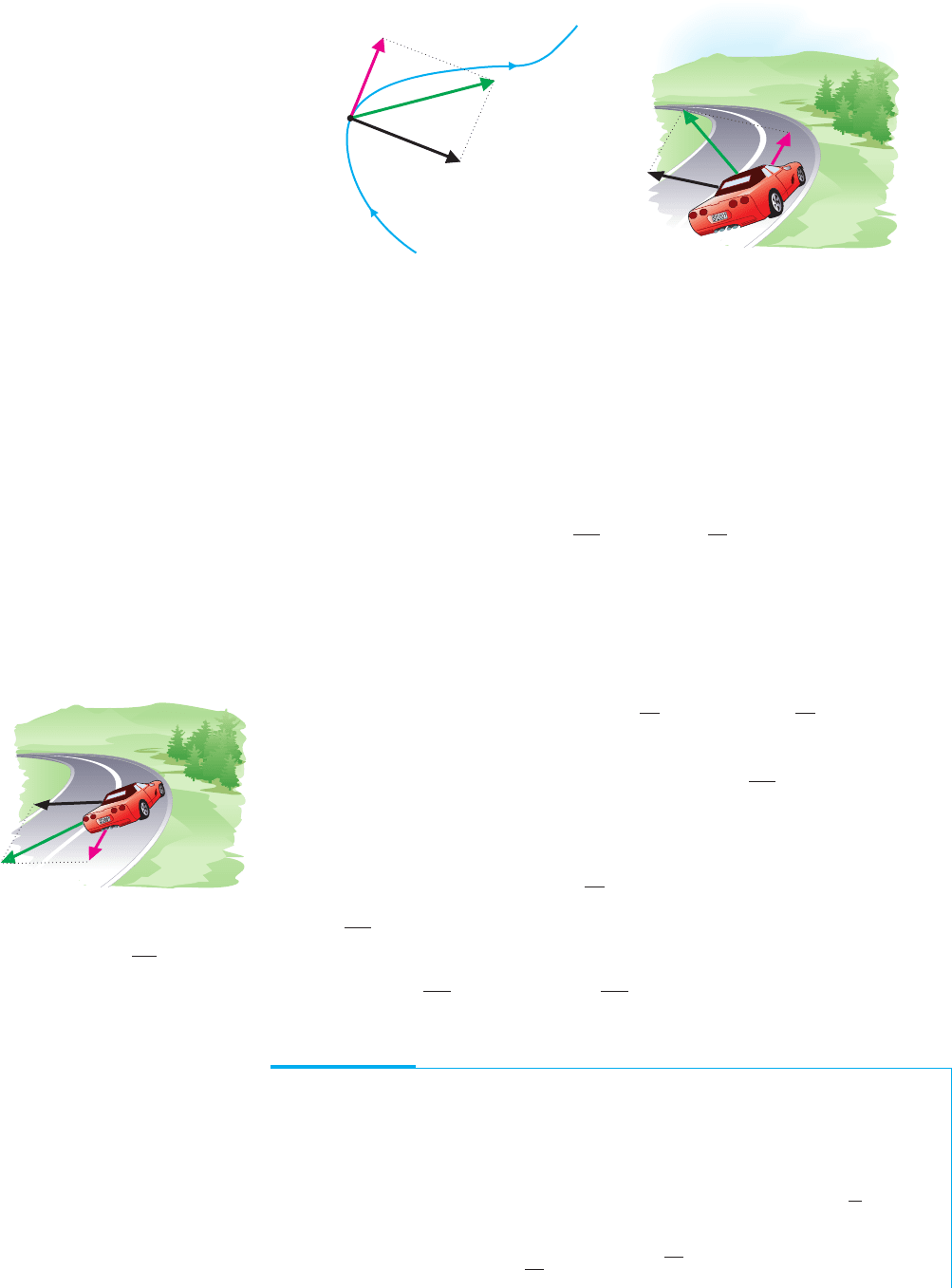
from the origin in the direction of N(0) (i.e., along the positive x-axis). We draw the
curve and the osculating circle (x −
1
/
2
)
2
+ y
2
=
1
/
4
in Figure 12.29.
Tangential and Normal Components of Acceleration
Now that we have defined the unit tangent and principal unit normal vectors, we can make
a remarkable observation about the motion of an object. In particular, we’ll see how this
observation helps to explain the behavior of an automobile as it travels along a curved
stretch of road.
x
y
1
FIGURE 12.29
Osculating circle
TODAY IN
MATHEMATICS
Edward Witten (1951– )
An American theoretical physicist
who is one of the world’s experts
in string theory. He earned the
Fields Medal in 1990 for his
contributions to mathematics.
Michael Atiyah, a mathematics
colleague, wrote, “Although he is
definitely a physicist (as his list of
publications clearly shows), his
command of mathematics is
rivalled by few mathematicians,
and his ability to interpret physical
ideas in mathematical form is
quite unique. Time and again he
has surprised the mathematical
community by his brilliant
application of physical insight
leading to new and deep
mathematical theorems.’’ In
addition, Atiyah wrote, “In his
hands, physics is once again
providing a rich source of
inspiration and insight in
mathematics.’’
Suppose that an object moves along a smooth curve traced out by the vector-valued
function r(t), where t represents time. Recall from the definition of the unit tangent vector
thatT(t) =
r
(t)
r
(t)
andfrom(4.5),r
(t)=
ds
dt
,wheres representsarclength.Thevelocity
of the object is then given by
v(t) = r
(t) =r
(t)T(t) =
ds
dt
T(t).
Using the product rule [Theorem 2.3 (iii)], the acceleration is given by
a(t) = v
(t) =
d
dt
ds
dt
T(t)
=
d
2
s
dt
2
T(t) +
ds
dt
T
(t). (5.3)
Recall that we had defined the principal unit normal by N(t) =
T
(t)
T
(t)
, so that
T
(t) =T
(t)N(t). (5.4)
Further, by the chain rule,
T
(t)=
dT
dt
=
dT
ds
ds
dt
=
ds
dt
dT
ds
= κ
ds
dt
, (5.5)
where we have also used the definition of the curvature κ given in (4.3) and the fact that
ds
dt
> 0. Putting together (5.4) and (5.5), we now have that
T
(t) =T
(t)N(t) = κ
ds
dt
N(t).
Using this together with (5.3), we now get
a(t) =
d
2
s
dt
2
T(t) +κ
ds
dt
2
N(t). (5.6)
Equation (5.6) provides us with a surprising wealth of insight into the motion of an object.
First, notice that since a(t) is written as a sum of a vector parallel to T(t) and a vector
parallel to N(t), the acceleration vector always lies in the plane determined by T(t)and N(t)
(i.e., the osculating plane). In particular, this says that the acceleration is always orthogonal
to the binormal B(t). We call the coefficient of T(t) in (5.6) the tangential component of
acceleration a
T
and the coefficient of N(t) the normal component of acceleration a
N
.
That is,
a
T
=
d
2
s
dt
2
and a
N
= κ
ds
dt
2
. (5.7)
P1: OSO/OVY P2: OSO/OVY QC: OSO/OVY T1: OSO
MHDQ256-Ch12 MHDQ256-Smith-v1.cls December 27, 2010 20:38
LT (Late Transcendental)
CONFIRMING PAGES
12-43 SECTION 12.5
..
Tangent and Normal Vectors 791
a
T
T(t)
a(t)
a
N
N(t)
a
T
T(t)
F(t)
a
N
N(t)
FIGURE 12.30 FIGURE 12.31
Tangential and normal components Driving around a curve
of acceleration
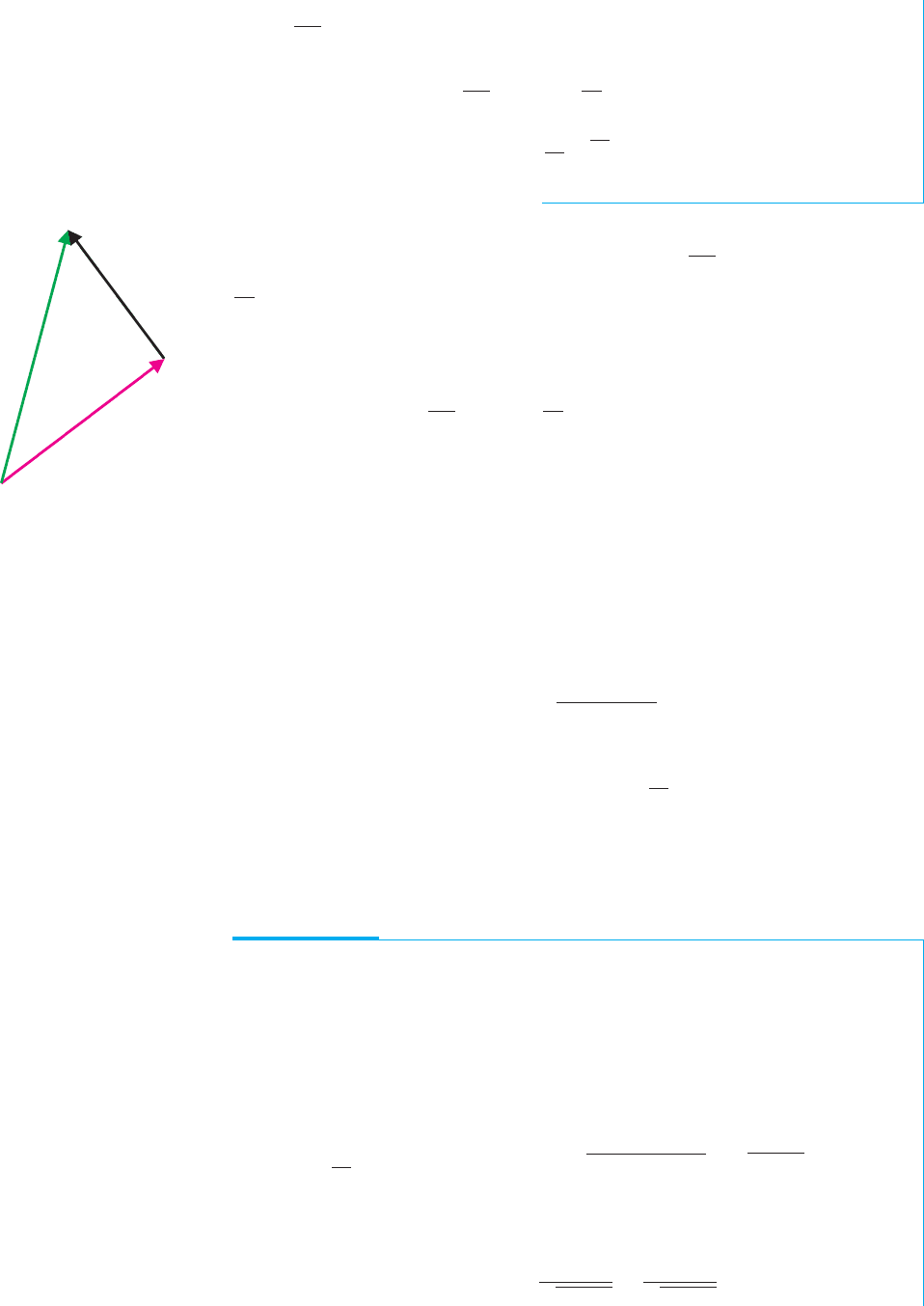
See Figure 12.30 for a graphical depiction of this decomposition of a(t) into tangential and
normal components.
a
T
T(t)
F(t)
a
N
N(t)
FIGURE 12.32
Net force:
d
2
s
dt
2
< 0
We now discuss (5.6) in the familiar context of a car driving around a curve in the
road. (See Figure 12.31.) From Newton’s second law of motion, the net force acting on
the car at any given time t is F(t) = ma(t), where m is the mass of the car. From (5.6),
we have
F(t) = ma(t) = m
d
2
s
dt
2
T(t) +mκ
ds
dt
2
N(t).
Since T(t) points in the direction of the path of motion, you want the component of the
force acting in the direction of T(t) to be as large as possible compared to the component of
the force acting in the direction of the normal N(t). (If the normal component of the force
is too large, it may exceed the normal component of the force of friction between the tires
and the highway, causing the car to skid off the road.) Notice that the only way to minimize
the force applied in this direction is to make
ds
dt
2
small, where
ds
dt
is the speed. So,
reducing speed is the only way to reduce the normal component of the force. To have a
larger tangential component of the force, you will need to have
d
2
s
dt
2
(the instantaneous rate
of change of speed with respect to time) larger. So, to maximize the tangential component
of the force, you need to be accelerating while in the curve. You have probably noticed
advisory signs on the highway advising you to slow down before you enter a sharp curve.
Notice that reducing speed (i.e., reducing
ds
dt
) before the curve and then gently accelerating
(keeping
d
2
s
dt
2
> 0) once you’re in the curve keeps the resultant force F(t) pointing in the
general direction in which you are moving. Alternatively, waiting until you’re in the curve
to slow down keeps
d
2
s
dt
2
< 0, which makes
d
2
s
dt
2
T(t) point in the opposite direction as T(t).
The net force F(t) will then point away from the direction of motion. (See Figure 12.32.)
EXAMPLE 5.5 Finding Tangential and Normal Components
of Acceleration
Find the tangential and normal components of acceleration for an object with position
vector r(t) =2sint, 2cos t, 4t.
Solution In example 4.5, we found that the curvature of this curve is κ =
1
10
. We also
have r
(t) =2 cost, −2sint, 4, so that
ds
dt
=r
(t)=
√
20
P1: OSO/OVY P2: OSO/OVY QC: OSO/OVY T1: OSO
MHDQ256-Ch12 MHDQ256-Smith-v1.cls December 27, 2010 20:38
LT (Late Transcendental)
CONFIRMING PAGES
792 CHAPTER 12
..
Vector-Valued Functions 12-44
and so,
d
2
s
dt
2
= 0, for all t. From (5.6), we have that the acceleration is
a(t) =
d
2
s
dt
2
T(t) +κ
ds
dt
2
N(t)
= (0) T(t) +
1
10
√
20
2
N(t) = 2N(t).
So, here we have a
T
= 0 and a
N
= 2.
a
T
T(t)
a(t)
a
N
N(t)
FIGURE 12.33
Components of a(t)
Notice that it’s reasonably simple to compute a
T
=
d
2
s
dt
2
. You must only calculate
ds
dt
=r
(t) and then differentiate the result. On the other hand, computing a
N
is a bit
more complicated, since it requires you to first compute the curvature κ. We can simplify
the calculation of a
N
with the following observation. From (5.6), we have
a(t) =
d
2
s
dt
2
T(t) +κ
ds
dt
2
N(t) = a
T
T(t) +a
N
N(t).
This says that a(t) is the vector resulting from adding the orthogonal vectors a
T
T(t) and
a
N
N(t). (See Figure 12.33, where we have drawn the vectors so that the initial point of
a
N
N(t) is located at the terminal point of a
T
T(t).) From the Pythagorean Theorem, we have
that
a(t)
2
=a
T
T(t)
2
+a
N
N(t)
2
= a
2
T
+ a
2
N
, (5.8)
sinceT(t)and N(t)are unit vectors(i.e., T(t)=N(t)=1).Solving (5.8) for a
N
,we get
a
N
=
a(t)
2
− a
2
T
, (5.9)
where we have taken the positive root since a
N
= κ
ds
dt
2
≥ 0. Once you know a(t) and
a
T
, you can use (5.9) to quickly calculate a
N
, without first computing the curvature. As an
alternative, observe that a
T
is the component of a(t) along the velocity vector v(t). Further,
from (5.7) and (5.9), we can compute a
N
and κ. This allows us to compute a
T
, a
N
and κ
without first computing the derivative of the speed.
EXAMPLE 5.6 Finding Tangential and Normal Components
of Acceleration
Find the tangential and normal components of acceleration for an object whose path is
defined by r(t) =t, 2t, t
2
. In particular, find these components at t = 1. Also, find the
curvature.
Solution First, we compute the velocity v(t) = r
(t) =1, 2, 2t and the acceleration
a(t) =0, 0, 2. This gives us
ds
dt
=r
(t)=1, 2, 2t =
1
2
+ 2
2
+ (2t)
2
=
5 + 4t
2
.
The tangential component of acceleration a
T
is the component of a(t) =0, 0, 2 along
v(t) =1, 2, 2t:
a
T
=0, 0, 2·
1, 2, 2t
√
5 + 4t
2
=
4t
√
5 + 4t
2
.