
Smith R., Minton R. Calculus
Подождите немного. Документ загружается.

P1: OSO/OVY P2: OSO/OVY QC: OSO/OVY T1: OSO
MHDQ256-Ch12 MHDQ256-Smith-v1.cls December 27, 2010 20:38
LT (Late Transcendental)
CONFIRMING PAGES
12-25 SECTION 12.3
..
Motion in Space 773
To determine the horizontal range, we first need to determine the instant at which the
object strikes the ground. Notice that this occurs when the vertical component of the
position vector is zero (i.e., when the height above the ground is zero). From (3.4), we
see that this occurs when
0 = 25
√
2t −4.9t
2
= t(25
√
2 − 4.9t).
There are two solutions of this equation: t = 0 (the time at which the projectile is
launched) and t =
25
√
2
4.9
(the time of impact). The horizontal range is then the
horizontal component of position at this time:
Range = 25
√
2t
t=
25
√
2
4.9
=
25
√
2
25
√
2
4.9
=
1250
4.9
= 255.1m.
Finally, the speed at impact is the magnitude of the velocity vector at the time of
impact:
v
25
√
2
4.9
=
25
√
2, 25
√
2 − 9.8
25
√
2
4.9
=
25
√
2, −25
√
2
= 50 m/s.
You might have noticed in example 3.4 that the speed at impact was the same as the
initial speed. Don’t expect this to always be the case. Generally, this will be true only for a
projectile of constant mass that is fired from ground level and returns to ground level and
that is not subject to air resistance or other forces.
Equations of Motion
We now derive the equations of motion for a projectile in a slightly more general setting
than that described in example 3.4. Consider a projectile launched from an altitude h above
the ground at an angle θ to the horizontal and with initial speed v
0
. We can use Newton’s
second law of motion to determine the position of the projectile at any time t and once we
have this, we can answer any questions about the motion.
We again start with Newton’s second law and assume that the only force acting on the
object is gravity. We have
−mgj = F(t) = ma(t).
This gives us (as in example 3.4)
v
(t) = a(t) =−gj. (3.5)
Integrating (3.5) gives us
v(t) =
a(t) dt =−gtj + c
1
, (3.6)
where c
1
is an arbitrary constant vector. In order to solve for c
1
, we need the value of v(t)
for some t, but we are given only the initial speed v
0
and the angle at which the projectile
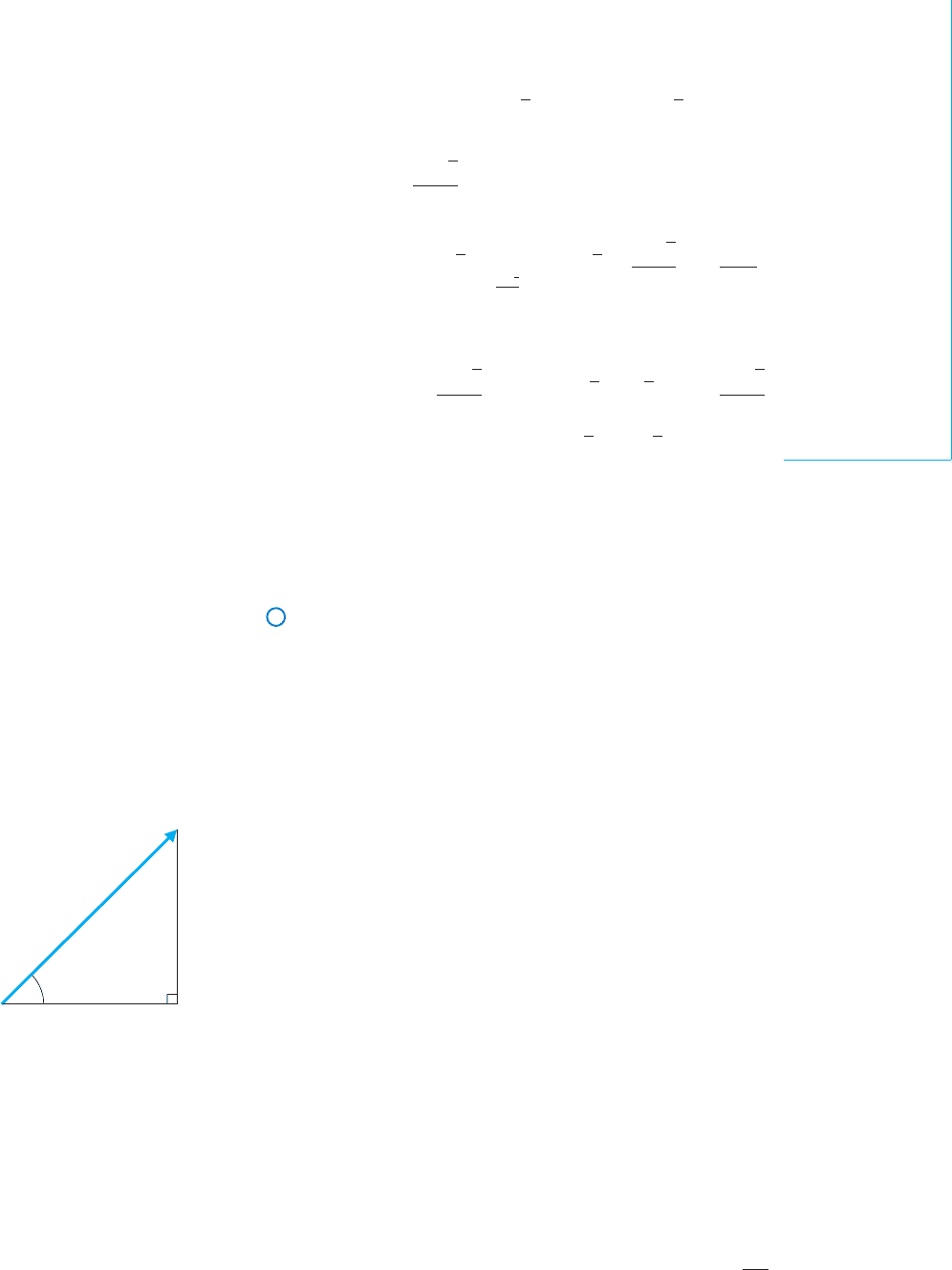
is fired. Notice that from the definitions of sine and cosine, we can read off the components
of v(0) from Figure 12.18a. From this and (3.6), we have
v
0
sin u
v
0
cos u
u
v
0
v(0)
FIGURE 12.18a
Initial velocity
v
0
cosθ,v
0
sinθ =v(0) = c
1
.
This gives us the velocity vector
v(t) =v
0
cosθ,v
0
sinθ − gt. (3.7)
Since r
(t) = v(t), we integrate (3.7) to get the position:
r(t) =
v(t) dt =
(v
0
cosθ )t, (v
0
sinθ )t −
gt
2
2
+ c
2
.
P1: OSO/OVY P2: OSO/OVY QC: OSO/OVY T1: OSO
MHDQ256-Ch12 MHDQ256-Smith-v1.cls December 27, 2010 20:38
LT (Late Transcendental)
CONFIRMING PAGES
774 CHAPTER 12
..
Vector-Valued Functions 12-26
To solve for c
2
, we want to use the initial position r(0), but we’re not given it. We’re told
only that the projectile starts from an altitude of h feet above the ground. So, we choose the
origin to be the point on the ground directly below the launching point, giving us
0, h=r(0) = c
2
,
so that r(t) =
(v
0
cosθ )t, (v
0
sinθ )t −
gt
2
2
+0, h
=
(v
0
cosθ )t, h + (v
0
sinθ )t −
gt
2
2
. (3.8)
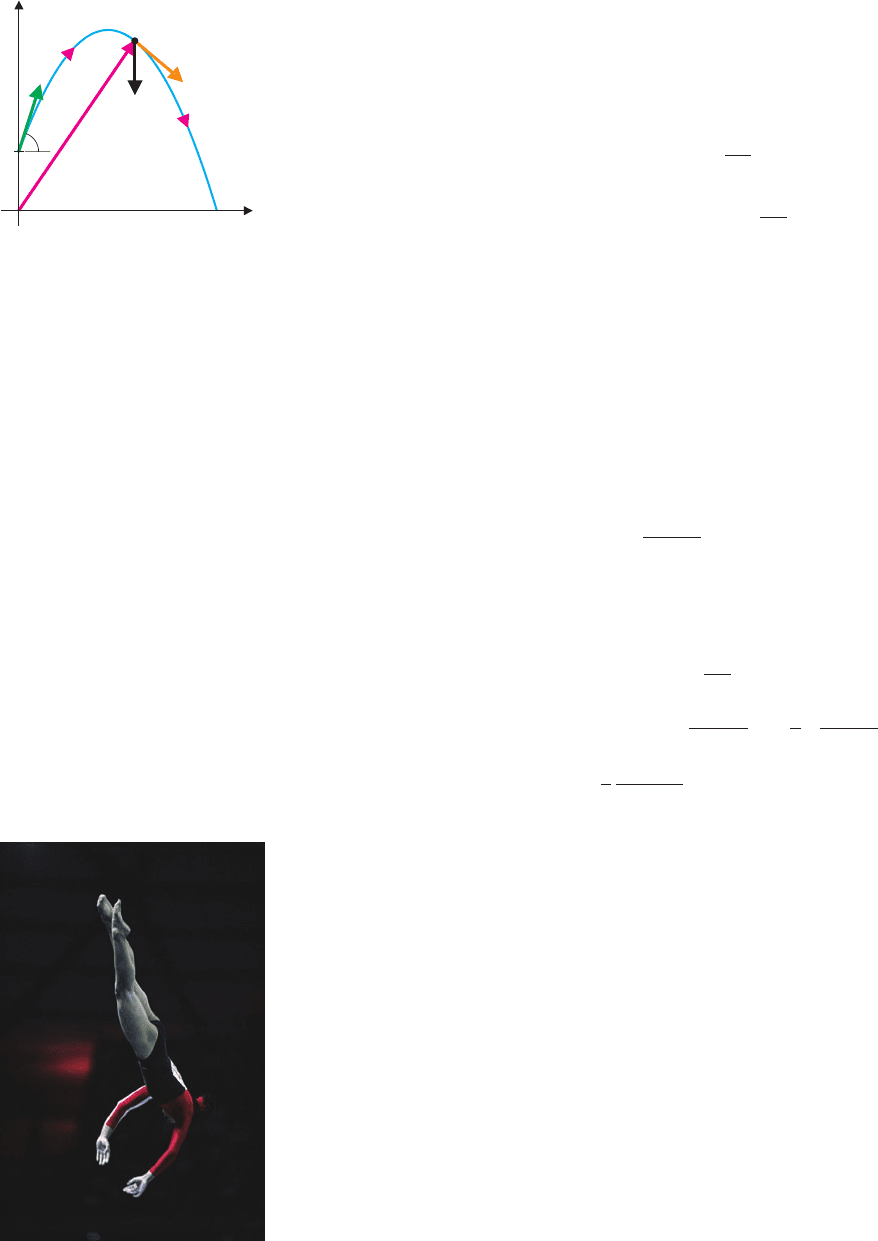
Notice that the path traced out by r(t) (from t = 0 until impact) is a portion of a parabola.
(See Figure 12.18b.)
h
O
x
y
v(0)
r xi yj
a gj
v
u
FIGURE 12.18b
Path of the projectile
Now that we have derived (3.7) and (3.8), we have all we need to answer any further
questions about the motion. For instance, the maximum altitude occurs at the time at which
the vertical component of velocity is zero (i.e., at the time when the projectile stops rising).
From (3.7), we solve
0 = v
0
sinθ − gt,
so that the time at which the maximum altitude is reached is given by
t
max
=
v
0
sinθ
g
.
The maximum altitude is then the vertical component of the position vector at this time.
Time to reach maximum altitude
From (3.8), we have
Maximum altitude = h + (v
0
sinθ )t −
gt
2
2
t=t
max
= h + (v
0
sinθ )
v
0
sinθ
g
−
g
2
v
0
sinθ
g
2
= h +
1
2
v
2
0
sin
2
θ
g
.
In all of the foregoing analysis, we left the constant acceleration due to gravity as g.
Maximum altitude
You will usually use one of the two approximations:
g ≈ 32 ft/s
2
or g ≈ 9.8m/s
2
.
When using any other units, simply adjust the units to feet or meters and the time scale to
seconds or make the corresponding adjustments to the value of g.
We next use the calculus to analyze the motion of a body rotating about an axis. (For
instance, think about the motion of a gymnast performing a complicated routine). We use a
rotational version of Newton’s second law to analyze such motion. Torque (denoted by τ )
is defined in section 11.4. In the caseof an object rotating in two dimensions, the torque has
magnitude (denoted by τ =τ ) given by the product of the force acting in the direction
of the motion and the distance from the rotational center. The moment of inertia I of a body
is a measure of how an applied force will cause the object to change its rate of rotation.
This is determined by the mass and the distance of the mass from the center of rotation
and is examined in some detail in section 14.2. In rotational motion, the primary variable
that we track is an angle of displacement, denoted by θ. For a rotating body, the angle
measured from some fixed ray changes with time t, so that the angle is a function θ (t).
We define the angular velocity to be ω(t) = θ
(t) and the angular acceleration to be
α(t) = ω
(t) = θ
(t). The equation of rotational motion is then
τ = I α. (3.9)

P1: OSO/OVY P2: OSO/OVY QC: OSO/OVY T1: OSO
MHDQ256-Ch12 MHDQ256-Smith-v1.cls December 27, 2010 20:38
LT (Late Transcendental)
CONFIRMING PAGES
12-27 SECTION 12.3
..
Motion in Space 775
Notice how closely this resembles Newton’s second law, F = ma. The calculus used
in example 3.5 should look familiar.
EXAMPLE 3.5 The Rotational Motion of a Merry-Go-Round
A stationary merry-go-round of radius 5 feet is started in motion by a push consisting of
a force of 10 pounds on the outside edge, tangent to the circular edge of the merry-go-
round, for 1 second. The moment of inertia of the merry-go-round is I = 25. Find the
resulting angular velocity of the merry-go-round.
Solution We first compute the torque of the push. The force is applied 5 feet from the
center of rotation, so that the torque has magnitude
τ = (Force)(Distance from axis of rotation) = (10)(5) = 50 foot-pounds.
From (3.9), we have 50 = 25α,
so that α = 2. Since the force is applied for 1 second, this equation holds for 0 ≤ t ≤ 1.
Integrating both sides of the equation ω
= α from t = 0tot = 1, we have by the
Fundamental Theorem of Calculus that
ω(1) −ω(0) =
1
0
α dt =
1
0
2 dt = 2. (3.10)
If the merry-go-round is initially stationary, then ω(0) = 0 and (3.10) becomes simply
ω(1) = 2 rad/s.
Notice that we could draw a more general conclusion from (3.10). Even if the merry-
go-round is already in motion, applying a force of 10 pounds tangentially to the edge for 1
second will increase the rotation rate by 2 rad/s.
For rotational motion in three dimensions, the calculations are somewhat more com-
plicated. Recall that we had defined the torque τ due to a force F applied at position r to
be
τ = r × F.
Example 3.6 relates torque to angular momentum. The linear momentum p of an object
of mass m with velocity v is given by p = mv. The angular momentum L is defined by
L(t) = r(t) × mv(t).
EXAMPLE 3.6 Relating Torque and Angular Momentum
Show that torque equals the derivative of angular momentum.
Solution From the definition of angular momentum and the product rule for the
derivative of a cross product [Theorem 2.3 (v)], we have
L
(t) =
d
dt
[r(t) ×mv(t)]
= r
(t) ×mv(t) + r(t) × mv
(t)
= v(t) × mv(t) + r(t) × ma(t).
Notice that the first term on the right-hand side is the zero vector, since it is the cross
product of parallel vectors. From Newton’s second law, we have F(t) = ma(t), so we
have
L
(t) = r(t) × ma(t) = r ×F = τ .
P1: OSO/OVY P2: OSO/OVY QC: OSO/OVY T1: OSO
MHDQ256-Ch12 MHDQ256-Smith-v1.cls December 27, 2010 20:38
LT (Late Transcendental)
CONFIRMING PAGES
776 CHAPTER 12
..
Vector-Valued Functions 12-28
From this result, it is a short step to the principle of conservation of angular momen-
tum, which states that, in the absence of torque, angular momentum remains constant. This
is left as an exercise.
k
x
y
Magnus force
East
z
v(0)
O
North
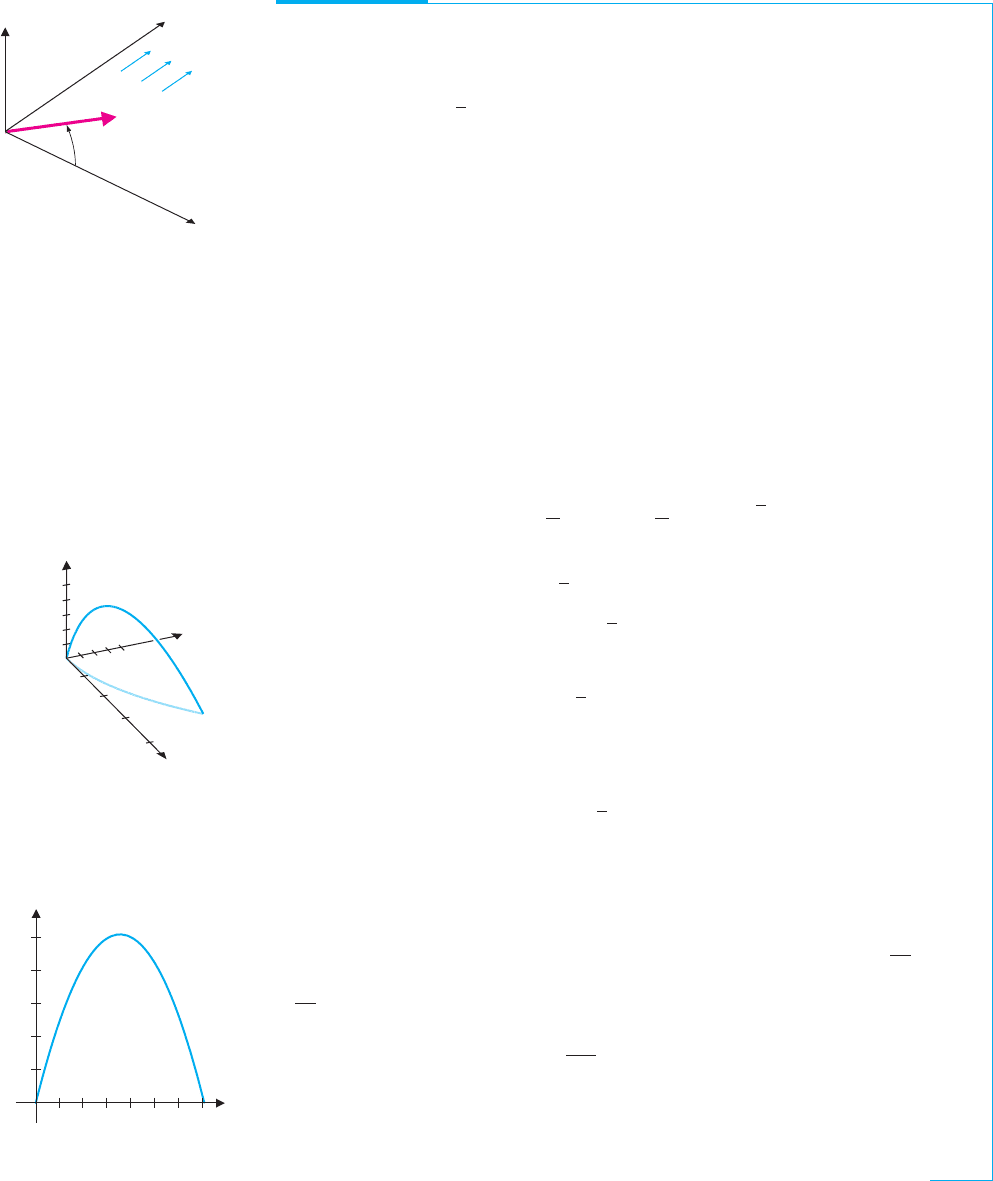
FIGURE 12.19a
The initial velocity and Magnus
force vectors
400
x
z
y
2000
4000
400
FIGURE 12.19b
Path of the projectile
z
x
500
400
300
200
100
1000 2000 3000
FIGURE 12.19c
Projection of path onto the xz-plane
In example 3.7, we examine a fully three-dimensional projectile motion problem for
the first time.
EXAMPLE 3.7 Analyzing the Motion of a Projectile
in Three Dimensions
A projectile of mass 1 kg is launched from ground level toward the east at 200 meters/
second, at an angle of
π
6
to the horizontal. If the spinning of the projectile applies a
steady northerly Magnus force of 2 newtons to the projectile, find the landing location
of the projectile and its speed at impact.
Solution Notice that because of the Magnus force, the motion is fully three-
dimensional. We orient the x-, y- and z-axes so that the positive y-axis points north,
the positive x-axis points east and the positive z-axis points up, as in Figure 12.19a,
where we also show the initial velocity vector and vectors indicating the Magnus force.
The two forces acting on the projectile are gravity (in the negative z-direction with
magnitude 9.8m = 9.8 newtons) and the Magnus force (in the y-direction with
magnitude 2 newtons). Newton’s second law is F = ma = a.Wehave
a(t) = v
(t) =0, 2, −9.8
Integrating gives us the velocity function
v(t) =0, 2t, −9.8t+c
1
, (3.11)
where c
1
is an arbitrary constant vector. Note that the initial velocity is
v(0) =
200cos
π
6
, 0, 200sin
π
6
=
100
√
3, 0, 100
.
From (3.11), we now have
100
√
3, 0, 100
= v(0) = c
1
,
which gives us v(t) =
100
√
3, 2t, 100 − 9.8t
.
We integrate this to get the position vector:
r(t) =
100
√
3t, t
2
, 100t − 4.9t
2
+ c
2
,
for a constant vector c
2
. Taking the initial position to be the origin, we get
0 = r(0) = c
2
,
so that r(t) =
100
√
3t, t
2
, 100t − 4.9t
2
. (3.12)
Note that the projectile strikes the ground when the k component of position is zero.
From (3.12), we have that this occurs when
0 = 100t − 4.9t
2
= t(100 −4.9t).
So, the projectile is on the ground when t = 0 (time of launch) and when t =
100
4.9
≈ 20.4
seconds (the time of impact). The location of impact is then the endpoint of the vector
r
100
4.9
≈3534.8, 416.5, 0 and the speed at impact is
v
100
4.9
≈ 204 m/s.
We show a computer-generated graph of the path of the projectile in Figure 12.19b,
where we also indicate the shadow made by the path of the projectile on the ground. In
Figure 12.19c, we show the projection of the projectile’s path onto the xz-plane.
Observe that this parabola is analogous to the parabola shown in Figure 12.17b.

P1: OSO/OVY P2: OSO/OVY QC: OSO/OVY T1: OSO
MHDQ256-Ch12 MHDQ256-Smith-v1.cls December 27, 2010 20:38
LT (Late Transcendental)
CONFIRMING PAGES
12-29 SECTION 12.3
..
Motion in Space 777
EXERCISES 12.3
WRITING EXERCISES
1. Explain why it makes sense in example 3.4 that the speed at
impact equals the initial speed. (Hint: What force would slow
the object down?) If the projectile were launched from above
ground, discuss how the speed at impact would compare to the
initial speed.
2. If we had taken air drag into account in example 3.4, discuss
how the calculated speed at impact would have changed.
3. In this section,we assumed that the acceleration due to gravity
is constant. By contrast, air resistance is a function of veloc-
ity. (The faster the object goes, the more air resistance there
is.) Explain why including air resistance in our Newton’s law
model of projectile motionwould make the mathematics much
more complicated.
4. In example 3.7, use the x- and y-components of the position
function to explain why the projection of the projectile’s path
onto the xy-plane would be a parabola. The projection onto the
xz-plane is also a parabola. Discuss whether or not the path in
Figure 12.19b is a parabola. If you were watching the projec-
tile, would the path appear to be parabolic?
In exercises 1–6, find the velocity and acceleration functions for
the given position function.
1. r(t) =5 cos 2t, 5sin2t
2. r(t) =2 cos t + sin 2t, 2sint + cos2t
3. r(t) =25t, −16t
2
+ 15t + 5
4. r(t) =25te
−2t
, −16t
2
+ 10t + 20
5. r(t) =4te
−2t
,
√
t
2
+ 1, t/(t
2
+ 1)
6. r(t) =3e
−3t
2
, sin2t, e
−t
sint
............................................................
In exercises 7–14, find the position function from the given ve-
locity or acceleration function.
7. v(t) =10, −32t + 4, r(0) =3, 8
8. v(t) =4t, t
2
− 1, r(0) =10, −2
9. a(t) =0, −32, v(0) =5, 0, r(0) =0, 16
10. a(t) =t, sin t, v(0) =2, −6, r(0) =10, 4
11. v(t) =12
√
t, t/(t
2
+ 1), te
−t
, r(0) =8, −2, 1
12. v(t) =te
−t
2
, 1/(t
2
+ 1), 2/(t + 1), r(0) =4, 0, −3
13. a(t) =t, 0, −16, v(0) =12, −4, 0, r(0) =5, 0, 2
14. a(t) =e
−3t
, t, sint, v(0) =4, −2, 4, r(0) =0, 4, −2
............................................................
In exercises 15–18, find the magnitude of the net force on an
object of mass 10 kg with the given position function (in units
of meters and seconds).
15. r(t) =4 cos 2t, 4sin2t 16. r(t) =3 cos 5t, 3sin5t
17. r(t) =6 cos 4t, 6sin4t 18. r(t) =2 cos 3t, 2sin3t
............................................................
In exercises 19–22, find the net force acting on an object of
mass m with the given position function (in units of meters and
seconds).
19. r(t) =3 cos 2t, 5sin2t, m = 10 kg
20. r(t) =3 cos 4t, 2sin5t, m = 10 kg
21. r(t) =3t
2
+ t, 3t − 1, m = 20 kg
22. r(t) =20t − 3, −16t
2
+ 2t + 30, m = 20 kg
............................................................
In exercises 23–28, a projectile is fired with initial speed v
0
m/s
from a height of h meters at an angle of θ above the horizontal.
Assuming that the only force acting on the object is gravity, find
the maximum altitude, horizontal range and speed at impact.
23. v
0
= 98, h = 0,θ =
π
3
24. v
0
= 98, h = 0,θ =
π
6
25. v
0
= 49, h = 0,θ =
π
4
26. v
0
= 98, h = 0,θ =
π
4
27. v
0
= 60, h = 10,θ =
π
3
28. v
0
= 60, h = 20,θ =
π
3
............................................................
29. Based on your answers to exercises25and 26, what effectdoes
doubling the initial speed have on the horizontal range?
30. The angles
π
3
and
π
6
are symmetric about
π
4
; that is,
π
4
−
π
6
=
π
3
−
π
4
. Based on your answers to exercises 23 and
24, how do horizontal ranges for symmetric angles compare?
31. Beginning with Newton’s second law of motion, derive the
equations of motion for a projectile fired from altitude h above
the ground at an angle θ to the horizontal and with initial
speed v
0
.
32. For the general projectile of exercise 31, with h = 0, (a) show
that the horizontal range is
v
2
0
sin2θ
g
and (b) find the angle that
produces the maximum horizontal range.
33. A force of 20 pounds is applied to the outside of a stationary
merry-go-round of radius 5 feet for 0.5 second. The moment of
inertia is I = 10. Find the resultant change in angular velocity
of the merry-go-round.
34. A merry-go-round of radius 5 feet and moment of inertia
I = 10 rotates at 4 rad/s. Find the constant force needed to
stop the merry-go-round in 2 seconds.
35. A golfer rotates a club with constant angular acceleration α
through an angle of π radians. If theangular velocity increases
from 0 to 15 rad/s, find α.
36. For the golf club in exercise 35, find the increase in angular
velocity if the club is rotated through an angle of
3π
2
radians
with the same angular acceleration. Describe one advantage of
a long swing.
37. Softball pitchers such as Jennie Finch often use a double wind-
mill to generate arm speed. At a constant angular acceleration,
compare the speeds obtained rotating through an angle of π
versus rotating through an angle of 3π.
38. Asthesoftballinexercise37rotates,itslinearspeedv isrelated
to the angular velocity ω by v = rω, where r is the distance of
the ball from the center of rotation. The pitcher’s arm should
P1: OSO/OVY P2: OSO/OVY QC: OSO/OVY T1: OSO
MHDQ256-Ch12 MHDQ256-Smith-v1.cls December 30, 2010 19:29
LT (Late Transcendental)
CONFIRMING PAGES
778 CHAPTER 12
..
Vector-Valued Functions 12-30
be fully extended. Explain why this is a good technique for
throwing a fast pitch.
39. Use the result of example 3.6 to prove the Law of Conserva-
tion of Angular Momentum: if there is zero (net) torque on
an object, its angular momentum remains constant.
40. Prove the Law of Conservation of Linear Momentum: if
there is zero (net) force on an object, its linear momentum
remains constant.
41. If acceleration is parallel to position (ar), show that there is
no torque. Explain this result in terms of the change in angu-
lar momentum. (Hint: If ar, would angular velocity or linear
velocity be affected?)
42. If the acceleration a is constant, show that L
= 0.
43. Find the landing point in exercise 23 if the object has mass
1 slug, is launched due east and there is a northerly Magnus
force of 8 pounds.
44. Find the landing point in exercise 24 if the object has mass
1 slug, is launched due east and there is a southerly Magnus
force of 4 pounds.
45. Suppose an airplane is acted on by three forces: gravity, wind
and engine thrust. Assume that the force vector for gravity is
mg = m0, 0, −32, the force vector for wind is w =0, 1, 0
for 0 ≤ t ≤ 1 and w =0, 2, 0 for t > 1, and the force vector
for engine thrust is e =2t, 0, 24. Newton’s second law of
motion gives us ma = mg +w +e. Assume that m = 1 and
the initial velocity vector is v(0) =100, 0, 10. Show that the
velocity vector for 0 ≤ t ≤ 1isv(t) =t
2
+ 100, t, 10 −8t.
For t > 1, integrate the equation a = g +w +e, to get
v(t) =t
2
+ a, 2t + b, −8t + c, for constants a, b and c. Ex-
plain (on physical grounds) why the function v(t) should be
continuous and find the values of the constants that make it
so. Show that v(t) is not differentiable. Given the nature of the
force function, why does this make sense?
46. Find the position function for the airplane in exercise 45.
47. Find a vector equation for position and the point of impact if
the projectile in exercise 23 is launched in the plane y = x.
48. Find a vector equation for position and the point of impact if
the projectile in exercise 27 is launched in the plane y = 2x.
49. Given that the horizontal range of a projectile launched from
the ground is 100 m and the launch angle is
π
3
, find the initial
speed.
50. Given that the horizontal range of a projectile launched from
the ground is 240 feet and the launch angle is 30
◦
, find the
initial speed.
APPLICATIONS
In exercises 51–54, neglect all forces except gravity. In all these
situations, the effect of air resistance is actually significant, but
your calculations will give a good first approximation.
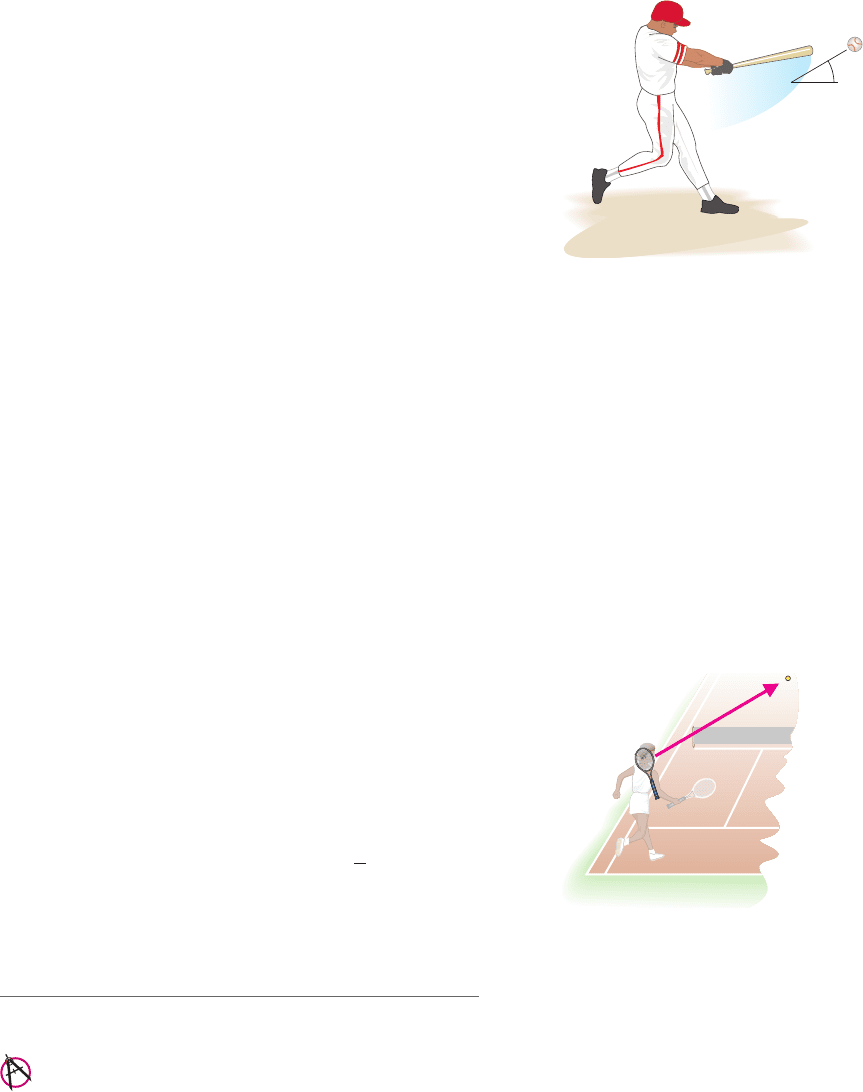
51. A baseball is hit from a height of 3 feet with initial speed
120 feet per second and at an angle of 30 degrees above the
horizontal.(a) Find a vector-valuedfunction describing the po-
sition of the ball t seconds after it is hit. (b) To be a home run,
the ball must clear a wall that is 385 feet away and 6 feet tall.
Determinewhetherthis is ahome run. (c) Repeatwith an initial
angle of 31 degrees.
30⬚
52. A baseball pitcher throws a pitch horizontally from a height of
6 feet with an initial speed of 130 feet per second. (a) Find a
vector-valued function describingthe position ofthe ball t sec-
onds after release. (b) If home plate is 60 feet away, how high
is the ball when it crosses home plate? (c) If a person drops a
ball from height 6 feet at the same time the pitcher releases the
ball, how high will the dropped ball be when the pitch crosses
home plate?
53. Atennisserveis struck horizontally fromaheightof8feetwith
initial speed 120 feet per second. (a) Find a vector function for
the position of the ball. (b) For the serve to count (be “in”), it
must clear a net that is 39 feet away and 3 feet high and must
land before the service line 60 feet away. Determine whether
this serve is in or out. (c) Repeat with an initial speed of 80
ft/s; (d) 65 ft/s.
54. A football punt is launched from the ground at an angle of 50
degreeswith an initial speed of 55 mph. (a) Compute the “hang
time” (the amount of time in the air) for the punt. (b) Compute
the extra hang time if the initial speed is increased to 60 mph.
............................................................
55. A roller coaster is designed to travel a circular loop of radius
100 feet. If the riders feel weightless at the top of the loop,
what is the speed of the roller coaster?
56. A roller coaster travels at variable angular speed ω(t) and ra-
dius r(t) but constant speed c = ω(t)r(t). For the centripetal
P1: OSO/OVY P2: OSO/OVY QC: OSO/OVY T1: OSO
MHDQ256-Ch12 MHDQ256-Smith-v1.cls December 27, 2010 20:38
LT (Late Transcendental)
CONFIRMING PAGES
12-31 SECTION 12.4
..
Curvature 779
force F(t) = mω
2
(t)r(t), show that F
(t) = mω(t)r(t)ω
(t).
Conclude that entering a tight curve with r
(t) < 0 but main-
taining constant speed, the centripetal force increases.
57. A jet pilot executinga circular turn experiencesan acceleration
of “5 g’s” (that is, a=5 g). If the jet’s speed is 900 km/hr,
what is the radius of the turn?
58. For the jet pilot of exercise 57, how many g’s would be expe-
rienced if the speed were 1800 km/hr?
59. Example 3.3 is a model of a satellite orbiting the Earth. In this
case, the force F is the gravitational attraction of the Earth on
the satellite. The magnitude of the force is
mMG
b
2
, where m is
the mass of the satellite, M is the mass of the Earth and G
is the universal gravitational constant. Using example 3.3, this
shouldbe equal to mω
2
b. Fora geosynchronous orbit, the fre-
quency ω is such that the satellite completes one orbit in one
day. (By orbiting at the same rate astheEarthspins,thesatellite
can remain directly above the same point on the Earth.) For a
sidereal day of 23 hours, 56 minutes and 4 seconds, find ω.
Using MG ≈ 39.87187 ×10
13
N-m
2
/kg, find b for a geosyn-
chronous orbit (the units of b will be m).
60. Example 3.3 can also model a jet executing a turn. For a jet
traveling at 1000 km/h, find the radius b such that the pilot
feels 7 g’s of force; that is, the magnitude of the force is 7 mg.
61. For a satellite in Earth orbit, the speed v in miles per second
is related to the height h miles above the surface of the Earth
by v =
95,600
4000+h
. Suppose a satellite is in orbit 15,000 miles
above the surface of the Earth. How much does the speed need
to decrease to raise the orbit to a height of 20,000 miles?
EXPLORATORY EXERCISES
1. A ball rolls off a table of height 3 feet. Its initial velocity is
horizontal with speed v
0
. Determine where the ball hits the
ground and the velocity vector of the ball at the moment of
impact. Find the angle between the horizontal and the impact
velocity vector. Next, assume that the next bounce of the ball
starts with the ball being launched from the ground with ini-
tial conditions determined by the impact velocity. The launch
speed equals 0.6 times the impact speed (so the ball won’t
bounce forever) and the launch angle equals the (positive) an-
gle between the horizontal and the impact velocity vector. Us-
ing these conditions, determine where the ball next hits the
ground. Continue on to find the third point at which the ball
bounces.
2. In many sports such as golf and ski jumping, it is important
to determine the range of a projectile on a slope. Suppose that
the ground passes through the origin and slopes at an angle
of α to the horizontal. Show that an equation of the ground
is y =−(tanα)x. An object is launched at height h = 0 with
initial speed v
0
at an angle of θ from the horizontal. Refer-
ring to exercise 31, show that the landing condition is now
y =−(tan α)x. Find the x-coordinate of the landing point and
show that the range (the distance along the ground) is given by
R =
2
g
v
2
0
secα cos θ (sinθ + tanα cosθ). Use trigonometric
identitiestorewritethisas R =
1
g
v
2
0
sec
2
α[sinα +sin(α +2θ)].
Usethis formulatofindthevalueofθ thatmaximizestherange.
For flat ground (α = 0), the optimal angle is 45
◦
. State an easy
way of taking the value of α (say, α = 10
◦
or α =−8
◦
) and
adjusting from 45
◦
to the optimal angle.
12.4 CURVATURE
In designing a highway, you would want to avoid curves that are too sharp, so that cars
are able to maintain a reasonable speed. To do this, it would help to have some concept
of how sharp a given curve is. In this section, we develop a measure of how much a curve
is twisting and turning at any given point. First, realize that any given curve has infinitely
many different parameterizations. For instance, for any real number a > 0, the parametric
equations x = (at)
2
and y = at describetheparabola x = y
2
.So, anymeasure ofhowsharp
acurveisshouldbe independent of theparameterization.Thesimplestchoice of a parameter
(forconceptual purposes, butnot for computational purposes) is arc length. Further,observe
that this is an ideal parameter to use, as we measure how sharp a curve is by seeing how
much it twists and turns per unit length. (Think about it this way: a turn of 90
◦
over a quarter
mile is not particularly sharp in comparison with a turn of 90
◦
over a distance of 30 feet.)
For the curve traced out by the endpoint of the vector-valued function
r(t) =f (t), g(t), h(t), for a ≤ t ≤ b, we define the arc length parameter s(t)tobethe
arc length of that portion of the curve from u = a up to u = t. That is, from (1.4),
s(t) =
t
a
[ f
(u)]
2
+ [g
(u)]
2
+ [h
(u)]
2
du.
Recognizing that
[ f
(u)]
2
+ [g
(u)]
2
+ [h
(u)]
2
=r
(u), we can write this more
simply as
s(t) =
t
a
r
(u)du. (4.1)
P1: OSO/OVY P2: OSO/OVY QC: OSO/OVY T1: OSO
MHDQ256-Ch12 MHDQ256-Smith-v1.cls December 27, 2010 20:38
LT (Late Transcendental)
CONFIRMING PAGES
780 CHAPTER 12
..
Vector-Valued Functions 12-32
Although explicitly finding an arc length parameterization of a curve is not the central
thrust of our discussion here, we briefly pause now to construct such a parameterization,
for the purpose of illustration.
EXAMPLE 4.1 Parameterizing a Curve in Terms of Arc Length
Find an arc length parameterization of the circle of radius 4 centered at the origin.
Solution Note that one parameterization of this circle is
C: x = f (t) = 4cos t, y = g(t) = 4sint, 0 ≤ t ≤ 2π.
In this case, the arc length from u = 0tou = t is given by
s(t) =
t
0
[ f
(u)]
2
+ [g
(u)]
2
du
=
t
0
[−4sin u]
2
+ [4 cosu]
2
du = 4
t
0
1du = 4t.
That is, t = s/4, so that an arc length parameterization for C is
C: x = 4cos
s
4
, y = 4 sin
s
4
, 0 ≤ s ≤ 8π.
For the smooth curve C traced out by the endpoint of the vector-valued function
r(t), recall that for each t, v(t) = r
(t) can be thought of as both the velocity vector and
a tangent vector, pointing in the direction of motion (i.e., the orientation of C). Notice
that
T(t) =
r
(t)
r
(t)
(4.2)
is also a tangent vector, but has length one (T(t)=1). We call T(t) the unit tangent
Unit tangent vector
vector to the curve C. That is, for each t, T(t) is a tangent vector of length one pointing in
the direction of the orientation of C.
EXAMPLE 4.2 Finding a Unit Tangent Vector
Find the unit tangent vector to the curve determined by r(t) =t
2
+ 1, t.
Solution We have
r
(t) =2t, 1,
so that r
(t)=
(2t)
2
+ 1 =
4t
2
+ 1.
From (4.2), the unit tangent vector is given by
T(t) =
r
(t)
r
(t)
=
2t, 1
√
4t
2
+ 1
=
2t
√
4t
2
+ 1
,
1
√
4t
2
+ 1
.
In particular, we have T(0) =0, 1 and T(1) =
2
√
5
,
1
√
5
. We indicate both of these in
Figure 12.20.
x
y
T(0)
T(1)
FIGURE 12.20
Unit tangent vectors
In Figures 12.21a and 12.21b, we showtwo curves, both connecting the points A and B.
Think about driving a car along roads in the shape of these two curves. The curve in Figure
12.21b indicates a much sharper turn than the curve in Figure 12.21a. However, how do we
mathematically describe this degree of “sharpness”? You should get an idea of this from
Figures 12.21c and 12.21d, which are identical to Figures 12.21a and 12.21b, respectively,
but with a number of unit tangent vectors drawn-in at equally spaced points on the curves.
Notice that the unit tangent vectors change very slowly along the gentle curve in Figure
12.21c, but twist and turn quite rapidly in the vicinity of the sharp curve in Figure 12.21d.
P1: OSO/OVY P2: OSO/OVY QC: OSO/OVY T1: OSO
MHDQ256-Ch12 MHDQ256-Smith-v1.cls December 30, 2010 19:29
LT (Late Transcendental)
CONFIRMING PAGES
12-33 SECTION 12.4
..
Curvature 781
The rate of change of the unit tangent vectors with respect to arc length along the curve will
then give us a measure of sharpness. To this end, we make the following definition.
z
x
y
A
B
O
z
x
y
A
B
O
FIGURE 12.21a FIGURE 12.21b
Gentle curve Sharp curve
z
x
y
A
B
O
z
x
y
A
B
O
FIGURE 12.21c FIGURE 12.21d
Unit tangent vectors Unit tangent vectors
DEFINITION 4.1
The curvature κ of a curve is the scalar quantity
κ =
dT
ds
. (4.3)
Note that, while the definition of curvature makes sense intuitively, it is not a simple
matter to compute κ directly from (4.3). To do so, we would need to first find the arc length
parameter s and the unit tangent vector T(t), rewrite T(t) in termsof s and then differentiate
with respect to s. This is not usually done. Instead, observe that by the chain rule,
T
(t) =
dT
dt
=
dT
ds
ds
dt
,
so that when
ds
dt
= 0, κ =
dT
ds
=
T
(t)
ds
dt
. (4.4)
Now, from (4.1), we had s(t) =
t
a
r
(u)du,
so that by part II of the Fundamental Theorem of Calculus,
ds
dt
=r
(t). (4.5)

P1: OSO/OVY P2: OSO/OVY QC: OSO/OVY T1: OSO
MHDQ256-Ch12 MHDQ256-Smith-v1.cls December 27, 2010 20:38
LT (Late Transcendental)
CONFIRMING PAGES
782 CHAPTER 12
..
Vector-Valued Functions 12-34
From (4.4) and (4.5), we now have
Curvature
κ =
T
(t)
r
(t)
, (4.6)
where r
(t) = 0, for a smooth curve. Notice that it should be comparatively simple to use
(4.6) to compute the curvature. We illustrate this in example 4.3.
EXAMPLE 4.3 Finding the Curvature of a Straight Line
Find the curvature of a straight line.
Solution First, think about what we’re asking. Straight lines are, well, straight, so their
curvatureshould be zero atevery point. Let’s see. Suppose that theline is traced outby the
vector-valued function r(t) =at +b, ct + d, et + f , for some constants a, b, c, d, e
and f (where at least one of a, c or e is nonzero). Then,
r
(t) =a, c, e
and so, r
(t)=
a
2
+ c
2
+ e
2
= constant = 0.
The unit tangent vector is then
T(t) =
r
(t)
r
(t)
=
a, c, e
√
a
2
+ c
2
+ e
2
,
which is a constant vector. This gives us T
(t) = 0, for all t. From (4.6), we now have
κ =
T
(t)
r
(t)
=
0
√
a
2
+ c
2
+ e
2
= 0,
as expected.
Well, if a line has zero curvature, can you think of a curve with lots of curvature? The
first one to come to mind is likely a circle, which we discuss next.
EXAMPLE 4.4 Finding the Curvature of a Circle
Find the curvature for a circle of radius a > 0.
Solution Notice that the circle of radius a centered at the point (b, c) is traced out by
the vector-valued function r(t) =a cost +b, a sint +c. Differentiating, we get
r
(t) =−a sint, a cos t
and r
(t)=
(−a sint)
2
+ (a cost)
2
= a
sin
2
t +cos
2
t = a.
The unit tangent vector is then given by
T(t) =
r
(t)
r
(t)
=
−a sint, a cos t
a
=−sint, cost.
Differentiating this gives us
T
(t) =−cost, −sin t
and from (4.6), we have
κ =
T
(t)
r
(t)
=
−cost, −sint
a
=
(−cost)
2
+ (−sin t)
2
a
=
1
a
.
In particular, note that the curvature depends only on the radius and not on the location
of the center.