
Smith R., Minton R. Calculus
Подождите немного. Документ загружается.

P1: OSO/OVY P2: OSO/OVY QC: OSO/OVY T1: OSO
MHDQ256-Ch12 MHDQ256-Smith-v1.cls December 27, 2010 20:38
LT (Late Transcendental)
CONFIRMING PAGES
12-55 SECTION 12.6
..
Parametric Surfaces 803
In exercises 17–26, find a parametric representation of the
surface.
17. z = 3x + 4y 18. x
2
+ y
2
+ z
2
= 9
19. x
2
+ y
2
− z
2
= 1 20. z
2
= x
2
+ y
2
21. The portion of x
2
+ y
2
= 4 from z = 0toz = 2
22. The portion of y
2
+ z
2
= 9 from x =−1tox = 1
23. The portion of z = 4 − x
2
− y
2
above the xy-plane
24. The portion of z = x
2
+ y
2
below z = 4
25. x
2
− y
2
− z
2
= 1 26. x = 4y
2
− z
2
............................................................
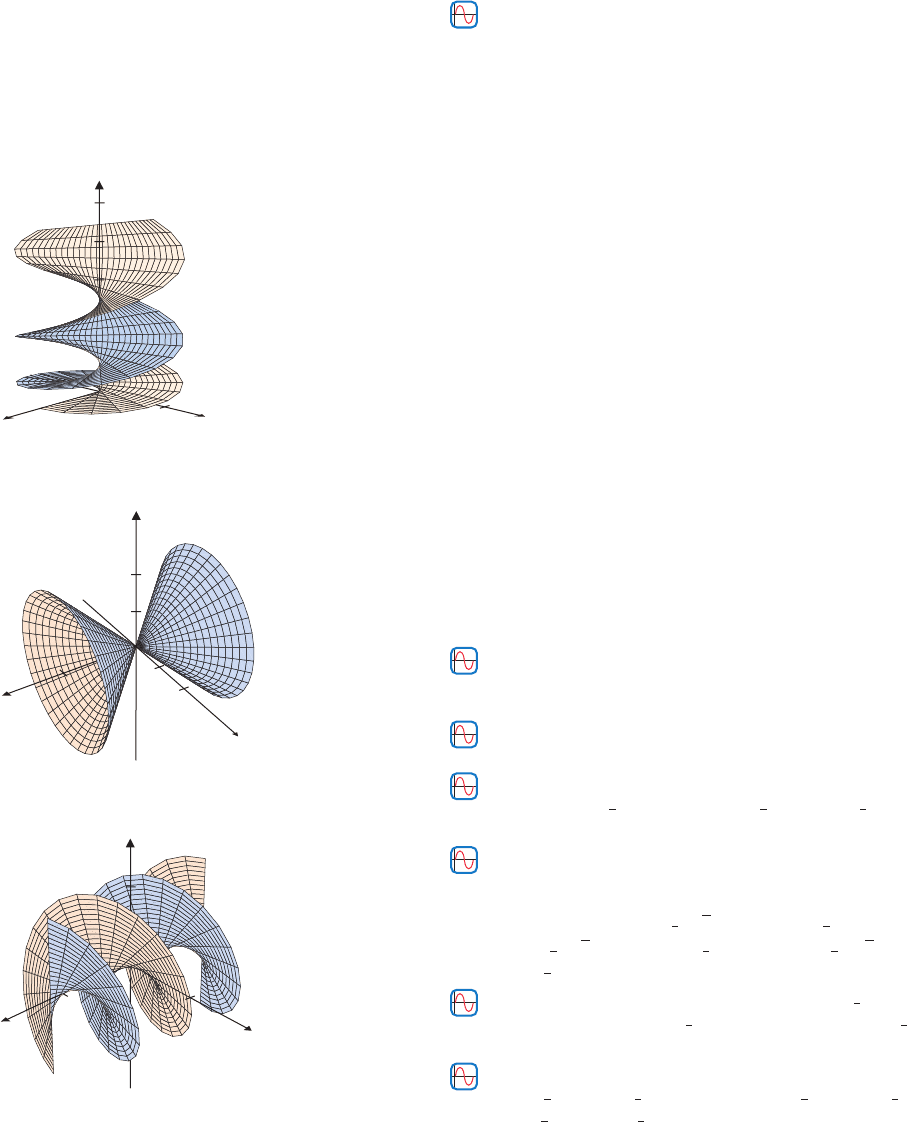
27. Match the parametric equations with the surface.
(a) x = u cosv, y = u sin v, z = v
2
(b) x = v, y = u cos v, z = u sin v
(c) x = u, y = u cos v, z = u sinv
z
y
x
100
10
10
SURFACE 1
z
y
x
4
4
4
SURFACE 2
z
x
y
4
4
4
SURFACE 3
28. Show that changing the parametric equations of example 6.1
to x = 2sinu cosv, y = 2cos u cosv and z = 2 sin v does not
change the fact that x
2
+ y
2
+ z
2
= 4.
29. To show that the surface in example 6.1 is the entire sphere
x
2
+ y
2
+ z
2
= 4, start by finding the traceof the sphere in the
plane z = k for −2 ≤ k ≤ 2. If z = 2 cosv = k, determine as
fully as possible the value of 2sin v and then determine the
trace in the plane z = k for x = 2cosu sinv, y = 2sin u sin v
and z = 2cosv. If the traces are the same, then the surfaces
are the same.
30. Investigate whether x = 2sin u cosv, y = 2cosu cosv and
z = 2 sin u also are parametric equations for the sphere
x
2
+ y
2
+ z
2
= 4. If not, use computer-generated graphs to
describe the surface.
Exercises 31–36 relate to parametric equations of a plane.
31. Sketch the plane with parametric equations x = 2 +u + 2v,
y =−1 +2u − v and z = 3 −3u + 2v. Show that the points
(2, −1, 3), (3, 1, 0) and (4, −2, 5) are on the plane by finding
thecorrect valuesof u and v. Sketchthese points along with the
plane and the displacement vectors 1, 2, −3 and 2, −1, 2.
32. Use the results of exercise 31 to find a normal vector to the
plane and an equation of the plane in terms of x, y, and z.
33. The parametric equations of exercise 31 can be written as
r =2, −1, 3+u1, 2, −3+v2, −1, 2 for r =x, y, z.
For the general equation r = r
0
+ uv
1
+ vv
2
, sketch a plane
and show how the vectors r
0
, v
1
and v
2
would relate to the
plane. In terms of v
1
and v
2
, find a normal vector to the plane.
34. Find an equation in x, y and z for the plane defined by
r =3, 1, −1+u2, −4, 1+v2, 0, 1.
35. Find parametric equations for the plane through the point
(3, 1, 1) and containing the vectors 2, −1, 3 and 4, 2, 1.
36. Find parametric equations for the plane through the point
(0, −1, 2) and containing the vectors −2, 4, 0and 3, −2, 5.
............................................................
37. Earth is approximately an oblate spheroid. Graph
a cos v cosu, a cosv sinu, b sin v with a = 7926 and
b = 7900 to see its shape.
38. A football is a prolate spheroid. Use the equations in exercise
37 with a = 2 and b = 6 to graph a football.
39. AM¨obius strip is a surface with unusual properties. Graph
(10 + v cos
u
2
)cosu, (10 +v cos
u
2
)sinu,vsin
u
2
with 0 ≤ u,
v ≤ 4π to see a M¨obius strip.
40. A Klein bottle is another surface with unusual properties.
While a true Klein bottle is a subset of four-dimensional
space, three-dimensional “immersions” help us visualize
it. Graph cosu[cos
u
2
(
√
2 + cos v) +sin
u
2
sinv cos v], sin u
[cos
u
2
(
√
2 + cos v) +sin
u
2
sinv cos v], sin
u
2
(
√
2 + cos v) +
cos
u
2
sinv cos v.
41. Graph a figure-8 torus cos u(2 +sinv cos u −
1
2
sin2v sin u),
sinu (2 + sinv cos u −
1
2
sin 2v sinu), sinu sinv +
1
2
cosu
sin2v.
42. Graph the figure-8 form of a Klein bottle cos u[4 +
cos
u
2
sinv −sin
u
2
sin2v), sinu(4+cos
u
2
sinv −sin
u
2
sin2v),
sin
u
2
sinv +cos
u
2
sin2v.

P1: OSO/OVY P2: OSO/OVY QC: OSO/OVY T1: OSO
MHDQ256-Ch12 MHDQ256-Smith-v1.cls December 27, 2010 20:38
LT (Late Transcendental)
CONFIRMING PAGES
804 CHAPTER 12
..
Vector-Valued Functions 12-56
Exercises 43–50 relate to cylindrical coordinates defined by
x r cos θ, y r sin θ and z z.
43. Sketchthe two-dimensionalpolargraphr = cos2θ .Sketchthe
solid in three dimensions defined by x = r cosθ, y = r sin θ
andz = z withr = cos 2θ and0 ≤ z ≤ 1,andcompareittothe
polar graph. Show that parametric equations for the solid are
x = cos2u cosu, y = cos2u sinu and z = v with0 ≤ u ≤ 2π
and 0 ≤ v ≤ 1.
44. Sketch the solid defined by x = (2 −2cosu) cosu,
y = (2 −2 cos u)sinu and z = v with 0 ≤ u ≤ 2π and
0 ≤ v ≤ 1. (Hint: Use polar coordinates as in exercise 43.)
45. Find parametric equations for the wedge in the first octant
bounded by y = 0, y = x, x
2
+ y
2
= 4, z = 0 and z = 1.
46. Find parametric equations for the portion of y =
√
x
2
+ z
2
to
the left of y = 5.
47. Sketch the (two-dimensional) graph of f (t) = e
−t
2
for t ≥ 0.
Sketch the surface z = e
−x
2
−y
2
and compare it to the graph
of f (t). Show that parametric equations of the surface are
x = u cosv, y = u sin v and z = e
−u
2
.
48. Sketch the surface defined by x = u cosv, y = u sin v and
z = ue
−u
2
. [Hint: Use the graph of f (t) = te
−t
2
.]
49. Find parametric equations for the surface z = sin
x
2
+ y
2
.
50. Find parametric equations for the surface z = cos(x
2
+ y
2
).
............................................................
Exercises 51–56 relate to spherical coordinates defined
by x ρ cos θ sin φ, y ρ sin θ sin φ and z ρ cos φ, where
0 ≤ ρ, 0 ≤ θ ≤ 2π and 0 ≤ φ ≤ π.
51. (a) Replace ρ with ρ = 3 and determine the surface with
parametric equations x = 3cosθ sinφ, y = 3 sin θ sin φ and
z = 3 cos φ.(b)Determinethesurfacedefinedbyρ = k,where
k is some positive constant.
52. (a) Replace φ with φ =
π
4
and determine the surface with
parametric equations x = ρ cos θ sin
π
4
, y = ρ sin θ sin
π
4
and
z = ρ cos
π
4
. (b) Replace φ with φ =
π
6
and determine
the surface with parametric equations x = ρ cos θ sin
π
6
, y =
ρ sinθ sin
π
6
and z = ρ cos
π
6
. (c) Determine the surface φ = k
for some constant k with 0 < k <π.
53. (a) Replace θ with θ =
π
4
and determine the surface with
parametric equations x = ρ cos
π
4
sinφ, y = ρ sin
π
4
sinφ and
z = ρ cos φ. (b) Replace θ with θ =
3π
4
and determine the
surface with parametric equations x = ρ cos
3π
4
sinφ, y =
ρ sin
3π
4
sinφ and z = ρ cosφ. (c) Determine the surfaceθ = k
for some constant k with 0 < k < 2π.
54. Use the results of exercises 51–53 to find parametric equations
for (a) the top half-sphere z =
9 − x
2
− y
2
and (b) the right
half-sphere y =
√
9 − x
2
− z
2
.
55. Use the results of exercises 51–53 to find parametric
equations for (a) the cone z =
x
2
+ y
2
, (b) the cone
z =−
x
2
+ y
2
, and (c) the cone z =
2(x
2
+ y
2
).
56. (a) Find parametric equations for the region that lies above
z =
x
2
+ y
2
and below x
2
+ y
2
+ z
2
= 4. (b) Find paramet-
ric equations for the sphere x
2
+ y
2
+ (z − 1)
2
= 1.
EXPLORATORY EXERCISES
1. If x = 3sinu cosv, y = 3cosu and z = 3 sin u sinv, show
that x
2
+ y
2
+ z
2
= 9. Explain why this equation doesn’t
guarantee that the parametric surface defined is the entire
sphere, but it does guarantee that all points on the surface
are also on the sphere. In this case, the parametric surface is
the entire sphere. To verify this in graphical terms, sketch
a picture showing geometric interpretations of the “spher-
ical coordinates” u and v. To see what problems can oc-
cur, sketch the surface defined by x = 3 sin
u
2
u
2
+ 1
cosv,
y = 3 cos
u
2
u
2
+ 1
and z = 3 sin
u
2
u
2
+ 1
sinv. Explain why
you do not get the entire sphere. To see a more subtle
example of the same problem, sketch the surface x =
cosu coshv, y = sinhv, z = sinu cosh v. Use identities
to show that x
2
− y
2
+ z
2
= 1 and identify the surface.
Then sketch the surface x = cos u coshv, y = cosu sinhv,
z = sin u and use identities to show that x
2
− y
2
+ z
2
= 1.
Explain why the second surface is not the entire hyper-
boloid. Explain in words and pictures exactly what the second
surface is.
2. Findparametricequationsforthesurfaceobtainedbyrevolving
(a) z = sin y about the z-axis (see exercise 49); (b) y = sin x
about the y-axis; (c) r = 2 +2 cos θ about the x-axis.
Review Exercises
WRITING EXERCISES
The following list includes terms that are defined and theorems that
arestatedin this chapter. Foreach term or theorem,(1) givea precise
definition or statement, (2) state in general terms what it means and
(3) describe the types of problems with which it is associated.
Vector-valued Tangential Normal component
function component Continuous F(x)
Tangent vector Arc length Speed
Angular velocity Velocity vector Angular momentum
Arc length Angular acceleration Principal unit normal
parameter Curvature Osculating circle
Binormal vector Radius of curvature Parametric surface
TRUE OR FALSE
State whether each statement is true or false and briefly explain
why. If the statement is false, try to “fix it” by modifying the given
statement to a new statement that is true.
P1: OSO/OVY P2: OSO/OVY QC: OSO/OVY T1: OSO
MHDQ256-Ch12 MHDQ256-Smith-v1.cls December 27, 2010 20:38
LT (Late Transcendental)
CONFIRMING PAGES
12-57 CHAPTER 12
..
Review Exercises 805
Review Exercises
1. The graph of the vector-valued function cost, sint, f (t), for
some function f lies on the circle x
2
+ y
2
= 1.
2. For vector-valued functions, derivatives are found component
by component and all of the usual rules (product, quotient,
chain) apply.
3. The derivative of a vector-valued function gives the slope of
the tangent line.
4. Newton’s laws apply only to straight-line motion and not to
rotational motion.
5. The greater the osculating circle, the greater the curvature.
6. While driving a car, the vector T would be “straight ahead,” N
in the direction you are turning and B straight up.
7. If parametric equations for a surface are x = x(u,v),
y = y(u,v) and z = z(u,v) with x
2
+ y
2
+ z
2
= 1, the sur-
face is a sphere.
In exercises 1 and 2, sketch the curve and plot the values of the
vector-valued function.
1. r(t) =t
2
, 2 −t
2
, 1, t = 0, t = 1, t = 2
2. r(t) =sin t, 2cost, 3, t =−π, t = 0, t = π
............................................................
Inexercises3–12,sketchthe curvetracedoutby the givenvector-
valued function.
3. r(t) =3 cos t + 1, sin t 4. r(t) =2sint, cost + 2
5. r(t) =3 cos t + 2 sin 3t, 3sint + 2cos3t
6. r(t) =3 cos t + sin 3t, 3sint + cos3t
7. r(t) =2 cos t, 3, 3sint 8. r(t) =3 cos t, −2, 2sint
9. r(t) =4 cos 3t + 6 cos t, 6sint, 4 sin 3t
10. r(t) =sin π t,
√
t
2
+ t
3
, cosπt
11. r(t) =tan t, 4cost, 4sint
12. r(t) =cos 5t, tant, 6sint
............................................................
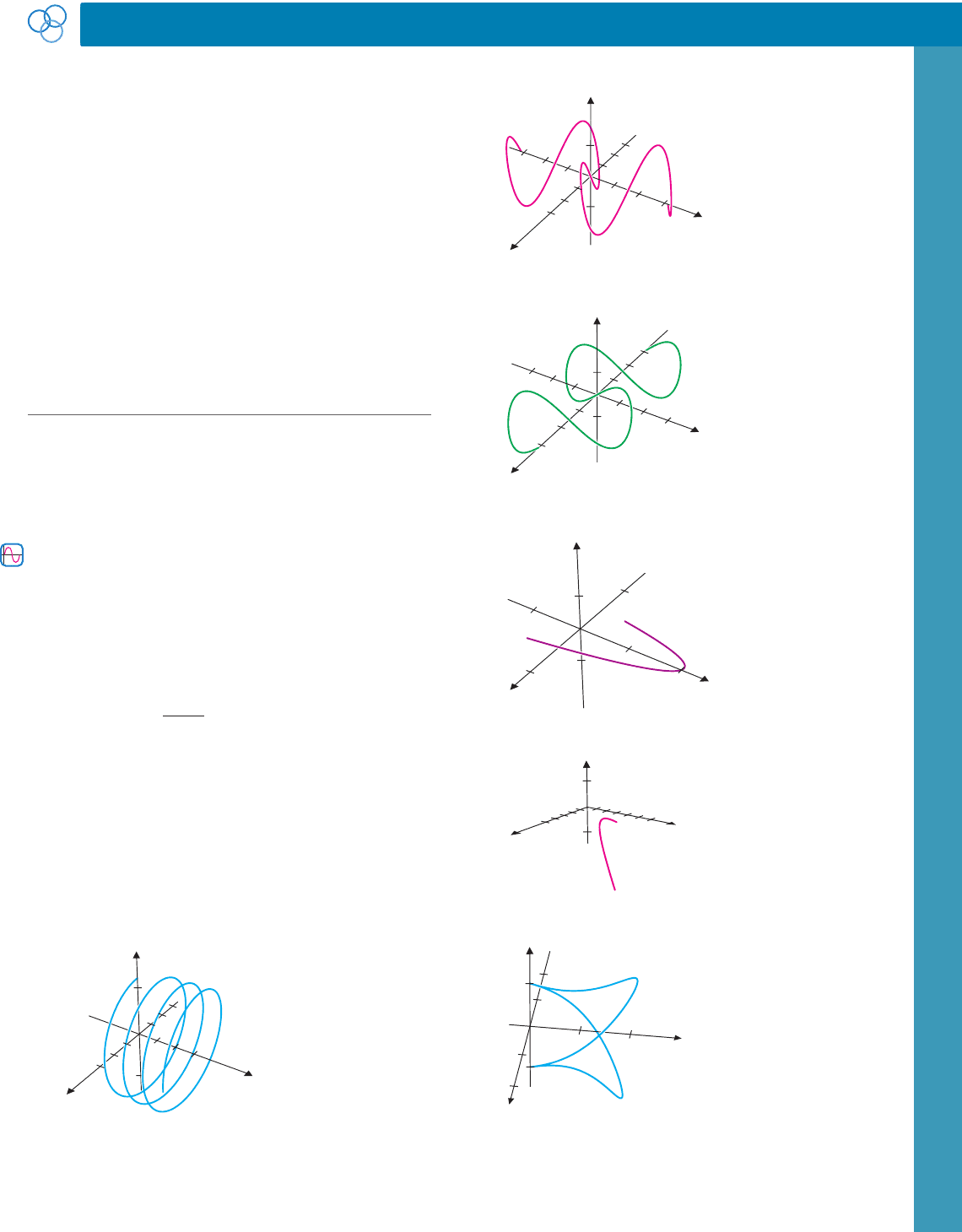
13. Inparts(a)–(f),matchthevector-valuedfunctionwithitsgraph.
(a) r(t) =sin t, t, sin 2t (b) r(t) =t, sin t, sin 2t
(c) r(t) =6 sin π t, t, 6 cos πt (d) r(t) =sin
5
t, sin
2
t, cost
(e) r(t) =cost, 1 −cos
2
t, cost
(f) r(t) =t
2
+ 1, t
2
+ 2, t − 1
y
x
5
2
2
z
GRAPH A
y
x
1
2
1
z
GRAPH B
y
x
1
1
2
z
GRAPH C
y
x
1
1
1
z
GRAPH D
y
x
z
2
1
1
GRAPH E
y
x
z
1
1
1
GRAPH F

P1: OSO/OVY P2: OSO/OVY QC: OSO/OVY T1: OSO
MHDQ256-Ch12 MHDQ256-Smith-v1.cls December 27, 2010 20:38
LT (Late Transcendental)
CONFIRMING PAGES
806 CHAPTER 12
..
Vector-Valued Functions 12-58
Review Exercises
In exercises 14–16, sketch the curve and find its arc length.
14. r(t) =cos πt, sin πt, cos 4πt, 0 ≤ t ≤ 2
15. r(t) =cos t, sint, 6t, 0 ≤ t ≤ 2π
16. r(t) =t, 4t − 1, 2 − 6t, 0 ≤ t ≤ 2
............................................................
In exercises 17 and 18, find the limit if it exists.
17. lim
t→1
t
2
− 1, e
2t
, cosπt
18. lim
t→1
e
−2t
, cscπt, t
3
− 5t
............................................................
In exercises 19 and 20, determine all values of t at which the
given vector-valued function is continuous.
19. r(t) =e
4t
, lnt
2
, 2t
20. r(t) =
sint, tan2t,
3
t
2
− 1
............................................................
In exercises 21 and 22, find the derivative of the given vector-
valued function.
21. r(t) =
√
t
2
+ 1, sin4t, ln4t
22. r(t) =te
−2t
, t
3
, 5
............................................................
In exercises 23–26, evaluate the given indefinite or definite
integral.
23.
e
−4t
,
2
t
3
, 4t − 1
dt
24.
2t
2
t
3
+ 2
,
√
t + 1
dt
25.
1
0
cosπt, 4t, 2dt
26.
2
0
e
−3t
, 6t
2
dt
............................................................
In exercises 27 and 28, find the velocity and acceleration vectors
for the given position vector.
27. r(t) =4 cos 2t, 4sin2t, 4t
28. r(t) =t
2
+ 2, 4, t
3
............................................................
In exercises 29–32, find the position vector from the given ve-
locity or acceleration vector.
29. v(t) =2t + 4, −32t, r(0) =2, 1
30. v(t) =4, t
2
− 1, r(0) =−4, 2
31. a(t) =0, −32, v(0) =4, 3, r(0) =2, 6
32. a(t) =t, e
2t
, v(0) =2, 0, r(0) =4, 0
............................................................
In exercises 33 and 34, find the force acting on an object of mass
4 with the given position vector.
33. r(t) =12t, 12 − 16t
2
34. r(t) =3 cos 2t, 2sin2t
............................................................
In exercises 35 and 36, a projectile is fired with initial speed v
0
feet per second from a height of h feet at an angle of θ above the
horizontal. Assuming that the only force acting on the object is
gravity, find the maximum altitude, horizontal range and speed
at impact.
35. v
0
= 80, h = 0,θ =
π
12
36. v
0
= 80, h = 6,θ =
π
4
............................................................
In exercises 37 and 38, find the unit tangent vector to the curve
at the indicated points.
37. r(t) =e
−2t
, 2t, 4, t = 0, t = 1
38. r(t) =2, sin πt
2
, lnt, t = 1, t = 2
............................................................
In exercises 39–42, find the curvature of the curve at the indi-
cated points.
39. r(t) =cos t, sint, sint, t = 0, t =
π
4
40. r(t) =4 cos 2t, 3sin2t, t = 0, t =
π
4
41. r(t) =4, 3t, t = 0, t = 1
42. r(t) =t
2
, t
3
, t
4
, t = 0, t = 2
............................................................
In exercises 43 and 44, find the unit tangent and principal unit
normal vectors at the given points.
43. r(t) =cos t, sint, sint at t = 0
44. r(t) =cos t, sint, sint at t =
π
2
............................................................
In exercises 45 and 46, find the tangential and normal compo-
nents of acceleration at the given points.
45. r(t) =2t, t
2
, 2 at t = 0, t = 1
46. r(t) =t
2
, 3, 2t at t = 0, t = 2
............................................................
In exercises 47 and 48, the friction force required to keep a car
from skidding on a curve is given by F
s
(t) ma
N
N(t). Find the
friction force needed to keep a car of mass m 120 (slugs) from
skidding for the given position vectors.
47. r(t) =80 cos 6t, 80sin6t
48. r(t) =80 cos 4t, 80sin4t
............................................................
P1: OSO/OVY P2: OSO/OVY QC: OSO/OVY T1: OSO
MHDQ256-Ch12 MHDQ256-Smith-v1.cls December 27, 2010 20:38
LT (Late Transcendental)
CONFIRMING PAGES
12-59 CHAPTER 12
..
Review Exercises 807
Review Exercises
In exercises 49–52, sketch a graph of the parametric surface.
49. x = 2sinu, y = v
2
, z = 3cosu
50. x = cosu sinv, y = sinu sin v, z = sinv
51. x = u
2
, y = v
2
, z = u + 2v
52. x = (3 +2cos u)cosv, y = (3 +2cosu) sin v, z = 2 cosv
............................................................
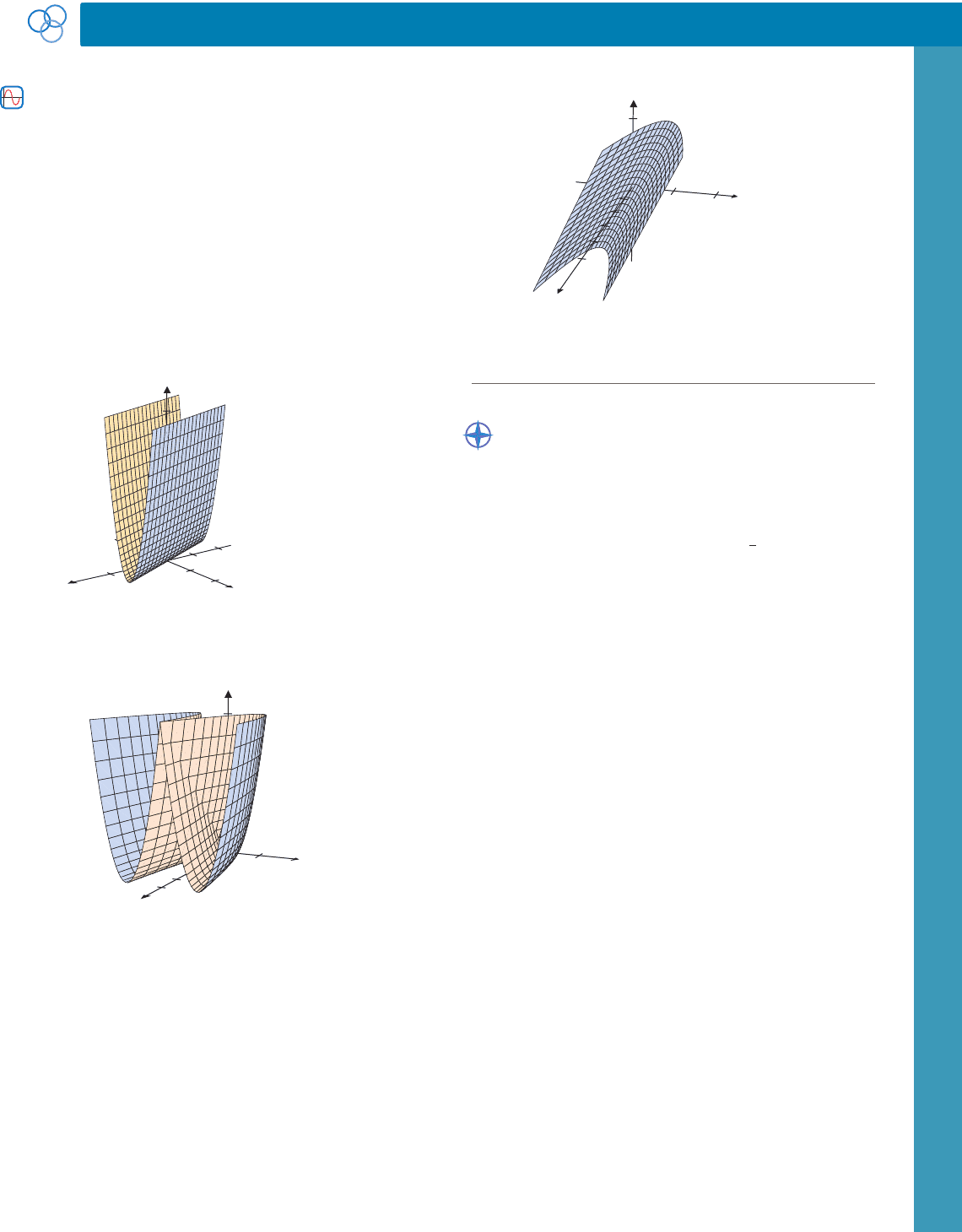
53. Match the parametric equations with the surfaces.
(a) x = u
2
, y = u + v, z = v
2
(b) x = u
2
, y = u + v, z = v
(c) x = u, y = u + v, z = v
2
z
y
x
4
10
25
SURFACE A
z
x
y
25
25
5
SURFACE B
z
x
y
4
25
5
10
SURFACE C
54. Find a parametric representation of x
2
+ y
2
+ z
2
= 16.
EXPLORATORY EXERCISES
1. Inthisthree-dimensional projectile problem,thinkofthex-axis
as pointing to the right, the y-axis as pointing straight ahead
and the z-axisas pointing up. Suppose that a projectile of mass
m = 1 kg is launched from the ground with an initial velocity
of 100 m/s in the yz-plane at an angle of
π
6
above the horizon-
tal. The spinning of the projectile produces a constant Magnus
force of 0.1, 0, 0 newtons. Find a vector for the position of
the projectile at time t ≥ 0. Assuming level ground, find the
timeofflight T fortheprojectile and findits landing place. Find
the curvature for the path of the projectile at time t ≥ 0. Find
the times of minimum and maximum curvature of the path for
0 ≤ t ≤ T .
2. A tennis serveis struck at an angle θ below the horizontal from
a height of 8 feet and with initial speed 120 feet per second.
For the serve to count (be “in”), it must clear a net that is 39
feet away and 3 feet high and must land before the service line
60 feet away. Find the range of angles for which the serveis in.
3. A baseball pitcher throws a pitch at an angle θ below the
horizontal from a height of 6 feet with an initial speed of 130
feet per second. Home plate is 60 feet away. For the pitch to
be a strike, the ball must cross home plate between 20
and
42
above the ground. Find the range of angles for which the
pitch will be a strike.
This page intentionally left blank

P1: OSO/OVY P2: OSO/OVY QC: OSO/OVY T1: OSO
MHDQ256-Ch13 MHDQ256-Smith-v1.cls December 31, 2010 16:55
LT (Late Transcendental)
CONFIRMING PAGES
CHAPTER
13
Functions of Several Variables
and Partial Differentiation
When a golf star like Lorena Ochoa hits a long drive over water, most
spectators have several seconds of suspense as the ball reaches its peak
height and then slowly drops back to the ground. Will the ball land safely
close to the hole or fall into a bad situation in the water or tall grass?
While professional golfers can often tell with some precision where their
ball will land, most spectators must wait for the ball to land to know if
the shot has gone the perfect distance.
Think for a moment about all of the factors that determine how far
a golf ball travels. In our studies of projectile motion, we identified three
forces that affect a ball’s path: gravity, air drag and the Magnus force
(caused by the spinning of the ball). Given the initial velocity (both the
initial speed and the angle that the ball’s path makes with the ground) and
the initial spin, we can write down a differential equation whose solution
gives us distance as a function of initial speed, angle and spin. In this
chapter, we introduce some of the basic techniques needed to analyze
functions like this of two or more variables.
You have probably realized that the flight of a golf ball is actually
far more complicated than outlined here. For instance, air drag depends
on environmental factors such as temperature and humidity, which would
needto be accounted for in a more complete model. Also,thedesignofthedimples
on the golf ball can reduce or increase the drag. Withall of these factors, we might
need a function of ten or more variables. Fortunately, the calculus of functions of
10 variables is very similar to the calculus of functions of two or three variables.
The theory presented in this chapter is easily extended to as many variables as
needed in a particular application.
13.1 FUNCTIONS OF SEVERAL VARIABLES
The first ten chapters of this book focused on functions f (x) whose domain and
range were subsets of the real numbers. In Chapter 12, we studied vector-valued
functions F(t) whose domain is a subset of the real numbers, but whose range
is a set of vectors in two or more dimensions. In this section, we consider func-
tions that depend on more than one variable, that is, functions whose domain is
multidimensional.
Afunction of two variables isarulethatassignsarealnumber f (x, y) toeach
ordered pair of real numbers (x, y) in the domain of the function. For a function f
defined on the domain D ⊂ R
2
, we sometimes write f: D ⊂ R
2
→ R, to indicate
that f maps points in two dimensions to real numbers. You may think of such a
function as a rule whose input is a pair of real numbers and whose output is a
single real number. For instance, f (x, y) = xy
2
and g(x, y) = x
2
− e
y
are both
functions of the two variables x and y.
809
P1: OSO/OVY P2: OSO/OVY QC: OSO/OVY T1: OSO
MHDQ256-Ch13 MHDQ256-Smith-v1.cls December 31, 2010 16:55
LT (Late Transcendental)
CONFIRMING PAGES
810 CHAPTER 13
..
Functions of Several Variables and Partial Differentiation 13-2
Likewise, a function of three variables is a rule that assigns a real number f (x, y, z)
to each ordered triple of real numbers (x, y, z) in the domain D ⊂ R
3
of the function.
We sometimes write f : D ⊂ R
3
→ R to indicate that f maps points in three dimensions
to real numbers. For instance, f (x, y, z) = xy
2
cos z and g(x, y, z) = 3zx
2
− e
y
are both
functions of the three variables x, y and z.
Wecan similarly definefunctions of four (or five or more) variables,although our focus
here is on functions of two and three variables.
Unless specifically stated otherwise, the domain of a function of several variables is
taken to be the set of all values of the variables for which the given expression is defined.
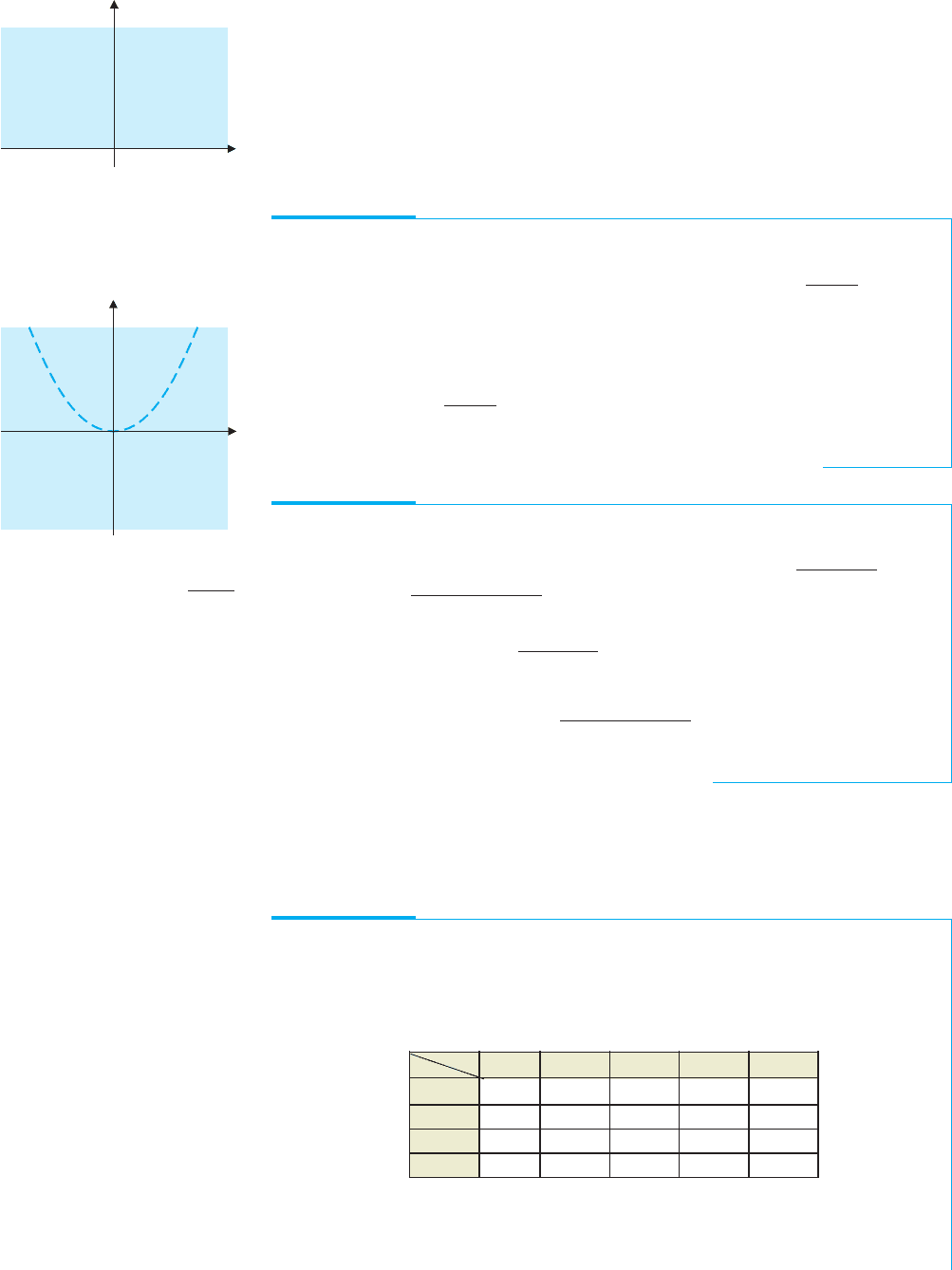
y
x
FIGURE 13.1a
The domain of f (x, y) = x ln y
y
x
y x
2
FIGURE 13.1b
The domain of g(x, y) =
2x
y − x
2
EXAMPLE 1.1 Finding the Domain of a Function of Two Variables
Find and sketch the domain for (a) f (x, y) = x ln y and (b) g(x, y) =
2x
y − x
2
.
Solution (a) For f (x, y) = x ln y, recall that ln y is defined only for y > 0. The
domain of f is then the set D ={(x, y)|y > 0}, that is, the half-plane lying above the
x-axis. (See Figure 13.1a.)
(b) For g(x, y) =
2x
y − x
2
, note that g is defined unless there is a division by zero,
which occurs when y − x
2
= 0. The domain of g is then {(x, y)|y = x
2
}, which is the
entire xy-plane with the parabola y = x
2
removed. (See Figure 13.1b.)
EXAMPLE 1.2 Finding the Domain of a Function of Three Variables
Find and describe in graphical terms the domains of (a) f (x, y, z) =
cos(x + z)
xy
and
(b) g(x, y, z) =
9 − x
2
− y
2
− z
2
.
Solution (a) For f (x, y, z) =
cos(x + z)
xy
, there is a division by zero if xy = 0, which
occurs if x = 0ory = 0. The domain is then {(x, y, z)|x = 0 and y = 0}, which is all
of three-dimensional space, excluding the yz-plane (x = 0) and the xz-plane (y = 0).
(b) Notice that for g(x, y, z) =
9 − x
2
− y
2
− z
2
to be defined, you’ll need to
have 9 − x
2
− y
2
− z
2
≥ 0, or x
2
+ y
2
+ z
2
≤ 9. The domain of g is then the sphere of
radius 3 centered at the origin, together with its interior.
In many applications, you won’t have a formula representing a function of interest.
Rather, you may know values of the function at only a relatively small number of points,
as in example 1.3.
EXAMPLE 1.3 A Function Defined by a Table of Data
A computer simulation of the flight of a baseball provided the data displayed in the
accompanying table for the range in feet of a ball hit with initial velocity v ft/s
and backspin rate of ω rpm. Each ball is struck at an angle of 30
◦
above the horizontal.
v
ω
0 1000 2000 3000 4000
150 294 312 333 350 367
160 314 334 354 373 391
170 335 356 375 395 414
180 355 376 397 417 436
Range of baseball in feet
Thinking of the range as a function R(v, ω), find R(180, 0), R(160, 0), R(160, 4000)
and R(160, 2000). Discuss the results in baseball terms.
P1: OSO/OVY P2: OSO/OVY QC: OSO/OVY T1: OSO
MHDQ256-Ch13 MHDQ256-Smith-v1.cls December 31, 2010 16:55
LT (Late Transcendental)
CONFIRMING PAGES
13-3 SECTION 13.1
..
Functions of Several Variables 811
Solution The function values are found by looking in the row with the given value of
v and the column with the given value of ω. Thus, R(180, 0) = 355, R(160, 0) = 314,
R(160, 4000) =391 and R(160, 2000) = 354. This says that a ball with no backspin and
initial velocity 180 ft/s flies 41 ft farther than one with initial velocity 160 ft/s (no
surprise there). However, observe that if a 160 ft/s ball also has backspin of 4000 rpm, it
actually flies 36 ft farther than the 180 ft/s ball with no backspin. (The backspin gives
the ball a lift force that keeps it in the air longer.) The combination of 160 ft/s and 2000
rpm produces almost exactly the same distance as 180 ft/s with no spin. (Watts and
Bahill estimate that hitting the ball
1
4
below center produces 2000 rpm.) Thus, both
initial velocity and spin have significant effects on the distance the ball flies.
y
x
z
5
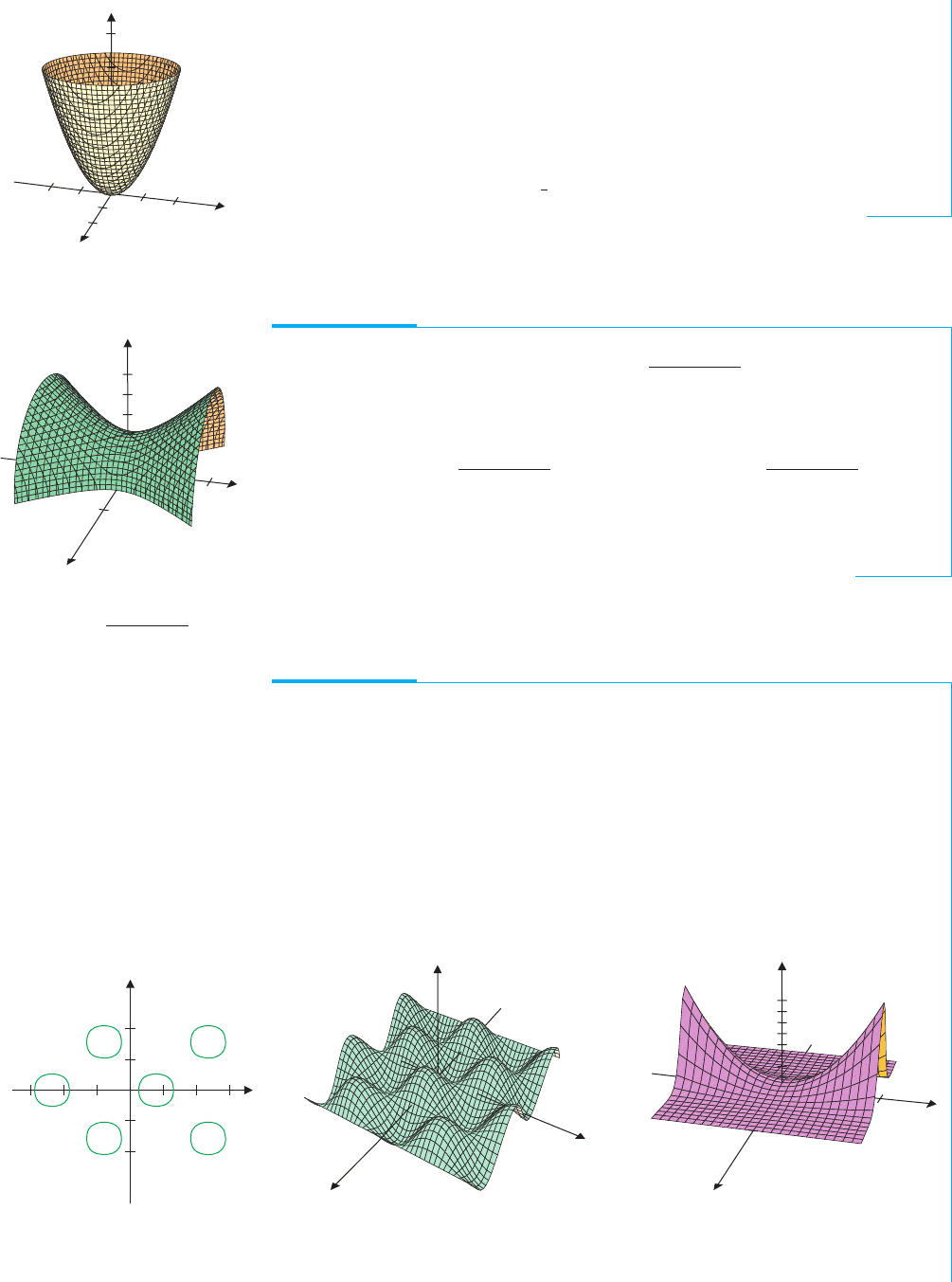
2
2
FIGURE 13.2a
z = x
2
+ y
2
The graph of the function f (x, y) is the graph of the equation z = f (x, y). This is not
new, as you have already graphed a number of quadric surfaces that represent functions of
two variables.
EXAMPLE 1.4 Graphing Functions of Two Variables
Graph (a) f (x, y) = x
2
+ y
2
and (b) g(x, y) =
4 − x
2
+ y
2
.
Solution (a) For f (x, y) = x
2
+ y
2
, you may recognize the surface z = x
2
+ y
2
as a
circular paraboloid. Notice that the traces in the planes z = k > 0 are circles, while the
traces in the planes x = k and y = k are parabolas. A graph is shown in Figure 13.2a.
(b) For g(x, y) =
4 − x
2
+ y
2
, note that the surface z =
4 − x
2
+ y
2
is the top
half of the surface z
2
= 4 − x
2
+ y
2
or x
2
− y
2
+ z
2
= 4. Here, observe that the traces
in the planes x = k and z = k are hyperbolas, while the traces in the planes y = k are
circles. This gives us a hyperboloid of one sheet, wrapped around the y-axis. The graph
of z = g(x, y) is the top half of the hyperboloid, as shown in Figure 13.2b.
y
x
z
5
4
4
FIGURE 13.2b
z =
4 − x
2
+ y
2
Recall from your earlier experience drawing surfaces in three dimensions that an
analysis of traces is helpful in sketching many graphs.
EXAMPLE 1.5 Graphing Functions in Three Dimensions
Graph (a) f (x, y) = sin x cos y and (b) g(x, y) = e
−x
2
(y
2
+ 1).
Solution (a) For f (x, y) = sin x cos y, notice that the traces in the planes y = k are
the sine curves z = sin x cos k, while its traces in the planes x = k are the cosine curves
z = sink cos y. The traces in the planes z = k are the curves k = sin x cos y. These are
a bit more unusual, as seen in Figure 13.3a (which is computer-generated) for k = 0.5.
The surface should look like a sine wave in multiple directions, as shown in the
computer-generated plot in Figure 13.3b.
6
422
2
2
4
4
6
4
y
x
z
y
x
y
x
z
8
16
4
4
FIGURE 13.3a
The traces of the surface
z = sin x cos y in the plane z = 0.5
FIGURE 13.3b
z = sin x cos y
FIGURE 13.3c
z = e
−x
2
(y
2
+ 1)
P1: OSO/OVY P2: OSO/OVY QC: OSO/OVY T1: OSO
MHDQ256-Ch13 MHDQ256-Smith-v1.cls December 31, 2010 16:55
LT (Late Transcendental)
CONFIRMING PAGES
812 CHAPTER 13
..
Functions of Several Variables and Partial Differentiation 13-4
(b) For g(x, y) = e
−x
2
(y
2
+ 1), observe that the traces of the surface in the planes
x = k are parabolic, while the traces in the planes y = k are proportional to z = e
−x
2
,
which are bell-shaped curves. The traces in the planes z = k are not particularly helpful
here. A sketch of the surface is shown in Figure 13.3c (on the preceding page).
Graphing functions of more than one variable is not a simple business. For most
functions of two variables, you must take hints from the expressions and try to piece
together the clues to identify the surface. Your knowledge of functions of one variable is
critical here.
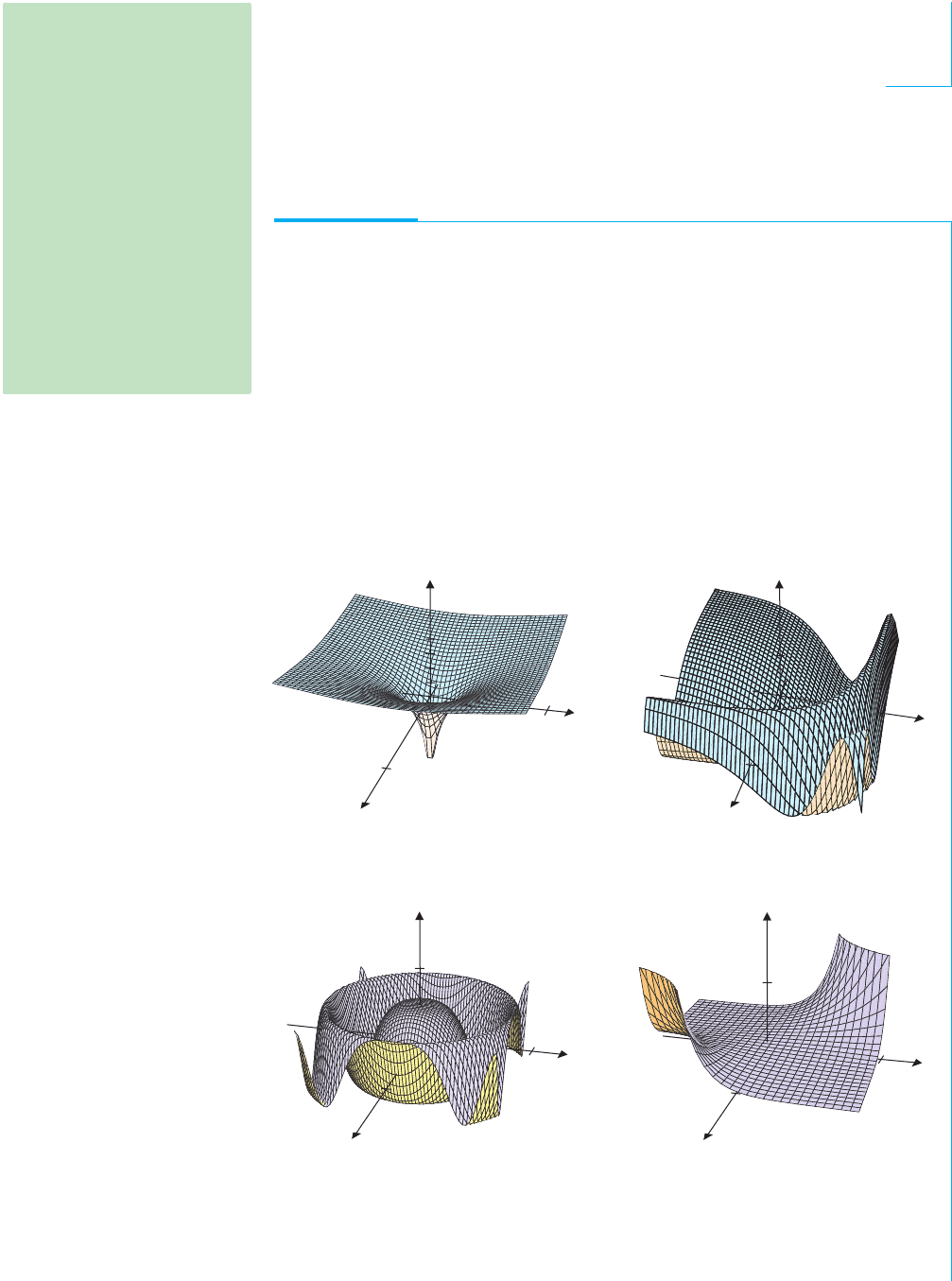
EXAMPLE 1.6 Matching a Function of Two Variables to Its Graph
Match the functions f
1
(x, y) = cos(x
2
+ y
2
), f
2
(x, y) = cos(e
x
+ e
y
),
f
3
(x, y) = ln(x
2
+ y
2
) and f
4
(x, y) = e
−xy
to the surfaces shown in Figures
13.4a–13.4d.
Solution There are two properties of f
1
(x, y) that you should immediately notice.
First, since the cosine of any angle lies between −1 and 1, z = f
1
(x, y) must always lie
between −1 and 1. Second, the expression x
2
+ y
2
is significant. Given any value of r,
and any point (x, y) on the circle x
2
+ y
2
= r
2
, the height of the surface at the point
(x, y) is a constant, given by z = f
1
(x, y) = cos(r
2
). Look for a surface that is bounded
(this rules out Figure 13.4a) and has circular cross sections parallel to the xy-plane
(ruling out Figures 13.4b and 13.4d). That leaves Figure 13.4c for the graph of
z = f
1
(x, y).
NOTES
You may be tempted to use
computer-generated graphs
throughout this chapter. However,
we must emphasize that our
goal is an understanding of
three-dimensional graphs, which
can best be obtained by sketching
many graphs by hand. Doing this
will help you know whether a
computer-generated graph is
accurate or misleading. Even
when you use a graphing utility
to produce a three-dimensional
graph, we urge you to think
through the traces, as we do in
example 1.5.
y
x
z
4
5
4
2
y
x
z
2
1
FIGURE 13.4a FIGURE 13.4b
y
x
z
3
2
y
x
z
12
2
2
FIGURE 13.4c FIGURE 13.4d
You should notice that y = f
3
(x, y) also has circular cross sections parallel to the
xy-plane, again because of the expression x
2
+ y
2
. (Think of polar coordinates.)
Another important property of f
3
for you to recognize is that the logarithm tends to −∞