
Thomas M. Cover, Joy A. Thomas. Elements of information theory
Подождите немного. Документ загружается.


11.2 LAW OF LARGE NUMBERS 355
by Theorem 11.1.2. Using the bounds on |T(P)| derived in Theorem
11.1.3, we have
1
(n + 1)
|X |
2
−nD(P ||Q)
≤ Q
n
(T (P )) ≤ 2
−nD(P ||Q)
. (11.58)
We can summarize the basic theorems concerning types in four equa-
tions:
|
P
n
|≤(n + 1)
|X |
, (11.59)
Q
n
(x) = 2
−n(D(P
x
||Q)+H(P
x
))
, (11.60)
|T(P)|
.
= 2
nH (P )
, (11.61)
Q
n
(T (P ))
.
= 2
−nD(P ||Q)
. (11.62)
These equations state that there are only a polynomial number of types
and that there are an exponential number of sequences of each type. We
also have an exact formula for the probability of any sequence of type P
under distribution Q and an approximate formula for the probability of a
type class.
These equations allow us to calculate the behavior of long sequences
based on the properties of the type of the sequence. For example, for
long sequences drawn i.i.d. according to some distribution, the type of
the sequence is close to the distribution generating the sequence, and we
can use the properties of this distribution to estimate the properties of the
sequence. Some of the applications that will be dealt with in the next few
sections are as follows:
•
The law of large numbers
•
Universal source coding
•
Sanov’s theorem
•
The Chernoff–Stein lemma and hypothesis testing
•
Conditional probability and limit theorems
11.2 LAW OF LARGE NUMBERS
The concept of type and type classes enables us to give an alternative
statement of the law of large numbers. In fact, it can be used as a proof
of a version of the weak law in the discrete case. The most important
property of types is that there are only a polynomial number of types, and

356 INFORMATION THEORY AND STATISTICS
an exponential number of sequences of each type. Since the probability
of each type class depends exponentially on the relative entropy distance
between the type P and the distribution Q, type classes that are far from
the true distribution have exponentially smaller probability.
Given an >0, we can define a typical set T
Q
of sequences for the
distribution Q
n
as
T
Q
={x
n
: D(P
x
n
||Q) ≤ }. (11.63)
Then the probability that x
n
is not typical is
1 − Q
n
(T
Q
) =
P :D(P ||Q)>
Q
n
(T (P )) (11.64)
≤
P :D(P ||Q)>
2
−nD(P ||Q)
(Theorem 11.1.4) (11.65)
≤
P :D(P ||Q)>
2
−n
(11.66)
≤ (n + 1)
|X |
2
−n
(Theorem 11.1.1) (11.67)
= 2
−n
−|X |
log(n+1)
n
, (11.68)
which goes to 0 as n →∞. Hence, the probability of the typical set T
Q
goes to 1 as n →∞. This is similar to the AEP proved in Chapter 3,
which is a form of the weak law of large numbers. We now prove that
the empirical distribution P
X
n
converges to P .
Theorem 11.2.1 Let X
1
,X
2
,...,X
n
be i.i.d. ∼ P(x).Then
Pr
{
D(P
x
n
||P) >
}
≤ 2
−n(−|X |
log(n+1)
n
)
, (11.69)
and consequently, D(P
x
n
||P) → 0 with probability 1.
Proof: The inequality (11.69) was proved in (11.68). Summing over n,
we find that
∞
n=1
Pr{D(P
x
n
||P) > } < ∞. (11.70)

11.3 UNIVERSAL SOURCE CODING 357
Thus, the expected number of occurrences of the event {D(P
x
n
||P) > }
for all n is finite, which implies that the actual number of such occur-
rences is also finite with probability 1 (Borel–Cantelli lemma). Hence
D(P
x
n
||P) → 0 with probability 1.
We now define a stronger version of typicality than in Chapter 3.
Definition We define the strongly typical set A
∗(n)
to be the set of
sequences in
X
n
for which the sample frequencies are close to the true
values:
A
∗(n)
=
x ∈
X
n
:
1
n
N(a|x) − P(a)
<
|X |
, if P(a) > 0
N(a|x) = 0ifP(a) = 0
.
(11.71)
Hence, the typical set consists of sequences whose type does not differ
from the true probabilities by more than /|
X| in any component. By the
strong law of large numbers, it follows that the probability of the strongly
typical set goes to 1 as n →∞. The additional power afforded by strong
typicality is useful in proving stronger results, particularly in universal
coding, rate distortion theory, and large deviation theory.
11.3 UNIVERSAL SOURCE CODING
Huffman coding compresses an i.i.d. source with a known distribution
p(x) to its entropy limit H(X). However, if the code is designed for
some incorrect distribution q(x), a penalty of D(p||q) is incurred. Thus,
Huffman coding is sensitive to the assumed distribution.
What compression can be achieved if the true distribution p(x) is
unknown? Is there a universal code of rate R, say, that suffices to describe
every i.i.d. source with entropy H(X) < R? The surprising answer is yes.
The idea is based on the method of types. There are 2
nH (P )
sequences of
type P . Since there are only a polynomial number of types with denom-
inator n, an enumeration of all sequences x
n
with type P
x
n
such that
H(P
x
n
)<R will require roughly nR bits. Thus, by describing all such
sequences, we are prepared to describe any sequence that is likely to arise
from any distribution Q having entropy H(Q) < R. We begin with a
definition.
Definition A fixed-rate block code of rate R for a source X
1
,X
2
,...,
X
n
which has an unknown distribution Q consists of two mappings: the
encoder,
f
n
: X
n
→{1, 2,...,2
nR
}, (11.72)

358 INFORMATION THEORY AND STATISTICS
and the decoder,
φ
n
: {1, 2,...,2
nR
}→X
n
. (11.73)
Here R is called the rate of the code. The probability of error for the
code with respect to the distribution Q is
P
(n)
e
= Q
n
(X
n
: φ
n
(f
n
(X
n
)) = X
n
) (11.74)
Definition ArateR block code for a source will be called universal
if the functions f
n
and φ
n
do not depend on the distribution Q and if
P
(n)
e
→ 0asn →∞if R>H(Q).
We now describe one such universal encoding scheme, due to Csisz
´
ar
and K
¨
orner [149], that is based on the fact that the number of sequences
of type P increases exponentially with the entropy and the fact that there
are only a polynomial number of types.
Theorem 11.3.1 There exists a sequence of (2
nR
,n) universal source
codes such that P
(n)
e
→ 0 for every source Q such that H(Q) < R.
Proof: Fix the rate R for the code. Let
R
n
= R −|X|
log(n + 1)
n
. (11.75)
Consider the set of sequences
A ={x ∈
X
n
: H(P
x
) ≤ R
n
}. (11.76)
Then
|A|=
P ∈P
n
:H(P)≤R
n
|T(P)| (11.77)
≤
P ∈P
n
:H(P)≤R
n
2
nH (P )
(11.78)
≤
P ∈P
n
:H(P)≤R
n
2
nR
n
(11.79)
≤ (n + 1)
|X |
2
nR
n
(11.80)
= 2
n(R
n
+|X |
log(n+1)
n
)
(11.81)
= 2
nR
. (11.82)
11.3 UNIVERSAL SOURCE CODING 359
By indexing the elements of A, we define the encoding function f
n
as
f
n
(x) =
index of x in A if x ∈ A,
0otherwise.
(11.83)
The decoding function maps each index onto the corresponding element
of A. Hence all the elements of A are recovered correctly, and all the
remaining sequences result in an error. The set of sequences that are
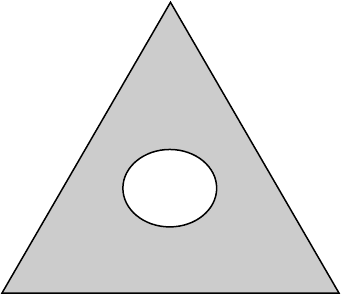
recovered correctly is illustrated in Figure 11.2.
We now show that this encoding scheme is universal. Assume that the
distribution of X
1
,X
2
,...,X
n
is Q and H(Q) < R. Then the probability
of decoding error is given by
P
(n)
e
= 1 −Q
n
(A) (11.84)
=
P :H(P)>R
n
Q
n
(T (P )) (11.85)
≤ (n + 1)
|X |
max
P :H(P)>R
n
Q
n
(T (P )) (11.86)
≤ (n + 1)
|X |
2
−n min
P :H(P)>R
n
D(P ||Q)
. (11.87)
Since R
n
↑ R and H(Q) < R, there exists n
0
such that for all n ≥ n
0
,
R
n
>H(Q). Then for n ≥ n
0
,min
P :H(P)>R
n
D(P ||Q) must be greater
than 0, and the probability of error P
(n)
e
converges to 0 exponentially fast
as n →∞.
H
(
P
) =
R
A
FIGURE 11.2. Universal code and the probability simplex. Each sequence with type that
lies outside the circle is encoded by its index. There are fewer than 2
nR
such sequences.
Sequences with types within the circle are encoded by 0.
360 INFORMATION THEORY AND STATISTICS
Error exponent
H
(
Q
) Rate of code
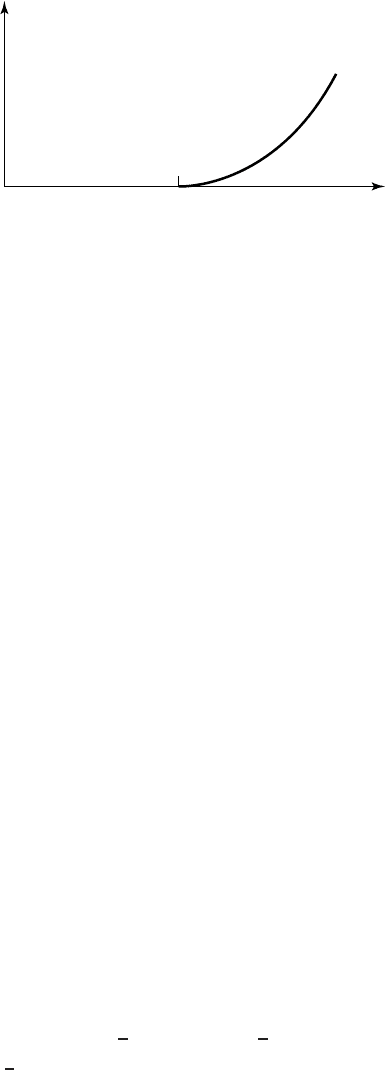
FIGURE 11.3. Error exponent for the universal code.
On the other hand, if the distribution Q is such that the entropy H(Q)
is greater than the rate R, then with high probability the sequence will
have a type outside the set A. Hence, in such cases the probability of
error is close to 1.
The exponent in the probability of error is
D
∗
R,Q
= min
P :H(P)>R
D(P ||Q), (11.88)
which is illustrated in Figure 11.3.
The universal coding scheme described here is only one of many such
schemes. It is universal over the set of i.i.d. distributions. There are other
schemes, such as the Lempel–Ziv algorithm, which is a variable-rate uni-
versal code for all ergodic sources. The Lempel–Ziv algorithm, discussed
in Section 13.4, is often used in practice to compress data that cannot be
modeled simply, such as English text or computer source code.
One may wonder why it is ever necessary to use Huffman codes, which
are specific to a probability distribution. What do we lose in using a
universal code? Universal codes need a longer block length to obtain
the same performance as a code designed specifically for the probability
distribution. We pay the penalty for this increase in block length by the
increased complexity of the encoder and decoder. Hence, a distribution
specific code is best if one knows the distribution of the source.
11.4 LARGE DEVIATION THEORY
The subject of large deviation theory can be illustrated by an example.
What is the probability that
1
n
X
i
is near
1
3
if X
1
,X
2
,...,X
n
are drawn
i.i.d. Bernoulli(
1
3
)? This is a small deviation (from the expected outcome)

11.4 LARGE DEVIATION THEORY 361
and the probability is near 1. Now what is the probability that
1
n
X
i
is greater than
3
4
given that X
1
,X
2
,...,X
n
are Bernoulli(
1
3
)? This is
a large deviation, and the probability is exponentially small. We might
estimate the exponent using the central limit theorem, but this is a poor
approximation for more than a few standard deviations. We note that
1
n
X
i
=
3
4
is equivalent to P
x
= (
1
4
,
3
4
). Thus, the probability that X
n
is
near
3
4
is the probability that type P
X
is near (
3
4
,
1
4
). The probability of
this large deviation will turn out to be ≈ 2
−nD((
3
4
,
1
4
)||(
1
3
,
2
3
))
. In this section
we estimate the probability of a set of nontypical types.
Let E be a subset of the set of probability mass functions. For example,
E may be the set of probability mass functions with mean µ. With a slight
abuse of notation, we write
Q
n
(E) = Q
n
(E ∩ P
n
) =
x:P
x
∈E∩P
n
Q
n
(x). (11.89)
If E contains a relative entropy neighborhood of Q, then by the weak
law of large numbers (Theorem 11.2.1), Q
n
(E) → 1. On the other hand,
if E does not contain Q or a neighborhood of Q,thenbytheweaklaw
of large numbers, Q
n
(E) → 0 exponentially fast. We will use the method
of types to calculate the exponent.
Let us first give some examples of the kinds of sets E that we are
considering. For example, assume that by observation we find that the
sample average of g(X) is greater than or equal to α [i.e.,
1
n
i
g(x
i
) ≥ α].
This event is equivalent to the event P
X
∈ E ∩ P
n
,where
E =
P :
a∈X
g(a)P (a) ≥ α
, (11.90)
because
1
n
n
i=1
g(x
i
) ≥ α ⇔
a∈X
P
X
(a)g(a) ≥ α (11.91)
⇔ P
X
∈ E ∩ P
n
. (11.92)
Thus,
Pr
1
n
n
i=1
g(X
i
) ≥ α
= Q
n
(E ∩ P
n
) = Q
n
(E). (11.93)
362 INFORMATION THEORY AND STATISTICS
P
*
Q
E
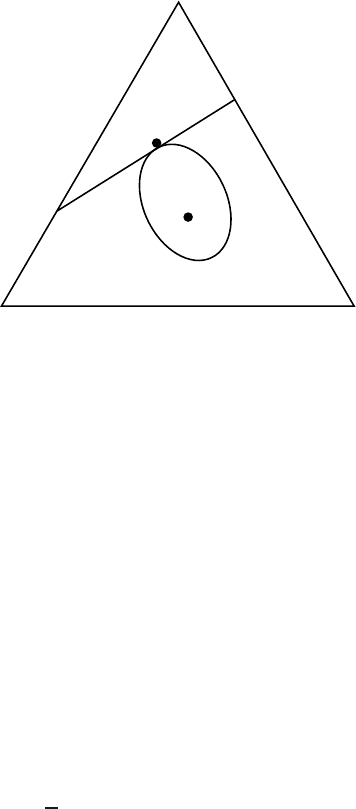
FIGURE 11.4. Probability simplex and Sanov’s theorem.
Here E is a half space in the space of probability vectors, as illustrated
in Figure 11.4.
Theorem 11.4.1 (Sanov’s theorem) Let X
1
,X
2
,...,X
n
be i.i.d.
∼ Q(x).LetE ⊆
P be a set of probability distributions. Then
Q
n
(E) = Q
n
(E ∩ P
n
) ≤ (n + 1)
|X |
2
−nD(P
∗
||Q)
, (11.94)
where
P
∗
= arg min
P ∈E
D(P ||Q) (11.95)
is the distribution in E that is closest to Q in relative entropy.
If, in addition, the set E is the closure of its interior, then
1
n
log Q
n
(E) →−D(P
∗
||Q). (11.96)
Proof: We first prove the upper bound:
Q
n
(E) =
P ∈E∩P
n
Q
n
(T (P )) (11.97)
≤
P ∈E∩P
n
2
−nD(P ||Q)
(11.98)

11.4 LARGE DEVIATION THEORY 363
≤
P ∈E∩P
n
max
P ∈E∩P
n
2
−nD(P ||Q)
(11.99)
=
P ∈E∩P
n
2
−n min
P ∈E∩P
n
D(P ||Q)
(11.100)
≤
P ∈E∩P
n
2
−n min
P ∈E
D(P ||Q)
(11.101)
=
P ∈E∩P
n
2
−nD(P
∗
||Q)
(11.102)
≤ (n + 1)
|X |
2
−nD(P
∗
||Q)
, (11.103)
where the last inequality follows from Theorem 11.1.1. Note that P
∗
need
not be a member of
P
n
. We now come to the lower bound, for which we
need a “nice” set E, so that for all large n, we can find a distribution in
E ∩
P
n
that is close to P
∗
. If we now assume that E is the closure of its
interior (thus, the interior must be nonempty), then since ∪
n
P
n
is dense
in the set of all distributions, it follows that E ∩
P
n
is nonempty for all
n ≥ n
0
for some n
0
. We can then find a sequence of distributions P
n
such
that P
n
∈ E ∩ P
n
and D(P
n
||Q) → D(P
∗
||Q). For each n ≥ n
0
,
Q
n
(E) =
P ∈E∩P
n
Q
n
(T (P )) (11.104)
≥ Q
n
(T (P
n
)) (11.105)
≥
1
(n + 1)
|X |
2
−nD(P
n
||Q)
. (11.106)
Consequently,
lim inf
1
n
log Q
n
(E) ≥ lim inf
−
|
X|log(n + 1)
n
− D(P
n
||Q)
=−D(P
∗
||Q). (11.107)
Combining this with the upper bound establishes the theorem.
This argument can be extended to continuous distributions using quan-
tization.

364 INFORMATION THEORY AND STATISTICS
11.5 EXAMPLES OF SANOV’S THEOREM
Suppose that we wish to find Pr{
1
n
n
i=1
g
j
(X
i
) ≥ α
j
,j = 1, 2,...,k}.
Then the set E is defined as
E =
P :
a
P(a)g
j
(a) ≥ α
j
,j = 1, 2,...,k
. (11.108)
To find the closest distribution in E to Q, we minimize D(P ||Q) subject
to the constraints in (11.108). Using Lagrange multipliers, we construct
the functional
J(P) =
x
P(x)log
P(x)
Q(x)
+
i
λ
i
x
P(x)g
i
(x) + ν
x
P(x).
(11.109)
We then differentiate and calculate the closest distribution to Q to be of
the form
P
∗
(x) =
Q(x)e
i
λ
i
g
i
(x)
a∈X
Q(a)e
i
λ
i
g
i
(a)
, (11.110)
where the constants λ
i
are chosen to satisfy the constraints. Note that if
Q is uniform, P
∗
is the maximum entropy distribution. Verification that
P
∗
is indeed the minimum follows from the same kinds of arguments as
given in Chapter 12.
Let us consider some specific examples:
Example 11.5.1 (Dice) Suppose that we toss a fair die n times; what
is the probability that the average of the throws is greater than or equal
to 4? From Sanov’s theorem, it follows that
Q
n
(E)
.
= 2
−nD(P
∗
||Q)
, (11.111)
where P
∗
minimizes D(P ||Q) over all distributions P that satisfy
6
i=1
iP(i) ≥ 4. (11.112)