
Thomas M. Cover, Joy A. Thomas. Elements of information theory
Подождите немного. Документ загружается.


11.7 HYPOTHESIS TESTING 375
theorem states that the first few elements are asymptotically independent
with common distribution P
∗
.
Example 11.6.2 As an example of the conditional limit theorem, let us
consider the case when n fair dice are rolled. Suppose that the sum of the
outcomes exceeds 4n. Then by the conditional limit theorem, the proba-
bility that the first die shows a number a ∈{1, 2,...,6} is approximately
P
∗
(a),whereP
∗
(a) is the distribution in E that is closest to the uni-
form distribution, where E ={P :
P(a)a ≥ 4}. This is the maximum
entropy distribution given by
P
∗
(x) =
2
λx
6
i=1
2
λi
, (11.173)
with λ chosen so that
iP
∗
(i) = 4 (see Chapter 12). Here P
∗
is the
conditional distribution on the first (or any other) die. Apparently, the
first few dice inspected will behave as if they are drawn independently
according to an exponential distribution.
11.7 HYPOTHESIS TESTING
One of the standard problems in statistics is to decide between two alter-
native explanations for the data observed. For example, in medical testing,
one may wish to test whether or not a new drug is effective. Similarly, a
sequence of coin tosses may reveal whether or not the coin is biased.
These problems are examples of the general hypothesis-testing problem.
In the simplest case, we have to decide between two i.i.d. distributions.
The general problem can be stated as follows:
Problem 11.7.1 Let X
1
,X
2
,...,X
n
be i.i.d. ∼ Q(x). We consider two
hypotheses:
•
H
1
: Q = P
1
.
•
H
2
: Q = P
2
.
Consider the general decision function g(x
1
,x
2
,...,x
n
),whereg(x
1
,
x
2
,...,x
n
) = 1 means that H
1
is accepted and g(x
1
,x
2
,...,x
n
) = 2
means that H
2
is accepted. Since the function takes on only two val-
ues, the test can also be specified by specifying the set A over which
g(x
1
,x
2
,...,x
n
) is 1; the complement of this set is the set where
g(x
1
,x
2
,...,x
n
) has the value 2. We define the two probabilities of error:
α = Pr(g(X
1
,X
2
,...,X
n
) = 2|H
1
true) = P
n
1
(A
c
) (11.174)

376 INFORMATION THEORY AND STATISTICS
and
β = Pr(g(X
1
,X
2
,...,X
n
) = 1|H
2
true) = P
n
2
(A). (11.175)
In general, we wish to minimize both probabilities, but there is a trade-
off. Thus, we minimize one of the probabilities of error subject to a
constraint on the other probability of error. The best achievable error
exponent in the probability of error for this problem is given by the
Chernoff–Stein lemma.
We first prove the Neyman–Pearson lemma, which derives the form of
the optimum test between two hypotheses. We derive the result for discrete
distributions; the same results can be derived for continuous distributions
as well.
Theorem 11.7.1 (Neyman–Pearson lemma) Let X
1
,X
2
,...,X
n
be
drawn i.i.d. according to probability mass function Q. Consider the deci-
sion problem corresponding to hypotheses Q = P
1
vs. Q = P
2
.ForT ≥ 0,
define a region
A
n
(T ) =
x
n
:
P
1
(x
1
,x
2
,...,x
n
)
P
2
(x
1
,x
2
,...,x
n
)
>T
. (11.176)
Let
α
∗
= P
n
1
(A
c
n
(T )), β
∗
= P
n
2
(A
n
(T )) (11.177)
be the corresponding probabilities of error corresponding to decision re-
gion A
n
.LetB
n
be any other decision re gion with associated probabilities
of error α and β.Ifα ≤ α
∗
,thenβ ≥ β
∗
.
Proof: Let A = A
n
(T ) be the region defined in (11.176) and let B ⊆ X
n
be any other acceptance region. Let φ
A
and φ
B
be the indicator func-
tions of the decision regions A and B, respectively. Then for all x =
(x
1
,x
2
,...,x
n
) ∈ X
n
,
(
φ
A
(x) − φ
B
(x)
)(
P
1
(x) − TP
2
(x)
)
≥ 0. (11.178)
This can be seen by considering separately the cases x ∈ A and x /∈ A.
Multiplying out and summing this over the entire space, we obtain
0 ≤
(φ
A
P
1
− Tφ
A
P
2
− P
1
φ
B
+ TP
2
φ
B
) (11.179)

11.7 HYPOTHESIS TESTING 377
=
A
(P
1
− TP
2
) −
B
(P
1
− TP
2
) (11.180)
= (1 −α
∗
) − Tβ
∗
− (1 − α) + Tβ (11.181)
= T(β− β
∗
) − (α
∗
− α). (11.182)
Since T ≥ 0, we have proved the theorem.
The Neyman–Pearson lemma indicates that the optimum test for two
hypotheses is of the form
P
1
(X
1
,X
2
,...,X
n
)
P
2
(X
1
,X
2
,...,X
n
)
>T. (11.183)
This is the likelihood ratio test and the quantity
P
1
(X
1
,X
2
,...,X
n
)
P
2
(X
1
,X
2
,...,X
n
)
is called the
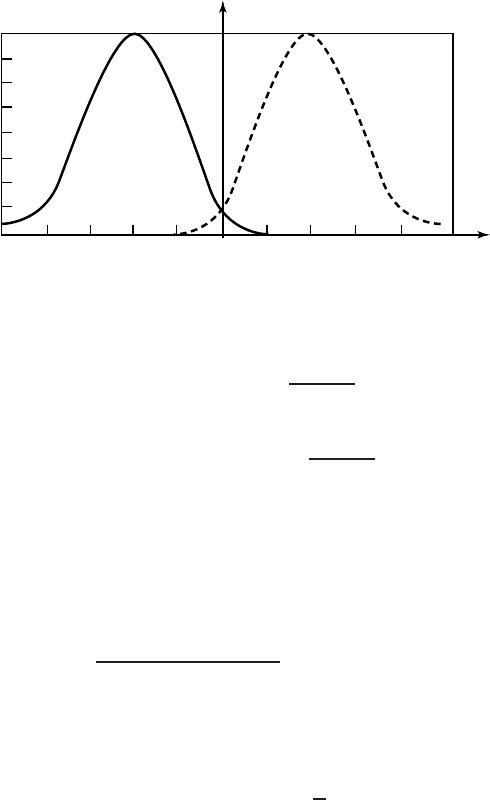
likelihood ratio. For example, in a test between two Gaussian distributions
[i.e., between f
1
= N(1,σ
2
) and f
2
= N(−1,σ
2
)], the likelihood ratio
becomes
f
1
(X
1
,X
2
,...,X
n
)
f
2
(X
1
,X
2
,...,X
n
)
=
n
i=1
1
√
2πσ
2
e
−
(X
i
−1)
2
2σ
2
n
i=1
1
√
2πσ
2
e
−
(X
i
+1)
2
2σ
2
(11.184)
= e
+
2
n
i=1
X
i
σ
2
(11.185)
= e
+
2nX
n
σ
2
. (11.186)
Hence, the likelihood ratio test consists of comparing the sample mean
X
n
with a threshold. If we want the two probabilities of error to be equal,
we should set T = 1. This is illustrated in Figure 11.8.
In Theorem 11.7.1 we have shown that the optimum test is a likelihood
ratio test. We can rewrite the log-likelihood ratio as
L(X
1
,X
2
,...,X
n
) = log
P
1
(X
1
,X
2
,...,X
n
)
P
2
(X
1
,X
2
,...,X
n
)
(11.187)
=
n
i=1
log
P
1
(X
i
)
P
2
(X
i
)
(11.188)
=
a∈X
nP
X
n
(a) log
P
1
(a)
P
2
(a)
(11.189)
=
a∈X
nP
X
n
(a) log
P
1
(a)
P
2
(a)
P
X
n
(a)
P
X
n
(a)
(11.190)
378 INFORMATION THEORY AND STATISTICS
0.35
0.3
0.25
0.2
0.15
0.1
0.05
0
−4
−3 −2 −1
0 1 2 3 4 5
x
−5
0.4
f
(
x
)
f
(
x
)
FIGURE 11.8. Testing between two Gaussian distributions.
=
a∈X
nP
X
n
(a) log
P
X
n
(a)
P
2
(a)
−
a∈X
nP
X
n
(a) log
P
X
n
(a)
P
1
(a)
(11.191)
= nD(P
X
n
||P
2
) − nD(P
X
n
||P
1
), (11.192)
the difference between the relative entropy distances of the sample type
to each of the two distributions. Hence, the likelihood ratio test
P
1
(X
1
,X
2
,...,X
n
)
P
2
(X
1
,X
2
,...,X
n
)
>T (11.193)
is equivalent to
D(P
X
n
||P
2
) − D(P
X
n
||P
1
)>
1
n
log T. (11.194)
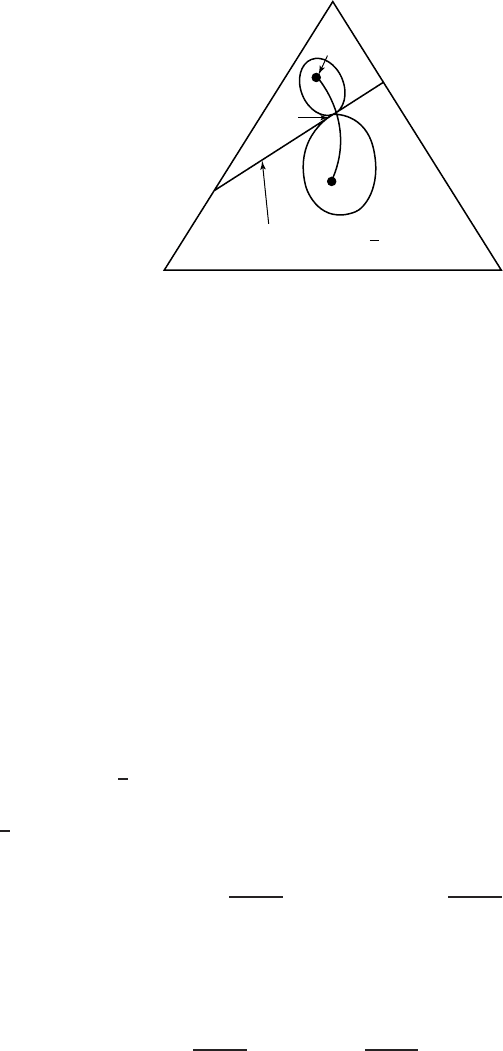
We can consider the test to be equivalent to specifying a region of the sim-
plex of types that corresponds to choosing hypothesis H
1
. The optimum
region is of the form (11.194), for which the boundary of the region is the
set of types for which the difference between the distances is a constant.
This boundary is the analog of the perpendicular bisector in Euclidean
geometry. The test is illustrated in Figure 11.9.
We now offer some informal arguments based on Sanov’s theorem to
show how to choose the threshold to obtain different probabilities of error.
Let B denote the set on which hypothesis 1 is accepted. The probability
11.7 HYPOTHESIS TESTING 379
P
2
D
(
P
||
P
1
) =
D
(
P
||
P
2
) = log
T
P
l
P
1
1
n
FIGURE 11.9. Likelihood ratio test on the probability simplex.
of error of the first kind is
α
n
= P
n
1
(P
X
n
∈ B
c
). (11.195)
Since the set B
c
is convex, we can use Sanov’s theorem to show that the
probability of error is determined essentially by the relative entropy of
the closest member of B
c
to P
1
. Therefore,
α
n
.
= 2
−nD(P
∗
1
||P
1
)
, (11.196)
where P
∗
1
is the closest element of B
c
to distribution P
1
. Similarly,
β
n
.
= 2
−nD(P
∗
2
||P
2
)
, (11.197)
where P
∗
2
is the closest element in B to the distribution P
2
.
Now minimizing D(P ||P
2
) subject to the constraint D(P ||P
2
) −
D(P ||P
1
) ≥
1
n
log T will yield the type in B that is closest to P
2
.Set-
ting up the minimization of D(P ||P
2
) subject to D(P||P
2
) − D(P||P
1
) =
1
n
log T using Lagrange multipliers, we have
J(P) =
P(x)log
P(x)
P
2
(x)
+ λ
P(x)log
P
1
(x)
P
2
(x)
+ ν
P(x).
(11.198)
Differentiating with respect to P(x) and setting to 0, we have
log
P(x)
P
2
(x)
+ 1 + λ log
P
1
(x)
P
2
(x)
+ ν = 0. (11.199)

380 INFORMATION THEORY AND STATISTICS
Solving this set of equations, we obtain the minimizing P of the form
P
∗
2
= P
λ
∗
=
P
λ
1
(x)P
1−λ
2
(x)
a∈X
P
λ
1
(a)P
1−λ
2
(a)
, (11.200)
where λ is chosen so that D(P
λ
∗
||P
1
) − D(P
λ
∗
||P
2
) =
1
n
log T .
From the symmetry of expression (11.200), it is clear that P
∗
1
= P
∗
2
and
that the probabilities of error behave exponentially with exponents given
by the relative entropies D(P
∗
||P
1
) and D(P
∗
||P
2
). Also note from the
equation that as λ → 1,P
λ
→ P
1
and as λ → 0,P
λ
→ P
2
.Thecurve
that P
λ
traces out as λ varies is a geodesic in the simplex. Here P
λ
is a
normalized convex combination, where the combination is in the exponent
(Figure 11.9).
In the next section we calculate the best error exponent when one of
the two types of error goes to zero arbitrarily slowly (the Chernoff–Stein
lemma). We will also minimize the weighted sum of the two probabilities
of error and obtain the Chernoff information bound.
11.8 CHERNOFF–STEIN LEMMA
We consider hypothesis testing in the case when one of the probabili-
ties of error is held fixed and the other is made as small as possible.
We will show that the other probability of error is exponentially small,
with an exponential rate equal to the relative entropy between the two
distributions. The method of proof uses a relative entropy version of the
AEP.
Theorem 11.8.1 (AEP for relative entropy) Let X
1
,X
2
,...,X
n
be
a sequence of random variables drawn i.i.d. according to P
1
(x), and let
P
2
(x) be any other distribution on X.Then
1
n
log
P
1
(X
1
,X
2
,...,X
n
)
P
2
(X
1
,X
2
,...,X
n
)
→ D(P
1
||P
2
) in probability. (11.201)
Proof: This follows directly from the weak law of large numbers.
1
n
log
P
1
(X
1
,X
2
,...,X
n
)
P
2
(X
1
,X
2
,...,X
n
)
=
1
n
log
n
i=1
P
1
(X
i
)
n
i=1
P
2
(X
i
)
(11.202)

11.8 CHERNOFF–STEIN LEMMA 381
=
1
n
n
i=1
log
P
1
(X
i
)
P
2
(X
i
)
(11.203)
→ E
P
1
log
P
1
(X)
P
2
(X)
in probability (11.204)
= D(P
1
||P
2
). (11.205)
Just as for the regular AEP, we can define a relative entropy typical
sequence as one for which the empirical relative entropy is close to its
expected value.
Definition For a fixed n and >0, a sequence (x
1
,x
2
,...,x
n
) ∈ X
n
is said to be relative entropy typical if and only if
D(P
1
||P
2
) − ≤
1
n
log
P
1
(x
1
,x
2
,...,x
n
)
P
2
(x
1
,x
2
,...,x
n
)
≤ D(P
1
||P
2
) + . (11.206)
The set of relative entropy typical sequences is called the relative entropy
typical set A
(n)
(P
1
||P
2
).
As a consequence of the relative entropy AEP, we can show that the
relative entropy typical set satisfies the following properties:
Theorem 11.8.2
1. For (x
1
,x
2
,...,x
n
) ∈ A
(n)
(P
1
||P
2
),
P
1
(x
1
,x
2
,...,x
n
)2
−n(D(P
1
||P
2
)+)
≤ P
2
(x
1
,x
2
,...,x
n
)
≤ P
1
(x
1
,x
2
,...,x
n
)2
−n(D(P
1
||P
2
)−)
. (11.207)
2. P
1
(A
(n)
(P
1
||P
2
)) > 1 − ,forn sufficiently large.
3. P
2
(A
(n)
(P
1
||P
2
)) < 2
−n(D(P
1
||P
2
)−)
.
4. P
2
(A
(n)
(P
1
||P
2
)) > (1 −)2
−n(D(P
1
||P
2
)+)
,forn sufficiently large.
Proof: The proof follows the same lines as the proof of Theorem 3.1.2,
with the counting measure replaced by probability measure P
2
. The proof
of property 1 follows directly from the definition of the relative entropy
382 INFORMATION THEORY AND STATISTICS
typical set. The second property follows from the AEP for relative entropy
(Theorem 11.8.1). To prove the third property, we write
P
2
(A
(n)
(P
1
||P
2
)) =
x
n
∈A
(n)
(P
1
||P
2
)
P
2
(x
1
,x
2
,...,x
n
) (11.208)
≤
x
n
∈A
(n)
(P
1
||P
2
)
P
1
(x
1
,x
2
,...,x
n
)2
−n(D(P
1
||P
2
)−)
(11.209)
= 2
−n(D(P
1
||P
2
)−)
x
n
∈A
(n)
(P
1
||P
2
)
P
1
(x
1
,x
2
,...,x
n
) (11.210)
= 2
−n(D(P
1
||P
2
)−)
P
1
(A
(n)
(P
1
||P
2
)) (11.211)
≤ 2
−n(D(P
1
||P
2
)−)
, (11.212)
where the first inequality follows from property 1, and the second inequal-
ity follows from the fact that the probability of any set under P
1
is less
than 1.
To prove the lower bound on the probability of the relative entropy
typical set, we use a parallel argument with a lower bound on the proba-
bility:
P
2
(A
(n)
(P
1
||P
2
)) =
x
n
∈A
(n)
(P
1
||P
2
)
P
2
(x
1
,x
2
,...,x
n
) (11.213)
≥
x
n
∈A
(n)
(P
1
||P
2
)
P
1
(x
1
,x
2
,...,x
n
)2
−n(D(P
1
||P
2
)+)
(11.214)
= 2
−n(D(P
1
||P
2
)+)
x
n
∈A
(n)
(P
1
||P
2
)
P
1
(x
1
,x
2
,...,x
n
) (11.215)
= 2
−n(D(P
1
||P
2
)+)
P
1
(A
(n)
(P
1
||P
2
)) (11.216)
≥ (1 −)2
−n(D(P
1
||P
2
)+)
, (11.217)
where the second inequality follows from the second property of A
(n)
(P
1
||P
2
).
With the standard AEP in Chapter 3, we also showed that any set that
has a high probability has a high intersection with the typical set, and
therefore has about 2
nH
elements. We now prove the corresponding result
for relative entropy.

11.8 CHERNOFF–STEIN LEMMA 383
Lemma 11.8.1 Let B
n
⊂ X
n
be any set of sequences x
1
,x
2
,...,x
n
such
that P
1
(B
n
)>1 − .LetP
2
be any other distribution such that D(P
1
||P
2
)
< ∞.ThenP
2
(B
n
)>(1 −2)2
−n(D(P
1
||P
2
)+)
.
Proof: For simplicity, we will denote A
(n)
(P
1
||P
2
) by A
n
.SinceP
1
(B
n
)
> 1 − and P(A
n
)>1 − (Theorem 11.8.2), we have, by the union of
events bound, P
1
(A
c
n
∪ B
c
n
)<2, or equivalently, P
1
(A
n
∩ B
n
)>1 −2.
Thus,
P
2
(B
n
) ≥ P
2
(A
n
∩ B
n
) (11.218)
=
x
n
∈A
n
∩B
n
P
2
(x
n
) (11.219)
≥
x
n
∈A
n
∩B
n
P
1
(x
n
)2
−n(D(P
1
||P
2
)+)
(11.220)
= 2
−n(D(P
1
||P
2
)+)
x
n
∈A
n
∩B
n
P
1
(x
n
) (11.221)
= 2
−n(D(P
1
||P
2
)+)
P
1
(A
n
∩ B
n
) (11.222)
≥ 2
−n(D(P
1
||P
2
)+)
(1 − 2), (11.223)
where the second inequality follows from the properties of the relative
entropy typical sequences (Theorem 11.8.2) and the last inequality follows
from the union bound above.
We now consider the problem of testing two hypotheses, P
1
vs. P
2
.We
hold one of the probabilities of error fixed and attempt to minimize the
other probability of error. We show that the relative entropy is the best
exponent in probability of error.
Theorem 11.8.3 (Chernoff–Stein Lemma) Let X
1
,X
2
,...,X
n
be
i.i.d. ∼ Q. Consider the hypothesis test between two alternatives, Q = P
1
and Q = P
2
,whereD(P
1
||P
2
)<∞.LetA
n
⊆ X
n
be an acceptance
region for hypothesis H
1
. Let the probabilities of error be
α
n
= P
n
1
(A
c
n
), β
n
= P
n
2
(A
n
). (11.224)
and for 0 <<
1
2
, define
β
n
= min
A
n
⊆ X
n
α
n
<
β
n
. (11.225)

384 INFORMATION THEORY AND STATISTICS
Then
lim
n→∞
1
n
log β
n
=−D(P
1
||P
2
). (11.226)
Proof: We prove this theorem in two parts. In the first part we exhibit
a sequence of sets A
n
for which the probability of error β
n
goes expo-
nentially to zero as D(P
1
||P
2
). In the second part we show that no other
sequence of sets can have a lower exponent in the probability of error.
For the first part, we choose as the sets A
n
= A
(n)
(P
1
||P
2
). As proved in
Theorem 11.8.2, this sequence of sets has P
1
(A
c
n
)<for n large enough.
Also,
lim
n→∞
1
n
log P
2
(A
n
) ≤−(D(P
1
||P
2
) − ) (11.227)
from property 3 of Theorem 11.8.2. Thus, the relative entropy typical set
satisfies the bounds of the lemma.
To show that no other sequence of sets can to better, consider any
sequence of sets B
n
with P
1
(B
n
)>1 −. By Lemma 11.8.1, we have
P
2
(B
n
)>(1 − 2)2
−n(D(P
1
||P
2
)+)
, and therefore
lim
n→∞
1
n
log P
2
(B
n
)>−(D(P
1
||P
2
) + ) + lim
n→∞
1
n
log(1 − 2)
=−(D(P
1
||P
2
) + ). (11.228)
Thus, no other sequence of sets has a probability of error exponent better
than D(P
1
||P
2
). Thus, the set sequence A
n
= A
(n)
(P
1
||P
2
) is asymptoti-
cally optimal in terms of the exponent in the probability.
Not that the relative entropy typical set, although asymptotically opti-
mal (i.e., achieving the best asymptotic rate), is not the optimal set for
any fixed hypothesis-testing problem. The optimal set that minimizes the
probabilities of error is that given by the Neyman–Pearson lemma.
11.9 CHERNOFF INFORMATION
We have considered the problem of hypothesis testing in the classical
setting, in which we treat the two probabilities of error separately. In the
derivation of the Chernoff–Stein lemma, we set α
n
≤ and achieved
β
n
.
= 2
−nD
. But this approach lacks symmetry. Instead, we can fol-
low a Bayesian approach, in which we assign prior probabilities to both