
Thomas M. Cover, Joy A. Thomas. Elements of information theory
Подождите немного. Документ загружается.

11.9 CHERNOFF INFORMATION 385
hypotheses. In this case we wish to minimize the overall probability of
error given by the weighted sum of the individual probabilities of error.
The resulting error exponent is the Chernoff information.
The setup is as follows: X
1
,X
2
,...,X
n
i.i.d. ∼ Q.Wehavetwo
hypotheses: Q = P
1
with prior probability π
1
and Q = P
2
with prior
probability π
2
. The overall probability of error is
P
(n)
e
= π
1
α
n
+ π
2
β
n
. (11.229)
Let
D
∗
= lim
n→∞
−
1
n
log min
A
n
⊆X
n
P
(n)
e
. (11.230)
Theorem 11.9.1 (Chernoff ) The best achievable exponent in the
Bayesian probability of error is D
∗
,where
D
∗
= D(P
λ
∗
||P
1
) = D(P
λ
∗
||P
2
), (11.231)
with
P
λ
=
P
λ
1
(x)P
1−λ
2
(x)
a∈X
P
λ
1
(a)P
1−λ
2
(a)
, (11.232)
and λ
∗
the value of λ such that
D(P
λ
∗
||P
1
) = D(P
λ
∗
||P
2
). (11.233)
Proof: The basic details of the proof were given in Section 11.8. We
have shown that the optimum test is a likelihood ratio test, which can be
considered to be of the form
D(P
X
n
||P
2
) − D(P
X
n
||P
1
)>
1
n
log T. (11.234)
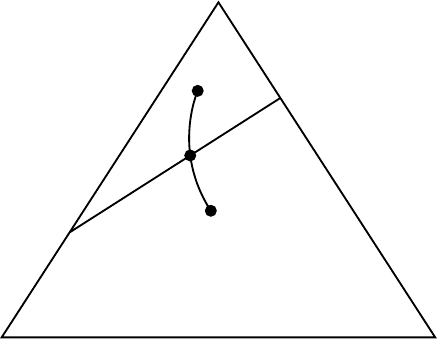
The test divides the probability simplex into regions corresponding to
hypothesis 1 and hypothesis 2, respectively. This is illustrated in Fig-
ure 11.10.
Let A be the set of types associated with hypothesis 1. From the dis-
cussion preceding (11.200), it follows that the closest point in the set A
c
to P
1
is on the boundary of A and is of the form given by (11.232). Then
from the discussion in Section 11.8, it is clear that P
λ
is the distribution
386 INFORMATION THEORY AND STATISTICS
P
1
P
2
P
l
FIGURE 11.10. Probability simplex and Chernoff information.
in A that is closest to P
2
; it is also the distribution in A
c
that is closest
to P
1
. By Sanov’s theorem, we can calculate the associated probabilities
of error,
α
n
= P
n
1
(A
c
)
.
= 2
−nD(P
λ
∗
||P
1
)
(11.235)
and
β
n
= P
n
2
(A)
.
= 2
−nD(P
λ
∗
||P
2
)
. (11.236)
In the Bayesian case, the overall probability of error is the weighted sum
of the two probabilities of error,
P
e
.
= π
1
2
−nD(P
λ
||P
1
)
+ π
2
2
−nD(P
λ
||P
2
)
.
= 2
−n min{D(P
λ
||P
1
),D(P
λ
||P
2
)}
,
(11.237)
since the exponential rate is determined by the worst exponent. Since
D(P
λ
||P
1
) increases with λ and D(P
λ
||P
2
) decreases with λ, the maxi-
mum value of the minimum of {D(P
λ
||P
1
), D(P
λ
||P
2
)} is attained when
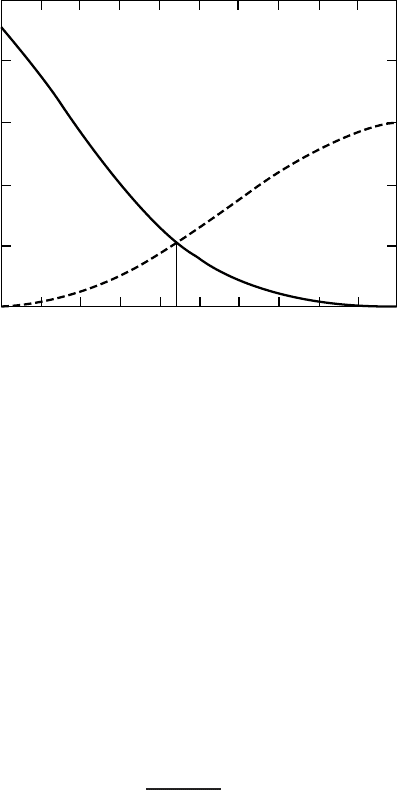
they are equal. This is illustrated in Figure 11.11. Hence, we choose λ so
that
D(P
λ
||P
1
) = D(P
λ
||P
2
). (11.238)
Thus, C(P
1
,P
2
) is the highest achievable exponent for the probability of
error and is called the Chernoff information.
11.9 CHERNOFF INFORMATION 387
2
D
(
P
l
||
P
1
)
D
(
P
l
||
P
2
)
Relative entropy
2.5
1.5
0.5
0
1
0
0.1 0.2 0.3 0.4
l
0.5 0.6 0.7 0.8 0.9 1
FIGURE 11.11. Relative entropy D(P
λ
||P
1
) and D(P
λ
||P
2
) as a function of λ.
The definition D
∗
= D(P
λ
∗
||P
1
) = D(P
λ
∗
||P
2
) is equivalent to the
standard definition of Chernoff information,
C(P
1
,P
2
)
=−min
0≤λ≤1
log
x
P
λ
1
(x)P
1−λ
2
(x)
. (11.239)
It is left as an exercise to the reader to show the equivalence of (11.231)
and (11.239).
We outline briefly the usual derivation of the Chernoff information
bound. The maximum a posteriori probability decision rule minimizes the
Bayesian probability of error. The decision region A for hypothesis H
1
for the maximum a posteriori rule is
A =
x :
π
1
P
1
(x)
π
2
P
2
(x)
> 1
, (11.240)
the set of outcomes where the a posteriori probability of hypothesis H
1
is
greater than the a posteriori probability of hypothesis H
2
. The probability
of error for this rule is
P
e
= π
1
α
n
+ π
2
β
n
(11.241)
=
A
c
π
1
P
1
+
A
π
2
P
2
(11.242)
=
min{π
1
P
1
,π
2
P
2
}. (11.243)

388 INFORMATION THEORY AND STATISTICS
Now for any two positive numbers a and b,wehave
min{a, b}≤a
λ
b
1−λ
for all 0 ≤ λ ≤ 1. (11.244)
Using this to continue the chain, we have
P
e
=
min{π
1
P
1
,π
2
P
2
} (11.245)
≤
(π
1
P
1
)
λ
(π
2
P
2
)
1−λ
(11.246)
≤
P
λ
1
P
1−λ
2
. (11.247)
For a sequence of i.i.d. observations, P
k
(x) =
n
i=1
P
k
(x
i
),and
P
(n)
e
≤
π
λ
1
π
1−λ
2
i
P
λ
1
(x
i
)P
1−λ
2
(x
i
) (11.248)
= π
λ
1
π
1−λ
2
i
P
λ
1
(x
i
)P
1−λ
2
(x
i
) (11.249)
≤
x
i
P
λ
1
P
1−λ
2
(11.250)
=
x
P
λ
1
P
1−λ
2
n
, (11.251)
where (11.250) follows since π
1
≤ 1,π
2
≤ 1. Hence, we have
1
n
log P
(n)
e
≤ log
P
λ
1
(x)P
1−λ
2
(x). (11.252)
Since this is true for all λ, we can take the minimum over 0 ≤ λ ≤ 1,
resulting in the Chernoff information bound. This proves that the exponent
is no better than C(P
1
,P
2
). Achievability follows from Theorem 11.9.1.
Note that the Bayesian error exponent does not depend on the actual
value of π
1
and π
2
, as long as they are nonzero. Essentially, the effect of
the prior is washed out for large sample sizes. The optimum decision rule
is to choose the hypothesis with the maximum a posteriori probability,
which corresponds to the test
π
1
P
1
(X
1
,X
2
,...,X
n
)
π
2
P
2
(X
1
,X
2
,...,X
n
)
>
< 1. (11.253)
11.9 CHERNOFF INFORMATION 389
Taking the log and dividing by n, this test can be rewritten as
1
n
log
π
1
π
2
+
1
n
i
log
P
1
(X
i
)
P
2
(X
i
)
<
> 0, (11.254)
where the second term tends to D(P
1
||P
2
) or −D(P
2
||P
1
) accordingly as
P
1
or P
2
is the true distribution. The first term tends to 0, and the effect
of the prior distribution washes out.
Finally, to round off our discussion of large deviation theory and hypoth-
esis testing, we consider an example of the conditional limit theorem.
Example 11.9.1 Suppose that major league baseball players have a bat-
ting average of 260 with a standard deviation of 15 and suppose that
minor league ballplayers have a batting average of 240 with a standard
deviation of 15. A group of 100 ballplayers from one of the leagues (the
league is chosen at random) are found to have a group batting average
greater than 250 and are therefore judged to be major leaguers. We are
now told that we are mistaken; these players are minor leaguers. What
can we say about the distribution of batting averages among these 100
players? The conditional limit theorem can be used to show that the dis-
tribution of batting averages among these players will have a mean of 250
and a standard deviation of 15. To see this, we abstract the problem as
follows.
Let us consider an example of testing between two Gaussian distribu-
tions, f
1
= N(1,σ
2
) and f
2
= N(−1,σ
2
), with different means and the
same variance. As discussed in Section 11.8, the likelihood ratio test in
this case is equivalent to comparing the sample mean with a threshold.
The Bayes test is “Accept the hypothesis f = f
1
if
1
n
n
i=1
X
i
> 0.” Now
assume that we make an error of the first kind (we say that f = f
1
when
indeed f = f
2
) in this test. What is the conditional distribution of the
samples given that we have made an error?
We might guess at various possibilities:
•
The sample will look like a (
1
2
,
1
2
) mix of the two normal distributions.
Plausible as this is, it is incorrect.
•
X
i
≈ 0foralli. This is quite clearly very unlikely, although it is
conditionally likely that
X
n
is close to 0.
•
The correct answer is given by the conditional limit theorem. If the
true distribution is f
2
and the sample type is in the set A, the condi-
tional distribution is close to f
∗
, the distribution in A that is closest to
f
2
. By symmetry, this corresponds to λ =
1
2
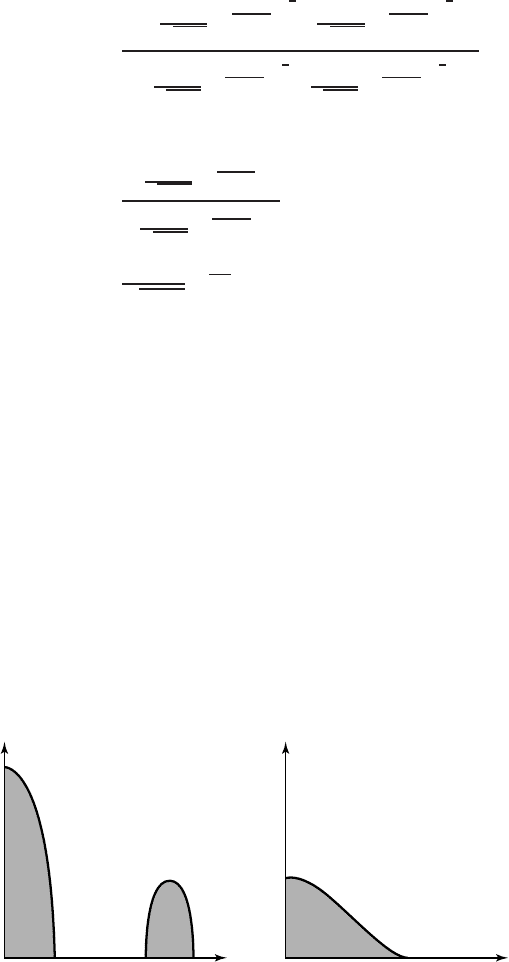
in (11.232). Calculating
390 INFORMATION THEORY AND STATISTICS
the distribution, we get
f
∗
(x) =
1
√
2πσ
2
e
−
(x−1)
2
2σ
2
1
2
1
√
2πσ
2
e
−
(x+1)
2
2σ
2
1
2
1
√
2πσ
2
e
−
(x−1)
2
2σ
2
1
2
1
√
2πσ
2
e
−
(x+1)
2
2σ
2
1
2
dx
(11.255)
=
1
√
2πσ
2
e
−
(x
2
+1)
2σ
2
1
√
2πσ
2
e
−
(x
2
+1)
2σ
2
dx
(11.256)
=
1
√
2πσ
2
e
−
x
2
2σ
2
(11.257)
= N (0,σ
2
). (11.258)
It is interesting to note that the conditional distribution is normal with
mean 0 and with the same variance as the original distributions. This
is strange but true; if we mistake a normal population for another, the
“shape” of this population still looks normal with the same variance
and a different mean. Apparently, this rare event does not result from
bizarre-looking data.
Example 11.9.2 (Large deviation theory and football ) Consider a very
simple version of football in which the score is directly related to the
number of yards gained. Assume that the coach has a choice between two
strategies: running or passing. Associated with each strategy is a distri-
bution on the number of yards gained. For example, in general, running
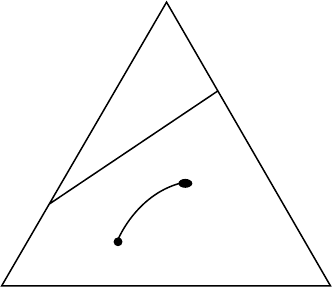
Yards gained in pass
Probability density
Yards gained in run
Probability density
FIGURE 11.12. Distribution of yards gained in a run or a pass play.
11.9 CHERNOFF INFORMATION 391
results in a gain of a few yards with very high probability, whereas passing
results in huge gains with low probability. Examples of the distributions
are illustrated in Figure 11.12.
At the beginning of the game, the coach uses the strategy that promises
the greatest expected gain. Now assume that we are in the closing min-
utes of the game and one of the teams is leading by a large margin.
(Let us ignore first downs and adaptable defenses.) So the trailing team
will win only if it is very lucky. If luck is required to win, we might
as well assume that we will be lucky and play accordingly. What is the
appropriate strategy?
Assume that the team has only n plays left and it must gain l yards,
where l is much larger than n times the expected gain under each play. The
probability that the team succeeds in achieving l yards is exponentially
small; hence, we can use the large deviation results and Sanov’s theorem to
calculate the probability of this event. To be precise, we wish to calculate
the probability that
n
i=1
Z
i
≥ nα,whereZ
i
are independent random
variables and Z
i
has a distribution corresponding to the strategy chosen.
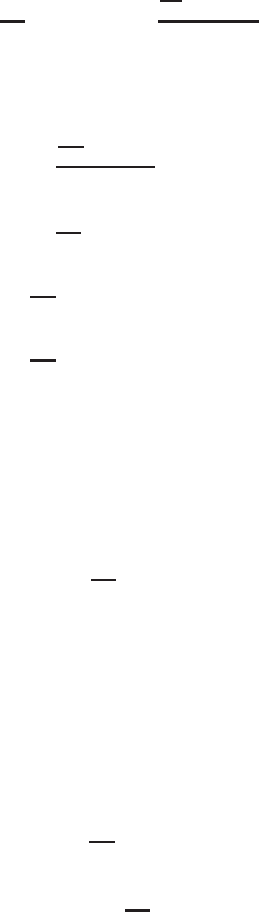
The situation is illustrated in Figure 11.13. Let E be the set of types
corresponding to the constraint,
E =
P :
a∈X
P(a)a ≥ α
. (11.259)
If P
1
is the distribution corresponding to passing all the time, the proba-
bility of winning is the probability that the sample type is in E,whichby
Sanov’s theorem is 2
−nD(P
∗
1
||P
1
)
,whereP
∗
1
is the distribution in E that is
closest to P
1
. Similarly, if the coach uses the running game all the time,
E
P
1
P
2
FIGURE 11.13. Probability simplex for a football game.

392 INFORMATION THEORY AND STATISTICS
the probability of winning is 2
−nD(P
∗
2
||P
2
)
. What if he uses a mixture of
strategies? Is it possible that 2
−nD(P
∗
λ
||P
λ
)
, the probability of winning with
a mixed strategy, P
λ
= λP
1
+ (1 − λ)P
2
, is better than the probability of
winning with either pure passing or pure running? The somewhat surpris-
ing answer is yes, as can be shown by example. This provides a reason
to use a mixed strategy other than the fact that it confuses the defense.
We end this section with another inequality due to Chernoff, which
is a special version of Markov’s inequality. This inequality is called the
Chernoff bound.
Lemma 11.9.1 Let Y be any random variable and let ψ(s) be the
moment generating function of Y ,
ψ(s) = Ee
sY
. (11.260)
Then for all s ≥ 0,
Pr(Y ≥ a) ≤ e
−sa
ψ(s), (11.261)
and thus
Pr(Y ≥ a) ≤ min
s≥0
e
−sa
ψ(s). (11.262)
Proof: Apply Markov’s inequality to the nonnegative random variable
e
sY
.
11.10 FISHER INFORMATION AND THE CRAM
´
ER–RAO
INEQUALITY
A standard problem in statistical estimation is to determine the parameters
of a distribution from a sample of data drawn from that distribution.
For example, let X
1
,X
2
,...,X
n
be drawn i.i.d. ∼ N(θ, 1). Suppose that
we wish to estimate θ from a sample of size n. There are a number of
functions of the data that we can use to estimate θ . For example, we can
use the first sample X
1
. Although the expected value of X
1
is θ , it is clear
that we can do better by using more of the data. We guess that the best
estimate of θ is the sample mean
X
n
=
1
n
X
i
. Indeed, it can be shown
that
X
n
is the minimum mean-squared-error unbiased estimator.
We begin with a few definitions. Let {f(x;θ)},θ∈ , denote an
indexed family of densities, f(x;θ) ≥ 0,
f(x;θ)dx = 1forallθ ∈ .
Here is called the parameter set.
Definition An estimator for θ for sample size n is a function T :
X
n
→ .

11.10 FISHER INFORMATION AND THE CRAM
´
ER–RAO INEQUALITY 393
An estimator is meant to approximate the value of the parameter. It
is therefore desirable to have some idea of the goodness of the approxi-
mation. We will call the difference T − θ the error of the estimator. The
error is a random variable.
Definition The bias of an estimator T(X
1
,X
2
,...,X
n
) for the param-
eter θ is the expected value of the error of the estimator [i.e., the bias is
E
θ
T(x
1
,x
2
,...,x
n
) − θ]. The subscript θ means that the expectation is
with respect to the density f(·;θ). The estimator is said to be unbiased
if the bias is zero for all θ ∈ (i.e., the expected value of the estimator
is equal to the parameter).
Example 11.10.1 Let X
1
,X
2
,...,X
n
drawn i.i.d. ∼ f(x) = (1/λ)
e
−x/λ
,x ≥ 0 be a sequence of exponentially distributed random variables.
Estimators of λ include X
1
and X
n
. Both estimators are unbiased.
The bias is the expected value of the error, and the fact that it is
zero does not guarantee that the error is low with high probability. We
need to look at some loss function of the error; the most commonly
chosen loss function is the expected square of the error. A good estima-
tor should have a low expected squared error and should have an error
that approaches 0 as the sample size goes to infinity. This motivates the
following definition:
Definition An estimator T(X
1
,X
2
,...,X
n
) for θ is said to be consis-
tent in probability if
T(X
1
,X
2
,...,X
n
) → θ in probability as n →∞.
Consistency is a desirable asymptotic property, but we are interested in
the behavior for small sample sizes as well. We can then rank estimators
on the basis of their mean-squared error.
Definition An estimator T
1
(X
1
,X
2
,...,X
n
) is said to dominate
another estimator T
2
(X
1
,X
2
,...,X
n
) if, for all θ,
E
(
T
1
(X
1
,X
2
,...,X
n
) − θ
)
2
≤ E
(
T
2
(X
1
,X
2
,...,X
n
) − θ
)
2
.
(11.263)
This raises a natural question: Is there a best estimator of θ that dom-
inates every other estimator? To answer this question, we derive the
Cram
´
er–Rao lower bound on the mean-squared error of any estimator.
We first define the score function of the distribution f(x;θ).Wethenuse
the Cauchy–Schwarz inequality to prove the Cram
´
er–Rao lower bound
on the variance of all unbiased estimators.
394 INFORMATION THEORY AND STATISTICS
Definition The score V is a random variable defined by
V =
∂
∂θ
ln f(X;θ) =
∂
∂θ
f(X;θ)
f(X;θ)
, (11.264)
where X ∼ f(x;θ).
The mean value of the score is
EV =
∂
∂θ
f(x;θ)
f(x;θ)
f(x;θ) dx (11.265)
=
∂
∂θ
f(x;θ) dx (11.266)
=
∂
∂θ
f(x;θ) dx (11.267)
=
∂
∂θ
1 (11.268)
= 0, (11.269)
and therefore EV
2
= var(V ). The variance of the score has a special
significance.
Definition The Fisher information J(θ) is the variance of the score:
J(θ) = E
θ
∂
∂θ
ln f(X;θ)
2
. (11.270)
If we consider a sample of n random variables X
1
,X
2
,...,X
n
drawn
i.i.d. ∼ f(x;θ),wehave
f(x
1
,x
2
,...,x
n
;θ) =
n
i=1
f(x
i
;θ), (11.271)
and the score function is the sum of the individual score functions,
V(X
1
,X
2
,...,X
n
) =
∂
∂θ
ln f(X
1
,X
2
,...,X
n
;θ) (11.272)
=
n
i=1
∂
∂θ
ln f(X
i
;θ) (11.273)
=
n
i=1
V(X
i
), (11.274)