
Thomas M. Cover, Joy A. Thomas. Elements of information theory
Подождите немного. Документ загружается.


11.10 FISHER INFORMATION AND THE CRAM
´
ER–RAO INEQUALITY 395
where the V(X
i
) are independent, identically distributed with zero mean.
Hence, the n-sample Fisher information is
J
n
(θ) = E
θ
∂
∂θ
ln f(X
1
,X
2
,...,X
n
;θ)
2
(11.275)
= E
θ
V
2
(X
1
,X
2
,...,X
n
) (11.276)
= E
θ
n
i=1
V(X
i
)
2
(11.277)
=
n
i=1
E
θ
V
2
(X
i
) (11.278)
= nJ (θ). (11.279)
Consequently, the Fisher information for n i.i.d. samples is n times the
individual Fisher information. The significance of the Fisher information
is shown in the following theorem.
Theorem 11.10.1 (Cram´er–Rao inequality) The mean-squared error
of any unbiased estimator T(X) of the parameter θ is lower bounded by
the reciprocal of the Fisher information:
var(T ) ≥
1
J(θ)
. (11.280)
Proof: Let V be the score function and T be the estimator. By the
Cauchy–Schwarz inequality, we have
(
E
θ
[
(V − E
θ
V )(T − E
θ
T)
]
)
2
≤ E
θ
(V − E
θ
V)
2
E
θ
(T − E
θ
T)
2
.
(11.281)
Since T is unbiased, E
θ
T = θ for all θ . By (11.269), E
θ
V = 0 and hence
E
θ
(V − E
θ
V )(T − E
θ
T)= E
θ
(V T ). Also, by definition, var(V ) = J(θ).
Substituting these conditions in (11.281), we have
[
E
θ
(V T )
]
2
≤ J(θ)var(T ). (11.282)
Now,
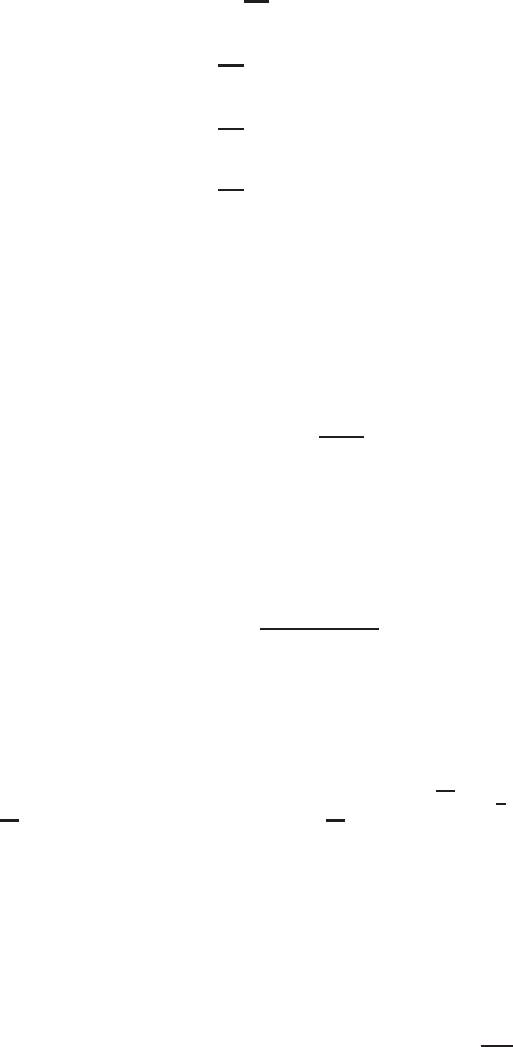
E
θ
(V T ) =
∂
∂θ
f(x;θ)
f(x;θ)
T(x)f(x;θ) dx (11.283)
396 INFORMATION THEORY AND STATISTICS
=
∂
∂θ
f(x;θ)T(x) dx (11.284)
=
∂
∂θ
f(x;θ)T(x) dx (11.285)
=
∂
∂θ
E
θ
T (11.286)
=
∂
∂θ
θ (11.287)
= 1, (11.288)
where the interchange of differentiation and integration in (11.285) can be
justified using the bounded convergence theorem for appropriately well
behaved f(x;θ), and (11.287) follows from the fact that the estimator T
is unbiased. Substituting this in (11.282), we obtain
var(T ) ≥
1
J(θ)
, (11.289)
which is the Cram
´
er–Rao inequality for unbiased estimators.
By essentially the same arguments, we can show that for any estimator
E(T − θ)
2
≥
(1 + b
T
(θ))
2
J(θ)
+ b
2
T
(θ), (11.290)
where b
T
(θ) = E
θ
T − θ and b
T
(θ) is the derivative of b
T
(θ) with respect
to θ. The proof of this is left as a problem at the end of the chapter.
Example 11.10.2 Let X
1
,X
2
,...,X
n
be i.i.d. ∼ N(θ, σ
2
), σ
2
known.
Here J(θ) = n/σ
2
.LetT(X
1
,X
2
,...,X
n
) = X
n
=
1
n
X
i
.Then
E
θ
(X
n
− θ)
2
= σ
2
/n = 1/J (θ ). Thus, X
n
is the minimum variance unbi-
ased estimator of θ, since it achieves the Cram
´
er–Rao lower bound.
The Cram
´
er–Rao inequality gives us a lower bound on the variance
for all unbiased estimators. When this bound is achieved, we call the
estimator efficient.
Definition An unbiased estimator T is said to be efficient if it meets
the Cram
´
er–Rao bound with equality [i.e., if var(T ) =
1
J(θ)
].

SUMMARY 397
The Fisher information is therefore a measure of the amount of “infor-
mation” about θ that is present in the data. It gives a lower bound on the
error in estimating θ from the data. However, it is possible that there does
not exist an estimator meeting this lower bound.
We can generalize the concept of Fisher information to the multipa-
rameter case, in which case we define the Fisher information matrix J(θ)
with elements
J
ij
(θ) =
f(x;θ)
∂
∂θ
i
ln f(x;θ)
∂
∂θ
j
ln f(x;θ) dx. (11.291)
The Cram
´
er–Rao inequality becomes the matrix inequality
≥ J
−1
(θ), (11.292)
where is the covariance matrix of a set of unbiased estimators for the
parameters θ and ≥ J
−1
(θ) in the sense that the difference − J
−1
is
a nonnegative definite matrix. We will not go into the details of the proof
for multiple parameters; the basic ideas are similar.
Is there a relationship between the Fisher information J(θ) and quanti-
ties such as entropy defined earlier? Note that Fisher information is defined
with respect to a family of parametric distributions, unlike entropy, which
is defined for all distributions. But we can parametrize any distribution
f(x)by a location parameter θ and define Fisher information with respect
to the family of densities f(x− θ) under translation. We explore the
relationship in greater detail in Section 17.8, where we show that while
entropy is related to the volume of the typical set, the Fisher information
is related to the surface area of the typical set. Further relationships of
Fisher information to relative entropy are developed in the problems.
SUMMARY
Basic identities
Q
n
(x) = 2
−n(D(P
x
||Q)+H(P
x
))
, (11.293)
|
P
n
|≤(n + 1)
|X |
, (11.294)
|T(P)|
.
= 2
nH (P )
, (11.295)
Q
n
(T (P ))
.
= 2
−nD(P ||Q)
. (11.296)

398 INFORMATION THEORY AND STATISTICS
Universal data compression
P
(n)
e
≤ 2
−nD(P
∗
R
||Q)
for all Q, (11.297)
where
D(P
∗
R
||Q) = min
P :H(P)≥R
D(P ||Q). (11.298)
Large deviations (Sanov’s theorem)
Q
n
(E) = Q
n
(E ∩ P
n
) ≤ (n + 1)
|X |
2
−nD(P
∗
||Q)
, (11.299)
D(P
∗
||Q) = min
P ∈E
D(P ||Q). (11.300)
If E is the closure of its interior, then
Q
n
(E)
.
= 2
−nD(P
∗
||Q)
. (11.301)
L
1
bound on relative entropy
D(P
1
||P
2
) ≥
1
2ln2
||P
1
− P
2
||
2
1
. (11.302)
Pythagorean theorem. If E is a convex set of types, distribution Q/∈
E,andP
∗
achieves D(P
∗
||Q) = min
P ∈E
D(P ||Q),wehave
D(P ||Q) ≥ D(P||P
∗
) + D(P
∗
||Q) (11.303)
for all P ∈ E.
Conditional limit theorem. If X
1
,X
2
,...,X
n
i.i.d. ∼ Q,then
Pr(X
1
= a|P
X
n
∈ E) → P
∗
(a) in probability, (11.304)
where P
∗
minimizes D(P ||Q) over P ∈ E. In particular,
Pr
X
1
= a
1
n
n
i=1
X
i
≥ α
→
Q(a)e
λa
x
Q(x)e
λx
. (11.305)
Neyman–Pearson lemma. The optimum test between two densities
P
1
and P
2
has a decision region of the form “accept P = P
1
if
P
1
(x
1
,x
2
,...,x
n
)
P
2
(x
1
,x
2
,...,x
n
)
>T.”

PROBLEMS 399
Chernoff–Stein lemma. The best achievable error exponent β
n
if
α
n
≤ :
β
n
= min
A
n
⊆ X
n
α
n
<
β
n
, (11.306)
lim
n→∞
1
n
log β
n
=−D(P
1
||P
2
). (11.307)
Chernoff information. The best achievable exponent for a Bayesian
probability of error is
D
∗
= D(P
λ
∗
||P
1
) = D(P
λ
∗
||P
2
), (11.308)
where
P
λ
=
P
λ
1
(x)P
1−λ
2
(x)
a∈X
P
λ
1
(a)P
1−λ
2
(a)
(11.309)
with λ = λ
∗
chosen so that
D(P
λ
||P
1
) = D(P
λ
||P
2
). (11.310)
Fisher information
J(θ) = E
θ
∂
∂θ
ln f(x;θ)
2
. (11.311)
Cram
´
er–Rao inequality. For any unbiased estimator T of θ ,
E
θ
(T (X) − θ)
2
= var(T ) ≥
1
J(θ)
. (11.312)
PROBLEMS
11.1 Chernoff–Stein lemma. Consider the two-hypothesis test
H
1
: f = f
1
vs. H
2
: f = f
2
.
Find D(f
1
f
2
) if

400 INFORMATION THEORY AND STATISTICS
(a) f
i
(x) = N(0,σ
2
i
), i = 1, 2.
(b) f
i
(x) = λ
i
e
−λ
i
x
,x ≥ 0,i = 1, 2.
(c) f
1
(x) is the uniform density over the interval [0, 1] and f
2
(x)
is the uniform density over [a, a + 1]. Assume that 0 <a<1.
(d) f
1
corresponds to a fair coin and f
2
corresponds to a two-
headed coin.
11.2 Relation between D(P Q) and chi-square. Show that the χ
2
statistic
χ
2
=
x
(P (x) − Q(x))
2
Q(x)
is (twice) the first term in the Taylor series expansion of D(P
Q) about Q. Thus, D(P Q) =
1
2
χ
2
+···.[Suggestion: Write
P
Q
= 1 +
P −Q
Q
and expand the log.]
11.3 Error exponent for universal codes. A universal source code of
rate R achieves a probability of error P
(n)
e
.
= e
−nD(P
∗
Q)
, where
Q is the true distribution and P
∗
achieves min D(P Q) over all
P such that H(P) ≥ R.
(a) Find P
∗
in terms of Q and R.
(b) Now let X be binary. Find the region of source probabili-
ties Q(x), x ∈{0, 1},forwhichrateR is sufficient for the
universal source code to achieve P
(n)
e
→ 0.
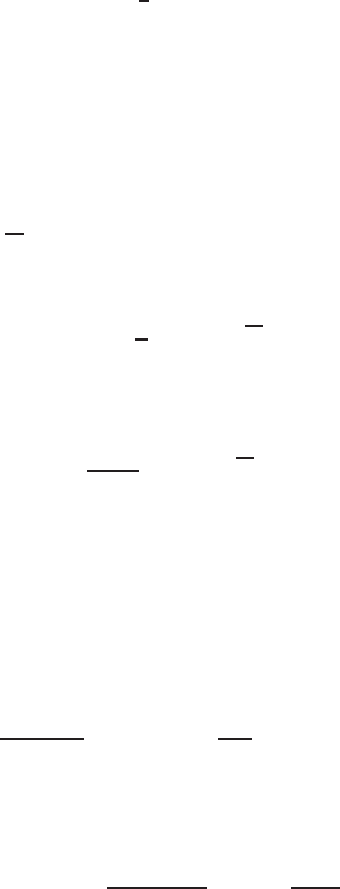
11.4 Sequential projection. We wish to show that projecting Q onto
P
1
and then projecting the projection
ˆ
Q onto P
1
P
2
is the same
as projecting Q directly onto P
1
P
2
. Let P
1
be the set of prob-
ability mass functions on
X satisfying
x
p(x) = 1, (11.313)
x
p(x)h
i
(x) ≥ α
i
,i= 1, 2,...,r. (11.314)
Let
P
2
be the set of probability mass functions on X satisfying
x
p(x) = 1, (11.315)
x
p(x)g
j
(x) ≥ β
j
,j= 1, 2,...,s. (11.316)
PROBLEMS 401
Suppose that Q ∈ P
1
P
2
. Let P
∗
minimize D(P Q) over all
P ∈
P
1
. Let R
∗
minimize D(R Q) over all R ∈ P
1
P
2
. Argue
that R
∗
minimizes D(R P
∗
) over all R ∈ P
1
P
2
.
11.5 Counting.Let
X ={1, 2,...,m}. Show that the number of se-
quences x
n
∈ X
n
satisfying
1
n
n
i=1
g(x
i
) ≥ α is approximately
equal to 2
nH
∗
, to first order in the exponent, for n sufficiently large,
where
H
∗
= max
P :
m
i=1
P(i)g(i)≥α
H(P). (11.317)
11.6 Biased estimates may be better. Consider the problem of esti-
mating µ and σ
2
from n samples of data drawn i.i.d. from a
N(µ, σ
2
) distribution.
(a) Show that
X
n
is an unbiased estimator of µ.
(b) Show that the estimator
S
2
n
=
1
n
n
i=1
(X
i
− X
n
)
2
(11.318)
is a biased estimator of σ
2
and the estimator
S
2
n−1
=
1
n − 1
n
i=1
(X
i
− X
n
)
2
(11.319)
is unbiased.
(c) Show that S
2
n
has a lower mean-squared error than that of
S
2
n−1
. This illustrates the idea that a biased estimator may be
“better” than an unbiased estimator.
11.7 Fisher information and relative entropy. Show for a parametric
family {p
θ
(x)} that
lim
θ
→θ
1
(θ −θ
)
2
D(p
θ
||p
θ
) =
1
ln 4
J(θ). (11.320)
11.8 Examples of Fisher information. The Fisher information J()
for the family f
θ
(x), θ ∈ R is defined by
J(θ) = E
θ
∂f
θ
(X)/∂θ
f
θ
(X)
2
=
(f
θ
)
2
f
θ
.
Find the Fisher information for the following families:

402 INFORMATION THEORY AND STATISTICS
(a) f
θ
(x) = N(0,θ) =
1
√
2πθ
e
−
x
2
2θ
(b) f
θ
(x) = θe
−θx
,x ≥ 0
(c) What is the Cram
`
er–Rao lower bound on E
θ
(
ˆ
θ(X)− θ)
2
,
where
ˆ
θ(X) is an unbiased estimator of θ for parts (a) and
(b)?
11.9 Two conditionally independent looks double the Fisher informa-
tion.Letg
θ
(x
1
,x
2
) = f
θ
(x
1
)f
θ
(x
2
). Show that J
g
(θ) = 2J
f
(θ).
11.10 Joint distributions and product distributions. Consider a joint
distribution Q(x, y) with marginals Q(x) and Q(y).LetE be
the set of types that look jointly typical with respect to Q:
E ={P(x, y) : −
x,y
P(x, y) log Q(x) − H(X) = 0,
−
x,y
P(x, y) log Q(y) − H(Y) = 0,
−
x,y
P(x, y) log Q(x, y)
−H(X,Y) = 0}. (11.321)
(a) Let Q
0
(x, y) be another distribution on X × Y. Argue
that the distribution P
∗
in E that is closest to Q
0
is of the
form
P
∗
(x, y) = Q
0
(x, y)e
λ
0
+λ
1
log Q(x)+λ
2
log Q(y)+λ
3
log Q(x,y)
,
(11.322)
where λ
0
,λ
1
,λ
2
,andλ
3
are chosen to satisfy the constraints.
Argue that this distribution is unique.
(b) Now let Q
0
(x, y) = Q(x)Q(y).VerifythatQ(x, y) is of the
form (11.322) and satisfies the constraints. Thus, P
∗
(x, y) =
Q(x, y) (i.e., the distribution in E closest to the product dis-
tribution is the joint distribution).
11.11 Cram´er–Rao inequality with a bias term.LetX ∼ f(x;θ) and
let T(X)be an estimator for θ.Letb
T
(θ) = E
θ
T − θ be the bias
of the estimator. Show that
E(T − θ)
2
≥
[1 + b
T
(θ)]
2
J(θ)
+ b
2
T
(θ). (11.323)

PROBLEMS 403
11.12 Hypothesis testing.LetX
1
,X
2
,...,X
n
be i.i.d. ∼ p(x). Con-
sider the hypothesis test H
1
: p = p
1
vs. H
2
: p = p
2
.Let
p
1
(x) =
1
2
,x=−1
1
4
,x= 0
1
4
,x= 1
and
p
2
(x) =
1
4
,x=−1
1
4
,x= 0
1
2
,x= 1.
Find the error exponent for Pr{Decide H
2
|H
1
true} in the best
hypothesis test of H
1
vs. H
2
subject to Pr{Decide H
1
|H
2
true}
≤
1
2
.
11.13 Sanov’s theorem. Prove a simple version of Sanov’s theorem for
Bernoulli(q) random variables.
Let the proportion of 1’s in the sequence X
1
,X
2
,...,X
n
be
X
n
=
1
n
n
i=1
X
i
. (11.324)
By the law of large numbers, we would expect
X
n
to be close
to q for large n. Sanov’s theorem deals with the probability that
p
X
n
is far away from q. In particular, for concreteness, if we take
p>q>
1
2
, Sanov’s theorem states that
−
1
n
log Pr
(X
1
,X
2
,...,X
n
) : X
n
≥ p
→ p log
p
q
+ (1 − p) log
1 − p
1 − q
= D((p, 1 −p)||(q, 1 −q)). (11.325)
Justify the following steps:
•
Pr
(X
1
,X
2
,...,X
n
) : X
n
≥ p
≤
n
i=np
n
i
q
i
(1 − q)
n−i
.
(11.326)

404 INFORMATION THEORY AND STATISTICS
•
Argue that the term corresponding to i =np is the largest
term in the sum on the right-hand side of the last equation.
•
Show that this term is approximately 2
−nD
.
•
Prove an upper bound on the probability in Sanov’s theorem
using the steps above. Use similar arguments to prove a lower
bound and complete the proof of Sanov’s theorem.
11.14 Sanov.LetX
i
be i.i.d. ∼ N(0,σ
2
).
(a) Find the exponent in the behavior of Pr{
1
n
n
i=1
X
2
i
≥ α
2
}.
This can be done from first principles (since the normal dis-
tribution is nice) or by using Sanov’s theorem.
(b) Whatdothedatalooklikeif
1
n
n
i=1
X
2
i
≥ α?Thatis,what
is the P
∗
that minimizes D(P Q)?
11.15 Counting states. Suppose that an atom is equally likely to be in
each of six states, X ∈{s
1
,s
2
,s
3
,...,s
6
}. One observes n atoms
X
1
,X
2
,...,X
n
independently drawn according to this uniform
distribution. It is observed that the frequency of occurrence of
state s
1
is twice the frequency of occurrence of state s
2
.
(a) To first order in the exponent, what is the probability of
observing this event?
(b) Assuming n large, find the conditional distribution of the state
of the first atom X
1
, given this observation.
11.16 Hypothesis testing.Let{X
i
} be i.i.d. ∼ p(x), x ∈{1, 2,...}.
Consider two hypotheses, H
0
: p(x) = p
0
(x) vs. H
1
: p(x) =
p
1
(x),wherep
0
(x) =
1
2
x
and p
1
(x) = qp
x−1
, x = 1, 2, 3,....
(a) Find D(p
0
p
1
).
(b) Let Pr{H
0
}=
1
2
. Find the minimal probability of error test for
H
0
vs. H
1
given data X
1
,X
2
,...,X
n
∼ p(x).
11.17 Maximum likelihood estimation.Let{f
θ
(x)} denote a parametric
family of densities with parameter θ
R.LetX
1
,X
2
,...,X
n
be
i.i.d. ∼ f
θ
(x). The function
l
θ
(x
n
) = ln
n
i=1
f
θ
(x
i
)
is known as the log likelihood function.Letθ
0
denote the true
parameter value.