
Thomas M. Cover, Joy A. Thomas. Elements of information theory
Подождите немного. Документ загружается.


12.4 SPECTRUM ESTIMATION 415
This example shows that the maximum entropy may only be -achiev-
able.
12.4 SPECTRUM ESTIMATION
Given a stationary zero-mean stochastic process {X
i
}, we define the auto-
correlation function as
R(k) = EX
i
X
i+k
. (12.33)
The Fourier transform of the autocorrelation function for a zero-mean
process is the power spectral density S(λ):
S(λ) =
∞
m=−∞
R(m)e
−imλ
, −π<λ≤ π, (12.34)
where i =
√
−1. Since the power spectral density is indicative of the
structure of the process, it is useful to form an estimate from a sample of
the process.
There are many methods to estimate the power spectrum. The simplest
way is to estimate the autocorrelation function by taking sample averages
for a sample of length n,
ˆ
R(k) =
1
n − k
n−k
i=1
X
i
X
i+k
. (12.35)
If we use all the values of the sample correlation function
ˆ
R(·) to cal-
culate the spectrum, the estimate that we obtain from (12.34) does not
converge to the true power spectrum for large n. Hence, this method, the
periodogram method, is rarely used. One of the reasons for the problem
with the periodogram method is that the estimates of the autocorrelation
function from the data have different accuracies. The estimates for low
values of k (called the lags) are based on a large number of samples and
those for high k on very few samples. So the estimates are more accurate
at low k. The method can be modified so that it depends only on the
autocorrelations at low k by setting the higher lag autocorrelations to 0.
However, this introduces some artifacts because of the sudden transition to
zero autocorrelation. Various windowing schemes have been suggested to
smooth out the transition. However, windowing reduces spectral resolution
and can give rise to negative power spectral estimates.
In the late 1960s, while working on the problem of spectral estimation for
geophysical applications, Burg suggested an alternative method. Instead of
416 MAXIMUM ENTROPY
setting the autocorrelations at high lags to zero, he set them to values that
make the fewest assumptions about the data (i.e., values that maximize the
entropy rate of the process). This is consistent with the maximum entropy
principle as articulated by Jaynes [294]. Burg assumed the process to be
stationary and Gaussian and found that the process which maximizes the
entropy subject to the correlation constraints is an autoregressive Gaussian
process of the appropriate order. In some applications where we can assume
an underlying autoregressive model for the data, this method has proved
useful in determining the parameters of the model (e.g., linear predictive
coding for speech). This method (known as the maximum entropy method
or Burg’s method) is a popular method for estimation of spectral densities.
We prove Burg’s theorem in Section 12.6.
12.5 ENTROPY RATES OF A GAUSSIAN PROCESS
In Chapter 8 we defined the differential entropy of a continuous random
variable. We can now extend the definition of entropy rates to real-valued
stochastic processes.
Definition The differential entropy rate of a stochastic process {X
i
},X
i
∈
R,isdefinedtobe
h(
X) = lim
n→∞
h(X
1
,X
2
,...,X
n
)
n
(12.36)
if the limit exists.
Just as in the discrete case, we can show that the limit exists for sta-
tionary processes and that the limit is given by the two expressions
h(
X) = lim
n→∞
h(X
1
,X
2
,...,X
n
)
n
(12.37)
= lim
n→∞
h(X
n
|X
n−1
,...,X
1
). (12.38)
For a stationary Gaussian stochastic process, we have
h(X
1
,X
2
,...,X
n
) =
1
2
log(2πe)
n
|K
(n)
|, (12.39)
where the covariance matrix K
(n)
is Toeplitz with entries R(0), R(1),...,
R(n − 1) along the top row. Thus, K
(n)
ij
= R(i − j) = E(X
i
− EX
i
)(X
j
12.6 BURG’S MAXIMUM ENTROPY THEOREM 417
− EX
j
).Asn →∞, the density of the eigenvalues of the covariance
matrix tends to a limit, which is the spectrum of the stochastic process.
Indeed, Kolmogorov showed that the entropy rate of a stationary Gaussian
stochastic process can be expressed as
h(
X) =
1
2
log 2πe +
1
4π
π
−π
log S(λ) dλ. (12.40)
The entropy rate is also lim
n→∞
h(X
n
|X
n−1
). Since the stochastic pro-
cess is Gaussian, the conditional distribution is also Gaussian, and hence
the conditional entropy is
1
2
log 2πeσ
2
∞
,whereσ
2
∞
is the variance of the
error in the best estimate of X
n
given the infinite past. Thus,
σ
2
∞
=
1
2πe
2
2h(X )
, (12.41)
where h(
X) is given by (12.40). Hence, the entropy rate corresponds to
the minimum mean-squared error of the best estimator of a sample of the
process given the infinite past.
12.6 BURG’S MAXIMUM ENTROPY THEOREM
Theorem 12.6.1 The maximum entropy rate stochastic process {X
i
} sat-
isfying the constraints
EX
i
X
i+k
= α
k
,k= 0, 1,...,p for all i, (12.42)
is the pth-order Gauss–Markov process of the form
X
i
=−
p
k=1
a
k
X
i−k
+ Z
i
, (12.43)
where the Z
i
are i.i.d. ∼ N(0,σ
2
) and a
1
,a
2
,...,a
p
,σ
2
are chosen to
satisfy (12.42).
Remark We do not assume that {X
i
} is (a) zero mean, (b) Gaussian, or
(c) wide-sense stationary.
Proof: Let X
1
,X
2
,...,X
n
be any stochastic process that satisfies the
constraints (12.42). Let Z
1
,Z
2
,...,Z
n
be a Gaussian process with the
same covariance matrix as X
1
,X
2
,...,X
n
. Then since the multivariate
normal distribution maximizes the entropy over all vector-valued random
418 MAXIMUM ENTROPY
variables under a covariance constraint, we have
h(X
1
,X
2
,...,X
n
) ≤ h(Z
1
,Z
2
,...,Z
n
) (12.44)
= h(Z
1
,...,Z
p
) +
n
i=p+1
h(Z
i
|Z
i−1
,Z
i−2
,...,Z
1
)
(12.45)
≤ h(Z
1
,...,Z
p
) +
n
i=p+1
h(Z
i
|Z
i−1
,Z
i−2
,...,Z
i−p
)
(12.46)
by the chain rule and the fact that conditioning reduces entropy. Now
define Z
1
,Z
2
,...,Z
n
as a pth-order Gauss–Markov process with the
same distribution as Z
1
,Z
2
,...,Z
n
for all orders up to p. (Existence of
such a process will be verified using the Yule–Walker equations immedi-
ately after the proof.) Then since h(Z
i
|Z
i−1
,...,Z
i−p
) depends only on
the pth-order distribution, h(Z
i
|Z
i−1
,...,Z
i−p
) = h(Z
i
|Z
i−1
,...,Z
i−p
),
and continuing the chain of inequalities, we obtain
h(X
1
,X
2
,...,X
n
) ≤ h(Z
1
,...,Z
p
) +
n
i=p+1
h(Z
i
|Z
i−1
,Z
i−2
,...,Z
i−p
)
(12.47)
= h(Z
1
,...,Z
p
) +
n
i=p+1
h(Z
i
|Z
i−1
,Z
i−2
,...,Z
i−p
)
(12.48)
= h(Z
1
,Z
2
,...,Z
n
), (12.49)
where the last equality follows from the pth-order Markovity of the {Z
i
}.
Dividing by n and taking the limit, we obtain
lim
1
n
h(X
1
,X
2
,...,X
n
) ≤ lim
1
n
h(Z
1
,Z
2
,...,Z
n
) = h
∗
, (12.50)
where
h
∗
=
1
2
log 2πeσ
2
, (12.51)
which is the entropy rate of the Gauss–Markov process. Hence, the max-
imum entropy rate stochastic process satisfying the constraints is the
pth-order Gauss–Markov process satisfying the constraints.
A bare-bones summary of the proof is that the entropy of a finite
segment of a stochastic process is bounded above by the entropy of a

12.6 BURG’S MAXIMUM ENTROPY THEOREM 419
segment of a Gaussian random process with the same covariance structure.
This entropy is in turn bounded above by the entropy of the minimal order
Gauss–Markov process satisfying the given covariance constraints. Such
a process exists and has a convenient characterization by means of the
Yule–Walker equations given below.
Note on the choice of a
1
,...,a
p
and σ
2
: Given a sequence of covariances
R(0), R(1),...,R(p), does there exist a pth-order Gauss–Markov pro-
cess with these covariances? Given a process of the form (12.43), can we
choose the a
k
’s to satisfy the constraints? Multiplying (12.43) by X
i−l
and taking expectations, noting that R(k) = R(−k),weget
R(0) =−
p
k=1
a
k
R(−k) + σ
2
(12.52)
and
R(l) =−
p
k=1
a
k
R(l − k), l = 1, 2,.... (12.53)
These equations are called the Yule–Walker equations.Therearep + 1
equations in the p + 1 unknowns a
1
,a
2
,...,a
p
,σ
2
. Therefore, we can
solve for the parameters of the process from the covariances.
Fast algorithms such as the Levinson algorithm and the Durbin algo-
rithm [433] have been devised to use the special structure of these
equations to calculate the coefficients a
1
,a
2
,...,a
p
efficiently from the
covariances. (We set a
0
= 1 for a consistent notation.) Not only do the
Yule–Walker equations provide a convenient set of linear equations for
calculating the a
k
’s and σ
2
from the R(k)’s, they also indicate how the
autocorrelations behave for lags greater than p. The autocorrelations for
high lags are an extension of the values for lags less than p. These val-
ues are called the Yule–Walker extension of the autocorrelations. The
spectrum of the maximum entropy process is seen to be
S(λ) =
∞
m=−∞
R(m)e
−imλ
(12.54)
=
σ
2
1 +
p
k=1
a
k
e
−ikλ
2
, −π ≤ λ ≤ π. (12.55)
This is the maximum entropy spectral density subject to the constraints
R(0), R(1),...,R(p).
However, for the pth-order Gauss–Markov process, it is possible to
calculate the entropy rate directly without calculating the a
i
’s. Let K
p
be

420 MAXIMUM ENTROPY
the autocorrelation matrix corresponding to this process—the matrix with
R
0
,R
1
,...,R
p
along the top row. For this process, the entropy rate is
equal to
h
∗
= h(X
p
|X
p−1
,...,X
0
) = h(X
0
,...,X
p
) − h(X
0
,...,X
p−1
)
(12.56)
=
1
2
log(2πe)
p+1
|K
p
|−
1
2
log(2πe)
p
|K
p−1
|
(12.57)
=
1
2
log(2πe)
|K
p
|
|K
p−1
|
. (12.58)
In a practical problem, we are generally given a sample sequence
X
1
,X
2
,...,X
n
, from which we calculate the autocorrelations. An impor-
tant question is: How many autocorrelation lags should we consider (i.e.,
what is the optimum value of p)? A logically sound method is to choose
the value of p that minimizes the total description length in a two-stage
description of the data. This method has been proposed by Rissanen
[442, 447] and Barron [33] and is closely related to the idea of Kol-
mogorov complexity.
SUMMARY
Maximum entropy distribution. Let f be a probability density satis-
fying the constraints
S
f(x)r
i
(x) = α
i
for 1 ≤ i ≤ m. (12.59)
Let f
∗
(x) = f
λ
(x) = e
λ
0
+
m
i=1
λ
i
r
i
(x)
, x ∈ S,andletλ
0
,...,λ
m
be cho-
sen so that f
∗
satisfies (12.59). Then f
∗
uniquely maximizes h(f ) over
all f satisfying these constraints.
Maximum entropy spectral density estimation. The entropy rate of a
stochastic process subject to autocorrelation constraints R
0
,R
1
,...,R
p
is maximized by the pth order zero-mean Gauss-Markov process satis-
fying these constraints. The maximum entropy rate is
h
∗
=
1
2
log(2πe)
|K
p
|
|K
p−1
|
, (12.60)
PROBLEMS 421
and the maximum entropy spectral density is
S(λ) =
σ
2
1 +
p
k=1
a
k
e
−ikλ
2
. (12.61)
PROBLEMS
12.1 Maximum entropy. Find the maximum entropy density f ,
defined for x ≥ 0, satisfying EX = α
1
,Eln X = α
2
. That is, max-
imize −
f ln f subject to
xf (x ) d x = α
1
,
(ln x)f(x)dx =
α
2
, where the integral is over 0 ≤ x<∞. What family of densi-
tiesisthis?
12.2 Min D(P Q) under constraints on P . We wish to find the
(parametric form) of the probability mass function P(x),x ∈{1, 2,
...} that minimizes the relative entropy D(P Q) over all P such
that
P(x)g
i
(x) = α
i
,i = 1, 2,... .
(a) Use Lagrange multipliers to guess that
P
∗
(x) = Q(x)e
∞
i=1
λ
i
g
i
(x)+λ
0
(12.62)
achieves this minimum if there exist λ
i
’s satisfying the α
i
constraints. This generalizes the theorem on maximum en-
tropy distributions subject to constraints.
(b) Verify that P
∗
minimizes D(P Q).
12.3 Maximum entropy processes. Find the maximum entropy rate
stochastic process {X
i
}
∞
−∞
subject to the constraints:
(a) EX
2
i
= 1,i= 1, 2,....
(b) EX
2
i
= 1, EX
i
X
i+1
=
1
2
,i= 1, 2,....
(c) Find the maximum entropy spectrum for the processes in parts
(a) and (b).
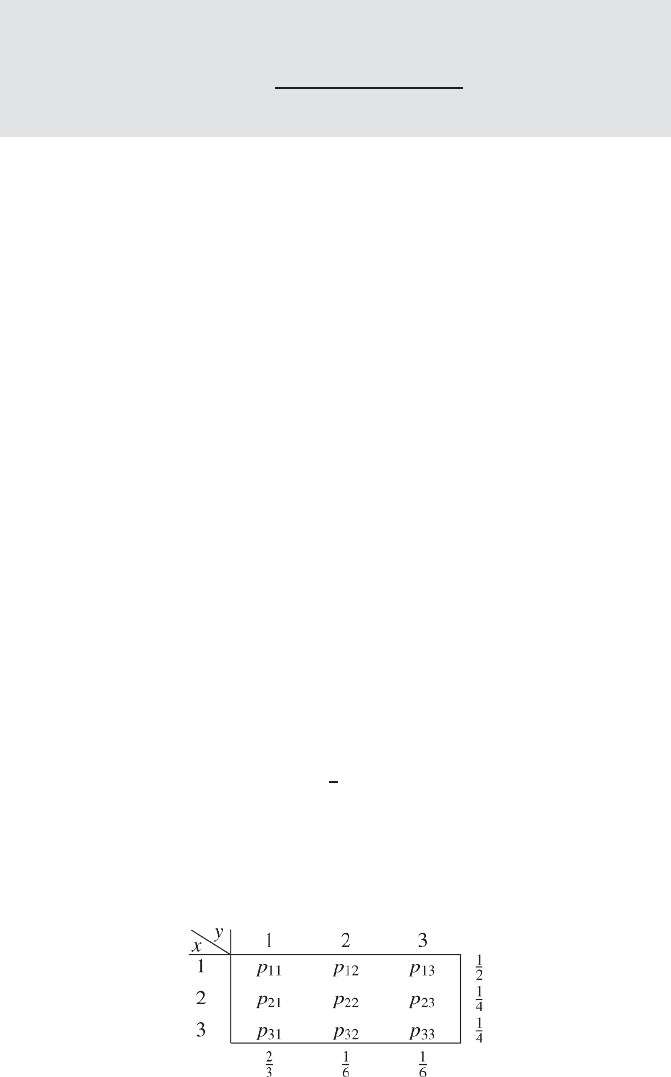
12.4 Maximum entropy with marginals. What is the maximum en-
tropy distribution p(x, y) that has the following marginals?
422 MAXIMUM ENTROPY
(Hint: You may wish to guess and verify a more general result.)
12.5 Processes with fixed marginals. Consider the set of all densities
with fixed pairwise marginals f
X
1
,X
2
(x
1
,x
2
), f
X
2
,X
3
(x
2
,x
3
),...,
f
X
n−1
,X
n
(x
n−1
,x
n
). Show that the maximum entropy process with
these marginals is the first-order (possibly time-varying) Markov
process with these marginals. Identify the maximizing f
∗
(x
1
,x
2
,
...,x
n
).
12.6 Every density is a maximum entropy density .Letf
0
(x) be a
given density. Given r(x),letg
α
(x) be the density maximizing
h(X) over all f satisfying
f (x)r(x)dx = α.Nowletr(x) =
ln f
0
(x). Show that g
α
(x) = f
0
(x) for an appropriate choice α =
α
0
. Thus, f
0
(x) is a maximum entropy density under the constraint
f ln f
0
= α
0
.
12.7 Mean-squared error.Let{X
i
}
n
i=1
satisfy EX
i
X
i+k
= R
k
,k =
0, 1,...,p. Consider linear predictors for X
n
;thatis,
ˆ
X
n
=
n−1
i=1
b
i
X
n−i
.
Assume that n>p.Find
max
f(x
n
)
min
b
E(X
n
−
ˆ
X
n
)
2
,
where the minimum is over all linear predictors b and the maxi-
mum is over all densities f satisfying R
0
,...,R
p
.
12.8 Maximum entropy characteristic functions. We ask for the max-
imum entropy density f(x),0 ≤ x ≤ a, satisfying a constraint on
the characteristic function (u) =
a
0
e
iux
f(x)dx. The answers
need be given only in parametric form.
(a) Find the maximum entropy f satisfying
a
0
f(x)cos(u
0
x)dx
= α, at a specified point u
0
.
(b) Find the maximum entropy f satisfying
a
0
f(x)sin(u
0
x)dx
= β.
(c) Find the maximum entropy density f(x),0 ≤ x ≤ a, having a
given value of the characteristic function (u
0
) at a specified
point u
0
.
(d) What problem is encountered if a =∞?

PROBLEMS 423
12.9 Maximum entropy processes
(a) Find the maximum entropy rate binary stochastic process
{X
i
}
∞
i=−∞
,X
i
∈{0, 1}, satisfying Pr{X
i
= X
i+1
}=
1
3
for
all i.
(b) What is the resulting entropy rate?
12.10 Maximum entropy of sums.LetY = X
1
+ X
2
. Find the maxi-
mum entropy density for Y under the constraint EX
2
1
= P
1
, EX
2
2
= P
2
:
(a) If X
1
and X
2
are independent.
(b) If X
1
and X
2
are allowed to be dependent.
(c) Prove part (a).
12.11 Maximum entropy Markov chain.Let{X
i
} be a stationary
Markov chain with X
i
∈{1, 2, 3}.LetI(X
n
;X
n+2
) = 0foralln.
(a) What is the maximum entropy rate process satisfying this
constraint?
(b) What if I(X
n
;X
n+2
) = α for all n for some given value of
α,0≤ α ≤ log 3?
12.12 Entropy bound on prediction error.Let{X
n
} be an arbitrary real
valued stochastic process. Let
ˆ
X
n+1
= E{X
n+1
|X
n
}. Thus the con-
ditional mean
ˆ
X
n+1
is a random variable depending on the n-past
X
n
.Here
ˆ
X
n+1
is the minimum mean squared error prediction of
X
n+1
given the past.
(a) Find a lower bound on the conditional variance E{E{(X
n+1
−
ˆ
X
n+1
)
2
|X
n
}} in terms of the conditional differential entropy
h(X
n+1
|X
n
).
(b) Is equality achieved when {X
n
} is a Gaussian stochastic pro-
cess?
12.13 Maximum entropy rate. What is the maximum entropy rate sto-
chastic process {X
i
} over the symbol set {0, 1} for which the
probability that 00 occurs in a sequence is zero?
12.14 Maximum entropy
(a) What is the parametric-form maximum entropy density f(x)
satisfying the two conditions
EX
8
= a, EX
16
= b?
(b) What is the maximum entropy density satisfying the condition
E(X
8
+ X
16
) = a + b?
(c) Which entropy is higher?
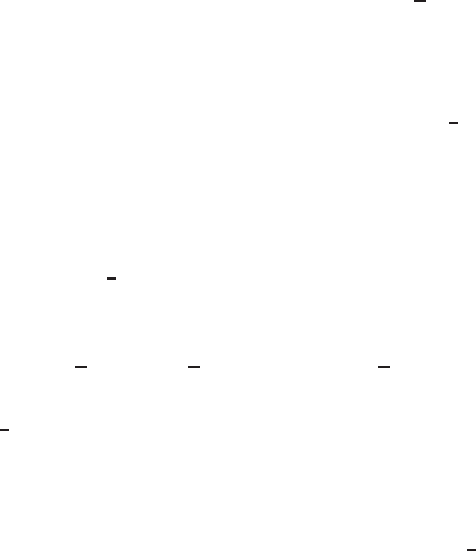
424 MAXIMUM ENTROPY
12.15 Maximum entropy. Find the parametric form of the maximum
entropy density f satisfying the Laplace transform condition
f(x)e
−x
dx = α,
and give the constraints on the parameter.
12.16 Maximum entropy processes. Consider the set of all stochastic
processes with {X
i
},X
i
∈ R, with
R
0
= EX
2
i
= 1,R
1
= EX
i
X
i+1
=
1
2
.
Find the maximum entropy rate.
12.17 Binary maximum entropy. Consider a binary process {X
i
},X
i
∈
{−1, +1}, with R
0
= EX
2
i
= 1andR
1
= EX
i
X
i+1
=
1
2
.
(a) Find the maximum entropy process with these constraints.
(b) What is the entropy rate?
(c) Is there a Bernoulli process satisfying these constraints?
12.18 Maximum entropy. Maximize h(Z, V
x
,V
y
,V
z
) subject to the en-
ergy constraint E(
1
2
mV
2
+ mgZ) = E
0
. Show that the resulting
distribution yields
E
1
2
mV
2
=
3
5
E
0
,EmgZ=
2
5
E
0
.
Thus,
2
5
of the energy is stored in the potential field, regardless of
its strength g.
12.19 Maximum entropy discrete processes
(a) Find the maximum entropy rate binary stochastic process
{X
i
}
∞
i=−∞
,X
i
∈{0, 1}, satisfying Pr{X
i
= X
i+1
}=
1
3
for all
i.
(b) What is the resulting entropy rate?
12.20 Maximum entropy of sums.LetY = X
1
+ X
2
. Find the maxi-
mum entropy of Y under the constraint EX
2
1
= P
1
,EX
2
2
= P
2
:
(a) If X
1
and X
2
are independent.
(b) If X
1
and X
2
are allowed to be dependent.