
Thomas M. Cover, Joy A. Thomas. Elements of information theory
Подождите немного. Документ загружается.

HISTORICAL NOTES 425
12.21 Entropy rate
(a) Find the maximum entropy rate stochastic process {X
i
} with
EX
2
i
= 1,EX
i
X
i+2
= α, i = 1, 2,.... Be careful.
(b) What is the maximum entropy rate?
(c) What is EX
i
X
i+1
for this process?
12.22 Minimum expected value
(a) Find the minimum value of EX over all probability density
functions f(x) satisfying the following three constraints:
(i) f(x) = 0forx ≤ 0.
(ii)
∞
−∞
f(x)dx = 1.
(iii) h(f ) = h.
(b) Solve the same problem if (i) is replaced by
(i
) f(x) = 0forx ≤ a.
HISTORICAL NOTES
The maximum entropy principle arose in statistical mechanics in the
nineteenth century and has been advocated for use in a broader con-
text by Jaynes [294]. It was applied to spectral estimation by Burg [80].
The information-theoretic proof of Burg’s theorem is from Choi and
Cover [98].

CHAPTER 13
UNIVERSAL SOURCE CODING
Here we develop the basics of universal source coding. Minimax regret
data compression is defined, and the descriptive cost of universality is
shown to be the information radius of the relative entropy ball containing
all the source distributions. The minimax theorem shows this radius to
be the channel capacity for the associated channel given by the source
distribution. Arithmetic coding enables the use of a source distribution
that is learned on the fly. Finally, individual sequence compression is
defined and achieved by a succession of Lempel–Ziv parsing algorithms.
In Chapter 5 we introduced the problem of finding the shortest rep-
resentation of a source, and showed that the entropy is the fundamental
lower limit on the expected length of any uniquely decodable represen-
tation. We also showed that if we know the probability distribution for
the source, we can use the Huffman algorithm to construct the optimal
(minimal expected length) code for that distribution.
For many practical situations, however, the probability distribution
underlying the source may be unknown, and we cannot apply the methods
of Chapter 5 directly. Instead, all we know is a class of distributions. One
possible approach is to wait until we have seen all the data, estimate the
distribution from the data, use this distribution to construct the best code,
and then go back to the beginning and compress the data using this code.
This two-pass procedure is used in some applications where there is a
fairly small amount of data to be compressed. But there are many situa-
tions in which it is not feasible to make two passes over the data, and it
is desirable to have a one-pass (or online) algorithm to compress the data
that “learns” the probability distribution of the data and uses it to com-
press the incoming symbols. We show the existence of such algorithms
that do well for any distribution within a class of distributions.
In yet other cases, there is no probability distribution underlying the
data—all we are given is an individual sequence of outcomes. Examples
Elements of Information Theory, Second Edition, By Thomas M. Cover and Joy A. Thomas
Copyright 2006 John Wiley & Sons, Inc.
427

428 UNIVERSAL SOURCE CODING
of such data sources include text and music. We can then ask the question:
How well can we compress the sequence? If we do not put any restric-
tions on the class of algorithms, we get a meaningless answer—there
always exists a function that compresses a particular sequence to one
bit while leaving every other sequence uncompressed. This function is
clearly “overfitted” to the data. However, if we compare our performance
to that achievable by optimal word assignments with respect to Bernoulli
distributions or kth-order Markov processes, we obtain more interesting
answers that are in many ways analogous to the results for the probabilis-
tic or average case analysis. The ultimate answer for compressibility for
an individual sequence is the Kolmogorov complexity of the sequence,
which we discuss in Chapter 14.
We begin the chapter by considering the problem of source coding as
a game in which the coder chooses a code that attempts to minimize
the average length of the representation and nature chooses a distribution
on the source sequence. We show that this game has a value that is
related to the capacity of a channel with rows of its transition matrix that
are the possible distributions on the source sequence. We then consider
algorithms for encoding the source sequence given a known or “estimated”
distribution on the sequence. In particular, we describe arithmetic coding,
which is an extension of the Shannon–Fano–Elias code of Section 5.9
that permits incremental encoding and decoding of sequences of source
symbols.
We then describe two basic versions of the class of adaptive dictionary
compression algorithms called Lempel–Ziv, based on the papers by Ziv
and Lempel [603, 604]. We provide a proof of asymptotic optimality for
these algorithms, showing that in the limit they achieve the entropy rate
for any stationary ergodic source. In Chapter 16 we extend the notion of
universality to investment in the stock market and describe online portfolio
selection procedures that are analogous to the universal methods for data
compression.
13.1 UNIVERSAL CODES AND CHANNEL CAPACITY
Assume that we have a random variable X drawn according to a dis-
tribution from the family {p
θ
}, where the parameter θ ∈{1, 2,...,m} is
unknown. We wish to find an efficient code for this source.
From the results of Chapter 5, if we know θ, we can construct a code
with codeword lengths l(x) = log
1
p
θ
(x)
, achieving an average codeword

13.1 UNIVERSAL CODES AND CHANNEL CAPACITY 429
length equal to the entropy H
θ
(x) =−
x
p
θ
(x) log p
θ
(x), and this is the
best that we can do. For the purposes of this section, we will ignore the
integer constraints on l(x), knowing that applying the integer constraint
will cost at most one bit in expected length. Thus,
min
l(x)
E
p
θ
[l(X)] = E
p
θ
log
1
p
θ
(X)
= H(p
θ
). (13.1)
What happens if we do not know the true distribution p
θ
,yetwishto
code as efficiently as possible? In this case, using a code with codeword
lengths l(x) and implied probability q(x) = 2
−l(x)
, we define the redun-
dancy of the code as the difference between the expected length of the
code and the lower limit for the expected length:
R(p
θ
,q) = E
p
θ
[l(X)] − E
p
θ
log
1
p
θ
(X)
(13.2)
=
x
p
θ
(x)
l(x) − log
1
p(x)
(13.3)
=
x
p
θ
(x)
log
1
q(x)
− log
1
p(x)
(13.4)
=
x
p
θ
(x) log
p
θ
(x)
q(x)
(13.5)
= D(p
θ
q), (13.6)
where q(x) = 2
−l(x)
is the distribution that corresponds to the codeword
lengths l(x).
We wish to find a code that does well irrespective of the true distribution
p
θ
, and thus we define the minimax redundancy as
R
∗
= min
q
max
p
θ
R(p
θ
,q) = min
q
max
p
θ
D(p
θ
q). (13.7)
This minimax redundancy is achieved by a distribution q that is at the
“center” of the information ball containing the distributions p
θ
,thatis,
the distribution q whose maximum distance from any of the distributions
p
θ
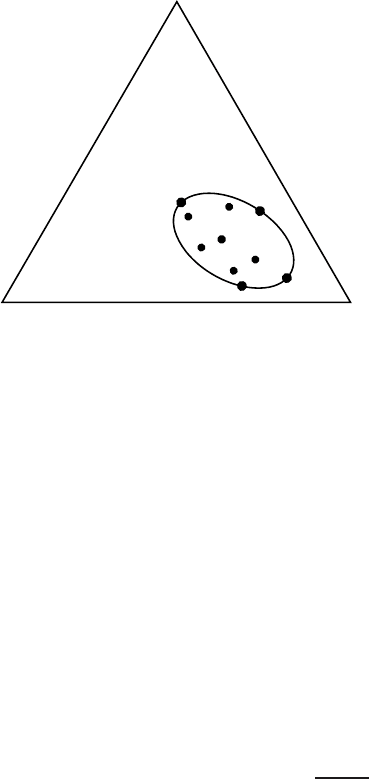
is minimized (Figure 13.1).
To find the distribution q that is as close as possible to all the possible
p
θ
in relative entropy, consider the following channel:
430 UNIVERSAL SOURCE CODING
p
1
q
*
p
m
FIGURE 13.1. Minimum radius information ball containing all the p
θ
’s
θ →
...p
1
...
...p
2
...
.
.
.
...p
θ
...
.
.
.
...p
m
...
→ X. (13.8)
This is a channel {θ,p
θ
(x), X} with the rows of the transition matrix equal
to the different p
θ
’s, the possible distributions of the source. We will show
that the minimax redundancy R
∗
is equal to the capacity of this channel,
and the corresponding optimal coding distribution is the output distribution
of this channel induced by the capacity-achieving input distribution. The
capacity of this channel is given by
C = max
π(θ)
I(θ;X) = max
π(θ)
θ
π(θ)p
θ
(x) log
p
θ
(x)
q
π
(x)
, (13.9)
where
q
π
(x) =
θ
π(θ)p
θ
(x). (13.10)
The equivalence of R
∗
and C is expressed in the following theorem:
Theorem 13.1.1 (Gallager [229], Ryabko [450]) The capacity of a
channel p(x|θ) with rows p
1
,p
2
,...,p
m
is given by
C = R
∗
= min
q
max
θ
D(p
θ
q). (13.11)

13.1 UNIVERSAL CODES AND CHANNEL CAPACITY 431
The distribution q that achieves the minimum in (13.11) is the output
distribution q
∗
(x) induced be the capacity-achieving input distribution
π
∗
(θ):
q
∗
(x) = q
π
∗
(x) =
θ
π
∗
(θ)p
θ
(x). (13.12)
Proof: Let π(θ) be an input distribution on θ ∈{1, 2,...,m},andlet
the induced output distribution be q
π
:
(q
π
)
j
=
m
i=1
π
i
p
ij
, (13.13)
where p
ij
= p
θ
(x) for θ = i, x = j . Then for any distribution q on the
output, we have
I
π
(θ;X) =
i,j
π
i
p
ij
log
p
ij
(q
π
)
j
(13.14)
=
i
π
i
D(p
i
q
π
) (13.15)
=
i,j
π
i
p
ij
log
p
ij
q
j
q
j
(q
π
)
j
(13.16)
=
i,j
π
i
p
ij
log
p
ij
q
j
+
i,j
π
i
p
ij
log
q
j
(q
π
)
j
(13.17)
=
i,j
π
i
p
ij
log
p
ij
q
j
+
j
(q
π
)
j
log
q
j
(q
π
)
j
(13.18)
=
i,j
π
i
p
ij
log
p
ij
q
j
− D(q
π
q) (13.19)
=
i
π
i
D(p
i
q) − D(q
π
q) (13.20)
≤
i
π
i
D(p
i
q) (13.21)
for all q, with equality iff q = q
π
. Thus, for all q,
i
π
i
D(p
i
q) ≥
i
π
i
D(p
i
q
π
), (13.22)
432 UNIVERSAL SOURCE CODING
and therefore
I
π
(θ;X) = min
q
i
π
i
D(p
i
q) (13.23)
is achieved when q = q
π
. Thus, the output distribution that minimizes the
average distance to all the rows of the transition matrix is the the output
distribution induced by the channel (Lemma 10.8.1).
The channel capacity can now be written as
C = max
π
I
π
(θ;X) (13.24)
= max
π
min
q
i
π
i
D(p
i
q). (13.25)
We can now apply a fundamental theorem of game theory, which states
that for a continuous function f (x, y), x ∈
X, y ∈ Y,iff (x, y) is convex
in x and concave in y,and
X, Y are compact convex sets, then
min
x∈X
max
y∈Y
f (x,y) = max
y∈Y
min
x∈X
f (x,y). (13.26)
The proof of this minimax theorem can be found in [305, 392].
By convexity of relative entropy (Theorem 2.7.2),
i
π
i
D(p
i
q) is
convex in q and concave in π, and therefore
C = max
π
min
q
i
π
i
D(p
i
q) (13.27)
= min
q
max
π
i
π
i
D(p
i
q) (13.28)
= min
q
max
i
D(p
i
q), (13.29)
where the last equality follows from the fact that the maximum is achieved
by putting all the weight on the index i maximizing D(p
i
q) in (13.28).
It also follows that q
∗
= q
π
∗
. This completes the proof.
Thus, the channel capacity of the channel from θ to X is the minimax
expected redundancy in source coding.
Example 13.1.1 Consider the case when
X ={1, 2, 3} and θ takes only
two values, 1 and 2, and the corresponding distributions are p
1
= (1 −α,
α, 0) and p
2
= (0,α,1 − α). We would like to encode a sequence of
symbols from
X without knowing whether the distribution is p
1
or p
2
.
The arguments above indicate that the worst-case optimal code uses the

13.2 UNIVERSAL CODING FOR BINARY SEQUENCES 433
codeword lengths corresponding to the distribution that has a minimal
relative entropy distance from both distributions, in this case, the midpoint
of the two distributions. Using this distribution, q =
1−α
2
,α,
1−α
2
,we
achieve a redundancy of
D(p
1
q) = D(p
2
q) = (1 − α) log
1 − α
(1 − α)/2
+ α log
α
α
+ 0 = 1 − α.
(13.30)
The channel with transition matrix rows equal to p
1
and p
2
is equivalent
to the erasure channel (Section 7.1.5), and the capacity of this channel can
easily be calculated to be (1 −α), achieved with a uniform distribution on
the inputs. The output distribution corresponding to the capacity-achieving
input distribution is equal to
1−α
2
,α,
1−α
2
(i.e., the same as the distri-
bution q above). Thus, if we don’t know the distribution for this class of
sources, we code using the distribution q rather than p
1
or p
2
,andincur
an additional cost of 1 − α bits per source symbol above the ideal entropy
bound.
13.2 UNIVERSAL CODING FOR BINARY SEQUENCES
Now we consider an important special case of encoding a binary sequence
x
n
∈{0, 1}
n
. We do not make any assumptions about the probability dis-
tribution for x
1
,x
2
,...,x
n
.
We begin with bounds on the size of
n
k
, taken from Wozencraft and
Reiffen [567] proved in Lemma 17.5.1: For k = 0orn,
n
8k(n − k)
≤
n
k
2
−nH (k/n)
≤
n
πk(n − k)
. (13.31)
We first describe an offline algorithm to describe the sequence; we
count the number of 1’s in the sequence, and after we have seen the entire
sequence, we send a two-stage description of the sequence. The first stage
is a count of the number of 1’s in the sequence [i.e., k =
i
x
i
(using
log(n + 1) bits)], and the second stage is the index of this sequence
among all sequences that have k 1’s (using log
n
k
bits). This two-stage
description requires total length
l(x
n
) ≤ log(n + 1) + log
n
k
+ 2 (13.32)
≤ log n + nH
k
n
−
1
2
log n −
1
2
log
π
k
n
(n − k)
n
+ 3 (13.33)
434 UNIVERSAL SOURCE CODING
= nH
k
n
+
1
2
log n −
1
2
log
π
k
n
n − k
n
+ 3. (13.34)
Thus, the cost of describing the sequence is approximately
1
2
log n bits
above the optimal cost with the Shannon code for a Bernoulli distribution
corresponding to k/n. The last term is unbounded at k = 0ork = n,so
the bound is not useful for these cases (the actual description length is
log(n + 1) bits, whereas the entropy H(k/n) = 0whenk = 0ork = n).
This counting approach requires the compressor to wait until he has
seen the entire sequence. We now describe a different approach using a
mixture distribution that achieves the same result on the fly. We choose
the coding distribution q(x
1
,x
2
,...,x
n
) = 2
−l(x
1
,x
2
,...,x
n
)
to be a uniform
mixture of all Bernoulli(θ) distributions on x
1
,x
2
,...,x
n
. We will analyze
the performance of a code using this distribution and show that such codes
perform well for all input sequences.
We construct this distribution by assuming that θ , the parameter of
the Bernoulli distribution is drawn according to a uniform distribution on
[0, 1]. The probability of a sequence x
1
,x
2
,...,x
n
with k ones is θ
k
(1 −
θ)
n−k
under the Bernoulli(θ) distribution. Thus, the mixture probability
of the sequence is
p(x
1
,x
2
,...,x
n
) =
1
0
θ
k
(1 − θ)
n−k
dθ
= A(n, k). (13.35)
Integrating by parts, setting u = (1 − θ)
n−k
and dv = θ
k
dθ,wehave
1
0
θ
k
(1 − θ)
n−k
dθ =
1
k + 1
θ
k+1
(1 − θ)
n−k
1
0
+
n − k
k + 1
1
0
θ
k+1
(1 − θ)
n−k−1
dθ, (13.36)
or
A(n, k) =
n − k
k + 1
A(n, k + 1). (13.37)
Now A(n, n) =
1
0
θ
n
dθ =
1
n+1
, and we can easily verify from the recur-
sion that
p(x
1
,x
2
,...,x
n
) = A(n, k) =
1
n + 1
1
n
k
. (13.38)