
Thomas M. Cover, Joy A. Thomas. Elements of information theory
Подождите немного. Документ загружается.

13.2 UNIVERSAL CODING FOR BINARY SEQUENCES 435
The codeword length with respect to the mixture distribution is
log
1
q(x
n
)
≤ log(n + 1) + log
n
k
+ 1, (13.39)
which is within one bit of the length of the two-stage description above.
Thus, we have a similar bound on the codeword length
l(x
1
,x
2
,...,x
n
) ≤ H
k
n
+
1
2
log n −
1
2
log
π
k
n
(n − k)
n
+ 2 (13.40)
for all sequences x
1
,x
2
,...,x
n
. This mixture distribution achieves a code-
word length within
1
2
log n bits of the optimal code length nH (k/n) that
would be required if the source were really Bernoulli(k/n), without any
assumptions about the distribution of the source.
This mixture distribution yields a nice expression for the conditional prob-
ability of the next symbol given the previous symbols of x
1
,x
2
,...,x
n
.Let
k
i
be the number of 1’s in the first i symbols of x
1
,x
2
,...,x
n
. Using (13.38),
we have
q(x
i+1
= 1|x
i
) =
q(x
i
, 1)
q(x
i
)
(13.41)
=
1
i + 2
1
i+1
k
i
+1
1
i + 1
1
i
k
i
(13.42)
=
1
i + 2
(k
i
+ 1)!(n − k
i
)!
(i + 1)!
(i + 1)
k
i
!(i − k
i
)!
i!
(13.43)
=
k
i
+ 1
i + 2
. (13.44)
This is the Bayesian posterior probability of 1 given the uniform prior
on θ , and is called the Laplace estimate for the probability of the next
symbol. We can use this posterior probability as the probability of the next
symbol for arithmetic coding, and achieve the codeword length log
1
q(x
n
)
in a sequential manner with finite-precision arithmetic. This is a horizon-
free result, in that the procedure does not depend on the length of the
sequence.
One issue with the uniform mixture approach or the two-stage approach
is that the bound does not apply for k = 0ork = n. The only uni-
form bound that we can give on the extra redundancy is log n,which
we can obtain by using the bounds of (11.40). The problem is that
436 UNIVERSAL SOURCE CODING
we are not assigning enough probability to sequences with k = 0or
k = n. If instead of using a uniform distribution on θ ,weusedthe
Dirichlet
1
2
,
1
2
distribution, also called the Beta
1
2
,
1
2
distribution, the
probability of a sequence x
1
,x
2
,...,x
n
becomes
q
1
2
(x
n
) =
1
0
θ
k
(1 − θ)
n−k
1
π
√
θ(1 − θ)
dθ (13.45)
and it can be shown that this achieves a description length
log
1
q
1
2
(x
n
)
≤ H(k/n)+
1
2
log n + log
π
8
(13.46)
for all x
n
∈{0, 1}
n
, achieving a uniform bound on the redundancy of the
universal mixture code. As in the case of the uniform prior, we can cal-
culate the conditional distribution of the next symbol, given the previous
observations, as
q
1
2
(x
i+1
= 1|x
i
) =
k
i
+
1
2
i + 1
, (13.47)
which can be used with arithmetic coding to provide an online algorithm
to encode the sequence. We will analyze the performance of the mix-
ture algorithm in greater detail when we analyze universal portfolios in
Section 16.7.
13.3 ARITHMETIC CODING
The Huffman coding procedure described in Chapter 5 is optimal for
encoding a random variable with a known distribution that has to be
encoded symbol by symbol. However, due to the fact that the codeword
lengths for a Huffman code were restricted to be integral, there could be a
loss of up to 1 bit per symbol in coding efficiency. We could alleviate this
loss by using blocks of input symbols—however, the complexity of this
approach increases exponentially with block length. We now describe a
method of encoding without this inefficiency. In arithmetic coding, instead
of using a sequence of bits to represent a symbol, we represent it by a
subinterval of the unit interval.
The code for a sequence of symbols is an interval whose length decreases
as we add more symbols to the sequence. This property allows us to have a
coding scheme that is incremental (the code for an extension to a sequence
can be calculated simply from the code for the original sequence) and for
which the codeword lengths are not restricted to be integral. The motivation

13.3 ARITHMETIC CODING 437
for arithmetic coding is based on Shannon–Fano–Elias coding (Section 5.9)
and the following lemma:
Lemma 13.3.1 Let Y be a random variable with continuous probability
distribution function F(y).LetU = F(Y)(i.e., U is a function of Y defined
by its distribution function). Then U is uniformly distributed on [0, 1].
Proof: Since F(y) ∈ [0, 1], the range of U is [0, 1]. Also, for u ∈ [0, 1],
F
U
(u) = Pr(U ≤ u) (13.48)
= Pr(F (Y ) ≤ u) (13.49)
= Pr(Y ≤ F
−1
(u)) (13.50)
= F(F
−1
(u)) (13.51)
= u, (13.52)
which proves that U has a uniform distribution in [0, 1].
Now consider an infinite sequence of random variables X
1
,X
2
,...from
a finite alphabet
X = 0, 1, 2,...,m. For any sequence x
1
,x
2
,..., from
this alphabet, we can place 0. in front of the sequence and consider it as
a real number (base m + 1) between 0 and 1. Let X be the real-valued
random variable X = 0.X
1
X
2
....ThenX has the following distribution
function:
F
X
(x) = Pr{X ≤ x = 0.x
1
x
2
···} (13.53)
= Pr{0.X
1
X
2
···≤0.x
1
x
2
···} (13.54)
= Pr{X
1
<x
1
}+Pr{X
1
= x
1
,X
2
<x
2
}+···. (13.55)
Now let U = F
X
(X) = F
X
(0.X
1
X
2
...) = 0.F
1
F
2
.... If the distribution
on infinite sequences X
∞
has no atoms, then, by the lemma above, U has a
uniform distribution on [0, 1], and therefore the bits F
1
F
2
...in the binary
expansion of U are Bernoulli(
1
2
) (i.e., they are independent and uniformly
distributed on {0, 1}). These bits are therefore incompressible, and form a
compressed representation of the sequence 0.X
1
X
2
.... For Bernoulli or
Markov models, it is easy to calculate the cumulative distribution function,
as illustrated in the following example.
Example 13.3.1 Let X
1
,X
2
,...,X
n
be Bernoulli(p). Then the sequence
x
n
= 110101 maps into
438 UNIVERSAL SOURCE CODING
F(x
n
) = Pr(X
1
< 1) + Pr(X
1
= 1,X
2
< 1)
+ Pr(X
1
= 1,X
2
= 1,X
3
< 0)
+ Pr(X
1
= 1,X
2
= 1,X
3
= 0,X
4
< 1)
+ Pr(X
1
= 1,X
2
= 1,X
3
= 0,X
4
= 1,X
5
< 0)
+ Pr(X
1
= 1,X
2
= 1,X
3
= 0,X
4
= 1,X
5
= 0,X
6
< 1)
(13.56)
= q + pq + p
2
·0 + p
2
q·q + p
2
qp·0 + p
2
qpqq (13.57)
= q + pq + p
2
q
2
+ p
3
q
3
. (13.58)
Note that each term is easily computed from the previous terms. In general,
for an arbitrary binary process {X
i
},
F(x
n
) =
n
k=1
p(x
k−1
0)x
k
. (13.59)
The probability transform thus forms an invertible mapping from infi-
nite source sequences to incompressible infinite binary sequences. We
now consider the compression achieved by this transformation on finite
sequences. Let X
1
,X
2
,...,X
n
be a sequence of binary random vari-
ables of length n,andletx
1
,x
2
,...,x
n
be a particular outcome. We
can treat this sequence as representing an interval [0.x
1
x
2
...x
n
000 ...,
0.x
1
x
2
...x
n
1111 ...), or equivalently, [0.x
1
x
2
...x
n
, 0.x
1
x
2
...x
n
+
(
1
2
)
n
). This is the set of infinite sequences that start with 0.x
1
x
2
···x
n
.
Under the probability transform, this interval gets mapped into another
interval, [F
Y
(0.x
1
x
2
···x
n
), F
Y
(0.x
1
x
2
···x
n
+ (
1
2
)
n
)), whose length is
equal to P
X
(x
1
,x
2
,...,x
n
), the sum of the probabilities of all infinite
sequences that start with 0.x
1
x
2
···x
n
. Under the probability inverse trans-
form, any real number u within this interval maps into a sequence that
starts with x
1
,x
2
,...,x
n
, and therefore given u and n, we can recon-
struct x
1
,x
2
,...,x
n
. The Shannon–Fano–Elias coding scheme described
earlier allows one to construct a prefix-free code of length log
1
p(x
1
,x
2
,...,x
n
)
+ 2 bits, and therefore it is possible to encode the sequence
x
1
,x
2
,...,x
n
with this length. Note that log
1
p(x
1
,...,x
n
)
is the ideal code-
word length for x
n
.
The process of encoding the sequence with the cumulative distribution
function described above assumes arbitrary accuracy for the computa-
tion. In practice, though, we have to implement all numbers with finite
precision, and we describe such an implementation. The key is to consider
13.3 ARITHMETIC CODING 439
not infinite-precision points for the cumulative distribution function but
intervals in the unit interval. Any finite-length sequence of symbols can
be said to correspond to a subinterval of the unit interval. The objective
of the arithmetic coding algorithm is to represent a sequence of random
variables by a subinterval in [0, 1]. As the algorithm observes more input
symbols, the length of the subinterval corresponding to the input sequence
decreases. As the top end of the interval and the bottom end of the inter-
val get closer, they begin to agree in the first few bits. These will be first
few bits of the output sequence. As soon as the two ends of the interval
agree, we can output the corresponding bits. We can therefore shift these
bits out of the calculation and effectively scale the remaining intervals so
that entire calculation can be done with finite precision. We will not go
into the details here—there is a very good description of the algorithm
and performance considerations in Bell et al. [41]
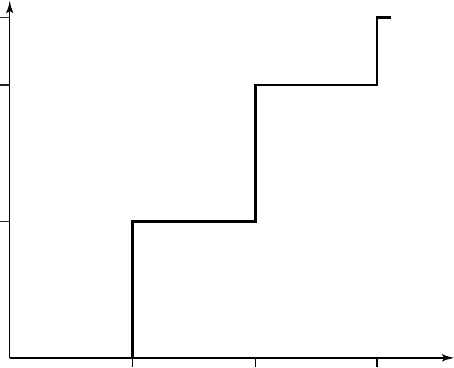
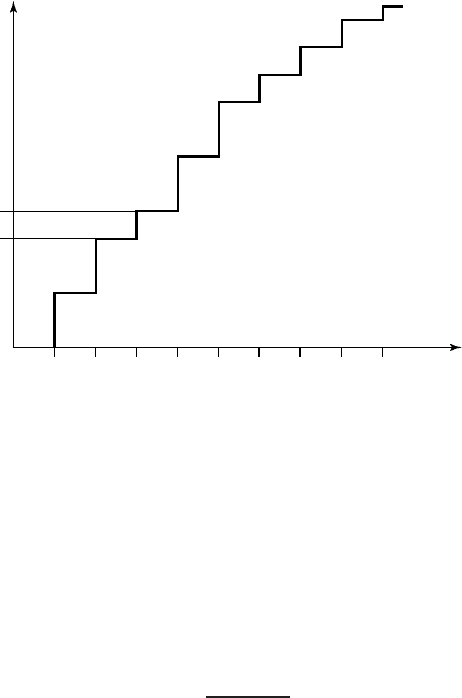
Example 13.3.2 (Arithmetic coding for a ternary input alphabet) Con-
sider a random variable X with a ternary alphabet {A, B, C},which
are assumed to have probabilities 0.4, 0.4, and 0.2, respectively. Let
the sequence to be encoded by ACAA. Thus, F
l
(·) = (0, 0.4, 0.8) and
F
h
(·) = (0.4, 0.8, 1.0). Initially, the input sequence is empty, and the cor-
responding interval is [0, 1). The cumulative distribution function after
the first input symbol is shown in Figure 13.2. It is easy to calculate that
the interval in the algorithm without scaling after the first symbol A is
A
1.0
0.8
0.4
B C
x
n
F
(
x
n
)
FIGURE 13.2. Cumulative distribution function after the first symbol.
440 UNIVERSAL SOURCE CODING
AA AB AC BA BB BC CA CB CC
x
n
F
(
x
n
)
0.32
0.4
FIGURE 13.3. Cumulative distribution function after the second symbol.
[0, 0.4); after the second symbol, C, it is [0.32, 0.4) (Figure 13.3); after
the third symbol A, it is [0.32,0.352); and after the fourth symbol A, it
is [0.32, 0.3328). Since the probability of this sequence is 0.0128, we
will use log(1/0.0128) + 2 (i.e., 9 bits) to encode the midpoint of the
interval sequence using Shannon–Fano–Elias coding (0.3264, which is
0.010100111 binary).
In summary, the arithmetic coding procedure, given any length n and
probability mass function q(x
1
x
2
···x
n
), enables one to encode the sequence
x
1
x
2
···x
n
in a code of length log
1
q(x
1
x
2
···x
n
)
+ 2 bits. If the source is i.i.d.
and the assumed distribution q is equal to the true distribution p of the data,
this procedure achieves an average length for the block that is within 2 bits
of the entropy. Although this is not necessarily optimal for any fixed block
length (a Huffman code designed for the distribution could have a lower
average codeword length), the procedure is incremental and can be used for
any blocklength.
13.4 LEMPEL–ZIV CODING
In Section 13.3 we discussed the basic ideas of arithmetic coding and
mentioned some results on worst-case redundancy for coding a sequence
from an unknown distribution. We now discuss a popular class of tech-
niques for source coding that are universally optimal (their asymptotic
13.4 LEMPEL–ZIV CODING 441
compression rate approaches the entropy rate of the source for any sta-
tionary ergodic source) and simple to implement. This class of algorithms
is termed Lempel–Ziv, named after the authors of two seminal papers
[603, 604] that describe the two basic algorithms that underlie this class.
The algorithms could also be described as adaptive dictionary compression
algorithms.
The notion of using dictionaries for compression dates back to the
invention of the telegraph. At the time, companies were charged by the
number of letters used, and many large companies produced codebooks for
the frequently used phrases and used the codewords for their telegraphic
communication. Another example is the notion of greetings telegrams
that are popular in India—there is a set of standard greetings such as
“25:Merry Christmas” and “26:May Heaven’s choicest blessings be show-
ered on the newly married couple.” A person wishing to send a greeting
only needs to specify the number, which is used to generate the actual
greeting at the destination.
The idea of adaptive dictionary-based schemes was not explored until
Ziv and Lempel wrote their papers in 1977 and 1978. The two papers
describe two distinct versions of the algorithm. We refer to these ver-
sions as LZ77 or sliding window Lempel–Ziv and LZ78 or tree-structured
Lempel–Ziv. (They are sometimes called LZ1 and LZ2, respectively.)
We first describe the basic algorithms in the two cases and describe
some simple variations. We later prove their optimality, and end with
some practical issues. The key idea of the Lempel–Ziv algorithm is to
parse the string into phrases and to replace phrases by pointers to where
the same string has occurred in the past. The differences between the
algorithms is based on differences in the set of possible match locations
(and match lengths) the algorithm allows.
13.4.1 Sliding Window Lempel–Ziv Algorithm
The algorithm described in the 1977 paper encodes a string by finding the
longest match anywhere within a window of past symbols and represents
the string by a pointer to location of the match within the window and the
length of the match. There are many variations of this basic algorithm,
and we describe one due to Storer and Szymanski [507].
We assume that we have a string x
1
,x
2
,... to be compressed from a
finite alphabet. A parsing S of a string x
1
x
2
···x
n
is a division of the
string into phrases, separated by commas. Let W be the length of the
window. Then the algorithm can be described as follows: Assume that
we have compressed the string until time i − 1. Then to find the next
phrase, find the largest k such that for some j, i − 1 − W ≤ j ≤ i − 1,
442 UNIVERSAL SOURCE CODING
the string of length k starting at x
j
is equal to the string (of length k)
starting at x
i
(i.e., x
j+l
= x
i+l
for all 0 ≤ l<k). The next phrase is then
of length k (i.e., x
i
...x
i+k−1
) and is represented by the pair (P , L),where
P is the location of the beginning of the match and L is the length of
the match. If a match is not found in the window, the next character is
sent uncompressed. To distinguish between these two cases, a flag bit
is needed, and hence the phrases are of two types: (F, P , L) or (F, C),
where C represents an uncompressed character.
Note that the target of a (pointer,length) pair could extend beyond the
window, so that it overlaps with the new phrase. In theory, this match
could be arbitrarily long; in practice, though, the maximum phrase length
is restricted to be less than some parameter.
For example, if W = 4 and the string is ABBABBABBBAABABA
and the initial window is empty, the string will be parsed as follows:
A,B,B,ABBABB,BA,A,BA,BA, which is represented by the sequence of
“pointers”: (0,A),(0,B),(1,1,1),(1,3,6),(1,4,2),(1,1,1),(1,3,2),(1,2,2), where
the flag bit is 0 if there is no match and 1 if there is a match, and the
location of the match is measured backward from the end of the window.
[In the example, we have represented every match within the window
using the (P , L) pair; however, it might be more efficient to represent
short matches as uncompressed characters. See Problem 13.8 for details.]
We can view this algorithm as using a dictionary that consists of all
substrings of the string in the window and of all single characters. The
algorithm finds the longest match within the dictionary and sends a pointer
to that match. We later show that a simple variation on this version of
LZ77 is asymptotically optimal. Most practical implementations of LZ77,
such as
gzip and pkzip, are also based on this version of LZ77.
13.4.2 Tree-Structured Lempel–Ziv Algorithms
In the 1978 paper, Ziv and Lempel described an algorithm that parses a
string into phrases, where each phrase is the shortest phrase not seen ear-
lier. This algorithm can be viewed as building a dictionary in the form of
a tree, where the nodes correspond to phrases seen so far. The algorithm is
particularly simple to implement and has become popular as one of the early
standard algorithms for file compression on computers because of its speed
and efficiency. It is also used for data compression in high-speed modems.
The source sequence is sequentially parsed into strings that have not
appeared so far. For example, if the string is ABBABBABBBAABABAA
..., we parse it as A,B,BA,BB,AB,BBA,ABA,BAA .... After every com-
ma, we look along the input sequence until we come to the shortest string
that has not been marked off before. Since this is the shortest such string,
13.5 OPTIMALITY OF LEMPEL–ZIV ALGORITHMS 443
all its prefixes must have occurred earlier. (Thus, we can build up a tree
of these phrases.) In particular, the string consisting of all but the last bit
of this string must have occurred earlier. We code this phrase by giving
the location of the prefix and the value of the last symbol. Thus, the string
above would be represented as (0,A),(0,B),(2,A),(2,B),(1,B),(4,A),(5,A),
(3,A), ....
Sending an uncompressed character in each phrase results in a loss of
efficiency. It is possible to get around this by considering the extension
character (the last character of the current phrase) as part of the next
phrase. This variation, due to Welch [554], is the basis of most practical
implementations of LZ78, such as
compress on Unix, in compression in
modems, and in the image files in the GIF format.
13.5 OPTIMALITY OF LEMPEL–ZIV ALGORITHMS
13.5.1 Sliding Window Lempel–Ziv Algorithms
In the original paper of Ziv and Lempel [603], the authors described the
basic LZ77 algorithm and proved that it compressed any string as well
as any finite-state compressor acting on that string. However, they did
not prove that this algorithm achieved asymptotic optimality (i.e., that the
compression ratio converged to the entropy for an ergodic source). This
result was proved by Wyner and Ziv [591].
The proof relies on a simple lemma due to Kac: the average length of
time that you need to wait to see a particular symbol is the reciprocal of
the probability of a symbol. Thus, we are likely to see the high-probability
strings within the window and encode these strings efficiently. The strings
that we do not find within the window have low probability, so that
asymptotically, they do not influence the compression achieved.
Instead of proving the optimality of the practical version of LZ77, we
will present a simpler proof for a different version of the algorithm, which,
though not practical, captures some of the basic ideas. This algorithm
assumes that both the sender and receiver have access to the infinite past
of the string, and represents a string of length n by pointing to the last
timeitoccurredinthepast.
We assume that we have a stationary and ergodic process defined
for time from −∞ to ∞, and that both the encoder and decoder have
access to ...,X
−2
,X
−1
, the infinite past of the sequence. Then to encode
X
0
,X
1
,...,X
n−1
(a block of length n), we find the last time we have
seen these n symbols in the past. Let
R
n
(X
0
,X
1
,...,X
n−1
) =
max{j<0:(X
−j
,X
−j +1
...X
−j +n−1
) = (X
0
,...,X
n−1
)}. (13.60)

444 UNIVERSAL SOURCE CODING
Then to represent X
0
,...,X
n−1
, we need only to send R
n
to the receiver,
who can then look back R
n
bits into the past and recover X
0
,...,X
n−1
.
Thus, the cost of the encoding is the cost of representing R
n
. We will show
that this cost is approximately log R
n
and that asymptotically
1
n
E log R
n
→ H(X), thus proving the asymptotic optimality of this algorithm.
We will need the following lemmas.
Lemma 13.5.1 There exists a prefix-free code for the integers such that
the length of the codeword for integer k is log k + 2loglogk + O(1).
Proof: If we knew that k ≤ m, we could encode k with log m bits. How-
ever, since we don’t have an upper limit for k, we need to tell the receiver
the length of the encoding of k (i.e., we need to specify log k). Consider
the following encoding for the integer k:Wefirstrepresentlog k in
unary, followed by the binary representation of k:
C
1
(k) = 00 ···0
log k 0’s
1 xx ···x
k in binary
. (13.61)
It is easy to see that the length of this representation is 2log k+1 ≤
2logk + 3. This is more than the length we are looking for since we are
using the very inefficient unary code to send log k. However, if we use C
1
to represent log k, it is now easy to see that this representation has a length
less than log k + 2loglogk + 4, which proves the lemma. A similar method
is presented in the discussion following Theorem 14.2.3.
The key result that underlies the proof of the optimality of LZ77 is
Kac’s lemma, which relates the average recurrence time to the proba-
bility of a symbol for any stationary ergodic process. For example, if
X
1
,X
2
,...,X
n
is an i.i.d. process, we ask what is the expected waiting
time to see the symbol a again, conditioned on the fact that X
1
= a.In
this case, the waiting time has a geometric distribution with parameter
p = p(X
0
= a), and thus the expected waiting time is 1/p(X
0
= a).The
somewhat surprising result is that the same is true even if the process is
not i.i.d., but stationary and ergodic. A simple intuitive reason for this
is that in a long sample of length n, we would expect to see a about
np (a ) times, and the average distance between these occurrences of a is
n/(np(a)) (i.e., 1/p(a)).
Lemma 13.5.2 (Kac) Let ...,U
2
,U
1
,U
0
,U
1
,... be a stationary
ergodic process on a countable alphabet. For any u such that p(u) > 0