
Thomas M. Cover, Joy A. Thomas. Elements of information theory
Подождите немного. Документ загружается.


13.5 OPTIMALITY OF LEMPEL–ZIV ALGORITHMS 445
and for i = 1, 2,...,let
Q
u
(i) = Pr
U
−i
= u;U
j
= u for − i<j<0|U
0
= u
(13.62)
[i.e., Q
u
(i) is the conditional probability that the most recent previous
occurrence of the symbol u is i, given that U
0
= u]. Then
E(R
1
(U )|X
0
= u) =
i
iQ
u
(i) =
1
p(u)
. (13.63)
Thus, the conditional expected waiting time to see the symbol u again,
looking backward from zero, is 1/p(u).
Note the amusing fact that the expected recurrence time
ER
1
(U ) =
p(u)
1
p(u)
= m, (13.64)
where m is the alphabet size.
Proof: Let U
0
= u. Define the events for j = 1, 2,...andk = 0, 1, 2,...:
A
jk
=
U
−j
= u, U
l
= u, −j<l<k,U
k
= u
. (13.65)
Event A
jk
corresponds to the event where the last time before zero at
which the process is equal to u is at −j , the first time after zero at which
the process equals u is k. These events are disjoint, and by ergodicity, the
probability Pr{∪
j,k
A
jk
}=1. Thus,
1 = Pr
∪
j,k
A
jk
(13.66)
(a)
=
∞
j=1
∞
k=0
Pr{A
jk
} (13.67)
=
∞
j=1
∞
k=0
Pr(U
k
= u) Pr
U
−j
= u, U
l
= u, −j<l<k|U
k
= u
(13.68)
(b)
=
∞
j=1
∞
k=0
Pr(U
k
= u)Q
u
(j + k) (13.69)

446 UNIVERSAL SOURCE CODING
(c)
=
∞
j=1
∞
k=0
Pr(U
0
= u)Q
u
(j + k) (13.70)
= Pr(U
0
= u)
∞
j=1
∞
k=0
Q
u
(j + k) (13.71)
(d)
= Pr(U
0
= u)
∞
i=1
iQ
u
(i), (13.72)
where (a) follows from the fact that the A
jk
are disjoint, (b) follows from
the definition of Q
u
(·), (c) follows from stationarity, and (d) follows from
the fact that there are i pairs (j, k) such that j +k = i in the sum. Kac’s
lemma follows directly from this equation.
Corollary Let ...,X
−1
,X
0
,X
1
,...be a stationary ergodic process and
let R
n
(X
0
,...,X
n−1
) be the recurrence time looking backward as defined
in (13.60). Then
E
R
n
(X
0
,...,X
n−1
)|(X
0
,...,X
n−1
) = x
n−1
0
=
1
p(x
n−1
0
)
. (13.73)
Proof: Define a new process with U
i
= (X
i
,X
i+1
,...,X
i+n−1
).TheU
process is also stationary and ergodic, and thus by Kac’s lemma the aver-
age recurrence time for U conditioned on U
0
= u is 1/p(u). Translating
this to the X process proves the corollary.
We are now in a position to prove the main result, which shows that
the compression ratio for the simple version of Lempel–Ziv using recur-
rence time approaches the entropy. The algorithm describes X
n−1
0
by
describing R
n
(X
n−1
0
), which by Lemma 13.5.1 can be done with log R
n
+
2loglogR
n
+ 4 bits. We now prove the following theorem.
Theorem 13.5.1 Let L
n
(X
n−1
0
) = log R
n
+ 2loglogR
n
+ O(1) be the
description length for X
n−1
0
in the simple algorithm described above. Then
1
n
EL
n
(X
n−1
0
) → H(X) (13.74)
as n →∞,whereH(
X) is the entropy rate of the process {X
i
}.
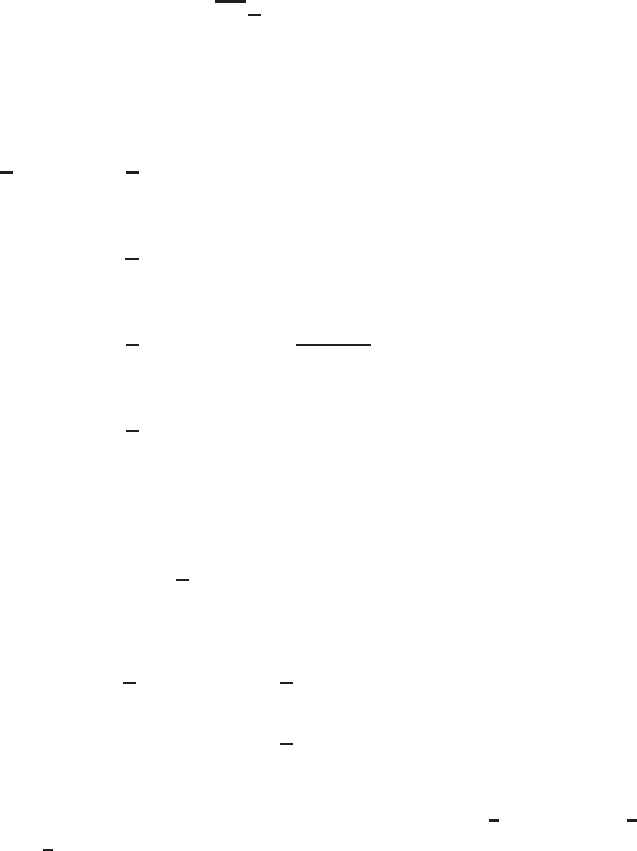
13.5 OPTIMALITY OF LEMPEL–ZIV ALGORITHMS 447
Proof: We will prove upper and lower bounds for EL
n
. The lower bound
follows directly from standard source coding results (i.e., EL
n
≥ nH for
any prefix-free code). To prove the upper bound, we first show that
lim
1
n
E log R
n
≤ H (13.75)
and later bound the other terms in the expression for L
n
. To prove the
bound for E log R
n
, we expand the expectation by conditioning on the
value of X
n−1
0
and then applying Jensen’s inequality. Thus,
1
n
E log R
n
=
1
n
x
n−1
0
p(x
n−1
0
)E[log R
n
(X
n−1
0
)|X
n−1
0
= x
n−1
0
] (13.76)
≤
1
n
x
n−1
0
p(x
n−1
0
) log E[R
n
(X
n−1
0
)|X
n−1
0
= x
n−1
0
] (13.77)
=
1
n
x
n−1
0
p(x
n−1
0
) log
1
p(x
n−1
0
)
(13.78)
=
1
n
H(X
n−1
0
) (13.79)
H(
X). (13.80)
The second term in the expression for L
n
is log log R
n
, and we wish to
show that
1
n
E[log log R
n
(X
n−1
0
)] → 0. (13.81)
Again, we use Jensen’s inequality,
1
n
E log log R
n
≤
1
n
log E[log R
n
(X
n−1
0
)] (13.82)
≤
1
n
log H(X
n−1
0
), (13.83)
where the last inequality follows from (13.79). For any >0, for large
enough n, H(X
n−1
0
)<n(H+ ), and therefore
1
n
log log R
n
<
1
n
log n +
1
n
log(H + ) → 0. This completes the proof of the
theorem.
Thus, a compression scheme that represents a string by encoding the
last time it was seen in the past is asymptotically optimal. Of course, this
scheme is not practical, since it assumes that both sender and receiver

448 UNIVERSAL SOURCE CODING
have access to the infinite past of a sequence. For longer strings, one
would have to look further and further back into the past to find a match.
For example, if the entropy rate is
1
2
and the string has length 200 bits,
one would have to look an average of 2
100
≈ 10
30
bits into the past to
find a match. Although this is not feasible, the algorithm illustrates the
basic idea that matching the past is asymptotically optimal. The proof of
the optimality of the practical version of LZ77 with a finite window is
based on similar ideas. We will not present the details here, but refer the
reader to the original proof in [591].
13.5.2 Optimality of Tree-Structured Lempel–Ziv Compression
We now consider the tree-structured version of Lempel–Ziv, where the
input sequence is parsed into phrases, each phrase being the shortest string
that has not been seen so far. The proof of the optimality of this algorithm
has a very different flavor from the proof for LZ77; the essence of the
proof is a counting argument that shows that the number of phrases cannot
be too large if they are all distinct, and the probability of any sequence of
symbols can be bounded by a function of the number of distinct phrases
in the parsing of the sequence.
The algorithm described in Section 13.4.2 requires two passes over the
string—in the first pass, we parse the string and calculate c(n), the number
of phrases in the parsed string. We then use that to decide how many bits
[log c(n)] to allot to the pointers in the algorithm. In the second pass, we
calculate the pointers and produce the coded string as indicated above.
The algorithm can be modified so that it requires only one pass over the
string and also uses fewer bits for the initial pointers. These modifications
do not affect the asymptotic efficiency of the algorithm. Some of the
implementation details are discussed by Welch [554] and Bell et al. [41].
We will show that like the sliding window version of Lempel–Ziv,
this algorithm asymptotically achieves the entropy rate for the unknown
ergodic source. We first define a parsing of the string to be a decomposition
into phrases.
Definition A parsing S of a binary string x
1
x
2
···x
n
is a division of the
string into phrases, separated by commas. A distinct parsing is a parsing
such that no two phrases are identical. For example, 0,111,1 is a distinct
parsing of 01111, but 0,11,11 is a parsing that is not distinct.
The LZ78 algorithm described above gives a distinct parsing of the
source sequence. Let c(n) denote the number of phrases in the LZ78
parsing of a sequence of length n. Of course, c(n) depends on the sequence
X
n
. The compressed sequence (after applying the Lempel–Ziv algorithm)

13.5 OPTIMALITY OF LEMPEL–ZIV ALGORITHMS 449
consists of a list of c(n) pairs of numbers, each pair consisting of a pointer
to the previous occurrence of the prefix of the phrase and the last bit of
the phrase. Each pointer requires log c(n) bits, and hence the total length
of the compressed sequence is c(n)[log c(n) + 1] bits. We now show that
c(n)(log c(n)+1)
n
→ H(X) for a stationary ergodic sequence X
1
,X
2
,...,X
n
.
Our proof is based on the simple proof of asymptotic optimality of LZ78
coding due to Wyner and Ziv [575].
Before we proceed to the details of the proof, we provide an outline
of the main ideas. The first lemma shows that the number of phrases in
a distinct parsing of a sequence is less than n/ log n; the main argument
in the proof is based on the fact that there are not enough distinct short
phrases. This bound holds for any distinct parsing of the sequence, not
just the LZ78 parsing.
The second key idea is a bound on the probability of a sequence based
on the number of distinct phrases. To illustrate this, consider an i.i.d.
sequence of random variables X
1
,X
2
,X
3
,X
4
that take on four possible
values, {A, B, C, D}, with probabilities p
A
, p
B
, p
C
,andp
D
, respec-
tively. Now consider the probability of a sequence P(D,A,B,C) =
p
D
p
A
p
B
p
C
.Sincep
A
+ p
B
+ p
C
+ p
D
= 1, the product p
D
p
A
p
B
p
C
is
maximized when the probabilities are equal (i.e., the maximum value of
the probability of a sequence of four distinct symbols is 1/256). On the
other hand, if we consider a sequence A, B, A, B, the probability of this
sequence is maximized if p
A
= p
B
=
1
2
, p
C
= p
D
= 0, and the maximum
probability for A, B, A, B is
1
16
. A sequence of the form A, A, A, A could
have a probability of 1. All these examples illustrate a basic point—se-
quences with a large number of distinct symbols (or phrases) cannot have
a large probability. Ziv’s inequality (Lemma 13.5.5) is the extension of
this idea to the Markov case, where the distinct symbols are the phrases
of the distinct parsing of the source sequence.
Since the description length of a sequence after the parsing grows as
c log c, the sequences that have very few distinct phrases can be com-
pressed efficiently and correspond to strings that could have a high prob-
ability. On the other hand, strings that have a large number of distinct
phrases do not compress as well; but the probability of these sequences
could not be too large by Ziv’s inequality. Thus, Ziv’s inequality enables
us to connect the logarithm of the probability of the sequence with the
number of phrases in its parsing, and this is finally used to show that the
tree-structured Lempel–Ziv algorithm is asymptotically optimal.
We first prove a few lemmas that we need for the proof of the theorem.
The first is a bound on the number of phrases possible in a distinct parsing
of a binary sequence of length n.

450 UNIVERSAL SOURCE CODING
Lemma 13.5.3 (Lempel and Ziv [604]) The number of phrases c(n) in
a distinct parsing of a binary sequence X
1
,X
2
,...,X
n
satisfies
c(n) ≤
n
(1 −
n
) log n
, (13.84)
where
n
= min{1,
log(log n)+4
log n
}→0 as n →∞.
Proof: Let
n
k
=
k
j=1
j2
j
= (k − 1)2
k+1
+ 2 (13.85)
be the sum of the lengths of all distinct strings of length less than or equal
to k. The number of phrases c in a distinct parsing of a sequence of length
n is maximized when all the phrases are as short as possible. If n = n
k
,
this occurs when all the phrases are of length ≤ k, and thus
c(n
k
) ≤
k
j=1
2
j
= 2
k+1
− 2 < 2
k+1
≤
n
k
k − 1
. (13.86)
If n
k
≤ n<n
k+1
, we write n = n
k
+ ,where<(k+ 1)2
k+1
.Then
the parsing into shortest phrases has each of the phrases of length ≤ k
and /(k + 1) phrases of length k + 1. Thus,
c(n) ≤
n
k
k − 1
+
k + 1
≤
n
k
+
k − 1
=
n
k − 1
. (13.87)
We now bound the size of k for a given n.Letn
k
≤ n<n
k+1
.Then
n ≥ n
k
= (k − 1)2
k+1
+ 2 ≥ 2
k
, (13.88)
and therefore
k ≤ log n. (13.89)
Moreover,
n ≤ n
k+1
= k2
k+2
+ 2 ≤ (k + 2)2
k+2
≤ (log n + 2)2
k+2
, (13.90)
by (13.89), and therefore
k + 2 ≥ log
n
log n + 2
, (13.91)
13.5 OPTIMALITY OF LEMPEL–ZIV ALGORITHMS 451
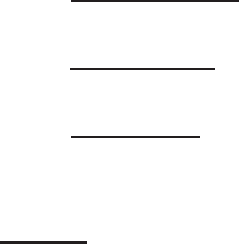
or for all n ≥ 4,
k − 1 ≥ log n − log(log n + 2) − 3 (13.92)
=
1 −
log(log n + 2) + 3
log n
log n (13.93)
≥
1 −
log(2logn) + 3
log n
log n (13.94)
=
1 −
log(log n) + 4
log n
log n (13.95)
=
(
1 −
n
)
log n. (13.96)
Note that
n
= min{1,
log(log n)+4
log n
}. Combining (13.96) with (13.87), we
obtain the lemma.
We will need a simple result on maximum entropy in the proof of the
main theorem.
Lemma 13.5.4 Let Z be a nonnegative integer-valued random variable
with mean µ. Then the entropy H(Z) is bounded by
H(Z) ≤ (µ + 1) log(µ + 1) − µ log µ. (13.97)
Proof: The lemma follows directly from the results of Theorem 12.1.1,
which show that the geometric distribution maximizes the entropy of a
nonnegative integer-valued random variable subject to a mean constraint.
Let {X
i
}
∞
i=−∞
be a binary stationary ergodic process with probabil-
ity mass function P(x
1
,x
2
,...,x
n
). (Ergodic processes are discussed in
greater detail in Section 16.8.) For a fixed integer k,definethekth-order
Markov approximation to P as
Q
k
(x
−(k−1)
,...,x
0
,x
1
,...,x
n
)
= P(x
0
−(k−1)
)
n
j=1
P(x
j
|x
j−1
j−k
), (13.98)
where x
j
i
= (x
i
,x
i+1
,...,x
j
), i ≤ j , and the initial state x
0
−(k−1)
will be
part of the specification of Q
k
.SinceP(X
n
|X
n−1
n−k
) is itself an ergodic

452 UNIVERSAL SOURCE CODING
process, we have
−
1
n
log Q
k
(X
1
,X
2
,...,X
n
|X
0
−(k−1)
) =−
1
n
n
j=1
log P(X
j
|X
j−1
j−k
)
(13.99)
→−E log P(X
j
|X
j−1
j−k
) (13.100)
= H(X
j
|X
j−1
j−k
). (13.101)
We will bound the rate of the LZ78 code by the entropy rate of the kth-
order Markov approximation for all k. The entropy rate of the Markov
approximation H(X
j
|X
j−1
j−k
) converges to the entropy rate of the process
as k →∞, and this will prove the result.
Suppose that X
n
−(k−1)
= x
n
−(k−1)
, and suppose that x
n
1
is parsed into c
distinct phrases, y
1
,y
2
,...,y
c
.Letν
i
be the index of the start of the
ith phrase (i.e., y
i
= x
ν
i+1
−1
ν
i
). For each i = 1, 2,...,c,defines
i
= x
ν
i
−1
ν
i
−k
.
Thus, s
i
is the k bits of x preceding y
i
. Of course, s
1
= x
0
−(k−1)
.
Let c
ls
be the number of phrases y
i
with length l and preceding state
s
i
= s for l = 1, 2,... and s ∈ X
k
.Wethenhave
l,s
c
ls
= c (13.102)
and
l,s
lc
ls
= n. (13.103)
We now prove a surprising upper bound on the probability of a string
based on the parsing of the string.
Lemma 13.5.5 (Ziv’s inequality) For any distinct parsing (in particu-
lar, the LZ78 parsing) of the string x
1
x
2
···x
n
, we have
log Q
k
(x
1
,x
2
,...,x
n
|s
1
) ≤−
l,s
c
ls
log c
ls
. (13.104)
Note that the right-hand side does not depend on Q
k
.
Proof: We write
Q
k
(x
1
,x
2
,...,x
n
|s
1
) = Q
k
(y
1
,y
2
,...,y
c
|s
1
) (13.105)
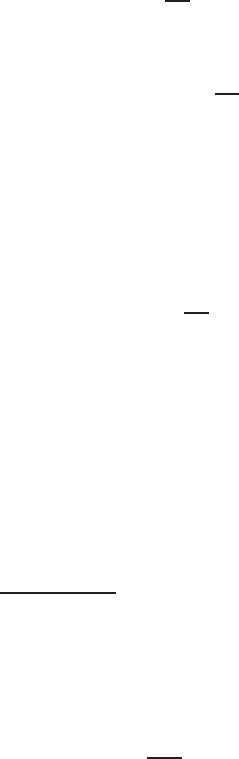
13.5 OPTIMALITY OF LEMPEL–ZIV ALGORITHMS 453
=
c
i=1
P(y
i
|s
i
) (13.106)
or
log Q
k
(x
1
,x
2
,...,x
n
|s
1
) =
c
i=1
log P(y
i
|s
i
) (13.107)
=
l,s
i:|y
i
|=l,s
i
=s
log P(y
i
|s
i
) (13.108)
=
l,s
c
ls
i:|y
i
|=l,s
i
=s
1
c
ls
log P(y
i
|s
i
) (13.109)
≤
l,s
c
ls
log
i:|y
i
|=l,s
i
=s
1
c
ls
P(y
i
|s
i
)
,
(13.110)
where the inequality follows from Jensen’s inequality and the concavity
of the logarithm.
Now since the y
i
are distinct, we have
i:|y
i
|=l,s
i
=s
P(y
i
|s
i
) ≤ 1. Thus,
log Q
k
(x
1
,x
2
,...,x
n
|s
1
) ≤
l,s
c
ls
log
1
c
ls
, (13.111)
proving the lemma.
We can now prove the main theorem.
Theorem 13.5.2 Let {X
n
} be a binary stationary ergodic process with
entropy rate H(
X), and let c(n) be the number of phrases in a distinct
parsing of a sample of length n from this process. Then
lim sup
n→∞
c(n) log c(n)
n
≤ H(
X) (13.112)
with probability 1.
Proof: We begin with Ziv’s inequality, which we rewrite as
log Q
k
(x
1
,x
2
,...,x
n
|s
1
) ≤−
l,s
c
ls
log
c
ls
c
c
(13.113)
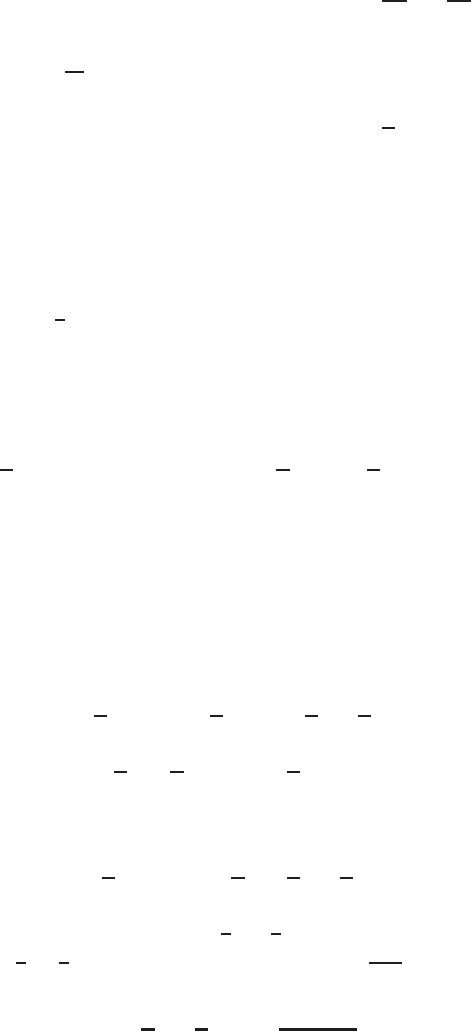
454 UNIVERSAL SOURCE CODING
=−c log c − c
ls
c
ls
c
log
c
ls
c
. (13.114)
Writing π
ls
=
c
ls
c
,wehave
l,s
π
ls
= 1,
l,s
lπ
ls
=
n
c
, (13.115)
from (13.102) and (13.103). We now define random variables U , V such
that
Pr(U = l, V = s) = π
ls
. (13.116)
Thus, EU =
n
c
and
log Q
k
(x
1
,x
2
,...,x
n
|s
1
) ≤ cH (U, V ) − c log c (13.117)
or
−
1
n
log Q
k
(x
1
,x
2
,...,x
n
|s
1
) ≥
c
n
log c −
c
n
H(U,V). (13.118)
Now
H(U,V) ≤ H(U)+ H(V) (13.119)
and H(V) ≤ log |
X|
k
= k. By Lemma 13.5.4, we have
H(U) ≤ (EU + 1) log(EU + 1) − (EU ) log(EU ) (13.120)
=
$
n
c
+ 1
%
log
$
n
c
+ 1
%
−
n
c
log
n
c
(13.121)
= log
n
c
+
$
n
c
+ 1
%
log
$
c
n
+ 1
%
. (13.122)
Thus,
c
n
H(U,V) ≤
c
n
k +
c
n
log
n
c
+ o(1). (13.123)
For a given n, the maximum of
c
n
log
n
c
is attained for the maximum value
of c (for
c
n
≤
1
e
). But from Lemma 13.5.3, c ≤
n
log n
(1 + o(1)). Thus,
c
n
log
n
c
≤ O
log log n
log n
, (13.124)