
Thomas M. Cover, Joy A. Thomas. Elements of information theory
Подождите немного. Документ загружается.

13.5 OPTIMALITY OF LEMPEL–ZIV ALGORITHMS 455
and therefore
c
n
H(U,V) → 0asn →∞. Therefore,
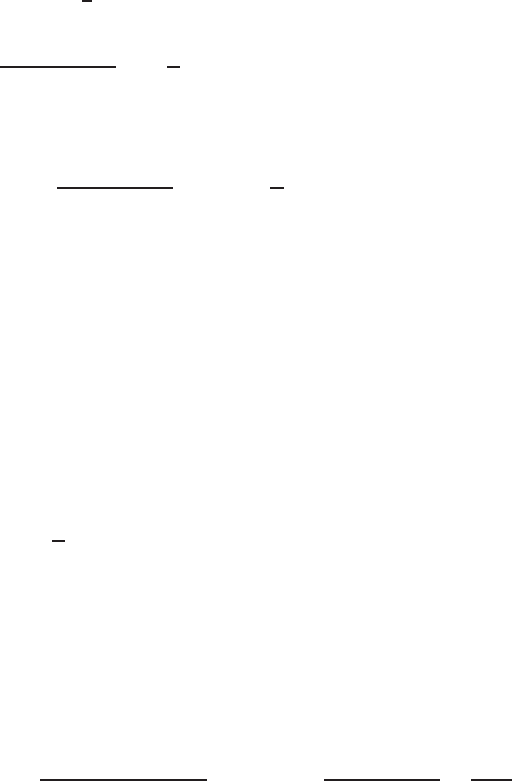
c(n) log c(n)
n
≤−
1
n
log Q
k
(x
1
,x
2
,...,x
n
|s
1
) +
k
(n), (13.125)
where
k
(n) → 0asn →∞. Hence, with probability 1,
lim sup
n→∞
c(n) log c(n)
n
≤ lim
n→∞
−
1
n
log Q
k
(X
1
,X
2
,...,X
n
|X
0
−(k−1)
)
(13.126)
= H(X
0
|X
−1
,...,X
−k
) (13.127)
→ H(
X) as k →∞. (13.128)
We now prove that LZ78 coding is asymptotically optimal.
Theorem 13.5.3 Let {X
i
}
∞
−∞
be a binary stationary ergodic stochastic
process. Let l(X
1
,X
2
,...,X
n
) be the LZ78 codeword length associated
with X
1
,X
2
,...,X
n
.Then
lim sup
n→∞
1
n
l(X
1
,X
2
,...,X
n
) ≤ H(X) with probability 1, (13.129)
where H(
X) is the entropy rate of the process.
Proof: We have shown that l(X
1
,X
2
,...,X
n
) = c(n)(log c(n) + 1),
where c(n) is the number of phrases in the LZ78 parsing of the
string X
1
,X
2
,...,X
n
. By Lemma 13.5.3, lim sup c(n)/n = 0, and thus
Theorem 13.5.2 establishes that
lim sup
l(X
1
,X
2
,...,X
n
)
n
= lim sup
c(n) log c(n)
n
+
c(n)
n
≤ H(
X) with probability 1. (13.130)
Thus, the length per source symbol of the LZ78 encoding of an ergodic
source is asymptotically no greater than the entropy rate of the source.
There are some interesting features of the proof of the optimality of LZ78
that are worth noting. The bounds on the number of distinct phrases
and Ziv’s inequality apply to any distinct parsing of the string, not just
the incremental parsing version used in the algorithm. The proof can be
extended in many ways with variations on the parsing algorithm; for
example, it is possible to use multiple trees that are context or state

456 UNIVERSAL SOURCE CODING
dependent [218, 426]. Ziv’s inequality (Lemma 13.5.5) remains partic-
ularly intriguing since it relates a probability on one side with a purely
deterministic function of the parsing of a sequence on the other.
The Lempel–Ziv codes are simple examples of a universal code (i.e., a
code that does not depend on the distribution of the source). This code can
be used without knowledge of the source distribution and yet will achieve
an asymptotic compression equal to the entropy rate of the source.
SUMMARY
Ideal word length
l
∗
(x) = log
1
p(x)
. (13.131)
Average description length
E
p
l
∗
(x) = H(p). (13.132)
Estimated probability distribution ˆp(x). If
ˆ
l(x) = log
1
ˆp(x)
,then
E
p
ˆ
l(x) = H(p) + D(p|| ˆp). (13.133)
Average redundancy
R
p
= E
p
l(X) − H(p). (13.134)
Minimax redundancy. For X ∼ p
θ
(x), θ ∈ θ,
D
∗
= min
l
max
p
R
p
= min
q
max
θ
D(p
θ
||q). (13.135)
Minimax theorem. D
∗
= C,whereC is the capacity of the channel
{θ,p
θ
(x), X}.
Bernoulli sequences. For X
n
∼Bernoulli(θ), the redundancy is
D
∗
n
= min
q
max
θ
D(p
θ
(x
n
)||q(x
n
)) ≈
1
2
log n + o(log n). (13.136)
Arithmetic coding. nH bits of F(x
n
) reveal approximately n bits
of x
n
.

PROBLEMS 457
Lempel–Ziv coding (recurrence time coding). Let R
n
(X
n
) be the
last time in the past that we have seen a block of n symbols X
n
.Then
1
n
log R
n
→ H(X), and encoding by describing the recurrence time is
asymptotically optimal.
Lempel–Ziv coding (sequence parsing). If a sequence is parsed into
the shortest phrases not seen before (e.g., 011011101 is parsed to
0,1,10,11,101,...) and l(x
n
) is the description length of the parsed se-
quence, then
lim sup
1
n
l(X
n
) ≤ H(X) with probability 1 (13.137)
for every stationary ergodic process
{
X
i
}
.
PROBLEMS
13.1 Minimax regret data compression and channel capacity.First
consider universal data compression with respect to two source
distributions. Let the alphabet V ={1,e,0} and let p
1
(v) put mass
1 − α on v = 1andmassα on v = e.Letp
2
(v) put mass 1 − α on
0andmassα on v = e. We assign word lengths to V according to
l(v) = log
1
p(v)
, the ideal codeword length with respect to a clev-
erly chosen probability mass function p(v). The worst-case excess
description length (above the entropy of the true distribution) is
max
i
E
p
i
log
1
p(V )
− E
p
i
log
1
p
i
(V )
= max
i
D(p
i
p).
(13.138)
Thus, the minimax regret is D
∗
= min
p
max
i
D(p
i
p).
(a) Find D
∗
.
(b) Find the p(v) achieving D
∗
.
(c) Compare D
∗
to the capacity of the binary erasure channel
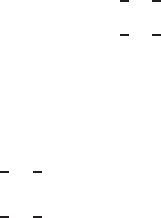
1 − αα 0
0 α 1 − α
and comment.
458 UNIVERSAL SOURCE CODING
13.2 Universal data compression. Consider three possible source dis-
tributions on
X,
P
a
= (0.7, 0.2, 0.1), P
b
= (0.1, 0.7, 0.2), P
c
= (0.2, 0.1, 0.7).
(a) Find the minimum incremental cost of compression
D
∗
= min
P
max
θ
D(P
θ
P),
the associated mass function P = (p
1
,p
2
,p
3
), and ideal code-
word lengths l
i
= log(1/p
i
).
(b) What is the channel capacity of a channel matrix with rows
P
a
,P
b
,P
c
?
13.3 Arithmetic coding.Let{X
i
}
∞
i=0
be a stationary binary Markov
chain with transition matrix
p
ij
=
&
3
4
1
4
1
4
3
4
'
. (13.139)
Calculate the first 3 bits of F(X
∞
) = 0.F
1
F
2
... when X
∞
=
1010111 .... How many bits of X
∞
does this specify?
13.4 Arithmetic coding.LetX
i
be binary stationary Markov with
transition matrix
&
1
3
2
3
2
3
1
3
'
.
(a) Find F(01110) = Pr{.X
1
X
2
X
3
X
4
X
5
<.01110}.
(b) How many bits .F
1
F
2
... can be known for sure if it is not
known how X = 01110 continues?
13.5 Lempel–Ziv. Give the LZ78 parsing and encoding of
00000011010100000110101.
13.6 Compression of constant sequence. We are given the constant
sequence x
n
= 11111 ....
(a) Give the LZ78 parsing for this sequence.
(b) Argue that the number of encoding bits per symbol for this
sequence goes to zero as n →∞.
13.7 Another idealized version of Lempel–Ziv coding. An idealized
version of LZ was shown to be optimal: The encoder and decoder
both have available to them the “infinite past” generated by the
process, ...,X
−1
,X
0
, and the encoder describes the string (X
1
,
X
2
,...,X
n
) by telling the decoder the position R
n
in the past
PROBLEMS 459
of the first recurrence of that string. This takes roughly log R
n
+
2loglogR
n
bits. Now consider the following variant: Instead of
describing R
n
, the encoder describes R
n−1
plus the last sym-
bol, X
n
. From these two the decoder can reconstruct the string
(X
1
,X
2
,...,X
n
).
(a) What is the number of bits per symbol used in this case to
encode (X
1
,X
2
,...,X
n
)?
(b) Modify the proof given in the text to show that this version is
also asymptotically optimal: namely, that the expected number
of bits per symbol converges to the entropy rate.
13.8 Length of pointers in LZ77 . In the version of LZ77 due to Storer
and Szymanski [507] described in Section 13.4.1, a short match
can be represented by either (F, P , L) (flag, pointer, length) or
by (F, C) (flag, character). Assume that the window length is W ,
and assume that the maximum match length is M.
(a) How many bits are required to represent P ?TorepresentL?
(b) Assume that C, the representation of a character, is 8 bits
long. If the representation of P plus L is longer than 8 bits,
it would be better to represent a single character match as
an uncompressed character rather than as a match within the
dictionary. As a function of W and M, what is the shortest
match that one should represent as a match rather than as
uncompressed characters?
(c) Let W = 4096 and M = 256. What is the shortest match that
one would represent as a match rather than uncompressed
characters?
13.9 Lempel–Ziv 78 .
(a) Continue the Lempel–Ziv parsing of the sequence
0,00,001,00000011010111.
(b) Give a sequence for which the number of phrases in the LZ
parsing grows as fast as possible.
(c) Give a sequence for which the number of phrases in the LZ
parsing grows as slowly as possible.
13.10 Two versions of fixed-database Lempel–Ziv . Consider a source
(
A,P). For simplicity assume that the alphabet is finite |A|=
A<∞ and the symbols are i.i.d. ∼ P . A fixed database
D is
given and is revealed to the decoder. The encoder parses the tar-
get sequence x
n
1
into blocks of length l, and subsequently encodes
them by giving the binary description of their last appearance

460 UNIVERSAL SOURCE CODING
in the database. If a match is not found, the entire block is
sent uncompressed, requiring l log A bits. A flag is used to tell
the decoder whether a match location is being described or the
sequence itself. Parts (a) and (b) give some preliminaries you will
need in showing the optimality of fixed-database LZ in part (c).
(a) Let x
l
be a δ-typical sequence of length l starting at 0, and let
R
l
(x
l
) be the corresponding recurrence index in the infinite
past ...,X
−2
,X
−1
. Show that
E
(
R
l
(X
l
)|X
l
= x
l
)
≤ 2
l(H+δ)
,
where H is the entropy rate of the source.
(b) Prove that for any >0, Pr
R
l
(X
l
)>2
l(H+)
→ 0asl →
∞.(Hint: Expand the probability by conditioning on strings
x
l
, and break things up into typical and nontypical. Markov’s
inequality and the AEP should prove handy as well.)
(c) Consider the following two fixed databases: (i)
D
1
is formed
by taking all δ-typical l-vectors; and (ii)
D
2
formed by taking
the most recent
˜
L = 2
l(H+δ)
symbols in the infinite past (i.e.,
X
−
˜
L
,...,X
−1
). Argue that the algorithm described above is
asymptotically optimal: namely, that the expected number of
bits per symbol converges to the entropy rate when used in
conjunction with either database
D
1
or D
2
.
13.11 Tunstall coding. The normal setting for source coding maps a
symbol (or a block of symbols) from a finite alphabet onto a variable-
length string. An example of such a code is the Huffman code, which
is the optimal (minimal expected length) mapping from a set of
symbols to a prefix-free set of codewords. Now consider the dual
problem of variable-to-fixed length codes, where we map a variable-
length sequence of source symbols into a fixed-length binary (or
D-ary) representation. A variable-to-fixed length code for an i.i.d.
sequence of random variables X
1
,X
2
,...,X
n
,X
i
∼ p(x), x ∈ X
={0, 1,...,m− 1}, is defined by a prefix-free set of phrases A
D
⊂
X
∗
,whereX
∗
is the set of finite-length strings of symbols of X,and
|A
D
|=D. Given any sequence X
1
,X
2
,...,X
n
, the string is parsed
into phrases from A
D
(unique because of the prefix-free property of
A
D
) and represented by a sequence of symbols from a D-ary alpha-
bet. Define the efficiency of this coding scheme by
R(A
D
) =
log D
EL(A
D
)
, (13.140)
HISTORICAL NOTES 461
where EL(A
D
) is the expected length of a phrase from A
D
.
(a) Prove that R(A
D
) ≥ H(X).
(b) The process of constructing A
D
can be considered as a process
of constructing an m-ary tree whose leaves are the phrases in
A
D
. Assume that D = 1 + k(m − 1) for some integer k ≥ 1.
Consider the following algorithm due to Tunstall:
(i) Start with A ={0, 1,...,m− 1} with probabilities p
0
,
p
1
,...,p
m−1
. This corresponds to a complete m-ary tree
of depth 1.
(ii) Expand the node with the highest probability. For ex-
ample, if p
0
is the node with the highest probability, the
new set is A ={00, 01,...,0(m − 1), 1,...,(m− 1)}.
(iii) Repeat step 2 until the number of leaves (number of
phrases) reaches the required value.
Show that the Tunstall algorithm is optimal in the sense that
it constructs a variable to a fixed code with the best R(A
D
)
for a given D [i.e., the largest value of EL(A
D
) for a given
D].
(c) Show that there exists a D such that R(A
∗
D
)<H(X)+ 1.
HISTORICAL NOTES
The problem of encoding a source with an unknown distribution was
analyzed by Fitingof [211] and Davisson [159], who showed that there
were classes of sources for which the universal coding procedure was
asymptotically optimal. The result relating the average redundancy of a
universal code and channel capacity is due to Gallager [229] and Ryabko
[450]. Our proof follows that of Csisz
´
ar. This result was extended to
show that the channel capacity was the lower bound for the redundancy
for “most” sources in the class by Merhav and Feder [387], extending the
results obtained by Rissanen [444, 448] for the parametric case.
The arithmetic coding procedure has its roots in the Shannon–Fano
code developed by Elias (unpublished), which was analyzed by Jelinek
[297]. The procedure for the construction of a prefix-free code described
in the text is due to Gilbert and Moore [249]. Arithmetic coding itself was
developed by Rissanen [441] and Pasco [414]; it was generalized by Lang-
don and Rissanen [343]. See also the enumerative methods in Cover [120].
Tutorial introductions to arithmetic coding can be found in Langdon [342]
and Witten et al. [564]. Arithmetic coding combined with the context-tree
weighting algorithm due to Willems et al. [560, 561] achieve the Rissanen
462 UNIVERSAL SOURCE CODING
lower bound [444] and therefore have the optimal rate of convergence to
the entropy for tree sources with unknown parameters.
The class of Lempel–Ziv algorithms was first described in the seminal
papers of Lempel and Ziv [603, 604]. The original results were theoreti-
cally interesting, but people implementing compression algorithms did not
take notice until the publication of a simple efficient version of the algo-
rithm due to Welch [554]. Since then, multiple versions of the algorithms
have been described, many of them patented. Versions of this algorithm
are now used in many compression products, including GIF files for image
compression and the CCITT standard for compression in modems. The
optimality of the sliding window version of Lempel–Ziv (LZ77) is due to
Wyner and Ziv [575]. An extension of the proof of the optimality of LZ78
[426] shows that the redundancy of LZ78 is on the order of 1/ log(n),
as opposed to the lower bounds of log(n)/n. Thus even though LZ78
is asymptotically optimal for all stationary ergodic sources, it converges
to the entropy rate very slowly compared to the lower bounds for finite-
state Markov sources. However, for the class of all ergodic sources, lower
bounds on the redundancy of a universal code do not exist, as shown by
examples due to Shields [492] and Shields and Weiss [494]. A lossless
block compression algorithm based on sorting the blocks and using simple
run-length encoding due to Burrows and Wheeler [81] has been analyzed
by Effros et al. [181]. Universal methods for prediction are discussed in
Feder, Merhav and Gutman [204, 386, 388].
CHAPTER 14
KOLMOGOROV COMPLEXITY
The great mathematician Kolmogorov culminated a lifetime of research
in mathematics, complexity, and information theory with his definition in
1965 of the intrinsic descriptive complexity of an object. In our treatment
so far, the object X has been a random variable drawn according to
a probability mass function p(x).IfX is random, there is a sense in
which the descriptive complexity of the event X = x is log
1
p(x)
, because
log
1
p(x)
is the number of bits required to describe x by a Shannon code.
One notes immediately that the descriptive complexity of such an object
depends on the probability distribution.
Kolmogorov went further. He defined the algorithmic (descriptive)
complexity of an object to be the length of the shortest binary com-
puter program that describes the object. (Apparently, a computer, the
most general form of data decompressor, will after a finite amount of
computation, use this description to exhibit the object described.) Thus,
the Kolmogorov complexity of an object dispenses with the probability
distribution. Kolmogorov made the crucial observation that the definition
of complexity is essentially computer independent. It is an amazing fact
that the expected length of the shortest binary computer description of a
random variable is approximately equal to its entropy. Thus, the shortest
computer description acts as a universal code which is uniformly good
for all probability distributions. In this sense, algorithmic complexity is a
conceptual precursor to entropy.
Perhaps a good point of view of the role of this chapter is to consider
Kolmogorov complexity as a way to think. One does not use the shortest
computer program in practice because it may take infinitely long to find
such a minimal program. But one can use very short, not necessarily mini-
mal programs in practice; and the idea of finding such short programs leads
to universal codes, a good basis for inductive inference, a formalization
of Occam’s razor (“The simplest explanation is best”) and to fundamental
understanding in physics, computer science, and communication theory.
Elements of Information Theory, Second Edition, By Thomas M. Cover and Joy A. Thomas
Copyright 2006 John Wiley & Sons, Inc.
463
464 KOLMOGOROV COMPLEXITY
Before formalizing the notion of Kolmogorov complexity, let us give
three strings as examples:
1. 0101010101010101010101010101010101010101010101010101010101010101
2. 0110101000001001111001100110011111110011101111001100100100001000
3. 1101111001110101111101101111101110101101111000101110010100111011
What are the shortest binary computer programs for each of these
sequences? The first sequence is definitely simple. It consists of thirty-
two 01’s. The second sequence looks random and passes most tests for
randomness, but it is in fact the initial segment of the binary expansion
of
√
2 − 1. Again, this is a simple sequence. The third again looks ran-
dom, except that the proportion of 1’s is not near
1
2
. We shall assume
that it is otherwise random. It turns out that by describing the number
k of 1’s in the sequence, then giving the index of the sequence in a
lexicographic ordering of those with this number of 1’s, one can give a
description of the sequence in roughly log n + nH (
k
n
) bits. This again is
substantially fewer than the n bits in the sequence. Again, we conclude
that the sequence, random though it is, is simple. In this case, however, it
is not as simple as the other two sequences, which have constant-length
programs. In fact, its complexity is proportional to n. Finally, we can
imagine a truly random sequence generated by pure coin flips. There are
2
n
such sequences and they are all equally probable. It is highly likely
that such a random sequence cannot be compressed (i.e., there is no bet-
ter program for such a sequence than simply saying “Print the following:
0101100111010...0”). The reason for this is that there are not enough
short programs to go around. Thus, the descriptive complexity of a truly
random binary sequence is as long as the sequence itself.
These are the basic ideas. It will remain to be shown that this notion of
intrinsic complexity is computer independent (i.e., that the length of the
shortest program does not depend on the computer). At first, this seems
like nonsense. But it turns out to be true, up to an additive constant. And
for long sequences of high complexity, this additive constant (which is
the length of the preprogram that allows one computer to mimic the other)
is negligible.
14.1 MODELS OF COMPUTATION
To formalize the notions of algorithmic complexity, we first discuss accept-
able models for computers. All but the most trivial computers are univer-
sal, in the sense that they can mimic the actions of other computers.