
Thomas M. Cover, Joy A. Thomas. Elements of information theory
Подождите немного. Документ загружается.

14.1 MODELS OF COMPUTATION 465
We touch briefly on a certain canonical universal computer, the universal
Turing machine, the conceptually simplest universal computer.
In 1936, Turing was obsessed with the question of whether the thoughts
in a living brain could be held equally well by a collection of inani-
mate parts. In short, could a machine think? By analyzing the human
computational process, he posited some constraints on such a computer.
Apparently, a human thinks, writes, thinks some more, writes, and so on.
Consider a computer as a finite-state machine operating on a finite symbol
set. (The symbols in an infinite symbol set cannot be distinguished in finite
space.) A program tape, on which a binary program is written, is fed left
to right into this finite-state machine. At each unit of time, the machine
inspects the program tape, writes some symbols on a work tape, changes
its state according to its transition table, and calls for more program. The
operations of such a machine can be described by a finite list of tran-
sitions. Turing argued that this machine could mimic the computational
ability of a human being.
After Turing’s work, it turned out that every new computational sys-
tem could be reduced to a Turing machine, and conversely. In particular,
the familiar digital computer with its CPU, memory, and input output
devices could be simulated by and could simulate a Turing machine. This
led Church to state what is now known as Church’s thesis, which states
that all (sufficiently complex) computational models are equivalent in the
sense that they can compute the same family of functions. The class of
functions they can compute agrees with our intuitive notion of effectively
computable functions, that is, functions for which there is a finite pre-
scription or program that will lead in a finite number of mechanically
specified computational steps to the desired computational result.
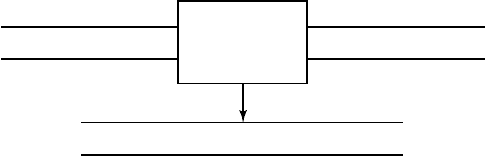
We shall have in mind throughout this chapter the computer illustrated
in Figure 14.1. At each step of the computation, the computer reads a
symbol from the input tape, changes state according to its state transition
table, possibly writes something on the work tape or output tape, and
Input tape Output tape
Finite
State
Machine
Work tape
... ...
p
2
p
1
x
1
x
2
FIGURE 14.1. A Turing machine.
466 KOLMOGOROV COMPLEXITY
moves the program read head to the next cell of the program read tape.
This machine reads the program from right to left only, never going back,
and therefore the programs form a prefix-free set. No program leading to a
halting computation can be the prefix of another such program. The restric-
tion to prefix-free programs leads immediately to a theory of Kolmogorov
complexity which is formally analogous to information theory.
We can view the Turing machine as a map from a set of finite-length
binary strings to the set of finite- or infinite-length binary strings. In
some cases, the computation does not halt, and in such cases the value of
the function is said to be undefined. The set of functions f : {0, 1}
∗
→
{0, 1}
∗
∪{0, 1}
∞
computable by Turing machines is called the set of par-
tial recursive functions.
14.2 KOLMOGOROV COMPLEXITY: DEFINITIONS
AND EXAMPLES
Let x be a finite-length binary string and let
U be a universal computer.
Let l(x) denote the length of the string x.Let
U(p) denote the output of
the computer
U when presented with a program p.
We define the Kolmogorov (or algorithmic) complexity of a string x
as the minimal description length of x.
Definition The Kolmogorov complexity K
U
(x) of a string x with respect
to a universal computer
U is defined as
K
U
(x) = min
p: U (p)=x
l(p), (14.1)
the minimum length over all programs that print x and halt. Thus, K
U
(x)
is the shortest description length of x over all descriptions interpreted by
computer
U.
A useful technique for thinking about Kolmogorov complexity is the
following—if one person can describe a sequence to another person in
such a manner as to lead unambiguously to a computation of that sequence
in a finite amount of time, the number of bits in that communication is an
upper bound on the Kolmogorov complexity. For example, one can say
“Print out the first 1,239,875,981,825,931 bits of the square root of e.”
Allowing 8 bits per character (ASCII), we see that the unambiguous 73-
symbol program above demonstrates that the Kolmogorov complexity of
this huge number is no greater than (8)(73) = 584 bits. Most numbers of
this length (more than a quadrillion bits) have a Kolmogorov complexity
14.2 KOLMOGOROV COMPLEXITY: DEFINITIONS AND EXAMPLES 467
of nearly 1,239,875,981,825,931 bits. The fact that there is a simple algo-
rithm to calculate the square root of e provides the saving in descriptive
complexity.
In the definition above, we have not mentioned anything about the
length of x. If we assume that the computer already knows the length of
x, we can define the conditional Kolmogorov complexity knowing l(x) as
K
U
(x|l(x)) = min
p: U (p,l(x))=x
l(p). (14.2)
This is the shortest description length if the computer
U has the length of
x made available to it.
It should be noted that K
U
(x|y) is usually defined as K
U
(x|y, y
∗
),
where y
∗
is the shortest program for y. This is to avoid certain slight
asymmetries, but we will not use this definition here.
We first prove some of the basic properties of Kolmogorov complexity
and then consider various examples.
Theorem 14.2.1 (Universality of Kolmogorov complexity) If
U is a
universal computer, for any other computer
A there exists a constant c
A
such that
K
U
(x) ≤ K
A
(x) + c
A
(14.3)
for all strings x ∈{0, 1}
∗
, and the constant c
A
does not depend on x.
Proof: Assume that we have a program p
A
for computer A to print x.
Thus,
A(p
A
) = x. We can precede this program by a simulation program
s
A
which tells computer U how to simulate computer A. Computer U
will then interpret the instructions in the program for A, perform the
corresponding calculations and print out x. The program for
U is p =
s
A
p
A
and its length is
l(p) = l(s
A
) + l(p
A
) = c
A
+ l(p
A
), (14.4)
where c
A
is the length of the simulation program. Hence,
K
U
(x) = min
p:U (p)=x
l(p) ≤ min
p:A(p)=x
(
l(p) + c
A
)
= K
A
(x) + c
A
(14.5)
for all strings x.
The constant c
A
in the theorem may be very large. For example, A may
be a large computer with a large number of functions built into the system.
468 KOLMOGOROV COMPLEXITY
The computer U can be a simple microprocessor. The simulation program
will contain the details of the implementation of all these functions, in
fact, all the software available on the large computer. The crucial point is
that the length of this simulation program is independent of the length of
x, the string to be compressed. For sufficiently long x, the length of this
simulation program can be neglected, and we can discuss Kolmogorov
complexity without talking about the constants.
If
A and U are both universal, we have
|
K
U
(x) − K
A
(x)
|
<c (14.6)
for all x. Hence, we will drop all mention of
U in all further definitions. We
will assume that the unspecified computer
U is a fixed universal computer.
Theorem 14.2.2 (Conditional complexity is less than the length of the
sequence)
K(x|l(x)) ≤ l(x) + c. (14.7)
Proof: A program for printing x is
Print the following l-bit sequence: x
1
x
2
...x
l(x)
.
Note that no bits are required to describe l since l is given. The program
is self-delimiting because l(x) is provided and the end of the program is
thus clearly defined. The length of this program is l(x) + c.
Without knowledge of the length of the string, we will need an addi-
tional stop symbol or we can use a self-punctuating scheme like the one
described in the proof of the next theorem.
Theorem 14.2.3 (Upper bound on Kolmogorov complexity)
K(x) ≤ K(x|l(x)) + 2logl(x) + c. (14.8)
Proof: If the computer does not know l(x), the method of Theorem
14.2.2 does not apply. We must have some way of informing the com-
puter when it has come to the end of the string of bits that describes
the sequence. We describe a simple but inefficient method that uses a
sequence 01 as a “comma.”
Suppose that l(x) = n. To describe l(x), repeat every bit of the binary
expansion of n twice; then end the description with a 01 so that the
computer knows that it has come to the end of the description of n.

14.2 KOLMOGOROV COMPLEXITY: DEFINITIONS AND EXAMPLES 469
For example, the number 5 (binary 101) will be described as 11001101.
This description requires 2log n+2 bits. Thus, inclusion of the binary
representation of l(x) does not add more than 2 log l(x) + c bits to the
length of the program, and we have the bound in the theorem.
A more efficient method for describing n is to do so recursively. We
first specify the number (log n) of bits in the binary representation of n
and then specify the actual bits of n. To specify log n, the length of the
binary representation of n, we can use the inefficient method (2 log log n)
or the efficient method (log log n +···). If we use the efficient method at
each level, until we have a small number to specify, we can describe n
in log n + log log n + log log log n +···bits, where we continue the sum
until the last positive term. This sum of iterated logarithms is sometimes
written log
∗
n. Thus, Theorem 14.2.3 can be improved to
K(x) ≤ K(x|l(x)) + log
∗
l(x) + c. (14.9)
We now prove that there are very few sequences with low complexity.
Theorem 14.2.4 (Lower bound on Kolmogorov complexity). The
number of strings x with complexity K(x) < k satisfies
|{x ∈{0, 1}
∗
: K(x) < k}| < 2
k
. (14.10)
Proof: There are not very many short programs. If we list all the pro-
grams of length <k,wehave
1
, 0, 1
2
, 00, 01, 10, 11
4
,...,...,
k−1
11 ...1
2
k−1
(14.11)
and the total number of such programs is
1 + 2 +4 +···+2
k−1
= 2
k
− 1 < 2
k
. (14.12)
Since each program can produce only one possible output sequence, the
number of sequences with complexity <k is less than 2
k
.
To avoid confusion and to facilitate exposition in the rest of this chapter,
we shall need to introduce a special notation for the binary entropy func-
tion
H
0
(p) =−p log p − (1 − p) log(1 − p). (14.13)
470 KOLMOGOROV COMPLEXITY
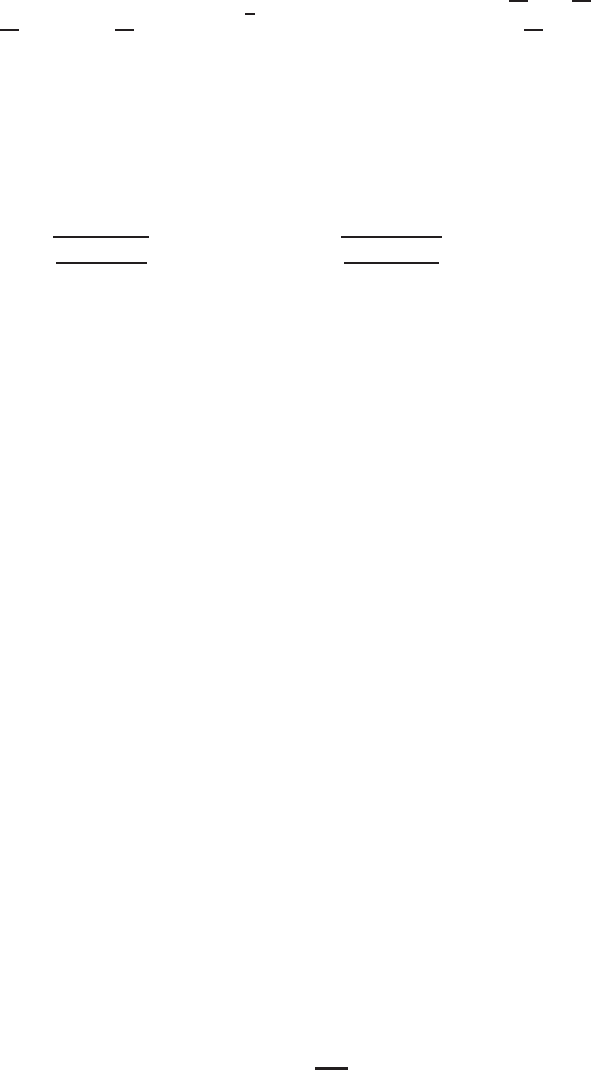
Thus, when we write H
0
(
1
n
n
i=1
X
i
), we will mean −X
n
log X
n
− (1 −
X
n
) log(1 −X
n
) and not the entropy of random variable X
n
. When there
is no confusion, we shall simply write H(p) for H
0
(p).
Now let us consider various examples of Kolmogorov complexity. The
complexity will depend on the computer, but only up to an additive con-
stant. To be specific, we consider a computer that can accept unambiguous
commands in English (with numbers given in binary notation). We will
use the inequality
n
8k(n − k)
2
nH (k/n)
≤
n
k
≤
n
πk(n − k)
2
nH (k/n)
,k= 0,n,
(14.14)
which is proved in Lemma 17.5.1.
Example 14.2.1 (A sequence of n zeros) If we assume that the com-
puter knows n, a short program to print this string is
Print the specified number of zeros.
The length of this program is a constant number of bits. This program
length does not depend on n. Hence, the Kolmogorov complexity of this
sequence is c,and
K(000 ...0|n) = c for all n. (14.15)
Example 14.2.2 (Kolmogorov complexity of π)Thefirstn bits of π
can be calculated using a simple series expression. This program has a
small constant length if the computer already knows n. Hence,
K(π
1
π
2
···π
n
|n) = c. (14.16)
Example 14.2.3 (Gotham weather) Suppose that we want the com-
puter to print out the weather in Gotham for n days. We can write a
program that contains the entire sequence x = x
1
x
2
···x
n
,wherex
i
= 1
indicates rain on day i. But this is inefficient, since the weather is quite
dependent. We can devise various coding schemes for the sequence to
take the dependence into account. A simple one is to find a Markov
model to approximate the sequence (using the empirical transition prob-
abilities) and then code the sequence using the Shannon code for this
probability distribution. We can describe the empirical Markov transitions
in O(log n) bits and then use log
1
p(x)
bits to describe x,wherep is the
14.2 KOLMOGOROV COMPLEXITY: DEFINITIONS AND EXAMPLES 471
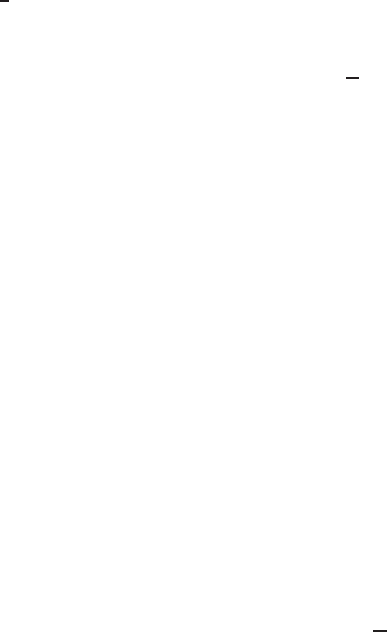
specified Markov probability. Assuming that the entropy of the weather
is
1
5
bit per day, we can describe the weather for n days using about n/5
bits, and hence
K(Gotham weather|n) ≈
n
5
+ O(log n) + c. (14.17)
Example 14.2.4 (Repeating sequence of the form 01010101...01 )A
short program suffices. Simply print the specified number of 01 pairs.
Hence,
K(010101010 ...01|n) = c. (14.18)
Example 14.2.5 (Fractal) A fractal is part of the Mandelbrot set and
is generated by a simple computer program. For different points c in the
complex plane, one calculates the number of iterations of the map z
n+1
=
z
2
n
+ c (starting with z
0
= 0) needed for |z| to cross a particular threshold.
The point c is then colored according to the number of iterations needed.
Thus, the fractal is an example of an object that looks very complex but
is essentially very simple. Its Kolmogorov complexity is essentially zero.
Example 14.2.6 (Mona Lisa) We can make use of the many structures
and dependencies in the painting. We can probably compress the image
by a factor of 3 or so by using some existing easily described image
compression algorithm. Hence, if n is the number of pixels in the image
of the Mona Lisa,
K(Mona Lisa|n) ≤
n
3
+ c. (14.19)
Example 14.2.7 (Integer n) If the computer knows the number of bits
in the binary representation of the integer, we need only provide the values
of these bits. This program will have length c + log n.
In general, the computer will not know the length of the binary repre-
sentation of the integer. So we must inform the computer in some way
when the description ends. Using the method to describe integers used
to derive (14.9), we see that the Kolmogorov complexity of an integer is
bounded by
K(n) ≤ log
∗
n + c. (14.20)
Example 14.2.8 (Sequence of n bits with k ones) Can we compress a
sequence of n bits with k ones?
Our first guess is no, since we have a series of bits that must be repro-
duced exactly. But consider the following program:
472 KOLMOGOROV COMPLEXITY
Generate, in lexicographic order, all sequences with k ones;
Of these sequences, print the ith sequence.
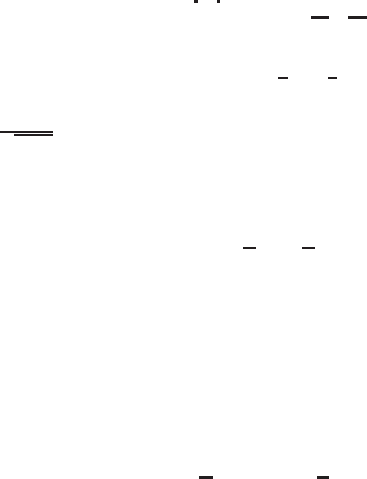
This program will print out the required sequence. The only variables in
the program are k (with known range {0, 1,...,n})andi (with conditional
range {1, 2,...,
n
k
}). The total length of this program is
l(p) = c + log n
to express
k
+ log
n
k
to express
i
(14.21)
≤ c
+ log n + nH
k
n
−
1
2
log n, (14.22)
since
n
k
≤
1
√
πnpq
2
nH
0
(p)
by (14.14) for p = k/n and q = 1 −p and k =
0andk = n.Wehaveusedlogn bits to represent k.Thus,if
n
i=1
x
i
= k,
then
K(x
1
,x
2
,...,x
n
|n) ≤ nH
0
k
n
+
1
2
log n + c. (14.23)
We can summarize Example 14.2.8 in the following theorem.
Theorem 14.2.5 The Kolmogorov complexity of a binary string x is
bounded by
K(x
1
x
2
···x
n
|n) ≤ nH
0
1
n
n
i=1
x
i
+
1
2
log n + c. (14.24)
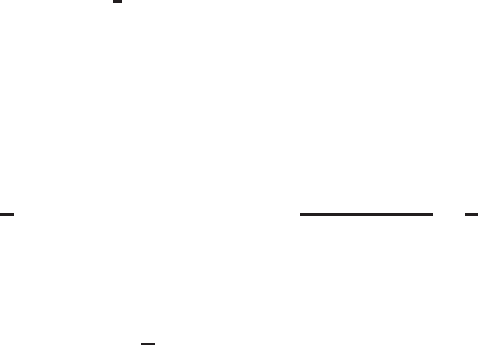
Proof: Use the program described in Example 14.2.8.
Remark Let x ∈{0, 1}
∗
bethedatathatwewishtocompress,and
consider the program p to be the compressed data. We will have succeeded
in compressing the data only if l(p) < l(x),or
K(x) < l(x). (14.25)
In general, when the length l(x) of the sequence x is small, the constants
that appear in the expressions for the Kolmogorov complexity will over-
whelm the contributions due to l(x). Hence, the theory is useful primarily
when l(x) is very large. In such cases we can safely neglect the terms
that do not depend on l(x).
14.3 KOLMOGOROV COMPLEXITY AND ENTROPY 473
14.3 KOLMOGOROV COMPLEXITY AND ENTROPY
We now consider the relationship between the Kolmogorov complexity of
a sequence of random variables and its entropy. In general, we show that
the expected value of the Kolmogorov complexity of a random sequence
is close to the Shannon entropy. First, we prove that the program lengths
satisfy the Kraft inequality.
Lemma 14.3.1 For any computer
U,
p: U (p)halts
2
−l(p)
≤ 1. (14.26)
Proof: If the computer halts on any program, it does not look any further
for input. Hence, there cannot be any other halting program with this
program as a prefix. Thus, the halting programs form a prefix-free set,
and their lengths satisfy the Kraft inequality (Theorem 5.2.1).
We now show that
1
n
EK(X
n
|n) ≈ H(X) for i.i.d. processes with a
finite alphabet.
Theorem 14.3.1 (Relationship of Kolmogorov complexity and entropy)
Let the stochastic process {X
i
} be drawn i.i.d. according to the probability
mass function f(x), x ∈
X,whereX is a finite alphabet. Let f(x
n
) =
n
i=1
f(x
i
). Then there exists a constant c such that
H(X) ≤
1
n
x
n
f(x
n
)K(x
n
|n) ≤ H(X)+
(|
X|−1) log n
n
+
c
n
(14.27)
for all n. Consequently,
E
1
n
K(X
n
|n) → H(X). (14.28)
Proof: Consider the lower bound. The allowed programs satisfy the pre-
fix property, and thus their lengths satisfy the Kraft inequality. We assign
to each x
n
the length of the shortest program p such that U(p, n) = x
n
.
These shortest programs also satisfy the Kraft inequality. We know from
the theory of source coding that the expected codeword length must be
greater than the entropy. Hence,
x
n
f(x
n
)K(x
n
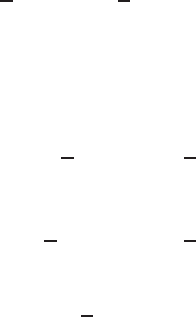
|n) ≥ H(X
1
,X
2
,...,X
n
) = nH (X). (14.29)
474 KOLMOGOROV COMPLEXITY
We first prove the upper bound when X is binary (i.e., X
1
,X
2
,...,X
n
are i.i.d. ∼ Bernoulli(θ)). Using the method of Theorem 14.2.5, we can
bound the complexity of a binary string by
K(x
1
x
2
...x
n
|n) ≤ nH
0
1
n
n
i=1
x
i
+
1
2
log n + c. (14.30)
Hence,
EK(X
1
X
2
...X
n
|n) ≤ nEH
0
1
n
n
i=1
X
i
+
1
2
log n + c (14.31)
(a)
≤ nH
0
1
n
n
i=1
EX
i
+
1
2
log n + c (14.32)
= nH
0
(θ) +
1
2
log n + c, (14.33)
where (a) follows from Jensen’s inequality and the concavity of the
entropy. Thus, we have proved the upper bound in the theorem for binary
processes.
We can use the same technique for the case of a nonbinary finite alpha-
bet. We first describe the type of the sequence (the empirical frequency
of occurrence of each of the alphabet symbols as defined in Section 11.1)
using (|
X|−1) log n bits (the frequency of the last symbol can be cal-
culated from the frequencies of the rest). Then we describe the index
of the sequence within the set of all sequences having the same type.
The type class has less than 2
nH (P
x
n
)
elements (where P
x
n
is the type
of the sequence x
n
) as shown in Chapter 11, and therefore the two-stage
description of a string x
n
has length
K(x
n
|n) ≤ nH (P
x
n
) + (|X|−1) log n + c. (14.34)
Again, taking the expectation and applying Jensen’s inequality as in the
binary case, we obtain
EK(X
n
|n) ≤ nH (X) + (|X|−1) log n + c. (14.35)
Dividing this by n yields the upper bound of the theorem.