
Thomas M. Cover, Joy A. Thomas. Elements of information theory
Подождите немного. Документ загружается.

15.8 SOURCE CODING WITH SIDE INFORMATION 575
3. Assuming that s
i
is decoded correctly at the receiver, the receiver
constructs a list Ł(y(i − 1)) of indices that the receiver considers to
be jointly typical with y(i − 1) in the (i − 1)th block. The receiver
then declares ˆw
i−1
= w as the index sent in block i − 1ifthereis
a unique w in S
s
i
∩ Ł(y(i − 1)).Ifn is sufficiently large and if
R<I(X;Y |X
1
) + R
0
, (15.255)
then ˆw
i−1
= w
i−1
with arbitrarily small probability of error. Com-
bining the two constraints (15.254) and (15.255), R
0
drops out,
leaving
R<I(X;Y |X
1
) + I(X
1
;Y) = I(X,X
1
;Y). (15.256)
For a detailed analysis of the probability of error, the reader is
referred to Cover and El Gamal [127].
Theorem 15.7.2 can also shown to be the capacity for the following
classes of relay channels:
1. Reversely degraded relay channel, that is,
p(y, y
1
|x, x
1
) = p(y|x, x
1
)p(y
1
|y, x
1
). (15.257)
2. Relay channel with feedback
3. Deterministic relay channel,
y
1
= f(x,x
1
), y = g(x, x
1
). (15.258)
15.8 SOURCE CODING WITH SIDE INFORMATION
We now consider the distributed source coding problem where two random
variables X and Y are encoded separately but only X is to be recovered.We
now ask how many bits R
1
are required to describe X if we are allowed
R
2
bits to describe Y .IfR
2
>H(Y),thenY can be described perfectly,
and by the results of Slepian–Wolf coding, R
1
= H(X|Y) bits suffice
to describe X. At the other extreme, if R
2
= 0, we must describe X
without any help, and R
1
= H(X) bits are then necessary to describe X.In
general, we use R
2
= I(Y;
ˆ
Y) bits to describe an approximate version of
Y . This will allow us to describe X using H(X|
ˆ
Y) bits in the presence of
side information
ˆ
Y . The following theorem is consistent with this intuition.
576 NETWORK INFORMATION THEORY
Theorem 15.8.1 Let (X, Y ) ∼ p(x, y).IfY is encoded at rate R
2
and
X is encoded at rate R
1
, we can recover X with an arbitrarily small prob-
ability of error if and only if
R
1
≥ H(X|U), (15.259)
R
2
≥ I(Y;U) (15.260)
for some joint probability mass function p(x, y)p(u|y),where|
U|≤
|
Y|+2.
We prove this theorem in two parts. We begin with the converse, in
which we show that for any encoding scheme that has a small probability
of error, we can find a random variable U with a joint probability mass
function as in the theorem.
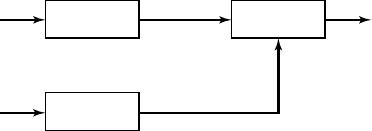
Proof: (Converse). Consider any source code for Figure 15.32. The
source code consists of mappings f
n
(X
n
) and g
n
(Y
n
) such that the rates of
f
n
and g
n
are less than R
1
and R
2
, respectively, and a decoding mapping
h
n
such that
P
(n)
e
= Pr{h
n
(f
n
(X
n
), g
n
(Y
n
)) = X
n
} <. (15.261)
Define new random variables S = f
n
(X
n
) and T = g
n
(Y
n
).Thensince
we can recover X
n
from S and T with low probability of error, we have,
by Fano’s inequality,
H(X
n
|S, T ) ≤ n
n
. (15.262)
Then
nR
2
(
a)
≥ H(T) (15.263)
(b)
≥ I(Y
n
;T) (15.264)
Encoder Decoder
Encoder
XX
R
1
R
2
Y
^
FIGURE 15.32. Encoding with side information.
15.8 SOURCE CODING WITH SIDE INFORMATION 577
=
n
i=1
I(Y
i
;T |Y
1
,...,Y
i−1
) (15.265)
(c)
=
n
i=1
I(Y
i
;T,Y
1
,...,Y
i−1
) (15.266)
(d)
=
n
i=1
I(Y
i
;U
i
) (15.267)
where
(a) follows from the fact that the range of g
n
is {1, 2,...,2
nR
2
}
(b) follows from the properties of mutual information
(c) follows from the chain rule and the fact that Y
i
is independent of
Y
1
,...,Y
i−1
and hence I(Y
i
;Y
1
,...,Y
i−1
) = 0
(d) follows if we define U
i
= (T , Y
1
,...,Y
i−1
)
We also have another chain for R
1
,
nR
1
(
a)
≥ H(S) (15.268)
(b)
≥ H(S|T) (15.269)
= H(S|T)+ H(X
n
|S, T ) − H(X
n
|S, T ) (15.270)
(c)
≥ H(X
n
,S|T)− n
n
(15.271)
(d)
= H(X
n
|T)− n
n
(15.272)
(e)
=
n
i=1
H(X
i
|T,X
1
,...,X
i−1
) − n
n
(15.273)
(f)
≥
n
i=1
H(X
i
|T,X
i−1
,Y
i−1
) − n
n
(15.274)
(g)
=
n
i=1
H(X
i
|T,Y
i−1
) − n
n
(15.275)
(h)
=
n
i=1
H(X
i
|U
i
) − n
n
, (15.276)

578 NETWORK INFORMATION THEORY
where
(a) follows from the fact that the range of S is {1, 2,...,2
nR
1
}
(b) follows from the fact that conditioning reduces entropy
(c) follows from Fano’s inequality
(d) follows from the chain rule and the fact that S is a function of X
n
(e) follows from the chain rule for entropy
(f) follows from the fact that conditioning reduces entropy
(g) follows from the (subtle) fact that X
i
→ (T , Y
i−1
) → X
i−1
forms
a Markov chain since X
i
does not contain any information about
X
i−1
that is not there in Y
i−1
and T
(h) follows from the definition of U
Also, since X
i
contains no more information about U
i
than is present
in Y
i
, it follows that X
i
→ Y
i
→ U
i
forms a Markov chain. Thus we have
the following inequalities:
R
1
≥
1
n
n
i=1
H(X
i
|U
i
), (15.277)
R
2
≥
1
n
n
i=1
I(Y
i
;U
i
). (15.278)
We now introduce a timesharing random variable Q so that we can rewrite
these equations as
R
1
≥
1
n
n
i=1
H(X
i
|U
i
,Q= i) = H(X
Q
|U
Q
,Q), (15.279)
R
2
≥
1
n
n
i=1
I(Y
i
;U
i
|Q = i) = I(Y
Q
;U
Q
|Q). (15.280)
Now since Q is independent of Y
Q
(the distribution of Y
i
does not depend
on i), we have
I(Y
Q
;U
Q
|Q) = I(Y
Q
;U
Q
,Q)− I(Y
Q
;Q) = I(Y
Q
;U
Q
,Q). (15.281)
Now X
Q
and Y
Q
have the joint distribution p(x, y) in the theorem. Defin-
ing U = (U
Q
,Q), X = X
Q
,andY = Y
Q
, we have shown the existence
of a random variable U such that
R
1
≥ H(X|U), (15.282)
R
2
≥ I(Y;U) (15.283)

15.8 SOURCE CODING WITH SIDE INFORMATION 579
for any encoding scheme that has a low probability of error. Thus, the
converse is proved.
Before we proceed to the proof of the achievability of this pair of rates,
we will need a new lemma about strong typicality and Markov chains.
Recall the definition of strong typicality for a triple of random variables
X, Y ,andZ. A triplet of sequences x
n
,y
n
,z
n
is said to be -strongly
typical if
1
n
N(a,b,c|x
n
,y
n
,z
n
) − p(a, b, c)
<
|X||Y||Z|
. (15.284)
In particular, this implies that (x
n
,y
n
) are jointly strongly typical and
that (y
n
,z
n
) are also jointly strongly typical. But the converse is not true:
The fact that (x
n
,y
n
) ∈ A
∗(n)
(X, Y ) and (y
n
,z
n
) ∈ A
∗(n)
(Y, Z) does not
in general imply that (x
n
,y
n
,z
n
) ∈ A
∗(n)
(X, Y, Z).ButifX → Y → Z
forms a Markov chain, this implication is true. We state this as a lemma
without proof [53, 149].
Lemma 15.8.1 Let (X, Y, Z) form a Markov chain X → Y → Z [i.e.,
p(x, y, z) = p(x, y)p(z|y)]. If for a given (y
n
,z
n
) ∈ A
∗(n)
(Y, Z), X
n
is
drawn ∼
n
i=1
p(x
i
|y
i
),thenPr{(X
n
,y
n
,z
n
) ∈ A
∗(n)
(X,Y,Z)} > 1 −
for n sufficiently large.
Remark The theorem is true from the strong law of large numbers if
X
n
∼
n
i=1
p(x
i
|y
i
,z
i
). The Markovity of X → Y → Z is used to show
that X
n
∼ p(x
i
|y
i
) is sufficient for the same conclusion.
We now outline the proof of achievability in Theorem 15.8.1.
Proof: (Achievability in Theorem 15.8.1). Fix p(u|y). Calculate p(u) =
y
p(y)p(u|y).
Generation of codebooks: Generate 2
nR
2
independent codewords of
length n, U(w
2
), w
2
∈{1, 2,...,2
nR
2
} according to
n
i=1
p(u
i
).Ran-
domly bin all the X
n
sequences into 2
nR
1
bins by independently generating
an index b distributed uniformly on {1, 2,...,2
nR
1
} for each X
n
.LetB(i)
denote the set of X
n
sequences allotted to bin i.
Encoding: The X sender sends the index i of the bin in which X
n
falls.
The Y sender looks for an index s such that (Y
n
,U
n
(s)) ∈ A
∗(n)
(Y, U ).
If there is more than one such s, it sends the least. If there is no such
U
n
(s) in the codebook, it sends s = 1.
Decoding: The receiver looks for a unique X
n
∈ B(i) such that (X
n
,
U
n
(s)) ∈ A
∗(n)
(X, U ). If there is none or more than one, it declares an
error.
580 NETWORK INFORMATION THEORY
Analysis of the probability of error: The various sources of error are as
follows:
1. The pair (X
n
,Y
n
) generated by the source is not typical. The proba-
bility of this is small if n is large. Hence, without loss of generality,
we can condition on the event that the source produces a particular
typical sequence (x
n
,y
n
) ∈ A
∗(n)
.
2. The sequence Y
n
is typical, but there does not exist a U
n
(s) in the
codebook that is jointly typical with it. The probability of this is
small from the arguments of Section 10.6, where we showed that if
there are enough codewords; that is, if
R
2
>I(Y;U), (15.285)
we are very likely to find a codeword that is jointly strongly typical
with the given source sequence.
3. The codeword U
n
(s) is jointly typical with y
n
but not with x
n
.But
by Lemma 15.8.1, the probability of this is small since X → Y → U
forms a Markov chain.
4. We also have an error if there exists another typical X
n
∈ B(i) which
is jointly typical with U
n
(s). The probability that any other X
n
is
jointly typical with U
n
(s) is less than 2
−n(I (U;X)−3)
, and therefore
the probability of this kind of error is bounded above by
|B(i) ∩ A
∗(n)
(X)|2
−n(I (X;U)−3)
≤ 2
n(H (X)+)
2
−nR
1
2
−n(I (X;U)−3)
,
(15.286)
which goes to 0 if R
1
>H(X|U).
Hence, it is likely that the actual source sequence X
n
is jointly typical
with U
n
(s) and that no other typical source sequence in the same bin is
also jointly typical with U
n
(s). We can achieve an arbitrarily low proba-
bility of error with an appropriate choice of n and , and this completes
the proof of achievability.
15.9 RATE DISTORTION WITH SIDE INFORMATION
We know that R(D) bits are sufficient to describe X within distortion D.
We now ask how many bits are required given side information Y .
We begin with a few definitions. Let (X
i
,Y
i
) be i.i.d. ∼p(x, y) and
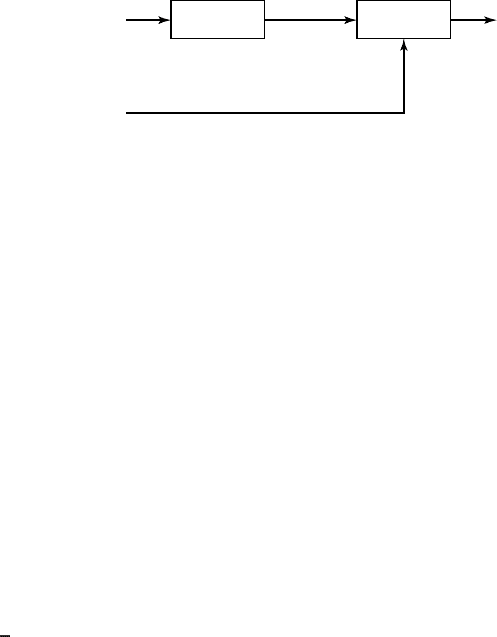
encoded as shown in Figure 15.33.
15.9 RATE DISTORTION WITH SIDE INFORMATION 581
Encoder Decoder
XX
Ed
(
X
,
X
) =
D
R
Y
^
^
FIGURE 15.33. Rate distortion with side information.
Definition The rate distortion function with side information R
Y
(D)
is defined as the minimum rate required to achieve distortion D if the
side information Y is available to the decoder. Precisely, R
Y
(D) is the
infimum of rates R such that there exist maps i
n
: X
n
→{1,...,2
nR
},
g
n
: Y
n
×{1,...,2
nR
}→
ˆ
X
n
such that
lim sup
n→∞
Ed(X
n
,g
n
(Y
n
,i
n
(X
n
))) ≤ D. (15.287)
Clearly, since the side information can only help, we have R
Y
(D) ≤
R(D). For the case of zero distortion, this is the Slepian–Wolf problem
and we will need H(X|Y) bits. Hence, R
Y
(0) = H(X|Y).Wewishto
determine the entire curve R
Y
(D). The result can be expressed in the
following theorem.
Theorem 15.9.1 (Rate distortion with side information (Wyner and Ziv))
Let (X, Y ) be drawn i.i.d. ∼ p(x, y) and let d(x
n
, ˆx
n
)
=
1
n
n
i=1
d(x
i
, ˆx
i
) be given. The rate distortion function with side infor-
mation is
R
Y
(D) = min
p(w|x)
min
f
(
I(X;W)− I(Y;W)
)
(15.288)
where the minimization is over all functions f :
Y × W →
ˆ
X and condi-
tional probability mass functions p(w|x), |
W|≤|X|+1, such that
x
w
y
p(x, y)p(w|x)d(x, f (y, w)) ≤ D. (15.289)
The function f in the theorem corresponds to the decoding map that
maps the encoded version of the X symbols and the side information Y to
the output alphabet. We minimize over all conditional distributions on W
and functions f such that the expected distortion for the joint distribution
is less than D.
We first prove the converse after considering some of the properties of
the function R
Y
(D) defined in (15.288).
582 NETWORK INFORMATION THEORY
Lemma 15.9.1 The rate distortion function with side information
R
Y
(D) defined in (15.288) is a nonincreasing convex function of D.
Proof: The monotonicity of R
Y
(D) follows immediately from the fact
that the domain of minimization in the definition of R
Y
(D) increases with
D. As in the case of rate distortion without side information, we expect
R
Y
(D) to be convex. However, the proof of convexity is more involved
because of the double rather than single minimization in the definition of
R
Y
(D) in (15.288). We outline the proof here.
Let D
1
and D
2
be two values of the distortion and let W
1
,f
1
and
W
2
,f
2
be the corresponding random variables and functions that achieve
the minima in the definitions of R
Y
(D
1
) and R
Y
(D
2
), respectively. Let
Q be a random variable independent of X, Y, W
1
,andW
2
which takes on
the value 1 with probability λ and the value 2 with probability 1 − λ.
Define W = (Q, W
Q
) and let f(W,Y) = f
Q
(W
Q
,Y). Specifically,
f(W,Y) = f
1
(W
1
,Y) with probability λ and f(W,Y)= f
2
(W
2
,Y) with
probability 1 −λ. Then the distortion becomes
D = Ed(X,
ˆ
X) (15.290)
= λEd(X, f
1
(W
1
,Y))+ (1 − λ)Ed(X, f
2
(W
2
,Y)) (15.291)
= λD
1
+ (1 − λ)D
2
, (15.292)
and (15.288) becomes
I(W;X) −I(W;Y) = H(X)− H(X|W) − H(Y)+ H(Y|W)
(15.293)
= H(X)− H(X|W
Q
,Q)− H(Y) + H(Y|W
Q
,Q)
(15.294)
= H(X)− λH (X|W
1
) − (1 −λ)H (X|W
2
)
− H(Y)+ λH (Y |W
1
) + (1 −λ)H (Y |W
2
)
(15.295)
= λ
(
I(W
1
,X)− I(W
1
;Y)
)
+ (1 − λ)
(
I(W
2
,X)− I(W
2
;Y)
)
, (15.296)
and hence
R
Y
(D) = min
U:Ed≤D
(
I(U;X) − I(U;Y)
)
(15.297)
≤ I(W;X) − I(W;Y) (15.298)
15.9 RATE DISTORTION WITH SIDE INFORMATION 583
= λ
(
I(W
1
,X)− I(W
1
;Y)
)
+ (1 − λ)
(
I(W
2
,X)− I(W
2
;Y)
)
= λR
Y
(D
1
) + (1 −λ)R
Y
(D
2
), (15.299)
proving the convexity of R
Y
(D).
We are now in a position to prove the converse to the conditional rate
distortion theorem.
Proof: (Converse to Theorem 15.9.1). Consider any rate distortion code
with side information. Let the encoding function be f
n
: X
n
→{1, 2,...,
2
nR
}. Let the decoding function be g
n
: Y
n
×{1, 2,...,2
nR
}→
ˆ
X
n
,and
let g
ni
: Y
n
×{1, 2,...,2
nR
}→
ˆ
X denote the ith symbol produced by the
decoding function. Let T = f
n
(X
n
) denote the encoded version of X
n
.
We must show that if Ed(X
n
,g
n
(Y
n
,f
n
(X
n
))) ≤ D,thenR ≥ R
Y
(D).
We have the following chain of inequalities:
nR
(a)
≥ H(T) (15.300)
(b)
≥ H(T|Y
n
) (15.301)
≥ I(X
n
;T |Y
n
) (15.302)
(c)
=
n
i=1
I(X
i
;T |Y
n
,X
i−1
) (15.303)
=
n
i=1
H(X
i
|Y
n
,X
i−1
) − H(X
i
|T,Y
n
,X
i−1
) (15.304)
(d)
=
n
i=1
H(X
i
|Y
i
) − H(X
i
|T,Y
i−1
,Y
i
,Y
n
i+1
,X
i−1
) (15.305)
(e)
≥
n
i=1
H(X
i
|Y
i
) − H(X
i
|T,Y
i−1
,Y
i
,Y
n
i+1
) (15.306)
(f)
=
n
i=1
H(X
i
|Y
i
) − H(X
i
|W
i
,Y
i
) (15.307)
(g)
=
n
i=1
I(X
i
;W
i
|Y
i
) (15.308)

584 NETWORK INFORMATION THEORY
=
n
i=1
H(W
i
|Y
i
) − H(W
i
|X
i
,Y
i
) (15.309)
(h)
=
n
i=1
H(W
i
|Y
i
) − H(W
i
|X
i
) (15.310)
=
n
i=1
H(W
i
) − H(W
i
|X
i
) − H(W
i
) + H(W
i
|Y
i
) (15.311)
=
n
i=1
I(W
i
;X
i
) − I(W
i
;Y
i
) (15.312)
(i)
≥
n
i=1
R
Y
(Ed(X
i
,g
ni
(W
i
,Y
i
))) (15.313)
= n
1
n
n
i=1
R
Y
(Ed(X
i
,g
ni
(W
i
,Y
i
))) (15.314)
(j)
≥ nR
Y
1
n
n
i=1
Ed(X
i
,g
ni
(W
i
,Y
i
))
(15.315)
(k)
≥ nR
Y
(
D
)
, (15.316)
where
(a) follows from the fact that the range of T is {1, 2,...,2
nR
}
(b) follows from the fact that conditioning reduces entropy
(c) follows from the chain rule for mutual information
(d) follows from the fact that X
i
is independent of the past and future
Y ’s and X’s given Y
i
(e) follows from the fact that conditioning reduces entropy
(f) follows by defining W
i
= (T , Y
i−1
,Y
n
i+1
)
(g) follows from the definition of mutual information
(h) follows from the fact that since Y
i
depends only on X
i
and is condi-
tionally independent of T and the past and future Y ’s, W
i
→ X
i
→
Y
i
forms a Markov chain
(i) follows from the definition of the (information) conditional
rate distortion function since
ˆ
X
i
= g
ni
(T , Y
n
)
= g
ni
(W
i
,Y
i
),
and hence I(W
i
;X
i
) − I(W
i
;Y
i
) ≥ min
W :Ed(X,
ˆ
X)≤D
i
I(W;X) −
I(W;Y) = R
Y
(D
i
)