
Thomas M. Cover, Joy A. Thomas. Elements of information theory
Подождите немного. Документ загружается.

15.6 BROADCAST CHANNEL 565
15.6.3 Capacity Region for the Degraded Broadcast Channel
We now consider sending independent information over a degraded broad-
cast channel at rate R
1
to Y
1
and rate R
2
to Y
2
.
Theorem 15.6.2 The capacity region for sending independent infor-
mation over the degraded broadcast channel X → Y
1
→ Y
2
is the convex
hull of the closure of all (R
1
,R
2
) satisfying
R
2
≤ I(U;Y
2
), (15.210)
R
1
≤ I(X;Y
1
|U) (15.211)
for some joint distribution p(u)p(x|u)p(y
1
,y
2
|x), where the auxiliary ran-
dom variable U has cardinality bounded by |
U|≤min{|X|, |Y
1
|, |Y
2
|}.
Proof: (The cardinality bounds for the auxiliary random variable U are
derived using standard methods from convex set theory and are not dealt
with here.) We first give an outline of the basic idea of superposition
coding for the broadcast channel. The auxiliary random variable U will
serve as a cloud center that can be distinguished by both receivers Y
1
and Y
2
. Each cloud consists of 2
nR
1
codewords X
n
distinguishable by the
receiver Y
1
. The worst receiver can only see the clouds, while the better
receiver can see the individual codewords within the clouds. The formal
proof of the achievability of this region uses a random coding argument:
Fix p(u) and p(x|u).
Random codebook generation: Generate 2
nR
2
independent codewords
of length n, U(w
2
), w
2
∈{1, 2,...,2
nR
2
}, according to
n
i=1
p(u
i
).For
each codeword U(w
2
), generate 2
nR
1
independent codewords X(w
1
,w
2
)
according to
n
i=1
p(x
i
|u
i
(w
2
)).Hereu(i) plays the role of the cloud
center understandable to both Y
1
and Y
2
, while x(i, j ) is the j th satellite
codeword in the ith cloud.
Encoding: To send the pair (W
1
,W
2
), send the corresponding codeword
X(W
1
,W
2
).
Decoding: Receiver 2 determines the unique
ˆ
ˆ
W
2
such that (U(
ˆ
ˆ
W
2
),
Y
2
) ∈ A
(n)
. If there are none such or more than one such, an error is
declared.
Receiver 1 looks for the unique (
ˆ
W
1
,
ˆ
W
2
) such that (U(
ˆ
W
2
), X(
ˆ
W
1
,
ˆ
W
2
),
Y
1
) ∈ A
(n)
. If there are none such or more than one such, an error is
declared.
Analysis of the probability of error: By the symmetry of the code gen-
eration, the probability of error does not depend on which codeword was
566 NETWORK INFORMATION THEORY
sent. Hence, without loss of generality, we can assume that the mes-
sage pair (W
1
,W
2
) = (1, 1) was sent. Let P(·) denote the conditional
probability of an event given that (1,1) was sent.
Since we have essentially a single-user channel from U to Y
2
, we will
be able to decode the U codewords with a low probability of error if
R
2
<I(U;Y
2
). To prove this, we define the events
E
Yi
={(U(i), Y
2
) ∈ A
(n)
}. (15.212)
Then the probability of error at receiver 2 is
P
(n)
e
(2) = P(E
c
Y 1
i=1
E
Yi
) (15.213)
≤ P(E
c
Y 1
) +
i=1
P(E
Yi
) (15.214)
≤ + 2
nR
2
2
−n(I (U;Y
2
)−2)
(15.215)
≤ 2 (15.216)
if n is large enough and R
2
<I(U;Y
2
), where (15.215) follows from the
AEP. Similarly, for decoding for receiver 1, we define the events
˜
E
Yi
={(U(i), Y
1
) ∈ A
(n)
}, (15.217)
˜
E
Yij
={(U(i), X(i, j ), Y
1
) ∈ A
(n)
}, (15.218)
where the tilde refers to events defined at receiver 1. Then we can bound
the probability of error as
P
(n)
e
(1) = P
˜
E
c
Y 1
˜
E
c
Y 11
i=1
˜
E
Yi
j=1
˜
E
Y 1j
(15.219)
≤ P(
˜
E
c
Y 1
) + P(
˜
E
c
Y 11
) +
i=1
P(
˜
E
Yi
) +
j=1
P(
˜
E
Y 1j
). (15.220)
By the same arguments as for receiver 2, we can bound P(
˜
E
Yi
) ≤
2
−n(I (U;Y
1
)−3)
. Hence, the third term goes to 0 if R
2
<I(U;Y
1
).But
by the data-processing inequality and the degraded nature of the chan-
nel, I(U;Y
1
) ≥ I(U;Y
2
), and hence the conditions of the theorem imply
15.6 BROADCAST CHANNEL 567
that the third term goes to 0. We can also bound the fourth term in the
probability of error as
P(
˜
E
Y 1j
) = P((U(1), X(1,j),Y
1
) ∈ A
(n)
) (15.221)
=
(U,X,Y
1
)∈A
(n)
P((U(1), X(1,j),Y
1
)) (15.222)
=
(U,X,Y
1
)∈A
(n)
P(U(1))P (X(1,j)|U(1))P (Y
1
|U(1)) (15.223)
≤
(U,X,Y
1
)∈A
(n)
2
−n(H (U )−)
2
−n(H (X|U)−)
2
−n(H (Y
1
|U)−)
(15.224)
≤ 2
n(H (U,X,Y
1
)+)
2
−n(H (U )−)
2
−n(H (X|U)−)
2
−n(H (Y
1
|U)−)
(15.225)
= 2
−n(I (X;Y
1
|U)−4)
. (15.226)
Hence, if R
1
<I(X;Y
1
|U), the fourth term in the probability of error
goes to 0. Thus, we can bound the probability of error
P
(n)
e
(1) ≤ + + 2
nR
2
2
−n(I (U;Y
1
)−3)
+ 2
nR
1
2
−n(I (X;Y
1
|U)−4)
(15.227)
≤ 4 (15.228)
if n is large enough and R
2
<I(U;Y
1
) and R
1
<I(X;Y
1
|U). The above
bounds show that we can decode the messages with total probability
of error that goes to 0. Hence, there exists a sequence of good ((2
nR
1
,
2
nR
2
), n) codes C
∗
n
with probability of error going to 0. With this, we com-
plete the proof of the achievability of the capacity region for the degraded
broadcast channel. Gallager’s proof [225] of the converse is outlined in
Problem 15.11.
So far we have considered sending independent information to each
receiver. But in certain situations, we wish to send common information
to both receivers. Let the rate at which we send common information be
R
0
. Then we have the following obvious theorem:
Theorem 15.6.3 If the rate pair (R
1
,R
2
) is achievable for a broadcast
channel with independent information, the rate triple (R
0
,R
1
− R
0
,R
2
−
R
0
) withacommonrateR
0
is achievable, provided that R
0
≤
min(R
1
,R
2
).
568 NETWORK INFORMATION THEORY
In the case of a degraded broadcast channel, we can do even better.
Since by our coding scheme the better receiver always decodes all the
information that is sent to the worst receiver, one need not reduce the
amount of information sent to the better receiver when we have common
information. Hence, we have the following theorem:
Theorem 15.6.4 If the rate pair (R
1
,R
2
) is achievable for a degraded
broadcast channel, the rate triple (R
0
,R
1
,R
2
− R
0
) is achievable for the
channel with common information, provided that R
0
<R
2
.
We end this section by considering the example of the binary symmetric
broadcast channel.
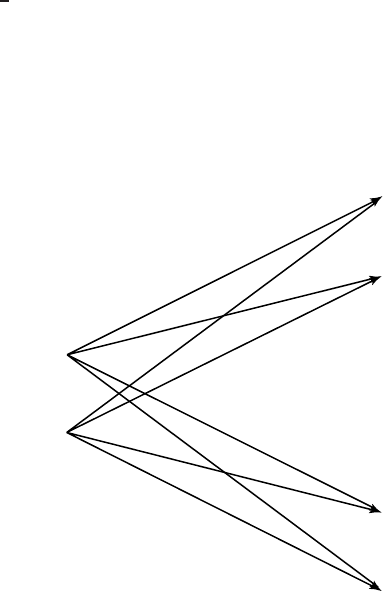
Example 15.6.5 Consider a pair of binary symmetric channels with
parameters p
1
and p
2
that form a broadcast channel as shown in Fig-
ure 15.27. Without loss of generality in the capacity calculation, we can
recast this channel as a physically degraded channel. We assume that
p
1
<p
2
<
1
2
. Then we can express a binary symmetric channel with
parameter p
2
as a cascade of a binary symmetric channel with parameter
p
1
with another binary symmetric channel. Let the crossover probability
of the new channel be α. Then we must have
p
1
(1 − α) + (1 − p
1
)α = p
2
(15.229)
X
Y
1
Y
2
0
0
1
1
0
1
FIGURE 15.27. Binary symmetric broadcast channel.

15.6 BROADCAST CHANNEL 569
U
1 − b
1 − b
1
− a
1 − a
1
−
p
1
1 −
p
1
XY
1
Y
2
b
b
a
a
p
1
p
1
FIGURE 15.28. Physically degraded binary symmetric broadcast channel.
or
α =
p
2
− p
1
1 − 2p
1
. (15.230)
We now consider the auxiliary random variable in the definition of the
capacity region. In this case, the cardinality of U is binary from the bound
of the theorem. By symmetry, we connect U to X by another binary
symmetric channel with parameter β, as illustrated in Figure 15.28.
We can now calculate the rates in the capacity region. It is clear by sym-
metry that the distribution on U that maximizes the rates is the uniform
distribution on {0, 1},sothat
I(U;Y
2
) = H(Y
2
) − H(Y
2
|U) (15.231)
= 1 −H(β ∗ p
2
), (15.232)
where
β ∗ p
2
= β(1 − p
2
) + (1 − β)p
2
. (15.233)
Similarly,
I(X;Y
1
|U) = H(Y
1
|U)− H(Y
1
|X, U ) (15.234)
= H(Y
1
|U)− H(Y
1
|X) (15.235)
= H(β ∗p
1
) − H(p
1
), (15.236)
where
β ∗ p
1
= β(1 − p
1
) + (1 − β)p
1
. (15.237)
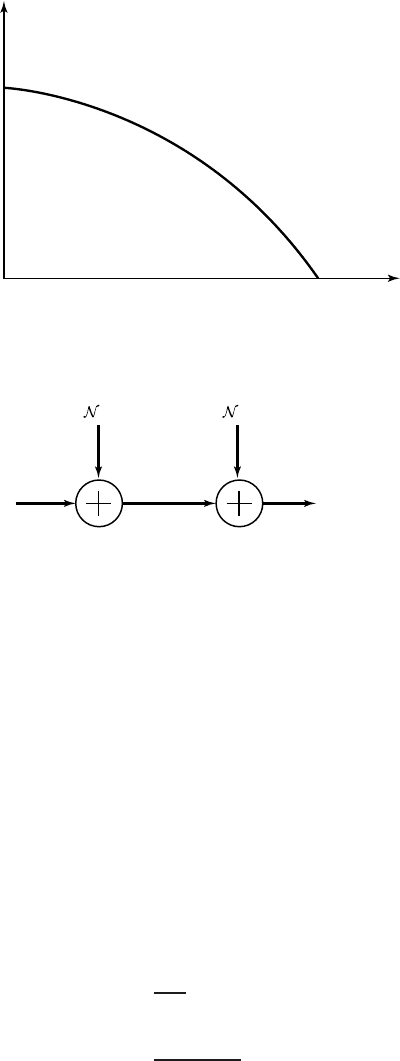
Plotting these points as a function of β, we obtain the capacity region
in Figure 15.29. When β = 0, we have maximum information transfer
to Y
2
[i.e., R
2
= 1 −H(p
2
) and R
1
= 0]. When β =
1
2
, we have maxi-
mum information transfer to Y
1
[i.e., R
1
= 1 −H(p
1
)] and no information
transfer to Y
2
. These values of β give us the corner points of the rate
region.
570 NETWORK INFORMATION THEORY
R
2
R
1
I
−
H
(
p
2
)
I
−
H
(
p
1
)
FIGURE 15.29. Capacity region of binary symmetric broadcast channel.
Z
1
~
Y
1
Y
2
(0,
N
1
)
Z
′
2
~
(0,
N
2
−
N
1
)
X
FIGURE 15.30. Gaussian broadcast channel.
Example 15.6.6 (Gaussian broadcast channel ) The Gaussian broad-
cast channel is illustrated in Figure 15.30. We have shown it in the case
where one output is a degraded version of the other output. Based on
the results of Problem 15.10, it follows that all scalar Gaussian broadcast
channels are equivalent to this type of degraded channel.
Y
1
= X + Z
1
, (15.238)
Y
2
= X + Z
2
= Y
1
+ Z
2
, (15.239)
where Z
1
∼ N(0,N
1
) and Z
2
∼ N(0,N
2
− N
1
).
Extending the results of this section to the Gaussian case, we can show
that the capacity region of this channel is given by
R
1
<C
αP
N
1
(15.240)
R
2
<C
(1 − α)P
αP + N
2
, (15.241)
15.7 RELAY CHANNEL 571
where α may be arbitrarily chosen (0 ≤ α ≤ 1). The coding scheme that
achieves this capacity region is outlined in Section 15.1.3.
15.7 RELAY CHANNEL
The relay channel is a channel in which there is one sender and one
receiver with a number of intermediate nodes that act as relays to help
the communication from the sender to the receiver. The simplest relay
channel has only one intermediate or relay node. In this case the channel
consists of four finite sets
X, X
1
, Y,andY
1
and a collection of probability
mass functions p(y, y
1
|x, x
1
) on Y × Y
1
, one for each (x, x
1
) ∈ X × X
1
.
The interpretation is that x is the input to the channel and y is the output
of the channel, y
1
is the relay’s observation, and x
1
is the input symbol
chosen by the relay, as shown in Figure 15.31. The problem is to find the
capacity of the channel between the sender X and the receiver Y .
The relay channel combines a broadcast channel (X to Y and Y
1
)anda
multiple-access channel (X and X
1
to Y ). The capacity is known for the
special case of the physically degraded relay channel. We first prove an
outer bound on the capacity of a general relay channel and later establish
an achievable region for the degraded relay channel.
Definition A (2
nR
,n) code for a relay channel consists of a set of
integers
W ={1, 2,...,2
nR
}, an encoding function
X : {1, 2,...,2
nR
}→X
n
, (15.242)
a set of relay functions {f
i
}
n
i=1
such that
x
1i
= f
i
(Y
11
,Y
12
,...,Y
1i−1
), 1 ≤ i ≤ n, (15.243)
and a decoding function,
g :
Y
n
→{1, 2,...,2
nR
}. (15.244)
X
Y
1
:
X
1
Y
FIGURE 15.31. Relay channel.

572 NETWORK INFORMATION THEORY
Note that the definition of the encoding functions includes the nonan-
ticipatory condition on the relay. The relay channel input is allowed to
depend only on the past observations y
11
,y
12
,...,y
1i−1
. The channel is
memoryless in the sense that (Y
i
,Y
1i
) depends on the past only through
the current transmitted symbols (X
i
,X
1i
). Thus, for any choice p(w),
w ∈
W, and code choice X : {1, 2,...,2
nR
}→X
n
i
and relay functions
{f
i
}
n
i=1
, the joint probability mass function on W × X
n
× X
n
1
× Y
n
× Y
n
1
is given by
p(w, x, x
1
, y, y
1
) = p(w)
n
i=1
p(x
i
|w)p(x
1i
|y
11
,y
12
,...,y
1i−1
)
× p(y
i
,y
1i
|x
i
,x
1i
). (15.245)
If the message w ∈ [1, 2
nR
] is sent, let
λ(w) = Pr{g(Y) = w|w sent} (15.246)
denote the conditional probability of error. We define the average proba-
bility of error of the code as
P
(n)
e
=
1
2
nR
w
λ(w). (15.247)
The probability of error is calculated under the uniform distribution over
the codewords w ∈{1,...,2
nR
}.TherateR is said to be achievable
by the relay channel if there exists a sequence of (2
nR
,n) codes with
P
(n)
e
→ 0. The capacity C of a relay channel is the supremum of the set
of achievable rates.
We first give an upper bound on the capacity of the relay channel.
Theorem 15.7.1 For any relay channel (
X × X
1
,p(y,y
1
|x, x
1
), Y ×
Y
1
), the capacity C is bounded above by
C ≤ sup
p(x,x
1
)
min
{
I(X,X
1
;Y),I(X;Y, Y
1
|X
1
)
}
. (15.248)
Proof: The proof is a direct consequence of a more general max-flow
min-cut theorem given in Section 15.10.
This upper bound has a nice max-flow min-cut interpretation. The first
term in (15.248) upper bounds the maximum rate of information transfer
15.7 RELAY CHANNEL 573
from senders X and X
1
to receiver Y . The second terms bound the rate
from X to Y and Y
1
.
We now consider a family of relay channels in which the relay receiver
is better than the ultimate receiver Y in the sense defined below. Here the
max-flow min-cut upper bound in the (15.248) is achieved.
Definition The relay channel (
X × X
1
,p(y,y
1
|x, x
1
), Y × Y
1
) is said
to be physically degraded if p(y, y
1
|x, x
1
) can be written in the form
p(y, y
1
|x, x
1
) = p(y
1
|x, x
1
)p(y|y
1
,x
1
). (15.249)
Thus, Y is a random degradation of the relay signal Y
1
.
For the physically degraded relay channel, the capacity is given by the
following theorem.
Theorem 15.7.2 The capacity C of a physically degraded relay channel
is given by
C = sup
p(x,x
1
)
min
{
I(X,X
1
;Y),I(X;Y
1
|X
1
)
}
, (15.250)
where the supremum is over all joint distributions on
X × X
1
.
Proof:
Converse: The proof follows from Theorem 15.7.1 and by degradedness,
since for the degraded relay channel, I(X;Y, Y
1
|X
1
) = I(X;Y
1
|X
1
).
Achievability: The proof of achievability involves a combination
of the following basic techniques: (1) random coding, (2) list codes,
(3) Slepian–Wolf partitioning, (4) coding for the cooperative multiple-
access channel, (5) superposition coding, and (6) block Markov encoding
at the relay and transmitter. We provide only an outline of the proof.
Outline of achievability: We consider B blocks of transmission, each of
n symbols. A sequence of B − 1 indices, w
i
∈{1,...,2
nR
},i = 1, 2,...,
B − 1, will be sent over the channel in nB transmissions. (Note that as
B →∞for a fixed n,therateR(B − 1)/B is arbitrarily close to R.)
We define a doubly indexed set of codewords:
C ={x(w|s),x
1
(s)} : w ∈{1, 2
nR
},s ∈{1, 2
nR
0
}, x ∈ X
n
, x
1
∈ X
n
1
.
(15.251)
We will also need a partition
S ={S
1
,S
2
,...,S
2
nR
0
} of W ={1, 2,...,2
nR
} (15.252)
574 NETWORK INFORMATION THEORY
into 2
nR
0
cells, with S
i
∩ S
j
= φ,i = j ,and∪S
i
= W. The partition will
enable us to send side information to the receiver in the manner of Slepian
and Wolf [502].
Generation of random code: Fix p(x
1
)p(x|x
1
).
First generate at random 2
nR
0
i.i.d. n-sequences in X
n
1
, each
drawn according to p(x
1
) =
n
i=1
p(x
1i
). Index them as x
1
(s), s ∈
{1, 2,...,2
nR
0
}. For each x
1
(s), generate 2
nR
conditionally independent
n-sequences x(w|s),w ∈{1, 2,...,2
nR
}, drawn independently accord-
ing to p(x|x
1
(s)) =
n
i=1
p(x
i
|x
1i
(s)). This defines the random code-
book
C ={x(w|s),x
1
(s)}. The random partition S ={S
1
,S
2
,...,S
2
nR
0
} of
{1, 2,...,2
nR
} is defined as follows. Let each integer w ∈{1, 2,...,2
nR
}
be assigned independently, according to a uniform distribution over the
indices s = 1, 2,...,2
nR
0
, to cells S
s
.
Encoding: Let w
i
∈{1, 2,...,2
nR
} be the new index to be sent in block
i,andlets
i
be defined as the partition corresponding to w
i−1
(i.e., w
i−1
∈
S
s
i
). The encoder sends x(w
i
|s
i
). The relay has an estimate
ˆ
ˆw
i−1
of the
previous index w
i−1
. (This will be made precise in the decoding section.)
Assume that
ˆ
ˆw
i−1
∈ S
ˆ
ˆs
i
. The relay encoder sends x
1
(
ˆ
ˆs
i
) in block i.
Decoding: We assume that at the end of block i − 1, the receiver
knows (w
1
,w
2
,...,w
i−2
) and (s
1
,s
2
,...,s
i−1
) and the relay knows (w
1
,
w
2
,...,w
i−1
) and consequently, (s
1
,s
2
,...,s
i
). The decoding procedures
at the end of block i are as follows:
1. Knowing s
i
and upon receiving y
1
(i),therelay receiver estimates
the message of the transmitter
ˆ
ˆw
i
= w if and only if there exists
a unique w such that (x(w|s
i
), x
1
(s
i
), y
1
(i)) are jointly -typical.
Using Theorem 15.2.3, it can be shown that
ˆ
ˆw
i
= w
i
with an arbi-
trarily small probability of error if
R<I(X;Y
1
|X
1
) (15.253)
and n is sufficiently large.
2. The receiver declares that ˆs
i
= s was sent iff there exists one and
only one s such that (x
1
(s), y(i)) are jointly -typical. From Theo-
rem 15.2.1 we know that s
i
can be decoded with arbitrarily small
probability of error if
R
0
<I(X
1
;Y) (15.254)
and n is sufficiently large.