
Thomas M. Cover, Joy A. Thomas. Elements of information theory
Подождите немного. Документ загружается.

15.4 ENCODING OF CORRELATED SOURCES 555
15.4.2 Converse for the Slepian–Wolf Theorem
The converse for the Slepian–Wolf theorem follows obviously from the
results for a single source, but we will provide it for completeness.
Proof: (Converse to Theorem 15.4.1). As usual, we begin with Fano’s
inequality. Let f
1
,f
2
,g be fixed. Let I
0
= f
1
(X
n
) and J
0
= f
2
(Y
n
).Then
H(X
n
,Y
n
|I
0
,J
0
) ≤ P
(n)
e
n(log |X|+log |Y|) + 1 = n
n
, (15.178)
where
n
→ 0asn →∞. Now adding conditioning, we also have
H(X
n
|Y
n
,I
0
,J
0
) ≤ n
n
, (15.179)
and
H(Y
n
|X
n
,I
0
,J
0
) ≤ n
n
. (15.180)
We can write a chain of inequalities
n(R
1
+ R
2
)
(a)
≥ H(I
0
,J
0
) (15.181)
= I(X
n
,Y
n
;I
0
,J
0
) + H(I
0
,J
0
|X
n
,Y
n
) (15.182)
(b)
= I(X
n
,Y
n
;I
0
,J
0
) (15.183)
= H(X
n
,Y
n
) − H(X
n
,Y
n
|I
0
,J
0
) (15.184)
(c)
≥ H(X
n
,Y
n
) − n
n
(15.185)
(d)
= nH (X, Y ) − n
n
, (15.186)
where
(a) follows from the fact that I
0
∈{1, 2,...,2
nR
1
} and J
0
∈
{1, 2,...,2
nR
2
}
(b) follows from the fact the I
0
is a function of X
n
and J
0
is a function
of Y
n
(c) follows from Fano’s inequality (15.178)
(d) follows from the chain rule and the fact that (X
i
,Y
i
) are i.i.d.
556 NETWORK INFORMATION THEORY
Similarly, using (15.179), we have
nR
1
(
a)
≥ H(I
0
) (15.187)
≥ H(I
0
|Y
n
) (15.188)
= I(X
n
;I
0
|Y
n
) + H(I
0
|X
n
,Y
n
) (15.189)
(b)
= I(X
n
;I
0
|Y
n
) (15.190)
= H(X
n
|Y
n
) − H(X
n
|I
0
,J
0
,Y
n
) (15.191)
(c)
≥ H(X
n
|Y
n
) − n
n
(15.192)
(d)
= nH (X|Y)− n
n
, (15.193)
where the reasons are the same as for the equations above. Similarly, we
can show that
nR
2
≥ nH (Y |X) − n
n
. (15.194)
Dividing these inequalities by n and taking the limit as n →∞,wehave
the desired converse.
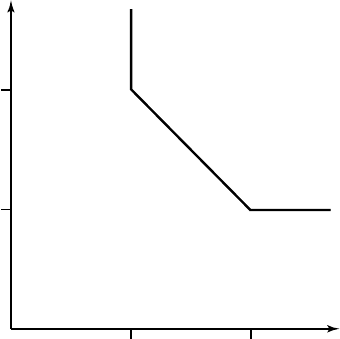
The region described in the Slepian–Wolf theorem is illustrated in
Figure 15.21.
15.4.3 Slepian–Wolf Theorem for Many Sources
The results of Section 15.4.2 can easily be generalized to many sources.
The proof follows exactly the same lines.
Theorem 15.4.2 Let (X
1i
,X
2i
,...,X
mi
) be i.i.d. ∼ p(x
1
,x
2
,...,x
m
).
Then the set of rate vectors achievable for distributed source coding with
separate encoders and a common decoder is defined by
R(S) > H (X(S)|X(S
c
)) (15.195)
for all S ⊆{1, 2,...,m},where
R(S) =
i∈S
R
i
(15.196)
and X(S) ={X
j
: j ∈ S}.
15.4 ENCODING OF CORRELATED SOURCES 557
R
2
R
1
H
(
Y
)
H
(
Y
|
X
)
H
(
X
|
Y
)
H
(
X
)
0
FIGURE 15.21. Rate region for Slepian–Wolf encoding.
Proof: The proof is identical to the case of two variables and is
omitted.
The achievability of Slepian–Wolf encoding has been proved for an
i.i.d. correlated source, but the proof can easily be extended to the case
of an arbitrary joint source that satisfies the AEP; in particular, it can
be extended to the case of any jointly ergodic source [122]. In these
cases the entropies in the definition of the rate region are replaced by the
corresponding entropy rates.
15.4.4 Interpretation of Slepian–Wolf Coding
We consider an interpretation of the corner points of the rate region in
Slepian–Wolf encoding in terms of graph coloring. Consider the point
with rate R
1
= H(X),R
2
= H(Y|X).UsingnH (X) bits, we can encode
X
n
efficiently, so that the decoder can reconstruct X
n
with arbitrarily low
probability of error. But how do we code Y
n
with nH (Y |X) bits? Looking
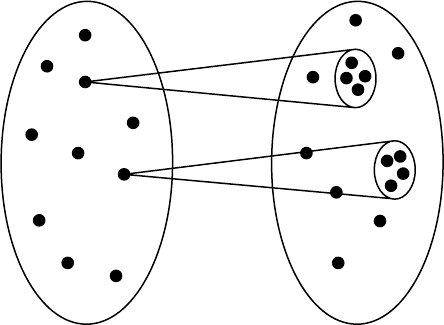
at the picture in terms of typical sets, we see that associated with every
X
n
is a typical “fan” of Y
n
sequences that are jointly typical with the
given X
n
as shown in Figure 15.22.
If the Y encoder knows X
n
, the encoder can send the index of the Y
n
within this typical fan. The decoder, also knowing X
n
, can then construct
this typical fan and hence reconstruct Y
n
.ButtheY encoder does not
know X
n
. So instead of trying to determine the typical fan, he randomly
558 NETWORK INFORMATION THEORY
x
n
y
n
FIGURE 15.22. Jointly typical fans.
colors all Y
n
sequences with 2
nR
2
colors. If the number of colors is high
enough, then with high probability all the colors in a particular fan will
be different and the color of the Y
n
sequence will uniquely define the
Y
n
sequence within the X
n
fan. If the rate R
2
>H(Y|X), the number of
colors is exponentially larger than the number of elements in the fan and
we can show that the scheme will have an exponentially small probability
of error.
15.5 DUALITY BETWEEN SLEPIAN–WOLF ENCODING
AND MULTIPLE-ACCESS CHANNELS
With multiple-access channels, we considered the problem of sending
independent messages over a channel with two inputs and only one output.
With Slepian–Wolf encoding, we considered the problem of sending a
correlated source over a noiseless channel, with a common decoder for
recovery of both sources. In this section we explore the duality between
the two systems.
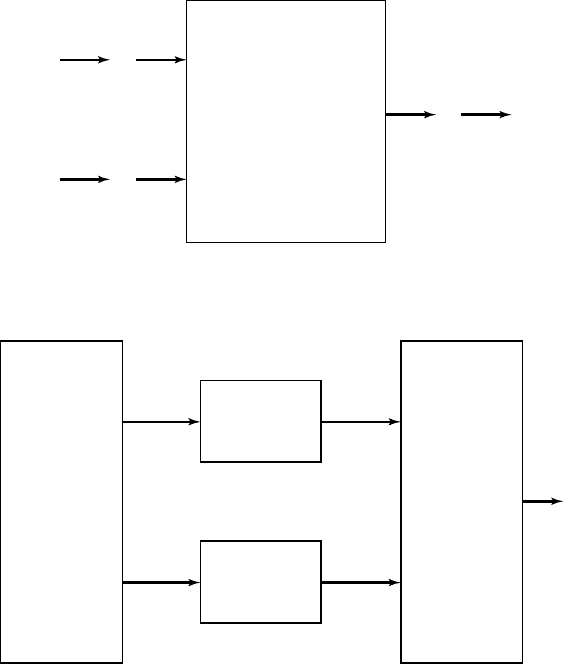
In Figure 15.23, two independent messages are to be sent over the
channel as X
n
1
and X
n
2
sequences. The receiver estimates the messages
from the received sequence. In Figure 15.24 the correlated sources are
encoded as “independent” messages i and j . The receiver tries to estimate
the source sequences from knowledge of i and j .
In the proof of the achievability of the capacity region for the multiple-
access channel, we used a random map from the set of messages to the
15.5 SLEPIAN–WOLF ENCODING AND MULTIPLE-ACCESS CHANNELS 559
p
(
y
|
x
1
,
x
2
)
X
1
X
2
W
1
(
W
1
,
W
2
)
W
2
Y
^^
FIGURE 15.23. Multiple-access channels.
X
(
X
,
Y
)
(
X
,
Y
)
Encoder
Decoder
R
1
Y
Encoder
R
2
^^
FIGURE 15.24. Correlated source encoding.
sequences X
n
1
and X
n
2
. In the proof for Slepian–Wolf coding, we used a
random map from the set of sequences X
n
and Y
n
to a set of messages.
In the proof of the coding theorem for the multiple-access channel, the
probability of error was bounded by
P
(n)
e
≤ +
codewords
Pr(codeword jointly typical with sequence received)
(15.197)
= +
2
nR
1
terms
2
−nI
1
+
2
nR
2
terms
2
−nI
2
+
2
n(R
1
+R
2
)
terms
2
−nI
3
,
(15.198)
560 NETWORK INFORMATION THEORY
where is the probability the sequences are not typical, R
i
are the rates
corresponding to the number of codewords that can contribute to the
probability of error, and I
i
is the corresponding mutual information that
corresponds to the probability that the codeword is jointly typical with
the received sequence.
In the case of Slepian–Wolf encoding, the corresponding expression
for the probability of error is
P
(n)
e
≤ +
jointly typical sequences
Pr( have the same codeword) (15.199)
= +
2
nH
1
terms
2
−nR
1
+
2
nH
2
terms
2
−nR
2
+
2
nH
3
terms
2
−n(R
1
+R
2
)
,
(15.200)
where again the probability that the constraints of the AEP are not satisfied
is bounded by , and the other terms refer to the various ways in which
another pair of sequences could be jointly typical and in the same bin as
the given source pair.
The duality of the multiple-access channel and correlated source encod-
ing is now obvious. It is rather surprising that these two systems are duals
of each other; one would have expected a duality between the broadcast
channel and the multiple-access channel.
15.6 BROADCAST CHANNEL
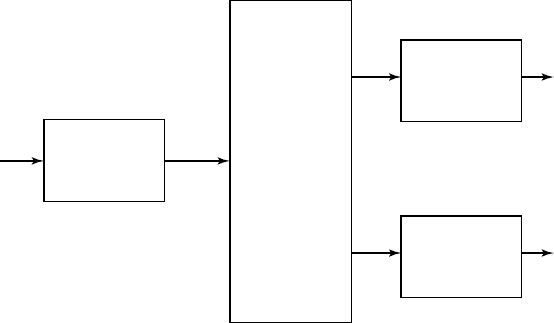
The broadcast channel is a communication channel in which there is one
sender and two or more receivers. It is illustrated in Figure 15.25. The
basic problem is to find the set of simultaneously achievable rates for
communication in a broadcast channel. Before we begin the analysis, let
us consider some examples.
Example 15.6.1 (TV station) The simplest example of the broadcast
channel is a radio or TV station. But this example is slightly degenerate
in the sense that normally the station wants to send the same informa-
tion to everybody who is tuned in; the capacity is essentially max
p(x)
min
i
I(X;Y
i
), which may be less than the capacity of the worst receiver.
But we may wish to arrange the information in such a way that the bet-
ter receivers receive extra information, which produces a better picture
or sound, while the worst receivers continue to receive more basic infor-
mation. As TV stations introduce high-definition TV (HDTV), it may be
necessary to encode the information so that bad receivers will receive the
15.6 BROADCAST CHANNEL 561
(
W
1
,
W
2
)
W
1
Decoder
p
(
y
1
,
y
2
|
x
)
W
2
Y
1
Y
2
Decoder
Encoder
X
^
^
FIGURE 15.25. Broadcast channel.
regular TV signal, while good receivers will receive the extra informa-
tion for the high-definition signal. The methods to accomplish this will
be explained in the discussion of the broadcast channel.
Example 15.6.2 (Lecturer in classroom) A lecturer in a classroom is
communicating information to the students in the class. Due to differences
among the students, they receive various amounts of information. Some of
the students receive most of the information; others receive only a little. In
the ideal situation, the lecturer would be able to tailor his or her lecture in
such a way that the good students receive more information and the poor
students receive at least the minimum amount of information. However, a
poorly prepared lecture proceeds at the pace of the weakest student. This
situation is another example of a broadcast channel.
Example 15.6.3 (Orthogonal broadcast channels) The simplest broad-
cast channel consists of two independent channels to the two receivers.
Here we can send independent information over both channels, and we
can achieve rate R
1
to receiver 1 and rate R
2
to receiver 2 if R
1
<C
1
and
R
2
<C
2
. The capacity region is the rectangle shown in Figure 15.26.
Example 15.6.4 (Spanish and Dutch speaker) To illustrate the idea of
superposition, we will consider a simplified example of a speaker who can
speak both Spanish and Dutch. There are two listeners: One understands
only Spanish and the other understands only Dutch. Assume for simplicity
that the vocabulary of each language is 2
20
words and that the speaker
speaks at the rate of 1 word per second in either language. Then he

562 NETWORK INFORMATION THEORY
R
2
R
1
C
2
C
1
0
FIGURE 15.26. Capacity region for two orthogonal broadcast channels.
can transmit 20 bits of information per second to receiver 1 by speaking
to her all the time; in this case, he sends no information to receiver 2.
Similarly, he can send 20 bits per second to receiver 2 without sending
any information to receiver 1. Thus, he can achieve any rate pair with
R
1
+ R
2
= 20 by simple time-sharing. But can he do better?
Recall that the Dutch listener, even though he does not understand
Spanish, can recognize when the word is Spanish. Similarly, the Spanish
listener can recognize when Dutch occurs. The speaker can use this to
convey information; for example, if the proportion of time he uses each
language is 50%, then of a sequence of 100 words, about 50 will be
Dutch and about 50 will be Spanish. But there are many ways to order the
Spanish and Dutch words; in fact, there are about
100
50
≈ 2
100H(
1
2
)
ways
to order the words. Choosing one of these orderings conveys information
to both listeners. This method enables the speaker to send information at
a rate of 10 bits per second to the Dutch receiver, 10 bits per second to
the Spanish receiver, and 1 bit per second of common information to both
receivers, for a total rate of 21 bits per second, which is more than that
achievable by simple timesharing. This is an example of superposition of
information.
The results of the broadcast channel can also be applied to the case
of a single-user channel with an unknown distribution. In this case, the
objective is to get at least the minimum information through when the
channel is bad and to get some extra information through when the channel
is good. We can use the same superposition arguments as in the case of
the broadcast channel to find the rates at which we can send information.
15.6 BROADCAST CHANNEL 563
15.6.1 Definitions for a Broadcast Channel
Definition A broadcast channel consists of an input alphabet
X and
two output alphabets,
Y
1
and Y
2
, and a probability transition function
p(y
1
,y
2
|x). The broadcast channel will be said to be memoryless if
p(y
n
1
,y
n
2
|x
n
) =
n
i=1
p(y
1i
,y
2i
|x
i
).
We define codes, probability of error, achievability, and capacity regions
for the broadcast channel as we did for the multiple-access channel. A
((2
nR
1
, 2
nR
2
), n) code for a broadcast channel with independent informa-
tion consists of an encoder,
X : ({1, 2,...,2
nR
1
}×{1, 2,...,2
nR
2
}) → X
n
, (15.201)
and two decoders,
g
1
: Y
n
1
→{1, 2,...,2
nR
1
} (15.202)
and
g
2
: Y
n
2
→{1, 2,...,2
nR
2
}. (15.203)
We define the average probability of error as the probability that the
decoded message is not equal to the transmitted message; that is,
P
(n)
e
= P(g
1
(Y
n
1
) = W
1
or g
2
(Y
n
2
) = W
2
), (15.204)
where (W
1
,W
2
) are assumed to be uniformly distributed over 2
nR
1
× 2
nR
2
.
Definition A rate pair (R
1
,R
2
) is said to be achievable for the broad-
cast channel if there exists a sequence of ((2
nR
1
, 2
nR
2
), n) codes with
P
(n)
e
→ 0.
We will now define the rates for the case where we have common
information to be sent to both receivers. A ((2
nR
0
, 2
nR
1
, 2
nR
2
), n) code
for a broadcast channel with common information consists of an encoder,
X : ({1, 2,...,2
nR
0
}×{1, 2,...,2
nR
1
}×{1, 2,...,2
nR
2
}) → X
n
,
(15.205)
and two decoders,
g
1
: Y
n
1
→{1, 2,...,2
nR
0
}×{1, 2,...,2
nR
1
} (15.206)
and
g
2
: Y
n
2
→{1, 2,...,2
nR
0
}×{1, 2,...,2
nR
2
}. (15.207)
564 NETWORK INFORMATION THEORY
Assuming that the distribution on (W
0
,W
1
,W
2
) is uniform, we can define
the probability of error as the probability that the decoded message is not
equal to the transmitted message:
P
(n)
e
= P(g
1
(Y
n
1
) = (W
0
,W
1
) or g
2
(Z
n
) = (W
0
,W
2
)). (15.208)
Definition Aratetriple(R
0
,R
1
,R
2
) is said to be achievable for the
broadcast channel with common information if there exists a sequence of
((2
nR
0
, 2
nR
1
, 2
nR
2
), n) codes with P
(n)
e
→ 0.
Definition The capacity region of the broadcast channel is the closure
of the set of achievable rates.
We observe that an error for receiver Y
n
1
depends only the distribution
p(x
n
,y
n
1
) and not on the joint distribution p(x
n
,y
n
1
,y
n
2
).Thus,wehave
the following theorem:
Theorem 15.6.1 The capacity region of a broadcast channel depends
only on the conditional marginal distributions p(y
1
|x) and p(y
2
|x).
Proof: See the problems.
15.6.2 Degraded Broadcast Channels
Definition A broadcast channel is said to be physically degraded if
p(y
1
,y
2
|x) = p(y
1
|x)p(y
2
|y
1
).
Definition A broadcast channel is said to be stochastically degraded if
its conditional marginal distributions are the same as that of a physically
degraded broadcast channel; that is, if there exists a distribution p
(y
2
|y
1
)
such that
p(y
2
|x) =
y
1
p(y
1
|x)p
(y
2
|y
1
). (15.209)
Note that since the capacity of a broadcast channel depends only on the
conditional marginals, the capacity region of the stochastically degraded
broadcast channel is the same as that of the corresponding physically
degraded channel. In much of the following, we therefore assume that the
channel is physically degraded.