
Tsoulos George (ред.) MIMO System Technology for Wireless Communications
Подождите немного. Документ загружается.


94 MIMO System Technology for Wireless Communications
4.3 Space–Time Block Codes
Space–Time Block Codes (STBCs) are the simplest type of spatial temporal
codes that exploit the diversity offered in systems with several transmit
antennas. In 1998, Alamouti designed a simple transmission diversity tech-
nique for systems having two transmit antennas [3]. This method provides
full diversity and requires simple linear operations at both transmission and
reception side. The encoding and decoding processes are performed with
blocks of transmission symbols. Alamouti’s simple transmit diversity scheme
was extended in [4] and [5] thanks to the theory of orthogonal designs for
larger numbers of transmit antennas. These codes are referred to in the
literature as Orthogonal Space–Time Block Codes (OSTBCs). In this section,
we initially describe the simple Alamouti’s scheme. A brief overview of STBC
based on orthogonal design is given next.
4.3.1 Alamouti’s Transmit Technique
Historically, the transmit diversity technique proposed by Alamouti was the
first STBC. The encoding and decoding operation is carried out in sets of
two modulated symbols. Hence, the information data bits are first modulated
and mapped into their corresponding constellation points. Therefore, let us
denote by x
1
and x
2
the two modulated symbols that enter the space–time
encoder. Usually, in systems with only one transmit antenna, these two
symbols are transmitted at two consecutive time instances t
1
and t
2
. The
times t
1
and t
2
are separated by a constant time duration T
. In the Alamouti
scheme, during the first time instance, the symbol x
1
and x
2
are transmitted
by the first and the second antenna element, respectively. During the second
time instance t
2
, the negative of the conjugate of the second symbol, i.e., –x
2
*
,
is sent to the first antenna while the conjugate of the first constellation point,
i.e., x
1
*
, is transmitted from the second antenna. The encoding operation is
described in the Table 4.1. The transmission rate is equal to the transmission
rate of a SISO system.
The space–time encoding mapping of Alamouti’s two-branch transmit
diversity technique can be represented by the coding matrix:
(4.3)
In the coding matrix X
1
, the subscript index gives the transmit rate com-
pared to a SISO system. For Alamouti’s scheme, the transmission rate is 1.
The rows of the coding matrix represent the transmit antennas while its
columns correspond to different time instances.
X
xx
xx
1
12
21
=
¬
®
¼
¾
½
*
*
.
4190_book.fm Page 94 Tuesday, February 7, 2006 12:44 PM
Introduction to Space–Time Coding
95
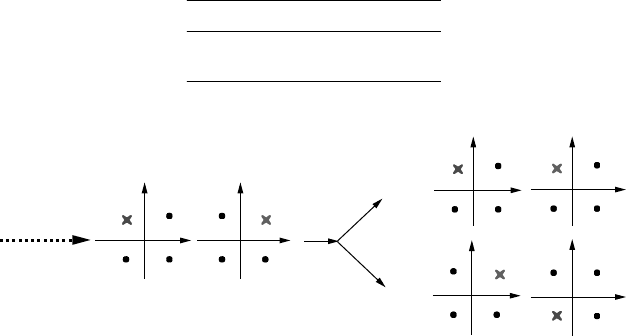
An example of the space–time encoding process is schematically shown
in Figure 4.3. The two modulated symbols are selected from a Quadrature
Phase Shift Keying (QPSK) constellation. Their representation in the complex
plane is depicted in the figure. The transmitted symbols from the two anten-
nas are sketched to the right side of the figure.
The decoding operation assumes that the fading channel coefficients dur-
ing the two consecutive transmission time periods, t
1
and t
2
, are to remain
constant. In other words, the channel coefficients from the first antenna to
the j
th receiver antenna h
j
,1
and those from the second antenna to the j
th
receiver antenna h
j
,2
must satisfy the following set of equations:
(4.4)
The received signals at receiver antenna j
during the two time instances
are r
j
1
and r
j
2
. The received signals satisfy the equations:
(4.5)
TABLE 4.1
Encoding of the Alamouti’s
Transmit Diversity Scheme.
Antenna 1 Antenna 2
Time t
1
x
1
x
2
Time t
2
–x
2
*
x
1
*
FIGURE 4.3
An example of the Alamouti’s encoding process for QPSK.
0001
11 10
0001
11 10
x
2
x
1
0100
Antenna 1
Antenna 2
x
1
x
2
x
1
∗
−x
2
∗
t
1
t
2
t
1
t
2
h ht htT ht ht
h
jj j j j
j
,, , , ,
,
11 1 11 12
=
()
=+
()
=
()
=
()
222 2 21 22
=
()
=+
()
=
()
=
()
ht htT ht ht
jj j j,, , ,
.
rhxhxn
rhxhx
jj j j
jj j
1
11 22
1
2
12 2
= + +
= +
,,
,
*
,11
2*
.+ n
j
4190_book.fm Page 95 Tuesday, February 7, 2006 12:44 PM

96 MIMO System Technology for Wireless Communications
In Equation 4.5, the Additive White Gaussian Noise (AWGN) components
added at each receiver antenna element j during the transmission time
instances t
1
and t
2
, are denoted n
j
1
and n
j
2
, respectively.
The decoding process is simple and requires signal combining and a max-
imum likelihood decoding. The combiner block performs elementary linear
operations such as additions, multiplications and conjugate transformations
of the received signals. However, the fading channel coefficients are consid-
ered perfectly known at the receiver. The fading components can be recovered
at the receiver side through commonly known procedures, such as pilot
training sequences. The processing of the linear combiner and the signals
fed to the maximum likelihood decoder are given in the following equations:
(4.6)
We notice that the decision statistics are composed by an amplification of
the transmitted signals and a noise component. The signal amplification is
equal to the sum of the amplitudes of all channel coefficients. The noise
component is a sum of the receiver antenna noises multiplied by channel
fading components.
4.3.2 Orthogonal Space–Time Block Codes
The transmit diversity scheme designed by Alamouti can be used only in a
system with two transmit antennas. It turns out that this technique belongs
to a general class of codes named Space–Time Block Codes or, more precisely,
Orthogonal STBCs, since they are based on the theory of orthogonal designs.
The authors of [4] introduced the theory of generalized orthogonal designs
in order to create codes for an arbitrary number of transmit antennas.
The general idea behind STBCs construction is based on finding coding
matrices X that can satisfy the following condition:
(4.7)
In this equation, X
H
is the Hermitian of X, p is a constant, I
MT
is the identity
matrix of size M
T
× M
T
, M
T
represents the number of transmit antennas, and
n is the number of symbols x
i
transmitted per transmission block in X. The
xhrhr hx
jj j j
j
M
ji
j
R
11
1
2
2
1
2
1
= +
()
{}
=
=
¨
,
*
,
*
,
====
¨¨¨
+ +
()
{}
11
2
1
1
2
2
1
M
i
jjj j
j
M
RR
hnh n
x
,
*
,
*
222
1
1
2
1
2
2
=
()
{}
=
==
¨
hrh r h x
jj j j
j
M
ji
j
R
,
*
,
*
,
111
2
2
1
1
2
1
M
i
jjj j
j
M
RR
hnh n
¨¨¨
==
+
()
{}
,
*
,
*
.
XX p x I
H
i
i
n
M
T
=
©
«
ª
ª
¹
»
º
º
=
¨
2
1
.
4190_book.fm Page 96 Tuesday, February 7, 2006 12:44 PM
Introduction to Space–Time Coding 97
generalized theory of orthogonal design is exploited to provide codes that
satisfy Equation 4.7.
The orthgonality property of STBCs is reflected in the fact that all rows of
X are orthogonal to each other. In other words, the sequences transmitted
from two different antenna elements are orthogonal to each other for each
transmission block.
For real signal, it is possible to reach full rate. However, it has been proven
in [4] that this statement is false for two-dimensional constellations, i.e.,
complex signals. The encoding and decoding approaches follow the pattern
described in Alamouti’s scheme.
For complex signals, the theory of orthogonal designs can be used to
generate coding matrices that achieve a transmission rate of 1/2 for the cases
of 3 and 4 transmission antennas:
(4.8)
(4.9)
Using the theory of orthogonal design to construct STBCs is not necessarily
the optimal approach. There exist some sporadic STBCs mentioned in the
literature, [6–8], that can provide a transmission rate of 3/4 for schemes of
either 3 or 4 transmit antennas.
(4.10)
(4.11)
It is important to notice that the channel coefficients must remain constant
during the transmission of a block of coded symbols X.
X
xxxxxxxx
xxxxxx
12
12341234
21432
=
****
*
1143
34123412
***
****
,xx
xxxxxxxx
¬
®
¼
¾
½
½
½
X
xxxxxxxx
xxxxxx
12
12341234
21432
=
****
*
1143
34123412
43214
***
****
xx
xxxxxxxx
xxxxx
*****
.
xxx
321
¬
®
¼
¾
½
½
½
½
½
X
xxx
xx x
xxx
34
123
21 3
312
0
0
0
=
¬
®
¼
¾
½
½
**
**
**
½½
,
X
xxx
xx x
xxx
xx x
34
123
13 2
231
32 1
0
0
0
0
=
¬
**
**
**
®®
¼
¾
½
½
½
½
½
.
4190_book.fm Page 97 Tuesday, February 7, 2006 12:44 PM

98 MIMO System Technology for Wireless Communications
The decoding of the STBCs described above can be easily deduced from
the encoding matrix. Let us assume that we wish to estimate symbols x
p
and
that we have defined by r
j
k
the received signal from antenna j at time instance
k. The values to be added at the linear combiner are:
•+(h
j,i
)* r
j
k
if we have x
p
at column k and line (transmit antenna) i of X
• (h
j,i
)* r
j
k
if we have x
p
at column k and line (transmit antenna) i of X
•+h
j,i
(r
j
k
)* if we have (x
p
)* at column k and line (transmit antenna) i
of X
• h
j,i
(r
j
k
)* if we have (x
p
)* at column k and line (transmit antenna)
i of X
The linear combiner sum is realized for all receive antennas j.
It is important to remember that STBCs based on orthogonal design do
not achieve a rate of 1 for complex signal constellations. In [8], it has been
shown for 3 and 4 transmit antennas the maximum possible rate is 3/4 with
4 delays. For 5 to 8 transmit antennas, the achievable rate is 1/2 with 8
delays, and for the 9 to 16 case, the rate becomes 5/16 in 16 time instances.
In order to achieve the rate of a SISO system, the orthogonal property of
STBCs must be broken as described in [9].
4.4 Space–Time Trellis Codes
As mentioned in the previous section, STBCs cannot achieve the transmission
rate of a SISO system when complex signals and more than two transmit
antennas are available. Furthermore, even though STBCs provide diversity,
the capacity of the MIMO system is not fully exploited. It is possible to design
codes that provide not only diversity but also some coding gain. The side
effect of this additional provision is a serious increase in complexity. More
precisely, the code’s complexity also increases according to the number of
transmission bits of the modulation used. The codes proposed are denoted
in the literature as STTCs. These codes are based on the well-known convo-
lutional encoding technique. Initial STTCs were presented in [10].
4.4.1 Encoding and Decoding
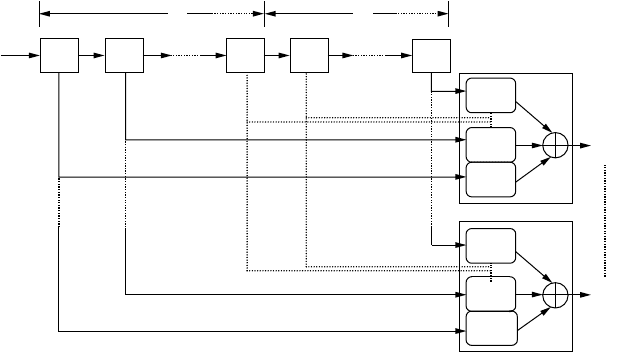
The STTC encoder is composed of a convolutional encoder as described in
[11]. The data bits are inserted into the convolutional encoder composed by
a fixed number of feed forward shift registers. The values of these registers
at any instance represent the current state of the encoder. The complexity of
4190_book.fm Page 98 Tuesday, February 7, 2006 12:44 PM
Introduction to Space–Time Coding 99
the codes but also their coding gains augment with the number of shift
registers. A block diagram of an encoder is shown in Figure 4.4.
The shift registers are connected to multipliers and adders. All multipli-
cations and additions are performed with a modulo equal to the constellation
size. The coefficients of the multipliers give the coefficients of the generator
polynomial that describes the convolutional encoder.
The encoding process is described by Equation 4.12 where a set {b} com-
posed of r input bits and q bits describing the shift registers, i.e., the state of
the encoder, is multiplied by the generator polynomial. All operations and
values are performed with a modulo equal to the constellation size.
(4.12)
The encoder state of the shift registers is initialized with zeros at the
beginning of transmission and is required to reach the zero state at the end
of transmission.
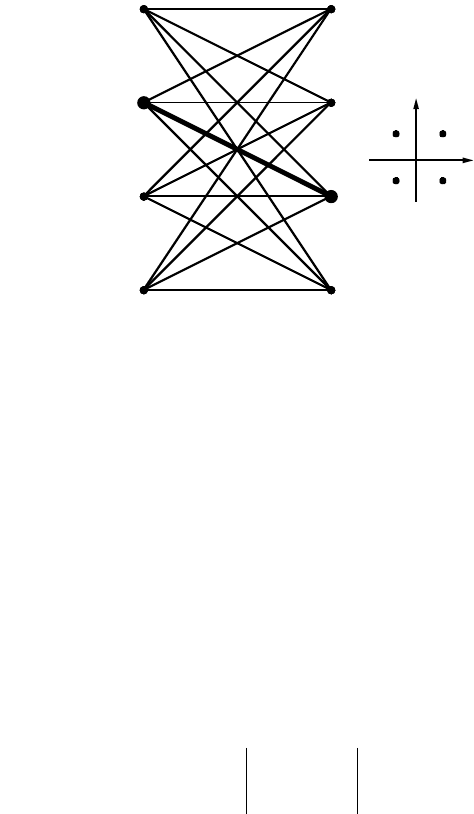
Convolutional codes can be represented with a trellis diagram. The trellis
code is a tree graph giving the transitions between the states of the registers
according to the input bits. The trellis of a STTC composed of four states,
designed for QPSK modulation, and applied to a system with two transmit
antennas is given as an example in Figure 4.5.
FIGURE 4.4
Space–Time Trellis encoder diagram.
r bits
b
1
b
2
b
b
g
b,1
g
2,1
g
1,1
x
1
r
b
r
b
r + 1
q
g
2,M
T
x
M
T
g
b,M
T
g
1,M
T
xx x b b b
g
Mrb
T
12 1
1,
¬
®
¼
¾
=
¬
®
¼
¾
1112 1
21 22 2
12
gg
gg g
gg g
M
M
bb bM
T
T
,,
,, ,
,, ,
TT
¬
®
¼
¾
½
½
½
½
½
.
4190_book.fm Page 99 Tuesday, February 7, 2006 12:44 PM
100 MIMO System Technology for Wireless Communications
In this figure, the branches emerging from each state from top to bottom
are labeled by x
1
,x
2
, which are the symbols transmitted from the first and
second antenna, respectively. An example is marked in bold in the figure.
We assume that we are already at state 1 and that the inputs bits are 1 and
0, which correspond to the QPSK symbol labeled by 2 in the right side of
the figure. The next state is then 2, and the symbols transmitted from the
two antennas are the QPSK symbols labeled by the numbers 1 and 2.
During the decoding of the STC code, each branch connecting two different
states can be assigned with a branch metric as a function of the received
signals r
j
of the M
R
receive antennas, the channel coefficients h
j,i
and the
constellation points marked by the labels of the transitions x
1
… x
MT
. This
branch metric BM(aqb), identifying the transition from state a to state b, is
given by:
(4.13)
The Viterbi algorithm can be used to compute the path metric with the
lowest accumulated metric. The path metric calculation can be simplified by
selecting the minimum branch metric arriving at each node or state. The
selected branch metric is called the survivor. In Figure 4.5, the bold branch
is the survivor for state 2 when BM(1q2) is inferior to BM(0q2), BM(2q2)
and BM(3q2). The Viterbi algorithm is composed of a forward and a back-
ward phase. During the forward phase, the Viterbi algorithm saves at each
stage, the sum of the branch metric of the survivor and the previously saved
path metric of the state from which the survivor emerges. In other words
and following the previous example, the path metric saved at state 2 in
FIGURE 4.5
Trellis of a four-state, STTC-coded QPSK with two transmit antennas.
0,0
0,1
0,3
0,2
1,0
1,1
1,3
1,2
2,0
2,1
2,3
2,2
3,0
3,1
3,3
3,2
0
1
2
3
0
1
2
3
0/001/01
3/11 2/10
QPSK
BM a b r h x
jjii
i
M
j
M
TR
q
()
=
==
¨¨
,
.
1
2
1
4190_book.fm Page 100 Tuesday, February 7, 2006 12:44 PM
Introduction to Space–Time Coding 101
Figure 4.5 is equal to BM(1q2) plus the previously calculated metric of state
1. After the end of this forward phase, a back trace operation starts by
selecting the minimum of the path metrics and tracing back the states of the
path selected and, hence, the transmitted sequence.
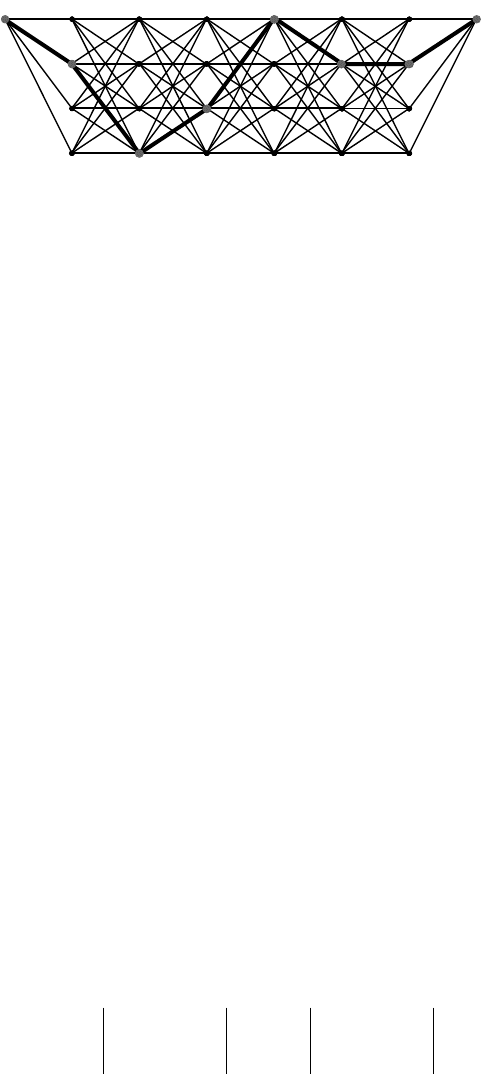
In Figure 4.6, an example is drawn based on the trellis described in Figure
4.5. The selected path shown in bold format follows the state transitions 0,
1, 3, 2, 0, 1, 1, 0. Based on the four-state STTC of Figure 4.5, the labels of the
symbols transmitted are 0, 1, 3, 2, 0, 1, 1 from antenna 1 and 1, 3, 1, 0, 1, 1,
0 from antenna 2.
4.4.2 Performance Analysis and Code Design
In order to conduct a performance analysis of space–time trellis codes, we
assume that a sequence of L consecutive symbols is transmitted from each
transmit antennas during L consecutive time instances. We can then define
the space–time codeword matrix X as:
(4.14)
The superscript indexes of x
t
i
represent the antenna element while the
subscript indexes gives the time instance. We will refer by x
i
the ith row of
X and by x
t
the tth column of X.
The pairwise error probability is defined as the probability that the decoder
estimates erroneously the transmitted sequence. This case occurs during the
maximum likelihood (ML) decoding process of the Viterbi algorithm when:
(4.15)
FIGURE 4.6
Example of a trellis path Viterbi selection for a four-state, STTC-coded QPSK with two transmit
antennas.
0
1
2
3
0
1
2
3
X
xx
xx
L
M
L
M
TT
=
¬
®
¼
¾
½
½
½
1
11
1
.
rhx rhx
t
j
ji
t
t
i
i
M
j
M
t
L
t
j
ji
t
TR
v
===
¨¨¨
,,
ˆ
111
tt
i
i
M
j
M
t
L
TR
===
¨¨¨
111
.
4190_book.fm Page 101 Tuesday, February 7, 2006 12:44 PM
102 MIMO System Technology for Wireless Communications
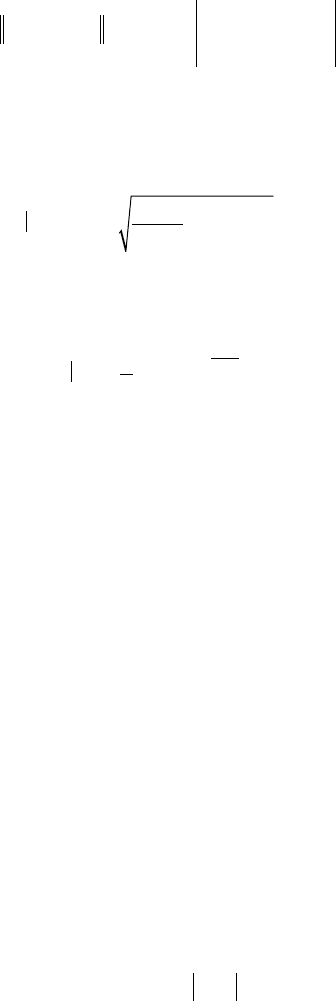
The modified Euclidian distance between two space–time codeword matrices
is identified as:
(4.16)
The pairwise error probability conditioned by the matrix H of channel
fading coefficients is given by the following equation where erfc(.) is the
complementary error function:
(4.17)
The upper bound of this conditional pairwise error probability is given by
the following equation:
(4.18)
Tarok et al. in [10] conducted a performance analysis for both Rician and
Rayleigh types of channels. The Rayleigh distribution is more representative
of the Non-Line-of-Sight (NLOS) environment and is considered in this
chapter. Nevertheless, in both channel situations, two different cases must
be dissociated. The first case involves slow fading channels, which implies
that the channel coefficients remain constant for the time durations equal to
L symbols. In the second case, which involves fast or rapid fading channels,
the channel coefficients change at each time instance.
In the case of slow Rayleigh fading channels, Tarok et al. in [10] define
the codeword difference matrix B between the codeword transmitted and the
erroneous codeword as:
(4.19)
Then, the codeword distance matrix A is defined to be the product of
matrix B with its Hermitian transpose, i.e., its transpose conjugate. The
modified Euclidian distance necessary to define the pairwise error probabil-
ity of Equation 4.17 becomes:
(4.20)
dXX HXX h x x
hji
t
t
i
t
i
i
M
T
2
2
1
2
,
ˆˆ
ˆ
,
()
=
()
=
()
=
¨
jj
M
t
L
R
==
¨¨
11
.
PXXH erfc
E
N
dXX
s
h
,
ˆ
,
ˆ
.
()
=
()
©
«
ª
¹
»
º
2
0
2
PXXH e
dXX
E
N
h
s
,
ˆ
.
,
ˆ
()
f
()
1
2
2
0
4
BXX
xx
xx
x
MM
L
TT
= =
ˆ
ˆ
ˆ
1
1
1
1
11
111
¬
®
¼
¾
½
½
½
ˆ
ˆ
.
x
xx
L
L
M
L
M
TT
dXX hv
hiji
j
M
j
M
RT
2
11
,
ˆ
.
()
=
==
¨¨
Q
4190_book.fm Page 102 Tuesday, February 7, 2006 12:44 PM

Introduction to Space–Time Coding 103
In the previous equation, Q
i
are the eigenvalues of A, h
j
are the jth rows of
H and v
i
represent the ith eigenvector of A.
The case of fast fading channels is more complex, and we invite the reader
to refer to Tarok et al. in [10] for the complete performance analysis. Distinc-
tive treatment is conducted according to the value of the space–time symbol-
wise Hamming distance. This distance represents the number of differences
in the space–time symbol difference vector F at a specific time t:
(4.21)
Tarok et al. defined design criteria for both slow and fast fading Rayleigh
channel conditions. The space–time code design rules for slow fading Ray-
leigh channels are known as the rank and the determinant criteria. The
optimum designed code must:
• Maximize the minimum rank of matrix A over all possible pairs of
distinct transmission codewords
• Maximize the minimum product of all non-zero eigenvalues of
matrix row along the pairs of distinct codewords with the minimum
rank
Similarly, for the case of rapid fading Rayleigh channel coefficients design
criteria are defined. They are named distance and product criteria. In this
case, the optimum codes must:
• Maximize the minimum space–time symbol-wise Hamming dis-
tance between all pairs of distinct codewords
• Maximize the minimum product distance along the path with the
minimum symbol-wise Hamming distance
The design criteria presented in this section were the first to be presented.
Several investigations have been conducted in this area and other more
refined criteria have been defined, [11] and [12].
4.5 Spatial Multiplexing
Spatial Multiplexing (SM) techniques have a different orientation than the
coding methods presented in the previous sections. The general operation
behind SM processing is to break the sequence of information bits into a
F
xx
xx
tt
t
M
t
M
TT
=
¬
®
¼
¾
½
½
½
11
ˆ
ˆ
.
4190_book.fm Page 103 Tuesday, February 7, 2006 12:44 PM