
Tsoulos George (ред.) MIMO System Technology for Wireless Communications
Подождите немного. Документ загружается.

64 MIMO System Technology for Wireless Communications
between adjacent elements to accommodate new ones within the fixed aper-
ture. When the element spacing decreases, the capacity increase slows down,
and finally, when the element spacing is less than the minimum distance,
d
min
~ Q/2, the capacity saturates. Hence, there is an optimal number of
antennas, for which the full capacity is achieved with the minimum number
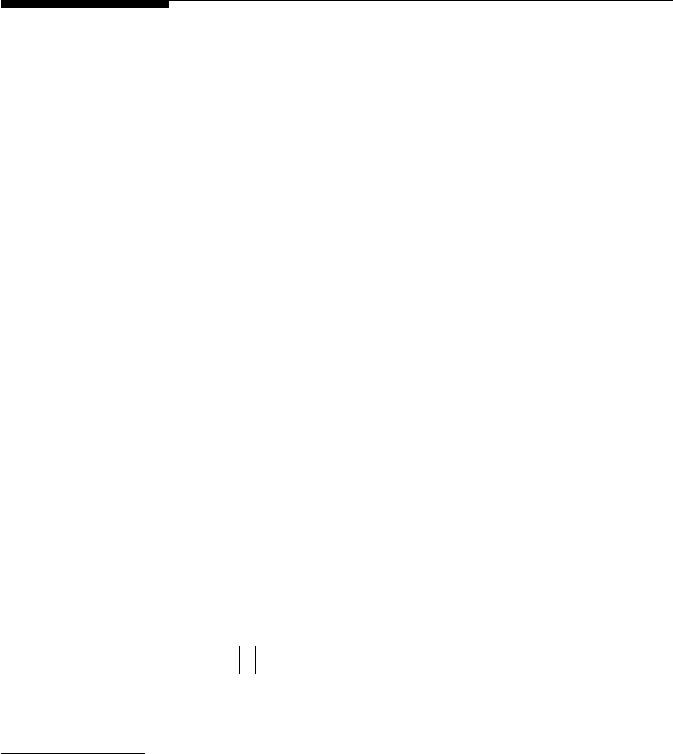
of antenna elements (i.e., the minimum complexity). Figure 3.3 demonstrates
this capacity saturation effect for a fixed-aperture antenna array using the
model in [8]. Note the dual nature of capacity saturation: the capacity satu-
rates with increasing the element spacing over d
min
for a given number of
elements n (1st type saturation — Figure 3.2) and also with increasing n over
number N
opt
for given aperture length L (2nd type saturation — Figure 3.3).
A similar capacity saturation argument has already been presented earlier
in [9]. However, no appropriate model has been developed, and also the
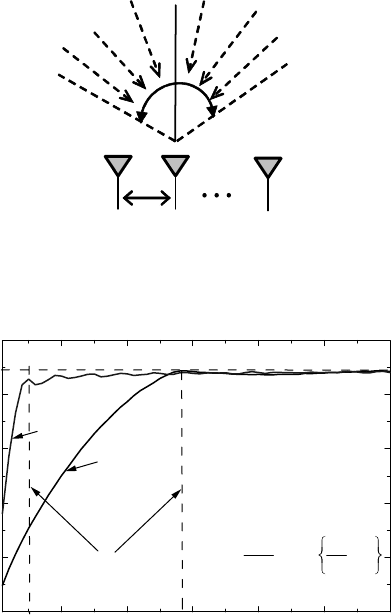
FIGURE 3.1
Incoming multipath signals arrive to a uniform linear antenna array of isotropic elements within
±)/2 of the broadside direction.
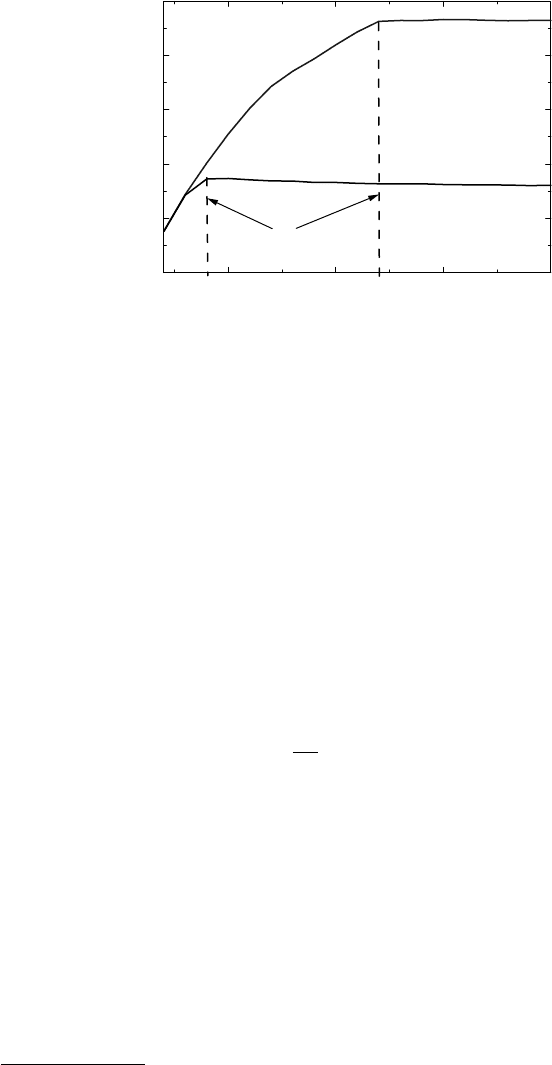
FIGURE 3.2
The average capacity vs. antenna spacing for the uniform linear array and the single-cluster
multipath channel of Figure 3.1 with angular spread ) at the Rx end (the Tx end is assumed
to be uncorrelated); n = 10, SNR = 30 dB. When ) = 360°, d
min
~ Q/2.
d
∆
0 6 5 4 3 2 1
0
20
30
40
50
60
C
max
d
min
∆ = 10°
∆ = 360°
Capacity, bit/s/Hz
d/λ
1
max , 0.5
2∆
d
min
λ
≈
4190_book.fm Page 64 Tuesday, February 21, 2006 9:14 AM
Information Theory and Electromagnetism: Are They Related? 65
optimal number of antennas has not been evaluated. Using the model in [8]
or the equivalent 3D model results in d
min
~ Q/2 for ) = 360° (uniform
scattering), and the optimal number N
opt
of antennas for a given aperture
size L is straightforward to evaluate (1D aperture, i.e., linear antenna array):
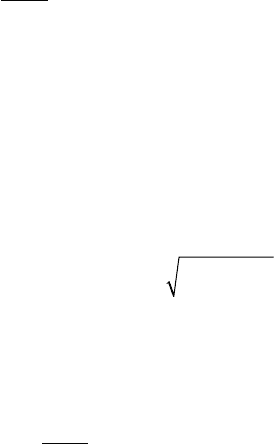
. (3.11)
For an angular spread smaller than 360°, the optimal number of antennas
decreases correspondingly,
.
This result is a spatial domain equivalent of the 2WT dimension theorem
[36].
It should be emphasized that the 2nd type capacity saturation has been
observed under the assumption of fixed average SNR at the receiver, which
is equivalent to , where n
T
is the number of Tx antennas, which
is fixed. Since increasing n results in more power collected by the Rx antenna
elements, which is equivalent to increasing the average SNR, it was specu-
lated that the 2nd type saturation may not exist if the SNR increase is taken
into account.* As we show later, this is not so (since the total power collected
by the Rx array is limited for fixed L).
FIGURE 3.3
The average capacity vs. the number of elements n of a uniform linear array and a single-cluster
multipath channel with the angular spread ) at the Rx end. The Tx end is assumed to be
uncorrelated, the number of Tx antenna elements is n
T
= 10; the aperture length L = 5Q, SNR =
30 dB.
* A. Molisch, private communication.
10 5 0 15 20
0
20
30
40
50
60
L = 5λ
∆ = 360°
N
opt
∆ = 10°
Capacity , bit/s/Hz
n
NL
opt
~ +21/Q
N
L
opt
~
{}
+
2
11
Q
min ,)
tr n
T
GG
+
{}
=
4190_book.fm Page 65 Tuesday, February 21, 2006 9:14 AM
66 MIMO System Technology for Wireless Communications
While our analysis above was based on 1D antenna arrays, the similar
saturation effects can be observed for 2D and 3D arrays as well. Additionally,
the capacity saturation effect has been also noted for circular arrays [24].
Hence, this effect is not a consequence of a specific array geometry but rather
a generic property of any array: capacity saturates as long as adjacent ele-
ment spacing is about Q/2, regardless of the geometry.* Finally, we note that
the results above are consistent with the diversity combining analysis, where
the minimum spacing is about half a wavelength (for ) = 360°) as well [22],
and with the earlier speculation in [1].
3.5 Spatial Sampling and MIMO Capacity
In the previous section, we argued that the channel correlation limits the
minimum antenna spacing to half a wavelength (even in the case of “ideal”
scattering). In this section, we demonstrate that the same limit can be
obtained directly from the wave equations, Equation 3.3 or Equation 3.5,
without reference to the channel correlation.
Let us start with the wave equation, Equation 3.5. The field spectrum
K(k, \) can be computed in a general case provided there is a sufficient
knowledge of the propagation channel and of the Tx antennas (note that we
have not made, so far, any simplifying assumptions regarding the propaga-
tion channel). Knowing the field, which is given by the inverse Fourier
transform in Equation 3.6, and Rx antenna properties, one may further
compute the signal at the antenna output and, hence, the channel matrix G.
The result will, of course, depend on the Rx antenna design details. In order
to find a fundamental limit, imposed by the wave equations (Equation 3.5)
on the channel capacity (Equation 3.1), we have to avoid any design-specific
details. Thus, as we did earlier, we assume that the Rx antennas are ideal
field sensors (with no size, no coupling between them, etc.), and conse-
quently, the signal at the antenna output is proportional to the field (any of
the six field components may be used). Hence, the channel matrix entries g
ij
must satisfy the same wave equation as the field itself. In general, different
Tx antennas will produce different plane-wave spectra around the Rx anten-
nas, and hence, the wave equation is
, (3.12)
* We should note that mutual coupling between antenna elements is not taken into account in
the present study. Based on the results in [30,31], if this effect is accounted for, the capacity may
actually decrease for n > N
opt
since d < Q/2 in that region.
kgk
2
2
0
()
=()(,)\\/c
j
4190_book.fm Page 66 Tuesday, February 21, 2006 9:14 AM
Information Theory and Electromagnetism: Are They Related? 67
where is the plane-wave spectrum produced by jth Tx antenna. To
simplify things further, we employ the narrowband assumption: \ = const,
and hence, 冨k冨 = \/c is constant (the case of a frequency-selective channel
can be analyzed in a similar way — see below). The channel matrix entries
for given locations of the Rx antennas can be found using the inverse Fourier
transform in the wave vector domain:
, (3.13)
where is the position vector of ith Rx antenna, and is the channel
“vector,” i.e., propagation factor from jth Tx antenna to an Rx antenna located
at position r. The integration in Equation 3.13 is performed on a hypersurface
冨k冨 = \/c. As we show below, this results in a very important consequence.
Consider, for simplicity, the 2D case (the 3D case can be considered in a
similar way). In this case, the integration in Equation 3.13 is performed along
the line given by
. (3.14)
Assume that the Rx antenna is a linear array of elements located on the
OX axis, i.e., r
y
= 0. In this case, Equation 3.13 reduces to
(3.15)
where k
max
= \/c due to Equation 3.14. At this point, we ignored the eva-
nescent waves with 冨k冨 > k
max
because they decay exponentially with distance
and can be ignored at distances more than a few Q from the source [15,16].
Note that computing g
ij
corresponds to sampling with sampling
points being x
i
. Let us now apply the Nyquist sampling theorem to Equation
3.15. According to it, a band-limited signal, in our case (it is band-
limited in k
x
-domain), can be exactly recovered from its samples taken at a
rate equal at least to twice the maximum signal frequency (Nyquist rate). In
our case, the Nyquist rate is and the sampling interval is
, (3.16)
where Q = 2Uc/\ is the wavelength. There is no loss of information associated
with the sampling since the original channel “vector” (as well as the
gk
j
(,)\
gr gk k gr
kr
jj
j
ij j i
edg(, )
()
(,) , (,\
U
\\==
µ
1
2
3
))
r
i
gr
j
(, )\
kk c k c k
xy x y
22
22
2
+=
()
q =±
()
\\//
gg
jjx
k
k
jk r
x
xkedk
xx
(, )
()
(,)
max
max
\
U
\=
µ
1
2
2
,,
(,),gx
ij j i
= g \
g
j
x(, )\
g
jx
k(,)\
2k
max
)xk
min max
()==22 2UQ//
gr
j
(, )\
4190_book.fm Page 67 Tuesday, February 21, 2006 9:14 AM

68 MIMO System Technology for Wireless Communications
field itself) can be recovered exactly from its samples at x = 0, ±)x
min
, ±2)x
min
,
…. This means that by locating the field sensors at sampling points, which
are separated by )x
min
, we are able to recover all the information transmitted
by electromagnetic waves to the receiver. Hence, the channel capacity is not
reduced. This implies, in turn, that the minimum spacing between antennas
is half a wavelength:
. (3.17)
Locating antennas closer to each other does not provide any additional
information and, hence, does not increase the channel capacity. It should be
noted that the same half-wavelength limit was established in Section 3.4
using the channel correlation argument, i.e., locating antennas closer will
increase correlation and, hence, the capacity will not increase. However,
while the channel correlation argument may produce some doubts as to
whether the limit is of fundamental nature or not (correlation depends on a
scenario considered), the spatial sampling argument demonstrates explicitly
that the limit is of fundamental nature because it follows directly from
Maxwell equations (i.e., the wave equation), without any simplifying
assumptions as, for example, the geometrical optics approximation [18]
(when evaluating correlation, we have to use it to make the ray tracing valid).
Note that the spatial sampling arguments hold also for a broadband channel
(the smallest wavelength, corresponding to the highest frequency, should be
used in this case to find )x
min
) and for the case of 2D and 3D antenna
apertures. However, in the latter two cases, the minimum distance (i.e., the
sampling interval) is different [21]. If one uses a 2D antenna aperture (i.e.,
2D sampling), the sampling interval is
(3.18)
and in the case of 3D aperture,
(3.19)
While the minimum distance in these two cases is different from the 2D
case, )x
min
< )x
min,2
< )x
min,3
(i.e., each additional dimension possesses fewer
degrees of freedom than the previous one), the numerical values are quite
close to each other.
Another interpretation of the minimum distance effect can be made
through a concept of the number of degrees of freedom. As the sampling
argument shows, for any limited region of space (1D, 2D or 3D), there is a
limited number of degrees of freedom possessed by the EM field itself. No
antenna design or its specific location can provide more. This is a fundamental
dx
min min
==)Q/2
)x
min,
,
2
3= Q/
)x
min,
.
3
2= Q/
4190_book.fm Page 68 Tuesday, February 21, 2006 9:14 AM

Information Theory and Electromagnetism: Are They Related? 69
limitation imposed by the laws of electromagnetism (Maxwell equations) on
the MIMO channel capacity.
An important remark, often overlooked, on using the sampling theorem
to find the minimum antenna spacing is worth mentioning. The sampling
theorem guarantees that the original band-limited signal can be recovered
from its samples, provided that the infinite number of samples are used
(band-limited signal cannot be time limited!). Hence, the half-wavelength
limit, as derived using the sampling theorem, holds true only asymptotically,
when n q h. For finite n, the sampling series does not represent exactly
anymore the continuous signal (field) due to the truncation error [19]. This
is often overlooked in the array processing area [27] when the minimum
antenna (sensor) spacing is derived for n = h, while the number of antennas
is actually finite. In the latter case, the optimal number of antennas may be
larger than that given by Equation 3.11, i.e., the minimum spacing may be less
than Q/2 because a slight oversampling is required to reduce the truncation
error. The maximum truncation error of the sampling series for a given
limited space region (i.e., the antenna aperture in our case) decreases to zero
as the number of terms in the sampling series (i.e., the number of antennas
in our case) increases and provided that there is a small oversampling [20].
Below we present some truncation error bounds and discuss them in the
context of spatial sampling for the MIMO system.
3.5.1 Bounds on Truncation Error in Sampling Series
Consider reconstruction of a band-limited signal x(t) from its samples x(n)):
, (3.20)
where sin c(t) = sin(Ut)/(Ut), ) = 1/f
s
and f
s
v 2 f
max
are the sampling interval
and frequency, respectively, f
max
is the maximum frequency in the spectrum
of x(t),
, (3.21)
where S
x
( f ) is the spectrum of x(t). When the series in Equation 3.20 is
truncated to ,
, (3.22)
xt xn ft n
s
n
() ( )sin=
()
=h
h
¨
) c
xt S f e df
x
jft
f
f
() ( )=
µ
2U
max
max
nNf
xt xn ftn
Ns
nN
N
() ( )sin=
()
=
¨
) c
4190_book.fm Page 69 Tuesday, February 21, 2006 9:14 AM
70 MIMO System Technology for Wireless Communications
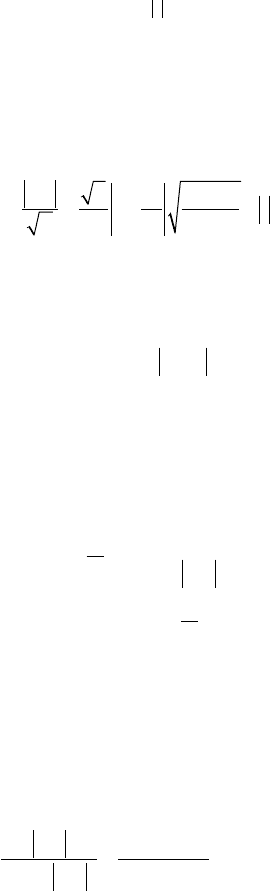
the truncation error is
. (3.23)
Several bounds to 冨J(t)冨 are known [19,20], depending on the nature of the
signal and the interval of interest. When the recovered signal x
N
(t) is con-
sidered over a finite interval only (i.e., limited antenna aperture), 冨t冨 f T =
N), 冨J(t)冨 can be bounded as [20]:
(3.24)
where E is the signal’s energy,
. (3.25)
As Equation 3.24 indicates, when ) q 0 (i.e., increasing oversampling) for
fixed T (i.e., more antennas for fixed antenna aperture), or when T q h for
fixed ), we obtain 冨J(t)冨 q 0. In practical terms, as the mean squared error
(MSE),
,
becomes smaller than the noise power, , its impact on the capacity is
small, and hence, it can be neglected. A tighter bound can be obtained from
Equation 3.24 by using the energy carried out by the truncated samples
instead of the total energy E [20]. We also note that Equation 3.24 does not
necessarily require oversampling.
Another bound to 冨J(t)冨, which does involve oversampling, is of the follow-
ing form [19]:
(3.26)
where F = f
max
/f
s
is the oversampling ratio. Note that this bound limits the
error over the entire range of t. Clearly, as N q h, the truncation error 冨J(t)冨 q 0
J() () () ( )sintxtxt xn ftn
Ns
nN
= =
()
>
¨
) c
J
U
U
()
sin , ,
t
E
tT
Tt
tTf
f
2
22
)
)
ESfdf
x
f
f
=
µ
()
max
max
2
JJ
21
0
2
=
µ
Ttdt
T
()
JX
2
0
2
<
J
UF
()
max ( )
()
,,
t
xt
N
t
{}
f
h <<h
4
1
2
4190_book.fm Page 70 Tuesday, February 21, 2006 9:14 AM
Information Theory and Electromagnetism: Are They Related? 71
for any F < 1. We note that Equation 3.24 and Equation 3.26 also justify the
use of truncated series in the time-domain as any transmission spans a finite
number of symbols. The difference between time-domain and spatial domain
cases is that in the former case, the number of samples is much larger, and
hence, the truncation error is much smaller. On the contrary, since the num-
ber of antennas in many practical systems is small, the truncation error may
be, generally speaking, significant. The smaller the F (i.e., larger oversam-
pling), the smaller the N is required for the same bound. While the conver-
gence of 冨J(t)冨 to 0 in Equation 3.24 and Equation 3.26 is slow in N, these
bounds, in many cases, overestimate the error, which converges to 0 much
faster with N. Additionally, it should be noted that the bound in Equation
3.26 applies to the entire range, –h < t < h, while the function is recovered
from the samples in –T < t < T, and hence, significant contribution to the
error may come from the interval 冨t冨 > T, i.e., outside of the antenna aperture.
This interval does not contribute anything to the capacity for aperture-
limited system, and hence, this part of the error is irrelevant. Needless to
say, more accurate bounds can be obtained if more details are known about
the signal [35].
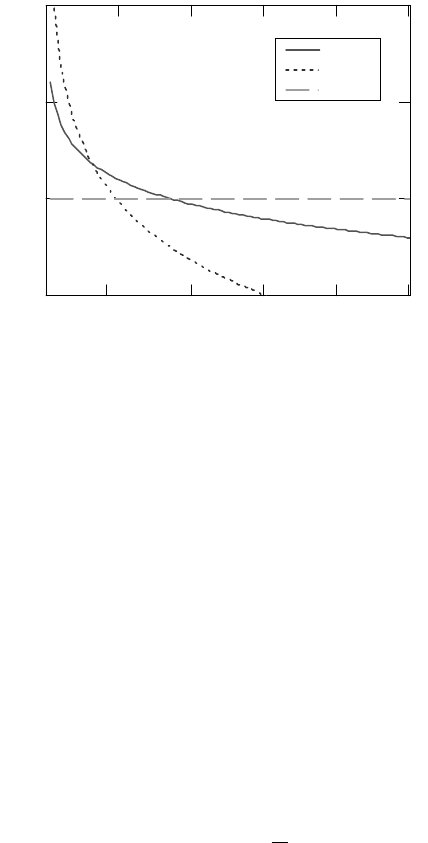
Figure 3.4 illustrates the normalized MSE using the bounds in Equa-
tion 3.24 and Equation 3.26, where c = E and c = max冨x(t)冨
2
, respectively, vs.
the number of samples. Clearly, for more than ten samples the error is already
small.
3.5.2 Impact of Truncation Error on the Capacity
As the discussion above demonstrates, even for small oversampling, the
truncation error goes to zero as the number of antennas (samples) increases.
FIGURE 3.4
Normalized mean square truncation error bounds vs. the number of samples; F = 0.8.
100 0 20 40
60
80
1.10
−3
0.01
0.1
1
eq. 3.24
eq. 3.26
0.01
N
SNR = 20 dB
J
2
/c
4190_book.fm Page 71 Tuesday, February 21, 2006 9:14 AM

72 MIMO System Technology for Wireless Communications
While the truncation error expressions above are useful on their own (in
particular, because they provide confidence that indeed a truncated sampling
series can be good enough), they not only overestimate the error in many
cases, but also do not indicate explicitly the effect of the truncation on the
capacity.
A way to overcome this difficulty is to consider the true mean squared
error and to compare it with the noise power. When the squared truncation
error averaged over the antenna aperture is less than the noise power, MSE <
1/SNR, it is negligible as one is able to recover almost all the information
conveyed by the EM field to the antenna aperture (but, possibly, not outside
of the aperture) in given noise. For example, using Figure 3.4, SNR = 20 dB
corresponds to MSE < 0.01 and N > 20 or N > 35 using Equation 3.24 or
Equation 3.26, respectively. It should not be surprising that these bounds are
different because different normalizations are used in Equation 3.24 and
Equation 3.26; also the nature of the bounds themselves is different, i.e.,
Equation 3.26 implies oversampling but Equation 3.24 does not (it is clear
from Figure 3.4 that oversampling results in much smaller truncation error
when N is not too small). Note also that larger SNR requires a larger number
of samples to make the truncation error small (less than the noise). Using
Equation 3.26, the required number of samples, which provides negligible
truncation error for given SNR W, can be estimated as
.
Since the truncation error is zero for an infinite number of samples and
the required spacing is d
min
= Q/2 in this case, one may expect that the actual
minimum antenna spacing is quite close to half a wavelength for a finite but
large number of antennas. The channel correlation argument, which roughly
does not depend on n, also confirms this. Detailed analysis shows that the
truncation error effect can be eliminated by approximately a 10% increase
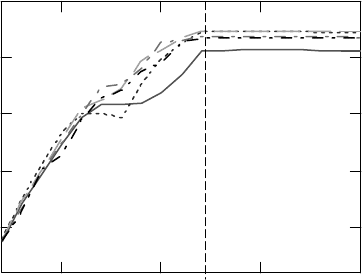
in the number of antennas for many practical cases. Figure 3.5 illustrates the
effect of oversampling by considering the MIMO capacity vs. the number of
antennas for given (fixed) aperture length (linear antenna) L = 5Q for different
realizations of an independent identically distributed (i.i.d.) Rayleigh fading
channel. Clearly, there exists an optimum number of antennas n
max
; using
more antennas does not result in higher capacity for any channel realization.
Remarkably, this maximum is only slightly larger than that in Equation 3.11,
i.e., spatial sampling and correlation arguments agree well. There is, how-
ever, one significant difference between these two arguments: while the latter
is valid “on average” (i.e., for the mean capacity), the former is valid for
each channel realization (i.e., for the instantaneous capacity) and not only
on average. Clearly, the sampling argument is more powerful in this respect.
N >
4
1
2
W
UF()
4190_book.fm Page 72 Tuesday, February 21, 2006 9:14 AM
Information Theory and Electromagnetism: Are They Related? 73
Keeping this in mind, one may say, based on the sampling theorem, that
the optimal number of antennas for a given aperture size is given approxi-
mately by Equation 3.11. Due to the reciprocity of Equation 3.1, the same
argument holds true for the transmit antennas as well. Hence, using Equation
3.2 and Equation 3.11, the maximum MIMO capacity can be found for a
given aperture size.
It should be noted that, as it was indicated above, in some practical cases
increasing n over N
opt
in Equation 3.11 may result in higher SNR due to
antenna gain increase (i.e., more power collected by the Rx antenna elements)
and, consequently, in logarithmic increase in capacity. However, if this
increase does take place, it is very slow (logarithmic) and it does not occur
if the SNR is fixed, i.e., when one factors out the effect of the antenna gain.
From a physical perspective, the total power collected by the antenna array
cannot exceed the power collected by the ideal continuous aperture of the
same size, which equals the total power delivered by the electromagnetic
wave to the given space region. Consequently, the array antenna gain vs.
the number of elements for a fixed aperture is limited by the gain of a
continuous antenna (with the same aperture). As an example, Figure 3.6
shows the gain of a uniform linear array of isotropic elements vs. the number
of elements, computed using the well-known model [26], and compares it
to the gain of continuous linear antenna (aperture) of the same size L = 5Q.
Clearly, the array gain saturates at about the same point as the capacity, n ~
2L/Q, which corresponds to d ~ Q/2, and equals that of the continuous
aperture at that point (this is explained, of course, by the convergence of the
array antenna pattern to that of the linear aperture as the number of array
FIGURE 3.5
MIMO channel capacity vs. the number of Rx antennas for L = 5Q, n
T
= 10. Capacities of five
different realizations of a Rayleigh fading channel are shown. Capacity saturation for each of
them is clear.
15 5 10
20
30
40
50
60
20
.
n
R
n
max
≈ 2L/λ + 2
Capacity, bit/s/Hz
4190_book.fm Page 73 Tuesday, February 21, 2006 9:14 AM