
Tsoulos George (ред.) MIMO System Technology for Wireless Communications
Подождите немного. Документ загружается.

74 MIMO System Technology for Wireless Communications
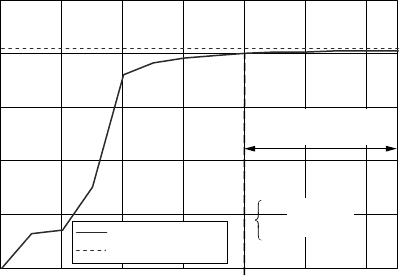
elements increases within the fixed aperture). Hence, there is no increase in
SNR beyond that point and, consequently, no increase in capacity can be
expected due to higher SNR. As a side remark, we note that the similar gain
saturation effect can be observed for an array of collinear short dipoles and
other elements.
As it was indicated above, in many practical cases the minimum spacing
can be substantially larger than Q/2. For example, when all the multipath
components arrive within a narrow angle spread )
1, d
min
~ Q/(2)) Q/2
[8] (remarkably, the same limit follows from the spatial sampling argument).
Hence, fewer antennas can be accommodated within a given aperture, N
opt
~ 2L)/Q + 1, and, consequently, the MIMO capacity is smaller for a given
aperture size.
A note is in order on practical value of the minimum spacing results above.
Since these results were derived under the assumption of ideal antennas
(isotropic field sensors with no mutual coupling), it is expected that practical
implementation of real antenna arrays operating in real scattering environ-
ments may result in some deviations from the results above. For example,
it was observed in the literature that mutual coupling (neglected in the
present study) may have a significant effect on the capacity [28–31]. Since
both positive (i.e., higher capacity) [28,29] and negative [30,31] effects of the
mutual coupling have been reported, one has to conclude that this effect
depends significantly on the environment, antenna design and also on the
assumptions, i.e., whether the SNR is assumed to be fixed or affected by the
coupling, whether the matching network takes the coupling into account,
etc. [32]. This demonstrates once more that numerous details tend to hide
the fundamental principles behind them. A side remark is that when this
FIGURE 3.6
Linear uniform array gain vs. the number of (isotropic) elements for L = 5Q. Continuous aperture
(1D) gain is also indicated.
10 8 6 4 2 12
n = 2L/λ = 10
d = λ/2
14
2
4
6
8
10
12
SNR does not
increase here
Gain
N
Array
Cont. aperture
4190_book.fm Page 74 Tuesday, February 21, 2006 9:14 AM

Information Theory and Electromagnetism: Are They Related? 75
effect is positive, smaller element spacing becomes feasible without signifi-
cant capacity loss [29]. This clearly shows that practical implementation may
somewhat deviate from our idealistic theoretical analysis.* There exists, how-
ever, a final number of degrees of freedom possessed by the electromagnetic
field itself, which ultimately limits any practical system (with or without
mutual coupling, etc.). The way these degrees of freedom are used in practice
by realistic antennas may of course differ from what the idealistic theory
above suggests.
We should also note that applications of the sampling theorem to electro-
magnetic problems have a long history. Among others, these applications
include spatial sampling techniques in optics [33], which is electromagnetics
at very high, i.e., optical, frequencies, and also in near-field measurements
and numerical analysis of electromagnetic fields [34]. A significant difference,
however, with the present analysis is that, while the former deals mostly
with free-space propagation, the latter considers a (rich) scattering environ-
ment, where the advantages of MIMO systems are most pronounced (as free-
space propagation results in rank-deficient channel and, hence, low capacity,
unless the Tx-Rx antenna spacing is very small). Additionally, while the
earlier applications have used the sampling theorem only as a convenient
analysis tool, when the sampling theorem is considered in the context of
MIMO systems a fundamental link with information theory becomes clear.
With respect to the minimum antenna spacing, it is interesting to note that
the MIMO capacity analysis of waveguide channels, which is based on a
rigorous electromagnetic approach and does not involve the usage of the
sampling theorem, indicates that the minimum antenna spacing is about Q/2
as well [12,14]. This is discussed in detail in the next section.
3.6 MIMO Capacity of Waveguide Channels**
The case of an ideal waveguide MIMO channel (i.e., lossless uniform
waveguide) is especially interesting because the relationship between infor-
mation theory and electromagnetics manifests itself in the clearest form in this
scenario. We further consider such a waveguide unless otherwise indicated.
Arbitrary electromagnetic fields inside of a waveguide can be presented
as a linear combination of the modes [15,16],
* While mutual coupling can have a significant effect on antenna array pattern (especially in the
sidelobe region) even for d > Q/2, the MIMO capacity is not significantly affected by it in that
case [28,30,31]. A possible explanation for this is that the channel matrix, which includes the
effect of mutual coupling, is known to the receiver and taken into account in the processing, and,
hence, the mutual coupling is implicitly compensated for. Consequently, most of our results for
d > Q/2 will hold true even if the effect of mutual coupling is taken into account.
** This section is based on [12,14].
4190_book.fm Page 75 Tuesday, February 21, 2006 9:14 AM
76 MIMO System Technology for Wireless Communications
(3.27)
where E
n
(x, y) and H
n
(x, y) are the normalized modal functions of the electric
and magnetic fields, F
n
and G
n
are the expansion coefficients (mode ampli-
tudes), k
zn
is the axial component of the wave vector and n is the (composite)
mode index. The modal functions E
n
(x, y) and H
n
(x, y) give the field variation
in the transverse directions (x,y) and the variation along the axial direction
(z) is given by . While the particular form of the modal functions
depends on the guide cross-section and may be difficult to find in explicit
form (unless some symmetry is present), an important general property of
the modal functions of a lossless cylindrical waveguide is their orthogonality
in the following sense [16],
(3.28)
where the integrals are over the guide cross-sectional area S, I
mn
= 1 if m = n
and 0 otherwise. For a given frequency, there exist a finite number of prop-
agating modes and all the other modes are evanescent, i.e., they decay
exponentially with z.
Equation 3.27 and Equation 3.28 immediately suggest the transmission
strategy for a waveguide channel, which is to use all the eigenmodes (or
simply modes) as independent subchannels since they are orthogonal, and
it is well known that the MIMO capacity is maximum for independent
subchannels. In this case, the maximum number of independent subchannels
equals the number of modes and there is no loss in capacity if all the modes
are used. For lossy and/or non-uniform waveguides, there exist some cou-
pling between the modes [16], and hence, the capacity is smaller (due to the
power loss as well as to the mode coupling). Thus, the capacity of a lossless
waveguide will provide an upper bound for a true capacity since some loss
and non-uniformity is always inevitable. It should be noted that if the cou-
pling results in the normalized mode correlation being less than approxi-
mately 0.5, the capacity decrease is not significant [23]. We further assume
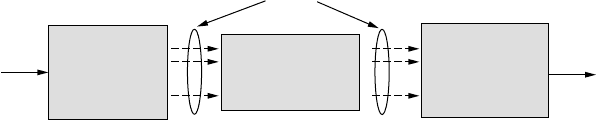
that the waveguide is lossless and is matched at both ends. Figure 3.7 shows
the system block diagram. At the Tx end, all the possible modes are excited
eE
hH
(,,) (,)
(,,) (,
xyz xye
xyz x
nn
jk z
n
nn
zn
=
=
¨
F
G yye
jk z
n
zn
),
¨
e
jk z
zn
EE
HH
EH
n
S
mmn
nm
S
mn
n
S
m
dxdy
dxdy
dxdy
µµ
µµ
µµ
=
=
=
I
I
0,,
4190_book.fm Page 76 Tuesday, February 21, 2006 9:14 AM
Information Theory and Electromagnetism: Are They Related? 77
using any of the well-known techniques (i.e., eigenmode modulator) and at
the Rx end the transverse electric field is measured on the waveguide cross-
sectional area (proper spatial sampling may be used to reduce the number
of field sensors) and is further correlated with the distribution functions of
each mode (i.e., spatial correlation receiver). The signals at the correlator
outputs are proportional to the corresponding transmitted signals since the
modes are orthogonal, and, hence, there is no cross-coupling between differ-
ent Tx signals. Thus, the channel matrix (i.e., Tx end-Rx end-correlator out-
puts) for this system can be expressed using the modal functions (for
simplicity, we use only the E-field — the H-field can be used in the same
way) as follows [14]:
, (3.29)
and, for a uniform lossless waveguide, , where is a N × N identity
matrix, and N is the number of modes. Clearly, the capacity achieves its
maximum (Equation 3.2) in this case. Knowing the number of modes N, the
maximum MIMO capacity can easily be evaluated. The maximum capacity
(we call it further simply “capacity”) of the present MIMO architecture
described above does not vary along the waveguide length and it increases
with the number of modes, as one would intuitively expect. If not all the
available modes are used, the capacity decreases accordingly. The capacity
may also decrease if the Rx antennas measure the field at some specific points
rather than the field distribution along the cross-sectional area (since the
mode orthogonality cannot be efficiently used in this case). In order to
evaluate the maximum capacity, we further evaluate the number of modes.
3.6.1 Rectangular Waveguide Capacity
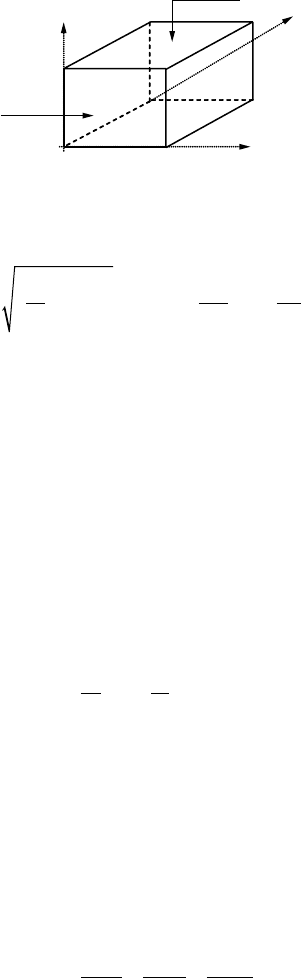
Let us consider first a rectangular waveguide located along the OZ axis (see
Figure 3.8). The field distribution at the XY plane (cross-section of the
waveguide) for E and H modes is given by well-known expressions [16] and
the variation along the OZ axis is given by , where j is an imaginary
unit, and k
z
is the longitudinal component of the wavenumber:
FIGURE 3.7
MIMO system architecture for a wavelength channel. (© 2005 IEEE.)
Eigenmode
modulator
(Tx)
Waveguide
Eigenmode
demodulator
(cor. Rx)
...
...
Modes
α
2
α
1
α
2
α
1
G x y x y dxdy
ij i
S
j
=
µµ
EE(,) (,)
GI=
N
I
N
e
jk z
z
4190_book.fm Page 77 Tuesday, February 21, 2006 9:14 AM
78 MIMO System Technology for Wireless Communications
(3.30)
where \ is the radial frequency, c
0
is the speed of light, and m and n designate
the mode (note that E and H modes with the same (m,n) pair have the same
L
mn
). The sign of k
z
is chosen in such a way that the field propagates along
the OZ axis (i.e., from the Tx end to the Rx end). The case of L
mn
> \/c
corresponds to the evanescent field, which decays exponentially with z and
is negligible at a few wavelengths from the source [16]. Assuming that the
Rx end is located far enough from the Tx end (i.e., at least a few wavelengths),
we neglect the evanescent field. Hence, the maximum value of L
mn
is L
mn,max
=
\/c. This limits the number of modes that exist in the waveguide at a given
frequency \. All the modes must satisfy the following inequality, which
follows from Equation 3.30:
, (3.31)
where ae = a/Q, be = b/Q and Q is the free-space wavelength; and m n = 1, 2, …
for E mode and m, n = 0, 1, …, m + n | 0 for H mode. Using a numerical
procedure and Equation 3.31, the number of modes N can be easily evalu-
ated. A closed-form approximate expression can be obtained for large ae and
be by observing that Equation 3.31 is, in fact, an equation of ellipse in terms
of (m,n) and all the allowed (m,n) pairs are located within the ellipse. Hence,
the number of modes is given approximately by the ratio of areas:
(3.32)
where S
c
= 4Uaebe is the ellipse area, S
0
= 1 is the area around each (m,n) pair,
S
w
= ab is the waveguide cross-sectional area, the factor 1/4 is due to the
FIGURE 3.8
Rectangular waveguide geometry. (© 2005 IEEE.)
O
y
z
x
a
b
Tx end
Rx end
k
c
m
a
n
b
zmnmn
=
©
«
ª
¹
»
º
=
©
«
ª
¹
»
º
+
©
\
LL
UU
0
2
22
2
,
««
ª
¹
»
º
2
,
m
a
n
b
e
©
«
ª
¹
»
º
+
e
©
«
ª
¹
»
º
f
22
4
N
S
S
ab S
ew
~ ==2
42 2
0
22
/ U
Q
U
Q
,
4190_book.fm Page 78 Tuesday, February 21, 2006 9:14 AM
Information Theory and Electromagnetism: Are They Related? 79
fact that only non-negative m and n are considered, and the factor 2 is due
to the contributions of both E and H modes. As Equation 3.32 demonstrates,
the number of modes is determined by the ratio of the waveguide cross-
section area ab to the wavelength squared. As we will see later on, this is
true for a circular waveguide as well. Hence, one may conjecture that this
is true for a waveguide of arbitrary cross-section as well. This conjecture
seems to be consistent with the spatial sampling argument (2D sampling
must be considered in this case). In fact, Equation 3.32 gives the number of
degrees of freedom the rectangular waveguide is able to support and which
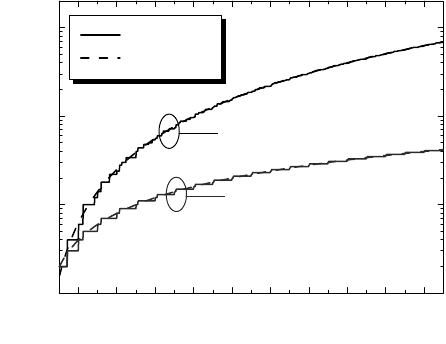
can be used for MIMO communication. Figure 3.9 compares the exact num-
ber of modes computed numerically using Equation 3.31 and the approxi-
mate number (Equation 3.32). As one may see, Equation 3.32 is quite accurate
when a and b are greater than approximately a wavelength. Note that the
number of modes has a step-like behavior with a/Q, which is consistent with
Equation 3.31. Using Equation 3.2 and Equation 3.32, the maximum capacity
of the rectangular waveguide channel can be easily evaluated.
The analysis above assumes that the vector E-field (including both E
x
and
E
y
components) is measured on the entire cross-sectional area (or at a suffi-
cient number of points to recover it using the sampling expansion). However,
it may happen in practice that only one of the components is measured, or
that the field is measured only along the OX (or OY) axis. Apparently, it
should lead to the decrease of the available modes.
To analyze this in detail, let us assume that the E-field (both components)
is measured along the OX axis only, which corresponds to a 1D antenna
array located along the OX axis. Due to this limitation, one can compute the
correlations at the Rx using the integration over the OX axis only, since the field
distribution along the OY axis is not known. Hence, we need to find the
modes that are orthogonal in the following sense:
FIGURE 3.9
Number of modes in a rectangular waveguide for a=b. (© 2005 IEEE.)
10 8 7 9 6 5 4 3 2 1
10
1
100
1000
1D array (OX)
2D array
Exact
Approximate
Num
b
er o
f
mo
d
es
a/λ
4190_book.fm Page 79 Tuesday, February 21, 2006 9:14 AM

80 MIMO System Technology for Wireless Communications
, (3.33)
where µ and S are composite mode indices. In this case, one finds that two
different E-modes, and , are orthogonal provided that ; if
these modes have the same m index, they are not orthogonal. The same is true
about two H-modes and about one E-mode and one H-mode. This results
in a substantial reduction of the number of orthogonal modes since, in the
general case, two E-modes are orthogonal if at least one of the indices is
different, i.e., if or . Surprisingly, if one measures only E
x
component in this case, the modes are still orthogonal provided that .
Hence, if the receive antenna array is located along the OX axis, there is no
need to measure the E
y
component — it does not provide any additional
degrees of freedom that can be used for MIMO communications (recall that
only orthogonal modes can be used). The number of orthogonal modes can
be evaluated using Equation 3.31:
(3.34)
This corresponds to 2a/Q degrees of freedom for each (E and H) field. Note
that this result is similar to that obtained using the spatial sampling argu-
ment, i.e., independent field samples (which are, in fact, the degrees of
freedom) are located at Q/2.
A similar argument holds true when the receive array is located along the
OY axis. In this case two modes are orthogonal provided that , and
there is also no need to measure the E
x
component. The number of orthogonal
modes is approximately
(3.35)
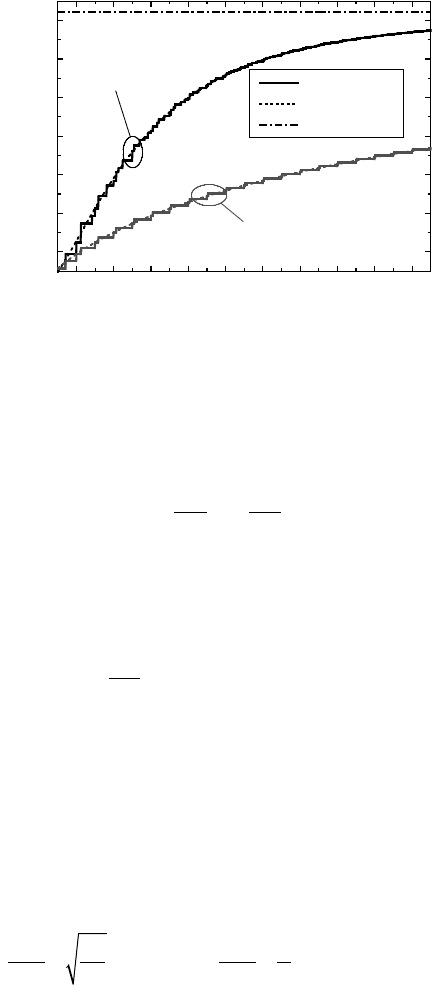
Figure 3.10 shows the MIMO capacity of a rectangular waveguide of the
same geometry as in Figure 3.8 for SNRW = 20 dB. Note that the capacity
saturates as a/Q increases. This is because Equation 3.2 saturates as well as
N increases:
. (3.36)
C in Equation 3.2 can be expanded as
. (3.37)
Idxc
a
==
µ
EE
µ S µS
I
0
E
mn
11
E
mn
22
mm
12
|
mm
12
| nn
12
|
mm
12
|
Na
x
~ 4/Q.
nn
12
|
Nb
y
~ 4/Q.
lim ln
N
C
qh
= W/2
C
iN
i
i
i
=
+
©
«
ª
¹
»
º
=
h
¨
WW
ln
()
2
1
1
0
4190_book.fm Page 80 Tuesday, February 21, 2006 9:14 AM
Information Theory and Electromagnetism: Are They Related? 81
For large N, i.e., for small W/N, this series converges very fast, and it can
be approximated by the first two terms:
. (3.38)
The capacity does not change substantially when the contribution of the
second term is small:
. (3.39)
N
max
is the maximum “reasonable” number of antennas (modes) for given
SNR (or vice versa): if N increases above this number, the capacity does not
increase significantly. It may be considered as a practical limit (since further
increase in capacity is very small and it requires for very large increase in
complexity). Using Equation 3.32 and Equation 3.34, one finds the maximum
“reasonable” size of the waveguide for the case of 2D and 1D arrays corre-
spondingly:
(3.40)
Note that Figure 3.10 shows, in fact, the fundamental limit of the
waveguide capacity, which is imposed jointly by the laws of information
theory and electromagnetics.
FIGURE 3.10
MIMO capacity in a rectangular waveguide for a=b and SNR=20 dB. (© 2005 IEEE.)
10 9 8 7 6 5 4 3 2 1
20
40
60
80
100
120
140
1D array(OX)
2D array
Exact
Approximate
Limit(36)
Capacity,
b
it/s/Hz
a/λ
C
N
~
©
«
ª
¹
»
º
WW
ln 2
1
2
W
W
2
1
N
NN<< ¡ > ~
max
aa
max max
Q
W
UQ
W
~~
24
(2D array), (1D OX arrayy).
4190_book.fm Page 81 Tuesday, February 21, 2006 9:14 AM

82 MIMO System Technology for Wireless Communications
3.6.2 Rectangular Cavity Capacity
The analysis of MIMO capacity in cavities is different from that in
waveguides in one important aspect. Namely, the modes of a cavity exist
only for some finite discrete set of frequencies (recall that, as in the case of
waveguide, we consider a lossless cavity). Hence, there may be no modes
for an arbitrary frequency. To avoid this problem, we evaluate the number
of modes for a given bandwidth, , starting at f
0
. For a rectan-
gular cavity, the wave vector must satisfy [16]:
(3.41)
where c is the waveguide length (along the OZ axis in Figure 3.8), and p is
a non-negative integer; m, n = 1, 2, 3, …, p = 0, 1, 2, … for E-modes, and m,
n = 0, 2, 3, …, p = 1, 2, … for H-modes (m = n = 0 is not allowed). Noting
that Equation 3.41 is a equation of a sphere in terms of (Um/a, Un/b, Up/c),
the number of modes with can be found as the number of
(m,n,p) points between two spheres with radii of k
0
and k
0
+ )k, correspond-
ingly. Using the ratio of areas approach described above, the number of
modes is approximately:
(3.42)
where is the volume between the two spheres, V
0
= U
3
/V
c
is the
volume around each (m,n,p) point, V
c
= abc is the cavity volume; factor 2 is
due to two types of modes, and factor 1/8 is due to the fact that only non-
negative values of (m,n,p) are allowed. An important conclusion from Equa-
tion 3.42 is that the number of modes is determined by the cavity volume
expressed in terms of wavelength and by the normalized bandwidth.
Detailed analysis shows that Equation 3.42 is accurate for large a, b, and c,
and if c/Q < f
0
/4)f.
It should be noted that the mode orthogonality for cavities is expressed
through the volume integral (over the entire waveguide volume),
, (3.43)
and, hence, all the modes are orthogonal provided that the field is measured
along all three dimensions, which, in turn, means that 3D arrays must be
used, which may not be feasible in practice. If only 2D arrays are used, then
the mode orthogonality is expressed as for a waveguide, i.e., Equation 3.28,
and, consequently, only those modes are orthogonal that have different (m,n)
fff f
¬
®
¼
¾
00
, +)
k
m
a
n
b
p
cc
2
222
0
=
©
«
ª
¹
»
º
+
©
«
ª
¹
»
º
+
©
«
ª
¹
»
º
=
©
«
ª
¹
UUU\
»»
º
2
,
kkk k
¬
®
¼
¾
00
, +)
N
V
V
Vf
f
c
ec
~ =2
88
0
3
0
/ U
Q
)
,
Vkk
e
= 4
2
U)
EE
µ S µS
I
V
c
dV c
µµµ
=
4190_book.fm Page 82 Tuesday, February 21, 2006 9:14 AM
Information Theory and Electromagnetism: Are They Related? 83
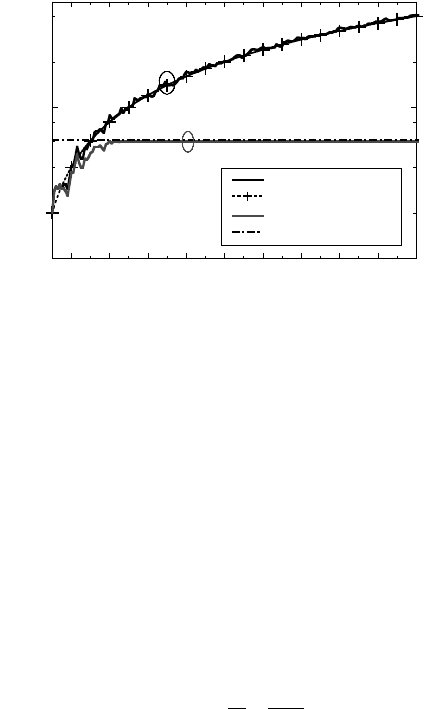
indices. The use of a 2D array results in significant reductions of the number
of modes for large c, as Figure 3.11 demonstrates. Note that for small c, there
is no loss in the number of orthogonal modes. This is because different p
corresponds in this case to different (m,n) pairs (this can also be seen from
Equation 3.41). However, as c increases, different p may include the same
(m,n) pairs, which results in the number loss if a 2D array is used. In fact,
the 2D case with large c is the same as the waveguide case (with the same
cross-sectional area), as it should be. The value of c for which the cavity has
the same number of orthogonal modes as the corresponding waveguide can
be found from the following equality:
. (3.44)
Hence, if 2D antenna arrays are used and c v c
t
, the waveguide model
provides approximately the same results as the cavity model does, i.e., the
cross-section has the major impact on the capacity, while the effect of cavity
length is negligible. The waveguide model should be used to evaluate the
number of orthogonal modes (and capacity) in this case because it is simpler
to deal with. For example, a long corridor can be modeled as a waveguide
rather than a cavity (despite the fact that it is closed and looks like a cavity).
Figure 3.12 shows the MIMO capacity in the cavity. While the capacity of a
2D array system saturates like the waveguide capacity, which is limited by a
and b, the capacity of a 3D system is larger and saturates at the value given
by Equation 3.36. It should be noted that Equation 3.36 is the capacity limit
due to the information theory laws, and Equation 3.32, Equation 3.34, Equation
3.35 and Equation 3.44 are the capacity limits due to the laws of electromag-
netism (i.e., limited due to the number of degrees of freedom of the EM field).
FIGURE 3.11
Number of orthogonal modes in a rectangular cavity for a = 4Q, b = 2Q and )f/f
0
= 0.2.
10 9 8 7 6 5 4 3 2 1
10
20
40
60
80
100
200
400
2D
3D
Exact(3D)
Approximate(3D)
Exact(2D)
Waveguide(2D)
Number of modes
c/λ
NN
cf
f
cw
t
~¡=
Q
0
4)
4190_book.fm Page 83 Tuesday, February 21, 2006 9:14 AM