
Tsoulos George (ред.) MIMO System Technology for Wireless Communications
Подождите немного. Документ загружается.

144 MIMO System Technology for Wireless Communications
62. D.J. Love and R.W. Heath, Jr. 2003. “Grassmannian precoding for spatial mul-
tiplexing systems.” Proc. of Allerton Conf. on Comm. Cont. and Comp., Oct. 2003.
63. D.J. Love, R.W. Heath, Jr., and T. Strohmer. 2003. “Grassmannian beam-forming
for multiple-input multiple-output wireless systems.” IEEE Trans. Info. Th., 49,
Oct. 2003, 2735–2747.
63b. D.J. Love, R.W. Heath, Jr., W. Santipach, and M.L. Honig. 2004. “What is the
value of limited feedback for MIMO channels?” IEEE Commun. Mag., 42, Oct.
2004, 54–59.
64. H. Miyakawa and H. Harashima. 1969. “A method of code conversion for
digital communication channels with intersymbol interference.” Transactions of
the Institute of Electronic Communication Engineering, Japan, 52-A, June 1969,
272–273.
65. B. Mondal and R.W. Heath, Jr. 2005. “Algorithms for quantized precoding for
mimo ofdm.” Proc. of Third SPIE Int. Symp. on Fluctuations and Noise, Austin,
TX, May 2005.
66. K.K. Mukkavilli, A. Sabharwal, and B. Aazhang. 2001. “Design of multiple
antenna coding schemes with channel feedback.” Proc. of the 35th Annual Asil.
Conf. on Sig. Sys. and Comp., Nov. 2001, 1009–1013.
67. K.K. Mukkavilli, A. Sabharwal, E. Erkip, and B. Aazhang. 2003. “On beam-
forming with finite rate feedback in multiple antenna systems.” IEEE Trans.
Info. Th., 49, Oct. 2003, 2562–2579.
68. R.U. Nabar, H. Bolcskei, V. Erceg, D. Gesbert, and A.J. Paulraj. 2002. “Perfor-
mance of multiantenna signaling techniques in the presence of polarization
diversity.” IEEE Trans. on Sig. Proc., 50, Oct. 2002, 2553–2562.
69. A. Narula, M.J. Lopez, M.D. Trott, and G.W. Wornell. 1998. “Efficient use of
side information in multiple-antenna data transmission over fading channels.”
IEEE Jour. Select. Areas in Commun., 16, Oct. 1998, 1423–1436.
70. A. Paulraj, R. Nabar, and D. Gore. 2003. Introduction to Space-Time Wireless
Communications, New York: Cambridge University Press.
71. J.G. Proakis. 2001. Digital Communications, 4th edition, Boston: McGraw Hill.
72. G.G. Raleigh and J.M. Cioffi.1998. “Spatio-temporal coding for wireless com-
munication.” IEEE Jour. Select. Areas in Commun., 46, March 1998, 357–366.
73. J.C. Roh and B.D. Rao. 2004. “Channel feedback quantization methods for
MISO and MIMO systems.” Proc. IEEE Int. Symp. Personal, Indoor, and Mobile
Radio Commun., 2, Sept. 2004, 805–809
74. J.C. Roh and B.D. Rao. 2004. “An efficient feedback method for MIMO systems
with slowly time-varying channels.” Proc. IEEE Wireless Comm. and Net. Conf.,
2, March 2004, 760–764.
75. J.C. Roh and B.D. Rao. 2004. “Multiple antenna channels with partial channel
state information at the transmitter.” IEEE Trans. Wireless Comm., 3, March 2004,
677–688.
76. M.A. Sadrabadi, A.K. Khandani, and F. Lahouti. 2004. A new method of channel
feedback quantization for high data rate MIMO systems.” Proc. IEEE Glob.
Telecom. Conf., 1, Nov.–Dec. 2004, 91–95.
77. H. Sampath and A. Paulraj. 2002. “Linear precoding for space-time coded
systems with known fading correlations.” IEEE Commun. Lett., 6, June 2002,
239–241.
78. H. Sampath, S. Talwar, J. Tellado, V. Erceg, and A. Paulraj. 2002. “A fourth-
generation MIMO-OFDM broadband wireless system: design, performance,
and field trial results.” IEEE Comm. Mag., 40, Sept. 2002, 143–149.
4190_book.fm Page 144 Tuesday, February 21, 2006 9:14 AM
Feedback Techniques for MIMO Channels 145
79. W. Santipach and M.L. Honig. 2003. “Asymptotic performance of MIMO wire-
less channels with limited feedback.” Proc. IEEE Mil. Comm. Conf., 1, Oct. 2003,
141–146.
80. W. Santipach, Y. Sun, and M.L. Honig. 2003. “Benefits of limited feedback for
wireless channels.” Proc. of Allerton Conf. on Comm. Cont. and Comp., Oct. 2003.
81. A. Scaglione, P. Stoica, S. Barbarossa, G.B. Giannakis, and H. Sampath. 2002.
“Optimal designs for space-time linear precoders and decoders.” IEEE Trans.
Sig. Proc., 50, May 2002, 1051–1064.
82. L. Schumacher, J.P. Kermoal, F. Frederiksen, K.I. Pedersen, A. Algans, and P.
E. Mogensen. 2001. MIMO channel characterisation. Technical report, European
IST-1999-11729 Project METRA, Feb. 2001.
83. L. Schumacher, K.I. Pedersen, and P.E. Mogensen. 2002. “From antenna spacings
to theoretical capacities — guidelines for simulating MIMO systems.” Proc. IEEE
Int. Symp. Personal, Indoor, and Mobile Radio Commun., 2, Sept. 2002, 587–592.
84. M.B. Shoemake. 2004. Status of project IEEE 802.11n. http://grouper.ieee.org/
groups/802/11/Reports/tgn update.htm. Accessed on March 3, 2004.
85. I. Sohn, G.D. Golden, H. Lee, and J.W. Ahn. 2003. “Overview of METRA model
for MBWA MIMO channel.” IEEE C802.20-03-50, May 2003.
86. N.R. Sollenberger. 1993. “Diversity and automatic link transfer for a TDMA
wireless access link.” Proc. Glob. Telecom. Conf., 1, Nov.–Dec. 1993, 532–536.
87. T. Strohmer and R.W. Heath, Jr. 2003. “Grassmannian frames with applications
to coding and communications.” Applied and Computational Harmonic Analysis,
14, May 2003, 257–275.
88. G.L. Stuber, ed. 1996. Principles of Mobile Communications, Norwell, MA: Kluwer.
89. Y. Tan, M. Pereira, M. Mewburn, and M. Faulkner. Investigation of singular
value distributions of MIMO channels in indoor environment. Available at
http://www.telecommunications.crc.org.au/content/ConfPapers/Tan.pdf.
90. V. Tarokh, H. Jafarkhani, and A.R. Calderbank. 1999. “Space-time block codes
from orthogonal designs.” IEEE Trans. Inf. Th., 45, Jul. 1999, 1456–1467.
91. V. Tarokh, N. Seshadri, and A.R. Calderbank. 1998. “Space-time codes for high
data rate wireless communication: performance criterion and code construc-
tion.” IEEE Trans. Inf. Th., 44, March 1998, 744–765.
92. M. Tomlinson. 1971. “New automatic equalizer employing modulo arithmetic.”
Electronics Letters, 7, March 1971, 138–139.
93. J.A. Tropp, I. Dhillon, R.W. Heath, Jr., and T. Strohmer. 2005. “Designing struc-
tured tight frames via an alternating projection method.” IEEE Trans. Inf. Th.,
51, Jan. 2005, 188–209.
94. J.A. Tropp, R.W. Heath, Jr., and T. Strohmer. 2003. “An alternating projection
algorithm for constructing quasi-orthogonal CDMA signature sequences.”
Proc. Int. Symp. on Info. Theo., 407.
95. C.-H. Tse, K.-W. Yip, and T.-S. Ng. 2000. “Performance tradeoffs between max-
imum ratio transmission and switched-transmit diversity.” Proc. Int. Symp. on
Pers., Ind. and Mobile Radio Comm., 2, Sept. 2000, 1485–1489.
96. V. Erceg et al. 2003. “Indoor MIMO WLAN channel models.” IEEE 802.11-03/
161r2, Sept. 2003.
97. E. Visotsky and U. Madhow. 2001. “Space-time transmit precoding with im-
perfect feedback.” IEEE Trans. Info. Th., 47, Sept. 2001, 2632–2639.
98. J.W. Wallace and M.A. Jensen. 2002. “Modeling the indoor MIMO wireless
channel.” IEEE Trans. Antennas Propagat., 50, May 2002, 591–599.
99. G.S. Watson. 1983. Statistics on Spheres, New York: Wiley.
4190_book.fm Page 145 Tuesday, February 21, 2006 9:14 AM
146 MIMO System Technology for Wireless Communications
100. A. Wittneben. 1995. “Analysis and comparison of optimal predictive transmit-
ter selection and combining diversity for DECT.” Proc. IEEE Glob. Telecom. Conf.,
2, Nov. 1995, 1527–1531.
101. W.-H. Wong and E.G. Larsson. 2003. “Orthogonal space-time block coding with
antenna selection and power allocation.” Elect. Lett., 39, Feb. 2003, 379–381.
102. P. Xia, S. Zhou, and G.B. Giannakis. 2004. “Adaptive MIMO-OFDM based on
partial channel state information.” IEEE Trans. on Sig. Proc., 52, Jan. 2004,
202–213.
103. T. Xiaofeng, H. Harald, Y. Zhuizhuan, Q. Haiyan, and Z. Ping. 2001. “Closed
loop space-time block code.” Proc. Veh. Technol. Conf., 2, Oct. 2001, 1093–1096.
104. Y. Zhao, R.S. Adve, and T.J. Lim. 2004. “Optimal STBC precoding with channel
covariance feedback for minimum error probability.” EURASIP J. Applied Signal
Processing, Sept. 2004, 1257–1265.
105. L. Zheng and D.N.C. Tse. 2002. “Communication on the Grassmann manifold:
a geometric approach to the noncoherent multiple-antenna channel.” IEEE
Trans. Info. Th., 48, Feb. 2002, 359–383.
106. S. Zhou and G.B. Giannakis. 2002. “Optimal transmitter eigen-beamforming
and space-time block coding based on channel mean feedback.” IEEE Trans. on
Sig. Proc., 50, Oct. 2002, 2599–2613.
107. S. Zhou and G.B. Giannakis. 2003. “Optimal transmitter eigen-beamforming
and space-time block coding based on channel correlations.” IEEE Trans. Inf.
Th., 49, Jul. 2003, 1673–1690.
108. S. Zhou, Z. Wang, and G.B. Giannakis. 2004. “Performance analysis of transmit-
beamforming with finite-rate feedback.” Proc. of 38th Conf. on Info. Sciences and
Systems, Princeton University, March 2004.
4190_book.fm Page 146 Tuesday, February 21, 2006 9:14 AM

147
6
Antenna Selection in MIMO Systems
Neelesh B. Mehta and Andreas F. Molisch
CONTENTS
6.1 Introduction................................................................................................147
6.2 MIMO System Model................................................................................149
6.2.1 General Notation...........................................................................150
6.3 Spatial Multiplexing..................................................................................151
6.3.1 Optimum Signaling with Transmit Antenna Selection...........151
6.3.2 Performance of Antenna Selection.............................................152
6.3.3 Antenna Selection in Presence of Interference.........................154
6.4 Space–Time Codes .....................................................................................155
6.4.1 Space–Time Trellis Codes.............................................................155
6.4.2 Orthogonal Space–Time Block Codes........................................157
6.5 SIMO Systems ............................................................................................159
6.6 Implementing Antenna Selection: Criteria and Algorithms...............161
6.6.1 Capacity-Achieving Spatial Multiplexing.................................162
6.6.1.1 When Transmitter Has CSI ...........................................164
6.6.1.2 With Linear Receivers ....................................................164
6.6.2 Space–Time Codes.........................................................................165
6.7 Performance with Non-Idealities............................................................166
6.8 Antenna Selection with Spatial Correlation..........................................167
6.8.1 Alternate Antenna Selection Structures.....................................168
6.9 Summary.....................................................................................................170
References.............................................................................................................171
6.1 Introduction
MIMO systems, which employ multiple transmit and receive antenna ele-
ments, substantially improve the data rates that can be transmitted over the
channel and the reliability with which they can be received without any
4190_book.fm Page 147 Tuesday, February 7, 2006 12:44 PM
148 MIMO System Technology for Wireless Communications
additional bandwidth. Higher data rates are achieved by transmitting mul-
tiple data streams simultaneously using spatial multiplexing techniques. For
spatially uncorrelated channels, the data rates even increase linearly with
the minimum of the number of transmit and receive antenna elements [1].
Increased reliability is achieved by exploiting spatial diversity to signifi-
cantly reduce the probability that the channel is in a deep fade. Orthogonal
space–time block codes and space–time trellis codes are examples of diver-
sity techniques tailored to MIMO systems. A single input multiple output
(SIMO) system, which combines the many received copies of the transmitted
signal to improve reliability, is another example of a spatial diversity system.
While MIMO systems perform impressively, they also increase the hard-
ware and signal processing complexity, power consumption, and component
size in the transmitter and the receiver [2]. One of the main culprits behind
this increase in complexity is that each receive antenna element requires a
dedicated radio frequency (RF) chain that comprises a low noise amplifier,
a frequency down-converter, and an analog-to-digital converter, and each
transmit antenna element requires an RF chain that comprises a digital-to-
analog converter, a frequency up-converter, and a power amplifier. More-
over, processing the signals received in spatial multiplexing schemes or with
STTCs calls for sophisticated receivers whose complexity increases, sometimes
exponentially, with the number of transmit and receive antenna elements.
This increase in complexity has inhibited the widespread adoption of
MIMO systems. For example, the third-generation cellular system specifica-
tion (3GPP) currently supports only an optional two antenna space–time
transmit diversity scheme and does not require the handsets to have more
than one antenna element [3]. Sophisticated techniques that employ spatial
multiplexing or support more antenna elements have met with considerable
opposition in 3GPP. While the adoption of MIMO has made headway in the
next-generation wireless local area network (WLAN) standard IEEE 802.11n,
which aims to transfer raw information at rates greater than 100 Mbps over
a 20-MHz bandwidth, complexity considerations are likely to make the
adopted MIMO scheme an elementary one that supports a small number of
antenna elements.
Antenna selection is a solution that addresses some of the complexity
drawbacks associated with MIMO systems. It reduces the hardware com-
plexity of transmitters and receivers by using fewer RF chains than the
number of antenna elements. While the antenna elements are typically cheap,
and in some cases are just a patch of copper, the RF chains are considerably
more expensive. In antenna selection, a subset of the available antenna
elements is adaptively chosen by a switch, and only signals from the chosen
subset are processed further by the available RF chains.
Given its promise as a low-complexity solution, antenna selection has
received considerable attention recently. It has been considered at the trans-
mitter (transmit antenna selection [TAS]), at the receiver (receive antenna
selection [RAS]), and at both the transmitter and the receiver (transmit and
receive antenna selection [T-RAS]). Its performance has been explored from
4190_book.fm Page 148 Tuesday, February 7, 2006 12:44 PM

Antenna Selection in MIMO Systems 149
various angles such as capacity and outage for spatial multiplexing systems,
and diversity order and array gain for space–time coded systems. The diver-
sity order quantifies the effectiveness in avoiding deep fades and is defined
as the slope of average symbol error probability vs. input signal to noise
ratio (SNR) curve for high SNRs. The array gain quantifies the improvement
in average SNR seen at the combiner output when signals received by the
multiple antenna elements are combined.
As we shall see, antenna selection — for a variety of MIMO techniques —
achieves the full diversity inherent in the system at the expense of a small
loss in array gain compared to a full complexity system, i.e., a system that
can always allocate RF chains to each and every antenna element. Another
way of stating this is that for the same number of RF chains, using additional
antenna elements with antenna selection outperforms a system that lacks
additional antenna elements. Antenna selection has been found to modify,
on a fundamental level, the optimum Gaussian signaling required to transmit
information at the maximum possible rate. Considerable effort has also been
spent to develop various criteria, both optimal (but complicated) and sub-
optimal (but simple), to implement antenna selection algorithms.
This chapter studies various aspects of antenna selection in some depth,
and assumes basic knowledge about the operation of MIMO systems. The
reader is referred to the tutorial papers in [2,4] for a more basic introduction.
We first analyze the performance of antenna selection for different MIMO
systems. We then consider the algorithms and criteria to implement antenna
selection. We also consider antenna selection performance in the presence
of non-idealities, such as imperfect channel estimates, multipath dispersion,
fast fading, etc. Finally, we discuss a class of antenna selection algorithms
that are based on knowledge of the statistical variations of the channel. Using
statistical information instead of the instantaneous channel state information
often significantly reduces the demands on the transmitter and receiver. We
show that even a moderate spatial correlation, when properly exploited by
antenna selection, helps recover, to a great extent, the array gain loss that is
incurred by antenna selection.
In this chapter, we will focus most of our attention on the simplest setup
in which the receiver has full channel state information (CSI) while the
transmitter has no CSI, and knows only which antenna elements to use in
case of TAS and T-RAS. However, we do briefly discuss how other scenarios,
such as the availability of CSI at the transmitter and the presence of co-
channel interference in addition to noise, can be handled.
6.2 MIMO System Model
Let and denote the number of antenna elements that are available (but
not necessarily used every time) at the transmitter and receiver, respectively.
N
t
N
r
4190_book.fm Page 149 Tuesday, February 7, 2006 12:44 PM
150 MIMO System Technology for Wireless Communications
Let and denote the number of RF chains at the transmitter and receiver,
respectively. We always have 1 f L
t
f N
t
and 1 f L
r
f N
r
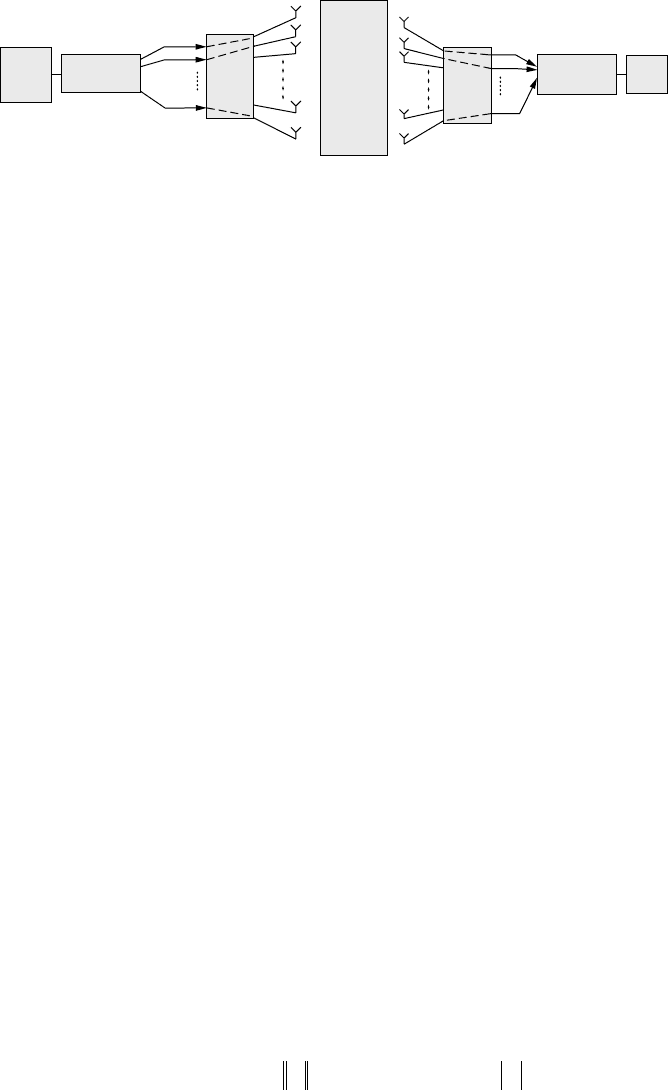
. A block diagram
representation of antenna selection at the transmitter and the receiver is
given in Figure 6.1.
The transmitted signal, of size N
r
× 1, is denoted by x. The signal, y, of size
N
r
× 1, received by the antenna elements is given by
(6.1)
where n represents noise and the matrix H, of size N
r
× N
t
, denotes the
instantaneous channel state. Unless otherwise mentioned, the elements of H
are assumed to be independent of each other. In case of TAS, N
t
L
t
elements
of x, which correspond to the transmit antenna elements not chosen, will be
0. The noise vector, n, of size N
r
× 1, is a zero-mean complex white Gaussian
random vector. To simplify notation, we shall use x to also denote the L
t
× 1
transmit vector and y to denote the L
r
× 1 receive vector that correspond to
only the selected transmit and receive elements, respectively. The notation
shall be obvious from the context. The total power transmitted from all the
antennas is denoted by W. Without loss of generality, we shall assume that
each element of n and H has unit variance. Therefore, the average SNR of
the signal input to any receive antenna element equals W/L
t
when the power
is equally allocated among the L
t
transmit elements.
We shall assume that the receiver has perfect channel state information.
The receiver can estimate the channel from the training sequences or by
using blind estimation techniques. A frequency-flat channel is assumed. The
channel is assumed to be block-fading, in that it does not change during
the transmission of the space–time codeword and decorrelates thereafter. We
shall comment on the impact of the breakdown of these assumptions toward
the end of the chapter.
6.2.1 General Notation
For a matrix A, the symbol A
†
denotes the Hermitian transpose of A, A
T
the
transpose, A
–1
the matrix inverse, the Frobenius norm, the determinant,
FIGURE 6.1
Block diagram of antenna selection with L
t
out of N
t
transmit antenna elements selected and
L
r
out of N
r
receive antenna elements selected [4]. (© 2004 IEEE.)
1
2
L
t
Data
source
Data
sink
Space/time
decoder
L
t
out
of N
t
switch
1
2
Mobile
radio
channel
H
1
2
L
r
L
r
out
of N
r
switch
1
2
Space/time
coder
N
t
N
r
N
t
− 1
N
r
− 1
L
t
L
r
N
r
yHxn=+,
A
F
A
4190_book.fm Page 150 Tuesday, February 7, 2006 12:44 PM
Antenna Selection in MIMO Systems 151
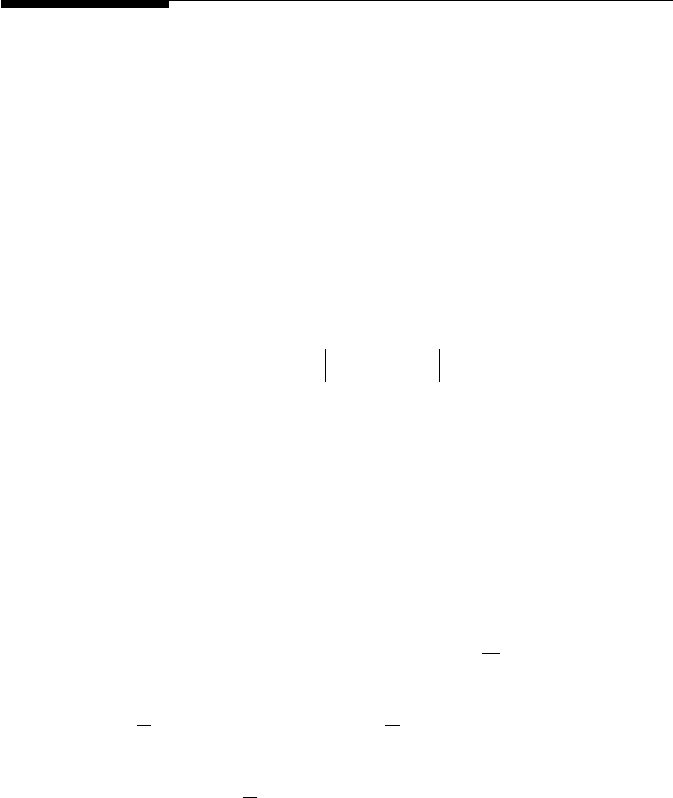
and the trace. The identity matrix of size shall be denoted by
I
n
. The symbol denotes the expectation with respect to the random
variable X.
As we shall see, order statistics, which deals with the statistics of ordered
random variables, is often used in the analysis of antenna selection. We shall
resort to the following commonly used order statistics notation. When n
numbers, x
1
, …, x
n
, are rearranged in descending order, they shall be denoted
by , where [i] denotes the index of the ith largest number.
6.3 Spatial Multiplexing
As mentioned, we shall first focus on the case where the transmitter has no
knowledge of the channel state H. (In the case of TAS, the transmitter knows,
in addition, which antenna elements to use.) This is typically achieved by
means of feedback from the receiver in frequency division duplex systems.
In time division duplex systems with slowly varying channels, the transmit-
ter can monitor the transmissions from the receiver to determine the channel
state without any help from the receiver.
The maximum data transmission rate of any communication system is
given by the Shannon capacity [5]. For MIMO systems, the Shannon capacity
given the channel state H takes the form [1]
(6.2)
where is the covariance matrix (of size N
t
× N
t
) of the transmitted signal.
The ergodic capacity is defined as the average of over all the channel
realizations. We first discuss the optimal form of for antenna selection.
6.3.1 Optimum Signaling with Transmit Antenna Selection
When no CSI is available at the transmitter, it is well known that in a full
complexity system it is optimal to allocate the transmit powers uniformly
across all the antenna elements and to keep the signals transmitted from
different antenna elements uncorrelated, i.e., [6]. In antenna
selection, however, this is no longer optimal. This was first highlighted by
an example in [7], which showed that at low SNR, a covariance matrix of
the form can outperform . Here, 1 is a vector of size
L
t
× 1 and is given by 1 = [11
…
1]
T
. . Notice that a covariance of the form 11
†
also treats all the transmit antenna elements equally and requires no CSI at
the transmitter. That is not optimal is because the channel is no
longer circularly symmetric Gaussian in the presence of antenna selection,
Tr A
{}
nn×
E
X
.
¬
®
¼
¾
xx x
n[] [] [ ]12
vvv
C
N
rX
() log ,
†
HIHQH=+
2
Q
X
C()H
Q
X
QI
X
t
t
N
N
=
W
Q
X
t
L
=
W
11
†
QI
X
t
t
L
L
=
W
QI
X
t
t
L
L
=
W
4190_book.fm Page 151 Tuesday, February 7, 2006 12:44 PM
152 MIMO System Technology for Wireless Communications
which, depending on the channel realization, changes which transmit
antenna elements are chosen.
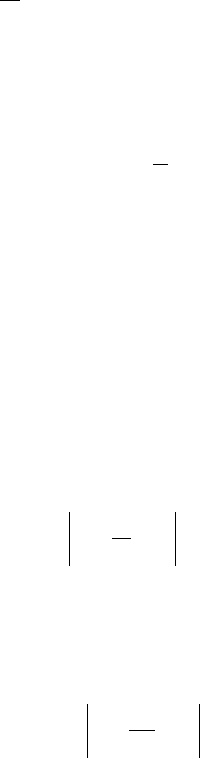
In fact, the optimum signaling takes the following simple form for all SNR
[8]:
(6.3)
where F is a real number that lies between 0 and L
t
/(L
t
– 1). However, closed-
form expressions are not available for F, and a one-dimensional numerical
search is required to determine its optimal value.
A large number of papers in the literature do not take the above optimal
signaling into account and assume that . This is equivalent to
setting F = 1 in the above equation. We shall also make this assumption
henceforth.
6.3.2 Performance of Antenna Selection
When antenna selection is employed at the transmitter or the receiver or
both, a subset of the transmit and/or receive antenna elements is chosen.
The channel seen by the subset is the sub-matrix, , that is obtained by
selecting only the rows and columns of H that correspond to the selected
receive and transmit antenna elements. The optimal subset is one that leads
to the largest mutual information between the antenna elements used for
transmission and reception. The capacity with antenna selection is given by
(6.4)
where is an L
r
× L
t
matrix obtained by removing columns and N
t
–
L
t
rows from H and denotes the set of all possible sub-matrices
of H. The optimal channel subset,
~
H
opt
, is given by
(6.5)
An exact analytical solution for is quite difficult. However, lower and
upper bounds are available for for RAS. An upper bound was derived
for in [9] by assuming that the signal components are received without
any interference from the other components. The receive antenna elements
that receive the largest signal components are then selected. Clearly,
neglecting the interference from other components is an unrealistic assump-
tion, which is why the formula below is an upper bound:
QI
Xt
L
t
L
=+
©
«
ª
¹
»
º
W
FF(),
†
111
QI
X
t
t
L
L
=
W
H
C
L
S
L
t
r
sel
=+max log ,
()
†
H
IHH
2
W
H NL
rr
S()
H LL
rt
×
HIHH
H
opt
=+.argmax log
()
†
S
L
t
r
N
2
W
C
sel
C
sel
C
sel
L
r
4190_book.fm Page 152 Tuesday, February 7, 2006 12:44 PM
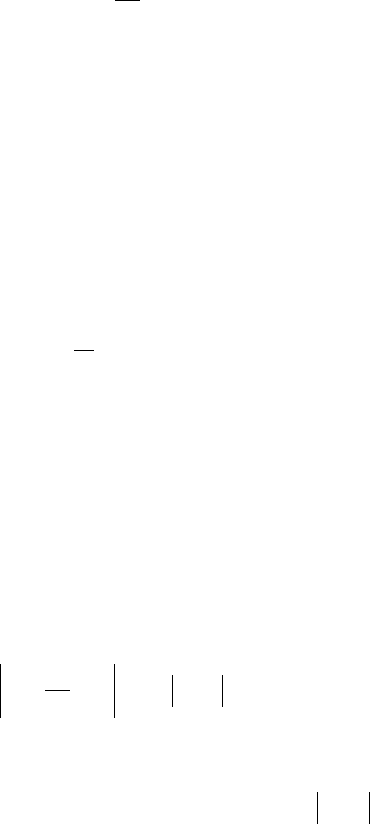
Antenna Selection in MIMO Systems 153
(6.6)
where are ordered chi-square random variables with 2N
t
degrees of
freedom such that . The bound is tight for L
r
f N
t
, but is
rather loose for . For the latter case, the following bound is better:
(6.7)
where
and, for each j,
are N
r
ordered chi-square random variables (ordered with respect to index
i) with 2 degrees of freedom.
Using matrix analysis, the following lower bound for the case L
t
= N
t
= N
r
was derived in [10]:
(6.8)
where is the orthonormal basis for the column space of and
is the block of corresponding to receive antenna elements chosen.
As is a sub-matrix of the unitary matrix U, we always have .
The capacity loss term has been characterized in detail in [10].
The performance of RAS as a function of L
r
for N
t
= 3 and N
r
= 8 for W =
20 dB is shown in Figure 6.2. The figure plots the cumulative distribution
function (CDF) of the capacity (in bits/sec/Hz). The CDF is a useful repre-
sentation because it contains information about not just the first moment
(expected value), but also its higher moments. It can be seen that the capacity
increases as the number of RF chains, L
r
, increases. However, the gains
diminish as L
r
increases. For L
r
= 5, the capacity CDF is already very close
to that of a full complexity receiver.
C
N
i
L
t
i
r
sel
f +
=
©
«
ª
ª
ª
¹
»
º
º
º
¨
1
2
1log ,
[]
W
L
i
N
i
r
=
{}
1
L
[]
LL L
[] [] [ ]12
>>>…
N
r
LN
rt
>
C
j
j
N
t
sel
f
=
¨
] ,
1
]
W
L
jz
t
i
j
i
L
L
r
=+
©
«
ª
¹
»
º
=
¨
log
[]
()
1
1
L
[]
()
i
j
i
N
r
{}
=1
C
N
N
t
rr
t
sel
v ++log log ,
††
22
IHHUU
W
U NN
rt
×
H
U
r
NN
tt
× U
U
r
log
†
2
0UU
rr
f
log ||
†
2
UU
rr
4190_book.fm Page 153 Tuesday, February 7, 2006 12:44 PM