
Tsoulos George (ред.) MIMO System Technology for Wireless Communications
Подождите немного. Документ загружается.

154 MIMO System Technology for Wireless Communications
TAS can even lead to “increased capacity” for low rank channels [11],
which arise due to keyhole effects [12] or due to spatial correlation between
the transmit and receive antenna elements [13]. This increase is a manifes-
tation of the additional CSI available at the transmitter about which antennas
to use; a transmitter without this additional information would have allo-
cated equal powers to all the N
t
elements.
6.3.3 Antenna Selection in Presence of Interference
So far, we have assumed that the noise is complex white circular Gaussian.
In cellular systems, the transmissions from other cells or from within the cell
give rise to co-channel interference, i. The received signal now takes the form
(6.9)
Let denote the covariance of the interference plus noise component.
The capacity formula for antenna selection changes to
(6.10)
It turns out that this case can be easily mapped to the white Gaussian noise
case that we have considered so far. By rearranging the terms in the deter-
minant above, it can be shown that that the scenario above is equivalent to
a system with an interference-free MIMO channel [14]. The equivalent chan-
nel takes the form where U
I
is the eigenspace of Q
I
and 1
I
is
a diagonal matrix of the eigenvalues of Q
I
. When the interference is not
Gaussian, the above formula provides a lower bound on the achievable
capacity as Gaussian interference is the worst form of interference [5].
We shall not delve into the case where the signaling of the interferers can
also be adjusted to maximize global system capacity [15].
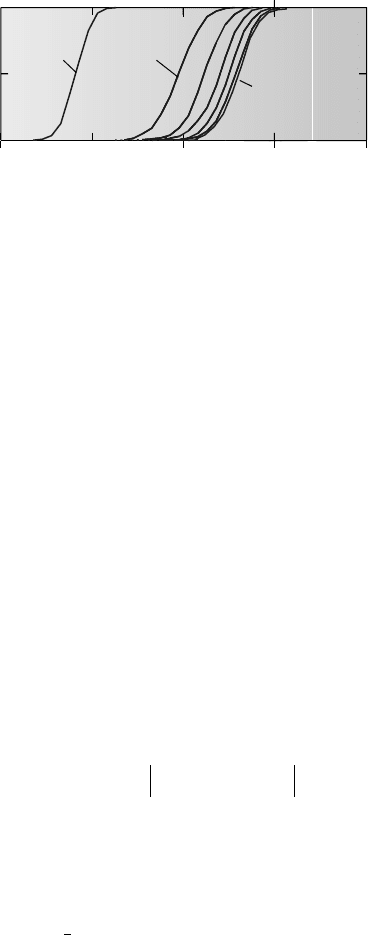
FIGURE 6.2
Capacity of a spatial multiplexing MIMO system with receive antenna selection for different
L
r
(N
t
= 3, N
r
= 8, and W = 20 dB) [4]. (© 2004 IEEE.)
L
r
= 2 L
r
= 3
L
r
= 8
cdf(C)
10
20
30
Capacity C(bits/s/Hz)
0
0.5
1
yHxni=++.
Q
I
C
S
N
rXI
sel
=+.
max log
()
†
H
IHQHQ
2
1
HUH
eq
=
1
I
I
1
2
†
,
4190_book.fm Page 154 Tuesday, February 7, 2006 12:44 PM

Antenna Selection in MIMO Systems 155
6.4 Space–Time Codes
Space–time codes were presented in a series of seminal papers by Tarokh
et al. [16,17]. They provide a practical means of exploiting spatial diversity
when multiple transmit and receive antenna elements are used. We shall
study antenna selection for two different kinds of space–time codes: space–
time trellis codes and orthogonal space–time block codes, which offer differ-
ent trade-offs between performance and complexity. The reader is referred
to Chapter 4 for a review of space–time codes.
6.4.1 Space–Time Trellis Codes
Space–time trellis codes (STTC) [16,18] are designed to exploit the spatial
diversity present in MIMO systems. Compared to orthogonal space–time
block codes, which we discuss in the following section, STTCs also deliver
a coding gain. However, the receiver for STTCs is more complicated, with
the complexity increasing exponentially with the number of transmit
antenna elements.
The performance of STTCs with RAS and a maximum likelihood detector
(MLD) was studied in [19]. For STTCs, the expression for the pair-wise error
probability of codewords of a given length provides considerable insight
into the performance of antenna selection. Performance measures such as
the overall error probability of the STTC may then be obtained from the pair-
wise error probabilities using classical approaches for trellis codes [20].
Let the ith antenna element transmit a codeword of length denoted by
. In this notation, the vector (of size l × 1) is transmitted
from the ith antenna element. Given that the receiver knows the channel H
perfectly, the probability that a full complexity receiver erroneously decodes
C to the codeword depends on the Euclidean distance
between the codewords. It is upper bounded by [16]
(6.11)
where is the jth row of H and corresponds to the jth receive antenna
element. The matrix B (of size N
t
× N
t
) depends on the codewords, with its
(p, q)
th
element given by . Note that the non-negative
term
l
Cc c=,,[]
1
…
N
t
c
i
Ee e=,,[]
1
…
N
t
P
N
t
j
N
jj
r
()exp ,
†
HhBhf
=
©
«
ª
ª
ª
ª
¹
»
º
º
º
º
¨
W
4
1
h
j
Bcece
pq p p q q
= ()()
†
j
N
jj
r
=
¨
1
hBh
†
4190_book.fm Page 155 Tuesday, February 7, 2006 12:44 PM

156 MIMO System Technology for Wireless Communications
corresponds to the distance between the codewords.
Ideally, the optimal antenna selection algorithm would choose the L
r
receive antenna elements with indices i
1
, …, i
L
r
that maximize the sum
However, the indices need not be the same for different pairs of codewords.
However, at high SNR, it is sufficient to only consider codewords that are
separated by the minimum distance of the code because they largely deter-
mine the probability of decoding error. For such pairs, it can be argued that
the norm-based selection criterion that chooses the antenna elements based
on the received signal strength effectively achieves this selection [19]. We
shall discuss this further in Section 6.6.2.
Therefore, the pair-wise error probability with RAS can be written as
(6.12)
(6.13)
The second step follows from the following simple inequality that holds for
any sequence of n numbers x
1
, x
2
, …, x
n
:
(6.14)
By averaging all the realizations of the channel, H, it can be shown that,
for large W, the average pair-wise error probability for a full rank STTC takes
the form
(6.15)
Notice that the exponent of W is N
r
N
t
and is independent of L
r
. This shows
that RAS retains the full diversity order N
t
N
r
. However, compared to a full
complexity system (with N
r
receive antenna elements and N
r
RF chains) this
is accompanied by an array gain loss of 10 log
10
(N
r
/L
r
). Tighter bounds on
the array gain loss are also derived in [19] for the case when only one receive
antenna element is selected (L
r
= 1).
j
L
ii
r
jj
=
¨
1
hBh
†
.
P
N
t
j
L
ii
r
jj
sel
()exp ,
†
HhBhf
=
©
«
ª
ª
ª
ª
¹
»
º
º
º
º
¨
W
4
1
f .
=
©
«
ª
ª
ª
ª
¹
»
º
º
º
º
¨
exp
†
L
NN
r
rt
j
N
jj
r
W
4
1
hBh
m
n
xx x mn
i
n
i
i
m
i
i
n
i
== =
¨¨ ¨
ff ff.
11 1
1
[]
,( )
EHB
H
P
L
NN
L
NN
r
rt
r
tr
sel
()
¬
®
¼
¾
f
©
«
ª
¹
»
º
.
W
4
4190_book.fm Page 156 Tuesday, February 7, 2006 12:44 PM
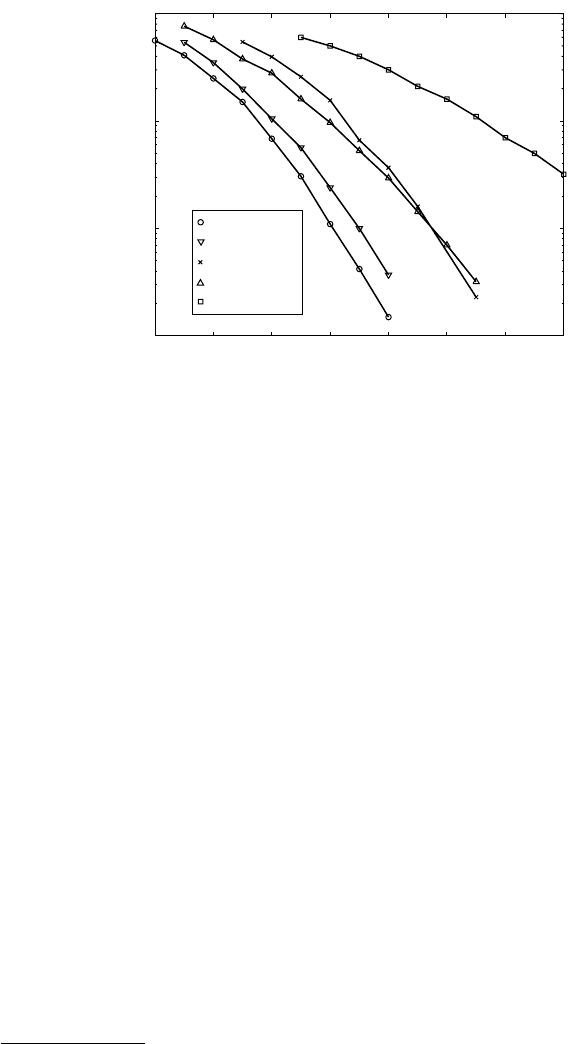
Antenna Selection in MIMO Systems 157
Figure 6.3 plots the pair-wise error probability as a function of SNR, W, for
2 transmit antennas for different numbers of receive antennas and RF chains.
It can be seen that when N
r
= 3, L
r
= 1, 2, and 3 cases have the same diversity
order, which is the slope at high SNR. Moreover, compared to the L
r
= N
r
=
3 case, the array gain losses equal 0.9 dB for L
r
= 2 and 3.4 dB for L
r
= 1.
Both the losses are considerably less than the respective upper bound values
of 1.76 dB and 4.77 dB.
TAS for STTCs was studied in [21]. The analysis turns out to be very similar
to the one given above for RAS. TAS also achieves the full diversity order
of the system, N
r
N
t
, and incurs an array gain loss that is upper bounded by
10 log
10
(N
t
/L
t
). That TAS achieves the full diversity order while transmitting
from only L
t
antenna elements is noteworthy. This implies that smaller STTCs
can be used in conjunction with antenna selection to achieve the full diversity
order. This circumvents the exponential increase in the number of trellis
states in STTCs that are designed for larger N
t
.
6.4.2 Orthogonal Space–Time Block Codes
Orthogonal space–time block codes (OSTBC), introduced in [17], achieve full
diversity and yet require only a simple linear receiver. They can be optimally
decoded by a low-complexity linear receiver.*
FIGURE 6.3
Pair-wise error probability of STTC with N
t
= 2 for different L
r
and N
r
as a function of SNR, W
[19]. (© 2003 IEEE.)
* Strictly speaking, the receiver should be called a widely linear receiver as it involves a conju-
gation operation [22].
(dB)
L
r
= 3, N
r
= 3
L
r
= 2, N
r
= 3
L
r
= 1, N
r
= 3
L
r
= 2, N
r
= 2
L
r
= 1, N
r
= 1
4
Frame error rate
10
−3
10
−2
10
−1
10
0
6 8 10 12 14 16 18
4190_book.fm Page 157 Tuesday, February 7, 2006 12:44 PM
158 MIMO System Technology for Wireless Communications
Therefore, antenna selection with OSTBCs has received considerable atten-
tion in the literature. In OSTBCs, the receive SNR after linear processing can
be expressed in terms of the Frobenius norm of the matrix, which is simply
the square root of the sum of the squares of the amplitudes of all the elements
of the matrix. This simple form for the SNR greatly facilitates analysis. The
probability of bit error or codeword error can then be easily written in terms
of the SNR depending on the modulation and channel coding scheme under
consideration. TAS and RAS have been studied in [23]. The analysis for RAS
was generalized to cover several cases in [24]. We illustrate the analysis for
RAS below.
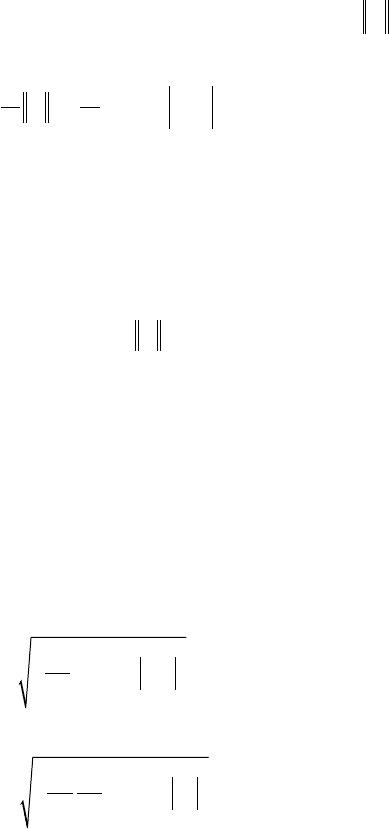
Given that the channel subset is selected, the SNR, L
sel
, of the received
data stream can be directly written in terms of the Frobenius norm, , of
[23] as follows:
(6.16)
where n
1
, …, n
L
r
and m
1
, …, m
L
t
denote the indices of the chosen receive and
transmit antenna elements, respectively.
Maximizing the instantaneous SNR is equivalent to maximizing the
mutual information or minimizing the BER. The optimal selection criterion
for all of these is therefore:
(6.17)
The above simple criterion is often referred to as the norm-based criterion.
In other words, in the case of TAS, the transmitter chooses the antenna
elements that correspond to the L
t
columns with the largest column-norms.
In the case of RAS, the receiver chooses antenna elements that correspond
to the L
r
rows with the largest row-norms. However, in the case of T-RAS,
transmit and receive antenna selection cannot be done independently.
As was the case for STTCs, the analyses for RAS and TAS are very similar.
We illustrate the performance of RAS below assuming that uncoded BPSK
is used [24]. The bit error probability is given in terms of the Q-function as
(6.18)
(6.19)
H
H
F
H
L
WW
sel
==
==
¨¨
LL
h
tt
i
L
j
L
n
i
m
j
F
r
t
H
2
11
2
,
HH
opt
=.argmax
()SH
F
2
PQ
N
h
t
i
L
j
N
ij
r
t
sel
()
[]
H =
==
©
«
ª
ª
ª
ª
ª
¹
»
º
º
º
¨¨
2
11
2
W
ºº
º
,
f .
==
©
«
ª
ª
ª
ª
ª
¹
»
º
º
º
º
º
¨¨
Q
L
NN
h
r
rt
i
N
j
N
ij
r
t
2
11
2
W
4190_book.fm Page 158 Tuesday, February 7, 2006 12:44 PM

Antenna Selection in MIMO Systems 159
For large W, the average bit error probability simplifies to
(6.20)
Therefore, receive antenna selection maintains the diversity order of N
t
N
r
with an array gain loss that is upper bounded by 10 log
10
(N
r
/L
r
).
As was the case with STTCs, tighter bounds on the array gain loss exist
for the case where L
r
= 1 [24]. When the Alamouti code (L
t
= 2) is used, exact
closed-form expressions for the average SNR and the outage probability have
also been derived [23].
6.5 SIMO Systems
In SIMO systems, which have only one transmit antenna, only one data
stream can be transmitted. Multiple copies of the transmitted signal arrive
at the receiver, but with different amplitudes and phases that depend on the
channel. The receiver uses maximum ratio combining (MRC) to combine the
multiple received signals and achieve the maximum possible SNR. In MRC,
each received signal is weighted with a complex conjugate of the correspond-
ing channel coefficient.
With antenna selection, L
r
out of the N
r
received signals are selected and
maximum ratio combined. Such a receiver is commonly referred to as the
hybrid-selection MRC (H-S/MRC) receiver. The SNR at the output of the
H-S/MRC receiver is given by
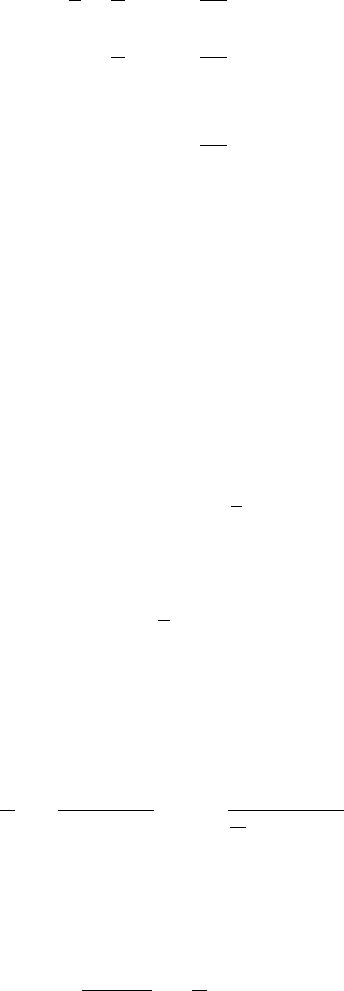
. (6.21)
Setting L
r
= 1 corresponds to the special case of a selection combining (SC)
receiver that uses only the best receive antenna element.
Closed-form expressions and tight bounds are available for both the SNR
and the BER for this case. At first glance, the analysis of HS-MRC receivers
seems complicated because the ordered random variables L
[1]
, …, L
[L
r
]
are
correlated even though the underlying variables L
1
, …, L
N
r
are independent of
each other. However, the minimum value L
[N
r
]
and the differences L
[1]
– L
[2]
, …,
are unconstrained, i.e., they can take any value between 0 and h.
This motivates the following linear mapping, called virtual branch analysis
[25], between L
[i]
s and the virtual variables V
j
s:
EH
H
P
NN
NN
L
N
tr
tr
NN
r
tr
sel
()
¬
®
¼
¾
f
©
«
ª
ª
ª
¹
»
º
º
º
21
rrt
N
4W
©
«
ª
¹
»
º
.
L
L
HSMRC /
=
=
¨
[]i
i
L
r
1
LL
[][]NN
rr
1
4190_book.fm Page 159 Tuesday, February 7, 2006 12:44 PM
160 MIMO System Technology for Wireless Communications
(6.22)
where the V
i
s are just conveniently scaled versions of the differences. In case
of Rayleigh fading, the V
i
s turn out to be independent and identically dis-
tributed exponential random variables with unit mean.
The mean SNR at the output of the H-S/MRC receiver can then be easily
shown to be [25,26]
(6.23)
(6.24)
(6.25)
And the average symbol error probability (SEP) for MPSK can be shown
to be [27]
(6.26)
where 6 = U(M – 1)/M and c = (sin(U/M))
2
. For the large SNR case, the
formula reduces to:
(6.27)
L
L
WW W
WW
[]
[]
1
12
0
2
N
r
r
N
N
¬
®
¼
¾
½
½
½
½
½
½
½
=
rr
r
N
N
V
V
r
00
1
W
¬
®
¼
¾
½
½
½
½
½
½
½
½
½
¬
®
¼
¾
½
½
½
½
½
½
½
½
,
EE
HH
LL
HSMRC /
¬
®
¼
¾
½
½
=
=
¬
®
¼
¾
½
¨
i
L
i
r
1
[]
=+
=
¬
®
¼
¾
½
=+
¬
®
¼
¨¨
WW
II
i
L
ir
iL
N
i
r
i
r
r
i
VL
i
V
11
1
EE
¾¾
½
=+
©
«
ª
ª
¹
»
º
º
.
=+
¨
L
i
r
iL
N
r
r
W 1
1
1
EH
H
P
c
L
i
r
()
(sin )
(sin )
¬
®
¼
¾
=
+
¬
®
¼
¾
½
µ
=
1
0
2
2
U
V
WV
6
LL
N
L
i
r
r
r
c
d
+
+
¬
®
¼
¾
½
½
1
2
2
(sin )
(sin )
,
V
WV
V
EH
H
P
N
LL
c
N
r
rr
NL
N
r
rr
r
() (sin)
¬
®
¼
¾
=
!
!
µ
W
U
V
1
0
6
22N
r
dV.
4190_book.fm Page 160 Tuesday, February 7, 2006 12:44 PM
Antenna Selection in MIMO Systems 161
Therefore, H-S/MRC achieves a diversity order of N
r
, and compared to a
full complexity receiver with N
r
RF chains, incurs an array gain loss equal to
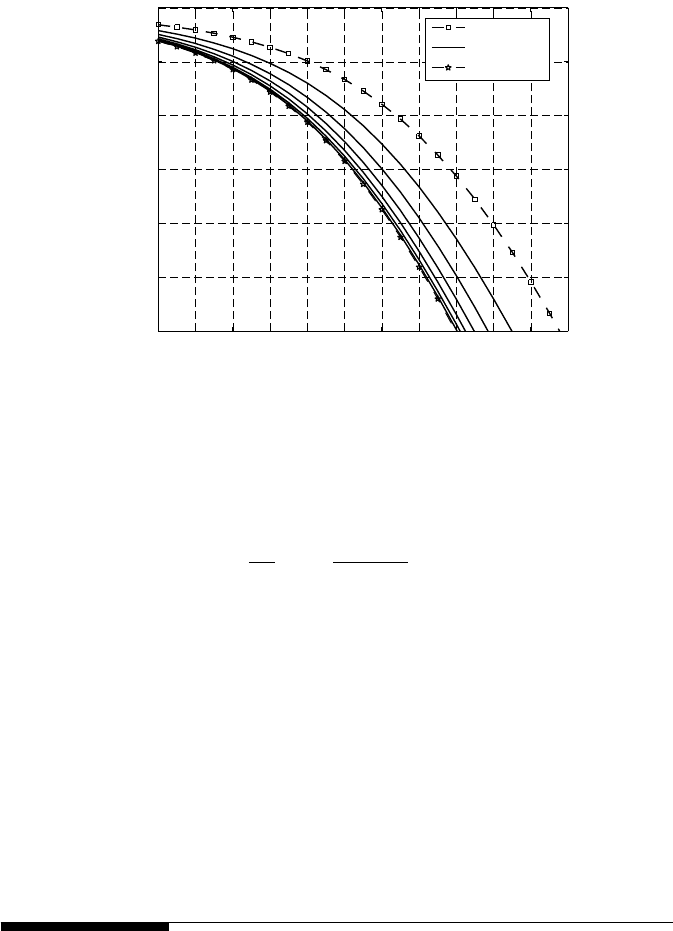
Upper and lower bounds for the array gain loss for HS-MRC are derived in
[28]. Figure 6.4 plots the SEP for N
r
= 8 as a function of the SNR, W, for
different values of L
r
. We again see that the SEP decreases as L
r
increases.
The gains diminish for larger L
r
.
The hybrid selection combining that we considered above can also be done
at the transmitter in a closed-loop MIMO diversity system, in which signals
input to the transmit antenna elements are weighted replicas of the same
data stream. The received streams are combined to maximize the instanta-
neous SNR at the output of the combiner. This is analyzed for the L
t
= 1 case
in [29] and for the general case in [30].
6.6 Implementing Antenna Selection:
Criteria and Algorithms
In TAS, the transmitter needs to examine possibilities to choose the best
subset of L
t
antenna elements out of the N
t
available. Similarly, in RAS, the
receiver needs to examine possibilities. In the case of T-RAS, the number
FIGURE 6.4
Symbol error probability as a function of SNR for different L
r
(N
r
= 8) [27]. (© 2001 IEEE.)
10
0
10
−1
10
−2
10
−3
10
−4
10
−5
10
−6
−2 0 2 4 6 8
ρ (SNR per branch, cB)
Symbol error probabiliy (SEP)
10 12 14 16 18 20
L
r
= 1
L
r
= 2,.....7
L
r
= N
r
= 8
10
10
N
N
LL
r
r
rr
NL
rr
log
!
!
.
©
«
ª
¹
»
º
L
t
v 1
()
L
N
t
t
()
L
N
r
r
4190_book.fm Page 161 Tuesday, February 7, 2006 12:44 PM
162 MIMO System Technology for Wireless Communications
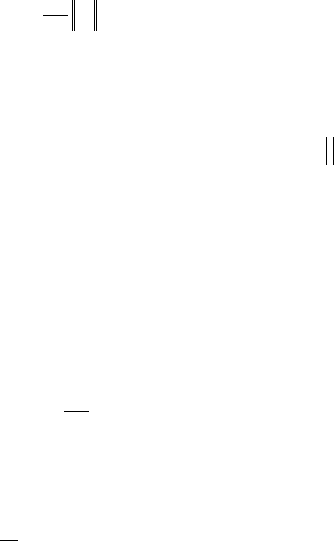
of possibilities balloons to , and coordination between the transmitter
and receiver is required to choose the optimal transmit and receive antenna
subsets. The combinatorial increase in the number of possibilities makes an
exhaustive search impractical even for moderate values of N
t
and N
r
.
Therefore, a large number of sub-optimal selection algorithms and heuris-
tics with varying levels of complexity have been proposed in the literature.
The criteria depend on whether OSTBCs, STTCs, or ideal capacity-achieving
space–time codes are assumed, and can also depend on the receiver archi-
tecture. We illustrate and compare a few of the proposed approaches for the
following cases:
• Capacity-achieving spatial multiplexing with an optimal receiver,
• Spatial multiplexing with linear receivers, and
• Space–time codes with an MLD receiver.
6.6.1 Capacity-Achieving Spatial Multiplexing
In Equation 6.4, the optimal choice of the selection subset is given by a non-
linear equation. However, for low SNR, the optimal selection criterion sim-
plifies as follows:
(6.28)
Therefore, at low SNR, norm-based selection is optimal [2,31]. Moreover, this
is the same as the criterion in Equation 6.17 for antenna selection with
OSTBCs.
However, the situation is not as simple for high SNR because of the
form of the capacity formula in Equation 6.4. Therefore, several iterative and
computationally simpler criteria have been proposed that exploit basic
results from matrix theory [32].
The effect of adding an additional receive antenna element to the capacity
formula was considered in [10,31]. A greedy criterion for selecting the next
receive antenna element was proposed based on the observation that the
capacity with n + 1 antenna elements can be written in terms of the capacity
with n antenna elements as follows:
(6.29)
where the matrix depends on the channel subset chosen so far, and equals
()()
L
N
L
N
t
t
r
r
C
N
S
t
F
sel
~ +.
©
«
ª
ª
ª
¹
»
º
º
º
max log
()H
H
2
2
1
W
log
2
.
CC
N
nn
t
jnj
()()log ,
†
HH hBh
+
©
«
ª
ª
ª
¹
»
º
º
º
=++
12
1
W
B
n
B
IHH
n
N
N
nn
t
t
=
+
()
1
W
†
.
4190_book.fm Page 162 Tuesday, February 7, 2006 12:44 PM

Antenna Selection in MIMO Systems 163
The criterion for choosing the next antenna element then becomes: choose
the receive antenna element j corresponding to the row h
j
of the channel
matrix, H, that maximizes the following quadratic form:
(6.30)
Calculating the matrix inverse is simplified by
using the following iteration:
(6.31)
The overall complexity of the algorithm is .
A decremental iterative search algorithm that successively removes
antenna elements has also been proposed [10]. The recursion formulae are
similar to the ones above, though with the + and – signs reversed. The
decremental approach is efficient when L
r
is close to N
r
, while the incremental
approach is efficient for large antenna arrays from which a small subset of
antenna elements needs to be chosen (L
r
N
r
). Both approaches achieve
performance very close to the optimal selection criterion.
A faster decremental algorithm that avoids matrix inversion and determi-
nants was proposed in [33]. For RAS, it is based on the intuition that a row
(receive antenna element) of the channel matrix that is highly correlated with
another row adds little additional information about the channel and may
be removed. The algorithm calculates the correlation between all the rows
of the channel matrix and selects the two rows with the highest correlation.
Between the two, it eliminates the row with the lower power. Given that the
MIMO transmission rate is better measured by mutual information, an alter-
nate approach is to calculate the mutual information between two rows
instead of their correlation. Of the two rows that result in the highest pair-
wise mutual information, the one with a lower power is eliminated.
Transmit antenna selection criteria have also been motivated by the water-
filling principle [6], which optimally allocates more power to the channel
modes with better channel quality. For example, [34] proposed finding the
subset, represented by the transmit covariance K
sel
, that is close (in mean
square error sense) to the ideal water-filling transmit covariance K
w
.
(6.32)
Here, is a diagonal matrix (of size N
t
× N
t
) in which the diagonal entries
that correspond to the selected antenna elements are set as , while the
remaining elements are all set to 0.
J
n
j
jnj
=.arg max
†
hB h
B
IHH
n
N
N
nn
t
t
+
++
=
+
()
1
1
11
W
†
BB
hBh
Bh h B
nn
N
JnJ
nJ J n
t
nn
nn
+
=
+
.
1
1
W
†
†
ONNNL
trtr
(max{ } ),
HKK
H
= .argmin
()S
w
2
sel
K
sel
W
L
t
4190_book.fm Page 163 Tuesday, February 7, 2006 12:44 PM