
Tsoulos George (ред.) MIMO System Technology for Wireless Communications
Подождите немного. Документ загружается.


175
7
Performance of Multi-User Spatial
Multiplexing with Measured Channel Data
Quentin H. Spencer, Jon W. Wallace, Christian B. Peel, Thomas Svantesson,
A. Lee Swindlehurst, Harry Lee, and Ajay Gumalla
CONTENTS
Abstract.................................................................................................................176
7.1 Introduction................................................................................................176
7.2 The Multiple-User MIMO Channel........................................................178
7.2.1 Capacity ..........................................................................................181
7.3 Multi-User MIMO Transmission Schemes ............................................183
7.3.1 Linear Processing, Single-Antenna Receivers ..........................183
7.3.1.1 Channel Inversion...........................................................183
7.3.1.2 Regularized Channel Inversion....................................184
7.3.1.3 Optimal Linear Precoders .............................................184
7.3.2 Linear Processing, Multi-Antenna Receivers ...........................187
7.3.2.1 Coordinated Zero-Forcing.............................................189
7.3.2.2 General Coordinated Beamforming.............................190
7.3.3 Non-Linear Processing Methods ................................................191
7.4 Channel Measurements ............................................................................191
7.5 Performance Results..................................................................................194
7.5.1 Multi-User Performance in Randomly Generated
Channels .........................................................................................195
7.5.2 Multi-User Performance in Channels Derived from
Measurements................................................................................197
7.5.2.1 Effects of Inter-User Separation....................................198
7.5.2.2 Effects of User Motion ...................................................200
7.6 Summary.....................................................................................................201
7.7 Acknowledgments.....................................................................................202
References.............................................................................................................203
4190_book.fm Page 175 Tuesday, February 21, 2006 9:14 AM

176 MIMO System Technology for Wireless Communications
Abstract
The application of MIMO processing techniques in channels that are shared
among multiple users is a relatively new problem that is increasingly impor-
tant as MIMO transmission is put into practical use. In this chapter we
specifically consider the multi-user downlink, where a base station with
multiple antennas transmits simultaneously to more than one user. We begin
with an overview of some of the multi-user MIMO transmission schemes
that have been proposed up to this point, then demonstrate how they might
be expected to perform by applying the algorithms to measurement data
from indoor and outdoor propagation environments. Specifically, we com-
pare the number of simultaneous users the channel will support for the two
different environments, the amount of separation of the users necessary to
achieve maximum throughput, and the quality of channel information avail-
able to the base station when the users are mobile. In both environments,
full multi-user diversity is achieved at relatively short distances on the order
of one meter. The total number of simultaneous users in outdoor environ-
ments is limited compared to uncorrelated channels due to the relatively
sparse multipath structure of the channel. The distances at which channel
information becomes too old to be useful to the transmitter appears to be
similar for both types of channels.
7.1 Introduction
One of the most important emerging problems for communications system
designers is applying multiple-input multiple-output (MIMO) concepts to
multi-user environments. The most ubiquitous wireless applications of our time
are cellular telephony and wireless LANs — inherently multi-user systems —
in which the increasing demand for higher capacity makes them obvious
candidates for the capacity improvements promised by MIMO processing.
In order to share a limited amount of frequency spectrum, all multi-user
communication systems use one or more of the traditional forms of multi-
plexing: time-division, frequency-division, and code-division. The best
multiplexing scheme for a given application is dependent on the character-
istics of the particular channel of interest. The use of antenna arrays in a multi-
user channel enables one further type of multiplexing often referred to as
spatial multiplexing. Spatial multiplexing is particularly appealing because
it can easily be used in conjunction with other forms of multiplexing to
dramatically improve the number of users that can share a given channel.
In addition to the promise of improved capacity for future communication
4190_book.fm Page 176 Tuesday, February 21, 2006 9:14 AM
Performance of Multi-User Spatial Multiplexing with Measured Channel Data
177
networks, in some cases these methods can be applied to existing commu-
nication protocols, thus extending their usefulness.
The problem of MIMO communications in multi-user environments can
be further divided into two distinct problems, each with unique challenges:
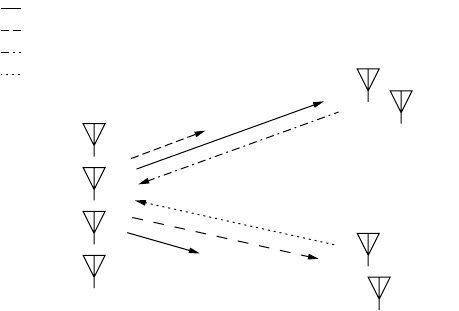
the “uplink” channel and “downlink” channel, as illustrated in Figure 7.1.
The uplink refers to the case where a group of users sharing the same channel
(representing a unique time slot, frequency, or code sequence) transmit
simultaneously. Among information theorists this is commonly labeled the
multiple access
channel. This scenario requires the multi-antenna base station
to successfully separate all of the interfering signals, which can be achieved
if the users are transmitting from different locations by exploiting the dif-
fering spatial characteristics of the respective channels at the receiver.
The downlink channel (the broadcast channel
among information theorists)
refers to the case where the base station transmits simultaneously to more
than one user over a shared channel. This poses challenges that are somewhat
different from the uplink channel, because the receivers are unable to coop-
erate, so the signals at the different receivers cannot be processed jointly.
Since the receivers pictured in Figure 7.1 have multiple antennas, they could,
in theory, use multiple-user detection (MUD) techniques to avoid the inter-
fering signals. This is typically computationally costly, and in cases where
users have only a single antenna, it is not possible without relying on other
forms of multiplexing such as CDMA. Ideally, then, we would like to miti-
gate the multiple-access interference (MAI) at the transmitter by intelligently
designing the transmitted signal.
In this chapter, we begin by reviewing the problem of the multi-user MIMO
downlink and discuss in general terms several different transmission
FIGURE 7.1
An illustration of a multiple-user MIMO channel with uplink and downlink. In the uplink, the
base station receives multiple interfering signals and uses their spatial properties to separate
them. In the downlink, each user often receives data intended for other users, and is not able
to coordinate with them.
Base
station
Uplink signal from user 2
Downlink signal intended for user 1
Downlink signal intended for user 2
Uplink signal from user 1
User 1
User 2
4190_book.fm Page 177 Tuesday, February 21, 2006 9:14 AM

178 MIMO System Technology for Wireless Communications
approaches that have been proposed. We compare the performance of some
of the schemes in randomly generated channels under ideal conditions. We
then show how the algorithms would perform under real-world conditions
using measurement data from an indoor propagation environment and two
different outdoor environments. We focus in particular on the achievable
capacity, the ability of the channels to support multiple sub-channels per
user, the required separation distance between users to maximize available
capacity, and the effects of channel estimation error due to user mobility. We
begin with a mathematical model used for characterizing multi-user MIMO
channels.
7.2 The Multiple-User MIMO Channel
A MIMO channel with transmitters and receivers is commonly repre-
sented as a matrix of dimension , where each of the coefficients
[H
]
i,j
represents the complex transfer function from the j
th transmitter to the
i
th receiver. We denote the signal transmitted from the j
th transmitter at time
t
as x
j
(t
), and represent the total transmitted signal with the vector x
(t
) of
dimension n
T
. Likewise, we represent the received signal with the n
R
-dimen-
sional vector y
(t
), which can be expressed as a function of the transmitted
signal, the channel matrix, and an n
R
-dimensional additive noise vector n
(t
):
(7.1)
For simplicity, we will omit the dependence on time, referring to the
transmitted and received signals instead as x
and y
. In a single-user point-
to-point MIMO link, all outputs are available to the receiver for processing.
In the multiple-user case, the n
R
receivers are distributed among different
users, so we extend the model to reflect this. Let K
represent the number of
users sharing a channel, and let n
R
j
represent the number of antennas for
user j
, so that the total number of receive antennas
The channel between the base and user j
is now the matrix H
j
, whose
rows we denote by as follows:
n
T
n
R
H nn
RT
×
yHxn() () ()ttt=+.
n
n
R
j
K
j
R
=
=
¨
1
.
j
R
T
n
n×
h
ij
Hh h
jj
n
j
j
R
=…
¬
®
¼
¾
½
½
1
,
4190_book.fm Page 178 Tuesday, February 21, 2006 9:14 AM
Performance of Multi-User Spatial Multiplexing with Measured Channel Data
179
where is used to denote the complex conjugate (Hermitian) transpose.
Note that this model is based on the assumption of a flat-fading or nar-
rowband channel, which is not true in many current and next-generation
wireless communications applications. This matrix channel model can still
be applied to many broadband channels. For example, many modern broad-
band communication protocols are based on orthogonal frequency division
multiplexing (OFDM). Typically, the bandwidth of one OFDM subcarrier is
narrow enough that the narrowband model applies, so MIMO processing
algorithms could be applied independently for each subcarrier. While we
assume a narrowband channel throughout this chapter, the methods dis-
cussed here can also be applied to broadband channels using OFDM or
similar techniques.
Using this model, consider the signal received by user j
. User j
not only
receives its own signal through the channel H
j
, but also contributions from
the signals intended for other users:
(7.2)
where n
j
is assumed to be spatially white noise. The transmitted signal is
then the sum of the transmitted signals for each user:
We assume that the transmitted signal x
j
is formed from a vector d
j
of m
j
symbols to be transmitted to user j
. In a single-user channel, the number of
symbols transmitted in parallel is limited by the rank of the channel matrix.
Likewise, in a multi-user channel, m
j
is limited by the rank of H
j
. We use the
vector d
to denote the data symbols transmitted to all users:
where the dimension of d
is
It is possible to transmit at different rates to each of the K
users by the choice
of symbol constellation and channel coding for each user, and by the number
of data streams m
j
transmitted to each user. Suitable values for m
1
, …, m
K
()
yHxn
j
k
K
jk j
=+
=
¨
1
,
x
xx=
=
¨
j
K
j
1
.
ddd d=…
¬
®
¼
¾
½
T
TT
K
T
12
,
mm
j
K
j
=
=
¨
1
.
4190_book.fm Page 179 Tuesday, February 21, 2006 9:14 AM
180 MIMO System Technology for Wireless Communications
will not only depend on the desired data rate for user j
, but also on the
available transmit power, the achievable SINR, and the number of transmit
and receive antennas. Without additional coding or multiplexing, typically
m
j
f
n
R
j
, and
8
m
k
f
n
T
. The choice of m
j
to obtain optimal system performance
is itself an important problem that has recently been studied in [1].
The transmitted signal x
is formed from d
using some encoding function that
we denote by f
e
, so that x
= f
e
(d
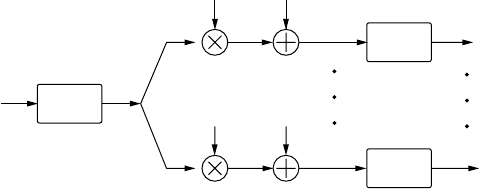
). The receivers use
a decoding function f
d
to estimate the data vectors: . This scheme is illustrated in
Figure 7.2. To describe the dimensions of a particular channel, we use the
notation {n
R
1
, …, n
R
K
} ×
n
T
. A system with K
= 4 users having one antenna
each and n
T
= 4 transmit antennas could be written as a {1,1,1,1} ×
4 system.
Likewise, a {1,1,2,2} ×
4 describes a similar case where two of the users have
two antennas. The challenge of the multi-user MIMO downlink is to choose
encoding and decoding functions f
e
and f
d
that optimize the use of channel
resources. Specific optimization goals may include maximizing total
throughput, ensuring a certain quality of service (QoS) for each user, or
minimizing transmit power, among others.
Achieving any of these goals requires that the transmitter have some
information about the channel. From an information-theoretic point of view,
a MIMO channel where the transmitter has channel state information (CSI)
has a different channel capacity than the same channel without CSI. Single-
user MIMO systems benefit from having CSI at the transmitter mainly when
n
T
v
n
R
or at low SNR. On the other hand, CSI in a multi-user MIMO
downlink is critical to minimizing inter-user interference under all channel
conditions. Obtaining CSI is itself a challenging problem [2]. It can generally
be obtained in a two-way communications system by either sending the infor-
mation over the reverse link, or estimating channel parameters of the reverse
link and applying them to the forward link. In this chapter, we assume that
CSI is available, and we will later investigate the effects of corrupted channel
information on multi-user performance.
Another property of radio channels to consider is how they vary over time.
The assumption that CSI is available at the transmitter usually implies that
FIGURE 7.2
An illustration of downlink multi-user processing, where each user has multiple antennas and
receives parallel data symbols.
Precoder
Channel K
Channel 1
Receiver K
Receiver 1
H
1
y
1
d
H
K
y
K
x
f
d
(y
K
)
f
d
(y
1
)
d
K
d
1
f
e
(d)
n
1
n
K
j
dj
ˆ
()
d
fy=
4190_book.fm Page 180 Tuesday, February 21, 2006 9:14 AM
Performance of Multi-User Spatial Multiplexing with Measured Channel Data
181
the channel is quasi-static, which has been assumed in much of the research
to date on multi-user MIMO channels. This is a reasonable assumption for
channel environments such as wireless local area networks (LANs), where
users are mobile but do not move rapidly. Cellular telephone applications
are more challenging because speeds are much higher. Downlink processing
methods for channels that are quickly time-varying with limited CSI is an
important problem for future research. However, the results included in
Section 7.4 suggest that the prediction horizons for MIMO systems may be
much longer than in the SISO case (which has usually proven to be too short
to be useful), since multiple antennas reveal more information about the
physical structure of the channel [3].
7.2.1 Capacity
Capacity is an important tool for analysis of communication channels. In
single-user MIMO channels it is common to assume a constraint on total
power broadcast by all transmit antennas. For a multi-user MIMO channel,
the problem is more complex. Given a constraint on the total transmitted
power, it is possible to allocate varying fractions of that power to different
users in the network, so a single power constraint can yield many different
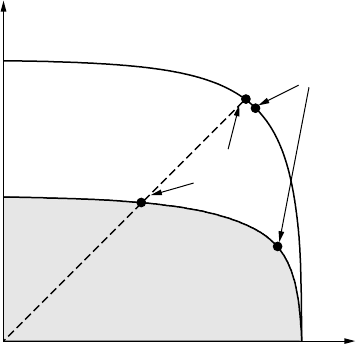
information rates. The result is a “capacity region” like that illustrated in
Figure 7.3 for a two-user channel. The “corners” of the region represent
allocation of 100% of the power to either one of the users. For every possible
power distribution in between, there is an achievable information rate, which
results in the outer boundary of the region. In Figure 7.3, two regions are
FIGURE 7.3
An illustration of a multi-user capacity region. The sum capacity may penalize certain users,
depending on the shape of the capacity region.
Equal
capacity
Maximum sum
capacity
Capacity
region
Rate for user 2
Rate for user 1
“Near-Far”
capacity
region
4190_book.fm Page 181 Tuesday, February 21, 2006 9:14 AM
182 MIMO System Technology for Wireless Communications
shown: one for the case where both users have similar maximum capacity,
and one for the case where they are different (due, for example, to user 2’s
channel being attenuated relative to user 1, sometimes referred to as the
“near-far” problem). For K users, the capacity region is characterized by a
K-dimensional volume.
In Figure 7.3, two points are indicated on the boundary of each of the two
regions. One point represents the maximum achievable throughput of the
entire system, or the point on the curve that maximizes the sum of all users’
information rates. It is clear that this sum capacity point does not always
represent a fair distribution of resources among the users. The second point
on the two curves is located where the curves intersect with the line C
2
=
C
1
, and represents the maximum achievable rate such that both users have
equal rates. The problem in this case is that the total throughput is substan-
tially reduced in the “near-far” case. While the sum capacity point clearly
does not convey all the relevant information about a multi-user MIMO
channel, it is nevertheless a useful tool for understanding the relative capa-
bilities of a particular transmission algorithm or channel, and will be used
extensively in this chapter for that purpose.
The capacity of the multi-user MIMO channel is achieved by applying a
concept that originates from a paper by M. Costa [4] known as “writing on
dirty paper.” Costa studied communication channels with interference and
proved the somewhat surprising result that if a received signal y is defined as
(7.3)
where s is the transmitted signal, i is interference known deterministically
to the transmitter, and w is additive white Gaussian noise, the capacity of the
system is the same as if there were no interference present, regardless of
how strong the interference is and whether or not it is known to the receiver.
Using the dirty paper analogy, the capacity of a dirty sheet of paper is the
same as that of a clean sheet if the location of the dirt is known.
The implications of this result for multi-user MIMO channels with CSI
available at the transmitter are clear: since the channel and the transmitted
signals are all known, the transmitter knows how a signal designed for one
user interferes with other users and can design the signals for the other users
to compensate. This is the basis for many of the results on capacity of the
MIMO broadcast channel [5–9]. While the initial capacity results characterize
the achievable rate, they only prove achievability, but do not describe how
this rate is achieved. More recently, some practical transmission schemes
[10–12] have been proposed that use dirty paper codes to approach the
capacity of the scalar interference channel. To date, no practical application
of dirty-paper codes to the downlink problem has appeared, though the
techniques of [13] are related to dirty-paper coding (DPC).
A simplified approach to transmission in multi-user channels is to treat
all interference as noise. Clearly, this is suboptimal, but it also results in much
ysiw=++ ,
4190_book.fm Page 182 Tuesday, February 21, 2006 9:14 AM

Performance of Multi-User Spatial Multiplexing with Measured Channel Data 183
simpler implementations. The result is that the encoder f
e
and decoder f
d
are
linear functions of the data to be transmitted and the received signals, respec-
tively. The linear class of transmission schemes can generally be viewed as
a type of beamforming. Linear transmission schemes exist for a wide variety
of channel configurations, while so far, dirty-paper schemes have only been
proposed for the special case where all receivers have one antenna n
R
j
= 1.
However, the existing dirty-paper schemes can be applied to the more gen-
eral case where n
R
j
> 1 by combining them with linear processing methods.
In the next section we review some of these schemes.
7.3 Multi-User MIMO Transmission Schemes
As noted above, the existing schemes for transmitting from an antenna array
to a group of users can be put in two broad categories: linear and non-linear.
They can also be categorized as algorithms for single-antenna receivers and
multi-antenna receivers. In this section we review some of the linear methods
that have been proposed, and briefly discuss non-linear methods.
7.3.1 Linear Processing, Single-Antenna Receivers
We begin with linear transmission schemes for the case where each user has
only one receive antenna: n
R
j
= 1. With only one antenna, the receiver is unable
to perform any spatial interference suppression of its own, so the transmitter
is responsible for precoding the data in such a way that the interference seen
by each user is tolerable. We consider three techniques for solving this
problem: channel inversion, regularized channel inversion, and optimal
beamforming.
7.3.1.1 Channel Inversion
Perhaps the simplest way of managing the inter-user interference in a multi-
user downlink is using the (pseudo-) inverse of the channel matrix H [14–16].
For non-square channels where n
T
v K = n
R
, the transmitted signal s is
(7.4)
The matrix , is a diagonal matrix used to scale the power transmitted to
each user. The channel inversion nulls out all inter-user interference, reduc-
ing the problem to K independent scalar channels, so the amount of power
allocated to one user does not affect the others. Given a constraint on the
total transmitted power W, , can be chosen in different ways to achieve
sHHH d=.
©
«
ª
¹
»
º
1
,
4190_book.fm Page 183 Tuesday, February 21, 2006 9:14 AM