
Tsoulos George (ред.) MIMO System Technology for Wireless Communications
Подождите немного. Документ загружается.


184 MIMO System Technology for Wireless Communications
different goals: allocate equal power to all users, allocate equal capacity to
all users, or maximize sum capacity. Sum capacity can be maximized by
computing the gain of each of the independent channels and using the water-
filling algorithm to distribute the available power.
A very simple way of allocating the power is to set , = LI, where L = 1/W.
One problem with channel inversion arises when H is ill-conditioned. In
such cases, at least one of the singular values of is very large, L will
be large, and the SNR at the receivers will be low. It is interesting to note
the similarity between channel inversion and least-squares or “zero-forcing”
(ZF) receive beamforming, which applies a dual of the transformation in
Equation 7.4 to the receive data. Such beamformers are known to cause noise
amplification when the channel is nearly rank deficient. On the transmit side,
ZF produces signal attenuation instead. In fact, it has been shown that in
the ideal case where the elements of H are independent complex Gaussian
random variables, the probability density of L has an infinite mean [17]. It
is also shown in [17] and the simulation results section of this chapter that
the capacity of channel inversion does not grow linearly with K.
7.3.1.2 Regularized Channel Inversion
When rank-deficient channels are encountered in ZF receive beamforming,
one technique to reduce the effects of noise amplification is to regularize the
inverse in the ZF filter. If the noise is spatially white and an appropriate
regularization value is chosen, this approach is equivalent to using a mini-
mum mean-squared error (MMSE) criterion to design the beamformer
weights. Applying this principle to the transmit side suggests the following
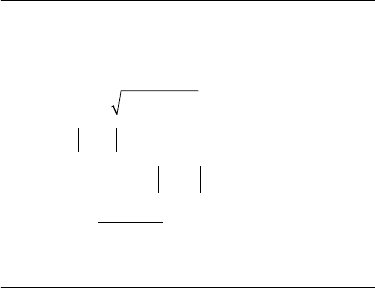
solution:
(7.5)
where _ is the regularization parameter. When _ | 0, the transmitter does
not perfectly cancel out all interference. The key is to define a value for _
that optimally trades off the numerical condition of the matrix inverse
against the amount of interference that is produced. It has been shown that
choosing _ = K/W approximately maximizes the SINR at each receiver, and
leads to linear capacity growth with K [17]. Because each user sees some
interference from other users, this scheme does not allow the same flexibility
as exact channel inversion in adjusting the power transmitted to each user,
because a change to the power weighting for one user changes the interfer-
ence seen by all other users.
7.3.1.3 Optimal Linear Precoders
Regularized channel inversion demonstrates that perfectly canceling out all
inter-user interference is not optimal, and provides a good solution in closed
()HH
1
sH
HH I
d=
+
()
1
1
L
_
,
4190_book.fm Page 184 Tuesday, February 21, 2006 9:14 AM
Performance of Multi-User Spatial Multiplexing with Measured Channel Data 185
form at low computational cost. However, it is still not necessarily the optimal
linear beamformer. Attempting to design a set of transmit beamformers with-
out any constraints on inter-user interference is a very challenging problem
because they are all interdependent. If an optimal beamformer is designed
for one user, it will produce some interference for the other users. If the
interference is taken into account in designing an optimal beamformer for a
second user, it will emit interference that makes the first user’s beamformer
suboptimal. This suggests that the optimal solution can not be computed in
closed form but requires an iterative approach.
With a zero-forcing solution, a set of independent channels is created, so
the power transmitted to each user can readily be adjusted to achieve a
variety of different goals, such as maximizing sum capacity or insuring equal
capacity for all users given a power constraint, or minimizing power given
a capacity constraint for each user. In the case where inter-user interference
is allowed, the solution to each of these problems will be different. Optimal
transmit beamformers have been found for a variety of different optimization
criteria [18–23]. We give as an example the linear precoder that optimizes
sum capacity [18], which takes the form
(7.6)
This is similar to regularized channel inversion, but we have introduced
two diagonal matrices, D and ), which are used respectively to weight the
rows of H inside the inverse and weight the columns of the resulting beam-
former. The optimal values for these matrices, and the scale constant _, can
be computed using the iterative algorithm given in Table 7.1.
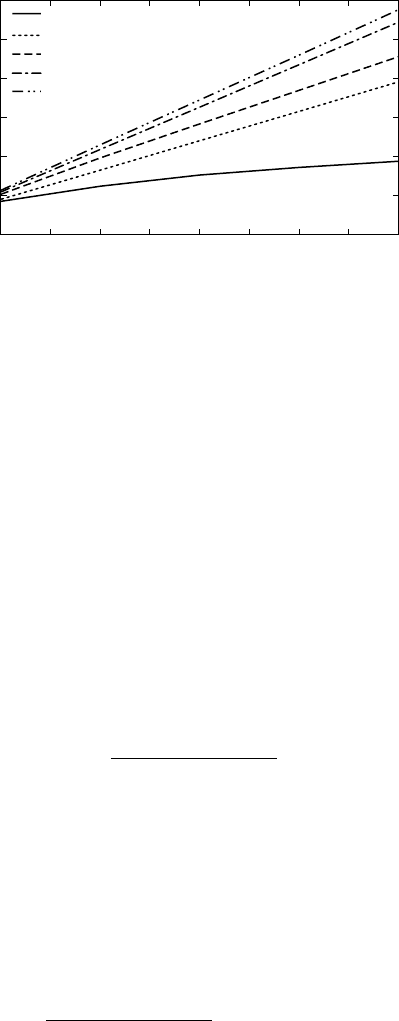
The sum capacity as a function of the channel matrix size for the linear
precoders we have discussed so far is compared with the sum capacity of
the channel and capacity of an equivalent single-user channel in Figure 7.4.
TABLE 7.1
Linear Precoding for Maximum Sum Capacity
1. Initialize W
j
(1) = 1 for j = 1…K, D = I, ) = I
2. Repeat until convergence
a.
b.
c.
d.
e.
f.
sHDHI Hd=+ ) .
©
«
ª
ª
¹
»
º
º
1
_
n
T
MHDH DIH=+
()
)
tr( )/W
WHM MM=
W/tr( )
n
jjj
=
,
[]W
2
d
j
iij
K
ij
=+
=,|
,
¨
1
1
2
[]W
[]
()
D
jj
j
jj j
n
dd n
,
=
+
[] [ ]) =
,,jj jj j
dW /
4190_book.fm Page 185 Tuesday, February 21, 2006 9:14 AM
186 MIMO System Technology for Wireless Communications
Of all the precoders, only channel inversion fails to achieve a sum capacity
that increases linearly with K and n
T
. Regularized channel inversion offers
a substantial improvement in performance, and the optimal linear precoder
(labeled capacity-optimal RCI) is even better, achieving most of the sum-
capacity of the channel that is achievable using DPC.
As we noted earlier, there are many situations in which optimizing sum
capacity is problematic because it does not guarantee a minimum level of
signal to any user. There are many other optimizations that have appeared
recently in the literature that may be of greater practical interest. The “power
control” problem was the first of these [19,20], and can be stated as follows:
given a set of SINR requirements for each user, compute the set of beam-
formers b
1
, …, b
k
such that the SINR requirements are met and total trans-
mitted power is minimized. We define L
j
as the SINR for user j, which can
be expressed as:
(7.7)
where we have assumed that the noise has unit variance. The power mini-
mization problem can be stated mathematically as
(7.8)
FIGURE 7.4
Mean sum-capacity of various precoders for uncorrelated Gaussian channels with K users and
n
T
= K transmitters at a SNR of 10 dB.
0
5
10
15
20
25
30
10 9 8 7 6 5 4 3 2
Capacity(bits/usr)
K
Channel inversion
Regularized channel inversion
Capacity-optimal RCI
Sum capacity
Single user
L
j
jjjj
kj
kjjk
=
+
|
¨
bHHb
bHHb 1
,
min
bb
bb
1
1
,,
=
¨
..
K
k
K
kk
st
bbHHb
bHHb
jjjj
kj
kjjk
j
jK
|
¨
+
v =,.
1
1L ,,
4190_book.fm Page 186 Tuesday, February 21, 2006 9:14 AM
Performance of Multi-User Spatial Multiplexing with Measured Channel Data 187
Solutions to this problem have been proposed in [19–21]. Other optimizations
for which solutions have recently been proposed include the maximization of
the SINR margin for all users given a minimum SINR requirement for each
user and a total power constraint [22,23]. In addition to the sum-capacity solu-
tion, [18] also proposes a solution for maximizing the minimum capacity for
each of the individual users. This whole class of solutions requires more
computation than plain or regularized inversion, but since beamformers are
typically computed once for an entire block of transmitted symbols, this is
still a practical solution.
7.3.2 Linear Processing, Multi-Antenna Receivers
With only a single antenna, the receivers are not able to perform spatial
interference suppression of their own, so they can only receive data over a
single spatial channel. With multiple antennas, these restrictions are
removed, provided that the transmitter and receiver can coordinate their
spatial processing, and appropriately allocate the available spatial resources.
A simple approach to this would be to apply the single-antenna techniques
just described, provided that n
R
f n
T
, where n
R
is the total number of receive
antennas summed over all users. This effectively treats each receive antenna
as if it were a separate user, so no joint processing among the receive antennas
is required, but performance is limited because the problem is overly con-
strained, and the number of users is limited more than necessary.
Both channel inversion and regularized channel inversion limit the num-
ber of users to K f n
T
. For optimal beamforming, it is technically possible to
support cases where K > n
T
, but realistically this can occur only when the SINR
requirements are very low. So, it is reasonable to consider n
T
to be the
practical upper bound on the number of users. If the receivers have multiple
antennas, it is still possible to support up to K = n
T
users by using the concept
of coordinated beamforming. To illustrate this, consider the block diagram
of Figure 7.2. Assume that the decoding function for user j is a linear
operator w
j
, so that
ˆ
d
j
= . If the beamformers were known to the trans-
mitter in advance, then the virtual channel, which represents the transfer
function from the transmitter to the output of the beamformer of user j, is
If we collect the virtual channels for each user, we can define a virtual
channel for the entire system:
As long as K f n
T
, it possible to apply any of the single-antenna algorithms
described earlier to the virtual channel . The remaining problem is deter-
mining the receive beamformers w
j
. This information could be obtained if
fy
dj
()
wy
jj
hwH
jjj
=.
H= h h … h
12 K
*
¬
®
¼
¾
H
4190_book.fm Page 187 Tuesday, February 21, 2006 9:14 AM

188 MIMO System Technology for Wireless Communications
the transmitter were to assume a specific approach to designing the beam-
formers. For example, both MMSE and MRC designs for w
j
are functions of
only the channel and the transmit beamformers, so w
j
could be computed
from information available to the transmitter. However, this results in a
situation where the solutions to the transmit and receive beamformers are
dependent on each other. This suggests the following iterative approach:
1. Assume an initial set of w
j
values.
2. Compute the virtual channel and the transmit beamformers.
3. Update the receive beamformers w
j
.
4. Repeat steps 2 and 3 until convergence.
The convergence properties of this approach will depend, in general, on
what algorithms are used on both the transmitter and receiver side to determine
the beamforming weights. The concept of beamforming that is coordinated
between the transmitter and receiver is the basis for several recent multi-
user transmission schemes [1,24–29].
In single-user MIMO channels with CSI available to the transmitter, capacity
is achieved by spatial multiplexing, where a number of independent sub-
channels are created that carry independent streams of data. In a multi-user
MIMO downlink where the receivers have multiple antennas, it is also pos-
sible to transmit multiple data streams to each user. We define m
j
to be the
number of sub-channels allocated to user j, and
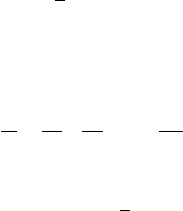
to be the total number of sub-channels. The restrictions on these values are
that m
j
f
~
L
j
, where
~
L
j
is the rank of and m f n
T
.
This means that allocating multiple sub-channels to individual users limits
the total number of users that can be served. The problem of choosing a
good value of m
j
has not yet been studied extensively, but the simulation
results presented later in this chapter illustrate the trade-offs involved. In
the case where m
j
> 1, define the receiver for user j as the m
j
× n
R
j
matrix W
j
,
and the linear precoder as the n
T
× m matrix,
where B
j
is the n
T
× m
j
precoder for user j. As in the single sub-channel case,
the transmit precoders B
j
can be derived by selecting an initial set of receivers
W
j
, and alternately updating B
j
and W
j
until convergence is reached.
In this section, we discuss two general approaches to this problem. The
first is a coordinated zero-forcing approach that is a generalization of channel
H
mm
j
K
j
=
=
¨
1
……HH HH H
j
T
j
T
j
T
k
T
T
=
¬
®
¼
¾
+111
,
B =
¬
®
¼
¾
BB B
12
…
k
,
4190_book.fm Page 188 Tuesday, February 21, 2006 9:14 AM

Performance of Multi-User Spatial Multiplexing with Measured Channel Data 189
inversion. The second is a framework for applying other methods like reg-
ularized channel inversion or optimal beamforming in a context where users
have multiple antennas.
7.3.2.1 Coordinated Zero-Forcing
As noted previously, in cases where the receivers have multiple antennas, it
is possible to use channel inversion at the transmitter if n
r
f n
T
, but this over-
constrains the problem, by forcing HB to be completely diagonal. In fact, all
inter-user interference can be eliminated by constraining HB to be block-
diagonal (i.e., H
i
B
j
= 0, for i | j). A procedure for computing the optimal B
given this constraint has been proposed [24,30–34], but it imposes restrictions
on the channel configurations that can be accommodated. In order to accom-
modate all possible receiver sizes, those restrictions can be eliminated using
the coordinated beamforming approach: estimate the receivers W
j
and force
to be zero. A method for computing this iteratively, referred to as
the “coordinated zero-forcing” algorithm, is listed in Table 7.2.
TABLE 7.2
Coordinated Zero-Forcing Algorithm
1. For each user, initialize W
j
as the m
j
dominant left singular vectors of H
j
, and define H
j
–
=
W
j
*H
j
.
2. For each user, define
let represent an orthogonal basis for the right null space of and compute the SVD
where and represent the first m
j
left and right singular vectors. Update the
transmitter and receiver beamformers: and and define
3. Repeat step 2 until
for some value of J.
4. Use water-filling to determine power allocation given the diagonal values of the 8
j
matrices as the channel gains.
WHB
iij
HH HH H
j
T
T
j
T
j
T
K
T
=… …
¬
®
¼
¾
+111
,
V
j
()0
H
j
,
H
V
UU VV
j
j
j
j
j
H
j
j
()
()
()
()
()
0
1
0
1
0
=
¬
®
¼
¾
½
¬
®
¼
¾
8
½½
,
U
j
()1
V
j
()1
WU
jj
=
()1
BV
jj
=
()
,
1
S
WH
WH
BB=
¬
®
¼
¾
½
½
½
½
½
½
½
¬
®
¼
¾
½
11
1
KK
K
.
min
[]
[]
iK
ii
ji
ij
=,,
,
|
,
¨
<
1
S
S
J
4190_book.fm Page 189 Tuesday, February 21, 2006 9:14 AM

190 MIMO System Technology for Wireless Communications
The result of the coordinated zero-forcing algorithm is a set of non-inter-
fering virtual channels. One advantage of this approach is that, since the
channels do not interfere, the solution is independent of the power allocation
to each channel, and therefore the power allocation can be performed inde-
pendently from the computation of the beamformers.
There are a few special cases of the coordinated zero-forcing algorithm
worth noting. First, if n
R
j
= 1 for all users, the solution is equivalent to channel
inversion with optimal power allocation. Second, if n
T
> max{rank(H
1
,
~
…,
rank(H
K
)},
~
the convergence criterion is reached at the first step, and the solution
is equivalent to the block-diagonalization solution of [24]. Third, if m
j
= 1 for
all users, the receiver beamformers W
j
are equivalent to maximal ratio combin-
ers, and the solution for B is equivalent to channel inversion of H
–
(this allows
for some computational savings over the generalized implementation).
7.3.2.2 General Coordinated Beamforming
As noted in the discussion of channel inversion, the use of zero-forcing at
the transmitter has some disadvantages, so there are good reasons to use
other beamforming methods at the transmitter. This can be done in channels
where the receivers have multiple antennas by applying the same general
approach as in coordinated zero-forcing. A general algorithm for doing this
is listed in Table 7.3.
There are two reasons that computing the zero-forcing solution makes a good
initialization point for the algorithm in step 1. The first is that as SNR increases,
the difference between the zero-forcing solution and other beamforming algo-
rithms will become increasingly small, so starting with the zero-forcing
solution can significantly reduce the number of iterations to convergence
[29]. The second reason is that zero-forcing is the only way the beamforming
weights and power allocation can be decided independently, so initializing
with zero-forcing is a means of intelligently estimating how many bits should
be allocated to each sub-channel before proceeding with beamformer opti-
mization. In [29] this approach was used with MMSE receivers and optimal
beamforming for minimum power at the transmitter.
TABLE 7.3
Coordinated Transmitter/Receiver Beamforming Algorithm
1. Assume an initial set of receiver weights W
1
, …, W
K
. Two good candidates for this are
to use the dominant left singular vectors of the respective channel matrices H
j
, or to
compute the full coordinated zero-forcing solution and use the resulting values of W
j
.
2. Given W
1
, …, W
K
, calculate
–
H and find B using any of the algorithms discussed earlier
(regularized channel inversion, optimal beamforming).
3. Given B, recalculate the receiver beamformers W
1
, …, W
K
according to some assumed
receiver design (MMSE, MRC, etc).
4. If the SNR or sum rate achieved by B and w
j
has changed from the last iteration, go to
step 2; otherwise, stop.
4190_book.fm Page 190 Tuesday, February 21, 2006 9:14 AM

Performance of Multi-User Spatial Multiplexing with Measured Channel Data 191
7.3.3 Non-Linear Processing Methods
All of the transmission schemes discussed so far use linear processing at the
transmitter and receiver. However, as noted previously, channel capacity in
a multi-user environment depends on the use of DPC techniques, which are
inherently non-linear in nature. DPC techniques have been demonstrated to
outperform linear methods [13], but implementation is more expensive.
Some efficient DPC precoders have computational complexity similar to that
of linear precoders, but the computation must be performed separately for
each transmitted symbol, while linear precoders can be computed once for an
entire block of transmitted symbols.
Another limitation of DPC it that none yet exists that is designed for
multiple-antenna receivers. However, there are straightforward ways of
combining DPC with linear processing methods to make them usable for
multi-antenna receivers. One simple example is using coordinated zero-
forcing to compute a set of transmit and receive vectors that allow one sub-
channel per user (m
j
= 1). After this is computed, the linear beamformers
could be replaced by a DPC encoder that uses the channel matrix .
It is reasonable to assume that in a real multi-user environment it will be
common to have a mixture of users with single and multiple antennas. In
this type of environment, one proposal for obtaining the benefits of non-
linear precoding is to use block-diagonalization for the users with multiple
antennas and non-linear DPC methods for the users with only one antenna
[35]. In this approach, the beamformers for the multiple-antenna users are
chosen to lie in the null space of the channel matrices of the other users
including those with single antennas. The equivalent channel for the single-
antenna users looks as if there are no multiple-antenna users present, which
improves diversity for those users. The data transmitted to the multiple-
antenna users are also precoded using a linear precoder in order to eliminate
the multi-user interference, which in this case only originates from the single-
antenna users. This approach significantly improves the performance of the
single-antenna users and, hence, also that of the overall system.
7.4 Channel Measurements
In the results that follow, we examine the performance of linear precoding
schemes in realistic environments using channel measurements from both
indoor and outdoor propagation environments. The measurements were
taken from a narrowband channel sounding system designed and built at
Brigham Young University (BYU). The transmitter of the system modulates
the chosen carrier frequency using BPSK modulation with a unique pseudo-
random binary sequence for each of the antennas in the transmit array. In
the receiver, the signals from each of the elements of the receive array are
H
4190_book.fm Page 191 Tuesday, February 21, 2006 9:14 AM
192 MIMO System Technology for Wireless Communications
down-converted to an intermediate frequency and sampled using a high
frequency, multi-channel, analog-to-digital converter. The sampled signals
are stored and processed off-line to extract the complex gain from each of
the transmit antennas to each of the receive antennas. The frequency with
which the channel can be sampled is a function of the length of binary
sequence used for modulation. For a more detailed description of the channel
sounder and the post-processing, see [36].
All of the results included here were collected at a carrier frequency of
2.43 GHz, with a bandwidth of 25 KHz. This frequency is used by some of
the popular wireless LAN standards and is close to the 1.9 GHz frequency
used in some mobile telephone networks. In the measurement results pre-
sented here, the transmitter was kept at a fixed location and the receiver
moved while sampling the channel every 2.5 ms. Multi-user channels are
created by selecting samples from multiple points along the measurement
path. Because the average number of samples per wavelength is as high as
30 for most of the cases considered here, relatively small separations between
users can be simulated.
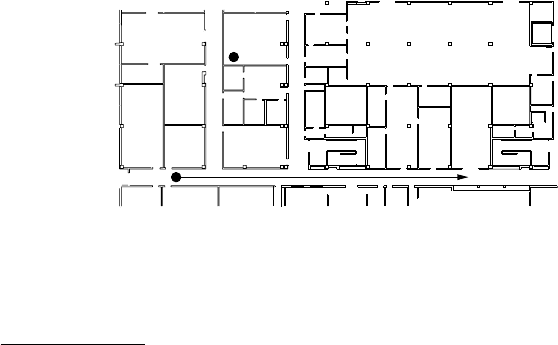
The measurements used here come from three different sets. The first is a
set of indoor measurements taken inside a typical university building.* The
measurements were taken with the transmitter in a fixed location and the
receiver moving in a straight path with an approximate length of about
40 meters along a long corridor at constant speed. The measurement path is
illustrated in Figure 7.5. All channels were non-line-of-sight (NLOS), which
would typically lead to reduced power but enhanced multipath diversity
relative to line-of-sight (LOS) channels. Both the transmitter and receiver
used 10 monopole antennas arranged in a circular pattern with a radius of
0.86 wavelengths, equivalent to a spacing of approximately 0.5 wavelengths
between adjacent elements.
* The building was the Clyde Engineering Building on the BYU campus, which has steel-rein-
forced concrete structural walls and cinder-block partition walls.
FIGURE 7.5
Illustration of the measurement path and part of the building used for the indoor channel
measurements.
Transmitter
Receiver
4190_book.fm Page 192 Tuesday, February 21, 2006 9:14 AM
Performance of Multi-User Spatial Multiplexing with Measured Channel Data 193
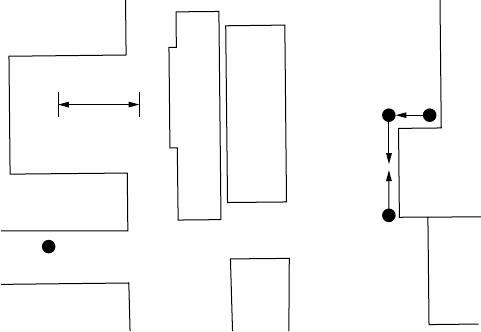
Two outdoor data sets are also considered here. The first, referred to as
outdoor channel A, placed the transmitter between two buildings on the
BYU campus, and the receiver behind a neighboring building, creating a
NLOS channel similar to that often seen in urban environments. These meas-
urements were collected with 8-element uniform linear arrays of monopole
antennas at both transmitter and receiver, with a spacing of 0.3 wavelengths.
The receiver was placed at three different locations and moved along a
straight path with a length of about 10 meters. The measurement paths and
neighboring buildings for outdoor channel A are illustrated in Figure 7.6.
The results in the next section derived from these measurements are aver-
aged over the three different locations.
The second outdoor environment, referred to in the next section as outdoor
channel B, contained mostly LOS channels. The transmitter was placed in
two locations a few meters from the wall of a building. The receiver was
placed at four different locations near the same building, and moved dis-
tances of 10–12 meters. These measurements were collected using uniform
linear arrays of seven antennas at both transmitter and receiver with a
spacing of 0.39 wavelengths. The building and the measurement paths for
this channel are illustrated in Figure 7.7. The composite results for outdoor
channel B also are averaged over the four measurement locations.
Most of the test cases considered scenarios with fewer antennas than the
original data set. Appropriate antenna subsets were selected as follows. On the
transmit side, antennas with maximal separation were chosen to mimic a base
station that uses the entire array aperture. For example, the 4-element trans-
mitter that is used in many of the results is taken from the 7-element linear
array by choosing 4 elements with uniform separation of 0.78 wavelengths.
A mobile receiver, on the other hand, would be expected to have limited
FIGURE 7.6
Illustration of the measurement paths and neighboring buildings for outdoor channel A. These
channels are almost all non-line-of-sight (NLOS).
Location 1
Receiver
Location 2
Location 3
Transmitter
10 m
4190_book.fm Page 193 Tuesday, February 21, 2006 9:14 AM