
Tsoulos George (ред.) MIMO System Technology for Wireless Communications
Подождите немного. Документ загружается.

214 MIMO System Technology for Wireless Communications
8.2.2 UTRA FDD Uplink
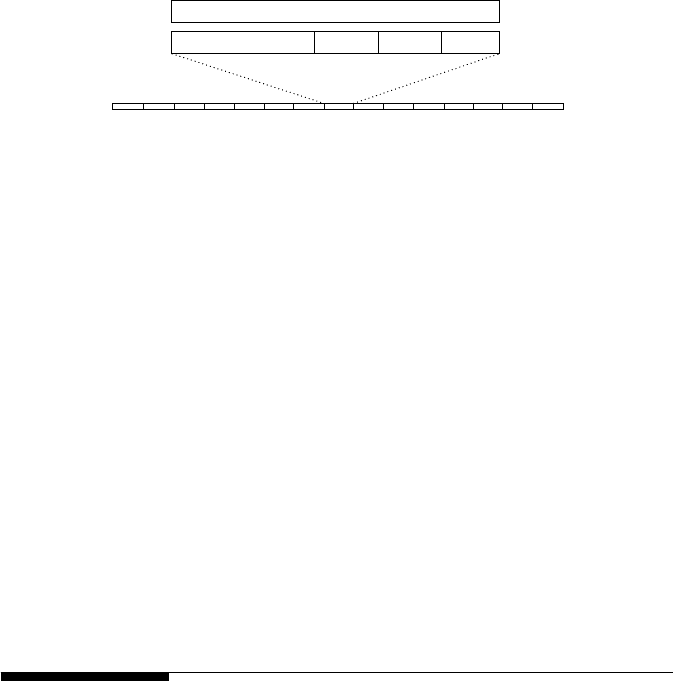
Figure 8.2 presents uplink frame and time slot structures for DPDCH and
DPCCH. In uplink, user and control data are I/Q code multiplexed and several
DPDCHs can be associated to a single DPCCH. In addition to pilot bits, the
TFCI and TPC uplink DPCCH slot contains feedback information bits (FBI)
used to convey partial channel state information when UTRA two-antenna
closed-loop transmit diversity modes are applied. Only user-specific dedi-
cated pilot channels are available in uplink.
Uplink users are not synchronized, and due to the non-orthogonality of
users’ channelization codes, multiuser interference cannot be avoided. Accu-
rate and fast TPC is indispensable to uplink performance, because otherwise
users in the vicinity of the base station would completely mask intracell
users on cell edges. Fast power control is an inherent characteristic of CDMA
systems, and it is applied in most of the downlink and uplink data channels
in UTRA FDD.
8.3 Current Multiantenna Methods in UTRA FDD
Conventionally, multiantenna techniques have mainly been considered
within base stations, because deploying multiple antennas in the user equip-
ment is not straightforward due to cost, complexity of signal processing, and
power consumption. This is still true in the present terminals that may
support several radios like WCDMA, GSM, GPS, Bluetooth, WLAN. Thus,
handsets that support only SISO processing may still require several anten-
nas for different frequency bands, although the current trend is to handle
the different frequencies with a single multifrequency antenna.
Multiantenna signal processing is useful in base station receivers, but the
use of multiple antennas for transmission requires careful study. All precod-
ing methods that modify the transmitted signal constellation must be stan-
dardized to ensure that all mobile receivers are able to estimate and detect
the signals from different antennas. An extensive standardization process
has been required even in the case of transmit beamforming.
FIGURE 8.2
Uplink frame structure for DPDCH/DPCCH.
DPDCH
1
R
adio frame = 15 time slots
:
10 ms
Data bits
Pilot bits TPC TFCI FBI
DPCCH
4190_book.fm Page 214 Tuesday, February 21, 2006 9:14 AM
Multiuser MIMO for UTRA FDD
215
Present UTRA FDD specification supports two-antenna transmit diversity
and transmit beamforming. Such MISO systems for downlink have been
intensively studied, because at the time when the 3GPP standardization was
initiated, most scenarios predicted that the capacity of wireless networks
would be limited by the downlink connection. Although diversity MISO
does not promise such high peak data rates as information MIMO, transmit
diversity improves fading resistance and beamforming increases the system
capacity while its impact to individual user data rates is small. Information
MIMO techniques are not included in the UTRA FDD specification, mostly
because the initial standardization work was carried out during the 1990s
when the development of practical information MIMO algorithms was still
only beginning.
8.3.1 Beamforming
Conventional transmit beamforming provides the simplest approach to
increase system capacity and coverage in downlink. The current 3GPP
specification supports both fixed beamforming (FBF) and user specific beam-
forming (USBF) modes in downlink. Fixed beamforming introduces addi-
tional sectors to the cell, because the short term variation of the beams is
small and a handover between the beams is required for mobile users. Each
beam is associated with a unique S-CPICH while P-CPICH is transmitted to
the whole cell.
Fixed beamforming is able to relax the code limitation in downlink, because
orthogonal spreading codes can be reused within the same cell due to spatial
filtering. It is also possible to use different scrambling codes in different beams.
In the presence of flat fading, the channelization codes of different users
within the same beam remain orthogonal because they are scrambled with
the same code. Different beams interfere with one another and increase
intracell interference, but when angular spread (AS) is reasonably small as
in macrocells, this interference remains acceptable. In addition to larger
interference levels, control signaling overhead increases due to inter-beam
handovers, because logically the fixed beams behave in the same way as
different sectors in base stations. The overall effect on system capacity is
positive, though, and according to [14], a 2.4-fold system capacity gain can
be achieved with a four-element antenna array when compared to a single
antenna BS.
Instead of fixed transmit beams, USBF generates individual beams to each
user. More sophisticated signal processing algorithms can be used, and con-
sequently, USBF is able to provide higher individual data rates than FBF. In
practice, USBF cannot be utilized in most cases within UTRA FDD downlink,
because it prevents the user from employing the P-CPICH as a phase refer-
ence, and according to the current specification, S-CPICH cannot be
employed in individual beams. Thus, channel estimation must be based on
dedicated pilot channels whose transmit power is low, which may seriously
4190_book.fm Page 215 Tuesday, February 21, 2006 9:14 AM
216 MIMO System Technology for Wireless Communications
corrupt channel estimation in UE. Then only high data rate users near the
base station may take full advantage from USBF. User-specific beamforming
is optional for UE in HS-DSCH and, therefore, the network cannot assume
that all UE users are able to support it.
Downlink beamforming changes the statistics of the fading signal, and in
environments with small angular spread, array gain dominates diversity
gain. Therefore, the estimation of downlink beamforming gain over single
antenna transmission is rather straightforward: The gain is approximately
the same as the array gain. This is not as simple, though, in uplink.
In uplink, both UTRA FDD beamforming techniques can be implemented
in a straightforward manner in the receiver. The simplest approach is to com-
bine the selected signal paths using maximal ratio combining (MRC) in the
beam space. This leads to a standard Rake-receiver concept. The most chal-
lenging practical problems are related to beam selection (direction of arrival
(DoA) estimation in USBF) and cost-efficient receiver structures. The former
problem is related to the large variety of physical environments with different
channel profiles. Furthermore, mobile’s transmit power is typically low for
low data rate connections, making the channel estimation difficult. The latter
problem arises from the fact that baseband complexity increases rapidly when
spatio-temporal estimation processes are introduced. For example, preambles
of random access channel (RACH) need to be monitored simultaneously for
each beam in order to avoid additional delays in connection setup time.
Transmit beamforming improves the downlink capacity in UTRA FDD,
but it is important to note that receive beamforming is not necessarily the
best solution in uplink due to the lack of diversity gain [15]. This gives rise
to a tradeoff between uplink and downlink design targets. If downlink
capacity is the bottleneck, FBF provides a good solution in macrocells. On
the other hand, if good uplink coverage is the primary target, uncorrelated
antennas with suitable receiver algorithms provide a better solution.
8.3.2 Transmit Diversity
According to [15], basic receive diversity solution outperforms receive beam-
forming performance even when angular spread is small. Moreover, transmit
beamforming in downlink loses its good performance in terms of capacity
and coverage when AS becomes large, so that beams cannot be accurately
pointed to users anymore. Hence, there is a need for a multiantenna trans-
mission method in downlink that performs well when correlation between
the transmit antennas is low. In general, low correlation can be achieved
when the distance between antenna elements in the base station is several
wavelengths. Conventional beamforming algorithms do not apply anymore,
and to this end, several open-loop transmit diversity techniques have been
developed in recent years. The simplest space–time block code [16] has
been adopted into 3GPP specification as a two-antenna open-loop transmit
diversity method. In UTRA FDD parlance, the scheme is referred to as
space–time transmit diversity (STTD).
4190_book.fm Page 216 Tuesday, February 21, 2006 9:14 AM

Multiuser MIMO for UTRA FDD
217
Space–time codes provide diversity reducing the variance of the received
signal, which further translates into reduced transmit power in downlink.
However, space–time codes do not increase the received SNR when com-
pared to single antenna transmission. With uncorrelated transmit antennas,
received SNR can be improved when short-term channel state information
(CSI) is made available in the transmitter. Such transmit diversity algorithms
are referred to as closed-loop transmit-diversity methods. The current UTRA
FDD specification contains two closed-loop modes [4], where the relative
phase and power between the two transmit antennas is adjusted according
to feedback information bits signaled from mobile to a base station through
a dedicated control channel. (See Figure 8.2.)
UTRA FDD supports two P-CPICHs in order to enable efficient channel
estimation of the two channels when transmit diversity is in use. In case of
closed-loop modes, feedback commands are determined from the P-CPICHs
and transmit weights are applied on dedicated traffic channels. Common
pilots are transmitted with higher power than dedicated pilots, and there-
fore, common pilots should be used for channel estimation whenever pos-
sible. With closed-loop modes, dedicated pilots are used for the verification
of the transmit weights (feedback commands may be erroneously decoded
in the base station, and the mobile cannot automatically assume that the
transmitter uses the weights that the mobile has instructed), and channel
estimates can still be calculated from P-CPICHs.
Closed-loop techniques outperform open-loop ones, particularly within
low-mobility environments, when the delay of the feedback signaling does
not exceed channel coherence time. Moreover, contrary to conventional
beamforming techniques, closed-loop algorithms do not require accurate
calibration of the transmit antennas due to feedback information. Only
coarse calibration of antenna elements is necessary in order to avoid spurious
antenna gain patterns and unexpected interference to the network.
The discussion on transmit diversity extensions to more than two transmit
antenna systems is ongoing within 3GPP [5,7]. The main concern is that the
benefits from additional transmit antennas may not justify the additional
complexity of transceiver and system design. Firstly, transmit diversity
increases the robustness of the link, but it does not increase data rate. Secondly,
a difficult backward compatibility with former releases is encountered if
transmit power of common pilot channels is divided between, say, four trans-
mit antennas to support channel estimation in UEs. Then legacy UEs that
are able to receive only two pilot channels lose performance, because they
lose half of the available power of the common pilot signals.
8.4 MIMO in UTRA FDD Uplink
MIMO discussion in 3GPP has focused downlink, but the introduction of
new services such as videophones will make it extremely important to reach
4190_book.fm Page 217 Tuesday, February 21, 2006 9:14 AM
218 MIMO System Technology for Wireless Communications
high spectral efficiency also in the uplink direction. Besides this service-based
demand, there are also two apparent reasons why MIMO in UTRA FDD
uplink is attractive and, thus, worthy of a closer study. First, base stations
will have two or more antennas in the near future, and at the same time, two-
antenna mobiles, which are at least capable of interference cancellation, will
become more common. Second, in contrast to UTRA FDD downlink, only
minor changes to the UTRA FDD specifications are needed to enable simple
uplink MIMO approaches.
8.4.1 MIMO Algorithms
We divide MIMO techniques into two main classes — diversity and infor-
mation MIMO. UTRA FDD uplink provides a good means to implement
diversity and information MIMO techniques, because uplink users are sep-
arated by different scrambling codes and, therefore, the whole channelization
code space is available for any one user.
8.4.1.1 Diversity MIMO
In diversity MIMO, M
t
replicas of the same data stream are transmitted by
using different orthogonal channelization codes but the same scrambling
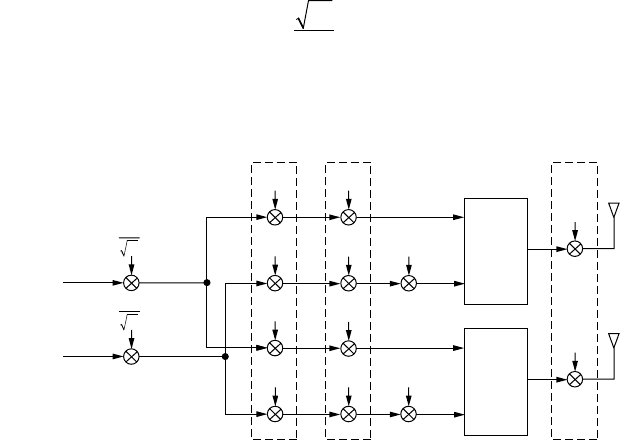
code. This is depicted in Figure 8.3, which shows the system model of
diversity MIMO for two transmit antennas. The received signal in k
th base
station antenna becomes
(8.1)
FIGURE 8.3
System model for diversity MIMO.
yt h t
P
M
StjS
k
im
M
mk
t
dm c
t
() () ()= +
=h
h
=
,,
¨¨
1
tx
,,
,,
{}
=
m
xm x x xm x
t
Stbi ctiT s
() ,
() [] ( )GI
dpcch
(),tiT
s
I
Spreading
1
2
c
d,1
s
dpch
s
dpch
I
Q
Q
I
j
j
β
d
β
c
Σ
Σ
β
d
β
c
c
c,1
c
d,2
c
c,2
DPDCH
DPCCH
Scaling Scrambling
1
2
4190_book.fm Page 218 Tuesday, February 21, 2006 9:14 AM

Multiuser MIMO for UTRA FDD
219
where the subscript x
{d
, c
}, refers to convolution with multipath channel
h
m,k
, and refers to chip-by-chip multiplication of user’s scrambling code
s
dpch
and channelization codes c
d,m
and c
c,m
of dedicated physical data channel
(DPDCH) and dedicated physical control channel (DPCCH), respectively.
Total transmit power is given by P
tx
, and power ratio between DPDCH and
DPCCH is adjusted by scaling factors G
d
and G
c
, and user’s transmitted bits
in DPDCH and DPCCH are denoted by b
d
and b
c
. Users are not synchronized
in uplink, and the delay is denoted by I
. Finally T
d
, T
c
, and T
s
refer to the
lengths of the two channelization codes and the scrambling code.
Each transmit antenna uses different channelization codes c
d,m
and c
c,m
so
that the base stations can separate the signals from different antennas and
later combine them using maximal ratio combining. Thus, the scheme dou-
bles the usage of uplink channelization codes when compared to single
antenna transmission. The achievable bit rate with diversity MIMO is at
maximum 2 Mbps/M
t
. This reduction of maximum bit rate could be partly
avoided by puncturing the applied error correcting codes, but information
MIMO provides a more attractive choice since the reduced code rate quite
rapidly destroys system performance. However, for low and medium bit
rate services, this does not present a problem.
We note that in the case of flat fading and perfect channel state information
in the receiver, the link performance of the proposed two-antenna diversity
MIMO algorithm is the same as with STTD, because the diversity order of
both schemes is two. However, the system utilizing orthogonal channeliza-
tion codes is more robust, because orthogonality of the received signals does
not depend on the channel estimation, as in the case of space–time coding.
8.4.1.2 Information MIMO
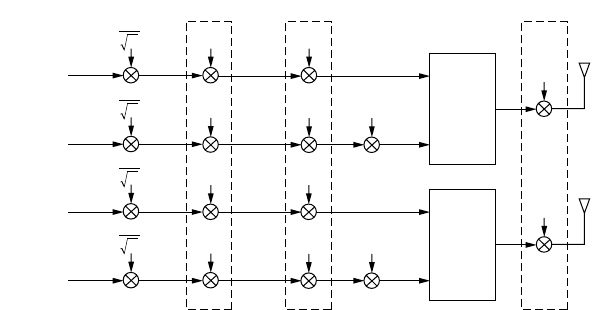
In the case of information MIMO of Figure 8.4, a composite data stream is
multiplexed into two or more independent substreams that are transmitted
from separate antennas by employing different scrambling codes. All streams
contain DPDCH and DPCCH so that in the base station they can be inter-
preted as signals from different independent users. The received wideband
signal in k
th antenna is given by
(8.2)
where again x
{d,c
}. We note that now information bits as well as scrambling
code chips vary between antennas. In contrast, the channelization code can
be the same in all antenna branches.
The present UTRA FDD specification allows the mobile to use only a single
scrambling code as well as a single DPCCH and DPDCH. For the proposed
yt h t
P
M
StjS
k
im
M
mk
t
dm c
t
() () ()= +
=h
h
=
,,
¨¨
1
tx
,,
,,
{}
=
m
xm xm x x x
t
Stbi ctiT s
() ,
() [] ( )GI
dpcch,
ms
tiT(),I
4190_book.fm Page 219 Tuesday, February 21, 2006 9:14 AM
220 MIMO System Technology for Wireless Communications
information MIMO, the specification should be changed such that the use
of multiple scrambling codes is allowed in the mobile end. Then, it would
be possible to independently apply DPCCH and DPDCH to each scrambling
code. This does not represent a big change to radio interface, because it only
requires that a single user can set up M
t
different links. For the effective use
of several simultaneous links, some new code puncturing sets would also
be needed.
8.4.1.3 Advanced Receiver Techniques
As mentioned before, UTRA FDD uplink is interference limited. The inter-
ference-limited nature of CDMA systems results from the receiver design:
the reception is typically based on a matched filter that does not take into
account multiple access interference (MAI). However, MAI arises in multi-
path channels or with asynchronous communications when spreading codes
do not usually stay completely orthogonal anymore. This limitation can be
relaxed by employing advanced multiuser receiver algorithms, which aim
to reduce MAI. Information MIMO increases MAI in the base station, and
therefore advanced receivers become important to the system performance
when implementing information MIMO techniques.
In order to avoid the overwhelming complexity of multiuser detection,
various suboptimal multiuser receivers have been developed to cope with
MAI. The multiuser receivers can be categorized in several ways. One pos-
sibility is to classify the receivers to linear (decorrelating detector, minimum
mean square error (MMSE) detector) and non-linear receivers. Subtractive
interference cancellation (IC) is one example of the latter category, which
first estimates the MAI component and then subtracts it from the received
signal to improve the reliability of the symbol decisions.
FIGURE 8.4
System model for information MIMO.
s
dpch,1
s
dpch,2
I
Q
I
Q
j
j
β
d
β
c
β
d
β
c
Σ
Σ
c
d
c
c
c
d
c
c
DPDCH
1
DPCCH
1
DPDCH
2
DPCCH
2
Spreading
Scaling Scrambling
1
2
1
2
1
2
1
2
4190_book.fm Page 220 Tuesday, February 21, 2006 9:14 AM

Multiuser MIMO for UTRA FDD
221
Cancellation of MAI can be carried out in parallel to all users, i.e., with
parallel interference cancellation (PIC) receivers, or in a serial fashion, i.e.,
using serial interference cancellation (SIC) receivers. In un-decoded (conven-
tional) PIC receivers, IC is based on tentative symbol decisions. The quality
of the tentative decisions is essential, because incorrect decisions increase
interference instead of decreasing it. In practice, the error rate of un-decoded
bits varies between 5 and 20% in UTRA FDD uplink. The error rate depends
mainly on the effective coding rate (i.e., rate of the channel encoder taking
into account possible repetition and puncturing), the radio environment, and
the quality of service requirements.
Unreliable tentative bit decisions compromise the performance of un-
decoded PIC. One possibility to improve the reliability of the decisions is to
first decode the received symbols, re-encode the decoded symbols again,
and finally subtract the contribution of the re-encoded symbols from the
received signal. For more details we refer to [17], where this kind of decoded
PIC is applied to the convolutionally coded CDMA system. In [18], this idea
is extended to the Turbo-coded CDMA system.
8.4.2 Uplink Load Equations
Load equations provide a useful tool in both initial planning and perfor-
mance analysis of the network. Here we briefly recall the load equations
[19,20] that will serve as a basis for further studies.
8.4.2.1 Basic Load Equations
In the following N
own
and N
other
refer to the number of own cell and other
cell users, respectively. The received wideband signal in baseband at time
instant t
can be expressed in the form
(8.3)
where n
(t
) is complex zero-mean Gaussian, y
n
(t
) is the interference from n
th
own cell user, and z
n
(t
) is the interference from n
th other cell user. The system
load can be estimated from the sum of received wideband powers of different
users. Signals from different users are mutually independent and from Equa-
tion 8.3 the received wideband power is given by
where E refers to expectation, P
N
is the noise power, and
rt y t z t nt
n
n
N
n
n
N
() () () (),=++
==
¨¨
11
own other
E
total own other
rt I I I P
N
() ,
2
{}
==++
4190_book.fm Page 221 Tuesday, February 21, 2006 9:14 AM

222 MIMO System Technology for Wireless Communications
Received energy per data bit divided by the noise spectral density is an
important variable in the analysis of UTRA FDD uplink. For user n
it is given
by
(8.4)
where refers to the received power and is the ratio between bit rate
and chip rate of user n
. In UTRA FDD uplink, fast power control tries to
keep E
n
at a target level. Therefore, changes in the interference do not reflect
to E
n
, as long as power control is able to compensate the increased interfer-
ence through P
rx,n
. From Equation 8.4 we easily find that
where is the load from the n
th user. For the received wideband power in
the own cell there holds
(8.5)
Furthermore, the total wideband power can be written in the form
(8.6)
where S
= I
other
/I
own
is the intercell to intracell interference ratio seen by the
base station receiver. After combining Equation 8.5 and Equation 8.6 and
solving I
total
from the resulting formula, we obtain the following expression
for the noise rise
(8.7)
where the sum term defines the own cell load M
. In UTRA FDD uplink, load
control drives noise rise to a target level. The more loading is allowed in the
IytI z
n
N
n
n
N
nown other
own other
EE=
{}
=
==
¨¨
1
2
1
() , (()t
2
{}
.
E
P
IP
n
n
n
n
=
,
,
1
P
rx
total rx
,
P
nrx,
P
n
P
E
E
II
n
nn
nn
nrx, total total
=
+
=:
P
P
M
1
,
M
n
IP I
n
n
N
n
n
N
own rx, total
own own
==
==
¨¨
11
M ·.
IIIP IP
NNtotal own other own
=++=+ +() ,1 S
µ SM== +
()
¨
I
P
N
n
N
total
n=1
own
11
1
(),
4190_book.fm Page 222 Tuesday, February 21, 2006 9:14 AM

Multiuser MIMO for UTRA FDD 223
system, the larger is the required interference margin max{µ} and the smaller
is the coverage area. Interference margin defines the maximum allowed noise
rise, and typically values 1.0 to 3.0 dB are used for coverage-limited cases
with 20 to 50% load, and in capacity-limited cases, higher interference mar-
gins up to 6 dB can be used [19].
8.4.2.2 Load Equations for MIMO
In diversity MIMO with Rake receiver, the load from the nth user is of the
form
where the superscript D refers to the diversity MIMO. Diversity MIMO
reduces the required energy per data bit and there holds
(8.8)
where the received energy per data bit in single antenna system E
n
is divided
by the number of receiver antennas, because Rake collects energy from M
r
independent antenna branches. Factor depends on the channel diversity
and system-related issues such as the accuracy of channel estimation. Only
in simple channels, such as single path and ITU Pedestrian A channels, may
the effect of be noticeable, while in more realistic channels, such as
ITU Vehicular A and ITU Pedestrian B, is round 0 dB. The ITU channel
profiles [21,22] are listed in Table 8.1.
In information MIMO with Rake, the uplink load of a single user is of the
form
(8.9)
where is the ratio between bit rate and chip rate of the mth data stream
and is the received energy per data bit divided by the noise spectral
TABLE 8.1
ITU Multipath Channel Profiles
Model Delay Profile [ns] Power Profile [dB]
Pedestrian A 0 110 190 410 0,9.7, 19.2, 22.8
Pedestrian B 0 200 800 1200 2300 3700 0, 0.9, 4.9, 8.0, 7.8, 23.9
Vehicular A 0 310 710 1090 1730 2510 0, 1, 9, 10, 15, 20
M
P
P
n
D
nn
D
nn
D
E
E
=
+1
,
EEM
n
D
MM n r
tr
=
,
I /,
I
MM
tr
,
I
MM
tr
,
I
MM
tr
,
M
P
P
n
I
m
M
nm nm
I
nm nm
I
t
E
E
=
+
=
,,
,,
¨
1
1
,
P
nm,
E
nm
I
,
4190_book.fm Page 223 Tuesday, February 21, 2006 9:14 AM