
Tsoulos George (ред.) MIMO System Technology for Wireless Communications
Подождите немного. Документ загружается.


234 MIMO System Technology for Wireless Communications
vector is a difficult non-convex optimization problem. All these multiuser
MIMO schemes assume perfect CSI at the transmitter. Under partial CSI as
in UTRA FDD, the performance of multiuser MIMO is still an open problem.
8.5.2 Proposed MIMO Algorithms within 3GPP Standardization
The standardization of MIMO for HSDPA is still ongoing, and many algo-
rithms have been proposed by different standardization bodies within 3GPP.
In the following, we briefly summarize the algorithms proposed so far; their
acronyms are presented in Table 8.4. All concepts adjust the modulation and
coding of independent substreams using CQI feedback, and D-BLAST-type
processing is not applied. In addition, some schemes employ space–time
coding and four transmit and two receive antennas to gain diversity and
improve link-level performance (DSTTD-SGRC and RC-MPD). Alternatively,
link performance is improved by linear precoding in the transmitter (SS CL
MIMO, PU
2
RC, S-PARC, D-TxAA).
The first two proposals, PARC and DSTTD-SGRC, are well documented,
but documentation on the other six algorithms is sparse. Therefore, we will
introduce them only briefly. A more detailed description and performance
analysis can be found in [10] and numerous standardization contributions
showing performance results for the algorithms of Table 8.4. However, there
is no widespread agreement concerning the ranking of the candidate algo-
rithms, and therefore, we refrain from comparing them here.
All proposals invariably increase the overhead of CSI feedback when com-
pared to HSDPA in Release 5. Multiple data streams require multiple CQIs,
and additional transmit antennas require additional CSI when compared to
2 × 1 MISO configuration supported in UTRA FDD Release 5. However,
reducing the overhead due to feedback signaling has been identified as one
of the goals in enhanced HSDPA [13]. Uplink interference due to feedback
signaling may cause problems, especially when the mobile is located on the
cell edge.
TABLE 8.4
Proposed MIMO Algorithms within
3GPP Standardization
MIMO Scheme
Space–Time
Coding
Linear
Precoding
PARC
DSTTD-SGRC ⻬
SS CL MIMO ⻬
RC-MPD ⻬
PU2 RC ⻬
TPRC for CD-SIG
S-PARC ⻬
D-TxAA ⻬
4190_book.fm Page 234 Tuesday, February 21, 2006 9:14 AM
Multiuser MIMO for UTRA FDD 235
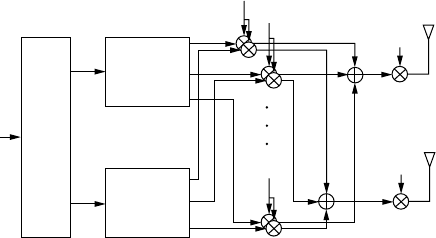
Per-Antenna Rate Control (PARC). Figure 8.7 shows a block diagram of
PARC architecture for two transmit antennas. The HS-DSCH data packet is
demultiplexed into two low-rate substreams. Both substreams are turbo
encoded, interleaved, and mapped to either QPSK or 16 QAM symbols. Code
rates and symbol mappings between the substreams may vary, and therefore
the number of information bits assigned to the streams can be different.
Furthermore, symbols in each spatial substream are divided into K subchan-
nels, where K is the maximum number of HS-PDSCHs defined by the UE
capability. After spreading these subchannels by different orthogonal spread-
ing codes (denoted by OSC 1-OSC K in Figure 8.7), the subchannels are
summed up and modulated by a scrambling code and are finally transmitted
from their designated antennas. Thus, PARC includes multiplexing in spatial
and code domains.
The base station selects data rates and corresponding modulation, coding,
and channelization codes for different antennas based on antenna-specific
CQI feedback. For this purpose, UE estimates SINR for all antennas, maps
SINR values to CQI values, and sends this information to the base station
through a feedback channel. The number of possible transport combinations
is large, and CQI must be quantized to avoid excessive feedback overhead.
In order to guarantee the performance of PARC at poor channel conditions,
the lower end of the CQI values should correspond to selective transmit
diversity (STD) transmission.
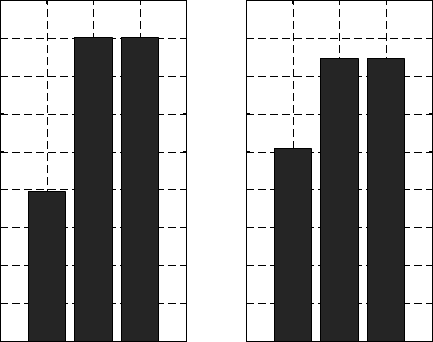
To emphasize the importance of STD feature for the PARC performance,
probabilities for dual stream and STD transmission for 2 × 2 PARC in a
macrocell environment are presented in Figure 8.8. Probabilities are pre-
sented both in ITU Pedestrian and Vehicular A channels. It should be noted
that the probability for the single stream transmission is as high as 75 to
80%. Moreover, Vehicular A has higher dual stream transmission probability
as it provides more multipath diversity than Pedestrian A.
Double STTD with Subgroup Rate Control (DSTTD-SGRC). This scheme
assumes that M
t
= 2M
r
. Transmit antennas are divided into M
r
two-antenna
subgroups that apply STTD and AMC. Both antennas within the subgroup
FIGURE 8.7
Transmitter structure for PARC.
Coding
interleaving
mapping
MCS 1
HS-DSCH
data stream
MCS 2
OSC K
OSC 2
SC
SC
OSC 1
Demux
Coding
interleaving
mapping
4190_book.fm Page 235 Tuesday, February 21, 2006 9:14 AM
236 MIMO System Technology for Wireless Communications
use the same modulation and coding scheme (MCS), but the data rates of
different groups can be adjusted independently or jointly by selecting a
suitable MCS. In WCDMA, the maximum number of transmit antennas is
expected to be four, and thus, at maximum, two independent data streams
can be transmitted.
DSTTD-SGRC is a natural extension to the conventional STTD supported
by UTRA FDD Release’99. While conventional STTD employs two transmit
antennas and a single data stream, DSTTD-SGRC doubles the number of
transmit antenna and data streams, provided that UE is equipped with at
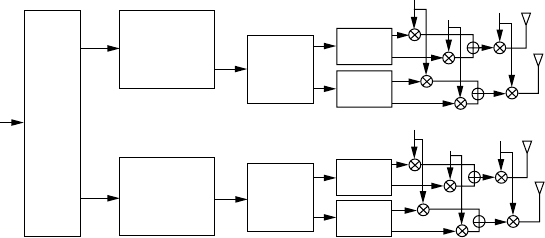
least two antennas. Figure 8.9 shows the structure of the DSTTD-SGRC with
four transmit antennas. The incoming HS-DSCH data are divided into two
substreams. Selected MCS and the number of orthogonal spreading codes
(OSC 1-OSC K) define the number of information bits allocated to each
substream. For both substreams, information bits are coded, interleaved, and
modulated according to the MCS scheme. After STTD encoding, the two
substreams are split into K parallel streams corresponding to K spreading
codes. In the last stage, streams are combined, scrambled, and transmitted.
Rate-Control Multipaths Diversity (RC-MPD). Here each data stream is trans-
mitted from at least two antennas, and the number of data streams is equal
to the number of transmit antennas. A pair of data streams that share the
same two antennas apply the same MCS. The basic idea is to transmit a
second copy of the signal after one chip delay by using the STTD encoding.
Hence, in the case of two transmit antennas, two data streams and corre-
sponding symbols s
1
and s
2
, the transmitted signal consists of symbols s
1
and
FIGURE 8.8
Stream distribution for 2–2 PARC in ITU Pedestrian A and Vehicular A channels. Round robin
scheduler is used and 70% of the total transmit power in the base station is allocated to
HS-DSCH.
1 & 2 1 2
0
5
10
15
20
25
30
35
40
45
VehA at 30 km/h
1 & 2 1 2
0
5
10
15
20
25
30
35
40
45
PedA at 3 km/h
4190_book.fm Page 236 Tuesday, February 21, 2006 9:14 AM
Multiuser MIMO for UTRA FDD 237
s
2
at time T and symbols and at time T + T
c
, where T
c
is the chip interval.
The aim of the method is to achieve multipath diversity that is orthogonal-
ized through STTD encoding.
Single Stream Closed-Loop MIMO (SS CL MIMO). This is a four-antenna
extension of the two-antenna closed-loop Mode 1 that is supported by UTRA
FDD Release’99. The scheme supports only a single data stream but requires
more CSI than Mode 1 due to additional transmit antennas.
Per-User Unitary Rate Control (PU
2
RC). This algorithm is based on the
singular value decomposition of the MIMO channels. Precoding in the trans-
mitter is based on the unitary matrix that is a combination of the selected
unitary basis vector from all UEs. The aim is to utilize multiuser diversity
on top of MIMO transmission.
Tx Power Ratio Control for Code Domain Successive Interference Cancellation
(TPRC for CD-SIC). Here the receiver applies code-domain SIC to suppress
the impact of code domain interference in addition to space–time interfer-
ence. System performance is further boosted by employing a code-domain
transmit power ratio control that requires additional feedback signaling.
Power control allocates different powers to different spreading codes accord-
ing to the order of successive interference cancellation in code domain.
Selective Per-Antenna Rate Control (S-PARC). The aim is to improve the per-
formance of conventional PARC by combining PARC with antenna selection.
Double Transmit Antenna Array (D-TxAA). Composite data stream is split
into two substreams and each substream is transmitted from two antennas
by applying either of the closed-loop methods in UTRA FDD Release’99.
Hence, the total number of transmit antennas is four.
8.5.3 Practical Considerations
The high speed downlink packet access in Release 5 contains several enhance-
ments to UTRA FDD downlink compared to earlier releases as discussed in
Section 8.1. MIMO concepts presented above show one possibility to further
FIGURE 8.9
Transmitter structure for DSTTD-SGRC.
Coding
interleaving
mapping
STTD
STTD
Demux
Demux
Demux
Demux
OSC 1
OSC K
SC
OSC 1
OSC K
SC
MCS 1
HS-DSCH
data stream
MCS 2
Demux
Coding
interleaving
mapping
s
2
s
1
4190_book.fm Page 237 Tuesday, February 21, 2006 9:14 AM
238 MIMO System Technology for Wireless Communications
improve the performance of HSDPA. Naturally, the improvement due to
MIMO has to be substantial when compared to the complexity of the imple-
mentation. We recall the most important requirements that should be taken
into account when evaluating different candidate MIMO techniques. In the
following, each paragraph starts with a direct quotation from [10].
MIMO proposals shall be comprehensive to include techniques for one, two, and
four antennas at both the base station and UE. Deploying multiple antennas in
the user equipment or base stations to support MIMO techniques is not
straightforward due to concerns of cost, implementation complexity, and
visual impact. This is especially true in the present mobile terminals, where
basic products with large production volumes may have, at most, two antennas.
Present macro base stations typically employ two or four antennas, and it is
expected that two-antenna base stations will dominate in number in the near
future.
For each proposal, the transmission techniques for the range of data rates from
low to high SIR shall be evaluated. This requirement is due to the fact that the
gain from information MIMO greatly depends on the SINR. For example, in
macrocell environments the operating SINR in HSDPA is less than 10 dB
most of the time. Therefore, practical performance differences between var-
ious diversity and information MIMO techniques are not great because the
differences become only significant at high SNR region.
Operation of the MIMO technique should be specified under a range of realistic
conditions. The requirement sparked the development of a new MIMO chan-
nel model for standardization purposes [47]. The model is a geometry-based
stochastic model, which replaced the earlier stochastic channel model [48,49].
Link-level simulations with the spatial channel model are only used for
calibration purposes, and system-level simulations are required to verify the
performance of MIMO proposals. Moreover, implementation un-idealities
should be taken into account when modeling realistic operation environments.
The MIMO technique shall have no significant negative impact on features avail-
able in earlier releases. This requirement makes the design of competitive four-
antenna MIMO algorithms difficult, because the present specification con-
tains only two primary common pilot channels. To support four-antenna
MIMO, a straightforward solution would be to define two additional primary
common pilot channels. However, since the total transmit power in the base
station cannot increase — otherwise the base station would generate more
interference to the network — the transmit power per antenna should be
halved. Legacy UEs can receive only two common pilot channels so that, in
case of a four-antenna cell, they would be able to gather only half of the
pilot power when compared to a two-antenna cell. This would seriously
limit the coverage and service availability within the four-antenna cell.
MIMO techniques should demonstrate significant incremental gain over the best
performing systems supported in the current release with reasonable complexity.
Theoretical capacity curves suggest that information MIMO may give
remarkable gains when compared to diversity MIMO. It has been observed,
4190_book.fm Page 238 Tuesday, February 21, 2006 9:14 AM
Multiuser MIMO for UTRA FDD 239
however, that with two transmit and receive antennas, practical gains from
information MIMO can be small [50]. Increasing the number of antennas
increases the gain of information MIMO, but at the same time, the imple-
mentation complexity grows rapidly, and backward compatibility, such as
the pilot design problem, becomes an issue.
The focus shall be on strengthening the UTRA system as a reliable and cost-
effective access technique in urban and suburban areas. This means that the goal
is to increase the number of users, and/or to increase their coverage com-
pared to earlier releases. In other words, the improvement of the service
availability as compared to earlier releases shall be used as a primary evaluation
criterion. The increase in maximum data rate per cell is also of interest. In
WCDMA downlink, capacity and coverage are highly interdependent. Mul-
tiple intracell users, which share the same transmit power resource, interfere
with each other. In general, the system can support more users at low power
than at high power, and the availability of services in a cell depends on
required transmit powers. This requirement suggests that instead of increas-
ing data rates with parallel multiplexing, multiple transceiver antennas
should be used for diversity or beamforming to improve the quality of the
received signal.
8.5.4 Multiuser Beamforming
In this section we present a concept that fulfills the requirements cited in the
previous section without additional feedback overhead or receiver complex-
ity when compared to WCDMA Release 5. This can be accomplished by
utilizing the existing closed-loop modes and CQI feedback in UTRA FDD
together with physical layer scheduling.
UTRA FDD two-antenna closed-loop modes [51] aim to maximize the
received SNR by signaling transmit weights from UE to BS. Due to the
limited overhead of the feedback channel, the transmit weights must be
quantized. Mathematical formulation of the problem for finding the optimal
transmit weight w
0
is given by
where and in the presence of flat
fading consists of complex impulse responses corresponding to
the first and the second channel. It can be assumed without loss of generality
that w
1
is real. Therefore, the solution can be characterized by a single
complex coefficient and
Find wWhw hw
wW
00
:=
max ,
Ww w= = :|| ||= {(,) , },ww ww C
T
12 12
1and
h =,()hh
12
wze
j
2
=
K
(,) argmax [ ] [ )zzhzehz
j
KKU
K
= +: ,, ,10102
2
12
2
¯¯
°
±
²
¿
À
Á
²
.
4190_book.fm Page 239 Tuesday, February 21, 2006 9:14 AM
240 MIMO System Technology for Wireless Communications
With UTRA FDD closed-loop Mode 1 and Mode 2, the feedback weights
are quantized to follow a time-varying QPSK and 16-QAM signal constella-
tion, respectively.
Assume now that the base station transmits to two users simultaneously
employing either of the present closed-loop modes, and let the channeliza-
tion and scrambling codes be the same for both users. Such assumptions are
reasonable in HSDPA, where the shortage of channelization codes puts strict
limits on the cell throughput. After despreading, the received signals of the
two users become
where r
i
is the received signal of user i and is the impulse
response vector between the transmitter and the user i, w
i
is the transmit
weight vector requested by user i, s
i
is the transmitted symbol, and n
i
is the
noise term.
Mutual interference between simultaneously scheduled users that use the
same channelization code can be suppressed by selecting users i and j in
such a way that their transmit weights are orthogonal, i.e., . Now
the expectation L
i,i
for the desired power of user i, (i {1,2}) is given by
(8.23)
and the expected undesired interference powers between the users are
Moreover, assuming that the channels corresponding to separate users are
uncorrelated, we find that
(8.24)
When the base station transmits with a fixed power, as in HSDPA, the
expectation of Equation 8.25 vanishes due to orthogonal transmit weights.
Computation of SIR can be carried out provided that the expectations of
Equation 8.23 and Equation 8.24 can be evaluated. This can be done by
rssn
rssn
11111221
22112222
=++
=++
hw hw
hw hw
,
,
h
iii
hh=,
,,
()
12
ww
ij
†
= 0
L
ii i i i,
¯
°
²
±
²
¿
À
²
Á
²
== :
{}
{}
EEhw hw w W
22
max
L
L
12 1 2
2
1
2
21
,
¯
°
²
±
²
¿
À
²
Á
²
,
== :
{}
{}
EEhw hw w Wmin ,
=== :
{}
{}
.
¯
°
²
±
²
¿
À
²
Á
²
EEhw hw w W
21
2
2
2
min
EE()
†
hw hw
11 12 1121 11
2
¯
°
±
¿
À
Á
,
,,
¯
°
²
±
²
¿
À
²
Á
= ww h
²²
,
,,
¯
°
²
±
²
¿
À
²
Á
²
+.ww h
12 22 21
2
E
4190_book.fm Page 240 Tuesday, February 21, 2006 9:14 AM

Multiuser MIMO for UTRA FDD 241
following the method of [52], and in the case of Rayleigh fading, the resulting
SIR values corresponding to Mode 1 and Mode 2 are given by
Performance of the proposed multiuser beamforming (MUB) technique is
simulated with a quasi-static system level simulator assuming UTRA FDD
closed-loop Mode 1. Average throughput per sector is used as a performance
measure and 2 × 2 PARC provides a reference case. The simulation param-
eters are listed in Table 8.5. The primary user is chosen by using a round
robin (RR) scheduler, which does not take into account CSI. The secondary
user with the same spreading code and orthogonal transmit weight vector
is chosen by either RR or max SINR scheduler. If there is no user having
orthogonal transmit weights with the primary user, full HS-DSCH power is
allocated to the primary user. Otherwise, HS-DSCH power is evenly divided
between the primary and the secondary user. Thus, the proposed scheduling
is a simple extension of the conventional RR providing a fair share of trans-
mission resources to primary users in a RR fashion while additional
resources are given to secondary users depending on the orthogonality of
transmit weights.
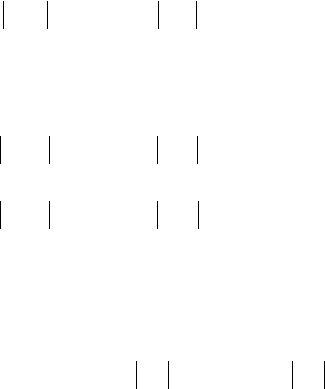
The average sector throughput values in Pedestrian A channel are pre-
sented in Figure 8.10. When the secondary user is scheduled by using RR
scheduler (legend “MUB, RR”), the gain in throughput over single-user
transmission is approximately 40%, whereas for max SINR scheduling (leg-
end “MUB, max SINR”) the gain is 70%. Multiuser beamforming with RR
scheduler provides almost the same average sector throughput as 2 × 2
PARC, whereas with max SINR scheduler MUB provides 15% better average
sector throughput than PARC. We emphasize that the MUB schemes employ
only one receive antenna in UE. It has been shown that the performance of
the MUB can be further improved by slightly modifying the calculation
of CQI in user equipment [53]. However, here the simulations assume that
TABLE 8.5
Simulation Assumptions
Site-to-site distance 2.8 km
Pathloss model 3GPP UMTS
Number of sectors Three/cell
Power delay profile ITU Pedestrian A, ITU Vehicular A
Number of HS-DSCH codes 10
MCS set {QPSK (1/2), QPSK (3/4), 16QAM (1/2),16QAM (3/4)}
Receiver Time-domain LMMSE equalizer
Power of HS-DSCH 70% of the total BS power
Power of overhead channels 30% of the total BS power
Feedback delay 1 slot
Feedback error rate 4%
SIR
dB for Mode
d
===
.
.
,
,
,
,
L
L
L
L
11
12
22
21
765 1
13 5 BB for Mode 2
¯
°
±
²
4190_book.fm Page 241 Tuesday, February 21, 2006 9:14 AM
242 MIMO System Technology for Wireless Communications
UEs are perfectly backward compatible to earlier UTRA FDD releases and
CQI calculation is not altered.
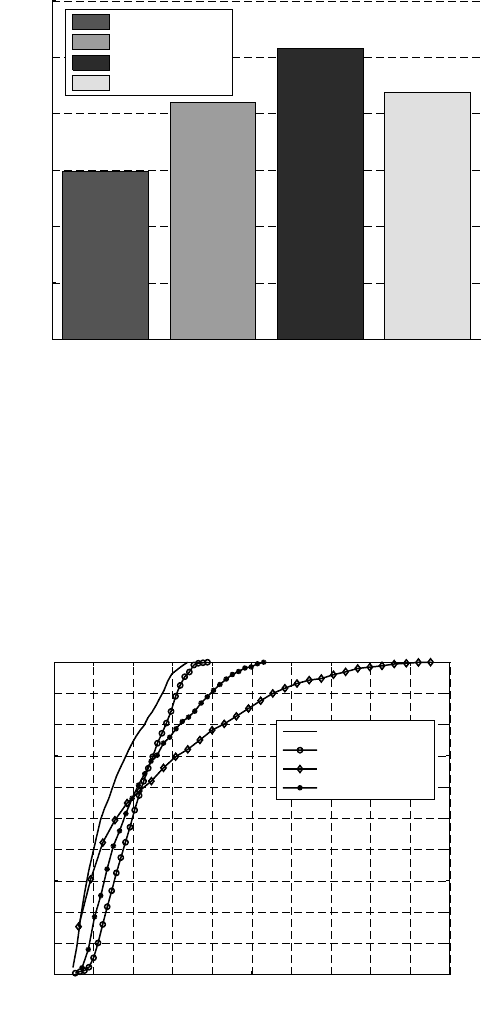
Cumulative distribution functions (CDF) for user throughputs are pre-
sented in Figure 8.11. For MUB with RR scheduler, the shape of the distri-
bution is maintained but the distribution is shifted to the right when
compared to the single-user distribution. The shape of the distribution of
MUB with max SINR scheduling is less steep than the CDF of MUB with
FIGURE 8.10
Average sector throughputs in ITU Pedestrian A channel with 3 km/h mobile speed.
FIGURE 8.11
User throughput CDFs, ITU Pedestrian A channel with 3 km/h mobile speed.
0
1000
2000
3000
4000
5000
6000
Scheme
roughput
(
kbps/sector)
Avg sector t
h
roug
h
put in ITU Pe
d
A at 3
k
m/
h
CL Mode 1
MUB, RR
MUB, max SINR
2 × 2 PARC
0 100 200 300 400 500 600 700 800 900 1000
0
0.1
0.2
0.3
0.4
0.5
0.6
0.7
0.8
0.9
1
roughput(kbps)
Cumu
l
ative pro
b
a
b
i
l
ity
CDF for throughput in ITU pedA at 3 km/h
CL Mode 1
MUB, RR
MUB, max SINR
2 × 2 PARC
4190_book.fm Page 242 Tuesday, February 21, 2006 9:14 AM
Multiuser MIMO for UTRA FDD 243
RR scheduling. Multiuser beamforming with max SINR scheduling increases
the probability of serving good users when compared to MUB with RR,
which explains the higher rates. On the other hand, users with a low SINR
are only scheduled as primary users in MUB with max SNR scheduling,
whereas MUB with RR schedules weak users as primary and secondary
users alike. This explains the shape of the CDF at low data rates. When
comparing the average user throughput CDFs of MUB against the PARC,
we note that MUB with RR provides best average user bit rates for users in
poor channel conditions, whereas PARC provides better average bit rates for
users in good channel conditions than MUB with RR scheduler. The max
SINR scheduler provides clearly the best average bit rates, but on the other
hand, it also provides the smallest average bit rates for the users in poor
channel conditions.
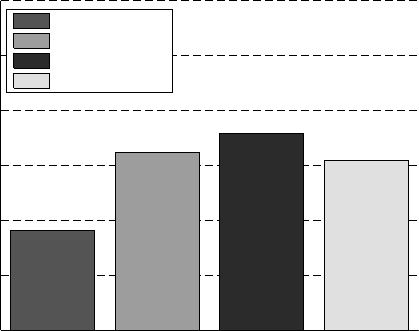
Average sector throughputs in ITU Vehicular A channel at 30 km/h are
presented in Figure 8.12, and the corresponding CDFs for average user
throughputs are shown in Figure 8.13. Comparing the results in Pedestrian
A and in Vehicular A channels reveals the following differences: First, the
average sector throughputs in Vehicular A channel are smaller than in Pedes-
trian A channel for all simulated schemes. For the closed-loop Mode 1 and
the MUB schemes the reduced throughputs are explained by reduced beam-
forming gains. For PARC the performance reduction is due to the interference
between the streams, which increases in multipath channels. Second, in Vehic-
ular A channel MUB with RR scheduler outperforms PARC, while the oppo-
site is true in Pedestrian A channel. This is due to the increase in interference
between users and substreams, the increment being larger for PARC than for
MUB. This is based on the fact that MUB minimizes the interference between
FIGURE 8.12
Average sector throughputs in ITU Vehicular A channel with 30 km/h mobile speed.
0
1000
2000
3000
4000
5000
6000
Scheme
roughput (kbps/sector)
Avg sector t
h
roug
h
put in ITU Ve
h
A at 30
k
m/
h
CL Mode 1
MUB, RR
MUB, max SINR
2 × 2 PARC
4190_book.fm Page 243 Tuesday, February 21, 2006 9:14 AM