
Tsoulos George (ред.) MIMO System Technology for Wireless Communications
Подождите немного. Документ загружается.

254 MIMO System Technology for Wireless Communications
the bandwidth (BW)
, efficiency (M
),
and the volume of small size antennas
is given by
(9.2)
where Q
is the minimum radiation quality factor of the antenna, which
increases by the reduction in antenna volume. From this formula, one can
conclude that there is a compromise between the maximum realizable per-
formances, i.e., bandwidth and efficiency, and the given electrical dimensions
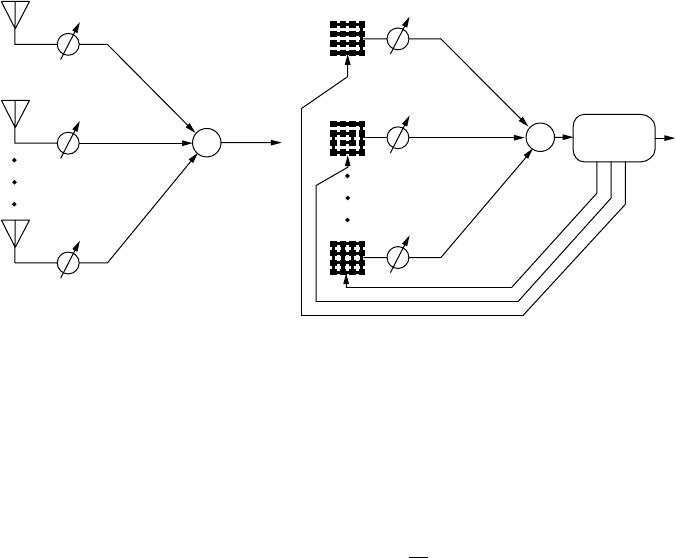
of small size antenna. The concept of RF MEMS integrated MRA is a revo-
lutionary approach to circumventing the performance limitations of small
size antennas by taking advantage of combined multiple functions in one
single antenna. An MRA combines multiple functions in one single antenna
architecture with the capability of altering its radiation, polarization, and
frequency characteristics. Thus, for given antenna performance characteris-
tics an MRA will occupy
only a small fraction of the space required by single-
function multiple antenna elements.
9.2.2 Links among Transmission Algorithms, Antenna Properties,
and Propagation Environment
In this section, we identify relationships among the transmission algorithms,
the radiation/polarization characteristics, and the configuration of the recon-
figurable antenna, and the propagation environment. These relationships
FIGURE 9.2
Block diagrams of (a) conventional and (b) MRA arrays.
Σ
Antenna 1
Antenna 2
Antenna M
Output
signal
(a) (b)
Σ
Recon
fi
gura
bl
e
antenna 1
Reconfigurable
antenna 2
Reconfigurable
antenna M
Processing
unit
BW k a
Q
× % ×
()
%M
3
1
4190_book.fm Page 254 Tuesday, February 7, 2006 12:44 PM
Multifunctional Reconfigurable Microelectromechanical Systems
255
enable the joint adjustment of the characteristics of the reconfigurable
antenna array and the coding schemes over varying channel conditions to
optimize performances at all times.
1. Number of antenna elements:
The most basic relationship, which does
not require reconfigurability in the geometrical domain of the mul-
tiple antennas, relates the number of antenna elements to a specific
transmission algorithm. For multiple antennas, if the number of
transmit antennas is larger than two, then it is not possible to design
orthogonal space–time block codes (STBCs) [7]. In case of more than
two antennas, recently developed quasi-orthogonal STBCs are used
to achieve full rate and full diversity at the expense of slight increase
in decoding complexity [8]. For high SNRs and very large number
of antennas SM is favorable over STBCs, since the data rate of SM
increases linearly with an increasing number of antennas, while the
diversity gain of STBC will saturate.
2. Array configuration and polarization:
Besides the number of antenna
elements, the subset of the elements selected in an array configura-
tion is an important factor to achieve the majority of the capacity
available in the channel [9]. This does not only improve performance
but also results in a less complex MIMO system as the number of
the transmit and receive RF chains are reduced. The performance
can be further enhanced if the polarizations of the elements are also
taken into account as the propagation of the electric field for different
polarizations differs depending on the environment. It has been
shown experimentally that for a line-of-sight (LOS) indoor environ-
ment, vertically polarized systems achieve higher capacity than hor-
izontally polarized ones [10]. Moreover, an antenna array with
hybrid polarization (i.e., some elements are vertically polarized
while others are horizontally polarized) performs better than single
polarization systems for both LOS and non-LOS (NLOS) conditions.
In practical communication scenarios, degenerate channel phenomena
called the keyhole channel effect
may arise where the antenna elements both
at the receiver and the transmitter have very low correlation due to rich
scattering, but the channel matrix has a very low rank, resulting in a single
mode of communication [11]. This shows that low correlation itself is not a
guarantee for achieving high capacity. It is shown in [11] that in an outdoor
propagation scenario, the keyhole problem may be avoided by using a hor-
izontally oriented transmitter array instead of a vertically oriented array. As
a consequence, both the array configuration and the polarization of each
individual element need to be adaptive in order to maintain the channel
performance over varying characteristics of the propagation environment.
A reconfigurable antenna array that can change its configuration and polar-
ization has the characteristics necessary to adapt variable transmission/
receiving environments.
4190_book.fm Page 255 Tuesday, February 7, 2006 12:44 PM
256 MIMO System Technology for Wireless Communications
1. Spatial and polarization antenna diversity:
A compromise between data
rate maximization and diversity maximization (i.e., choosing
between SM and STC) is critical in realizing MIMO gains, since the
performance of these signaling strategies is strongly dependent on
time-varying channel characteristics. As is known, SM performs par-
ticularly well in high SNR regions, while STBC has better perfor-
mance in a low SNR region. It is shown in [12] that, while having
multiple linear polarization diversity antennas at both ends of the
link degrades the performance of STBC from that of spatial diversity,
significant improvements in the symbol error rate for a SM scheme
are achieved in certain channel conditions such as in environments
with high scattering density and with a high K
-factor. This leads to
an important conclusion: A reconfigurable antenna array that can
readily switch between polarization and spatial diversity schemes
is needed to optimize an antenna performance for a given coding
scheme (i.e., SM or STBC) in a given channel environment.
2. Beamforming
, MIMO with STC
: When only the receiver knows the
channel, STC achieves the maximum diversity in a system with
multiple transmit antennas. On the other hand, if the transmitter
knows the channel perfectly, beamforming
is the optimal solution.
In some practical cases, the transmitter has some information about
the channel (e.g., the mean or variance) instead of a perfect knowl-
edge. When side information is available at the transmitter, it can
be exploited to enhance the performance. Even when the channel
information is based on poor channel estimation, its use improves
the performance of the system in combating fading. The improve-
ment can be achieved by combining STC and beamforming. Typi-
cally, when the quality of the channel feedback is high, the diversity
rank is less critical and the transmitter should lay most energy on
the “good” beam. On the other hand, when the feedback is unreli-
able, we should rely more on diversity and distribute energy evenly
among different beams. In the extreme case when the channel feed-
back quality is so poor it is entirely independent of the actual situa-
tion, the system becomes an open loop system and the beamforming
scheme should gradually fall back to nonbeamformed traditional
space–time coding. Therefore, the performance of the scheme should
be similar to that of the original space–time code. This requires the
design of an adaptive system that can utilize the partial available
channel information to change its behavior and provide the optimal
performance in all cases [13,14]. Such an adaptive system should
converge to space–time coding when the transmitter does not know
the channel at all and to beamforming when the transmitter knows the
channel perfectly. Performance can be improved further if the opti-
mal array design is employed simultaneously. While antenna elements
are closely spaced and correlated in beamforming arrays, MIMO
4190_book.fm Page 256 Tuesday, February 7, 2006 12:44 PM

Multifunctional Reconfigurable Microelectromechanical Systems
257
systems employing STCs require large antenna spacing for uncorre-
lated antennas. It is also important to note that beamforming is more
effective if the propagation environment has low scattering density
(i.e., LOS or near LOS) resulting in fewer multipaths. Weight selec-
tion algorithms can be more easily optimized for a few multipaths
than for many. In contrast, STCs take advantage of the multipath
richness by maximizing data rate or diversity. Variation in antenna
element separation is achieved by employing MRA instead of anten-
nas with fixed properties.
9.3 RF MEMS Technology Compatible with Microwave
Laminates for Fabricating MRAs
As indicated earlier, MEMS technology is gaining a greater foothold in many
existing applications, such as RF wireless communications, biomedical, and
optical, to name a few; at the same time, it is finding new applications such
as fuel cells and power generators. In particular, RF MEMS have had a
significant impact due to their potential to revolutionize RF and microwave
system implementation for the next generation of communication applica-
tions. One of the first impacts of RF MEMS was single MEMS switches [15]
with their excellent switching characteristics — very low insertion loss, very
low power requirements, and high isolation —which cannot be attained by
semiconductor switches. The true potential of RF MEMS goes beyond a
single switch. The key advantage of RF MEMS can be realized by system-
level implementation through monolithic integration capability with other
circuit components. This capability is key, in particular, for creating multi-
functional reconfigurable antenna systems employing a large number of RF
MEMS components and/or operating at high frequencies. Although RF MEMS
devices on semiconductor substrates (tunable RF matching circuits/filters,
variable capacitors, phase shifters, switches) have been demonstrated
[16–19], realization of monolithically integrated RF MEMS antenna systems
requires common substrate housing of both MEMS and antennas. Microwave
laminate printed circuit boards (PCBs) are commonly used for the design of
RF circuits and antennas and represent an ideal substrate for RF MEMS
device integration. However, PCB processing has been historically difficult
due to the process limitations imposed by PCBs, such as low temperatures
and non-planar surfaces. In order to overcome these problems, we recently
developed an RF MEMS technology compatible with microwave laminate
PCBs that overcomes the drawbacks of the silicon-based MEMS technology
in establishing reconfigurable antennas with low cost and high performance.
The details of PCB compatible RF MEMS technology and associated fabri-
cation processes are beyond the scope of this chapter and can be found in
4190_book.fm Page 257 Tuesday, February 7, 2006 12:44 PM

258 MIMO System Technology for Wireless Communications
references [2,3,20]. The main advantage of this technology lies in allowing
the monolithic integration of the antenna and the switches
on the same
substrate as part of the same lithographic process. This approach eliminates
the need for wire bonds to be interconnected to the RF MEMS switches, thus
simplifying the matching circuit as well, while reducing the switch parasitics.
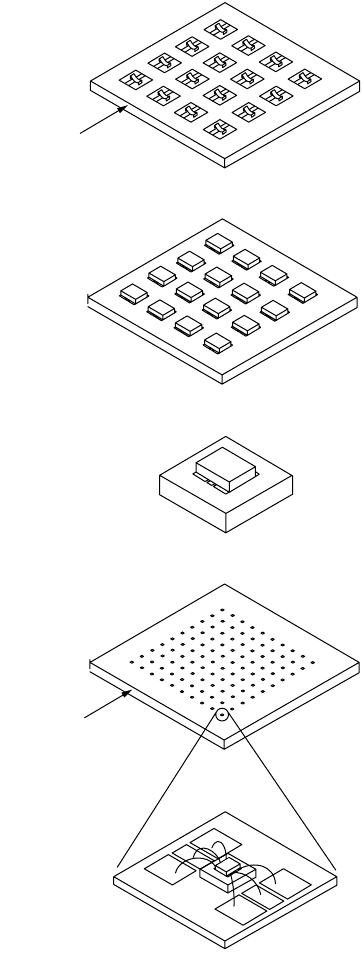
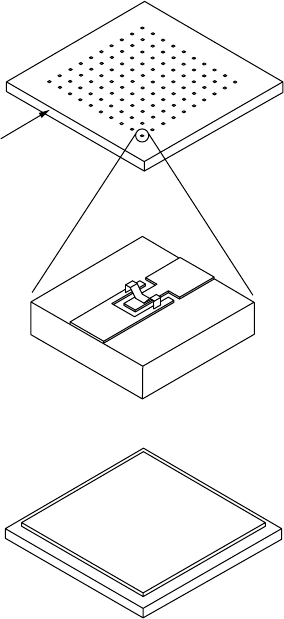
Figures 9.3 and 9.4 compare two MRA systems realized by silicon-based and
microwave laminate compatible RF MEMS technologies in terms of com-
plexity, cost, and performance. It is obvious from these figures that the latter
technology provides higher performance, less complexity, and low cost com-
pared to the former technology.
9.4 RF MEMS Integrated Antennas
In this section, the design, microfabrication, and results of two different RF
MEMS integrated antennas will be presented. The first design is a multi-
element selection diversity antenna (i.e., cactus antenna) in which RF MEMS
actuators are monolithically integrated with antenna feed lines to selectively
route the RF feed signal. In the second design, RF MEMS actuators are
integrated within the geometrical structure of the antenna to construct a
multifunctional reconfigurable spiral antenna capable of dynamically chang-
ing its polarization between right-hand and left-hand circular polarizations.
9.4.1 Three-Element Selection Diversity Antenna
We first designed a single antenna, which will henceforth be referred to as
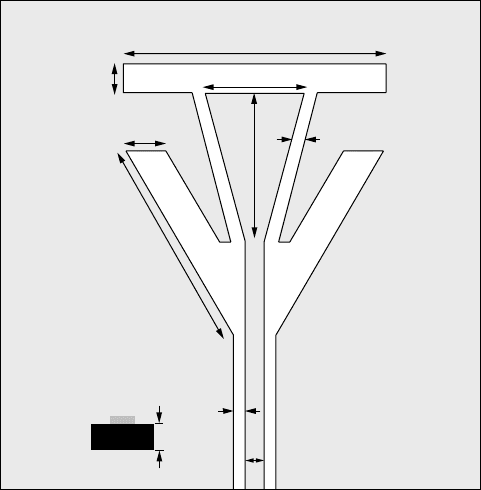
the cactus antenna. The geometry of the cactus is depicted in Figure 9.5. It
consists of two half-wavelength inductively coupled coplanar waveguide
(CPW) slots combined with the half-wavelength capacitively coupled slot
antenna, which is fed through a triangular-shaped half-wavelength CPW strip.
The inductively coupled slots are bent upward for compactness, necessary
in multi-element antenna systems. This structure produces three different
resonant frequencies, f
r
1
, f
r
2
, and f
r
3
, defined by the lengths of the two slots
(L
1
, L
2
) and the triangular-shaped CPW line (L
3
), respectively (see Figure 9.5).
These lengths are determined based on the half-wavelength resonance cri-
terion and are approximately calculated using Equation 9.3. By optimizing
L
1
, L
2
, and L
3
in conjunction with other design parameters (see Figure 9.5),
resonant frequencies of f
r
1
, f
r
2
, and f
r
3
are located such that the cactus antenna
possesses 42% impedance bandwidth for a voltage standing wave ratio
(VSWR) of 2.
; 0.8 f
P
i
f
1, i
= 1, 2, 3 (9.3)L
c
f
i
i
reff ri
=
P
J2
4190_book.fm Page 258 Tuesday, February 7, 2006 12:44 PM
Multifunctional Reconfigurable Microelectromechanical Systems
259
FIGURE 9.3
Process flows for silicon-based RF MEMS technology for realizing MRA systems, (a) Fabrication
of MEMS switches on a semiconductor, (b) Packaging individual MEMS switches, (c) Dicing,
(d) Assembling MEMS and antenna elements through wire bonding (or flip-chip) on PCB to
construct the MRA.
Semiconductor
substrate (Si, GaAs, etc.)
(a)
(b)
(c)
(d)
PCB substrate
4190_book.fm Page 259 Tuesday, February 7, 2006 12:44 PM
260 MIMO System Technology for Wireless Communications
In Equation 9.3, c
is the speed of light in free space and J
reff
represents the
effective dielectric constant of the dielectric supporting material. P
i
is a coef-
ficient and ranges from 0.8 to 1 [21].
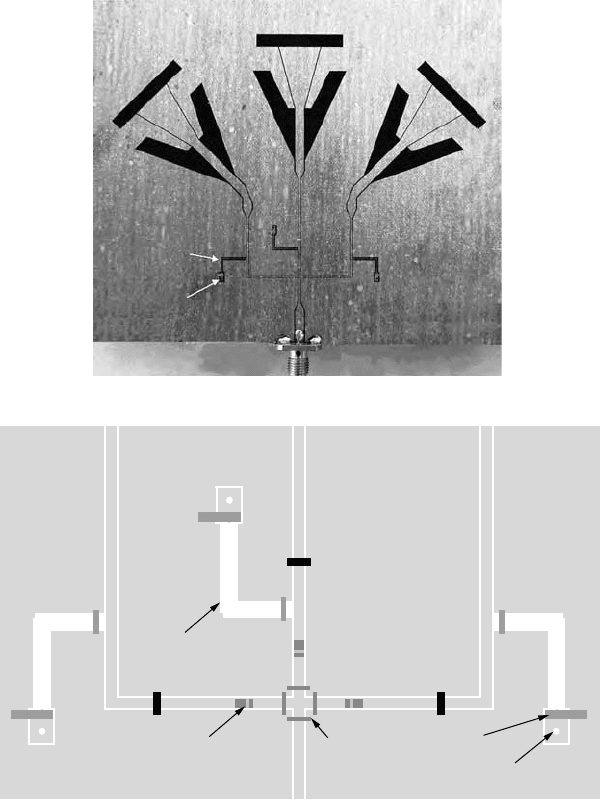
Next, a three-element selection diversity cactus antenna with RF MEMS
switches monolithically integrated on CPW feed network is fabricated on
RT/Duroid 5870 (see Figure 9.6). This material is particularly suitable for
antenna applications due to its low dielectric constant and low loss property
in the desired frequency range (J
r
= 2.33, tanI
= 0.0005 @ 5 GHz) [22]. The
switches used are capacitive and have a structure similar to those previously
published [15].
Three RF MEMS switches located on the CPW feed, single-pole three-
throw switch (SP3T), route the input to one of the branches in order to
maximize the signal-to-noise-ratio (SNR) of the diversity signal at the receiver
FIGURE 9.4
Process flows for microwave laminate compatible RF MEMS technology for realizing MRA
systems, (a) Fabrication of monolithically integrated MEMS antenna on PCB, (b) System level
packaging.
(b)
(a)
PCB substrate
4190_book.fm Page 260 Tuesday, February 7, 2006 12:44 PM
Multifunctional Reconfigurable Microelectromechanical Systems
261
(see Figure 9.6b). The distances from the centers of switches to the cross-
junction are designed to be quarter-wavelength in the substrate at the center
design frequency of 5 GHz. Thus, at the center frequency, the diversity
branch with switch in the down position is transformed into an open circuit
at the cross-junction due to the quarter-wave transmission line. This mechanism
slightly narrows the impedance bandwidth of the antenna since the signal
propagating on the selected diversity branch sees two quarter-wavelength
open transmission lines of the two disconnected diversity branches at the
junction. High impedance quarter-wavelength lines using the same concept
are utilized to actuate the switches. In this case, the bandwidth degradation
is very small due to the combined effect of the quarter-wave line and high
impedance of the line. In the current design, a bias voltage of 40V is required
to actuate the switch. Three metal-insulator-metal (MIM) capacitors located
on the CPW line are employed to decouple the RF signal path from the bias
voltage. Air bridges are used to ensure the continuity in the CPW ground
planes and to suppress possible slotline modes excited at the junctions. The
fabrication of air bridges, as well as MIM capacitors, is compatible with the
monolithic process.
The fabrication procedures of the cactus antenna integrated with RF MEMS
switches and that of the MRA that will be presented in the next section are
very similar. Therefore, only a brief summary of the fabrication process is
FIGURE 9.5
Top view of the CPW-fed antenna geometry and dimensions in mm. L
2
= 25, W
2
= 3.5, L
1
=
28.6, W
1
= 4.8, L
3
= 18, L = 12, S = 0.15, G = 0.25, W = 2.6, D = 15, h = 1.52, F: orientation angle.
h
ε
r
W
2
L
2
W
1
S
L
3
L
1
G
W
L
4190_book.fm Page 261 Tuesday, February 7, 2006 12:44 PM
262 MIMO System Technology for Wireless Communications
given here. The process starts with standard via hole formation for switch
biasing. Ease of via layout is an advantage of this process over existing
technologies, where deep vertical vias are normally difficult to form. Via
holes through the substrate connect the central electrode of each switch to
the bias line placed on the backside of the antenna. This separation does not
only create a space for multiple antennas but also helps increase the isolation
FIGURE 9.6
(a) Photograph of the selection diversity cactus antenna integrated with RF MEMS switches;
S1, S2, S3 are RF MEMS switches; A1, A2, A3 are cactus antennas; (b) Schematic of the feeding
structure, single-pole-three-throw switch (SP3T).
S1
S3
MIM capacitor
Air bridge
Bias via hole
MIM capacitor
Bias line
S2
(b)
(a)
Bias line
S2
A2
A1
A3
S1 S3
Bias via hole
4190_book.fm Page 262 Tuesday, February 7, 2006 12:44 PM
Multifunctional Reconfigurable Microelectromechanical Systems 263
between antenna elements and biasing circuit. This, in particular, is an impor-
tant advantage as the circuit complexity and the number of switches increase.
Next, antennas and all feed lines are formed by a simple wet etch process.
Finally, MEMS switches, MIM capacitors, and air bridges are monolithically
fabricated.
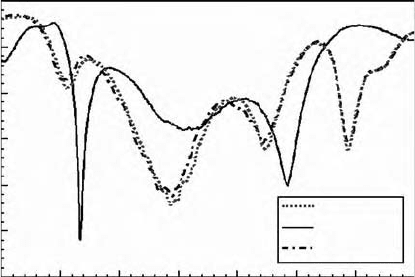
Results are presented in the following figures. Figure 9.7 shows the return
losses of each switched antenna. As mentioned earlier, the two quarter-
wavelength lines narrow the input impedance bandwidth of the cactus
antenna from its original 42% to 30%. However, the covered bandwidth is
still very large for most wireless local area network (WLAN) applications.
Figure 9.8 illustrates the measured x-y plane co-polar radiation patterns at
the center design frequency of 5 GHz, normalized with respect to the same
reference, corresponding to the sequential and individual activation of each
antenna. As a result of the inter-element 45° rotation angle, radiation patterns
with 45° rotation are clearly distinguished in the figure. Appropriate activa-
tion leads to angular or polarization discrimination of the signal of interest
in multipath scenarios. For example, the axis of the active element can be
oriented to the direction of strong interference.
9.4.2 Multifunctional Reconfigurable Spiral Antenna
9.4.2.1 Antenna Structure and Operational Mechanism
In the three-element cactus antenna design the role of RF MEMS switches,
which are located on antenna feed lines, are limited to selectively routing
the RF feed signal. In this design, a number of RF MEMS actuators are
monolithically integrated within the geometrical structure of the antenna to
construct a multifunctional reconfigurable spiral antenna (MRSA). In other
FIGURE 9.7
Measured return loss of individual selected cactus antenna.
0
3.5 4 4.5 5
Frequency(GHz)
5.5 6
Antenna 1
Antenna 2
Return loss(dB)
Antenna 3
6.5 7
−5
−10
−15
−20
−25
−35
4190_book.fm Page 263 Tuesday, February 7, 2006 12:44 PM