
Velten K. Mathematical Modeling and Simulation: Introduction for Scientists and Engineers
Подождите немного. Документ загружается.


1.5 Examples and Some More Definitions 25
AB C D
S
1
2.5 8.2 6.4 12.7
S
2
3.2 15.1 13.2 0.4
S
3
1.1 0.9 2.2 3.1
What is the concentration of S
3
in a mixture of these fluids that contains 75%
(percent by volume) of fluids A and B and which contains 4 gl
−1
and 5 gl
−1
of
the substances S
1
and S
2
, respectively?
Referring to step 1 and step 2 of the three-step procedure described in Note
1.5.7, it is obvious that we have only one unknown here which can be defined as
follows:
•
x: concentration of S
3
in the mixture (grams per liter)
Now step 3 requires us to write down mathematical statements involving x .
According to Note 1.5.9, we need to look for statements in the above problem
formulation that impose a restriction on the unknown x. Three statements of this
kind can be identified:
•
Statement 1: 75% of the mixture consists of A and B.
•
Statement 2:Themixturecontains4gl
−1
of S
1
.
•
Statement 3:Themixturecontains5gl
−1
of S
2
.
Each of these statements excludes a great number of possible mixtures and
thus imposes a restriction on x. Beginning with statement 1, it is obvious that this
statement can not be formulated in terms of x. We are here in a situation where a
number of auxiliary variables is needed to translate the problem formulation into
mathematics.
Note 1.5.11 (Auxiliary variables) In some cases, the translation of a problem
into mathematics may require the introduction of auxiliary variables.These
variables are ‘‘auxiliary’’ in the sense that they help us to determine the unknowns.
Usually, the problem formulation will provide enough information such that the
auxiliary variables and the unknowns can be determined (i.e. the auxiliary
variables will just increase the size of the system of equations).
In this case, we obviously need the following auxiliary variables:
•
x
A
: percent (by volume) of fluid A in the mixture
•
x
B
: percent (by volume) of fluid B in the mixture
•
x
C
: percent (by volume) of fluid C in the mixture
•
x
D
: percent (by volume) of fluid D in the mixture

26 1 Principles of Mathematical Modeling
Now the above statement 1 can be easily expressed as
x
A
+ x
B
= 0.75 (1.19)
Similar to above, statement 2 and statement 3 can be formulated as
Concentration of S1 in the mixture
= 4 (1.20)
and
Concentration of S2 in the mixture
= 5 (1.21)
Based on the information provided in the above table (and again following a
similar procedure as in the previous section), these equations translate to
2.5x
A
+ 8.2x
B
+ 6.4x
C
+ 12.7x
D
= 4 (1.22)
and
3.2x
A
+ 15.1x
B
+ 13.2x
C
+ 0.4x
D
= 5 (1.23)
Since x is the concentration of S
3
in the mixture, a similar argumentation
shows
1.1x
A
+ 0.9x
B
+ 2.2x
C
+ 3.1x
D
= x (1.24)
So far we have the four equations 1.19, 1.22, 1.23, and 1.24 for the five unknowns
x, x
A
, x
B
, x
C
,andx
D
, that is, we need one more equation. In this case, the missing
equation is given implicitly by the definition of x
A
, x
B
, x
C
,andx
D
.Thesevariables
express percent values, and hence, we have
x
A
+ x
B
+ x
C
+ x
D
= 1 (1.25)
Altogether, we have now obtained the following system of linear equations:
x
A
+ x
B
= 0.75 (1.26)
2.5x
A
+ 8.2x
B
+ 6.4x
C
+ 12.7x
D
= 4 (1.27)
3.2x
A
+ 15.1x
B
+ 13.2x
C
+ 0.4x
D
= 5 (1.28)
1.1x
A
+ 0.9x
B
+ 2.2x
C
+ 3.1x
D
= x (1.29)
x
A
+ x
B
+ x
C
+ x
D
= 1 (1.30)
Again, this system of equations can be solved similar to above using Maxima.
In the Maxima program
Mix1.mac in the book software (see Appendix A), the

1.5 Examples and Some More Definitions 27
problem is solved using the following code
1: out:solve([
2: xA+xB=0.75
3: ,2.5
*
xA+8.2
*
xB+6.4
*
xC+12.7
*
xD=4
4: ,3.2
*
xA+15.1
*
xB+13.2
*
xC+0.4
*
xD=5
5: ,1.1
*
xA+0.9
*
xB+2.2
*
xC+3.1
*
xD=x
6: ,xA+xB+xC+xD=1
7: ]);
8: out,numer;
(1.31)
which yields the following results in Maxima:
141437 1365 1783 77 14485
(%o6) [[x
= ------, xD =----, xC = -----, xB =----, xA =------]]
98620 19724 9862 4931 19724
(%o7) [[x
= 1.434161427702292, xD = 0.06920502940580003, xC = 0.1807949705942,
xB
= 0.01561549381464206, xA = 0.7343845061853579]]
As can be seen, the equation system 1.26–1.30 corresponds to lines 2–6 of the
abovecodeandtheselinesofcodeareembeddedintoMaxima’s
solve command
similar to the code in 1.17 that was discussed in the previous section. The only
new thing is that the result of the solve command is stored in a variable named
out in line 1 of Equation 1.31. This variable out is then used in line 8 of the code
to produce a decimal result using Maxima’s
numer command. This is why the
Maxima output above comprises of two parts: The output labeled as ‘‘
(%o6)’’ is the
immediate output of the
solve command, and as you can see above the solution
is expressed in terms of fractions there. Although this is the most precise way
to express the solution, one may prefer decimal numbers in practice. To achieve
this, the
numer command in line 8 of code (1.31) produces the second part of the
above output which is labeled as ‘‘
(%o7)’’. So we can finally say that the solution
of problem 2aboveisx ≈ 1.43 gl
−1
, which is the approximate concentration of S
3
in the mixture.
1.5.4.2 Tank Labeling Problem
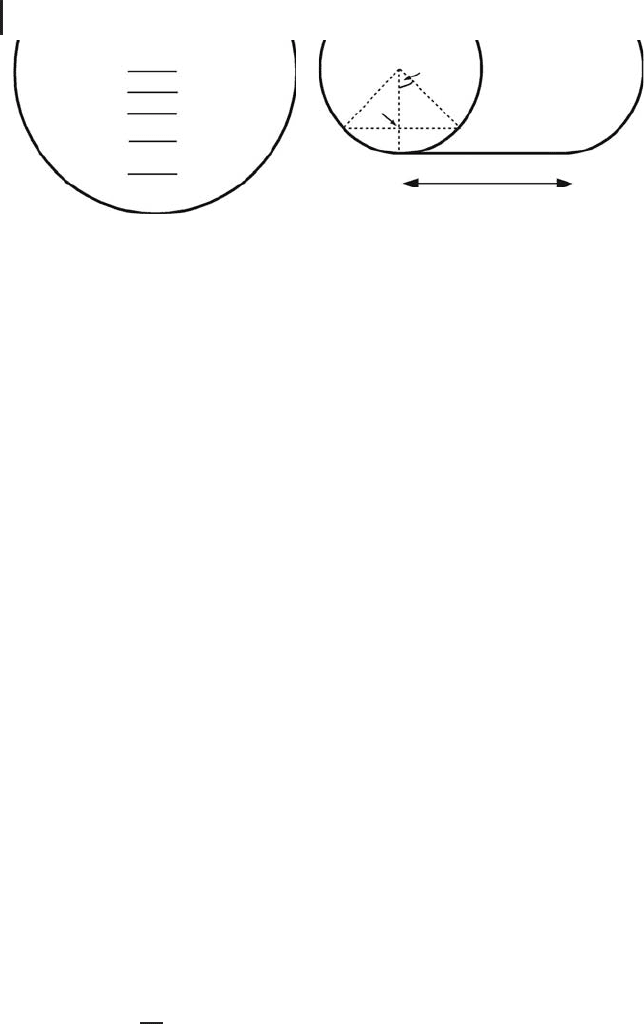
When fluids are stored in horizontal, cylindrical tanks similar to the one shown
in Figure 1.7b, one typically wants to have labels on the front side of the tank as
shown in Figure 1.7a. In practice, this problem is often solved ‘‘experimentally’’,
that is, by filling the tank with well-defined fluid volumes, and then setting the
labels at the position of the fluid surface that can be seen from outside. This
procedure may of course be inapplicable in situations where the fluid surface
cannot be seen from outside. More important, however, is the cost argument: this
28 1 Principles of Mathematical Modeling
5000 l
4000 l
3000 l
2000 l
1000 l
B
E
A
D
C
L
r
r−h
x
h
α
(a) (b)
Fig. 1.7 (a) Tank front side with volume labels.
(b) Unknowns and auxiliary variables of the tank labeling
problem.
experimental procedure is expensive in terms of time (working time of the people
who are performing the experiment) and material (e.g. the water that is wasted
during the experiment). It is much cheaper here to apply the mathematical model
that will be developed below. Unfortunately, the situation in this example – where
the problem could be solved cheap and efficiently using mathematical models and
open-source software, but where expensive experimental procedures or, in some
cases, expensive commercial software solutions are used – is still rather the rule
than the exception in many fields.
Let us start with the development of an appropriate mathematical model. Let h
(decimeters) be the height of a label at the front side of the tank as indicated in
Figure 1.7b, and let V(h) (cubic decimeters) be the filling volume of the tank that
corresponds to h. If we want to determine the label height for some filling volume
V
f
, then the following equation must be solved for h:
V(h) = V
f
(1.32)
Referring to Figure 1.7b, V(h) can be expressed as
V(h) = ACD · L (1.33)
where ACD (square decimeters) corresponds to the surface at the front side of
the tank that is enclosed by the line segments AC, CD and DA. ACD can be
expressed as
ACD = ABCD − ABC (1.34)
where the circular segment ABCD is
ABCD =
2α
2π
πr
2
= αr
2
(1.35)
In the last equation, α is expressed in radians (which makes sense here since the
problem is solved based on Maxima below, which uses radians in its trigonometric
1.5 Examples and Some More Definitions 29
functions). The surface of the triangle ABC is
ABC = x(r − h) (1.36)
where
x =
r
2
− (r − h)
2
(1.37)
due to the theorem of Pythagoras. Using the last five equations and
α = cos
−1
r − h
r
(1.38)
in Equation 1.32 yields
L · cos
−1
r − h
r
r
2
− L
r
2
− (r − h)
2
(r − h) = V
f
(1.39)
Unlike the equations treated in the last sections, this is now a transcendental
equation that cannot be solved in closed form using Maxima’s
solve command as
before. To solve Equation 1.39, numerical methods such as the bisection method
or Newton’s method must be applied [18]. In Maxima,the
find_root command
can be applied as follows:
1: for i:1 thru 4 do
2: (
3: out:find
root(
4: L
*
acos((r-h)/r)
*
r ˆ 2-L
*
sqrt(r ˆ 2-(r-h) ˆ 2)
*
(r-h)=i
*
1000
5: ,h,0,r
6: ),
7: print("Label for V=",i
*
1000,"l:",out,"dm")
8: )
;
(1.40)
This is the essential part of Label.mac,aMaxima code which is a part of the book
software (see Appendix A), and which solves the tank labeling problem assuming
a 10 000 l tank of length L = 2 m based on Equation 1.39. Equation 1.39 appears in
line 4 of the code, with its right-hand side replaced by
i*1000 which successively
generates 1000, 2000, 3000, and 4000 as the right-hand side of the equation due
to the
for command that is applied in line 1, so the problem is solved for 1000,
2000, 3000, and 4000 l of filling volume in a single run of the code (note that the
5000, 6000, and so on labels can be easily derived from this if required). What the
for...thru...do command in line 1 precisely does is this: it first sets i = 1and
then executes the entire code between the brackets in lines 2 and 8, which solves the
problem for V
f
= 1000 l; then, it sets i =2 and executes the entire code between the
brackets in lines 2 and 8 again, which solves the problem for V
f
= 2000, and so on
until the same has been done for i = 4 (the upper limit given by ‘‘
thru’’ in line 1).

30 1 Principles of Mathematical Modeling
Note that the arguments of the find_root command are in lines 4 and 5,
between the brackets in lines 3 and 6. Its first argument is the equation that is
to be solved (line 4), which is then followed by three more arguments in line 5:
thevariabletobesolvedfor(
h in this case), and upper and lower limits for the
interval in which the numerical algorithm is expected to look for a solution of the
equation (0 and r in this case). Usually, reasonable values for these limits can be
derived from the application – in this case, it is obvious that h > 0, and it is likewise
obvious that we will have h = r for 5000 l filling volume since a 10 000–l tank is
assumed, which means that we will have h < r for filling volumes below 5000 l. The
print command prints the result to the computer screen. Note how text, numbers
and variables (such as the variable
out that contains the result of the find_root
command, see line 3) can be mixed in this command. Since the print is a part
of the
for...thru...do environment, it is invoked four times and produces the
following result:
Label for V= 1000 l: 3.948086422946864 dm
Label for V
= 2000 l: 6.410499677168014 dm
Label for V
= 3000 l: 8.582542383270068 dm
Label for V
= 4000 l: 10.62571600771833 dm
1.5.5
Linear Programming
All mathematical models considered so far were formulated in terms of equations
only. Remember that according to Definition 1.4.1, a mathematical model may in-
volve any kind of mathematical statements. For example, it may involve inequalities.
One of the simplest class of problems involving inequalities are linear program-
ming problems that are frequently used e.g. in operations research. Consider
the following problem taken from the linear programming article of Wikipedia.
org:
Linear programming example
Suppose a farmer has a piece of farm land, say A square kilometers large, to be
planted with either wheat or barley or some combination of the two. Furthermore,
suppose the farmer has a limited permissible amount F of fertilizer and P of
insecticide which can be used, each of which is required in different amounts
perunitareaforwheat(F
1
, P
1
)andbarley(F
2
, P
2
). Let S
1
be the selling price
of wheat, and S
2
the price of barley. How many square kilometers should be
planted with wheat versus barley to maximize the revenue?
Denoting the area planted with wheat and barley with x
1
and x
2
respectively, the
problem can be formulated as follows:
x
1
, x
2
≥ 0 (1.41)
x
1
+ x
2
≤ A (1.42)

1.5 Examples and Some More Definitions 31
F
1
x
1
+ F
2
x
2
≤ F (1.43)
P
1
x
1
+ P
2
x
2
≤ P (1.44)
S
1
x
1
+ S
2
x
2
→ max (1.45)
Here, Equation 1.41 expresses the fact that the farmer cannot plant a negative
area, Equation 1.42 the fact that no more than the given A square kilometers of farm
land can be used, Equations 1.43 and 1.44 express the fertilizer and insecticide
limits, respectively, and Equation 1.45 is the required revenue maximization.
Taking Equations 1.41–1.45 as M, the system S as the farm land and the question
Q, ‘‘How many square kilometers should be planted with wheat versus barley to
maximize the revenue?’’, a mathematical model (S, Q, M) is obtained. For any set
of parameter values for A, F, P, ..., the problem can again be easily solved using
Maxima. This is done in the Maxima program
Farm.mac whichyoufindinthe
book software (see Appendix A). Let us look at the essential commands of this code:
1: load(simplex);
2: U:[x1>=0
3: ,x2>=0
4: ,x1+x2<=A
5: ,F1
*
x1+F2
*
x2 <=F
6: ,P1
*
x1+P2
*
x2<=P]
;
7: Z:S1
*
x1+S2
*
x2;
8: maximize lp(Z,U);
(1.46)
Line 1 of this code loads a package required by Maxima to solve linear program-
ming problems. Lines 2–6 define the inequalities, corresponding to Equations
1.41–1.44 above. Note that lines 2–6 together make up a single command that
stores the list of inequalities in the variable
U. Line 7 defines the function Z that
is to be maximized, and the problem is then solved in line 8 using Maxima’s
maximize_lp command. Based on the parameter settings in Farm.mac, Maxima
produces the following result:
[100, [x2 = 50, x1 = 0]]
This means that a maximum revenue of 100 is obtained if the farmer plants
barley only (50 square kilometers).
1.5.6
Modeling a Black Box System
In Section 1.3 it was mentioned that the systems investigated by scientists or
engineers typically are ‘‘input–output systems’’, which means they transform the
given input parameters into output parameters. Note that the previous examples
were indeed referring to such ‘‘input–output systems’’. In the tin example, the
radius and height of the tin are input parameters and the surface area of the tin is
32 1 Principles of Mathematical Modeling
x (N)
y (cm)
10 20 30 40
50
3 5 11 12 16
x
y
System 1
(a) (b)
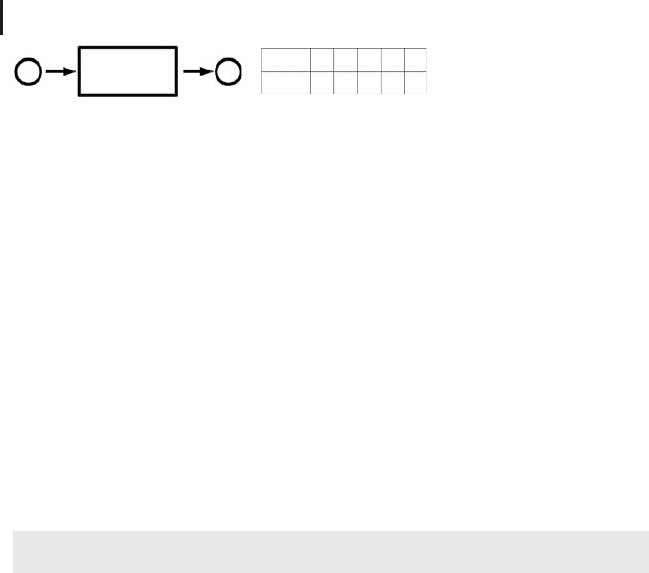
Fig. 1.8 (a) System 1 with input x (N) and output y (cm).
(b) System 1 data (file
spring.csv in the book software).
the output parameter. In the plant growth example, the growth rate of the plant and
its initial biomass is the input and the resulting time–biomass curve is the output
(details in Chapter 3). In the tank example, the geometrical data of the tank and the
concentration distribution are input parameters while the mass of the substance is
the output. In the linear programming examples, the areas planted with wheat or
barley are the input quantities and the resulting revenue is the output. Similarly,
all systems in the examples that will follow can be interpreted as input–output
systems.
The exploration of an example input–output system in some more detail will
now lead us to further important concepts and definitions. Assume a ‘‘system 1’’
as in Figure 1.8 which produces an output length y (centimeters) for every given
input force x [N]. Furthermore, assume that we do not know about the processes
inside the system that transform x into y,thatis,letthissystembea‘‘blackbox’’
to us as described above. Consider the following problem:
Q:Findaninputx that generates an output y = 20 cm.
This defines the question Q of the mathematical model (S, Q, M)thatweare
going to define. S is the ‘‘system 1’’ in Figure 1.8a, and we are now looking for an
appropriate set of mathematical statements M that can help us to answer Q.
All that the investigator of system 1 can do is to produce some data using the
system, hoping that these data will reveal something about the processes occurring
inside the ‘‘black box’’. Assume that the data in the file
spring.csv (which you find
in the
PhenMod/LinReg directory of the book software, see Appendix A) have been
obtained from this system, see Figure 1.8b. To see what happens, the investigator
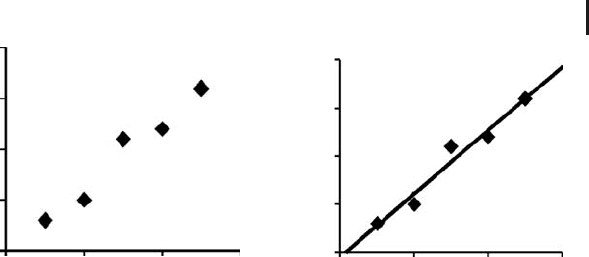
will probably produce a plot of the data as in Figure 1.9a. Note that the plots in
Figure 1.9 were generated using the scatter plot option of OpenOffice.org Calc (see
Appendix A on how you can obtain this software). Figure 1.9a suggests that there
is an approximately linear dependence between the x-andy-data. Mathematically,
this means that the function y = f (x) behind the data is a straight line:
f (x) = ax + b (1.47)
Now the investigator can apply a statistical method called linear regression (which
will be explained in detail in Section 2.2) to determine the coefficients a and b of
this equation from the data, which leads to the ‘‘regression line’’
f (x) = 0.33x − 0.5 (1.48)
1.5 Examples and Some More Definitions 33
6040200
0
5
10
15
20
x (N)
y(cm)
6040200
0
5
10
15
20
x (N)
y(cm)
(a) (b)
Fig. 1.9 (a) Plot of the data in spring.csv. (b) System 1
data with regression line. Both plots generated using Calc,
see Section 2.1.1.1.
Figure 1.9b shows that there is a good coincidence or, in statistical terminology,
a good ‘‘fit’’ between this regression line and the data. Equation 1.48 can now be
used as the M of a mathematical model of system 1. The question Q stated above
(‘‘Which system input x generates a desired output y = 20 cm? ’’) can then be easily
answered by setting y = f (x) = 20 in Equation 1.48, that is,
20 = 0.33x − 0.5 (1.49)
which gives x ≈ 62.1 N. Of course, this is just an approximate result for several
reasons. First of all, Figure 1.9 shows that there are some deviations between the
regression line and the data. These deviations may be due to measurement errors,
but they may also reflect some really existing effects. If the deviations are due to
measurement errors, then the precise location of the regression line and hence,
the prediction of x for y = 20 cm is affected by these errors. If, on the other hand,
the deviations reflect some really existing effects, then Equation 1.48 is no more
than an approximate model of the processes that transform x into y in system 1,
and hence, the prediction of x for y = 20 cm will be only approximate. Beyond this,
predictions based on data such as the data in Figure 1.8b are always approximate
for principal reasons. The y-range of these data ends at 16 cm, and system 1 may
behave entirely different for y-values beyond 16 cm which we would not be able
to see in such a data set. Therefore, the experimental validation of predictions
derived from mathematical models is always an indispensable part of the modeling
procedure (see Section 1.2). See also Chapter 2 for a deeper discussion of the quality
of predictions obtained from black box models.
Theexampleshowstheimportance of statistical methods in mathematical model-
ing. First of all, statistics itself is a collection of mathematical models that can be
used to describe data or to draw inferences from data [19]. Beyond this, statistical
methods provide a necessary link between nonstatistical mathematical models and

34 1 Principles of Mathematical Modeling
the real world. In mathematical modeling, one is always concerned with experi-
mental data, not only to validate model predictions, but also to develop hypotheses
about the system, which help to set up appropriate equations. In the example, the
data led us to the hypothesis that there is a linear relation between x and y.Wehave
used a plot of the data (Figure 1.9) and the regression method to find the coefficients
in Equation 1.48. These are methods of descriptive statistics, which can be used to
summarize or describe data. Beyond this, inferential statistics provides methods
that allow conclusions to be drawn from data in a way that accounts for randomness
and uncertainty. Some important methods of descriptive and inductive statistics
will be introduced below (Section 2.1).
Note 1.5.12 Statistical methods provide the link between mathematical models
and the real world.
The reader might say that the estimate of x above could also have been obtained
without any reference to models or computations, by a simple tuning of the input
using the real, physical system 1. We agree that there is no reason why models
should be used in situations where this can be done with little effort. In fact, we
do not want to propose any kind of a fundamentalist ‘‘mathematical modeling
and simulation’’ paradigm here. A pragmatic approach should be used, that is, any
problem in science and engineering should be treated using appropriate methods,
may this be mathematical models or a tuning of input parameters using the real
system. It is just a fact that in many cases the latter cannot be done in a simple
way. The generation of data such as in Figure 1.8 may be expensive, and thus,
an experimental tuning of x toward the desired y may be inapplicable. Or, the
investigator may be facing a very complex interaction of several input and output
parameters, which is rather the rule than the exception as explained in Section 1.1.
In such cases, the representation of a system in mathematical terms can be the
only efficient way to solve the problem.
1.6
Even More Definitions
1.6.1
Phenomenological and Mechanistic Models
The mathematical model used above to describe system 1 is called a phenomeno-
logical model since it was constructed based on experimental data only, treating the
system as a black box, that is, without using any information about the internal
processes occurring inside system 1 when x is transformed into y. On the other
hand, models that are constructed using information about the system S are called
mechanistic models, since such models are virtually based on a look into the internal
mechanics of S. Let us define this as follows [11]: