
Velten K. Mathematical Modeling and Simulation: Introduction for Scientists and Engineers
Подождите немного. Документ загружается.

1.6 Even More Definitions 35
Definition 1.6.1 (Phenomenological and mechanistic models) Amathematical
model (S, Q, M) is called
•
phenomenological, if it was constructed based on experimental
data only, using no a priori information about S,
•
mechanistic, if some of the statements in M are based on a priori
information about S.
Phenomenological models are also called empirical models, statistical models,
data-driven models or black box models for obvious reasons. Mechanistic models
for which all necessary information about S are available are also called white box
models. Most mechanistic models are located somewhere between the extreme
black and white box cases, that is, they are based on some information about S
while some other important information is unavailable. Such models are sometimes
called gray box models or semi-empirical models [20].
To better understand the differences between phenomenological and mechanistic
models, let us now construct an alternative mechanistic model for system 1
(Figure 1.8). Above, we have treated system 1 as a black box, that is, we have used
no information about the way in which system 1 transforms some given input x into
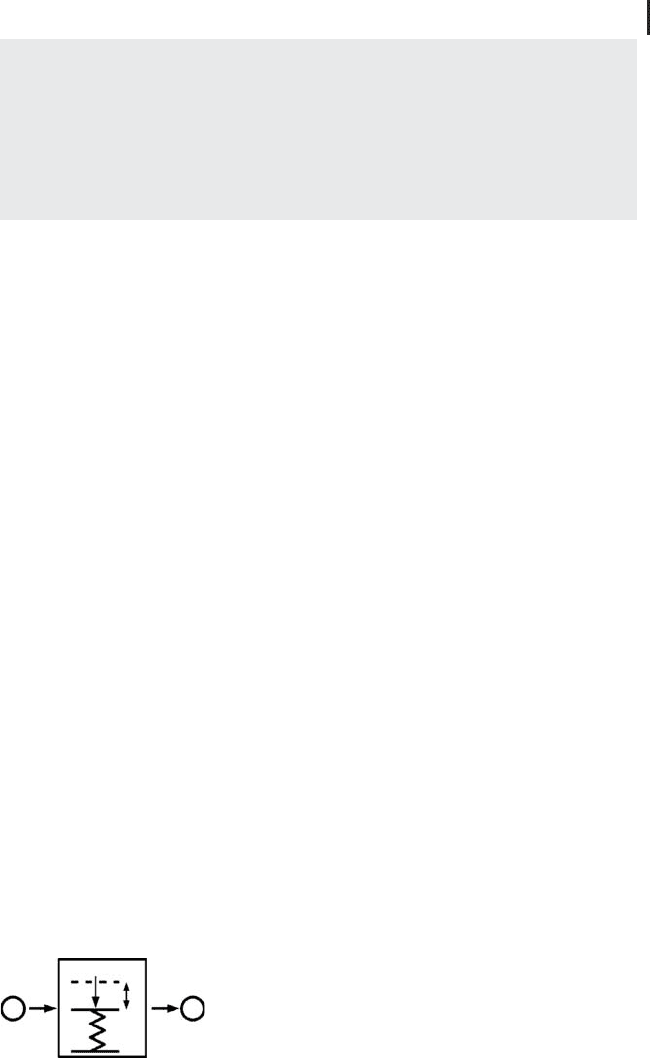
the output y (Figure 1.8). Let us now assume that the internal mechanics of system
1 looks as shown in Figure 1.10, that is, assume that system 1 is a mechanical
spring, x is a force acting on that spring, and y is the resulting elongation. This
is now an a priori information about system 1 in the sense of Definition 1.6.1
above, and it can be used to construct a mechanistic mathematical model based
on elementary physical knowledge. As is well known, mechanical springs can be
described by Hooke’s law, which in this case reads
x = k · y (1.50)
where k is the spring constant (newtons per centimeter), a measure of the elasticity
ofthespring.Theparameterk is either known (e.g. from the manufacturer of the
spring), or estimated based on data such as those in Figure 1.8. Now the following
mechanistic mathematical model (S, Q, M)isobtained:
•
S:System1
•
Q: Which system input x generates a desired output of
y = 20 cm?
•
M:Equation1.50
x
x
y
y
Fig. 1.10 Internal mechanics of system 1.

36 1 Principles of Mathematical Modeling
Based on this model, question Q can be answered as before by setting y = 20 cm
in the model equation (1.50), which leads to
x = k · 20 (1.51)
that is, we can answer the question Q depending on the value of the spring constant,
k. For example, assuming a value of k ≈ 3.11 N cm
−1
for the spring constant, we
wouldgetthesameestimatex ≈62.1 N as above. The mechanistic model of system
1 has several important advantages compared to the phenomenological model, and
these advantages are characteristic advantages of the mechanistic approach.Firstof
all, mechanistic models generally allow better predictions of system behavior. The
phenomenological model equation (1.48) was derived from the data in Figure 1.8.
These data involve forces x between 10 and 50 N. As mentioned below in our
discussion of regression methods, this means that one can expect Equation 1.48
to be valid only close to this range of data between 10 and 50 N. The mechanistic
model equation (1.50), on the other hand, is based on the well-established physical
theory of a spring. Hence, we have good reason to expect its validity even outside
the range of our own experimental testing.
Mechanistic models do also allow better predictions of modified systems. Assume
for example that system 1 in Figure 1.10 is replaced by a system 2 that consists of
two springs. Furthermore, assume that each of these system 2 springs has the same
spring constant k as the system 1 spring. Then, in the phenomenological approach,
the model developed for system 1 would be of no use, since we would not know
about the similarity of these two systems (remember that the phenomenological
approach assumes that no details are known about the internal mechanics of the
system under consideration). This means that a new phenomenological model
would have to be developed for system 2. A new data set similar to Figure 1.8 would
be required, appropriate experiments would have to be performed, and afterwards, a
new regression line similar to Figure 1.9 would have to be derived from the data. In
the mechanistic approach, on the other hand, Hooke’s law would immediately tell
us that in the case of two springs the appropriate modification of Equation 1.50 is
x = 2k · y (1.52)
Another advantage of mechanistic models is the fact that they usually involve
physically interpretable parameters, that is, parameters which represent real properties
of the system. To wit: the numerical coefficients of the phenomenological model
equation 1.47 are just numbers which cannot be related to the system. The
parameter k of the mechanistic model equation 1.50, on the other hand, can be
related to system properties, and this is of particular importance when we want
to optimize system performance. For example, if we want smaller forces x to be
required for a given elongation y, then in the phenomenological approach we would
have to test a number of systems 2, 3, 4, ..., until we would eventually arrive at some
system with the desired properties. That is, we would have to apply a trial-and-error
method. The mechanistic model, on the other hand, tells us exactly what we have
to do: we have to replace the system 1 spring with a spring having a smaller spring

1.6 Even More Definitions 37
constant k, and this will reduce the force x required for a given elongation y.In
this simple example, it may be hard to imagine that someone would really use
the phenomenological approach instead of Hooke’s law. But the example captures
an essential difference between phenomenological and mechanistic models, and it
tells us that we should use mechanistic models if possible.
So, if mechanistic models could be set up easily in every imaginable situation, we
would not have to talk about phenomenological models here. However, in many
situations, it is not possible or feasible to use mechanistic models. As an essential
prerequisite, mechanistic models need a priori knowledge of the system. If nothing is
known about the system, then we are in the ‘‘black box’’ situation and have to apply
phenomenological models. Suppose, for example, we want to understand why
some roses wilt earlier than others (this example will be explained in more detail in
Section 2.3). Suppose we assume that this is related to the concentrations of certain
carbohydrates that can be measured. Then we cannot set up a mechanistic model as
long as we do not know all the relevant processes that connect those carbohydrate
concentrations with the observed freshness of the rose. Unless these processes
are known, all we can do is to produce some data (carbohydrate concentration
versus some appropriate measure of rose freshness) and analyze these data using
phenomenological models.
This kind of situation where little is known about the system under investigation
is rather the rule than the exception, particularly at early stages of a scientific
investigation, or at the early stages of a product development in engineering. We
may also be in a situation where we principally know enough details about the
system under investigation, but where the system is so complex that it would take
too much time and resources to setup a mechanistic model. An example is the op-
timization of the wear resistance of composite materials: Suppose that a composite
material is made of the materials M
1
, M
2
, ..., M
n
, and we want to know how the
relative proportions of these materials should be chosen in order to maximize the
composite materials resistance to wear. Then, the wear resistance of the composite
material can depend in an extremely complex way on its composition. The author
has investigated a situation of this kind where mechanistic modeling attempts
failed due to the complexity of the overall system, and where a black box-type
phenomenological neural network approach (see Section 2.5) was used instead
[21]. An important advantage of phenomenological models is that they can be used in
black box situations of this kind, and that they typically require much less time and
resources. Pragmatic considerations should decide which type of model is used in
practice. A mechanistic model will certainly be a bad choice if we need three weeks
to make it work, and if it does not give substantially better answers to our question
Q compared to a phenomenological model which can be set up within a day.
Note 1.6.1 (Phenomenological vs. mechanistic) Phenomenological models are
universally applicable, easy to set up, but limited in scope. Mechanistic models
typically involve physically interpretable parameters, allow deeper insights into

38 1 Principles of Mathematical Modeling
system performance and better predictions, but they require a priori information
on the system and often need more time and resources.
1.6.2
Stationary and Instationary models
It was already mentioned above that the question Q is an important factor that
determines the appropriate mathematical model (S, Q, M). As an example, we have
considered the alternative treatment of mechanical problems with the equations of
classical or relativistic mechanics depending on the question Q that is investigated.
In the system 1 example, we have used Q: ‘‘Which system input x generates a
desired output of y = 20 cm? ’’. Let us now modify this Q in order to find other
important classes of mathematical models. Consider the following question:
Q: If a constant force x acts on the spring beginning with t = 0, what is the
resulting elongation y(t) of the spring at times t > 0?
This question cannot be answered based on the models developed above.
The phenomenological model (Equation 1.48) as well as the mechanistic model
(Equation 1.50) both refer to the so-called stationary state of system 1. This means
that the elongation y expressed by these equations represents the time-independent
(= stationary) state of the spring which is achieved after the spring has been
elongated into the state of equilibrium where the force x exactly matches the force
of the spring. On the other hand, the above question asks for the instationary (i.e.
time-dependent) development of the elongation y(t), beginning with time t = 0
when the force x is applied to the spring. To compute this y(t), an instationary
mathematical model (S, Q, M) is needed where the mathematical statements
in M involve the time t. Models of this kind can be defined based on ordinary
differential equations (details in Chapter 3). To make this important distinction
between stationary and instationary models precise, let us define
Definition 1.6.2 (Stationary/instationary models) Amathematicalmodel(S,
Q, M) is called
•
instationary, if at least one of its system parameters or state
variables depends on time and
•
stationary otherwise.
1.6.3
Distributed and Lumped models
Suppose now that the spring in system 1 broke into pieces under normal operational
conditions, and that it is now attempted to construct a more robust spring. In such

1.7 Classification of Mathematical Models 39
a situation, it is natural to ask the following question:
Q: Which part of the spring should be reinforced?
Naturally, those parts of the spring which bear the highest mechanical stresses
should be reinforced. To identify these regions, we need to know the distribution
of stresses inside the spring under load. Let σ(x, y, z) denote the mechanical stress
distribution inside the spring depending on the spatial coordinates x, y, and z.
Then we need a mathematical model with σ (x, y, z) as a state variable. Such a
mathematical model can be formulated based on PDEs as will be explained in
Chapter 4. The important difference between this model and the previous models
of system 1 lies in the fact that in this case the state variable depends on the spatial
coordinates. To predict the equilibrium elongation of the spring using Equations
1.47 or 1.50, it was sufficient to describe the spring based on the spring constant k
only. These equations, however, cannot be used to derive any spatially distributed
information regarding the spring. In this kind of models, all spatial information
is lumped together into the parameter k. In the case above, this was justified by
the fact that the equilibrium position of a spring can be predicted with sufficient
precision using k. On the other hand, if one is asking for the internal stress
distribution in the spring, a spatially distributed description of the stresses inside
the spring is needed. This motivates the following:
Definition 1.6.3 (Distributed/lumped models) Amathematicalmodel(S, Q,
M) is called
•
distributed, if at least one of its system parameters or state
variables depends on a space variable,
•
lumped otherwise.
1.7
Classification of Mathematical Models
Based on the examples in the last section, the reader can now distinguish between
some basic classes of mathematical models. We will now widen our perspective
toward a look at the entire ‘‘space of mathematical models’’, that is, this section will
give you an idea of various types of mathematical models that are used in practice.
Note 1.7.1 The practical use of a classification of mathematical models lies
in the fact that you understand ‘‘where you are’’ in the space of mathematical
models, and which types of models might be applicable to your problem beyond
the models that you have already used.
40 1 Principles of Mathematical Modeling
1.7.1
From Black to White Box Models
The ‘‘space of mathematical models’’ evolves naturally from Definition 1.4.1, where
we have defined a mathematical model to be a triple (S, Q, M) consisting of a system
S,aquestionQ, and a set of mathematical statements M. Based on this definition,
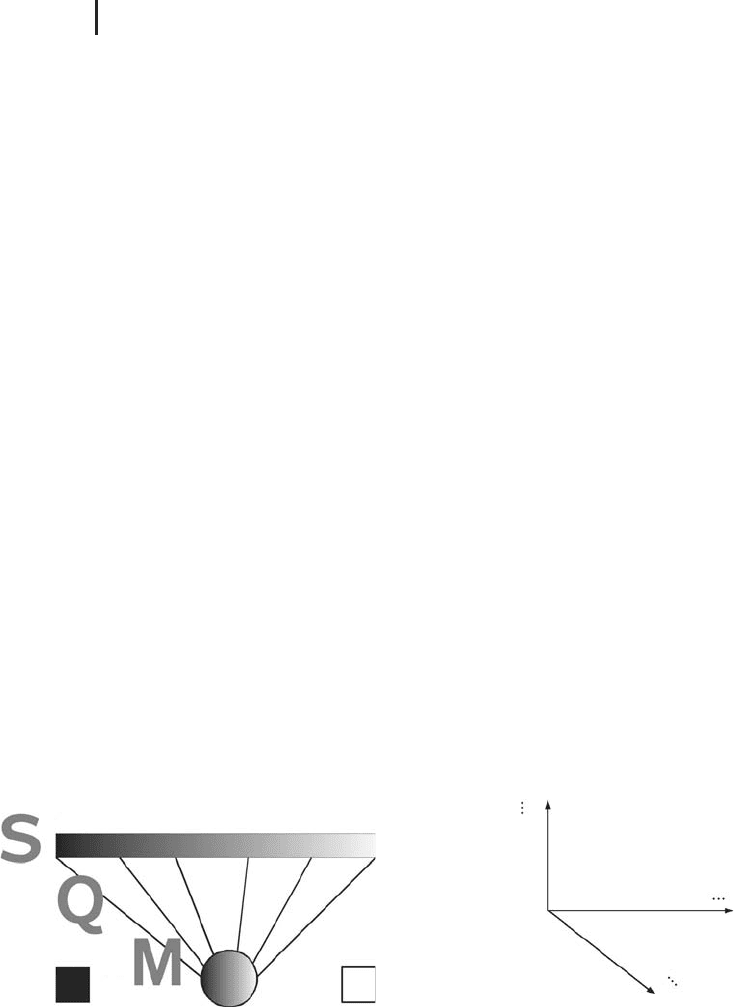
it is natural to classify mathematical models in an SQM space. Figure 1.11a shows
one possible approach to visualize this SQM space of mathematical models, based
on a classification of mathematical models between black and white box models.
Psychological and social systems constitute the ‘‘black box’’ end of the spectrum.
Only very vague phenomenological models can be developed for these systems due
to their complexity and due to the fact that too many subprocesses are involved
which are not sufficiently understood. On the other hand, mechanical systems,
electrical circuits etc. are at the white box end of the spectrum since they can be very
well understood in terms of mechanistic models (a famous example is Newton’s
model of planetary motion).
Note that the three dimensions of a mathematical model (S, Q, M)canbe
seen in the figure: the systems (S) are classified on top of the bar, immediately
below the bar there is a list of objectives that mathematical models in each of the
segments may have (which is Q), and at the bottom end there are corresponding
mathematical structures (M) ranging from algebraic equations (AEs) to differential
equations (DEs). Equation 1.47 (Section 1.5.6) is an example of a mathematical
model in the form of an AE. As suggested by Figure 1.11, black box regression
models of this kind are widely used for the modeling for example, of psychological,
social, or economic systems (see Chapter 2 for more on regression models). On the
other hand, the wine fermentation model discussed in Section 3.10.2 exemplifies
the modeling of a biological/chemical system using ODEs (see Chapters 3 and 4
for more examples of DE models).
The ‘‘Q’’-criteria in Figure 1.11a illustrate that mathematical models can be used
to solve increasingly challenging problems as the model gradually turns from a
White
box
Black
box
AEs
Prediction
Speculation
Analysis
AEs
DEs
DEs
DEs
Control
Design
Psychological
systems
Social
systems
Economic
systems
Biological
systems
Chemical
systems
Mechanical
systems
Electrical
circuits
Field of application
Dimension
Continous—discrete
Stochastic—deterministic
Natural—technical
Physical—conceptual
S
Q
M
Phenomonological—mechanistic
Stationary—instationary
Lumped—distributed
Direct—inverse
Research—management
Speculation—design
Scale
Linear—nonlinear
Autonomous—nonautonomous
Difference equations
Algebraic equations
Analytical—numerical
Continous—discrete
Differential equations
Integral equations
(a) (b)
Fig. 1.11 (a) Classification of mathematical models between
black and white box models (adapted from [3]). (b) Classifi-
cation of mathematical models in the SQM space.

1.7 Classification of Mathematical Models 41
black box to a white box model. At the black box end of the spectrum, models can
be used to make more or less reliable predictions based on data. For example, you
may think here of attempts that have been made to predict share prices using the
neural network methods described in Chapter 2 [22]. The model of a biological
predator–prey system discussed in Section 3.10.1 is already ‘‘white enough’’ such
that it can be used for an analysis of the dynamical system behavior in terms of
phase plot diagrams such as Figure 3.17. Beyond this, models of chemical systems
can be so precise that they can be used for a control of a process such as the wine
fermentation process discussed in Section 3.10.2.
At the white box end of the spectrum, mathematical models can be applied to
design, test, and optimize systems and processes on the computer before they
are actually physically realized. This is used e.g. in virtual engineering,which
includes techniques such as interactive design using CFD (see [23] and Section
4.10.3) or virtual prototyping [7, 24, 25]. As an example, you may think of the
computation of the temperature distribution within a three-dimensional device
using finite-element software, as it will be discussed in Section 4.9 below. Based
on the method described there, what-if studies can be performed, that is, it can
be investigated what happens with the temperature distribution if you change
certain characteristics of the device virtually on the computer, and this can then
be used to optimize the construction of the device so as to achieve certain desired
characteristics of the temperature distribution.
1.7.2
SQM Space Classification: S Axis
Since mathematical models are characterized by their respective individual S, Q
and M ‘‘values’’, one can also think of each model as being located somewhere
in the ‘‘SQM space’’ of Figure 1.11b. On each of the S-, Q-andM-axes of the
figure, mathematical models are classified with respect to a number of criteria
which were compiled based on various classification attempts in the literature
[3, 11, 20, 26–30]. Let us explain these criteria, beginning with the S axis of
Figure 1.11b:
Physical – conceptual. Physical systems are part of the real world, for example, a
fish or a car. Conceptual systems are made up of thoughts and ideas, for example,
a set of mathematical axioms. This book focuses entirely on physical systems.
Natural – technical. Naturally, a natural system is a part of nature, such as a fish
or a flower, while a technical system is a car, a machine, and so on. An example of
a natural system is the predator–prey system treated in Section 3.10.1, the stormer
viscometer treated in Section 2.4 exemplifies a technical system.
Stochastic – deterministic. Stochastic systems involve random effects, such as
rolling dice, share prices and so on. Deterministic systems involve no or very little
random effects, for example, mechanical systems, such as the planetary system, a
pendulum, and so on. In a deterministic system, a particular state A of the system
is always followed by one and the same state B, while A may be followed by B,

42 1 Principles of Mathematical Modeling
C or other states in an unpredictable way if the system is stochastic [31]. Below,
stochastic models will be considered mainly in Chapter 2 and deterministic models
mainly in Chapters 3 and 4.
Continuous – discrete. Continuous systems involve quantities that change con-
tinuously with time, such as sugar and ethanol concentrations in a wine fermenter
(Section 3.10.2). Discrete systems, on the other hand, involve quantities that change
at discrete times only, such as the number of individuals in animal populations
(Section 3.10.1). Note that on the M axis of Figure 1.11, continuous systems can
be represented by discrete mathematical statements and vice versa (e.g. a contin-
uous mathematical formulation is used in Section 3.10.1 to describe the discrete
predator–prey system).
Dimension. Depending on their spatial symmetries, physical systems can be
described using 1, 2, or 3 space variables. As will be discussed in Section 4.3.3, the
number of space variables used to describe a physical system is called its dimension
(frequently denoted 1D, 2D, or 3D). Examples: a 1D temperature distribution is
computed in Section 4.6 and a 3D temperature distribution in Section 4.9.
Field of application. We can distinguish between chemical systems, physical
systems, biological systems, and so on. Systems from these and more fields of
application will be considered below.
1.7.3
SQM Space Classification: Q Axis
On the Q- axis of Figure 1.11b, we have the following categories:
Phenomenological – mechanistic. This has been discussed in detail in Section 1.6.
Phenomenological models are treated in Chapter 2 and mechanistic models in
Chapters 3 and 4.
Stationary – instationary. Again, this has been discussed in Section 1.6. As dis-
cussed there, it depends on the question which we are asking (i.e. on the ‘‘Q’’ of
amathematicalmodel(S, Q, M)) whether a stationary (time-independent) or in-
stationary (time-dependent) model is appropriate. See also Problem 1 (instationary)
and Problem 2 (stationary) in Section 4.1.3.
Lumped – distributed. Again, see Section 1.6. As was discussed there, it depends
on the question which we are asking (i.e. on the ‘‘Q’’ of a mathematical model (S,
Q, M)) whether a lumped (space-independent) or distributed (space-dependent)
model is appropriate. The wine fermentation model (Section 3.10.2) is an example
of a lumped model since it does not use spatial coordinates. On the other hand,
the computation of a 3D temperature distribution in Section 4.9 is based on a
distributed model.
Direct – inverse. Consider an input–output system as in Figure 1.2a. If Q
assumes given input and system parameters and asks for the output, the model

1.7 Classification of Mathematical Models 43
solves a so-called direct problem [3]. Most of the models below refer to direct
problems. If, on the other hand, Q asks for the input or for parameters of S,the
model solves a so-called inverse problem [32]. If Q asks for parameters of S,the
resulting problem is also called a parameter identification problem. Examples are
the regression and neural network models discussed in Chapter 2, and the fitting
of ODEs to data discussed in Section 3.9. If Q asks for input parameters, the
resulting problem is also called a control problem, since in this case the problem is
to control the input in a way that generates some desired output ([33] and 4.11.3).
Research – management. Research models are used if Q aims at the understand-
ing of S; management models, on the other hand, are used if the focus is on the
solution of practical problems related to S. As pointed out in [20], research models
tend to be more complex and less manageable from a practical point of view.
Depending on Q, the same mathematical equations can be a part of a research or of
a management model. For example, the predator–prey model described in Section
3.10.1 is a research model if the investigator just wants to understand the oscilla-
tions of the predator and prey populations, and it is a management model if is used
to control the predator and prey populations (but as discussed in Section 3.10.1,
this model is so simple that it cannot be seriously used as a management model).
Speculation – design. See the above discussion of Figure 1.11a.
Scale. Depending on Q, the model will describe the system on an appropriate
scale. For example, depending on Q it can be appropriate to virtually follow a fluid
particle on its way through the complex channels of a porous medium, or just to
compute the pressure drop across a porous medium based on its permeability.
Obviously, these cases correspond to a description of a porous medium on two scales
(microscopic/macroscopic). Details of this example will follow in Section 4.10.2.
1.7.4
SQM Space Classification: M Axis
Finally, let us look at the categories on the M-axis of Figure 1.11b:
Linear – nonlinear. In linear models, the unknowns (or their derivatives) are
combined using linear mathematical operations only, such as addition/subtraction
or multiplication with parameters. Nonlinear models, on the other hand, may in-
volve the multiplication of unknowns, the application of transcendental functions,
and so on. Nonlinear models typically have more (and more interesting) solu-
tions but are harder to solve. Examples are linear or nonlinear regression models
(Sections 2.2 and 2.4, respectively) and linear or nonlinear ODEs (Section 3.5).
Analytical – numerical. In analytic models, the system behavior can be expressed
in terms of mathematical formulas involving the system parameters. Based on these
models, qualitative effects of parameters and the entire system behavior can be
studied theoretically, without using concrete values for the parameters. Numerical

44 1 Principles of Mathematical Modeling
models, on the other hand, can be used to obtain the system behavior for specific
parameter values. See Section 3.6 for a general discussion of analytical models
(which are also called closed form models) versus numerical models.
Autonomous – nonautonomous. This is a mathematical classification of insta-
tionary models (see above). If an equation does not depend explicitly on time, it is
called autonomous, otherwise nonautonomous; see the examples in Section 3.5.
Continuous – discrete. In continuous models, the independent variables may
assume arbitrary (typically real) values within some interval. For example, many of
the ODE models discussed in Chapter 3 use time (within some time interval) as
the independent variable. In discrete models, on the other hand, the independent
variables may assume some discrete values only. An example is the discrete
event simulation technique discussed in Section 2.7.2, or the Nicholson–Bailey
host–parasite interaction model discussed in Section 4.11.1, where the time
variable just counts the number of breeding seasons instead of expressing the
(continuous) physical time.
Difference equations. In difference equations, the quantity of interest is obtained
as a sequence of discrete values. Usually, this is expressed in terms of recurrence
relations in which each term of the sequence depends on previous terms. Differ-
ence equations are frequently used to describe discrete systems. See the examples
in Section 4.11.1.
Differential equations. Differential equations are equations involving derivatives
of an unknown function. They are a main tool to set up continuous mechanistic
models, see the examples in Chapters 3 and 4.
Integral equations. Integral equations are equations involving an integral of an
unknown function.
Algebraic equations. AEs are equations involving the usual algebraic operations
such as addition, subtraction, division, and so on. Examples are Equations (1.1) or
(1.4) in Section 1.5, or the regression equations discussed in Chapter 2.
Note that some of the above categorizations of mathematical models overlap.
For example, both phenomenological and mechanistic models can be lumped or
distributed, stationary or instationary, and so on. Thus, it may have confused the
reader if a single chapter would have been devoted to each of these categorizations.
Instead, it was decided to select the categorization between phenomenological mod-
els (Chapter 2) and mechanistic models (Chapters 3 and 4) as the main perspective
and as a principle to organize the book. The other categorizations are treated
within this perspective, that is, they will be referred to in the context of appropriate
examples. Note that referring to Figure 1.11b we can say that the categorization of
mathematical models between phenomenological and mechanistic models divides
the SQM space of mathematical models into two different ‘‘half-spaces’’ along the
Q-axis. We will repeatedly come back to the above classification of mathematical
models in the course of this book, using it like a compass (or, in more up-to-date
terminology: like a GPS system) so that the reader will always know about his
actual position in the overall space of mathematical models.