
Velten K. Mathematical Modeling and Simulation: Introduction for Scientists and Engineers
Подождите немного. Документ загружается.


1.2 Systems, Models, Simulations 5
Note 1.2.3 (Modeling and simulation scheme)
Definitions
•
Definition of a problem that is to be solved or of a question that
is to be answered
•
Definition of a system, that is, a part of reality that pertains to
this problem or question
Systems Analysis
•
Identification of parts of the system that are relevant for the
problem or question
Modeling
•
Development of a model of the system based on the results of the
systems analysis step
Simulation
•
Application of the model to the problem or question
•
Derivation of a strategy to solve the problem or answer the
question
Validation
•
Does the strategy derived in the simulation step solve the
problem or answer the question for the real system?
The application of this scheme to the examples discussed above is obvious: in
the car example, the problem is that the car does not start and the car itself is the
system. This is the ‘‘definitions’’ step of the above scheme. The ‘‘systems analysis’’
step identifies the battery and fuels levels as the relevant parts of the system as
explained above. Then, in the ‘‘modeling’’ step of the scheme, a model consisting
of a battery and a tank such as in Figure 1.1 is developed. The application of this
model to the given problem in the ‘‘simulation’’ step of the scheme then leads
to the strategy ‘‘check battery and fuel level’’. This strategy can then be applied
to the real car in the ‘‘validation’’ step. If it works, that is, if the car really starts
after refilling its battery or tank, we say that the model is valid or validated. If
not, we probably need a mechanic who will then look at other parts of the car,
that is, who will apply more complex models of the car until the problem is
solved.
In a real modeling and simulation project, the systems analysis step of the above
scheme can be a very time-consuming step. It will usually involve a thorough
evaluation of the literature. In many cases, the literature evaluation will show

6 1 Principles of Mathematical Modeling
that similar investigations have been performed in the past, and one should
of course try to profit from the experiences made by others that are described
in the literature. Beyond this, the system analysis step usually involves a lot of
discussions and meetings that bring together people from different disciplines who
can answer your questions regarding the system. These discussion will usually
show that new data are needed for a better understanding of the system and for
the validation of the models in the validation step of the above scheme. Hence, the
definition of an experimental program is also another typical part of the systems
analysis step.
The modeling step will also involve the identification of appropriate software
that can solve the equations of the mathematical model. In many cases, it will
be possible to use standard software such as the software tools discussed in the
next chapters. Beyond this, it may be necessary to write your own software in
cases where the mathematical model involves nonstandard equations. An example
of this case is the modeling of the press section of paper machines, which
involves highly convection-dominated diffusion equations that cannot be treated
by standard software with sufficient precision, and which hence need specifically
tailored numerical software [5].
In the validation step, the model results will be compared with experimental data.
These data may come from the literature, or from experiments that have been
specifically designed to validate the model. Usually, a model is required to fit the
data not only quantitatively, but also qualitatively in the sense that it reproduces the
general shape of the data as closely as possible. See Section 3.2.3.4 for an example
of a qualitative misfit between a model and data. But, of course, even a model that
perfectly fits the data quantitatively and qualitatively may fail the validation step of
the above scheme if it cannot be used to solve the problem that is to be solved,
which is the most important criterion for a successful validation.
The modeling and simulation scheme (Note 1.2.3) focuses on the essential
steps of modeling and simulation, giving a rather simplified picture of what really
happens in a concrete modeling and simulation project. For different fields of
application, you may find a number of more sophisticated descriptions of the
modeling and simulation process in books such as [6–9]. An important thing that
you should note is that a real modeling and simulation project will very rarely
go straight through the steps of the above scheme; rather, there will be a lot
of interaction between the individual steps of the scheme. For example, if the
validation step fails, this will bring you back to one of the earlier steps in a loop-like
structure: you may then improve your model formulation, reanalyze the system,
or even redefine your problem formulation (if your original problem formulation
turns out to be unrealistic).
Note 1.2.4 (Start with simple models!) To find the best model in the sense of
Note 1.2.2, start with the simplest possible model and then generate a sequence
of increasingly complex model formulations until the last model in the sequence
passes the validation step.

1.2 Systems, Models, Simulations 7
1.2.3
Simulation
So far we have given a definition of the term model only. The above modeling
and simulation schemes involve other terms, such as system and simulation,which
we may view as being implicitly defined by their role in the above scheme. Can
this be made more precise? In the literature, you will find a number of different
definitions, for example of the term simulation. These differences can be explained
by different interests of the authors. For example, in a book with a focus on the
so-called discrete event simulation which emphasizes the development of a system
over time, simulation is defined as ‘‘the imitation of the operation of a real-world
process or system over time’’ [6]. In general terms, simulation can be defined as
follows:
Definition 1.2.2 (Simulation) Simulation is the application of a model with
the objective to derive strategies that help solve a problem or answer a question
pertaining to a system.
Note that the term simulation originates from the Latin word ‘‘simulare’’, which
means ‘‘to pretend’’: in a simulation, the model pretends to be the real system.
A similar definition has been given by Fritzson [7] who defined simulation as
‘‘an experiment performed on a model’’. Beyond this, the above definition is a
teleological (purpose-oriented) definition similar to Definition 1.2.1 above, that is,
this definition again emphasizes the fact that simulation is always used to achieve
some goal. Although Fritzson’s definition is more general, the above definition
reflects the real use of simulation in science and engineering more closely.
1.2.4
System
Regarding the term system, you will again find a number of different definitions
in the literature, and again some of the differences between these definitions can
be explained by the different interests of their authors. For example, [10] defines
a system to be ‘‘a collection of entities, for example, people or machines, that act
and interact together toward the accomplishment of some logical end’’. According
to [11], a system is ‘‘a collection of objects and relations between objects’’. In the
context of mathematical models, we believe it makes sense to think of a ‘‘system’’
in very general terms. Any kind of object can serve as a system here if we have
a question relating to that object and if this question can be answered using
mathematics. Our view of systems is similar to a definition that has been given
by [12] (see also the discussion of this definition in [3]): ‘‘ A system is whatever is
distinguished as a system.’’ [3] gave another definition of a ‘‘system’’ very close to
our view of systems here: ‘‘A system is a potential source of data’’. This definition
emphasizes the fact that a system can be of scientific interest only if there is some
communication between the system and the outside world, as it will be discussed

8 1 Principles of Mathematical Modeling
below in Section 1.3.1. A definition that includes the teleological principle discussed
above has been given by Fritzson [7] as follows:
Definition 1.2.3 (System) A system is an object or a collection of objects whose
properties we want to study.
1.2.5
Conceptual and Physical Models
The model used in the car example is something that exists in our minds only.
We can write it down on a paper in a few sentences and/or sketches, but it does
not have any physical reality. Models of this kind are called conceptual models [11].
Conceptual models are used by each of us to solve everyday problems such as
the car that refuses to start. As K.R. Popper puts it, ‘‘all life is problem solving’’,
and conceptual models provide us with an important tool to solve our everyday
problems [13]. They are also applied by engineers or scientists to simple problems
or questions similar to the car example. If their problem or question is complex
enough, however, they rely on experiments, and this leads us to other types of
models. To see this, let us use the modeling and simulation scheme (Note 1.2.3)
to describe a possible procedure followed by an engineer who wants to reduce the
fuel consumption of an engine: In this case, the problem is the reduction of fuel
consumption and the system is the engine. Assume that the systems analysis leads
the engineer to the conclusion that the fuel injection pump needs to be optimized.
Typically, the engineer will then create some experimental setting where he can
study the details of the fuel injection process.
Such an experimental setting is then a model in the sense that it will typically be
a very simplified version of that engine, that is, it will typically involve only a few
parts of the engine that are closely connected with the fuel injection process. In
contrast to a conceptual model, however, it is not only an idea in our mind but also a
real part of the physical world, and this is why models of this kind are called physical
models [11]. The engineer will then use the physical model of the fuel injection
process to derive strategies – for example, a new construction of the fuel injection
pump – to reduce the engine’s fuel consumption, which is the simulation step of
the above modeling and simulation scheme. Afterwards, in the validation step of
the scheme, the potential of these new constructions to reduce fuel consumption
will be tested in the engine itself, that is, in the real system. Physical models are
applied by scientists in a similar way. For example, let us think of a scientist who
wants to understand the photosynthesis process in plants. Similar to an engineer,
the scientist will set up a simplified experimental setting – which might be some
container with a plant cell culture – in which he can easily observe and measure the
important variables, such as CO
2
,water,light,andsoon.Forthesamereasonsas
above, anything like this is a physical model. As before, any conclusion drawn from
such a physical model corresponds to the simulation step of the above scheme, and

1.3 Mathematics as a Natural Modeling Language 9
the conclusions need to be validated by data obtained from the real system, that is,
data obtained from real plants in this case.
1.3
Mathematics as a Natural Modeling Language
1.3.1
Input–Output Systems
Any system that is investigated in science or engineering must be observable in
the sense that it produces some kind of output that can be measured (a system that
would not satisfy this minimum requirement would have to be treated by theolo-
gians rather than by scientists or engineers). Note that this observability condition
can also be satisfied by systems where nothing can be measured directly, such as
black holes, which produce measurable gravitational effects in their surroundings.
Most systems investigated in engineering or science do also accept some kind
of input data, which can then be studied in relation to the output of the system
(Figure 1.2a). For example, a scientist who wants to understand photosynthesis will
probably construct experiments where the carbohydrate production of a plant is
measured at various levels of light, CO
2
, water supply, and so on. In this case, the
plant cell is the system; the light, CO
2
, and water levels are the input quantities; and
the measured carbohydrate production is the output quantity. Or, an engineer who
wants to optimize a fuel injection pump will probably change the construction of
that pump in various ways and then measure the fuel consumption resulting from
these modified constructions. In this case, the fuel injection pump is the system,
the construction parameters changed by the engineer are the input parameters and
the resulting fuel consumption is the output quantity.
Note 1.3.1 (Input–output systems) Scientists or engineers investigate ‘‘input–
output systems’’, which transform given input parameters into output
parameters.
Note that there are of course situations where scientists are looking at the system
itself and not at its input–output relations, for example when a botanist just wants
OutputSystemInput
Input 1 Output 1
Input 2 Output 2
Input 3 Output 3
Input n Output n
.
.
.
(
a
)(
b
)
Fig. 1.2 (a) Communication of a system with the outside
world. (b) General form of an experimental data set.

10 1 Principles of Mathematical Modeling
to describe and classify the anatomy of a newly discovered plant. Typically, however,
such purely descriptive studies raise questions about the way in which the system
works, and this is when input–output relations come into play. Engineers, on
the other hand, are always concerned with input–output relations since they are
concerned with technology. The Encyclopedia Britannica defines technology as
‘‘the application of scientific knowledge to the practical aims of human life’’. These
‘‘practical aims’’ will usually be expressible in terms of a system output, and the
tuning of system input toward optimized system output is precisely what engineers
typically do, and what is in fact the genuine task of engineering.
1.3.2
General Form of Experimental Data
The experimental procedure described above is used very generally in engineering
and in the (empirical) sciences to understand, develop, or optimize systems. It is
useful to think of it as a means to explore black boxes. At the beginning of an
experimental study, the system under investigation is similar to such a ‘‘black box’’
in the sense that there is some uncertainty about the processes that happen inside
the system when the input is transformed into the output. In an extreme case,
the experimenter may know only that ‘‘something’’ happens inside the system
which transforms input into output, that is, the system may be really a black
box. Typically, however, the experimenter will have some hypotheses about the
internal processes, which he wants to prove or disprove in the course of his
study. That is, experimenters typically are concerned with systems as gray boxes
which are located somewhere between black and white boxes (more details in
Section 1.5).
Depending on the hypothesis that the experimenter wants to investigate, he
confronts the system with appropriate input quantities, hoping that the outputs
produced by the system will help prove or disprove his hypothesis. This is similar
to a question-and-answer game: the experimenter poses questions to the system,
which is the input, and the system answers to these questions in terms of mea-
surable output quantities. The result is a data set of the general form shown in
Figure 1.2b. In rare cases, particularly if one is concerned with very simple systems,
the internal processes of the system may already be evident from the data set itself.
Typically, however, this experimental question-and-answer game is similar to the
questioning of an oracle: we know there is some information about the system in
the data set, but it depends on the application of appropriate ideas and methods
if one wants to uncover the information content of the data and, so to speak, shed
some light into the black box.
1.3.3
Distinguished Role of Numerical Data
Now what is an appropriate method for the analysis of experimental datasets? To
answer this question, it is important to note that in most cases experimental data

1.4 Definition of Mathematical Models 11
are numbers and can be quantified. The input and output data of Figure 1.2b will
typically consist of columns of numbers. Hence, it is natural to think of a system
in mathematical terms. In fact, a system can be naturally seen as a mathematical
function, which maps given input quantities x into output quantities y = f (x)
(Figure 1.2a). This means that if one wants to understand the internal mechanics
of a system ‘‘black box’’, that is, if one wants to understand the processes inside
the real system that transform input into output, a natural thing to do is to
translate all these processes into mathematical operations. If this is done, one
arrives at a simplified representation of the real system in mathematical terms.
Now remember that a simplified description of a real system (along with a problem
we want to solve) is a model by definition (Definition 1.2.1). The representation
of a real system in mathematical terms is thus a mathematical model of that
system.
Note 1.3.2 (Naturalness of mathematical models) Input–output systems usu-
ally generate numerical (or quantifiable) data that can be described naturally in
mathematical terms.
This simple idea, that is, the mapping of the internal mechanics of real systems
into mathematical operations, has proved to be extremely fruitful to the under-
standing, optimization, or development of systems in science and engineering.
The tremendous success of this idea can only be explained by the naturalness of
this approach – mathematical modeling is simply the best and most natural thing
one can do if one is concerned with scientific or engineering problems. Looking
back at Figure 1.2a, it is evident that mathematical structures emanate from the
very heart of science and engineering. Anyone concerned with systems and their
input–output relations is also concerned with mathematical problems – regardless
of whether he likes it or not and regardless of whether he treats the system ap-
propriately using mathematical models or not. The success of his work, however,
depends very much on the appropriate use of mathematical models.
1.4
Definition of Mathematical Models
To understand mathematical models, let us start with a general definition. Many
different definitions of mathematical models can be found in the literature. The
differences between these definitions can usually be explained by the different
scientific interests of their authors. For example, Bellomo and Preziosi [14] define
a mathematical model to be a set of equations which can be used to compute the
time-space evolution of a physical system. Although this definition suffices for the
problems treated by Bellomo and Preziosi, it is obvious that it excludes a great
number of mathematical models. For example, many economical or sociological
problems cannot be treated in a time-space framework or based on equations only.
Thus, a more general definition of mathematical models is needed if one wants

12 1 Principles of Mathematical Modeling
to cover all kinds of mathematical models used in science and engineering. Let us
start with the following attempt of a definition:
A mathematical model is a set of mathematical statements
M ={
1
,
2
, ...,
n
}.
Certainly, this definition covers all kinds of mathematical models used in science
and engineering as required. But there is a problem with this definition. For
example, a simple mathematical statement such as f (x) = e
x
would be a mathe-
matical model in the sense of this definition. In the sense of Minsky’s definition
of a model (Definition 1.2.1), however, such a statement is not a model as long
as it lacks any connection with some system and with a question we have relating
to that system. The above attempt of a definition is incomplete since it pertains to
the word ‘‘mathematical’’ of ‘‘mathematical model’’ only, without any reference to
purposes or goals. Following the philosophy of the teleological definitions of the
terms model, simulation,andsystem in Section 1.2, let us define instead:
Definition 1.4.1 (Mathematical Model) A mathematical model is a triplet
(S, Q, M)whereS is a system, Q is a question relating to S,andM is a set of
mathematical statements M ={
1
,
2
, ...,
n
} which can be used to answer Q.
Note that this is again a formal definition in the sense of Note 1.2.1 in Section 1.2.
Again, it is justified by the mere fact that it helps us to understand the nature
of mathematical models, and that it allows us to talk about mathematical models
in a concise way. A similar definition was given by Bender [15]: ‘‘A mathematical
model is an abstract, simplified, mathematical construct related to a part of reality
and created for a particular purpose.’’ Note that Definition 1.4.1 is not restricted
to physical systems. It covers psychological models as well that may deal with
essentially metaphysical quantities, such as thoughts, intentions, feelings, and
so on. Even mathematics itself is covered by the above definition. Suppose, for
example, that S is the set of natural numbers and our question Q relating to S is
whether there are infinitely many prime numbers or not. Then, a set (S, Q, M)is
a mathematical model in the sense of Definition 1.4.1 if M contains the statement
‘‘There are infinitely many prime numbers’’ along with other statements which
prove this statement. In this sense, the entire mathematical theory can be viewed
as a collection of mathematical models.
The notation (S, Q, M) in Definition 1.4.1 emphasizes the chronological order
in which the constituents of a mathematical model usually appear. Typically, a
system is given first, then there is a question regarding that system, and only then
a mathematical model is developed. Each of the constituents of the triplet (S, Q,
M) is an indispensable part of the whole. Regarding M, this is obvious, but S and Q
are important as well. Without S,wewouldnotbeabletoformulateaquestionQ;
without a question Q, there would be virtually ‘‘nothing to do’’ for the mathematical
model; and without S and Q, the remaining M would be no more than ‘‘l’art pour

1.5 Examples and Some More Definitions 13
l’art’’. The formula f (x) = e
x
, for example, is such a purely mathematical ‘‘l’art
pour l’art’’ statement as long as we do not connect it with a system and a question.
It becomes a mathematical model only when we define a system S and a question
Q relating to it. For example, viewed as an expression of the exponential growth
period of plants (Section 3.10.4), f (x) = e
x
is a mathematical model which can
be used to answer questions regarding plant growth. One can say it is a genuine
property of mathematical models to be more than ‘‘l’art pour l’art’’, and this is
exactly the intention behind the notation (S, Q, M) in Definition 2.3.1. Note that the
definition of mathematical models by Bellomo and Preziosi [14] discussed above
appears as a special case of Definition 1.4.1 if we restrict S to physical systems, M to
equations, and only allow questions Q which refer to the space-time evolution of S.
Note 1.4.1 (More than ‘‘l’art pour l’art’’) The system and the question relating
to the system are indispensable parts of a mathematical model. It is a genuine
property of mathematical models to be more than mathematical ‘‘l’art pour l’art’’.
Let us look at another famous example that shows the importance of Q. Suppose
we want to predict the behavior of some mechanical system S. Then the appropri-
ate mathematical model depends on the problem we want to solve, that is, on the
question Q.If Q is asking for the behavior of S at moderate velocities, classical
(Newtonian) mechanics can be used, that is, M ={equations of Newtonian mechan-
ics}. If, on the other hand, Q is asking for the behavior of S at velocities close to the
speed of light, then we have to set M ={equations of relativistic mechanics} instead.
1.5
Examples and Some More Definitions
Generally speaking, one can say we are concerned with mathematical models in the
sense of Definition 1.4.1 whenever we perform computations in our everyday life,
or whenever we apply the mathematics we have learned in schools and universities.
Since everybody computes in his everyday life, everybody uses mathematical
models, and this is why it was valid to say that ‘‘everyone models and simulates’’
in the preface of this book. Let us look at a few examples of mathematical models
now, which will lead us to the definitions of some further important concepts.
Note 1.5.1 (Everyone models and simulates) Mathematical models in the
sense of Definition 1.4.1 appear whenever we perform computations in our
everyday life.
Suppose we want to know the mean age of some group of people. Then, we apply
amathematicalmodel(S, Q, M)whereS is that group of people, Q asks for their
mean age, and M is the mean value formula
x =
n
i=1
x
i
/n. Or, suppose we want
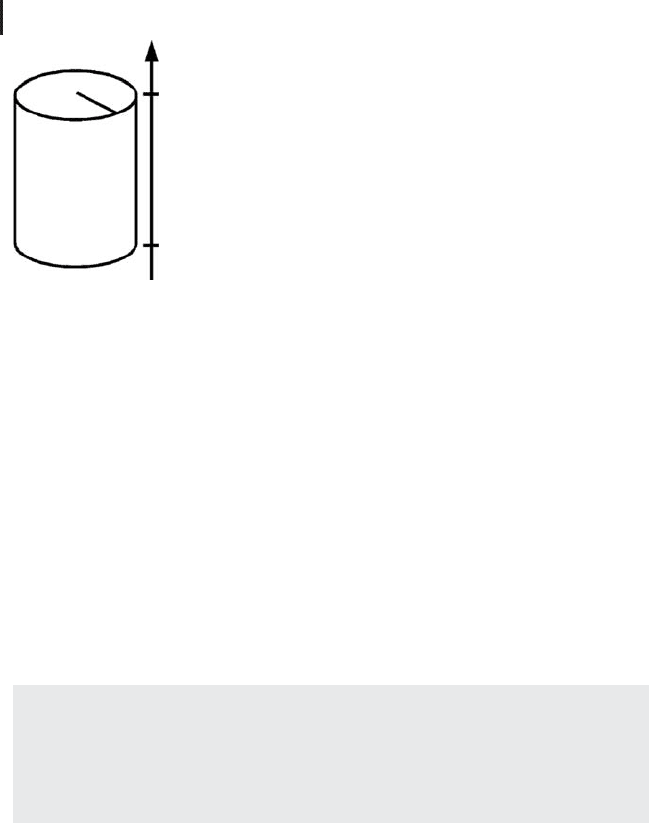
to know the mass X of some substance in the cylindrical tank of Figure 1.3, given
14 1 Principles of Mathematical Modeling
1m
x (m)
0
5
Fig. 1.3 Tank problem.
a constant concentration c of the substance in that tank. Then, a multiplication of
the tank volume with c gives the mass X of the substance, that is,
X = 5πc (1.1)
This means we apply a model (S, Q, M)whereS is the tank, Q asks for the mass
of the substance, and M is Equation 1.1. An example involving more than simple
algebraic operations is obtained if we assume that the concentration c in the tank of
Figure 1.3 depends on the height coordinate, x. In that case, Equation 1.1 turns into
X = π ·
5
0
c(x) dx (1.2)
This involves an integral, that is, we have entered the realms of calculus now.
Note 1.5.2 (Notational convention) Variables such as X and c in Equation 1.1,
which are used without further specification are always assumed to be real
numbers, and functions such as c(x) in Equation 1.2 are always assumed to be
real functions with suitable ranges and domains of definition (such as c : [0, 5]
→ R
+
in the above example) unless otherwise stated.
In many mathematical models (S, Q, M) involving calculus, the question Q asks
for the optimization of some quantity. Suppose for example we want to minimize
the material consumption of a cylindrical tin having a volume of 1 l. In this case,
M ={πr
2
h = 1, A = 2π r
2
+ 2πrh → min} (1.3)
canbeusedtosolvetheproblem.Denotingbyr and h the radius and height of the
tin, the first statement in Equation 1.3 expresses the fact that the tin volume is 1 l.
The second statement requires the surface area of the tin to be minimal, which is
equivalent to a minimization of the metal used to build the tin. The mathematical