
Velten K. Mathematical Modeling and Simulation: Introduction for Scientists and Engineers
Подождите немного. Документ загружается.


2.1 Elementary Statistics 55
S =
{
x ∈ R|0 ≤ x < 15
}
of this example indeed involves an infinite number of
continuously distributed possible results between 0 and 15 min. In this case, the
following formula can be used [19]:
Proposition 2.1.2 (Relative frequency approximation) Assume that a given
procedure is repeated n times, and let f
n
(A) denote the relative frequency with
which an event A occurs. Then,
P(A) = lim
n→∞
f
n
(A) (2.8)
This means that if we, for example, want to approximate the probability of bus
waiting times between 0 and 2 min (i.e. the probability of A = [0, 2[), the following
approximation can be used
P(A) ≈ f
n
(A) (2.9)
and the quality of this approximation will increase as n is increased.
2.1.2.3 Densities and Distributions
There is another important approach that can be used to compute probabilities,
which is based on an observation that can be made if a random process is repeated
a great number of times. Let X be a continuous random variable with sample
space S ⊂ R, and let us consider two disjunct events [a
1
, b
1
], [a
2
, b
2
] ⊂ S,thatis,
[a
1
, b
1
] ∩[a
2
, b
2
] =∅. Then, suppose that X has been observed n ∈ N times, and
that the same number of observations has been made within [a
1
, b
1
]and[a
2
, b
2
].
Now assume that b
2
− a
2
> b
1
− a
1
. Then, we can say that observations near the
interval [a
1
, b
1
] are more likely compared to observations near the interval [a
2
, b
2
],
since the same number of observations was made in each of the two intervals
although [a
1
, b
1
] is smaller. If m is the number of observations made in each of the
intervals, then this difference can be made precise as follows:
m/n
b
1
− a
1
>
m/n
b
2
− a
2
(2.10)
In this equation, m/n approximates the probability of either of the two events
[a
1
, b
1
]and[a
2
, b
2
] in the sense of Proposition 2.1.2. These probabilities are the same
for both events, but a difference is obtained if they are divided by the respective
sizes of the two intervals, which leads to a quantity known as probability density.
Basically, you can expect more observations within intervals of a given size in
regions of the sample space having a high probability density.
Figure 2.1 shows what happens with the probability density if a random exper-
iment (which is based on a ‘‘normally distributed’’ random variable in this case,
see below) is repeated a great number of times. The figure is a result of the code
RNumbers.r which you find in the book software (Appendix A), and which can
be used to simulate a random experiment (more details on this code will follow
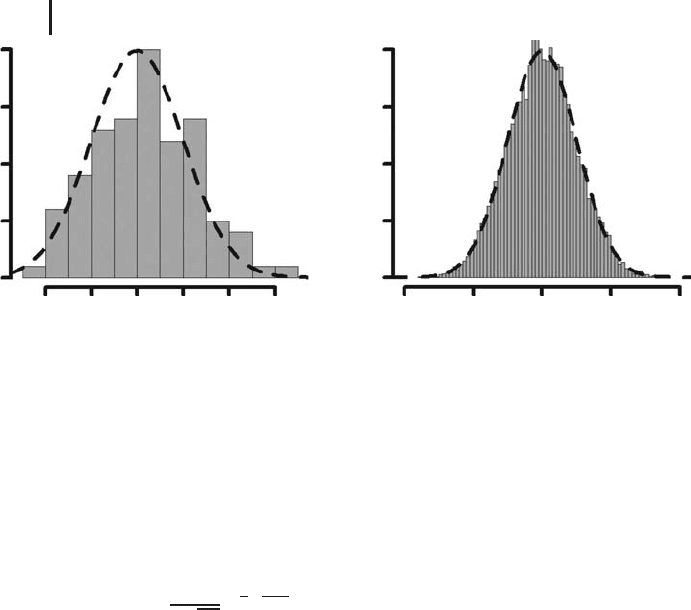
56 2 Phenomenological Models
Probability density
Probability density
4
3
2
1
0
4
3
2
1
0
19.8 19.9 20.0 20.1 20.2 20.3 19.6
19.8 20.0 20.2
20.4
XX
(a) (b)
Fig. 2.1 Probability density distributions computed using
RNumbers.r with (a) n = 100 and (b) n = 10 000.
further below). Figure 2.1a and b shows the distribution of the probability density
as a histogram for two cases where the random experiment is repeated (i) 100 and
(ii) 10 000 times. Basically, what can be seen here is that as n is increased, the
probability density approaches the ‘‘bell-shaped’’ function that is indicated by the
dashed line in the figure, and that can be expressed as:
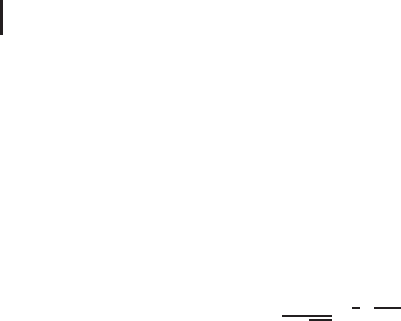
f (x) =
1
σ
√
2π
e
−
1
2
x−μ
σ
2
(2.11)
with μ = 20 and σ = 0.1 in this case. This function is an example of a probability
density function. Probability density functions characterize the random behavior of
a random variable, that is, the behavior of a random variable can be predicted once
we know its probability density function. For example, given a probability densitiy
function f of a random variable X with sample space S ⊂ R, the probability of an
event [a, b] ⊂ S can be computed by the following integral [37]:
P(a ≤ X ≤ b) =
b
a
f (t) dt (2.12)
Alternatively, the function
F(x) = P(X ≤ x) =
x
−∞
f (t) dt (2.13)
is also often used to characterize the behavior of a random variable. It is called
the probability distribution of the random variable. Basically, probability density
functions or probability distributions provide a compact way to describe the
behavior of a random variable. The probability density function in Equation 2.11,
for example, describes the behavior of the random variable based on only two

2.1 Elementary Statistics 57
parameters, μ and σ (more details on this distribution and its parameters will
follow below).
Probability density functions always satisfy f (t) ≥ 0and,ifS = R,
∞
−∞
f (t) dt = 1 (2.14)
that is, the area under the probability density function is always 1 (note that
otherwise Equation 2.12 would make no sense).
2.1.2.4 The Uniform Distribution
The probability density function of the bus waiting time (see above) is
f (x) =
⎧
⎨
⎩
1
15
if x ∈ [0, 15[
0 otherwise
(2.15)
that is, in this case the probability density is constant. As discussed above, this
expresses the fact that the same number of observations can be expected within any
interval of a given length within [0, 15]. This makes sense in the bus-waiting-time
example since each particular waiting time between 0 and 15 min is equally likely.
Using Equations 2.12 and 2.15, we can, for example, compute the probability of
waiting times between 3 and 5 min as follows:
P(3 ≤ X
2
≤ 5) =
5
3
f (t) dt =
1
15
· (5 −3) =
2
15
(2.16)
Equation 2.15 is the probability density function of the uniform distribution,which
is written generally as
f (x) =
⎧
⎨
⎩
1
b − a
if x ∈ [a, b[
0 otherwise
(2.17)
It is easy to show that the area under this probability density function is 1 as
required by Equation 2.14.
2.1.2.5 The Normal Distribution
Random variables that can be described by the probability density function in
Equation 2.11 are said to have the normal distribution, which is also known as the
Gaussian distribution since it was discovered by C.F. Gauss. In a sense, one can say
that the normal distribution is called normal since it is normal for random processes
to be normally distributed...A great number of random processes in science and
engineering can be described using this distribution. This can be theoretically
justified based on the central limit theorem, which states that the distribution of a
sum of a large number of independent and identically distributed random variables
can be approximated by the normal distribution (see [37] for details).
58 2 Phenomenological Models
Let us use the notation X ∼ N(μ, σ ) for a random variable X that is normally
distributed with parameters μ and σ (see Equation 2.11; more on these param-
eters will follow in the next section). Remember that a measurement device was
discussed at the beginning of this section, and that we were asking the follow-
ing question: with what probability will the deviation of the measurement value
from the true value be smaller than some specified value such as 0.1? Assum-
ing that the true value of the measured quantity is 20, and assuming normally
distributed measurement errors (which is typically true due to the central limit
theorem), this question can now be answered using Equations 2.11 and 2.12 as
follows:
P(19.9 ≤ X ≤ 20.1) =
20.1
19.9
1
σ
√
2π
e
−
1
2
x−μ
σ
2
dt (2.18)
Unfortunately, this integral cannot be solved in closed form, which means that
numerical methods must be applied to get the result (see Section 3.6.2 for a
general discussion of closed form versus numerical solutions). The simplest way
to compute probabilities of this kind numerically is to use spreadsheet programs
such as Calc. Calc offers a function
NORMDIST that can be used to compute values
either of the probability density function or of the distribution function of the
normal distribution. If F(x) is the distribution function of the normal distribution
(compare Equation 2.13), the above probability can be expressed as
P(19.9 ≤ X ≤ 20.1) = F(20.1) − F(19.9) (2.19)
which can be obtained using Calc as follows:
P(19.9 ≤ X ≤ 20.1) = NORMDIST(20.1;μ;σ ;1) −NORMDIST(19.9;μ;σ ;1)
(2.20)
For example, μ = 20 and σ = 0.1yieldP (19.9 ≤ X ≤ 20.1) ≈ 68, 3%.
We can now explain the background of the code
RNumbers.r that was used
above to motivate probability density functions. This code simulates a normally
distributed random variable based on R’s
rnorm command. The essential part of
this code is the line
out=rnorm(n,mu,sigma)
where rnorm is invoked with the parameters n (number of random numbers to
be generated),
mu and sigma (parameters μ and σ of Equation 2.11). R’s hist
and curve commands are used in RNumbers.r to generate the histogram and the
dashed curve in Figure 2.1, respectively (see the code for details).
2.1.2.6 Expected Value and Standard Deviation
Now it is time to understand the meaning of the parameters of the normal
distribution, μ and σ . Let us go back to the dice example, and let X
1
be the random

2.1 Elementary Statistics 59
variable expressing the result of the dice as before. Suppose two experiments are
performed:
Experiment 1
The dice is played five times. The result is: 5, 6, 4, 6, 5.
Experiment 2
The dice is played 10 000 times.
Analyzing Experiment 1 using the methods described in Section 2.1.1, you
will find that the average value is
x = 5.2 and the standard deviation is s ≈ 0.84.
Without knowing the exact numbers produced by Experiment 2, it is clear that the
average value and the standard deviation in Experiment 2 will be different from
x = 5.2ands ≈ 0.84. The relatively high numbers in Experiment 1, and hence, the
relatively high average value of
x = 5.2 has been obtained by chance only, and it
is clear that such an average value cannot be obtained in Experiment 2. If you get
a series of relatively high numbers such as the numbers produced in Experiment
1 as a part of the observations in Experiment 2, then it is highly likely that this
will be balanced by a corresponding series of relatively small numbers (assuming
a fair dice, of course). As the sample size increases, the average value of a sample
stabilizes toward a value that is known as the expected value of a random variable X
which is usually denoted as E(X)orμ, and which can be computed as
μ = E(X) =
1
6
· 1 +
1
6
· 2 +
1
6
· 3 +
1
6
· 4 +
1
6
· 5 +
1
6
· 6 = 3.5 (2.21)
in the case of the dice example. This means that we can expect x ≈ 3.5in
Experiment 2. The last formula can be generalized to
μ = E(X) =
n
i=1
p
i
x
i
(2.22)
if X is a discrete random variable with possible values x
1
, ..., x
n
having probabil-
ities p
1
, ..., p
n
. Analogously, the (sample) standard deviation of a sample stabilizes
toward a value that is known as the standard deviation of a random variable X which
is usually denoted as σ , and which can be computed as
σ =
n
i=1
p
i
(x
i
− μ)
2
(2.23)
for a discrete random variable. This formula yields σ ≈ 2.92 in the dice example,
that is, we can expect s ≈ 2.92 in Experiment 2. For a continuous random variable

60 2 Phenomenological Models
with probability density function f , the expected value and the standard deviation
can be expressed as follows [37]:
μ =
∞
−∞
t · f (t) dt (2.24)
σ =
∞
−∞
(t − μ)
2
· f (t) dt (2.25)
As suggested by the notation of the parameters μ and σ of the normal distribution,
it can be shown that these parameters indeed express the expected value and
the standard deviation of a random variable that is distributed according to
Equation 2.11.
2.1.2.7 More on Distributions
Beyond the uniform and normal distributions discussed above, there is a great
number of distribution functions that cannot be discussed in detail here, such as
Student’s t-distribution (which is used e.g. to estimate means of normally distributed
variables) or the gamma distribution (which is used e.g. to describe service times
in queuing theory [38]). Note also that all distribution functions considered so far
were referring to continuous random variables. Of course, the same concept can
also be used for discrete random variables, which leads to discrete distributions.An
important example is the binomial distribution, which refers to binomial random
processes which have only two possible results. Let us denote these two results by
0 and 1. Then, if p is the (fixed) probability of getting a 1 and the experiment is
repeated n times, the distribution function can be written as
F(x) = P(X ≤ x) =
floor(x)
j=0
n
j
p
j
(1 −p)
n−j
(2.26)
where floor(x) returns the highest integer less than or equal to x. See [19, 37] for
more details on the binomial distribution and on other discrete distributions.
2.1.3
Inferential Statistics
While the methods of descriptive statistics are used to describe data, the methods
of inferential statistics, on the other hand, are used to draw inferences from data (it
is as simple as that ...). This is a big topic. Within the scope of this book, we will
have to confine ourselves to a treatment of some basic ideas of statistical testing
that are required in the following chapters. Beyond this, inferential statistics is e.g.
concerned with the estimation of population parameters such as the estimation of
the expected value from data, see [19, 37] for more on that.

2.1 Elementary Statistics 61
2.1.3.1 Is Crop A’s Yield Really Higher?
Suppose the following yields of crops A and B have been measured (in g):
Crop A: 715, 683, 664, 659, 660, 762, 720, 715
Crop B: 684, 655, 657, 531, 638, 601, 611, 651
Thesedataareinthefile
crop.csv in the book software (Appendix A). The
average yield is 697.25 for crop A and 628.5 for crop B, and one may therefore be
tempted to say that crop A yields more than crop B. But we need to be careful: can
we be sure that crop A’s yield is really higher, or is it possible that the difference
in the average yields is just a random effect that may be the other way round
in our next experiment? And if the data indeed give us a good reason to believe
that crop A’s yield is higher, can the certainty of such an assertion be quantified?
Questions of this kind can be answered by the method of statistical hypothesis
testing.
2.1.3.2 Structure of a Hypothesis Test
Statistical hypothesis tests that are performed using software (we do not discuss
the traditional methods here, see [19, 37] for that) usually are conducted along the
following steps:
•
Select the hypothesis to be tested: the null hypothesis,often
abbreviated as H
0
.
•
Depending on the test that is performed, you may also have to
select an alternative hypothesis, which is assumed to hold true if
the null hypothesis is rejected as a result of the test. Let H
1
be
this alternative hypothesis, or let H
1
be the negation of H
0
if no
alternative hypothesis has been specified.
•
Select the significance level α, which is the probability to
erroneously reject a true H
0
as a result of the test. Make α small
if the consequences of rejecting a true H
0
are severe. Typical
choices are α = 0.1, α = 0.05, or α = 0.01.
•
Collect appropriate data and then use the computer to perform
an appropriate test using the data. As a result of the test, you will
obtain a pvalue(see below).
•
If p <α, reject H
0
.Inthiscase,H
1
is assumed to hold true, and
H
1
as well as the test itself are said to be statistically significant at
the level α.
Note that in the case of a nonsignificant test (p ≥ α), nothing can be derived
from the test. In particular – and you need to be careful regarding this point – the
fact that we do not reject H
0
in this case does not mean that it has been proved by
the test that H
0
is true. The p value can be defined as follows [37]:

62 2 Phenomenological Models
Definition 2.1.4 (P value)
The p value (or observed significance level) is the smallest level of significance at
which H
0
would be rejected when a specified test procedure is used on a given
dataset.
In view of the above testing procedure, this definition may seem somewhat
tautological, so you should note that the ‘‘test procedure’’ in the definition refers
to the mathematical details of the testing procedure that cannot be discussed here,
see [19, 37].
A hypothesis test may involve two main types of errors: a type I error,wherea
true null hypothesis is rejected, and a type II error, which is the error of failing to
reject a null hypothesis in a situation where the alternative hypothesis is true. As
mentioned above, α is the probability of a type I error, while the probability of a
type II error is usually denoted with β. The inverse probability 1 − β,thatis,the
probability of rejecting a false null hypothesis is called the power of the test [19, 37].
2.1.3.3 The t test
Coming back to the problem discussed in Section 2.1.3.1 above, let X
1
and X
2
denote the random variables that have generated the data of crop A and crop B,
respectively, and let μ
1
and μ
2
denote the (unknown) expected values of these
random variables. Referring to the general test structure explained in the last
section, let us define the data of a statistical test as follows:
•
H
0
: μ
1
= μ
2
•
H
1
: μ
1
>μ
2
•
α = 0.05
Now a ttestcan be used to get an appropriate p value [37]. This test can be
performed using the program
TTest.r in the book software (Appendix A). If you
run this program as described in Appendix B, it will produce a few lines of text
in which you will read ‘‘p value = 0.00319’’. Since this is smaller compared to the
significance level α assumed above, H
0
is rejected in favor of H
1
, and hence the
test shows what is usually phrased as follows: ‘‘The yield of crop A is statistically
significantly higher (at the 5% level) compared to crop B.’’ Note that this analysis
assumes normally distributed random variables, see [19, 37] for more details.
The main command in
TTest.r that does the computation is t.test,whichis
used here as follows:
t.test(Dataset$x, Dataset$y
,alternative="greater",paired=FALSE)
Dataset$x and Dataset$y are the data of crop A and crop B, respectively, which
TTest.r reads from crop.csv using the read.table command (see TTest.r
for details). alternative can be set to alternative="less" if H
1
: μ
1
<μ
2
is
used, and to
alternative="two.sided" inthecaseofH
1
: μ
1
= μ
2
. For obvious

2.1 Elementary Statistics 63
reasons, t tests using H
1
: μ
1
<μ
2
or H
1
: μ
1
>μ
2
are also called one-sided t tests,
whereas t tests using H
1
: μ
1
= μ
2
are called two-sided t tests. paired must be set
to true if each of the x values has a unique relationship with one of the y values, for
example, if x is the yield of a fruit tree in year 1 and y is the yield of the same tree in
year 2. This is a paired t test, whereas the above crop yield example – which involves
no unique relationships between the data of crop A and crop B – is called an
independent t test [37]. R’s
t.test command can also be used to perform one-sample
ttestswhere the expected value of a single sample (e.g. the concentration of an
air pollutant) is compared with a single value (e.g. a threshold value for that air
pollutant). Note that t tests can also be accessed using the ‘‘Statistics/Means’’ menu
option in the R Commander.
2.1.3.4 Testing Regression Parameters
A detailed treatment of linear regression will follow below in Section 2.2. At this
point, we just want to explain a statistical test that is related with linear regression.
As we will see below, linear regression involves the estimation of a straight line
y = ax + b or of a hyperplane y = a
0
+ a
1
x
2
+···+a
n
x
n
from data. Let us focus
on the one-dimensional case, y = ax + b (everything is completely analogous in
higher dimensions). In the applications, it is often important to know whether a
variable y depends on another variable x . In terms of the model y = ax + b,the
question is whether a = 0(i.e.y depends on x)ora = 0(i.e.y does not depend on
x). To answer this question, we can set up a statistical hypothesis test as follows:
•
H
0
: a = 0
•
H
1
: a = 0
•
α = 0.05
For this test, the line labeled with an ‘‘x’’ in the regression output in Figure 2.2a
reports a p value of p = 0.00318. This is smaller than α = 0.05, and hence we
can say that ‘‘a is statistically significantly different from zero (at the 5% level)’’,
which means that y depends statistically significantly on x.Inasimilarway,thep
value p = 0.71713 in the line labeled with ‘‘Intercept’’ in the regression output in
Figure 2.2a refers to a test of the null hypothesis H
0
: b = 0, that is, this p value can
be used to decide whether the intercept of the regression line (i.e. the y value for
x = 0) is significantly different from zero. Note that this analysis assumes normally
distributed random variables, and note also that a and b have been used above to
denote the random variables that are generating the slope and the intercept of the
regression line if the regression procedure described in Section 2.2 is performed
based on sample data.
2.1.3.5 Analysis of Variance
The regression test discussed in the previous section can be used to decide
about the dependence of y on x in a situation where x is expressed in terms of
numbers, which is often phrased like this: ‘‘x is at the ratio level of measurement’’
[19]. If x is expressed in terms of names, labels, or categories (the nominal
level of measurement), the same question can be answered using the analysis of

64 2 Phenomenological Models
variance, which is often abbreviated as anova. As an example, suppose that we
want to investigate whether fungicides have an impact on the density of fungal
spores on plants. To answer this question, three experiments with fungicides
A, B, and C and a control experiment with no treatment are performed. Then,
these experiments involve what is called a factor x which has the factor levels
‘‘Fungicide A’’, ‘‘Fungicide B’’, ‘‘Fungicide C’’, and ‘‘No Fungicide’’. At each of
these factor levels, the experiment must be repeated a number of times such
that the expected values of the respective fungal spore densities are sufficiently
characterized.
Theresultsofsuchanexperimentcanbefoundinthefile
fungicide.csv
in the book software (see Appendix A). Note that the ‘‘Factor’’ column of this
file corresponds to x, while the ‘‘Value’’ column corresponds to y (it reports the
result of the measurement, i.e. the density of the fungal spores on the plants in
an appropriate unit that we do not need to discuss here). Let X
1
, X
2
, X
3
,andX
4
denote the random variables that have generated these data, and let μ
1
, μ
2
, μ
3
,and
μ
4
denote the expected values of these random variables. Then, we can set up a
hypothesis test as follows:
•
H
0
: μ
1
= μ
2
= μ
3
= μ
4
•
H
1
:Therearei, j ∈{1, 2, 3, 4} s.t. μ
i
= μ
j
•
α = 0.05
Basically, H
0
says that the factor x does not have any impact on the fungal spore
density y, while the alternative hypothesis H
1
is the negation of H
0
. An appropriate
p value for this test can now be computed using the R program
Anova.r in the
book software, which is based on R’s
anova command. If you run this program
as described in Appendix B, it will produce a few lines of text in which you read
‘‘Pr(>F) = 0.000376’’, which means p = 0.000376. Again, the test is significant
since we have p <α.Hence,H
0
can be rejected and we can say that the factor
‘‘fungicide’’ has a statistically significant impact on the fungal spore density (again,
at the 5% level).
Note that this analysis assumes random variables that are normally dis-
tributed and which have homogeneous variances (i.e. squared standard devi-
ations), see [19, 37] for more details. The above example is called a one-way
analysis of variance or single-factor analysis of variance since it involves one
factor x only. R’s
anova command and the Anova.r code can also be ap-
plied to situations with several factors x
1
, ..., x
n
, which is called a multiway
analysis of variance or multifactor analysis of variance. Note that when you per-
form a multiway analysis of variance using
Anova.r,youwillhavetousea
data file which provides one column for each of the factors, and one more
column for the measurement value. What we have described so far is also
known as the fixed-effects model of the analysis of variance. Within the gen-
eral scope of the analysis of variance, a great number of different modeling
approaches can be used, for example, random effects models which assume a
hierarchy of different populations whose differences are constrained by the hierar-
chy [39].