
Velten K. Mathematical Modeling and Simulation: Introduction for Scientists and Engineers
Подождите немного. Документ загружается.

3.10 More Examples 215
it is not really surprising that such a fundamental relation from enzyme kinetics
is used here since a number of enzyme-mediated reactions is involved in the
metabolization of nitrogen by the yeast cells [124].
Equation 3.284 is appropriate under largely isothermal conditions. Since we want
to consider the temperature as a (nonconstant) control variable here, the effects
of the temperature on μ
max
need to be taken into account, which can be done as
follows [122, 124, 125]:
μ
max
(T) = 0.18 · exp
14 200 ·
T − 300
300RT
− 0.0054 · exp
121 000 ·
T − 300
300RT
(3.286)
Here, R = 8.314472 J · K
−1
· mol
−1
is the universal gas constant. The death
constant k
d
depends on the ethanol concentration E(t). In [121], the following
expression is used
k
d
= k · E (3.287)
The last equations describe the dynamics of the viable yeast cell concentration,
X(t). In these equations, we needed the nitrogen concentration, N(t), and the
ethanol concentration, E(t). This means we need equations characterizing N(t)and
E(t). Let us begin with an ODE describing the dynamics of E(t).
3.10.2.3 Ethanol and Sugar
Cramer describes the ethanol production rate proportional to the available amount
of yeast cells, that is,
dE
dt
= βX (3.288)
where, similar to Equation 3.284, the specific ethanol production rate β depends
on the available sugar concentration, S(t):
β = β
max
·
S
K
S
+ S
(3.289)
Again, the last two equations hold for essentially isothermal conditions, and a
temperature dependence of β
max
needs to be taken into account here. Following
[122], we use an expression derived from data in [121, 126]:
β
max
(T − 273.15) = β
max,24
◦
C
· (0.00132 ·T
2
+ 0.00987 · T − 0.00781)
(3.290)
It remains to describe N(t)andS(t) that are used in the last equations. As discussed
above, the dynamics of the sugar concentration S(t ) is intimately related with the

216 3 Mechanistic Models I: ODEs
ethanol production by the yeast cells. This is reflected by the fact that an ODE very
similar to Equation 3.288 can be used to describe the sugar dynamics [121]:
dS
dt
=−
β
Y
ES
X (3.291)
In this equation, the coefficient Y
ES
describes the stoichiometric bioconversion
of sugar into ethanol.
3.10.2.4 Nitrogen
Remember that we wanted to use N(t ) as one of our control variables. In practice,
any kind of fine tuning of N(t) is hard to achieve. Even the measurement of nitrogen
levels – which would be an essential prerequisite of controlling N(t) levels – is a
very difficult task [122, 124]. Nevertheless, nitrogen is an important variable in
this process and people try to make sure that there is sufficient nitrogen in the
fermenter. Since they usually do not know the actual nitrogen level N(t), this
is done largely in a ‘‘black box fashion’’, which means that nitrogen is added
to the fermenter at times which have proven to be reasonable based on the
experience made in previous fermentations. Let us denote with N
i
add
the nitrogen
concentrations added at times t
i
add
(i = 1, ..., n). From the process engineers point
of view, these are the nitrogen control variables, and they give rise to an essentially
unknown dynamics of N(t). One of the benefits of the model described here is that
based on the nitrogen levels computed by the model, the process engineer can at
least gain a qualitative idea of the effects that the nitrogen additions have on N(t).
Note 3.10.1 (Qualitative optimization) In a situation where an exact quan-
titative determination of a state variable cannot be achieved, mechanistic
mathematical models often provide information about its qualitative behav-
ior, which can be used for optimization. Such a ‘‘qualitative optimization’’ of
a process is a definite step beyond pure ‘‘black box optimization’’ based on
phenomenological models.
Since N(t) is required in the above equations, it must be computed based on the
nitrogen additions N
i
add
at times t
i
add
. To do this, we start with Cramer’s nitrogen
balance equation as follows:
dN
dt
=−
μ
Y
XN
· X (3.292)
This equation is based on the assumption that nitrogen is consumed proportional
to the growth rate of yeast. The yield coefficient Y
XN
is used to convert from nitrogen
to yeast biomass. Now the nitrogen additions N
i
add
at times t
i
add
must be incorporated
into the equations. Unfortunately, R’s
lsoda does not provide us with an option that
would allow us to impose a discontinuous change of N(t)byanamountofN
i
add
at
times t
i
add
. Principally, this could be done by splitting the overall integration interval
3.10 More Examples 217
[0, T]intosubintervals[0,t
1
add
], [t
1
add
, t
2
add
], and so on, applying lsoda separately to
each of the subintervals and using appropriate settings of the initial values that
account for the nitrogen additions N
i
add
. In our case, a more elegant and sufficiently
accurate alternative is the assumption that the nitrogen additions are not given
instantaneously, but at a constant rate over 1 h. This turns Equation 3.292 into
dN
dt
= r(t) −
μ
Y
XN
· X (3.293)
where
r(t) =
N
i
add
if t
i
add
−
1
2
< t < t
i
add
+
1
2
, i = 1, ..., n
0 else
(3.294)
The overall model is a system of four ODEs that can be summarized as follows:
Wine fermentation model
dX
dt
= μ(T, N) · X − k · E · X (3.295)
dN
dt
= r(t) −
1
Y
XN
· μ(T, N) ·X (3.296)
dE
dt
= β(T, S) · X (3.297)
dS
dt
=−
1
Y
ES
β(T, S) ·X (3.298)
We have used the notations μ(T, N)andβ(T, S) to emphasize the nonlinear
dependence of these parameters on their arguments as discussed above.
3.10.2.5 Using a Hand-fit to Estimate N
0
Now let us see if the above model is capable to reproduce the concrete fermentation
data in Figure 3.18. In this fermentation, the temperature has been varied between
12 and 18
◦
C by the process engineers (Figure 3.18), and nitrogen has been added
at two times during the fermentation (see t
i
add
and N
i
add
in Table 3.4). As a result of
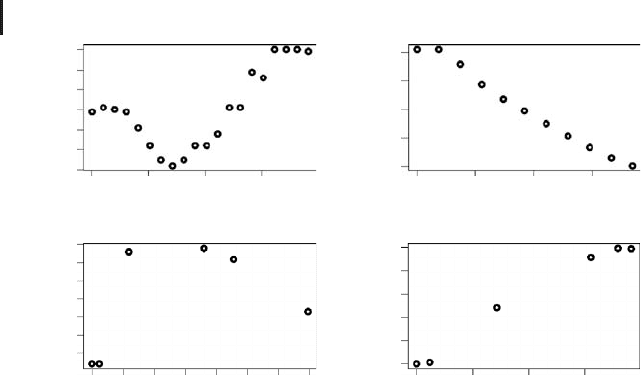
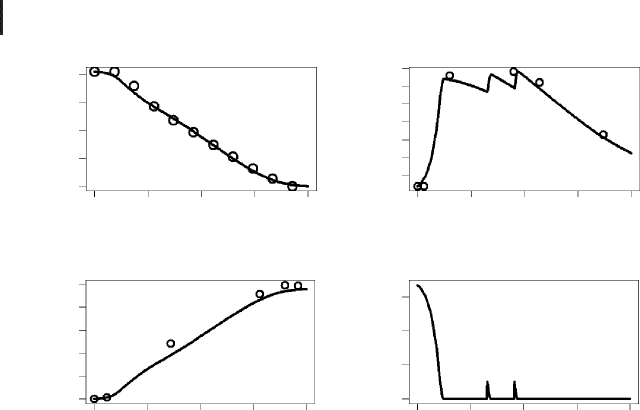
these measures, the figure shows data of X(t), E (t)andS(t). As it was mentioned
above, the measurement of N(t) is difficult and this is why no nitrogen data are
available from this trial. Figure 3.18 was produced using the program Fermentation.r
in the book software (set
PlotData=TRUE in the ‘‘Program Control Parameters’’
section).
Fermentation.r will now also be used to solve the ODE system, Equations
3.295–3.298, and to estimate parameters of these equations from the data. This
code has been derived by an appropriate editing of
ODEFitEx1.r (Section 3.9.1).
Some data handling aspects of
Fermentation.r closely related to the parameter
218 3 Mechanistic Models I: ODEs
0 100
t (h)
18
16
200
100
150
50
0
Temperature (°C)
Sugar (g l
−1
)
14
12
3.5
2.5
80
100
60
40
20
0
Cell biomass (g l
−1
)
Ethanol (g l
−1
)
1.5
0.5
0 50 100 150 200 250 300 350 0 100 200 300
200 300
0 100
t (h)
t (h) t (h)
200 300
Fig. 3.18 Wine fermentation data from [122]. See fermentation.csv in the book software.
estimation procedure have already been discussed in Section 3.9.2.2. Other aspects
of that code that are more closely related with the wine fermentation model
are addressed below. See also the discussion of
ODEEx1.r and ODEEx2.r in
Section 3.8.3 for more information on the general way how you should work with
this kind of codes.
Fermentation.r is based on Equations 3.295–3.298 and uses
the parameter values given in Table 3.4.
Looking at the table, you will note that there are two unknown parameters: k
and N
0
. N
0
is hard to measure because it refers to the yeast available nitrogen
that cannot be easily characterized experimentally [122, 128]. Regarding k, [121]
suggests a value of k = 10
−4
l/g ethanol/h for a temperature of 24
◦
C. This value
could have been used here as a fixed value in the simulations, but [122] says it
is better to estimate k from the data since this parameter is strongly temperature
dependent, and the temperatures in the trial investigated here are substantially
below 24
◦
C (Figure 3.18). Therefore, both N
0
and k are estimated from the data in
Fermentation.r using the procedure explained in Section 3.9.
First of all, starting values of k and N
0
are needed as initial values for the
parameter estimation procedure, that is, values in the right order of magnitude.
As explained above, one can try to get such approximate values from the literature
and/or by a hand-fitting of the parameters until the solutions of the ODE system
are at least in the neighborhood of the data. Regarding k, we can use the literature
value k = 10
−4
mentioned above. Since we do not have any information on N
0
,
the hand-fitting procedure is used for this parameter. A hand-fit of N
0
(setting
NonlinRegress=FALSE and PlotStateData=TRUE in the ‘‘program control pa-
rameters’’ Section of
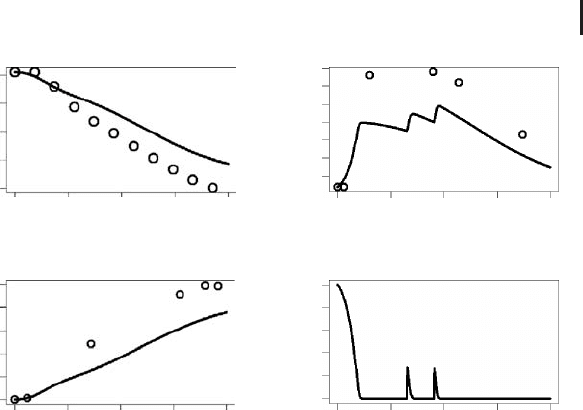
Fermentation.r) leads us, for example, to Figure 3.19,
which is obtained for k = 10
−4
and N
0
= 0.1.
3.10 More Examples 219
0 100
t (h)
200
100
150
3.5
2.5
1.5
0.5
Sugar (g l
−1
)
Cell biomass (g l
−1
)
50
0
80
100
60
40
0.08
0.04
0.00
Ethanol (g l
−1
)
Nitrogen (g l
−1
)
20
0
0 100 200 300 400 0 100 200 300 400
200 300 400 0 100
t (h)
t (h) t (h)
200 300 400
R
2
= 0.751
R
2
= 0.743
R
2
= 0.566
Fig. 3.19 Solution of Equations 3.295–3.298 using k = 10
−4
,
N
0
= 0.1 and the parameters in Table 3.4.
3.10.2.6 Parameter Estimation
The fine tuning of the parameters to be estimated can then be performed based on
R’s
nls function as discussed in Section 3.9, using k = 10
−4
and the hand-fitted
N
0
= 0.1asstartingvaluesofk and N
0
. Setting NonlinRegress=TRUE in the
‘‘program control parameters’’ section of
Fermentation.r, the result shown in
Figure 3.20 is obtained. As can be seen, a very good fit between the solution of
the ODE system and the data is obtained, with all R
2
values above 0.97. This is
a very good result since this is a fit between three nonlinear curves and data that
was obtained by a tuning of only two parameters. If you have achieved a result
like this, the next step is to test the predictive power of your model, applying it
to data not used for the parameter estimation. This has been done by Blank in
[122]. Blank shows that this model performs very well on unknown data in several
cases, although there are also datasets where the results are unsatisfactory – which
is not really surprising considering the aforementioned complexity of the wine
fermentation process. From the point of view of mathematical modeling, the latter
datasets producing the unsatisfactory results are the interesting ones, because they
give us hints for further improvements of the model.
Note that the relative and absolute tolerances
rtolDef and atolDef have both
been set to 10
−5
in Fermentation.r. This is based on the ‘‘rule of thumb’’
explained in Section 3.8.3.5: Considering the fact that the computations involve
nitrogen additions of 0.03 gl
−1
(see t
i
add
and N
i
add
in Table 3.4), it is clear that
atolDef must be smaller than 10
−2
. For example, we can set it to 10
−3
.Regarding
rtolDef, Figure 3.18 shows that the sugar and ethanol data have at least three
220 3 Mechanistic Models I: ODEs
0 100
t (h)
200
100
150
3.5
2.5
1.5
0.5
Sugar (g l
−1
)
Cell biomass (g l
−1
)
50
0
80
100
60
40
0.10
0.15
0.05
0.00
Ethanol (g l
−1
)
Nitrogen (g l
−1
)
20
0
0 100 200 300 400 0 100 200 300 400
200 300 400 0 100
t (h)
t (h) t (h)
200 300 400
R
2
= 0.996
R
2
= 0.984
R
2
= 0.976
Fig. 3.20 Solution of Equations 3.295–3.298 using the
estimated coefficients k = 6.637202 × 10
−5
and N
0
=
1.678096 × 10
−1
, and the parameters in Table 3.4.
significant digits, which means we should set rtolDef also, for example, to 10
−3
.
In
Fermentation.r, both tolerances were set to 10
−5
,thatis,twoordersof
magnitude smaller, which was based on the heuristical procedure for the choice
of
rtolDef and atolDef explained in Section 3.8.3.5 (a further decrease in the
tolerances below 10
−5
did not affect the result anymore).
3.10.2.7 Problems with Nonautonomous Models
Finally, let us look through Fermentation.r,focusingonnewaspectsinthis
code. As it was said above,
Fermentation.r was derived from ODEFitEx1.r
which was discussed in Section 3.9.1. Within Fermentation.r,theODEsystem
Equations 3.295–3.298 is defined in a function
dfn as follows:
1: dfn <-
2: function(t, y, p)
3: {
4: X=y[1]
5: N=y[2]
6: E=y[3]
7: S=y[4]
8: k=p[1]
9: dXdt=mu(T(t),N)*X-k*E*X
10: dNdt= r(t)-mu(T(t),N)*X/Yxn
11: dEdt=beta(T(t),S)*X
(3.299)

3.10 More Examples 221
12: dSdt=-beta(T(t),S)*X/Yes
13: list(c(dXdt,dNdt,dEdt,dSdt))
14: }
The general structure of the dfn function has been discussed in Section 3.8.3.
The correspondence between Equations 3.295–3.298 with lines 9–12 of program
3.299 is obvious. You may be irritated by the fact that the time dependence of
r(t) and T(t) is written explicitly in the code, while this is not done for the state
variables
X, N, E and S. This is related with the fact that Equations 3.295–3.298 are
a nonautonomous system of ODEs. As it was discussed in Section 3.5.3, this means
that at least one of the right-hand sides of these equations depends on t not only
(implicitly) via the state variables, but also via some explicitly given functions of t.
Looking at the equations, you see that all right-hand sides of the system depend
explicitly on the temperature T(t) or on the nitrogen supply rate r(t). When writing
down the
dfn function for nonautonomous ODEs, you must take care that only the
state variables are written without an explicit ‘‘
(t)’’, while all other time-dependent
function must be written similar to
T(t), r(t) and so on.
But even if you have done this correctly, you might run into another problem
characteristic of nonautonomous ODEs when you try to compute the numerical
solution. Remember our definition of the nitrogen supply rate in Equation 3.294.
In the above example, nitrogen is supplied at two times only, t
1
add
= 130 h and
t
2
add
= 181 h. Since the overall time interval in the example is from 0 to 400 h,
this means that the function r(t) defined in Equation 3.294 is almost everywhere
zero, except for two small 1-h intervals around t
1
add
= 130 h and t
2
add
= 181 h.
Remember also the discussion of
lsoda in Section 3.8: lsoda determines its
stepsize h automatically, choosing the stepsize as small as it is required by the error
tolerances, but not smaller. Now if
lsoda sets the stepsize relatively large around
t
1
add
= 130 h and t
2
add
= 181 h, it may happen that it ignores the nitrogen supply
rate r(t) in the sense that r(t) is never evaluated at one of its nonzero points. Then,
although you prescribe a substantial nitrogen supply in two small 1-h intervals
around t
1
add
= 130 h and t
2
add
= 181 h, you will not see this in the solution, that is,
the problem is solved by
lsoda in a way as if there would be no nitrogen supply
at all (r(t) = 0). Implementing the fermentation model yourself by an appropriate
editing of
ODEFitEx1.r, you will see that you get exactly this problem when you
do not apply appropriate measures to avoid this.
Note 3.10.2 (Problem with short external events) Numerical solutions of
nonautonomous ODE systems may ignore short external events (such as nitrogen
addition in the wine fermentation model).
The first and simplest thing that one can do is to prescribe a maximum stepsize
in
lsoda, which can be done using an argument of lsoda called hmax (see [108,
109] and R’s hep pages). Choosing
hmax sufficiently small, one can make sure that
r(t) is used in the computation as desired. For example,, based on
hmax=1/10, r(t)

222 3 Mechanistic Models I: ODEs
will be evaluated 10 times during each of those 2 h of nitrogen supply. Similar to
the heuristics for an optimal choice of the stepsize described above (Note 3.8.1),
one can then optimize the size of
hmax, making it small enough such that a further
decrease of
hmax does not affect your results, but not smaller since this would
further increase your computation times, roundoff errors and so on as discussed
in Section 3.8.
A second option that can avoid this unwanted ‘‘blindness’’ of
lsoda with respect
to r(t) lies in an appropriate choice of the time vector supplied in the call of
lsoda.
As it was mentioned in the above discussion of
ODEEx1.r,thetimevectorin
the call of
lsoda (line 2 in program 3.249) defines the times at which lsoda is
expected to generate numerical approximations of the state variables. Now if we
want
lsoda to ‘‘see’’ those 2 h where the nitrogen supply rate r(t) is different from
zero, we can define that time vector such that it involves several times within those
2 h. Exactly this has been done in
Fermentation.r, using a time vector supplied
to
lsoda called tInt. Check the definition of tInt in Fermentation.r to see
that it really does what has been described above.
3.10.2.8 Converting Data into a Function
The temperature T(t) in Equations 3.295–3.298 needs some special treatment since
it is not known as a mathematical function, but rather in the form of experimental
data (columns 1–2 in
fermentation.csv in the book software). The conversion
of such experimental data into a form that can be treated by software such as
lsoda
is a standard problem in the numerical treatment of ODEs, and it is usually solved
by a simple linear interpolation of the data. Denoting with (t
i
, T
i
)(i = 1, ..., n)the
experimental data, this means that T(t) is defined in each of the intervals [t
i−1
, t
i
]
(i = 2, ..., n) as follows:
T(t) = T
i−1
+
t − t
i−1
t
i
− t
i−1
· (T
i
− T
i−1
) (3.300)
3.10.2.9 Using Weighting Factors
The wine fermentation model is an example where it makes sense to use the
weighting factors w
ij
in the residual sum of squares, Equation 3.260 (Section 3.9.2).
As it was discussed there, weighting factors should be used in situations where
the measurement data cover several orders of magnitude. As Figure 3.18 shows,
the sugar and cell biomass data differ by about two orders of magnitude, and the
sugar and ethanol data cover two orders of magnitude. In [41] it is suggested that
aweightingw
ij
= 1/σ
2
i
j = 1, ..., m
i
should be used in this situation, where σ
i
is
the standard deviation of the measurement data referring to state variable i. [122]
reports the following values for the state variables of the wine fermentation model:
σ
X
= 0.1, σ
S
= 0.7, σ
E
= 0.7. This gives the weighting factors
w
X
=
1
σ
2
X
= 100 (3.301)

3.10 More Examples 223
w
S
=
1
σ
2
S
≈ 2 (3.302)
w
E
=
1
σ
2
E
≈ 2 (3.303)
Here, w
X
refers to all w
ij
in the residual sum of squares, Equation 3.260, where
i refers to X (similar for w
S
and w
E
). In Fermentation.r, this weighting is
prescribed in the ‘‘program control parameters’’ section as follows:
WhichData=c(1,1,50)
(3.304)
which means that X (third entry in WhichData) receives 50 times more weighting
compared to S and E (first and second entries in
WhichData). Looking into the call
of
nls further below in Fermentation.r,youcanseehowWhichData is used to
define an option of
nls called weights.
3.10.3
Pharmacokinetics
Most therapeutic drugs are ingested orally and then enter the blood stream via
gastrointestinal (GI) absorption. For a therapeutic drug to be effective, it is of
course important to know how fast the drug enters the blood stream, and how the
drug concentration changes depending on time. In (probably) the simplest possible
approach, we would just consider two state variables: G(t), the concentration of the
drug in the GI tract, and B(t), the concentration of the drug in the blood (we assume
units of micrograms per milliliter). If the application rate D(t) (micrograms per
milliliter per hour) expresses the drug dosage regime as seen by the GI tract, the
dynamics of the system can be described by the following ODE system [116, 129]:
G
(t) =−aG(t) +D (t) (3.305)
B
(t) = aG(t) − bB(t) (3.306)
Equation 3.306 says that the blood concentration B(t) grows proportionally to the
concentration in the GI tract, G(t), and it decays proportionally to B(t), where a
and b (per hour) are the constants of proportionality. The term aG(t) that describes
the increase of the blood concentration of the drug by absorption appears with an
inverse sign in Equation 3.305, expressing the mass balance of the drug in the
sense that precisely the amount of drug that enters the blood by absorption is lost
in the GI tract. Of course, the dosage D(t) causes an increase of G(t)andthus
appears with a ‘‘+’’-sign in Equation 3.305.
To show the qualitative behavior of the solution, we use the parameter settings
suggested in [116]: G(0) = B(0) = 0 (i.e. no drug has been applied before t = 0),
a = ln(2)/2, b = ln(2)/5, and
D(t) = 2 ·
10
n=0
H (t − 6n) − H
t −
6n +
1
2
(3.307)
224 3 Mechanistic Models I: ODEs
where H(x) is the Heaviside step function:
H (x) =
0ifx < 0
1ifx ≥ 0
(3.308)
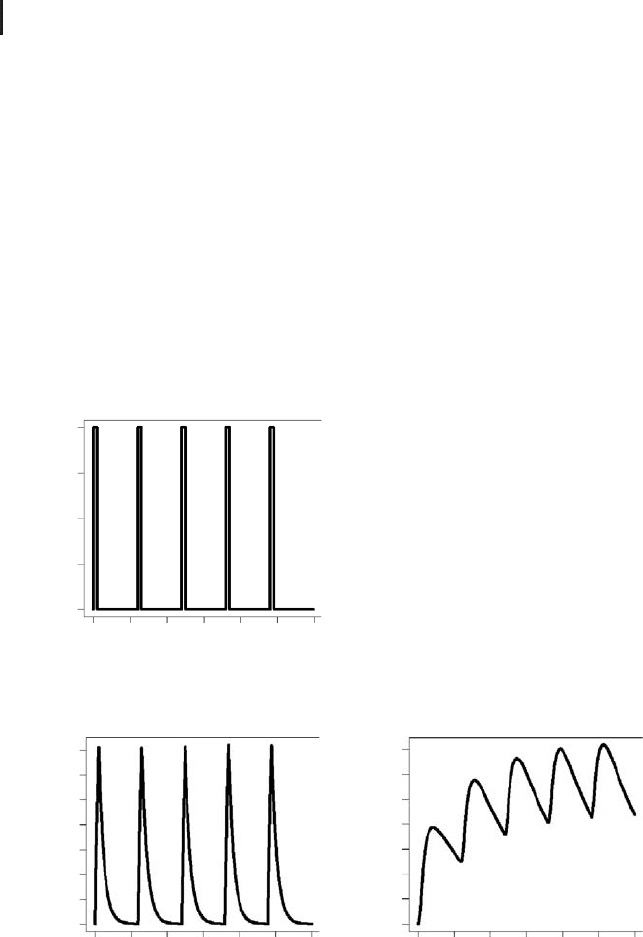
Equation 3.307 yields the drug dosage regime shown in Figure 3.21, which can
be thought of as representing a situation where the drug is applied every 6 h, for
example, at 6 a.m., 12 a.m., and 6 p.m. As can be seen in the figure (and as
it follows from Equation 3.307), it is assumed here that the drug is supplied at
a continuous rate of 2 μgml
−1
h
−1
, and that this rate is held constant for 1/2 h
after drug ingestion. Figure 3.22 shows the resulting patterns of B(t)andG(t)that
are obtained by a solution of the model, Equations 3.305 and 3.306. To solve the
mathematical problem, the code
ODEEx3.r hasbeenused.Thiscodeisapartof
the book software (see Appendix A), and it has been obtained by an editing of
ODEEx2.r, a similar code that has been discussed in Section 3.8.3 above.
t (h)
0 5 10 15 20 25 3
0
D (μg ml
−1
h
−1
)
0.0
0.5
1.0
1.5
2.0
Fig. 3.21 Assumed pattern of drug dosage D(t) corresponding to Equation 3.307.
0510
0.0
0.2
0.4
0.6
15 20 25 30
t (h)
G (μg ml
−1
)
0510
0.0
0.4
0.8
1.2
15 20 25 30
t (h)
(a) (b)
B (μg ml
−1
)
Fig. 3.22 Drug concentration (a) in the gastrointestinal tract and (b) in the blood.