
Velten K. Mathematical Modeling and Simulation: Introduction for Scientists and Engineers
Подождите немного. Документ загружается.


4.3 Some Theory You Should Know 245
hyperbolic PDEs are (in this order):
u
xx
+ u
yy
+···=0 (4.38)
u
xx
+ ...= 0 (4.39)
u
xx
− u
yy
+···=0 (4.40)
Referring to the standard form, one can, thus, say that elliptic PDEs are
characterized by the fact that they contain second-order derivatives with respect
to all independent variables, which all have the same sign when they are written
on one side of the equation. Parabolic PDEs involve one second-order derivative
and at least one first-order derivative. Note that Definition 4.1 requires that there
must be at least one first-order derivative in the ‘‘···’’ of Equation 4.39 (otherwise,
that equation would be an ODE). Finally, hyperbolic equations can be described
similar to elliptic equations except for the fact that the second-order derivatives
have opposite signs when brought on one side of the equation.
Comparing Equations 4.34 and 4.39, you see that the heat equation is an example
of a parabolic PDE. The stationary case of the two-dimensional heat equation (4.1)
is an example of an elliptic PDE. As was mentioned before, a stationary solution of
a PDE is a solution referring to the case where the time derivatives in the PDE
vanish. Solutions of this kind can usually be interpreted as expressing the state of
the system which is attained in a constant environment after a ‘‘very long’’ time
(mathematically, the state that is approached for t →∞). In this sense, stationary
solutions of the heat equation express the temperature distribution attained by a
system in a constant environment after a ‘‘very long’’ time. Using the index notation
for partial derivatives in Equation 4.1 and assuming T
t
= 0 in that equation, it turns
out that the two-dimensional stationary heat equation is
T
xx
+ T
yy
= 0 (4.41)
which corresponds to Equation 4.38, so we see that the stationary heat equation is
elliptic. Hyperbolic equations (Equation 4.40) are used to describe all kinds of wave
phenomena such as sound waves, light waves, or water waves [142].
Using appropriate methods of matrix algebra, the above classification of PDEs
into elliptic, parabolic, and hyperbolic PDEs can be generalized to multidimensions
(i.e. PDEs depending on x
1
, ..., x
n
) [142]. This classification is of particular impor-
tance in the numerical treatment of PDEs and will be discussed in Sections 4.6
and 4.8.
4.3.2
Initial and Boundary Conditions
Above we have seen that ODEs are usually solved by an entire family of solutions
unless initial or boundary conditions are imposed, which select one particular
solution among those many solutions (Section 3.7.1.1). For the same reason, initial

246 4 Mechanistic Models II: PDEs
or boundary conditions are used together with PDEs. From the mathematical
point of view, initial or boundary conditions are needed to make the mathematical
problem uniquely solvable. From the applications point of view, they are a necessary
part of the description of the system that is investigated. Considering Problem 1
in Section 4.1.3, for example, it is obvious from the applications point of view,
i.e. without any mathematical considerations, that this problem cannot be solved
unless we know the temperatures at the left and right ends of the cylinder (T
0
and T
1
) and the initial temperature distribution, T
i
(x). To solve Problem 1,wewill
use the one-dimensional form of the heat equation (4.33) (Section 4.6). Above we
have seen that this is a parabolic equation, and so we see here that this parabolic
equation requires a boundary condition referring to the spatial variable and an
initial condition referring to the time variable.
4.3.2.1 Well Posedness
Generally, the appropriate choice of initial and boundary conditions for PDEs can
be a subtle matter as discussed in [142]. It is related to the mathematical concept
of a well-posed problem, which was originally introduced by the French mathemati-
cian Hadamard. A well-posed differential equation problem satisfies the following
conditions [142]:
•
existence: a solution exists;
•
uniqueness: the solution is unique;
•
stability: the solution depends continuously on the data of the
problem.
Let us explain the last point referring to Problem 1 again. Assume a small change
in the temperature imposed at the left or right end of the cylinder, or small changes
in the initial temperature distribution. Then stability in the above sense means
that the change in the temperature distribution T(x, t) implied by your change
in the problem data should go to zero if you let the size of this change in the
data go to zero. This expresses our physical intuition, but you should know that
the discussion of stability matters and well-posedness matters in general can be
subtle (e.g. the appropriate definition of what is meant by ‘‘continuity’’). From a
mathematical point of view, we can thus say that initial or boundary conditions
have to be chosen in a way that makes the overall problem well posed in the above
sense.
4.3.2.2 A Rule of Thumb
The following ‘‘rule of thumb’’ for the proper selection of initial or boundary
conditions applies to many equations [138]:
Note 4.3.2 (Rule of thumb)
•
Elliptic equation: add a boundary condition
•
Parabolic equation: add a boundary condition for the space
variables and an initial condition at t = 0

4.3 Some Theory You Should Know 247
•
Hyperbolic equation: add a boundary condition and two initial
conditions at t = 0
Note that this is consistent with our above discussion of the initial and boundary
conditions of Problem 1, which was motivated by physical intuition. Generally, one
can say that physical intuition applied as above to Problem 1 frequently is a good
guideline for the proper choice of initial or boundary conditions.
Problem 2 from Section 4.1.3 gives us an example of boundary conditions for
an elliptic equation. In Section 4.9, this problem is solved using the stationary heat
equation. We have seen above that this is an elliptic equation in the two-dimensional
case (Section 4.3.1.3). Using appropriate methods of matrix algebra, the same can
be shown for the three-dimensional version of the stationary heat equation that is
used in the solution of Problem 2. Now looking at the formulation of Problem 2 in
Section 4.1.3, you see that this problem involves conditions for the space variables
at the boundary of the computational domain only, which is consistent with the
above ‘‘rule of thumb’’. Again, this is also consistent with physical intuition since
any change in the initial temperature distribution within the cube will certainly
affect the temperatures inside the cube for some time, but in the long run physical
intuition tells us that everything is determined by the constant conditions applied
at the boundaries of the cube and at its internal boundaries on the sphere surface
of Figure 4.1. For the hyperbolic case in the above ‘‘rule of thumb’’, appropriate
wave equation examples may be found in [138].
4.3.2.3 Dirichlet and Neumann Conditions
Note that two different kinds of boundary conditions are used in Problem 2.Onthe
top boundary of the cube and on the sphere surface, the value of the temperature is
prescribed. Boundary conditions that prescribe the values of the unknown function
of a PDE in this way are called Dirichlet boundary conditions. The remaining
boundaries of the cube are assumed to be ‘‘perfectly insulated’’ in Problem 2.
Perfect insulation means that there is no heat flow across these boundaries. Using
vector notation, this can be expressed as follows: Let S denote one of the cube
boundaries, and let q(x)(Wm
−2
) be the heat flow rate introduced in Section 4.2.
Then, if n(x) denotes the outward facing normal vector on S, q(x) ·n(x)(Wm
−2
)is
the (outward going) heat flow through S, which is zero since S is insulated:
q(x) ·n(x) = 0 x ∈ S (4.42)
Using Fourier’s law (Equation 4.6), this turns into
∂T
∂n
=∇T · n(x) = 0 x ∈ S (4.43)
where ∂T/∂n denotes the normal derivative of T with respect to n, which expresses
T’s rate of change in the direction of n. Boundary conditions that prescribe the

248 4 Mechanistic Models II: PDEs
normal derivative of the unknown function such as Equation 4.43 are called
Neumann boundary conditions.Ifu is the unknown function in a PDE defined on
adomain × I ⊂ R
n
× R and if S ⊂ ∂ is a subset of ’s boundary, the general
form of Dirichlet and Neumann boundary conditions in S can be written as [142]
Dirichlet: u(x, t) = f
1
(x, t)(x, t) ∈ S × I (4.44)
Neumann:
∂u(x, t)
∂n
= f
2
(x, t)(x, t) ∈ S × I (4.45)
where f
1
and f
2
are given real functions. Another frequently used boundary
condition is the Robin boundary condition, which specifies a linear combination of
u and ∂u/∂n as follows:
Robin: a(x, t)u(x, t) +b(x, t)
∂u(x, t)
∂n
= f
3
(x, t)(x, t) ∈ S × I (4.46)
Any of the above three boundary conditions is called homogeneous if its right-hand
side vanishes (e.g. f
1
(x, t) = 0), otherwise inhomogeneous. A homogeneous Neu-
mann condition (f
2
(x, t) = 0inEquation4.45)isalsoknownasano-flow condition.
Equation 4.43 is an example of such a homogeneous Neumann condition, which
forbids any heat flow through S as discussed above. Similar interpretations apply
in many other situations, and this is why the term ‘‘no-flow condition’’ is used.
Note that no-flow conditions can sometimes also be interpreted as expressing the
symmetry of a problem, and hence the term symmetry boundary condition is also
used. An example of this along with further explanations is given in Section 4.3.3.
Regarding Problem 1 and Problem 2 in Section 4.1.3, the above discussion can be
summarized as follows:
•
Problem 1 imposes an initial condition in the domain
0 < x < 1 and two Dirichlet conditions at x = 0andx = 1.
The Dirichlet condition at x = 0(orx = 1) is
inhomogeneous if a nonzero temperature is imposed there,
homogeneous otherwise.
•
Problem 2 imposes Dirichlet conditions at the top surface of
thecubeandatthespheresurface(homogeneousor
inhomogeneous Dirichlet conditions depending on the
actual values of T
c
and T
s
), and a homogeneous Neumann
condition (no-flow condition) at the remaining sides of the
cube.
4.3.3
Symmetry and Dimensionality
In practice, most PDEs cannot be solved in closed form, which means that they
are solved using numerical algorithms in most cases. The application of such
numerical algorithms can be extremely expensive in terms of computation time
and machine requirements such as memory or processor speed requirements [150].

4.3 Some Theory You Should Know 249
As has been already mentioned in Section 3.6.1, it may take several hours, days, or
even longer to solve complex coupled multidimensional PDE problems, even if you
are using supercomputers or large computer clusters (i.e. a great number of coupled
computers that work together to solve your problem). The continuous increase of
processor speeds and available memory does not change this situation since the
increase in computer power is accompanied by a similarly increasing complexity of
the problems that are solved. As faster computers become available, people begin
to solve problems that were beyond the scope of the old computer generation.
Therefore, the reduction of computation time and machine requirements is an
important issue in the solution of PDEs. As is explained below, a lot can be
achieved by the use of fast and efficient numerical algorithms, by the intelligent
use of these algorithms, and by using appropriate fast and efficient software.
But there is one thing you can do at an early stage before the application of
numerical algorithms: you can analyze the symmetry and dimensionality of your
problem.
Note 4.3.3 (Symmetry/dimensionality should be exploited) Based on a wise
consideration of symmetry and dimensionality, the complexity of a problem
and its computation time and machine requirements can often be substantially
reduced.
4.3.3.1 1D Example
To understand the point, consider the following Problem 3 (a modification of
Problem 2 discussed in Section 4.1.3):
Problem 3:
Referring to the configuration in Figure 4.4a and assuming
•
a constant temperature T
t
at the top surface of the cube (z = 1),
•
a constant temperature T
b
at the bottom surface of the cube
(z = 0),
•
and a perfect thermal insulation of all other surfaces of the cube,
what is the stationary temperature distribution T(x, y, z) within the cube?
It is simple to see that the solution of this problem will depend on z only, that
is, the resulting stationary temperature distribution will be of the form T(z)(see
the discussion of Problem 2 in Section 4.1.3 to understand what is meant by the
term ‘‘stationary temperature distribution’’). If there would be any temperature
differences in some given plane z = a inside the cube (0 ≤ a ≤ 1), then there
would be a point (x, y, a) in that plane where we would have either
∂T(x ,y,a)
∂x
= 0or
∂T(x ,y,a)
∂y
= 0. This would initiate a heat flow according to Fourier’s law (Equation
4.6), which would then tend to flatten out the temperature gradient at that point
until
∂T(x ,y,a)
∂x
=
∂T(x ,y,a)
∂y
= 0 would be achieved in the stationary limit. Similar to the
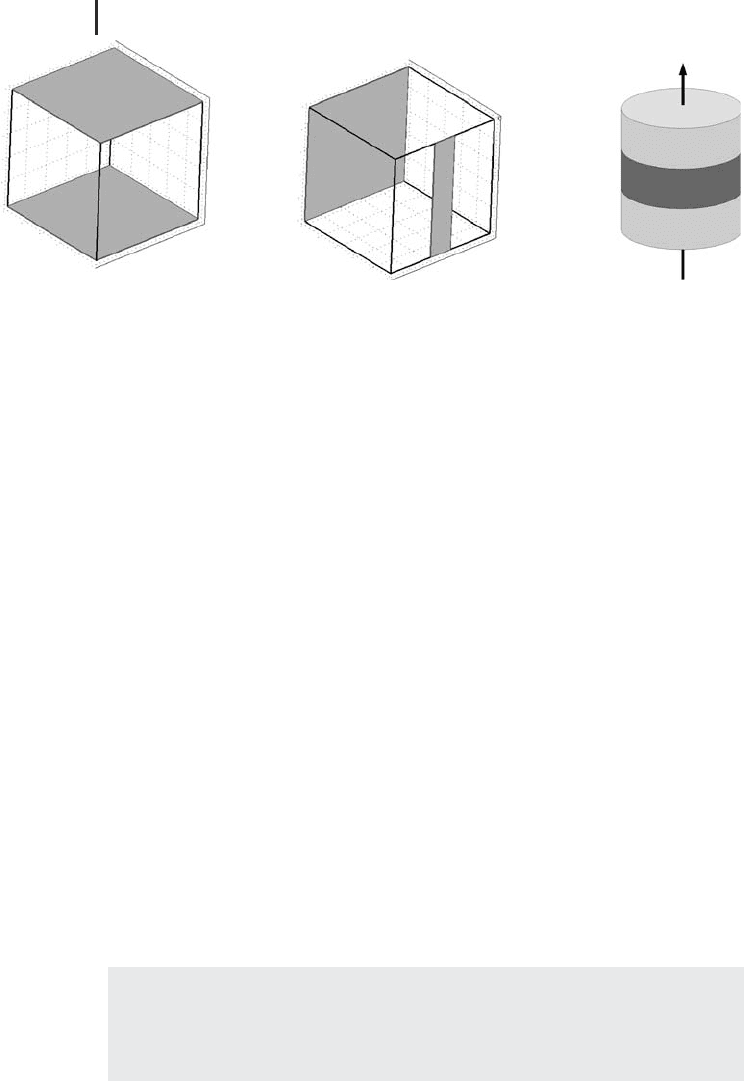
250 4 Mechanistic Models II: PDEs
y
x
z
1
1
1
0.8
0.8
0.8
0.6
0.6
0.6
0.4
0.4
0.4
0.2
0.2
0.2
0
0
0
y
x
z
z
1
1
0.8
0.8
0.6
0.6
0.4
0.4
0.2
0.2
0
0
(
a
)(
b
)(
c
)
1
0.8
0.6
0.4
0.2
0
Fig. 4.4 (a) Cube [0, 1]
3
with highlighted boundaries z = 0
(bottom surface) and z = 1(topsurface)usedinProblem 3.
(b) Cube [0, 1]
3
with highlighted boundaries y = 1(backsur-
face) and y = 0, 0.4 ≤ x ≤ 0.6 (strip on the front surface)
used in Problem 4. (c) Cylinder used in Problem 5.
derivation of Equation 3.70 in Section 3.5.5, the stationary temperature distribution
that solves Problem 3 can be derived from the heat equation as follows:
T(x, y, z) = T
b
+ (T
t
− T
b
) · z (4.47)
Since T(x, y, z) depends on z only, this can also be written as
T(z) = T
b
+ (T
t
− T
b
) · z (4.48)
Such a temperature distribution that depends on one space coordinate only is
called a one-dimensional temperature distribution, and the corresponding physical
problemfromwhichitisderived(Problem 4 in this case) is called a one-dimensional
problem. Correspondingly, the solution of a two-dimensional (three-dimensional)
problem depends on two (three) space coordinates. Intuitively, it is clear that
it is much less effort to compute a one-dimensional temperature distribution
T(x) compared to higher dimensional distributions such as T(x, y)orT(x, y, z).
The discussion of the PDE solving numerical algorithms in Section 4.5 indeed
shows that the number of unknowns in the resulting systems of equations –
and hence the overall computational effort – depends dramatically on the
dimension.
Note 4.3.4 (Dimension of a PDE problem) The solution of one-dimensional
(two-dimensional, three-dimensional) PDE problems depends on one (two, three)
independent variables. To reduce the computational effort, PDEs should always
be solved using the lowest possible dimension.
4.3 Some Theory You Should Know 251
4.3.3.2 2D Example
Consider the following problem:
Problem 4:
Referring to the configuration in Figure 4.4b and assuming
•
a constant temperature T
b
at the back surface of the cube (y = 1),
•
a constant temperature T
f
at the strip y = 0, 0.4 ≤ x ≤ 0.6atthe
front surface of the cube,
•
and a perfect thermal insulation of all other surfaces of the cube,
what is the stationary temperature distribution T(x, y, z) within the cube?
In this case, it is obvious that the stationary temperature distribution will depend
on x and y. Assuming T
f
> T
b
, for example, it is clear that the stationary temperature
will go down toward T
b
as we move in the y direction toward the (colder) back
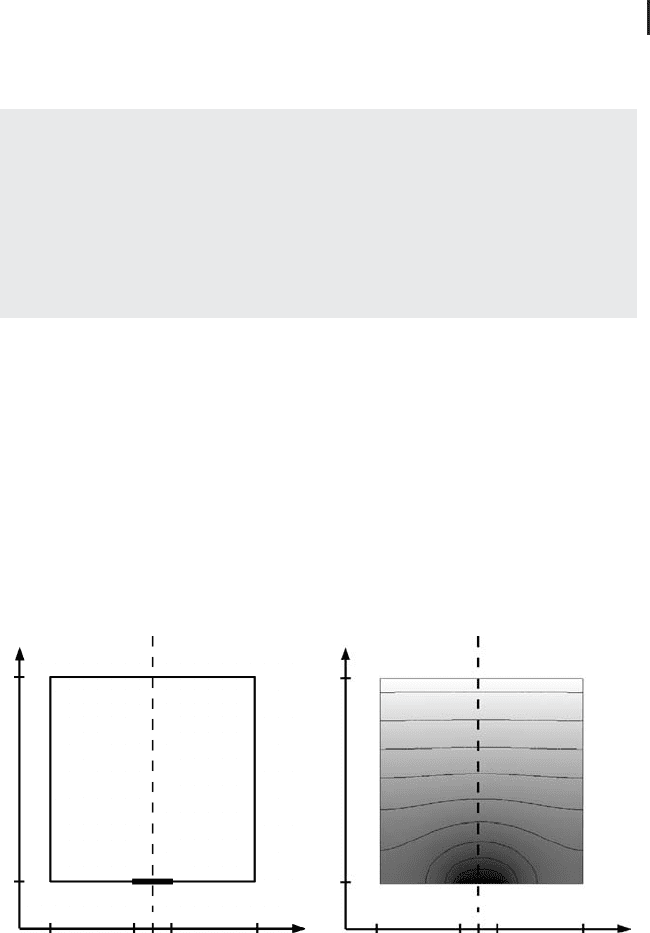
surface, and it is likewise clear that the stationary temperature will increase as we
move in the x direction toward x = 0.5, the point on the x axis closest to the (warm)
strip on the front surface (see also the discussion of Figure 4.5b further below).
On the other hand, there will be no gradients of the stationary temperature in the
z direction. To see this, a similar ‘‘flattening out’’ argument could be used as in
our above discussion of Problem 3. Alternatively, you could observe that the same
stationary temperature distribution would be obtained if the cube would extend
infinitely in the positive and negative z direction, which expresses the symmetry
y
y
xx
1
1
0
0
0
0 0.4 0.5 0.6
0.4 0.5 0.6
1
1
(b)(a)
Fig. 4.5 Example of a reduction of the computational do-
main due to symmetry: (a) Geometry. (b) Solution of
Problem 4forT
b
= 20
◦
CandT
f
= 0
◦
C (computed using
Salome-Meca). Colors range from white (20
◦
C) to black
(0
◦
C), lines in the domain are temperature isolines.

252 4 Mechanistic Models II: PDEs
of this problem in the z direction. More precisely, this expresses the translational
symmetry of this problem in the z direction, as you could translate the cube of
Problem 4 along the ‘‘infinitely extended cube’’ arbitrarily in the z direction without
changing the stationary temperature distribution. This and other kinds of spatial
symmetries can often be used to reduce the spatial dimensionality of a problem,
and hence to reduce the computation time and machine requirements of a PDE
problem [151].
4.3.3.3 3D Example
Problem 2 in Section 4.1.3 is an example of a three-dimensional problem. In this
case, there are no symmetries that could be used to reduce the spatial dimensionality
of the problem. The stationary temperature in any particular point (x, y, z) depends
in a complex three-dimensional manner on the point’s relative position toward
thesphereandthetopsideofthecubeinFigure4.1b.Thereis,however,akind
of symmetry in Problem 2 that can at least be used to reduce the computational
effort (although the problem remains three dimensional). Indeed, it is sufficient
to compute the temperature distribution in a quarter of the cube of Figure 4.1b,
which corresponds to (x, y) ∈ (0, 0.5) × (0, 0.5). The temperature distribution in
this quarter of the cube can then be extended to the other three quarters using the
mirror symmetry of the temperature distribution inside the cube with respect to the
planes y = 0.5andx = 0.5. See the discussion of Figure 4.5 for another example
of a mirror symmetry.
In the discussion of the finite-element method (Section 4.7), it will become clear
that the number of unknowns is reduced by about 75% if the computational domain
is reduced to a quarter of the original domain, so you see that the computational
effort is substantially reduced if Problem 2 is solved using the mirror symmetry.
However, note that we will not use the mirror symmetry when Problem 2 is solved
using Salome-Meca in Section 4.9, simply because the computational effort for this
problemisnegligibleevenwithoutthemirrorsymmetry(andwesavetheeffort
that would be necessary to extend the solution from the quarter of the cube into
the whole cube in the postprocessing step, see Section 4.9.4).
4.3.3.4 Rotational Symmetry
As another example of how the spatial dimension of a problem can be reduced due
to symmetry, consider
Problem 5:
Referring to the configuration in Figure 4.4c and assuming
•
a constant temperature T
t
at the top surface of the cylinder,
•
a constant temperature T
s
at the dark strip around the cylinder,
•
and a perfect thermal insulation of all other surfaces of the
cylinder,
what is the stationary temperature distribution T(x, y, z) within the cylinder?

4.3 Some Theory You Should Know 253
In this case, it is obvious that the problem exhibits rotational symmetry in
the sense that the stationary temperature distribution is identical in any vertical
section through the cylinder that includes the z axis (a reasoning similar to
the ‘‘flattening out’’ argument used in Section 4.3.3.1 would apply to temperature
distributions deviating from this pattern). Using cylindrical coordinates (r, φ, z), this
means that we will get identical stationary temperature distributions on any plane
φ = const. Hence, the stationary temperature distribution depends on the two
spatial coordinates r and z only, and Problem 5, thus, is a two-dimensional problem.
Note that in order to solve this problem in two dimensions, the heat equation
must be expressed in cylindrical coordinates (in particular, it is important to
choose the appropriate model involving cylindrical coordinates if you are using
software).
4.3.3.5 Mirror Symmetry
Consider Figure 4.5a, which shows the geometrical configuration of the two-
dimensional problem corresponding to Problem 4. AsinProblem 4, we assume
a constant temperature T
b
for y = 1 (the top end of the square in Figure 4.5a),
a constant temperature T
f
in the strip y = 0, 0.4 ≤ x ≤ 0.6 (the thick line at the
bottom end of the square in Figure 4.5a), and a perfect thermal insulation at all
other boundary lines of the square. Again, we ask for the stationary temperature
within the square. As discussed above, the solution of this problem will then
also solve Problem 4 due to the translational symmetry of Problem 4 in the z
direction.
Note that the situation in Figure 4.5a is mirror symmetric with respect to
the dashed line in the figure (similar to the mirror symmetry discussed in
Section 4.3.3.3). The boundary conditions imposed on each of the two sides of the
dashed line are mirror symmetric with respect to that line, and hence the resulting
stationary temperature distribution is also mirror symmetric with respect to that
dashed line. This can be seen in Figure 4.5b, which shows the solution of Problem 4
computed using Salome-Meca (Section 4.9). So we see here that it is sufficient to
compute the solution of Problem 4 in one half of the square only, for example, for
x < 0.5, and then to extend the solution into the other half of the square using
mirror symmetry. In this way, the size of the computational domain is reduced
by one half. This reduces the number of unknowns by about 50% and leads to
a substantial reduction of the computational effort necessary to solve the PDE
problem (see Section 4.5 for details).
4.3.3.6 Symmetry and Periodic Boundary Conditions
In all problems considered above, we have used ‘‘thermal insulation’’ as a boundary
condition. As discussed in Section 4.3.2.3 above, this boundary condition is
classified as a Neumann boundary condition, and it is also called a no-flow
condition since it forbids any heat flow across the boundary. Referring to Problem 4
and Figure 4.4b, the thermal insulation condition serves as a ‘‘no-flow’’ condition
in this sense, for example, at the cube’s side surfaces x = 0andx = 1andatthe

254 4 Mechanistic Models II: PDEs
cube’s front surface besides the strip. At the top and bottom surfaces of the cube,
the thermal insulation condition can be interpreted in the same way, but it can also
be interpreted there as expressing the symmetry of the problem in the z direction.
As was explained in Section 4.3.3.2, Problem 4 can be interpreted as describing
a situation where the cube extends infinitely into the positive and negative z
directions. In this case, the ‘‘no-flow’’ condition at the top and bottom surfaces of
the cube in Figure 4.4b would not be a consequence of a thermal insulation at
these surface – rather, it would be a consequence of the symmetry of the problem
which implies that there can be no temperature gradients in the z direction. This is
why no-flow conditions are often also referred to as symmetry boundary conditions.
Finally, we remark that substantial reductions of the complexity of a PDE problem
can also be achieved in the case of periodic media. For periodic media such as the
medium shown in Figure 4.3, it will usually be sufficient to compute the solution
of a PDE on a single periodicity cell along with appropriate periodic boundary
conditions at the boundaries of the periodicity cell. An example of this and some
further explanations is given in Section 4.10.2.1.
4.4
Closed Form Solutions
InSection3.6,wehaveseenthatODEscanbesolvedeitherinclosedformor
numerically. As was discussed there, closed form solutions can be expressed in
terms of well-known functions such as the exponential function and the sine
function, while the numerical approach is based on the approximate solution of
the equations on the computer. All these hold for PDEs as well, including the fact
that closed form solutions cannot be obtained in most cases – they are like ‘‘dust
particles in the ODE/PDE universe’’ as discussed in Section 3.7.4. Since PDEs
involve derivatives with respect to several variables and, thus, can express a much
more complex dynamical behavior compared to ODEs, it is not surprising that
one can generally say that it is even harder to find closed form solutions of PDEs
compared to ODEs.
Nevertheless, as was explained in Section 3.6, it is always a good idea to look
for closed form solutions of differential equations since they may provide valuable
information about the dependence of the solution on the parameters of the system
under investigation. A great number of techniques to derive closed form solutions
of differential equations – PDEs as well as ODEs – has been developed, but an
exhaustive treatment of this topic is beyond the scope of a first introduction
into mathematical modeling. Since closed form solutions are unavailable in most
cases, we will confine ourselves here to an example derivation of a closed form
solution for the one-dimensional heat equation. Readers who want to know more
on closed form solution techniques are referred to appropriate literature such
as [152].