
Velten K. Mathematical Modeling and Simulation: Introduction for Scientists and Engineers
Подождите немного. Документ загружается.

3.10 More Examples 225
Figure 3.22a shows the drug concentration in the GI tract that is implied by the
drug dosage regime in Figure 3.21. As can be seen, the five peaks of G(t) correspond
with the five peaks of D(t). While D(t) goes abruptly to zero after 1/2 h according
to the dosage regime assumed above, G(t) decreases much slower, reflecting the
gradual absorption of the drug from the GI tract into the blood stream. The drug
concentration in the blood in Figure 3.22b exhibits a periodical pattern which is
also showing five peaks corresponding to the five peaks of the dosage regime in
Figure 3.21. The peaks of B(t), however, are somewhat delayed compared with
the D(t) peaks, which again reflects the gradual absorption of the drug from the
GI tract into the blood stream. If the dosage regime is continued in the same
way for t > 30, B(t) becomes a periodical function that oscillates between 0.8 and
1.4 μgml
−1
, that is, the simulation shows that the above dosage regime guarantees
a blood concentration between 0.8 and 1.4 μgml
−1
. Simulations of this kind can
thus be used to optimize drug dosage regimes in a way that guarantees certain
limit blood concentrations of the drug that are required for medical reasons. Of
course, this model needs validation before it can be applied in this way (see [129,
130] for a comparison of this and similar models with data). Using phase plane
plots similar as in Section 3.10.1, it can be shown that the above model exhibits
an interesting dynamical behavior involving limit cycles which you will find further
discussed in [114] (see also the remarks on the theory of dynamical systems in
Section 3.10.1.2).
The above drug model and many other pharmacokinetic models are examples of
a concept called compartment models [130]. Compartment models are mathematical
models where each of the state variables expresses a specific property of some part of
a system, and these parts are referred to as the compartments of the model. Usually,
this reflects the assumption that the property of the compartment expressed by
the state variable is homogeneously distributed within the compartment. In this
sense, the above drug model is a two-compartment model. It involves two state
variables: G(t) expresses a property of the GI tract (which is compartment 1), and
B(t) expresses a property of the blood volume ( which is compartment 2). The
properties expressed by G(t)andB(t) – the drug concentration in the GI tract
and in the blood volume, respectively – are assumed to be independent of space,
that is, it is assumed that the drug is homogeneously distributed within the GI
tract and within the blood volume (like in a well-stirred container). Compartment
models thus are examples of what we have called lumped models in Section 1.6.3.
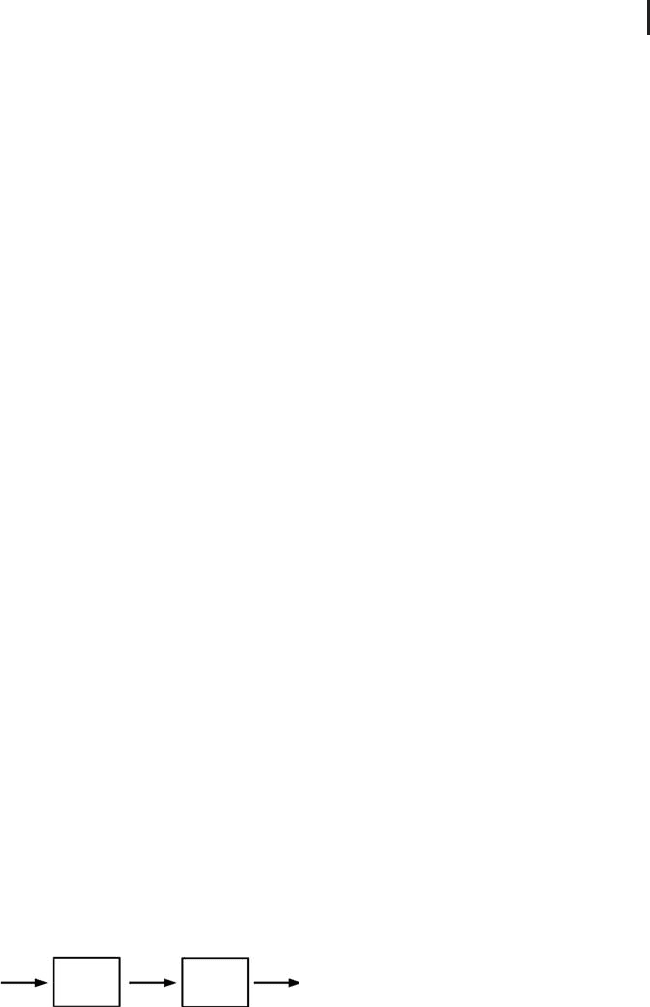
Typically, compartment models are visualized similar to Figure 3.23, that is, the
compartments are represented, for example, as rectangles, and arrows are used to
D(t)
G(t) B(t)
ab
Fig. 3.23 Drug model as a two-compartment model.

226 3 Mechanistic Models I: ODEs
indicate the mutual exchange of mass, energy etc. between the compartments as
well as the mass and energy flows between the compartments and the outside
world.
3.10.4
Plant Growth
A great number of mathematical models of plant growth has been developed, both
from the scientific perspective (for example: ‘‘how do plants grow?’’) and from
the engineering perspective (for example: ‘‘how can crop yield be maximized?’’),
see e.g. the books of Richter/S
¨
ondgerath [41] and Overman/Scholtz [131], which
emphasize the scientific and engineering perspectives, respectively. In its simplest
form (which applies to plants and to other growing organisms in general), plant
growthmodelscanbewrittenintheform[41]
B
(t) = r · B(t) ·(B(t)) (3.309)
where B(t) denotes the overall biomass of the plant at time t (e.g. in kg ha
−1
), r
(e.g. in day
−1
) is the growth rate of the plant and (x) is some (dimensionless)
nonlinear real function. As usual, an initial condition is needed before this equation
can be solved, that is, we need to specify the value of the biomass at some time,
for example, in the form B(0) = B
0
. Depending on the choice of the function (B),
several plant growth models can be derived from Equation 3.309. For example ,
setting (B) = 1 generates the exponential growth model:
B
(t) = r · B(t) (3.310)
while (B) = 1 − B/K (for K ∈ R)givesthelogistic growth model:
B
(t) = r · B(t) ·
1 −
B(t)
K
(3.311)
Here, K (kg ha
−1
) can be interpreted as the (genetically fixed) maximum possible
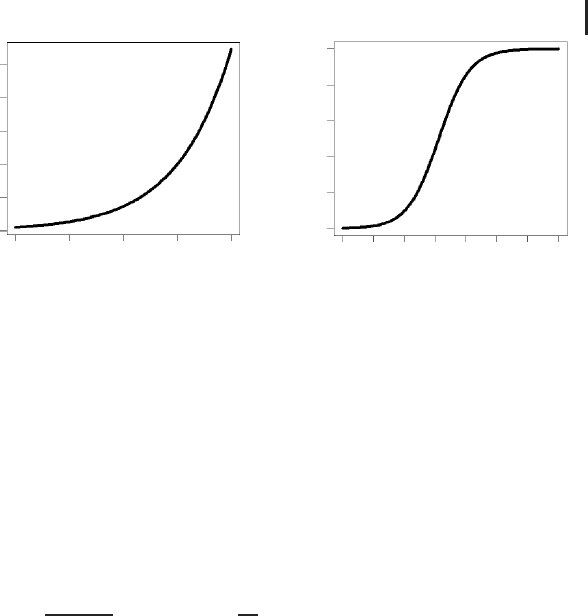
biomass of the plant. Figure 3.24 shows the typical patterns of the exponential and
logistic growth models. As can be seen, the exponential plant growth model yields
an exponential increase of the biomass, which holds true at the early stages of plant
growth. As the plant approaches its maximum possible biomass, the growth curve
will asymptotically slow down, which can be expressed using the logistic growth
model similar to Figure 3.24b.
Figure 3.24a,b has been produced using the codes
Plant1.r and Plant2.r
in the book software (see Appendix A), which were obtained by an appropriate
editing of
ODEEx1.r, and which are based on a numerical solution of the ODEs
Equations 3.310 and 3.311 (see Section 3.8.3). Of course, closed form solutions of
Equations 3.310 and 3.311 can also be easily obtained using the methods described
3.10 More Examples 227
0
0
100
B (kg ha
−1
)
200
300
400
500
0
10
B (kg ha
−1
)
20
30
40
50
10 20 30 40
t (days)
50 600 5 10 15
t (days)
(
b
)(
a
)
20 70
Fig. 3.24 Solutions (a) of the exponential plant growth
model, Equation 3.310 and (b) of the logistic plant growth
model, Equation 3.311 using: B(0) = 1, r = 0.2, K = 500
(plots generated using
Plant1.r and Plant2.r).
in Section 3.7. Assuming B(0) = B
0
as the initial condition, the closed form solution
of Equation 3.310 is
B(t) = B
0
e
rt
(3.312)
and the closed form solution of Equation 3.311 is
B(t) =
K
1 +e
β−rt
where β = ln
K
B
0
− 1
(3.313)
A great number of plant growth models are obtained by appropriate modifications
of this approach, depending on the data that are analyzed and depending on the
question that one is asking. For example, multiorgan plant growth models can be
formulated basically by adding a growth model of the above kind for each of the
plant organs such as roots, stems, leaves and fruits, and by balancing the mass
flows between these ‘‘compartments’’ following the idea of the compartmental
approach described in Section 3.10.3 above [41, 132, 133]. The above equations
can also be supplemented, for example, by equations describing the kinetics of
enzymes that are involved in photosynthesis if the focus of the investigation is on
air pollutants that affect these enzymes during plant growth [134, 135].
Different plant growth models may apply to one and the same plant depending on
the growth conditions. While the logistic growth model works well for the asparagus
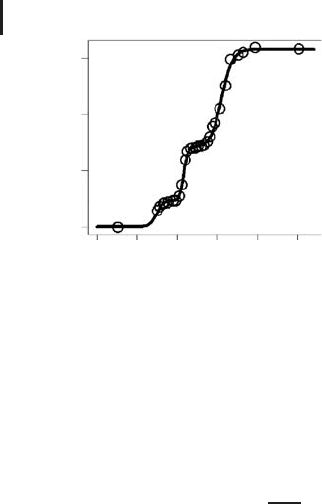
biomass data in [136], it was inapplicable to the staircase-like asparagus biomass
data shown in Figure 3.25. As discussed in [137], the staircase-like structure of the
data in the figure reflects the fact that several groups of asparagus spears had been
growing successively, that is, first group 1 began to grow and stopped growing after
some time, then group 2 began to grow and stopped growing after some time and
so on. The data in Figure 3.25 look like several logistic growth functions stacked
on top of each other, and they can indeed be described by a system of ODEs that
228 3 Mechanistic Models I: ODEs
0
0
500
1000
1500
50 100 150
days
B (cm)
200 250
Fig. 3.25 Asparagus spear biomass data as-
paragus.csv compared with model Equations
3.314 and 3.315, where r
1
= 0.23, r
2
= 0.42,
r
3
= 0.15, K
1
= 230, K
2
= 480, K
3
= 870,
t
1
= 50, t
2
= 93, t
3
= 110, B
1
(0) = B
2
(0) =
B
3
(0) = 1. Data from [137] (note: biomass in
‘‘centimeter’’ based on a constant assumed
spear diameter and density). Plot generated
using
Plant3.r.
involves three logistic growth equations (one for three groups of spears in the above
sense) as follows:
B
i
(t) = r
i
· H(t − t
i
) ·
1 −
B
i
(t)
K
i
· B
i
(t)fori = 1, 2, 3 (3.314)
B(t) =
3
i=1
B
i
(t) (3.315)
where H(x) is the Heaviside step function that was introduced in Section 3.10.3.
Basically, the Heaviside function is used here to successively ‘‘switch on’’ the
growth functions for the three groups of asparagus spears. Figure 3.25 shows
an almost perfect coincidence of this model with the data. The figure has been
plotted using the code
Plant3.r in the book software, which is based on the
numerical solution of Equation 3.314 using
ODEEx1.r again (as before, the closed
form solution Equation 3.313 could also have been used to get the same result).
Note that the parameters shown in Figure 3.25 have been obtained from a (quick)
manual tuning of the parameters, although the (slightly more tedious) automated
procedure described in Section 3.9 could also have been used.

229
4
Mechanistic Models II: PDEs
4.1
Introduction
4.1.1
Limitations of ODE Models
Ordinary differential equation (ODE) models are restricted in the sense that they
involve derivatives with respect to one variable only, which means that they describe
the dynamical behavior of the quantity of interest with respect to this one variable
only. In the wine fermentation model, for example, the quantities of interest have
been the sugar, ethanol, nitrogen, and yeast cell biomass concentrations, and
all these quantities were considered as a function of time only (Section 3.10.2).
Looking at the examples in Section 3, you will note that time was the independent
variable in most examples, although, of course, any kind of variable can be used
in principal (e.g. a space coordinate was used as the independent variable in the
metal rod example, see Section 3.5.5)
Now, obviously, we live in a world where everything depends on many variables
simultaneously. Using ODE models, therefore, usually means we are referring to
special situations where it can be assumed that the independent variable used in
the ODE model is the most important factor affecting our quantity of interest, while
the influence of other factors with a possible impact on our quantity of interest
can be assumed to be negligible. In the wine fermentation model, for example, it
is obvious that quantities such as the yeast biomass concentration will depend not
only on time but also on the space coordinates x, y,andz. Assuming the yeast
biomass concentration would not depend on the spatial coordinates would require
that quantity to be exactly the same at every particular spatial coordinate within the
fermenter. You do not need to be a wine fermentation specialist to understand that
this is an unrealistic assumption, and that it may of course happen that you have
variable yeast biomass concentrations in the fermenter; for example, gravitation
may increase the yeast biomass at the bottom of the fermenter as discussed in [124].
The fact that the wine fermentation model – as well as the other ODE models
discussed in Section 3 – can be applied successfully in some situations, thus,
does not ‘‘prove’’ the spatial homogeneity of the state variables, or the absence

230 4 Mechanistic Models II: PDEs
of any other variables affecting the state variables. It just means that spatial
dishomogeneities, if they exist, and any other variables have a negligible effect
on your state variables in those particular situations where you apply the model
successfully. And you must always keep in mind that you are making a strong
assumption when you are neglecting all those other possible influences on your state
variables. This is particularly important when you observe deviations between your
model and data. In the wine fermentation model, substantial deviations from data
might indicate that you are, for example, in a situation where the dishomogeneity
of the yeast biomass concentration is so high that it can no longer be neglected.
Then a possible solution would be to use partial differential equations (PDEs),
which describe the dynamics of the yeast biomass concentration in time and space.
Note 4.1.1 (Limitations of ODE models) Deviations between an ODE model
and data may indicate that its state variables depend on more than one variable
(e.g. on time and space variables). Then, it may be appropriate to use PDE models
instead.
4.1.2
Overview: Strange Animals, Sounds, and Smells
In contrast to ODEs, PDE models involve derivatives with respect to at least two
independent variables, and hence they can be used to describe the dynamics of
your quantities of interest with respect to several variables at the same time. A great
number of the classical laws of nature can be formulated as PDEs, such as the
laws of planetary motion, thermodynamics, electrodynamics, fluid flow, elasticity,
and so on. As a whole, PDEs are a really big topic. In particular, their structure
is much more variable compared to ODEs since they involve several variables and
derivatives. There are many different subtypes of PDEs, which need specifically
tailored numerical procedures for their solution. Many volumes could be filled with
a thorough discussion of all those subtypes and their appropriate treatment, and
it is hence obvious that we need to confine ourselves here to a first introduction
into the topic, with the aim of introducing the reader to some of the main ideas
and procedures that are applied when people formulate and solve PDE models. If
you imagine the PDE topic as a dense and big jungle, then the intention of this
chapter can be described as cutting a small machete path, which you can follow to
get first sensual impressions of those strange animals, sounds, and smells within
the jungle – so do not mistake yourself for a PDE expert after reading the following
pages. To know more about PDEs, readers are referred to an abundant literature
on the topic, for example, books such as [101, 138–142].
As a guide and compass for our machete path we will take the heat equation
that was already discussed in Section 3.5.5. This equation will serve as our main
example in the following introduction into PDEs and their numerical procedures.
The heat equation provides a way to compute temperature distributions, and since
so many processes in science and engineering are affected by temperature, it is

4.1 Introduction 231
important in all fields of science and engineering. This is why the two heat equation
problems posed in Section 4.1.3 really are ‘‘problems you should be able to solve’’.
Sections 4.2 and 4.3 provide some theoretical background on the heat equation
and on PDEs, in general. Sections 4.4–4.7 are devoted to the solution of PDEs
in closed form or based on numerical procedures, respectively. In Sections 4.8
and 4.9, software is discussed that solves PDEs based on the finite-element
method, which is one of the most important numerical procedures that can be
used to solve PDEs. Section 4.9 provides a sample session using the Salome-Meca
software, an open-source finite-element software with a general workflow similar
to commercial finite-element software (Appendix A). Then, Section 4.10 introduces
you to some of the most important PDE models ‘‘beyond the heat equation’’.
This includes, for example, computational fluid dynamics (CFD) and structural
mechanics models and appropriate open-source software to solve these models
in 3D. Finally, Section 4.11 ends the chapter with some examples of mechanistic
modeling approaches beyond differential equations.
4.1.3
Two Problems You Should Be Able to Solve
We begin with the formulation of two problems that are solved below using PDEs,
and that will be used to motivate and illustrate the material in subsequent sections.
These problems are concerned with the computation of temperature distributions
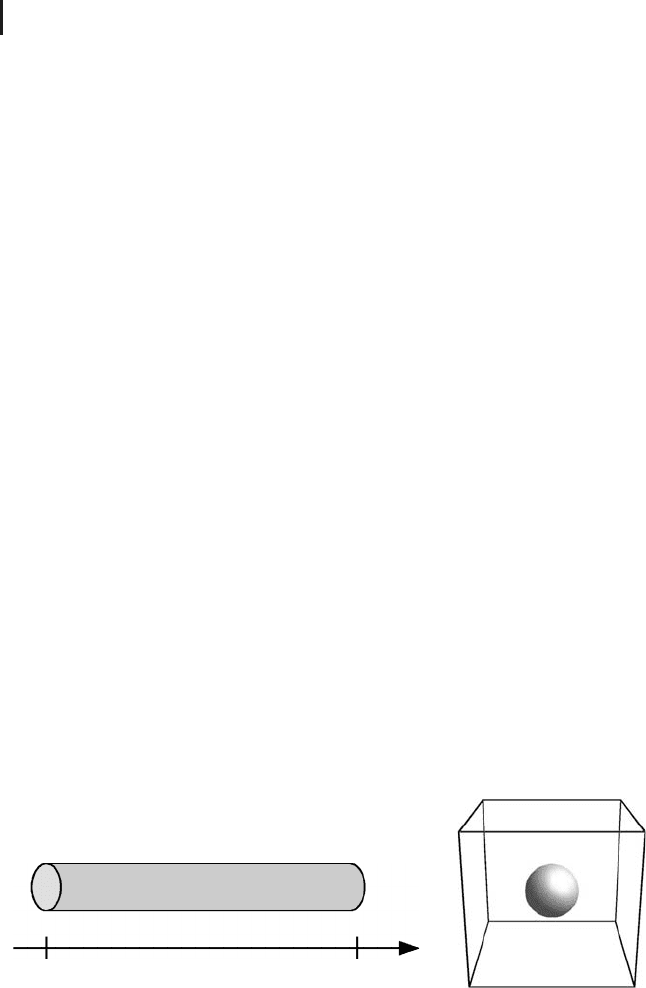
in the geometries shown in Figure 4.1:
Problem 1:
Consider the cylinder in Figure 4.1a. Assuming
•
a perfect insulation of the cylinder surface in 0 < x < 1,
•
constant temperatures in the y and z directions at time t = 0,
that is, no temperature variations across transverse sections,
•
a known initial temperature distribution T
i
(x)attimet = 0,
•
and constant temperatures T
0
and T
1
at the left and right ends of
the cylinder for all times t > 0,
what is the temperature T(x, t)forx ∈ (0, 1) and t ∈ (0, T]?
Problem 2:
Referring to the configuration in Figure 4.1b and assuming
•
a constant temperature T
c
at the top surface of the cube (z = 1),
•
a constant temperature T
s
atthespheresurface,
•
and a perfect insulation of all other surfaces of the cube,
what is the stationary temperature distribution T(x, y, z) within the cube (i.e. in
the domain [0, 1]
3
\ S if S is the sphere)?
232 4 Mechanistic Models II: PDEs
Note the practical relevance that problems of this kind have in both science and
engineering. As was mentioned above, PDEs are a very broad topic and involve a great
deal of really sophisticated mathematics. Taking one of the more mathematical
oriented books on PDEs, and then gazing at endless formulas, many of us will be
tempted to ask: ‘‘How can this be useful for me?’’ The above two problems give
the answer: PDEs are useful for everybody in science and engineering since they
provide the only way to solve absolutely fundamental and elementary problems
such as the computation of temperature distributions. No one can seriously doubt
the fundamental importance of temperature in science and engineering – just
remember, for example, the role of temperature in the wine fermentation model
discussed in Section 3.10.2. If you do not know how to solve this kind of problems,
then you lack to know one of the really fundamental methods in science and
engineering. Without too much exaggeration, one can say, it is a bit like not being
able to compute the surface area of a circle. Fortunately, you will be able to learn
about some PDE basics in this chapter from a very practical and software-oriented
point of view.
To make Problem 1 a little bit more concrete, you may imagine a situation
like this: the cylinder in Figure 4.1a is a metallic cylinder with a constant initial
temperature of 100
◦
C. At time t = 0, you keep the ends of the cylinder in ice water
(0
◦
C) and maintain this situation unchanged for all times t > 0. Then, you know
that the temperature of the cylinder will be approximately 0
◦
C after ‘‘some time’’.
The problem is to make this precise, and to be able to predict temperatures at any
particular time t > 0 and at any particular location x ∈ (0, 1) within the cylinder.
Exactly this problem is solved in Section 4.6.
Regarding Problem 2, remember from the discussion of the metallic rod problem
in Section 3.5.5 the meaning of stationarity: the stationary temperature distribution
is what you obtain for t →∞if you do not change the environment. Referring
to Figure 4.1b, ‘‘unchanged environment’’ means that the temperatures imposed
at the top of the cube and at the sphere surface remain unchanged for all times
t > 0, the other sides of the cube remain perfectly insulated, and so on. Stationarity
01
x
x
y
z
(b)(a)
Fig. 4.1 (a) Cylinder used in Problem 1. (b) Cube
[0, 1]
3
, containing a cylinder with radius 0.1 centered at
(0.5, 0.5, 0.5), as used in Problem 2.

4.2 The Heat Equation 233
can also be explained referring to the above discussion of Problem 1,whereitwas
said that the temperature of the cylinder will be 0
◦
C after ‘‘some time’’, which can
be phrased as follows: given the conditions in the above discussion of Problem 1,
T(x) = 0
◦
C is the stationary solution, which is approached for t →∞(this will be
formally shown in Section 4.4).
Again, let us spend a few thoughts on what the situation in Problem 2 could
mean in a practical situation. As was said above, temperatures are of great
importance in all kinds of applications in science and engineering. Many of the
devices used in science and engineering contain certain parts specially designed
to control the temperature. The question then is whether the design of these
temperature-controlling parts is good enough in the sense that the resulting
temperature distribution in the device satisfies your needs. In Problem 2above,
the small sphere inside the cube can be viewed as a temperature-controlling part.
Once we are able to solve Problem 2, we can, for example, compare the resulting
temperature distribution with the distributions obtained if we use a small cube,
tetrahedron, and so on, instead of the sphere, and then try to optimize the design
of the temperature-controlling part in this way.
This procedure has been used, for example, in [143, 144] to optimize cultivation
measures affecting the temperature distribution in asparagus dams.Inthewine
fermentation example discussed above, temperature is one of the variables that is
used to control the process (Section 3.10.2). To be able to adjust temperatures
during fermentation, various cooling devices are used inside fermenters, and the
question then is where these cooling devices should be placed and how they should
be controlled such that the temperature distribution inside the fermenter meets
the requirements. In this example, the computation of temperature distributions
is further complicated by the presence of convectional flows, which transport heat
through the fermenter. To compute temperature distributions in a situation like
this, we would have to solve a coupled problem, which would also involve the
computation of the fluid flow pattern in the fermenter. This underlines again that
Problem 2 can be seen as a first approximation to a class of problems of great
practical importance.
4.2
The Heat Equation
To solve the problems posed in Section 4.1.3, we need an equation that describes
the dynamics of temperature as a function of space and time: the heat equation.
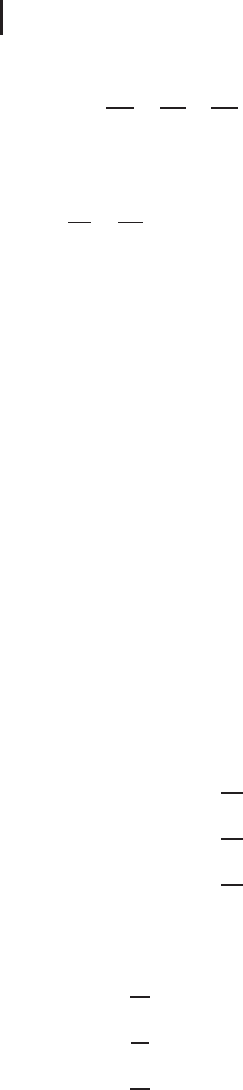
The heat equation is used here in the following form:
∂T
∂t
=
K
Cρ
∂
2
T
∂x
2
+
∂
2
T
∂y
2
+
∂
2
T
∂z
2
(4.1)
where K (WK
−1
m
−1
) is the thermal conductivity, C (J kg
−1
K
−1
) is the specific heat
capacity, and ρ (kg m
−3
) is the density.
234 4 Mechanistic Models II: PDEs
Using the so-called Laplace operator
=
∂
2
∂x
2
+
∂
2
∂y
2
+
∂
2
∂z
2
(4.2)
the heat equation is also frequently written as
∂T
∂t
=
K
Cρ
T (4.3)
We could end our discussion of the heat equation here (before it actually begins)
and work with this equation as it is. That is, we could immediately turn to the
mathematical question of how this equation can be solved, and how it can be
applied to the problems in Section 4.1.3. Indeed, the reader could skip the rest of
this section and continue with Section 4.3 if he or she is interested in the technical
aspects of solving this kind of problems. It is, nevertheless, recommended to read
the rest of this section, not only because it is always good to have an idea about the
background of the equations that one is using. The following discussion introduces
you into an important way how this and many other PDEs can be derived from
balance considerations, and beyond this you will understand why most PDEs in
the applications are of second order.
4.2.1
Fourier’s Law
The specific heat capacity C in the above equations is a measure of the amount
of heat energy required to increase the temperature of 1 kg of the material under
consideration by 1
◦
C. Values of C can be found in the literature, as well as values
for the thermal conductivity K, which is the proportionality constant in an empirical
relation called Fouriers’s law:
⎛
⎜
⎝
q
x
q
y
q
z
⎞
⎟
⎠
=−K ·
⎛
⎜
⎜
⎜
⎜
⎜
⎜
⎝
∂T
∂x
∂T
∂y
∂T
∂z
⎞
⎟
⎟
⎟
⎟
⎟
⎟
⎠
(4.4)
Using q = (q
x
, q
y
, q
z
)
t
and the nabla operator
∇=
⎛
⎜
⎜
⎜
⎜
⎜
⎜
⎝
∂
∂x
∂
∂y
∂
∂z
⎞
⎟
⎟
⎟
⎟
⎟
⎟
⎠
(4.5)