
Versteeg H., Malalasekra W. An Introduction to Computational Fluid Dynamics: The Finite Volume Method
Подождите немного. Документ загружается.

4.3 WORKED EXAMPLES 127
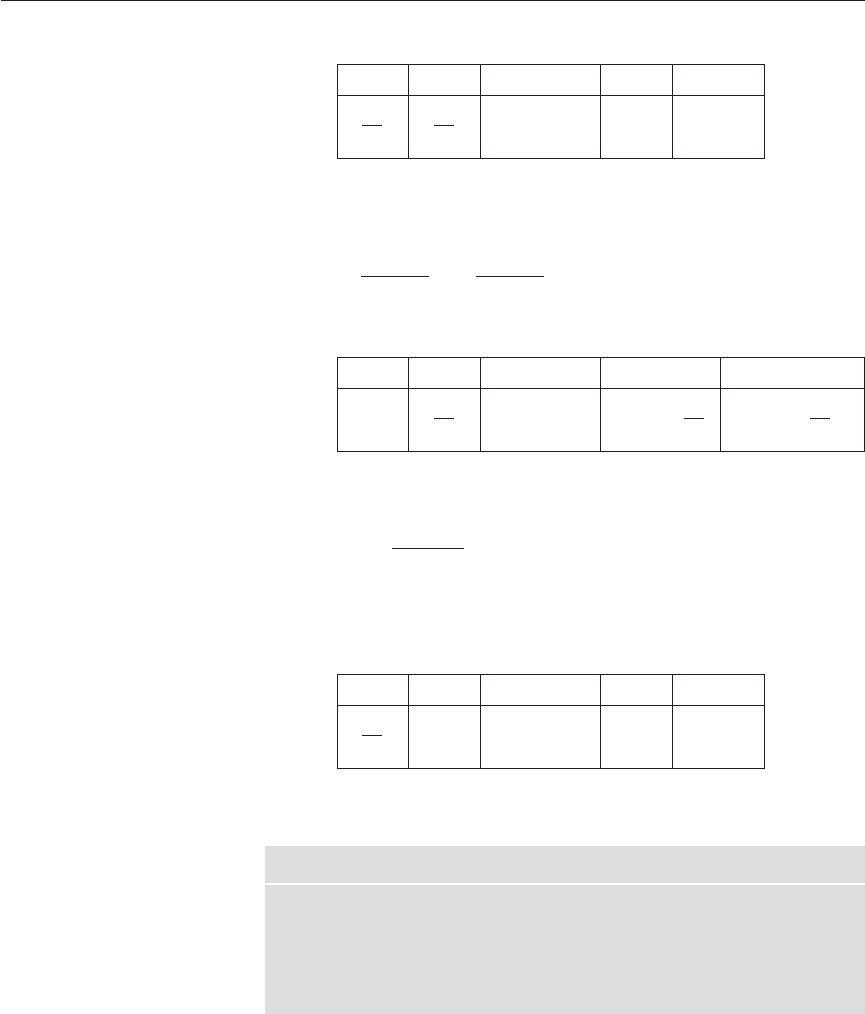
Table 4.4
Node a
W
a
E
S
u
S
P
a
P
= a
W
+ a
E
− S
P
1 0 5 100 + 10T
B
−15 20
2 5 5 100 −515
3 5 5 100 −515
4 5 5 100 −515
5 5 0 100 −510
with
a
W
a
E
a
P
S
P
S
u
a
W
+ a
E
− S
P
−n
2
δ
xn
2
δ
xT
∞
Next we apply the boundary conditions at nodal points 1 and 5. At node 1
the west control volume boundary is kept at a specified temperature. It is
treated in the same way as in Example 4.1, i.e.
−−[n
2
(T
P
− T
∞
)
δ
x] = 0 (4.47)
The coefficients of the discretised equation at boundary node 1 are
a
W
a
E
a
P
S
P
S
u
0 a
W
+ a
E
− S
P
−n
2
δ
x − n
2
δ
xT
∞
+ T
B
At node 5 the flux across the east boundary is zero since the east side of the
control volume is an insulated boundary:
0 −−[n
2
(T
P
− T
∞
)
δ
x] = 0 (4.48)
Hence the east coefficient is set to zero. There are no additional source terms
associated with the zero flux boundary condition. The coefficients at bound-
ary node 5 are given by
a
W
a
E
a
P
S
P
S
u
0 a
W
+ a
E
− S
P
−n
2
δ
xn
2
δ
xT
∞
Substituting numerical values gives the coefficients in Table 4.4.
1
δ
x
J
K
L
D
E
F
T
P
− T
W
δ
x
A
B
C
G
H
I
2
δ
x
2
δ
x
1
δ
x
J
K
L
D
E
F
T
P
− T
B
δ
x/2
A
B
C
D
E
F
T
E
− T
P
δ
x
A
B
C
G
H
I
1
δ
x
1
δ
x
The matrix form of the equations set is
G20 −5000JGT
1
JG1100J
H−515−500KHT
2
KH100K
H 0 −515−50KHT
3
K = H 100K (4.49)
H 00−515−5KHT
4
KH100K
I 000−510LIT
5
LI100L
ANIN_C04.qxd 29/12/2006 09:57 AM Page 127
The solution to the above system is
GT
1
JG64.22J
HT
2
KH36.91K
HT
3
K = H26.50K (4.50)
HT
4
KH22.60K
IT
5
LI21.30L
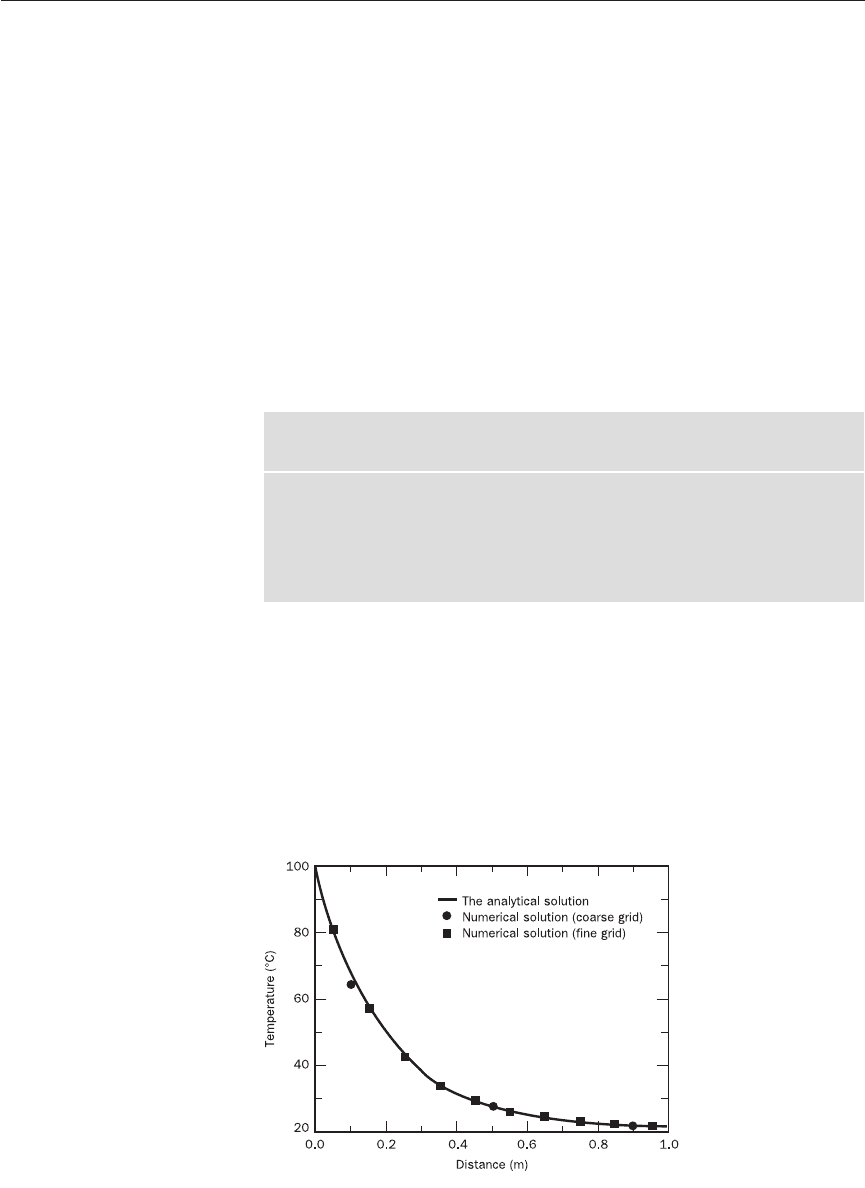
Comparison with the analytical solution
Table 4.5 compares the finite volume solution with analytical expression
(4.41). The maximum percentage error ((analytical solution – finite volume
solution)/analytical solution) is around 6%. Given the coarseness of the grid
used in the calculation, the numerical solution is reasonably close to the exact
solution.
128 CHAPTER 4 FINITE VOLUME METHOD FOR DIFFUSION PROBLEMS
Table 4.5
Node Distance Finite volume Analytical Difference Percentage
solution solution error
1 0.1 64.22 68.52 4.30 6.27
2 0.3 36.91 37.86 0.95 2.51
3 0.5 26.50 26.61 0.11 0.41
4 0.7 22.60 22.53 −0.07 −0.31
5 0.9 21.30 21.21 −0.09 −0.42
Figure 4.11 Comparison of
numerical and analytical results
The numerical solution can be improved by employing a finer grid.
Let us consider the same problem with the rod length sub-divided into 10
control volumes. The derivation of the discretised equations is the same as
before, but the numerical values of the coefficients and source terms are
different due to the smaller grid spacing of
δ
x = 0.1 m. The comparison of
results of the second calculation with the analytical solution is shown in
Figure 4.11 and Table 4.6. The second numerical results shows better agree-
ment with the analytical solution; now the maximum deviation is only 2%.
ANIN_C04.qxd 29/12/2006 09:57 AM Page 128
4.4 FINITE VOLUME METHOD FOR 2D DIFFUSION PROBLEMS 129
The methodology used in deriving discretised equations in the one-
dimensional case can be easily extended to two-dimensional problems. To
illustrate the technique let us consider the two-dimensional steady state
diffusion equation given by
Γ+Γ+S
φ
= 0 (4.51)
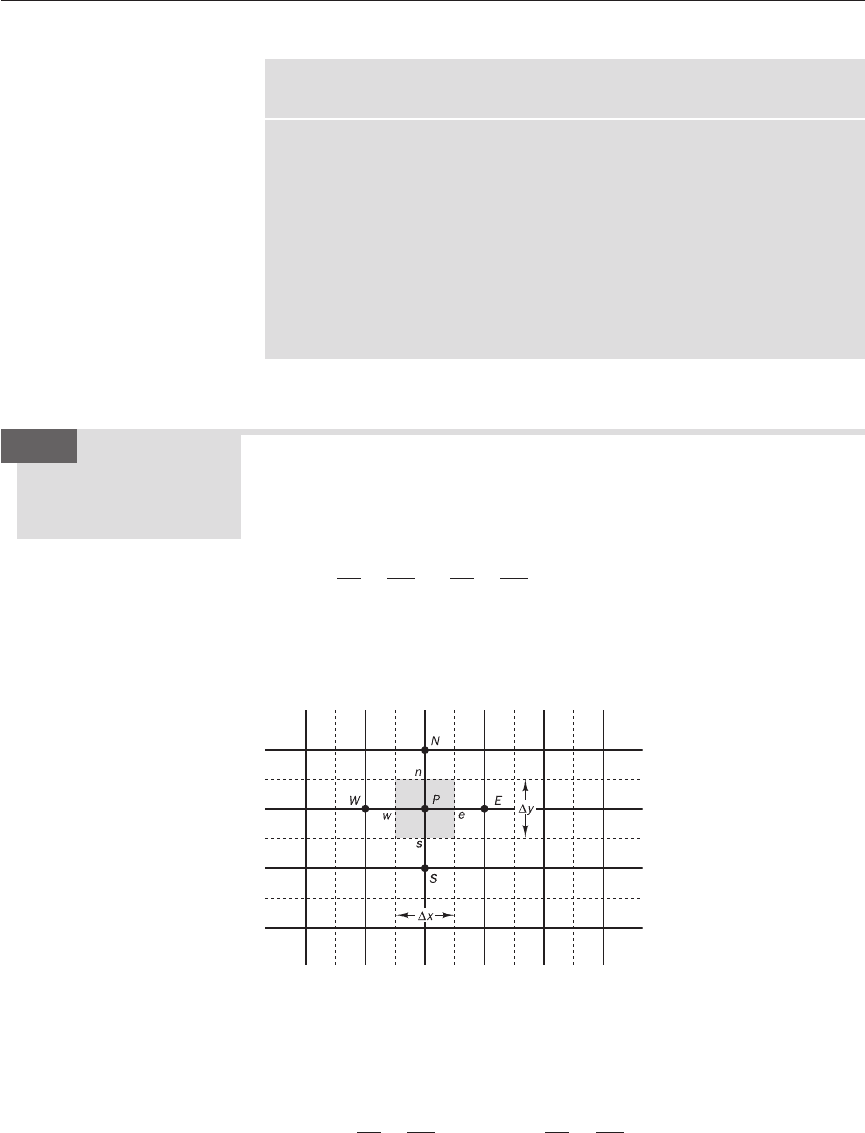
A portion of the two-dimensional grid used for the discretisation is shown in
Figure 4.12.
D
E
F
∂φ
∂
y
A
B
C
∂
∂
y
D
E
F
∂φ
∂
x
A
B
C
∂
∂
x
Table 4.6
Node Distance Finite volume Analytical Difference Percentage
solution solution error
1 0.05 80.59 82.31 1.72 2.08
2 0.15 56.94 57.79 0.85 1.47
3 0.25 42.53 42.93 0.40 0.93
4 0.35 33.74 33.92 0.18 0.53
5 0.45 28.40 28.46 0.06 0.21
6 0.55 25.16 25.17 0.01 0.03
7 0.65 23.21 23.19 −0.02 −0.08
8 0.75 22.06 22.03 −0.03 −0.13
9 0.85 21.47 21.39 −0.08 −0.37
10 0.95 21.13 21.11 −0.02 −0.09
Figure 4.12 A part of the two-
dimensional grid
Finite volume
method for
two-dimensional
diffusion problems
4.4
In addition to the east (E) and west (W) neighbours a general grid node
P now also has north (N) and south (S) neighbours. The same notation as in
the one-dimensional analysis is used for faces and cell dimensions. When the
above equation is formally integrated over the control volume we obtain
Γ dx . dy +Γdx . dy + S
φ
dV = 0 (4.52)
∆V
D
E
F
∂φ
∂
y
A
B
C
∂
∂
y
∆V
D
E
F
∂φ
∂
x
A
B
C
∂
∂
x
∆V
ANIN_C04.qxd 29/12/2006 09:57 AM Page 129
130 CHAPTER 4 FINITE VOLUME METHOD FOR DIFFUSION PROBLEMS
So, noting that A
e
= A
w
=∆y and A
n
= A
s
=∆x, we obtain
Γ
e
A
e
e
−Γ
w
A
w
w
+Γ
n
A
n
n
−Γ
s
A
s
s
+ D∆V = 0 (4.53)
As before, this equation represents the balance of the generation of
φ
in a
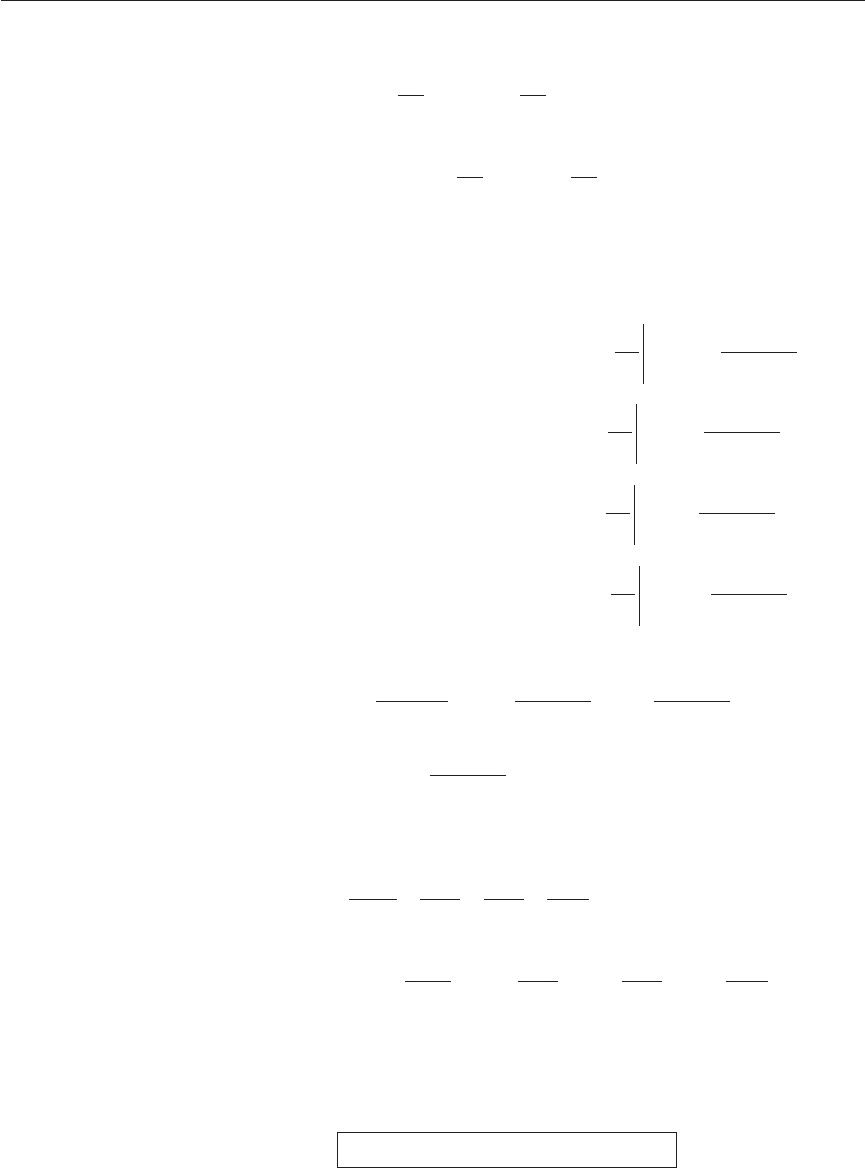
control volume and the fluxes through its cell faces. Using the approxima-
tions introduced in the previous section we can write expressions for the flux
through control volume faces:
Flux across the west face =Γ
w
A
w
w
=Γ
w
A
w
(4.54a)
Flux across the east face =Γ
e
A
e
e
=Γ
e
A
e
(4.54b)
Flux across the south face =Γ
s
A
s
s
=Γ
s
A
s
(4.54c)
Flux across the north face =Γ
n
A
n
n
=Γ
n
A
n
(4.54d)
By substituting the above expressions into equation (4.53) we obtain
Γ
e
A
e
−Γ
w
A
w
+Γ
n
A
n
−Γ
s
A
s
+ D∆V = 0 (4.55)
When the source term is represented in the linearised form D∆V = S
u
+ S
p
φ
P
,
this equation can be rearranged as
+++−S
p
φ
P
=
φ
W
+
φ
E
+
φ
S
+
φ
N
+ S
u
(4.56)
Equation (4.56) is now cast in the general discretised equation form for
interior nodes:
a
P
φ
P
= a
W
φ
W
+ a
E
φ
E
+ a
S
φ
S
+ a
N
φ
N
+ S
u
(4.57)
D
E
F
Γ
n
A
n
δ
y
PN
A
B
C
D
E
F
Γ
s
A
s
δ
y
SP
A
B
C
D
E
F
Γ
e
A
e
δ
x
PE
A
B
C
D
E
F
Γ
w
A
w
δ
x
WP
A
B
C
D
E
F
Γ
n
A
n
δ
y
PN
Γ
s
A
s
δ
y
SP
Γ
e
A
e
δ
x
PE
Γ
w
A
w
δ
x
WP
A
B
C
(
φ
P
−
φ
S
)
δ
y
SP
(
φ
N
−
φ
P
)
δ
y
PN
(
φ
P
−
φ
W
)
δ
x
WP
(
φ
E
−
φ
P
)
δ
x
PE
(
φ
N
−
φ
P
)
δ
y
PN
∂φ
∂
y
(
φ
P
−
φ
S
)
δ
y
SP
∂φ
∂
y
(
φ
E
−
φ
P
)
δ
x
PE
∂φ
∂
x
(
φ
P
−
φ
W
)
δ
x
WP
∂φ
∂
x
J
K
L
D
E
F
∂φ
∂
y
A
B
C
D
E
F
∂φ
∂
y
A
B
C
G
H
I
J
K
L
D
E
F
∂φ
∂
x
A
B
C
D
E
F
∂φ
∂
x
A
B
C
G
H
I
ANIN_C04.qxd 29/12/2006 09:57 AM Page 130
4.5 FINITE VOLUME METHOD FOR 3D DIFFUSION PROBLEMS 131
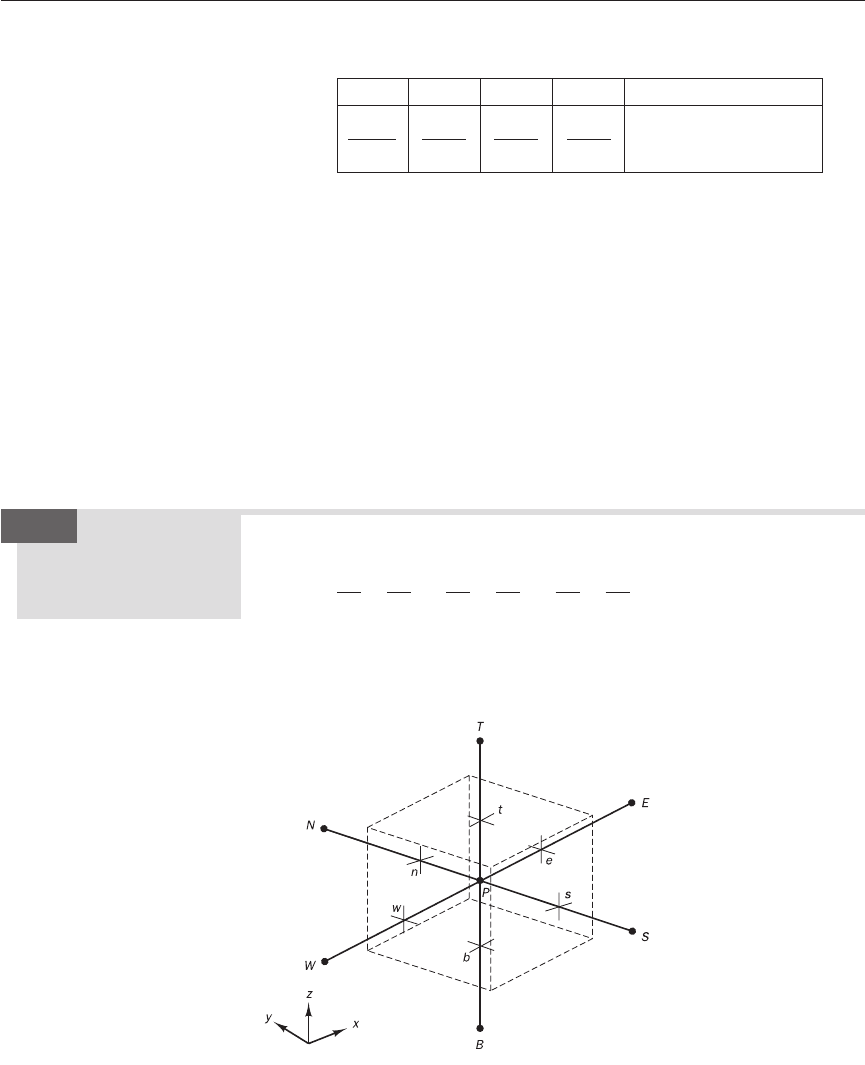
Figure 4.13 A cell in three
dimensions and neighbouring
nodes
Finite volume
method for
three-dimensional
diffusion problems
where
a
W
a
E
a
S
a
N
a
P
a
W
+ a
E
+ a
S
+ a
N
− S
p
The face areas in a two-dimensional case are A
w
= A
e
=∆y; A
n
= A
s
=∆x.
We obtain the distribution of the property
φ
in a given two-dimensional
situation by writing discretised equations of the form (4.57) at each grid node
of the sub-divided domain. At the boundaries where the temperatures or
fluxes are known the discretised equations are modified to incorporate
boundary conditions in the manner demonstrated in Examples 4.1 and 4.2.
The boundary-side coefficient is set to zero (cutting the link with the bound-
ary) and the flux crossing the boundary is introduced as a source which is
appended to any existing S
u
and S
p
terms. Subsequently, the resulting set of
equations is solved to obtain the two-dimensional distribution of the prop-
erty
φ
. Example 7.2 in Chapter 7 shows how the method can be applied to
calculate conductive heat transfer in two-dimensional situations.
Steady state diffusion in a three-dimensional situation is governed by
Γ+Γ+Γ+S
φ
= 0 (4.58)
Now a three-dimensional grid is used to sub-divide the domain. A typical
control volume is shown in Figure 4.13.
D
E
F
∂φ
∂
z
A
B
C
∂
∂
z
D
E
F
∂φ
∂
y
A
B
C
∂
∂
y
D
E
F
∂φ
∂
x
A
B
C
∂
∂
x
Γ
n
A
n
δ
y
PN
Γ
s
A
s
δ
y
SP
Γ
e
A
e
δ
x
PE
Γ
w
A
w
δ
x
WP
A cell containing node P now has six neighbouring nodes identified as
west, east, south, north, bottom and top (W, E, S, N, B, T ). As before, the
notation w, e, s, n, b and t is used to refer to the west, east, south, north,
bottom and top cell faces respectively.
4.5
ANIN_C04.qxd 29/12/2006 09:57 AM Page 131
132 CHAPTER 4 FINITE VOLUME METHOD FOR DIFFUSION PROBLEMS
Summary
Integration of Equation (4.58) over the control volume shown gives
Γ
e
A
e
e
−Γ
w
A
w
w
+Γ
n
A
n
n
−Γ
s
A
s
s
+Γ
t
A
t
t
−Γ
b
A
b
b
+ D∆V = 0
(4.59)
Following the procedure developed for one- and two-dimensional cases the
discretised form of equation (4.59) is obtained:
Γ
e
A
e
−Γ
w
A
w
+Γ
n
A
n
−Γ
s
A
s
+Γ
t
A
t
−Γ
b
A
b
+ (S
u
+ S
P
φ
P
) = 0 (4.60)
As before, this can be rearranged to give the discretised equation for interior
nodes:
a
P
φ
P
= a
W
φ
W
+ a
E
φ
E
+ a
S
φ
S
+ a
N
φ
N
+ a
B
φ
B
+ a
T
φ
T
+ S
u
(4.61)
where
a
W
a
E
a
S
a
N
a
B
a
T
a
P
a
W
+ a
E
+ a
S
+ a
N
+ a
B
+ a
T
− S
P
Boundary conditions can be introduced by cutting links with the appropri-
ate face(s) and modifying the source term as described in section 4.3.
• The discretised equations for one-, two- and three-dimensional diffusion
problems have been found to take the following general form:
a
P
φ
P
=∑a
nb
φ
nb
+ S
u
(4.62)
where Σ indicates summation over all neighbouring nodes (nb), a
nb
are
the neighbouring coefficients, a
W
, a
E
in one dimension, a
W
, a
E
, a
S
, a
N
in
two dimensions and a
W
, a
E
, a
S
, a
N
, a
B
, a
T
in three dimensions;
φ
nb
are
the values of the property
φ
at the neighbouring nodes; and (S
u
+ S
P
φ
P
)
is the linearised source term.
• In all cases the coefficients around point P satisfy the following relation:
a
P
=∑a
nb
− S
p
(4.63)
Γ
t
A
t
δ
z
PT
Γ
b
A
b
δ
z
BP
Γ
n
A
n
δ
y
PN
Γ
s
A
s
δ
y
SP
Γ
e
A
e
δ
x
PE
Γ
w
A
w
δ
x
WP
J
K
L
(
φ
P
−
φ
B
)
δ
z
BP
(
φ
T
−
φ
P
)
δ
z
PT
G
H
I
J
K
L
(
φ
P
−
φ
S
)
δ
y
SP
(
φ
N
−
φ
P
)
δ
y
PN
G
H
I
J
K
L
(
φ
P
−
φ
W
)
δ
x
WP
(
φ
E
−
φ
P
)
δ
x
PE
G
H
I
J
K
L
D
E
F
∂φ
∂
z
A
B
C
D
E
F
∂φ
∂
z
A
B
C
G
H
I
J
K
L
D
E
F
∂φ
∂
y
A
B
C
D
E
F
∂φ
∂
y
A
B
C
G
H
I
J
K
L
D
E
F
∂φ
∂
x
A
B
C
D
E
F
∂φ
∂
x
A
B
C
G
H
I
4.6
ANIN_C04.qxd 29/12/2006 09:57 AM Page 132

4.6 SUMMARY 133
• A summary of the neighbour coefficients for one-, two- and three-
dimensional diffusion problems is given in Table 4.7.
• Source terms can be included by identifying their linearised form
D∆V = S
u
+ S
p
φ
P
and specifying values for S
u
and S
p
.
• Boundary conditions are incorporated by suppressing the link to the
boundary side and introducing the boundary side flux – exact or linearly
approximated – through additional source terms S
u
and S
p
. For a
one-dimensional control volume of width ∆
ς
with a boundary B:
– link cutting:
set coefficient a
B
= 0 (4.64)
– source contributions:
fixed value
φ
B
: S
u
=
φ
B
S
p
=− (4.65)
fixed flux q
B
: S
u
+ S
p
φ
P
= q
B
(4.66)
2k
B
A
B
∆
ζ
2k
B
A
B
∆
ζ
Table 4.7
a
W
a
E
a
S
a
N
a
B
a
T
1D ––––
2D – –
3D
Γ
t
A
t
δ
z
PT
Γ
b
A
b
δ
z
BP
Γ
n
A
n
δ
y
PN
Γ
s
A
s
δ
y
SP
Γ
e
A
e
δ
x
PE
Γ
w
A
w
δ
x
WP
Γ
n
A
n
δ
y
PN
Γ
s
A
s
δ
y
SP
Γ
e
A
e
δ
x
PE
Γ
w
A
w
δ
x
WP
Γ
e
A
e
δ
x
PE
Γ
w
A
w
δ
x
WP
ANIN_C04.qxd 29/12/2006 09:57 AM Page 133

In problems where fluid flow plays a significant role we must account for the
effects of convection. Diffusion always occurs alongside convection in nature
so here we examine methods to predict combined convection and diffusion.
The steady convection–diffusion equation can be derived from the transport
equation (2.39) for a general property
φ
by deleting the transient term
div(
ρ
u
φ
) = div(Γ grad
φ
) + S
φ
(5.1)
Formal integration over a control volume gives
n . (
ρφ
u)dA = n . (Γ grad
φ
)dA + S
φ
dV (5.2)
This equation represents the flux balance in a control volume. The left hand
side gives the net convective flux and the right hand side contains the net
diffusive flux and the generation or destruction of the property
φ
within the
control volume.
The principal problem in the discretisation of the convective terms is the
calculation of the value of transported property
φ
at control volume faces and
its convective flux across these boundaries. In Chapter 4 we introduced the
central differencing method of obtaining discretised equations for the diffu-
sion and source terms on the right hand side of equation (5.2). It would seem
obvious to try out this practice, which worked so well for diffusion problems,
on the convective terms. However, the diffusion process affects the distribu-
tion of a transported quantity along its gradients in all directions, whereas
convection spreads influence only in the flow direction. This crucial difference
manifests itself in a stringent upper limit to the grid size, which is dependent
on the relative strength of convection and diffusion, for stable convection–
diffusion calculations with central differencing.
Naturally, we also present the case for a number of alternative discretisa-
tion practices for the convective effects which enable stable computations
under less restrictive conditions. In the current analysis no reference will
be made to the evaluation of face velocities. It is assumed that they are
‘somehow’ known. The method of computing velocities will be discussed
in Chapter 6.
CV
A
A
Chapter five The finite volume method for
convection---diffusion problems
Introduction5.1
ANIN_C05.qxd 29/12/2006 04:36PM Page 134
5.2 STEADY 1D CONVECTION AND DIFFUSION 135
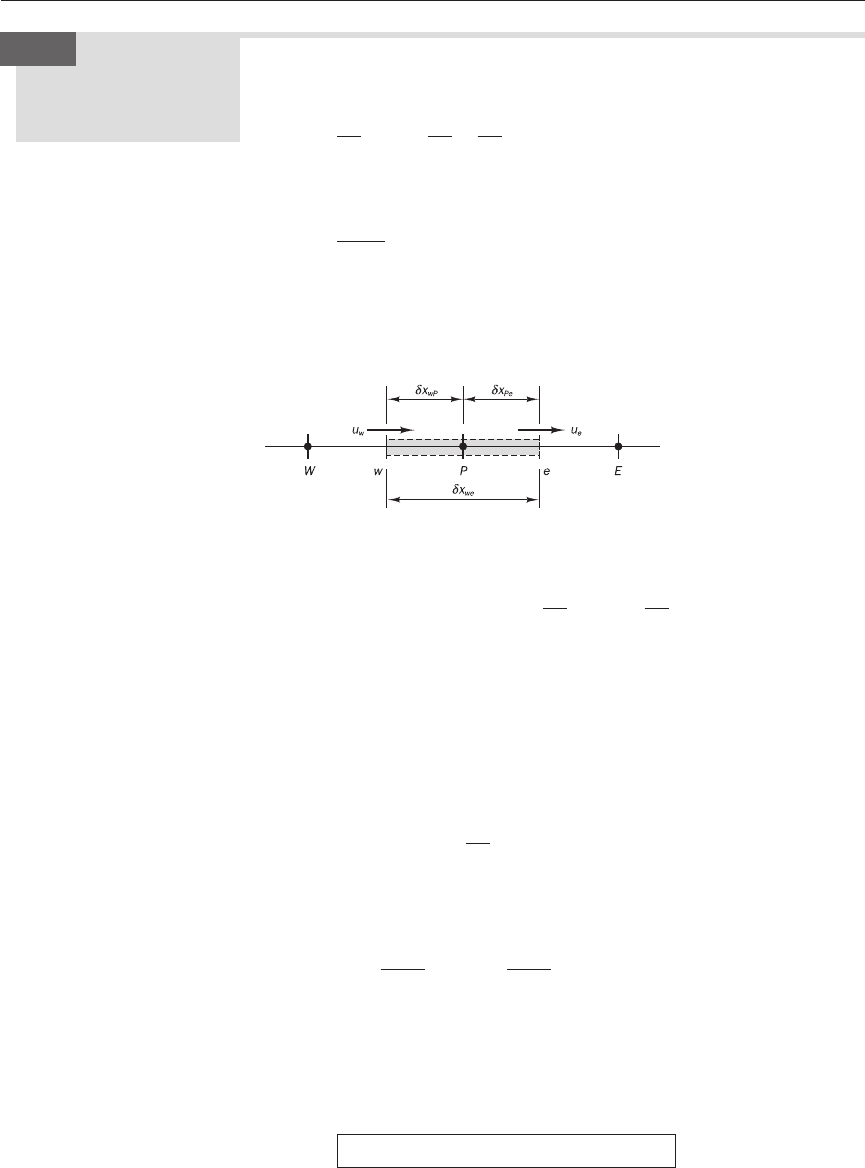
Figure 5.1 A control volume
around node P
In the absence of sources, steady convection and diffusion of a property
φ
in
a given one-dimensional flow field u is governed by
(
ρ
u
φ
) =Γ (5.3)
The flow must also satisfy continuity, so
= 0 (5.4)
We consider the one-dimensional control volume shown in Figure 5.1 and
use the notation introduced in Chapter 4. Our attention is focused on a
general node P; the neighbouring nodes are identified by W and E and the
control volume faces by w and e.
d(
ρ
u)
dx
D
E
F
d
φ
dx
A
B
C
d
dx
d
dx
Steady one-
dimensional
convection and
diffusion
5.2
Integration of transport equation (5.3) over the control volume of
Figure 5.1 gives
(
ρ
uA
φ
)
e
− (
ρ
uA
φ
)
w
=ΓA
e
−ΓA
w
(5.5)
And integration of continuity equation (5.4) yields
(
ρ
uA)
e
− (
ρ
uA)
w
= 0 (5.6)
To obtain discretised equations for the convection–diffusion problem we
must approximate the terms in equation (5.5). It is convenient to define two
variables F and D to represent the convective mass flux per unit area and
diffusion conductance at cell faces:
F =
ρ
u and D = (5.7)
The cell face values of the variables F and D can be written as
F
w
= (
ρ
u)
w
F
e
= (
ρ
u)
e
(5.8a)
D
w
= D
e
= (5.8b)
We develop our techniques assuming that A
w
= A
e
= A, so we can divide the
left and right hand sides of equation (5.5) by area A. As before, we employ
the central differencing approach to represent the contribution of the diffu-
sion terms on the right hand side. The integrated convection–diffusion
equation (5.5) can now be written as
F
e
φ
e
− F
w
φ
w
= D
e
(
φ
E
−
φ
P
) − D
w
(
φ
P
−
φ
W
) (5.9)
Γ
e
δ
x
PE
Γ
w
δ
x
WP
Γ
δ
x
D
E
F
d
φ
dx
A
B
C
D
E
F
d
φ
dx
A
B
C
ANIN_C05.qxd 29/12/2006 04:36PM Page 135
136 CHAPTER 5 FINITE VOLUME METHOD FOR C---D PROBLEMS
and the integrated continuity equation (5.6) as
F
e
− F
w
= 0 (5.10)
We also assume that the velocity field is ‘somehow known’, which takes care
of the values of F
e
and F
w
. In order to solve equation (5.9) we need to calcu-
late the transported property
φ
at the e and w faces. Schemes for this purpose
are assessed in the following sections.
The central differencing approximation has been used to represent the
diffusion terms which appear on the right hand side of equation (5.9), and it
seems logical to try linear interpolation to compute the cell face values for the
convective terms on the left hand side of this equation. For a uniform grid
we can write the cell face values of property
φ
as
φ
e
= (
φ
P
+
φ
E
)/2 (5.11a)
φ
w
= (
φ
W
+
φ
P
)/2 (5.11b)
Substitution of the above expressions into the convection terms of (5.9)
yields
(
φ
P
+
φ
E
) − (
φ
W
+
φ
P
) = D
e
(
φ
E
−
φ
P
) − D
w
(
φ
P
−
φ
W
) (5.12)
This can be rearranged to give
D
w
−+D
e
+
φ
P
= D
w
+
φ
W
+ D
e
−
φ
E
D
w
++D
e
− + (F
e
− F
w
)
φ
P
= D
w
+
φ
W
+ D
e
−
φ
E
(5.13)
Identifying the coefficients of
φ
W
and
φ
E
as a
W
and a
E
, the central differ-
encing expressions for the discretised convection–diffusion equation are
a
P
φ
P
= a
W
φ
W
+ a
E
φ
E
(5.14)
where
a
W
a
E
a
P
D
w
+ D
e
− a
W
+ a
E
+ (F
e
− F
w
)
It can be easily recognised that equation (5.14) for steady convection–diffusion
problems takes the same general form as equation (4.11) for pure diffusion
problems. The difference is that the coefficients of the former contain
F
e
2
F
w
2
D
E
F
F
e
2
A
B
C
D
E
F
F
w
2
A
B
C
J
K
L
D
E
F
F
e
2
A
B
C
D
E
F
F
w
2
A
B
C
G
H
I
D
E
F
F
e
2
A
B
C
D
E
F
F
w
2
A
B
C
J
K
L
D
E
F
F
e
2
A
B
C
D
E
F
F
w
2
A
B
C
G
H
I
F
w
2
F
e
2
The central
differencing
scheme
5.3
ANIN_C05.qxd 29/12/2006 04:36PM Page 136