
Versteeg H., Malalasekra W. An Introduction to Computational Fluid Dynamics: The Finite Volume Method
Подождите немного. Документ загружается.


3.8 LARGE EDDY SIMULATION 107
boundary condition can strongly affect simulation quality. The simplest
method is to specify measured mean velocity distributions and to super-
impose Gaussian random perturbations with the correct turbulence intensity,
but this ignores the cross-correlations between velocity components
(Reynolds stresses) and two-point correlations (i.e. spatial coherence) in real
turbulent flows. Distortions of turbulence properties can take considerable
settling distance before the mean flow reaches equilibrium with the turbu-
lence properties, and the settling distance is problem dependent. Several
alternatives are available:
1 Represent the inlet flow with the correct geometry using a RANS
turbulence model. The commonest method is to perform an unsteady
flow calculation with the RSM to obtain estimates of all the Reynolds
stresses at the inlet plane and impose these by maintaining correct
values of the relevant autocorrelations and cross-correlations during
the generation of the Gaussian random perturbations.
2 Extend the computational domain further upstream and use a
turbulence-free inflow (by developing the flow from a large reservoir).
This requires a long upstream distance, typically of the order of
50 hydraulic diameters, until a fully developed flow is reached,
but is feasible if an inlet flow with thin boundary layers is required.
3 Specify a fully developed inlet profile as the starting point for internal
flows in complex geometry. Such profiles can be economically computed
from an auxiliary LES computation with streamwise periodic
boundaries (see below).
4 Specify a precise inlet profile with prescribed shear stress, momentum
thickness and boundary layer thickness. Lund et al. (1998) proposed a
technique to extract inlet profiles for developing boundary layers from
auxiliary LES computations. Other methods with this objective have
been developed by Klein et al. (2003) and Ferrante and Elgobashi
(2004). The former is based on digital filtering of random data and the
specification of length scales in each co-ordinate direction to generate
two-point correlations. The latter proposes a refinement of the Lund
et al. procedure to ensure that the correct spectral energy distribution is
reproduced across the wavenumbers. Both algorithms are reported to
reduce the settling length between the inflow boundary and the location
in the computational domain of the actual LES calculations where the
turbulence reaches equilibrium with the mean flow.
Outflow boundaries
Outflow boundary conditions are less troublesome. The familiar zero gradient
boundary condition is used for the mean flow, and the fluctuating properties
are extrapolated by means of a so-called convective boundary condition:
+ R
n
= 0
Periodic boundary conditions
All LES and DNS calculations are three-dimensional because turbulence
is three-dimensional. Periodic boundary conditions are particularly useful
in directions where the mean flow is homogeneous (e.g. the z-direction in
∂φ
∂
n
∂φ
∂
t
ANIN_C03.qxd 29/12/2006 04:35PM Page 107
two-dimensional planar flow). All properties are set to be equal at equivalent
points on pairs of periodic boundaries. The distance between the two peri-
odic boundaries must be such that two-point correlations are zero for all
points on a pair of periodic boundaries. This means that the distance should
be chosen to be at least twice the size of the largest eddies so that the effect
of one boundary on the other is minimal.
3.8.6 LES applications in flows with complex geometry
Considerable effort has been made in the research community to develop
robust LES methods for general-purpose CFD computations involving
complex geometry. We briefly summarise some of the issues that have been
addressed in the recent literature.
Non-uniform grids are preferable in flows with solid boundaries to
resolve the rapid changes in the near-wall region. However, this would
require different filter cutoff width in the core flow and near-wall regions.
Suppose we adjust the cutoff width of a filter to give the correct separation
between large and small eddy scales in the core flow. This cutoff width
would be inappropriate for the near-wall region, where the size of turbulence
eddies is restricted by the presence of the solid boundary. Here the chosen
filter cutoff width would be too large and would cause anisotropic, energetic
near-wall eddies to be included in the SGS scales. Equation (3.86) states that
the cutoff width for three-dimensional computations should be taken as the
cube root of the control volume size. In non-uniform grids the cutoff width
would vary along with the control volume size. Scotti et al. (1993) show that
Smagorinsky’s constant C
SGS
should be corrected to take into account grid
anisotropy in the three dimensions:
C
SGS
= 0.16 × cosh
4
–
27
[(ln a
1
)
2
− ln a
1
× ln a
2
+ (ln a
2
)
2
]
where the grid-anisotropy factors are given by a
1
=∆x/∆z and a
2
=∆y/∆z.
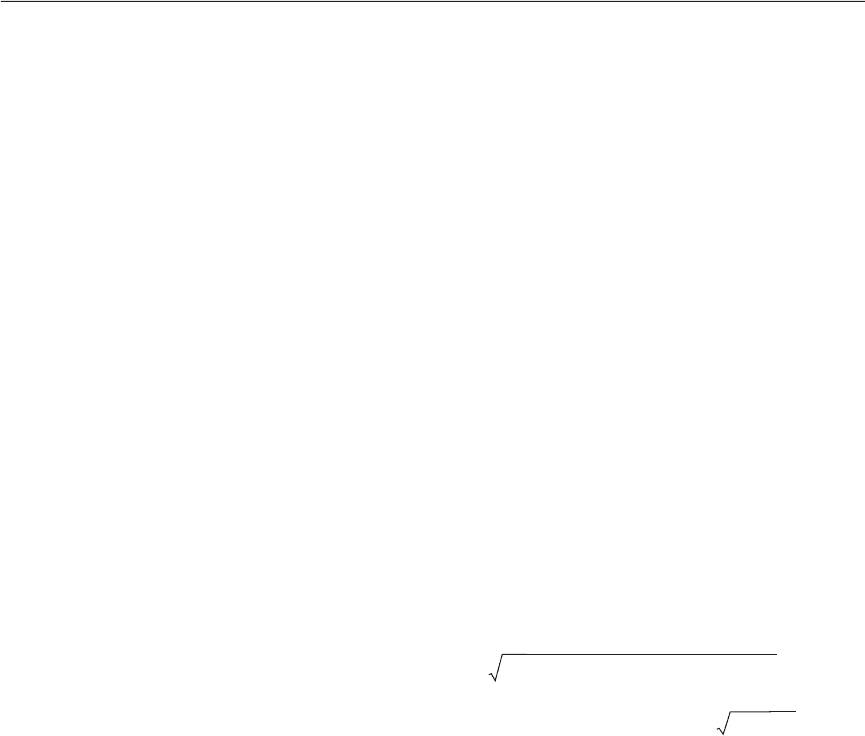
In finite volume applications the filter cutoff width ∆=
3
∆x∆y∆z is neces-
sarily close to the mesh size. There is a price to pay because this choice of
cutoff width blurs the distinction between the effects of the SGS eddies and
the numerical errors associated with the discretisation of the equations on the
grid. The SGS stresses will be similar in magnitude to the numerical trun-
cation errors. Unless careful attention is paid to the control of numerical
errors they may even swamp the SGS stresses. Upwind differencing (see
Chapter 5), which was standard practice in early CFD computations with
RANS turbulence modelling, is far too diffusive and generates large truncation
errors. Second-order or higher-order discretisation techniques are needed.
Moin (2002) reported the performance of a robust and non-dissipative dis-
cretisation method for unstructured grids in simulations of a gas turbine
combustor.
A uniform cutoff width was assumed in the development of the LES
equations (3.87) and (3.89a–c) to ensure that filtering commutes with time
and space derivatives. This is not the case when the cutoff width is non-
uniform. Ghosal and Moin (1995) show that the non-commutativity errors
associated with non-uniform cutoff width can be of similar magnitude to
the Leonard stresses and truncation errors. They propose a method based
on transformation of the co-ordinate system to control this error. Further
methods to minimise this problem have since been proposed: Vasilyev et al.
108 CHAPTER 3 TURBULENCE AND ITS MODELLING
ANIN_C03.qxd 29/12/2006 04:35PM Page 108
3.8 LARGE EDDY SIMULATION 109
(1998) developed a class of discrete commutative filters for non-uniform
structured grids, which was extended by Marsden et al. (2002) to unstructured
grids for use in conjunction with second-order accurate discretisation schemes.
3.8.7 General comments on performance of LES
It is the main task of turbulence modelling to develop computational pro-
cedures of sufficient accuracy and generality for engineers to predict the
Reynolds stresses and the scalar transport terms. The inherent unsteady
nature of LES suggests that the computational requirements should be much
larger than those of classical turbulence models. This is indeed the case when
LES is compared with two-equation models such as the k–
ε
and k–
ω
models. However, RSMs require the solution of seven additional PDEs, and
Ferziger (1977) noted that LES may only need about twice the computer
resources compared with RSM for the same calculation. With such modest
differences in computational requirements the focus switches to the achiev-
able solution accuracy and the ability of the LES to resolve certain time-
dependent features ‘for free’. Post-processing of LES results yields informa-
tion relating to the mean flow and statistics of the resolved fluctuations. The
latter are unique to LES, and Moin as well as Meinke and Krause (both in
Peyret and Krause, 2000) gave examples of flows where persistent large-scale
vortices have a substantial influence on flow development, e.g. vortex shed-
ding behind bluff bodies, flows in diffusing passages, flows in pipe bends and
tumble swirl in engine combustion chambers. The ability to obtain fluctuat-
ing pressure fields from LES output has also led to aeroacoustic applications
for the prediction of noise from jets and other high-speed flows.
As an illustration of the most advanced LES capability we show results
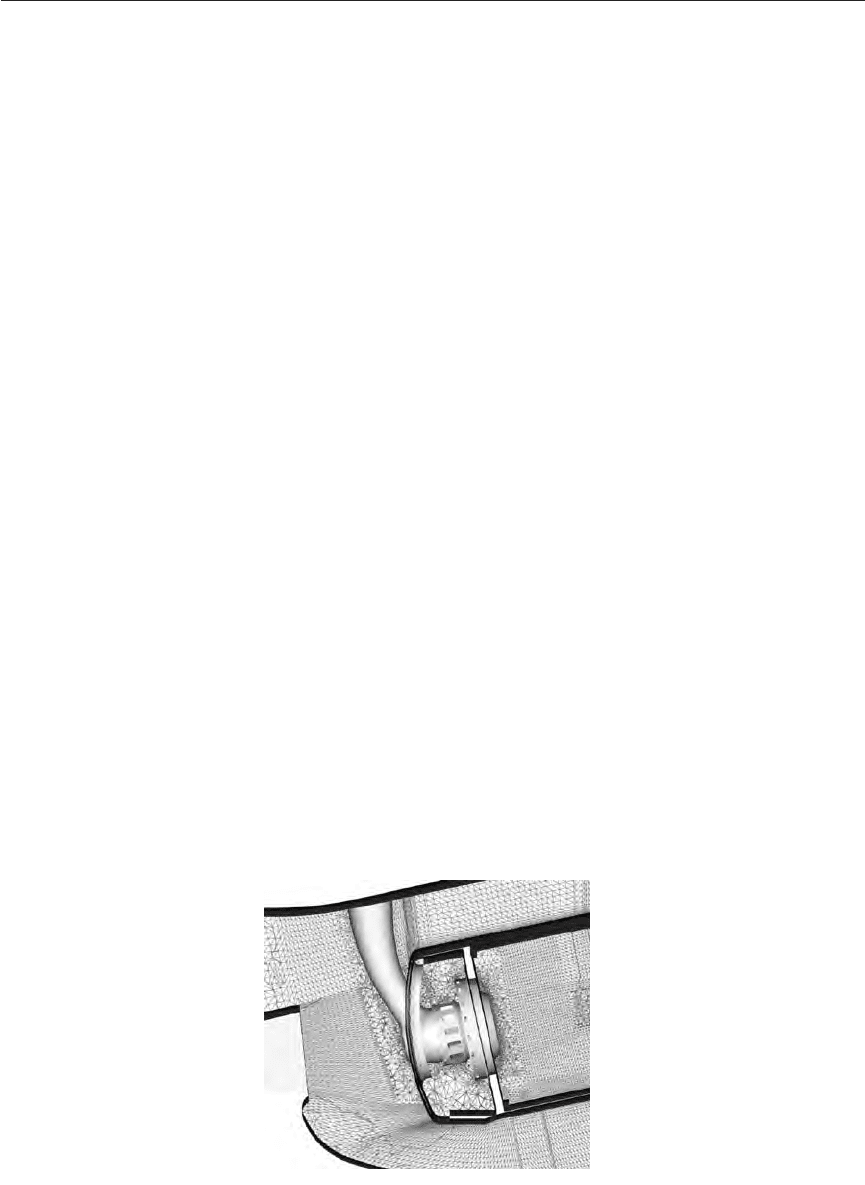
from Moin (2002) for a gas turbine. Figure 3.17 shows a detail of the com-
bustor geometry and the computational grid, which is unstructured to model
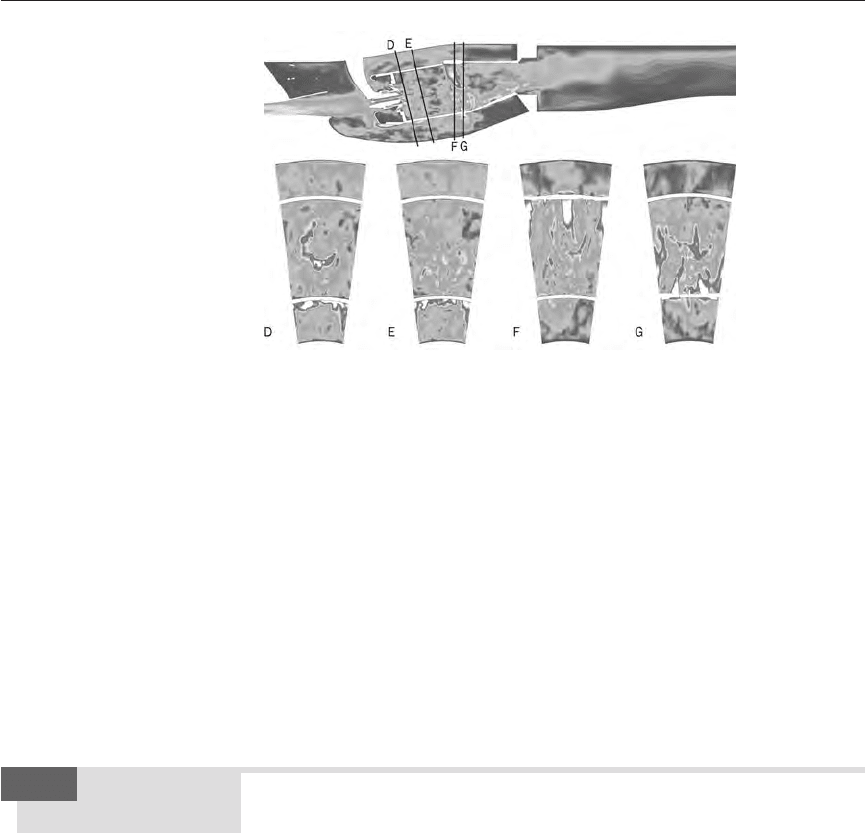
all the details in this very complex geometry. Figure 3.18 shows contours of
instantaneous velocity magnitude on a mid-section plane and on four further
perpendicular cross-sections as indicated on the diagram. The physics of the
turbulent flow is also highly complex, involving combustion, swirl, dilution
jets etc. Flow instabilities have serious consequences for combustion, and
the information generated by LES calculations is uniquely applicable to the
development of this technology.
Figure 3.17 LES computations
on Pratt & Whitney gas turbine –
detail of combustor geometry
and computational grid
Source: Moin (2002)
ANIN_C03.qxd 29/12/2006 04:35PM Page 109
LES has been around since the 1960s, but sufficiently powerful comput-
ing resources to consider application to industrially relevant problems have
only recently become available. Inclusion of LES in commercial CFD is even
more recent, so the range of validation experience is limited. Most code ven-
dors usually state that care must be taken with the interpretation of results
generated with their LES models. Furthermore, it should be noted that the
methodology for the treatment of non-commutativity effects in non-uniform
and unstructured grids is comparatively recent, as are treatments for com-
pressible flow and turbulent scalar fluctuations. This research does not yet
appear to have been incorporated in finite volume/LES codes. Geurts and
Leonard (2005) give a survey of the main issues that need to be addressed to
control error sources and generate robust LES methodology for application
to industrially relevant complex flows. It is likely that the pace of develop-
ments will increase as computing resources become more powerful and as the
CFD user community becomes more aware of the advantages of the LES
approach to turbulence modelling.
The instantaneous continuity and Navier–Stokes equations (3.23) and
(3.24a–c) for an incompressible turbulent flow form a closed set of four equa-
tions with four unknowns u, v, w and p. Direct numerical simulation
(DNS) of turbulent flow takes this set of equations as a starting point and
develops a transient solution on a sufficiently fine spatial mesh with
sufficiently small time steps to resolve even the smallest turbulent eddies and
the fastest fluctuations.
Reynolds (in Lumley, 1989) and Moin and Mahesh (1998) listed the
potential benefits of DNSs:
• Precise details of turbulence parameters, their transport and budgets at
any point in the flow can be calculated with DNS. These are useful for
the development and validation of new turbulence models. Refereed
databases giving free access to DNS results have started to emerge (e.g.
ERCOFTAC, http://ercoftac.mech.surrey.ac.uk/dns/homepage.html;
Turbulence and Heat Transfer Lab of the University of Tokyo,
http://www.thtlab.t.u-tokyo.ac.jp; the University of Manchester,
http://cfd.me.umist.ac.uk/ercoftac).
110 CHAPTER 3 TURBULENCE AND ITS MODELLING
Figure 3.18 LES computations
on Pratt & Whitney gas turbine
– instantaneous contours of
velocity magnitude on sectional
planes
Source: Moin (2002)
Direct numerical
simulation
3.9
ANIN_C03.qxd 29/12/2006 04:35PM Page 110

3.9 DIRECT NUMERICAL SIMULATION 111
• Instantaneous results can be generated that are not measurable with
instrumentation, and instantaneous turbulence structures can be
visualised and probed. For example, pressure–strain correlation terms in
RSM turbulence models cannot be measured, but accurate values can be
computed from DNSs.
• Advanced experimental techniques can be tested and evaluated in DNS
flow fields. Reynolds (in Lumley, 1989) noted that DNS has been used
to calibrate hot-wire anemometry probes in near-wall turbulence.
• Fundamental turbulence research on virtual flow fields that cannot
occur in reality, e.g. by including or excluding individual aspects of flow
physics. Moin and Mahesh (1998) listed some examples: shear-free
boundary layers developing on walls at rest with respect to the free
stream, effect of initial conditions on the development of self-similar
turbulent wakes, the study of the fundamentals of reacting flows (strain
rates of flamelets and distortion of mixing surfaces).
On the downside we note that direct solution of the flow equations is very
difficult because of the wide range of length and time scales caused by the
appearance of eddies in a turbulent flow. In section 3.1 we considered order-
of-magnitude estimates of the range of scales present in a turbulent flow and
found that the ratio of smallest to largest length scales varied in proportion
to Re
3/4
. To resolve the smallest and largest turbulence length scales a direct
simulation of a turbulent flow with a modest Reynolds number of 10
4
would
require of the order of 10
3
points in each co-ordinate direction. Thus, since
turbulent flows are inherently three-dimensional, we would need computing
meshes with 10
9
grid points (N ≅ Re
9/4
) to describe processes at all length
scales. Furthermore, the ratio of smallest to largest time scales varies as Re
1/2
,
so at Re = 10
4
we would need to run a simulation for at least 100 time steps.
In practice, a larger number of time steps would be needed to ensure the
passage of several of the largest eddies in order to obtain meaningful time-
average flow results and turbulence statistics.
Speziale (1991) estimated that the direct simulation of a turbulent pipe
flow at a Reynolds number of 500 000 requires a computer which is 10 mil-
lion times faster than a (then) current generation Cray supercomputer. Moin
and Kim (1997) estimated computing times of 100 hours to 300 years for tur-
bulent flows at Reynolds numbers in the range 10
4
to 10
6
based on high-
performance computer speeds of 150 Mflops available at that time. This
confirmed that it started to become possible to compute interesting turbulent
flows with DNS based on the unsteady Navier–Stokes equations. Advanced
supercomputers at present (2006) have processor speeds of the order 1–10
Tflops. If the performance scaling can be maintained across such a wide
range of speeds, this would reduce computing times to minutes or hours.
We briefly review progress in this rapidly growing area of turbulence
research.
3.9.1 Numerical issues in DNS
It is of course beyond the scope of this introduction to go into the details of
the methods used for DNS, but it is worth touching on the specific require-
ments for this type of computation. The review by Moin and Mahesh (1998)
highlights the following issues being tackled in the DNS research literature.
ANIN_C03.qxd 29/12/2006 04:35PM Page 111

Spatial discretisation
The first DNS simulations were performed with spectral methods (Orszag
and Patterson, 1972). These are based on Fourier series decomposition in
periodic directions and Chebyshev polynomial expansions in directions with
solid walls. The methods are economical and have high convergence rates,
but they are difficult to apply in complex geometry. Nevertheless, they are
still widely used in research on transitional flows and turbulent flows with
simple geometries: some recent applications are flow-induced vibrations
(Evangelinos et al., 2000), strained two-dimensional wake flow (Rogers, 2002)
and transition in rotor–stator cavity flow (Serre et al., 2002, 2004). Early
recognition of the limitations of spectral methods led to the development of
spectral element methods (Orszag and Patera, 1984; Patera, 1986). These
combine the geometric flexibility of the finite element method with the good
convergence properties of the spectral method. These methods have been
developed for complex turbulent flows by Karniadakis and co-workers (e.g.
Karniadakis, 1989, 1990).
Higher-order finite difference methods (Moin, 1991) are now widely
used for problems with more complex geometry. Particular attention needs
to be paid to the design of the spatial and temporal discretisation schemes to
ensure that the method is stable and to make sure that numerical dissipation
does not swamp turbulent eddy dissipation. A sample of recent work illus-
trates the range of applications: turbulent flow in a pipe rotating about its
axis (Orlandi and Fatica, 1997), flow around square cylinders (Tamura et al.,
1998), plumes ( Jiang and Luo, 2000) and diffusion flames (Luo et al., 2005).
Spatial resolution
Above we have noted that the spatial mesh for DNS is determined at one end
by the largest geometrical features that need to be resolved and at the other
end by the finest turbulence scales that are generated. Research has shown
that the grid point requirement N ∝ Re
9/4
can be somewhat relaxed, because
most of the dissipation actually takes place at scales that are substantially
larger than of the order of the Kolmogorov length scale
η
, say 5
η
–15
η
(Moin and Mahesh, 1998). As long as the bulk of the dissipation process is
adequately represented, the number of grid cells can be reduced. In typical
finite difference calculations reduction by a factor of around 100 is possible
without significant loss of accuracy.
Temporal discretisation
There is a wide range of time scales in a turbulent flow, so the system of
equations is stiff. Implicit time advancement and large time steps are
routinely used for stiff systems in general-purpose CFD, but these are
unsuitable in DNS because complete time resolution is needed to describe
the energy dissipation process accurately. Specially designed implicit and
explicit methods have been developed to ensure time accuracy and stability
(see e.g. Verstappen and Veldman, 1997).
Temporal resolution
Reynolds (in Lumley, 1989) noted that it is essential to have accurate time
resolution of all the scales of turbulent motion. The time steps must be
112 CHAPTER 3 TURBULENCE AND ITS MODELLING
ANIN_C03.qxd 29/12/2006 04:35PM Page 112

3.10 SUMMARY 113
adjusted so that fluid particles do not move more than one mesh spacing.
Moin and Mahesh (1998) demonstrated the strong influence of time step size
on small-scale amplitude and phase error.
Initial and boundary conditions
Issues relating to initial and boundary conditions are similar to those in LES.
The reader is referred to section 3.8.5 for a relevant discussion.
3.9.2 Some achievements of DNS
Early work on transitional flows is reviewed in Kleiser and Zang (1991).
Since the paper by Orszag and Patterson (1972) a range of turbulent incom-
pressible flows of fundamental importance have been investigated. We list
the most important studies and refer the interested reader to the review
paper by Moin and Mahesh (1998) for further details: homogeneous turbu-
lence with mean strain, free shear layers, fully developed channel flow,
curved channel flow, channel flow with riblets, channel flow with heat trans-
fer, rotating channel flow, channel flow with transverse curvature, flow over
a backward-facing step, flat plate boundary layer separation.
More recently the DNS methodology has been extended to compress-
ible flows: homogeneous compressible turbulence, isotropic and sheared
compressible turbulence, compressible channel flow, compressible turbulent
boundary layer, high-speed compressible turbulent mixing layer.
During the first two decades after the study by Orszag and Patterson the
resources required for DNS calculations were only available to a handful of
groups across the globe. Since the 1990s, however, high-performance com-
puting has become much more widely available, and the technique is within
reach of a much larger number of turbulence researchers with more diverse
interests including fundamental aspects of flows with multi-physics: gas–
liquid turbulent flows, particle-laden flows (Elghobashi and Truesdell, 1993)
and reacting flows (Poinsot et al., 1993). The unique ability of DNS to
generate accurate flow fields has led to the development of the new field of
computational aeroacoustics (reviewed in Tam, 1995; Lele, 1997).
Although most DNS computations are at comparatively low Reynolds
numbers (e.g. Hoarau et al., 2003), predictions in the 1960s and 1970s that
DNS would never be a realistic proposition for turbulent flows of relevance
to engineering may have been unduly pessimistic. Much effort will be
focused on speed and stability improvements of the basic numerical algo-
rithms (see e.g. Verstappen and Veldman, 1997) as well as the development
of methods to take best advantage of future high-performance computer
architectures. Given the potential benefits of DNS results it is likely that
rapid growth of interest in this area is set to continue.
This chapter provides a first glimpse of turbulent flows and of the practice of
turbulence modelling in CFD. Turbulence is a phenomenon of great com-
plexity and has challenged leading theoreticians for over a hundred years.
The flow fluctuations associated with turbulence give rise to additional trans-
fer of momentum, heat and mass. These changes to the flow character can be
Summary3.10
ANIN_C03.qxd 29/12/2006 04:35PM Page 113

favourable (efficient mixing) or detrimental (high energy losses) depending
on one’s point of view.
Engineers are mainly interested in the prediction of mean flow behaviour,
but turbulence cannot be ignored, because the fluctuations give rise to the
extra Reynolds stresses on the mean flow. These extra stresses must be
modelled in industrial CFD. What makes the prediction of the effects of
turbulence so difficult is the wide range of length and time scales of motion
even in flows with very simple boundary conditions. It should therefore be
considered as truly remarkable that RANS turbulence models, such as the
k–
ε
models, succeed in expressing the main features of many turbulent flows
by means of one length scale and one time scale defining variable. The stand-
ard k–
ε
model is valued for its robustness, and is still widely preferred in
industrial internal flow computations. The k–
ω
model and Spalart–Allmaras
model have become established as the leading RANS turbulence models for
aerospace applications. Many experts argue that the RSM is the only viable
way forward towards a truly general-purpose classical turbulence model,
but recent advances in the area of non-linear k–
ε
models are very likely to
reinvigorate research on two-equation turbulence models. As a cautionary
note, Leschziner (in Peyret and Krause, 2000) observes that performance
improvements of new RANS turbulence models have not been uniform: in
some cases the cubic k–
ε
model performs as well as the RSM, whereas in
other cases it is not discernibly better than the standard k–
ε
model, so the
verdict on these models is still open.
Large eddy simulation (LES) requires substantial computing resources,
and the technique needs further research and development before it can be
applied as an industrial general-purpose tool in flows with complex geometry.
However, it is already recognised that valuable information can be obtained
from LES computations in simple flows by generating turbulence properties
that cannot be measured in the laboratory due to the absence of suitable
experimental techniques. Hence, as a research tool LES will increasingly be
used to guide the development of classical models through comparative stud-
ies. Several commercial CFD codes now contain basic LES capability, and
these are likely to see more widespread industrial applications in flows where
large-scale time-dependent flow features (vortex shedding, swirl etc.) play a
role. The emergence of high-performance computing resources based around
Linux PC clusters is likely to accelerate this trend.
Although the resulting mathematical expressions of turbulence models
may be quite complicated it should never be forgotten that they all contain
adjustable constants that need to be determined as best-fit values from
experimental data that contain experimental uncertainties. Every engineer
is aware of the dangers of extrapolating an empirical model beyond its
data range. The same risks occur when (ab)using turbulence models in this
fashion. CFD calculations of ‘new’ turbulent flows should never be accepted
without validation against high-quality data. The source can be experiments,
but increasingly the data that can be generated by means of numerical experi-
ments with DNS are being used as benchmarks. DNS is likely to play an
increasingly important role in turbulence research in the near future.
114 CHAPTER 3 TURBULENCE AND ITS MODELLING
ANIN_C03.qxd 29/12/2006 04:35PM Page 114

The nature of the transport equations governing fluid flow and heat trans-
fer and the formal control volume integration were described in Chapter 2.
Here we develop the numerical method based on this integration, the
finite volume (or control volume) method, by considering the simplest
transport process of all: pure diffusion in the steady state. The governing
equation of steady diffusion can easily be derived from the general transport
equation (2.39) for property
φ
by deleting the transient and convective terms.
This gives
div(Γ grad
φ
) + S
φ
= 0 (4.1)
The control volume integration, which forms the key step of the finite
volume method that distinguishes it from all other CFD techniques, yields
the following form:
div(Γ grad
φ
)dV + S
φ
dV
= n . (Γ grad
φ
)dA + S
φ
dV = 0 (4.2)
By working with the one-dimensional steady state diffusion equation, the
approximation techniques that are needed to obtain the so-called discretised
equations are introduced. Later the method is extended to two- and three-
dimensional diffusion problems. Application of the method to simple one-
dimensional steady state heat transfer problems is illustrated through a series
of worked examples, and the accuracy of the method is gauged by compar-
ing numerical results with analytical solutions.
Consider the steady state diffusion of a property
φ
in a one-dimensional
domain defined in Figure 4.1. The process is governed by
Γ+S = 0 (4.3)
where Γ is the diffusion coefficient and S is the source term. Boundary values
of
φ
at points A and B are prescribed. An example of this type of process,
one-dimensional heat conduction in a rod, is studied in detail in section 4.3.
D
E
F
d
φ
dx
A
B
C
d
dx
CV
A
CV
CV
Chapter four The finite volume method for
diffusion problems
Introduction4.1
Finite volume
method for one-
dimensional steady
state diffusion
4.2
ANIN_C04.qxd 29/12/2006 09:57 AM Page 115
Step 1: Grid generation
The first step in the finite volume method is to divide the domain into dis-
crete control volumes. Let us place a number of nodal points in the space
between A and B. The boundaries (or faces) of control volumes are posi-
tioned mid-way between adjacent nodes. Thus each node is surrounded by a
control volume or cell. It is common practice to set up control volumes near
the edge of the domain in such a way that the physical boundaries coincide
with the control volume boundaries.
At this point it is appropriate to establish a system of notation that can be
used in future developments. The usual convention of CFD methods is
shown in Figure 4.2.
116 CHAPTER 4 FINITE VOLUME METHOD FOR DIFFUSION PROBLEMS
Figure 4.1
Figure 4.2
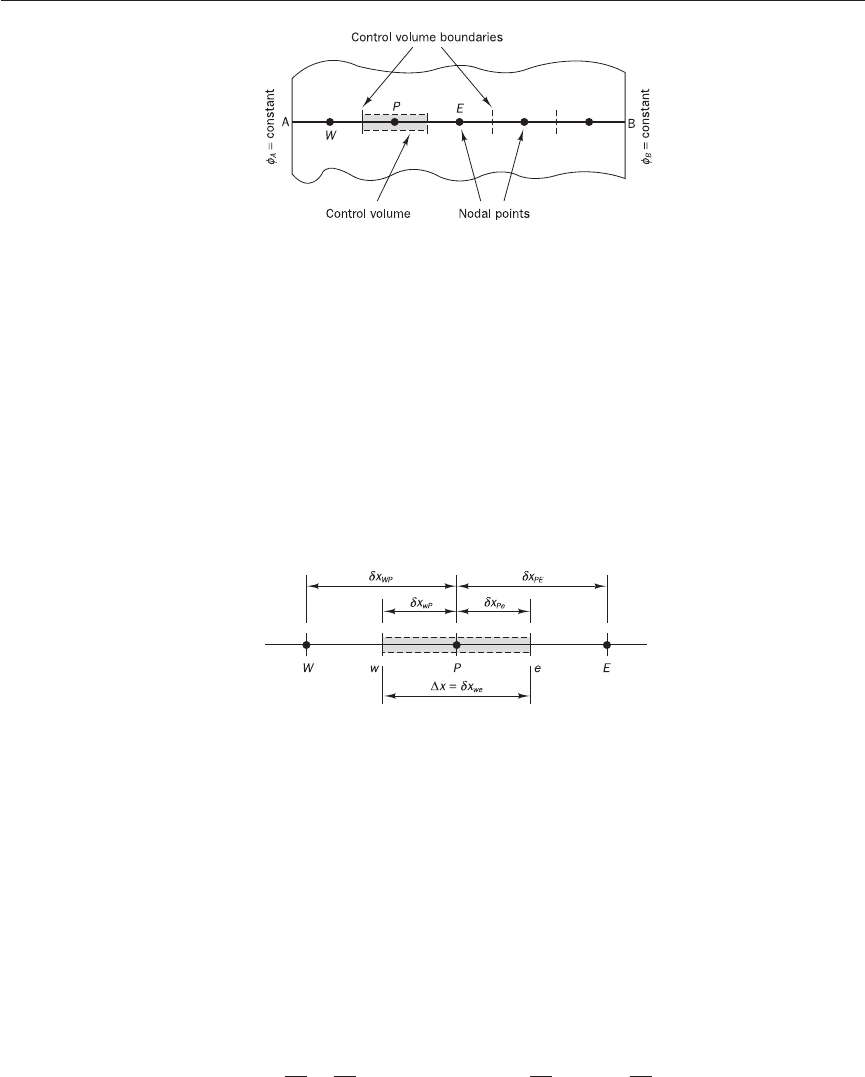
A general nodal point is identified by P and its neighbours in a one-
dimensional geometry, the nodes to the west and east, are identified by W
and E respectively. The west side face of the control volume is referred to by
w and the east side control volume face by e. The distances between the
nodes W and P, and between nodes P and E, are identified by
δ
x
WP
and
δ
x
PE
respectively. Similarly distances between face w and point P and between P
and face e are denoted by
δ
x
wP
and
δ
x
Pe
respectively. Figure 4.2 shows that
the control volume width is ∆x =
δ
x
we
.
Step 2: Discretisation
The key step of the finite volume method is the integration of the governing
equation (or equations) over a control volume to yield a discretised equation
at its nodal point P. For the control volume defined above this gives
Γ dV + SdV =ΓA
e
−ΓA
w
+ D∆V = 0 (4.4)
Here A is the cross-sectional area of the control volume face, ∆V is the
volume and D is the average value of source S over the control volume. It is
D
E
F
d
φ
dx
A
B
C
D
E
F
d
φ
dx
A
B
C
∆V
D
E
F
d
φ
dx
A
B
C
d
dx
∆V
ANIN_C04.qxd 29/12/2006 09:57 AM Page 116