
Versteeg H., Malalasekra W. An Introduction to Computational Fluid Dynamics: The Finite Volume Method
Подождите немного. Документ загружается.


3.7 RANS EQUATIONS AND TURBULENCE MODELS 87
The mixing length formulae are similar in form to the expression in Table 3.2
for the length scale in the viscous sub-layer of a wall boundary layer. In order
to avoid instabilities associated with differences between
µ
t,t
and
µ
t,v
at the
join between the fully turbulent and viscous regions, a blending formula is
used to evaluate the eddy viscosity in
τ
ij
=−
ρ
= 2
µ
t
S
ij
−
2
–
3
ρ
k
δ
ij
:
µ
t
= F
µ
µ
t,t
+ (1 − F
µ
)
µ
t,v
(3.64)
The blending function F
µ
= F
µ
(Re
y
) is zero at the wall and tends to 1 in the
fully turbulent region when Re
y
200. The functional form of F
µ
is designed
to ensure a smooth transition around Re
y
= 200.
The two-layer model is less grid dependent and more numerically
stable than the earlier low Reynolds number k–
ε
models and has become
quite popular in more complex flow simulations where integration to the wall
of the flow equations is necessary.
Strain sensitivity: RNG k---
εε
model
The statistical mechanics approach has led to new mathematical formalisms,
which, in conjunction with a limited number of assumptions regarding the
statistics of small-scale turbulence, provide a rigorous basis for the extension
of eddy viscosity models. The renormalization group (RNG) devised by
Yakhot and Orszag of Princeton University has attracted most interest. They
represented the effects of the small-scale turbulence by means of a random
forcing function in the Navier–Stokes equation. The RNG procedure sys-
tematically removes the small scales of motion from the governing equations
by expressing their effects in terms of larger scale motions and a modified
viscosity. The mathematics is highly abstruse; we only quote the RNG k–
ε
model equations for high Reynolds number flows derived by Yakhot et al.
(1992):
+ div(
ρ
kU) = div[
α
k
µ
eff
grad k] +
τ
ij
. S
ij
−
ρε
(3.65)
+ div(
ρε
U) = div[
α
ε
µ
eff
grad
ε
] + C *
1
ε
τ
ij
. S
ij
− C
2
ε
ρ
(3.66)
with
τ
ij
=−
ρ
= 2
µ
t
S
ij
−
ρ
k
δ
ij
and
µ
eff
=
µ
+
µ
t
µ
t
=
ρ
C
µ
and
C
µ
= 0.0845
α
k
=
α
ε
= 1.39 C
1
ε
= 1.42 C
2
ε
= 1.68 (3.67)
k
2
ε
2
3
u
i
′u
j
′
ε
2
k
ε
k
∂
(
ρε
)
∂
t
∂
(
ρ
k)
∂
t
u
i
′u
j
′
ANIN_C03.qxd 29/12/2006 04:35PM Page 87

The literature is too extensive even to begin to review here. The main
sources of useful, applications-oriented information are: Transactions of the
American Society of Mechanical Engineers – in particular the Journal of Fluids
Engineering, Journal of Heat Transfer and Journal of Engineering for Gas Turbines
and Power – as well as the AIAA Journal, the International Journal of Heat
and Mass Transfer and the International Journal of Heat and Fluid Flow.
In spite of century-long efforts to develop RANS turbulence models, a
general-purpose model suitable for a wide range of practical applications has
so far proved to be elusive. This is to a large extent attributable to differences
in the behaviour of large and small eddies. The smaller eddies are nearly
isotropic and have a universal behaviour (for turbulent flows at sufficiently
high Reynolds numbers at least). On the other hand, the larger eddies, which
interact with and extract energy from the mean flow, are more anisotropic
and their behaviour is dictated by the geometry of the problem domain, the
boundary conditions and body forces. When Reynolds-averaged equations
are used the collective behaviour of all eddies must be described by a
single turbulence model, but the problem dependence of the largest eddies
complicates the search for widely applicable models. A different approach
to the computation of turbulent flows accepts that the larger eddies need
to be computed for each problem with a time-dependent simulation. The
universal behaviour of the smaller eddies, on the other hand, should hope-
fully be easier to capture with a compact model. This is the essence of the
large eddy simulation (LES) approach to the numerical treatment of
turbulence.
Instead of time-averaging, LES uses a spatial filtering operation to separ-
ate the larger and smaller eddies. The method starts with the selection of a
filtering function and a certain cutoff width with the aim of resolving in an
unsteady flow computation all those eddies with a length scale greater than
the cutoff width. In the next step the spatial filtering operation is performed
on the time-dependent flow equations. During spatial filtering information
relating to the smaller, filtered-out turbulent eddies is destroyed. This, and
interaction effects between the larger, resolved eddies and the smaller unre-
solved ones, gives rise to sub-grid-scale stresses or SGS stresses. Their effect
on the resolved flow must be described by means of an SGS model. If the
finite volume method is used the time-dependent, space-filtered flow equa-
tions are solved on a grid of control volumes along with the SGS model of
the unresolved stresses. This yields the mean flow and all turbulent eddies at
scales larger than the cutoff width. In this section we review the methodo-
logy of LES computation of turbulent flows and summarise recent achieve-
ments in the calculation of industrially relevant flows.
3.8.1 Spatial filtering of unsteady Navier---Stokes equations
Filters are familiar separation devices in electronics and process applications
that are designed to split an input into a desirable, retained part and an un-
desirable, rejected part. The details of the design of a filter – in particular its
functional form and the cutoff width ∆ – determine precisely what is retained
and rejected.
98 CHAPTER 3 TURBULENCE AND ITS MODELLING
Large eddy
simulation
3.8
ANIN_C03.qxd 29/12/2006 04:35PM Page 98

3.8 LARGE EDDY SIMULATION 99
Filtering functions
In LES we define a spatial filtering operation by means of a filter function
G(x, x′, ∆) as follows:
2(x, t) ≡ G(x, x′, ∆)
φ
(x′, t)dx
1
′dx
2
′dx
3
′ (3.84)
where 2(x, t) = filtered function
and
φ
(x, t) = original (unfiltered) function
and ∆=filter cutoff width
In this section the overbar indicates spatial filtering, not time-averaging.
Equation (3.84) shows that filtering is an integration, just like time-averaging
in the development of the RANS equations, only in the LES the integration
is not carried out in time but in three-dimensional space. It should be noted
that filtering is a linear operation.
The commonest forms of the filtering function in three-dimensional LES
computations are
• Top-hat or box filter:
G(x, x′, ∆) =
!
1/∆
3
|x − x′| ≤ ∆ / 2 (3.85a)
@
0 |x − x′| > ∆ / 2
• Gaussian filter:
G(x, x′, ∆) =
3/2
exp −
γ
(3.85b)
typical value for parameter
γ
= 6
• Spectral cutoff:
G(x, x′, ∆) = (3.85c)
The top-hat filter is used in finite volume implementations of LES. The
Gaussian and spectral cutoff filters are preferred in the research literature.
The Gaussian filter was introduced for LES in finite differences by the
Stanford group, which, over a period of more than three decades, has been
the centre of research on LES and has established a rigorous basis for the
technique as a turbulence modelling tool. Spectral methods (i.e. Fourier
series to describe the flow variables) are also used in turbulence research, and
the spectral filter gives a sharp cutoff in the energy spectrum at a wavelength
of ∆/
π
. The latter is attractive from the point of view of separation of the
large and small eddy scales, but the spectral method cannot be used in
general-purpose CFD.
The cutoff width is intended as an indicative measure of the size of eddies
that are retained in the computations and the eddies that are rejected. In
principle, we can choose the cutoff width ∆ to be any size, but in CFD
computations with the finite volume method it is pointless to select a cutoff
width that is smaller than the grid size. In this type of computation only a
single nodal value of each flow variable is retained on each grid cell, so all
finer detail is lost anyway. The most common selection is to take the cutoff
sin[(x
i
− x
i
′)/∆]
(x
i
− x
i
′)
3
∏
i=1
D
E
F
|x − x′|
2
∆
2
A
B
C
D
E
F
γ
π
∆
2
A
B
C
∞
−∞
∞
−∞
∞
−∞
ANIN_C03.qxd 29/12/2006 04:35PM Page 99
100 CHAPTER 3 TURBULENCE AND ITS MODELLING
width to be of the same order as the grid size. In three-dimensional computa-
tions with grid cells of different length ∆x, width ∆y and height ∆z the
cutoff width is often taken to be the cube root of the grid cell volume:
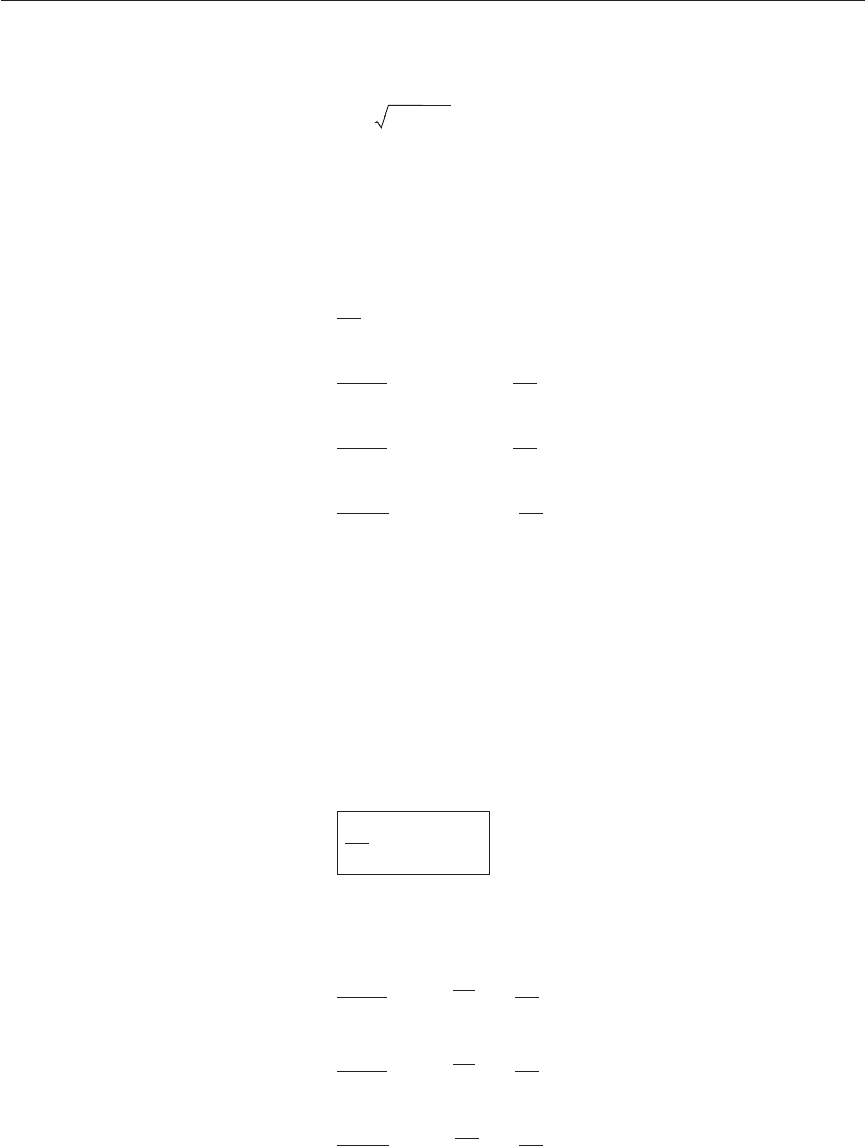
∆=
3
∆x∆y∆z (3.86)
Filtered unsteady Navier---Stokes equations
As before in section 3.3 we focus our attention on incompressible flows. As
usual we take Cartesian co-ordinates so that the velocity vector u has u-, v-,
w-components. The unsteady Navier–Stokes equations for a fluid with con-
stant viscosity
µ
are as follows:
+ div(
ρ
u) = 0 (2.4)
+ div(
ρ
uu) =− +
µ
div(grad(u)) + S
u
(2.37a)
+ div(
ρ
vu) =− +
µ
div(grad(v)) + S
v
(2.37b)
+ div(
ρ
wu) =− +
µ
div(grad(w)) + S
w
(2.37c)
If the flow is also incompressible we have div(u) = 0, and hence the viscous
momentum source terms S
u
, S
v
and S
w
are zero.
Considerable further simplification of the algebra is possible if we use the
same filtering function G(x, x′) = G(x − x′) throughout the computational
domain, i.e. G is independent of position x. If we use such a uniform filter
function we can, by exploiting the linearity of the filtering operation, swap
the order of the filtering and differentiation with respect to time, as well as
the order of filtering and differentiation with respect to space co-ordinates.
We have already seen this commutative property in action in section 3.3
when the time-averaged RANS flow equations were derived. Filtering of
equation (2.4) yields the LES continuity equation:
+ div(
ρ
=) = 0 (3.87)
The overbar in this and all following equations in this section indicates a
filtered flow variable.
Repeating the process for equations (2.37a–c) gives
+ div(
ρ
) =− +
µ
div(grad(R)) (3.88a)
+ div(
ρ
) =− +
µ
div(grad({)) (3.88b)
+ div(
ρ
) =− +
µ
div(grad(S)) (3.88c)
∂
Q
∂
z
wu
∂
(
ρ
S)
∂
t
∂
Q
∂
y
vu
∂
(
ρ
{)
∂
t
∂
Q
∂
x
uu
∂
(
ρ
R)
∂
t
∂ρ
∂
t
∂
p
∂
z
∂
(
ρ
w)
∂
t
∂
p
∂
y
∂
(
ρ
v)
∂
t
∂
p
∂
x
∂
(
ρ
u)
∂
t
∂ρ
∂
t
ANIN_C03.qxd 29/12/2006 04:35PM Page 100

3.8 LARGE EDDY SIMULATION 101
Equation set (3.87) and (3.88a–c) should be solved to yield the filtered veloc-
ity field R, {, S and filtered pressure field Q. We now face the problem that
we need to compute convective terms of the form div(
ρ
) on the left hand
side, but we only have available the filtered velocity field R, {, S and pressure
field Q. To make some progress we write
div(
ρ
) = div(2=) + (div(
ρ
) − div(2=))
The first term on the right hand side can be calculated from the filtered 2 –
and R – fields and the second term is replaced by a model.
Substitution into (3.88a–c) and some rearrangement yields the LES
momentum equations:
+ div(
ρ
R=) =− +
µ
div(grad(R)) − (div(
ρ
) − div(
ρ
R=)) (3.89a)
+ div(
ρ
{=) =− +
µ
div(grad({)) − (div(
ρ
) − div(
ρ
{=)) (3.89b)
+ div(
ρ
S=) =− +
µ
div(grad(S)) − (div(
ρ
) − div(
ρ
S=)) (3.89c)
(I) (II) (III) (IV) (V)
The filtered momentum equations look very much like the RANS momen-
tum equations (3.26a–c) or (3.27a–c). Terms (I) are the rate of change of
the filtered x-, y- and z-momentum. Terms (II) and (IV) are the convective
and diffusive fluxes of filtered x-, y- and z-momentum. Terms (III) are the
gradients in the x-, y- and z-directions of the filtered pressure field. The last
terms (V) are caused by the filtering operation, just like the Reynolds stresses
in the RANS momentum equations that arose as a consequence of time-
averaging. They can be considered as a divergence of a set of stresses
τ
ij
. In
suffix notation the i-component of these terms can be written as follows:
div(
ρ
−
ρ
) =+
+= (3.90a)
where
τ
ij
=
ρ
−
ρ
=
ρ
−
ρ
(3.90b)
In recognition of the fact that a substantial portion of
τ
ij
is attributable to
convective momentum transport due to interactions between the unresolved
or SGS eddies, these stresses are commonly termed the sub-grid-scale
stresses. However, unlike the Reynolds stresses in the RANS equations, the
LES SGS stresses contain further contributions. The nature of these contri-
butions can be determined with the aid of a decomposition of a flow variable
φ
(x, t) as the sum of (i) the filtered function 2(x, t) with spatial variations that
are larger than the cutoff width and are resolved by the LES computation
and (ii)
φ
′(x, t), which contains unresolved spatial variations at a length scale
smaller than the filter cutoff width:
u
j
u
i
u
i
u
j
uu
i
u
i
u
∂τ
ij
∂
x
j
∂
(
ρ
u
i
w −
ρ
u
i
w)
∂
z
∂
(
ρ
u
i
v −
ρ
u
i
v)
∂
y
∂
(
ρ
u
i
u −
ρ
u
i
u)
∂
x
uu
i
u
i
u
wu
∂
Q
∂
z
∂
(
ρ
S)
∂
t
vu
∂
Q
∂
y
∂
(
ρ
{)
∂
t
uu
∂
Q
∂
x
∂
(
ρ
R)
∂
t
φ
u
φ
u
φ
u
ANIN_C03.qxd 29/12/2006 04:35PM Page 101
102 CHAPTER 3 TURBULENCE AND ITS MODELLING
φ
(x, t) = 2(x, t) +
φ
′(x, t) (3.91)
Using this decomposition in equation (3.90b) we can write the first term on
the far right hand side as follows:
ρ
=
ρ
=
ρ
+
ρ
+
ρ
+
ρ
=
ρ
+ (
ρ
−
ρ
) +
ρ
+
ρ
+
ρ
Now we can write the SGS stresses as follows:
τ
ij
=
ρ
−
ρ
= (
ρ
−
ρ
) +
ρ
+
ρ
+
ρ
(3.92)
(I) (II) (III)
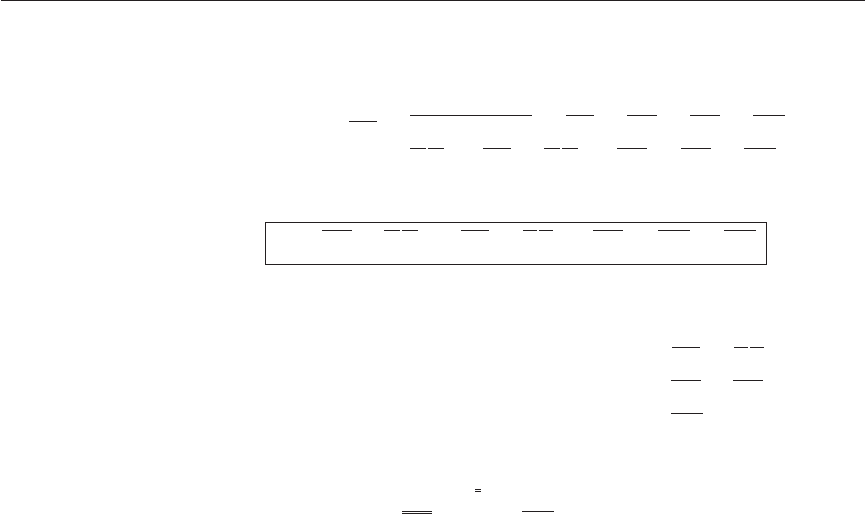
Thus, we find that the SGS stresses contain three groups of contributions:
• Term (I), Leonard stresses L
ij
: L
ij
=
ρ
−
ρ
• Term (II), cross-stresses C
ij
: C
ij
=
ρ
+
ρ
• Term (III), LES Reynolds stresses R
ij
: R
ij
=
ρ
The Leonard stresses L
ij
are solely due to effects at resolved scale. They are
caused by the fact that a second filtering operation makes a change to a
filtered flow variable, i.e. ≠ 2 for space-filtered variables, unlike in time-
averaging, where = + =Φ= (compare equation (3.21)). These stress
contributions were named after the American scientist A. Leonard, who first
identified an approximate method to compute them from the filtered flow
field (see Leonard (1974) for further details). The cross-stresses C
ij
are due
to interactions between the SGS eddies and the resolved flow. An approx-
imate expression for this term is given in Ferziger (1977). Finally, the LES
Reynolds stresses R
ij
are caused by convective momentum transfer due to
interactions of SGS eddies and are modelled with a so-called SGS turbu-
lence model. Just like the Reynolds stresses in the RANS equations, the SGS
stresses (3.92) must be modelled. Below we discuss the most prominent
SGS models.
3.8.2 Smagorinksy---Lilly SGS model
In simple flows such as two-dimensional thin shear layers the Boussinesq
eddy viscosity hypothesis (3.33) was often found to give good predictions of
Reynolds-averaged turbulent stresses. In recognition of the intimate connec-
tion between turbulence production and mean strain, the hypothesis takes
the turbulent stresses to be proportional to the mean rate of strain. Success
of the approach requires that (i) the changes in the flow direction should be
slow so that production and dissipation of turbulence are more or less in bal-
ance and (ii) the turbulence structure should be isotropic (or if this is not the
case the gradients of the anisotropic normal stresses should not be dynami-
cally active). Smagorinsky (1963) suggested that, since the smallest turbulent
eddies are almost isotropic, we expect that the Boussinesq hypothesis might
provide a good description of the effects of the unresolved eddies on the
resolved flow. Thus, in Smagorinsky’s SGS model the local SGS stresses
R
ij
are taken to be proportional to the local rate of strain of the
resolved flow D
ij
=
1
–
2
(
∂
R
i
/
∂
x
j
+
∂
R
j
/
∂
x
i
):
ϕ
(t)
ϕ
(t)
φ
u
i
′u
j
′
u
i
′R
j
R
i
u
j
′
u
j
u
i
R
i
R
j
u
i
′u
j
′u
i
′R
j
R
i
u
j
′u
j
u
i
R
i
R
j
u
j
u
i
u
i
u
j
u
i
′u
j
′u
i
′R
j
R
i
u
j
′u
j
u
i
R
i
R
j
u
j
u
i
u
i
′u
j
′u
i
′R
j
R
i
u
j
′R
i
R
j
(R
i
+ u
i
′)(R
j
+ u
j
′)u
i
u
j
1
2
3
ANIN_C03.qxd 29/12/2006 04:35PM Page 102
3.8 LARGE EDDY SIMULATION 103
R
ij
=−2
µ
SGS
D
ij
+ R
ii
δ
ij
=−
µ
SGS
++R
ii
δ
ij
(3.93)
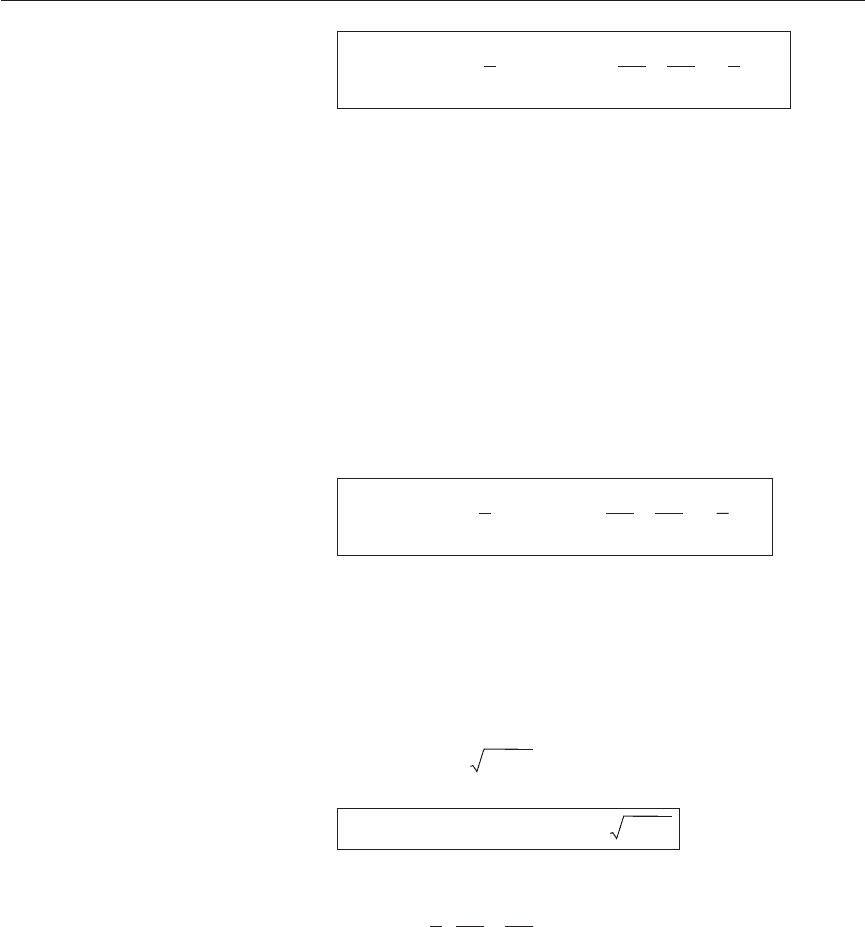
The constant of proportionality is the dynamic SGS viscosity
µ
SGS
, which
has dimensions Pa s. The term
1
–
3
R
ii
δ
ij
on the right hand side of equation
(3.93) performs the same function as the term −
2
–
3
ρ
k
δ
ij
in equation (3.33): it
ensures that the sum of the modelled normal SGS stresses is equal to the
kinetic energy of the SGS eddies. In much of the LES research literature the
above model is used along with approximate forms of the Leonard stresses
L
ij
and cross-stresses C
ij
for the particular filtering function applied in the
work.
Meinke and Krause (in Peyret and Krause, 2000) review applications
of finite volume/LES to complex, industrially relevant CFD computations.
These authors note that, in spite of the different nature of the Leonard
stresses and cross-stresses, they are lumped together with the LES Reynolds
stresses in the current versions of the finite volume method. The whole
stress
τ
ij
is modelled as a single entity by means of a single SGS turbulence
model:
τ
ij
=−2
µ
SGS
D
ij
+
τ
ii
δ
ij
=−
µ
SGS
++
τ
ii
δ
ij
(3.94)
The Smagorinsky–Lilly SGS model builds on Prandtl’s mixing length
model (3.39) and assumes that we can define a kinematic SGS viscosity
ν
SGS
(dimensions m
2
/s), which can be described in terms of one length scale and
one velocity scale and is related to the dynamic SGS viscosity by
ν
SGS
=
µ
SGS
/
ρ
. Since the size of the SGS eddies is determined by the details of the
filtering function, the obvious choice for the length scale is the filter cutoff
width ∆. As in the mixing length model, the velocity scale is expressed as
the product of the length scale ∆ and the average strain rate of the resolved
flow ∆×|D|, where |D|= 2D
ij
D
ij
. Thus, the SGS viscosity is evaluated as
follows:
µ
SGS
=
ρ
(C
SGS
∆)
2
|D|=
ρ
(C
SGS
∆)
2
2D
ij
D
ij
(3.95)
where C
SGS
= constant
and D
ij
=+
Lilly (1966, 1967) presented a theoretical analysis of the decay rates of iso-
tropic turbulent eddies in the inertial subrange of the energy spectrum, which
suggests values of C
SGS
between 0.17 and 0.21. Rogallo and Moin (1984)
reviewed work by other authors suggesting values of C
SGS
= 0.19–0.24 for
results across a range of grids and filter functions. They also quoted early
LES computations by Deardorff (1970) of turbulent channel flow, which has
strongly anisotropic turbulence, particularly in the near-wall regions. This work
established that the above values caused excessive damping and suggested
that C
SGS
= 0.1 is most appropriate for this type of internal flow calculation.
D
E
F
∂
R
j
∂
x
i
∂
R
i
∂
x
j
A
B
C
1
2
1
3
D
E
F
∂
R
j
∂
x
i
∂
R
i
∂
x
j
A
B
C
1
3
1
3
D
E
F
∂
R
j
∂
x
i
∂
R
i
∂
x
j
A
B
C
1
3
ANIN_C03.qxd 29/12/2006 04:35PM Page 103

104 CHAPTER 3 TURBULENCE AND ITS MODELLING
The difference in C
SGS
values is attributable to the effect of the mean flow
strain or shear. This gave an early indication that the behaviour of the small
eddies is not as universal as was surmised at first and that successful LES
turbulence modelling might require case-by-case adjustment of C
SGS
or a
more sophisticated approach.
3.8.3 Higher-order SGS models
A model of the SGS Reynolds stresses based on the Boussinesq eddy vis-
cosity hypothesis assumes that changes in the resolved flow take place
sufficiently slowly that the SGS eddies can adjust themselves instantan-
eously to the rate of strain of the resolved flow field. An alternative strategy
to case-by-case tuning of the constant C
SGS
is to use the ideas of RANS
turbulence modelling to make an allowance for transport effects. We keep
the filter cutoff width ∆ as the characteristic length scale of the SGS eddies,
but replace the velocity scale ∆×|D| by one that is more representative of the
velocity of the SGS eddies. For this we choose the square root of the SGS
turbulent kinetic energy k
SGS
. Thus,
µ
SGS
=
ρ
C′
SGS
∆ k
SGS
(3.96)
where C ′
SGS
= constant
To account for the effects of convection, diffusion, production and destruc-
tion on the SGS velocity scale we solve a transport equation to determine the
distribution of k
SGS
:
+ div(
ρ
k
SGS
=) = div grad(k
SGS
) + 2
µ
SGS
D
ij
. D
ij
−
ρε
SGS
(3.97)
Dimensional analysis shows that the rate of dissipation
ε
SGS
of SGS turbu-
lent kinetic energy is related to the length and velocity scales as follows:
ε
SGS
= C
ε
(3.98)
where C
ε
= constant
This is the LES equivalent of a one-equation RANS turbulence model, such
as the one used in the two-layer k–
ε
model for the viscous-dominated near-
wall region. Schumann (1975) successfully used such a model to compute
turbulent flows in two-dimensional channels and annuli. In a more recent
study Fureby et al. (1997) have carried out LES computations of homogen-
eous isotropic turbulence, which has revived interest in this model, leading
to its implementation in the commercial CFD code STAR-CD.
The above SGS models are all based on the Boussinesq assumption of a
constant SGS eddy viscosity to link SGS stresses and resolved-flow strain
rates. Challenging this isotropic eddy viscosity assumption naturally leads to
the LES equivalent of the Reynolds stress model. Deardorff (1973) used this
model in computations of the atmospheric boundary layer, where the filter
cutoff width must be chosen so large that the unresolved turbulent eddies are
anisotropic and the eddy viscosity assumption becomes inaccurate.
k
3/2
SGS
∆
D
E
F
µ
SGS
σ
k
A
B
C
∂
(
ρ
k
SGS
)
∂
t
ANIN_C03.qxd 29/12/2006 04:35PM Page 104

3.8 LARGE EDDY SIMULATION 105
3.8.4 Advanced SGS models
The Smagorinsky model is purely dissipative: the direction of energy flow is
exclusively from eddies at the resolved scales towards the sub-grid scales. Leslie
and Quarini (1979) have shown that the gross energy flow in this direction
is actually larger and offset by 30% backscatter – energy transfer in reverse
direction from SGS eddies to larger, resolved scales. Furthermore, analysis
of results from direct numerical simulation (DNS) by Clark et al. (1979) and
McMillan and Ferziger (1979) revealed that the correlation between the
actual SGS stresses (as computed by accurate DNS) and the modelled SGS
stresses using the Smagorinsky–Lilly model is not particularly strong. These
authors came to the conclusion that the SGS stresses should not be taken as
proportional to the strain rate of the whole resolved flow field, but, in recogni-
tion of the actual energy cascade processes (see section 3.1), should be estimated
from the strain rate of the smallest resolved eddies. Bardina et al. (1980) pro-
posed a method to compute local values of C
SGS
based on the application of
two filtering operations, taking the SGS stresses to be proportional to the
stresses due to eddies at the smallest resolved scale. They proposed
τ
ij
=
ρ
C′( − )
where C′ is an adjustable constant and the factor in the brackets can be eval-
uated from twice-filtered resolved flow field information. The correlation
between the actual SGS stresses as computed with a DNS and the modelled
SGS stresses was found to be much improved, but the appearance of nega-
tive viscosities generated stability problems. They proposed adding a damp-
ing term with the form of the Smagorinsky model (3.94)–(3.95) to stabilise
the calculations, which yields a mixed model:
τ
ij
=
ρ
C′( − ) − 2
ρ
C
2
SGS
∆
2
|D|D
ij
(3.99)
The value of the constant C′ depends on the cutoff width used for the sec-
ond filtering operation, but is always close to unity.
Germano (1986) proposed a different decomposition of the turbulent
stresses. This formed the basis of the dynamic SGS model (Germano
et al., 1991) for the computation of local values of C
SGS
. In Germano et al.’s
decomposition of turbulent stresses the difference of the SGS stresses for
two different filtering operations with cutoff widths ∆
1
and ∆
2
, respectively,
can be evaluated from resolved flow data:
τ
ij
(2)
−
τ
ij
(1)
=
ρ
L
ij
≡
ρ
−
ρ
(3.100)
The bracketed superscripts (1) and (2) indicate filtering at cutoff widths ∆
1
and ∆
2
.
The SGS stresses are modelled using Smagorinsky’s model (3.94)–(3.95)
assuming that the constant C
SGS
is the same for both filtering operations. It
can be shown that this yields:
L
ij
− L
kk
δ
ij
= C
2
SGS
M
ij
(3.101a)
with M
ij
=−2∆
2
2
|Y|Y
ij
+ 2∆
1
2
(3.101b)
Lilly (1992) suggested a least-squares approach to evaluate local values of
C
SGS
:
|D|D
ij
1
3
X
j
X
i
R
i
R
j
X
j
X
i
R
i
R
j
X
j
X
i
R
i
R
j
ANIN_C03.qxd 29/12/2006 04:35PM Page 105

C
2
SGS
= (3.102)
The angular brackets 〈〉indicate an averaging procedure. As Bardina et al.
(1980) before them, Germano et al. (1991) found that the dynamic SGS
model yielded highly variable eddy viscosity fields including regions with
negative values. This problem was resolved by averaging: for problems with
homogeneous directions (e.g. two-dimensional planar flows) the averaging
takes place over the homogeneous direction; in complex flows an average
over a small time interval is used.
Germano (in Peyret and Krause, 2000) reviewed other formulations for
the dynamic calculation of the SGS eddy viscosity. The dynamic model and
other advanced SGS models are reviewed in Lesieur and Métais (1996) and
Meneveau and Katz (2000). The interested reader is referred to these publi-
cations for further material in this area.
3.8.5 Initial and boundary conditions for LES
In LES computations the unsteady Navier–Stokes equations are solved, so
suitable initial and boundary conditions must be supplied to generate a well-
posed problem.
Initial conditions
For steady flows the initial state of the flow only determines the length of time
required to reach the steady state, and it is usually adequate to specify an initial
field that conserves mass with superimposed Gaussian random fluctuations
with the correct turbulence level or spectral content. If the development of a
time-dependent flow depends on its initial state it is necessary to specify it
more accurately using data from other sources (DNS or experiments).
Solid walls
The no-slip condition is used if the LES filtered Navier–Stokes equations
are integrated to the wall, which requires fine grids with near-wall grid
points y
+
≤ 1. For high Reynolds number flows with thin boundary layers it
is necessary to economise on computing resources by means of graded non-
uniform meshes. As an alternative it is possible to use wall functions.
Schumann (1975) proposed a model that takes the fluctuating shear stress to
be in phase with the fluctuating velocity parallel to the wall and links the
shear stress to the instantaneous velocity through logarithmic wall functions
of the same type as equation (3.49) used in the RANS k–
ε
model and RSM.
Moin (2002) reviewed an advanced method of dynamically computing von
Karman’s proportionality constant
κ
in his near-wall RANS mixing length
model by matching the values of the RANS and LES eddy viscosities at
matching points. This avoids excessive shear stress predictions associated
with the standard value
κ
= 0.41.
Inflow boundaries
Inflow boundary conditions are very challenging since the inlet flow propert-
ies are convected downstream, and inaccurate specification of the inflow
〈L
ij
M
ij
〉
〈M
ij
M
ij
〉
106 CHAPTER 3 TURBULENCE AND ITS MODELLING
ANIN_C03.qxd 29/12/2006 04:35PM Page 106