
Versteeg H., Malalasekra W. An Introduction to Computational Fluid Dynamics: The Finite Volume Method
Подождите немного. Документ загружается.

4.2 FINITE VOLUME METHOD FOR 1D STEADY STATE DIFFUSION 117
a very attractive feature of the finite volume method that the discretised
equation has a clear physical interpretation. Equation (4.4) states that the
diffusive flux of
φ
leaving the east face minus the diffusive flux of
φ
entering
the west face is equal to the generation of
φ
, i.e. it constitutes a balance equa-
tion for
φ
over the control volume.
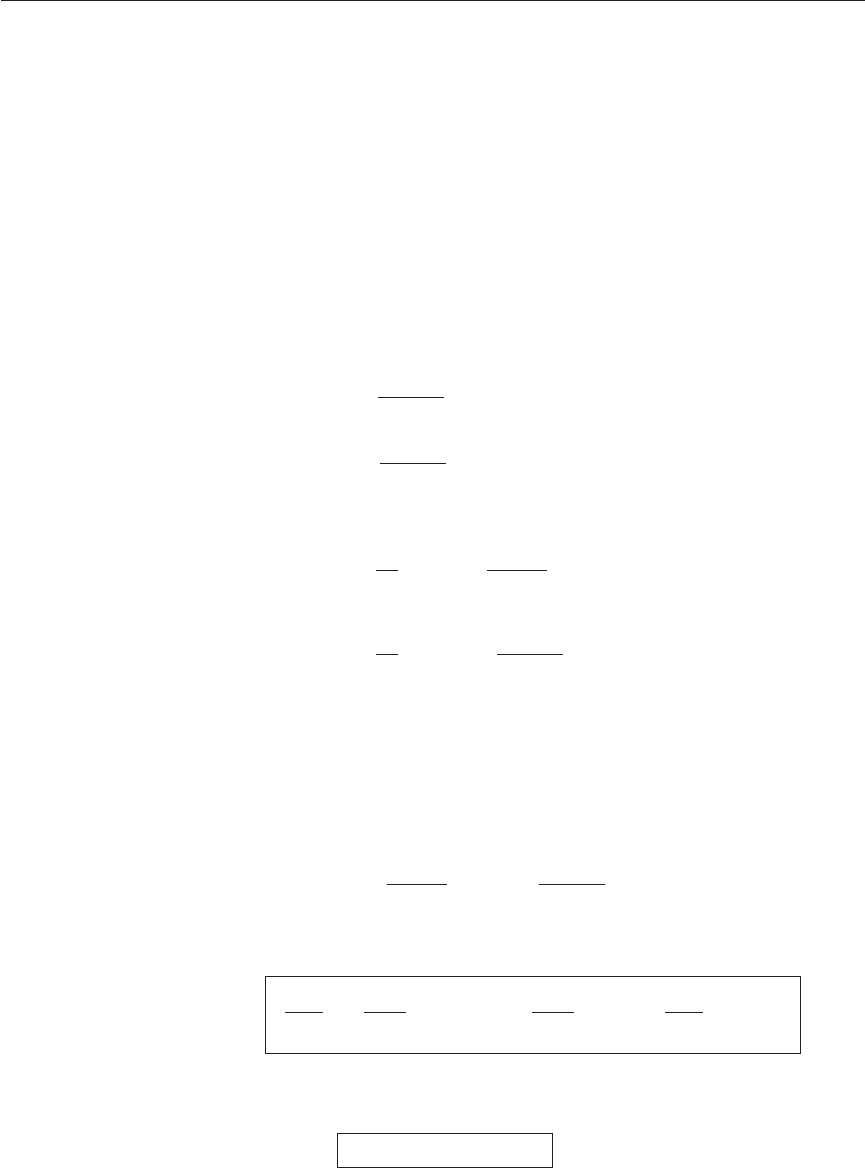
In order to derive useful forms of the discretised equations, the interface
diffusion coefficient Γ and the gradient d
φ
/dx at east (e) and west (w) are
required. Following well-established practice, the values of the property
φ
and the diffusion coefficient are defined and evaluated at nodal points.
To calculate gradients (and hence fluxes) at the control volume faces an
approximate distribution of properties between nodal points is used. Linear
approximations seem to be the obvious and simplest way of calculating inter-
face values and the gradients. This practice is called central differencing
(see Appendix A). In a uniform grid linearly interpolated values for Γ
w
and
Γ
e
are given by
Γ
w
= (4.5a)
Γ
e
= (4.5b)
And the diffusive flux terms are evaluated as
ΓA
e
=Γ
e
A
e
(4.6)
ΓA
w
=Γ
w
A
w
(4.7)
In practical situations, as illustrated later, the source term S may be a func-
tion of the dependent variable. In such cases the finite volume method
approximates the source term by means of a linear form:
D∆V = S
u
+ S
p
φ
P
(4.8)
Substitution of equations (4.6), (4.7) and (4.8) into equation (4.4) gives
Γ
e
A
e
−Γ
w
A
w
+ (S
u
+ S
p
φ
P
) = 0 (4.9)
This can be rearranged as
A
e
+ A
w
− S
p
φ
P
= A
w
φ
W
+ A
e
φ
E
+ S
u
(4.10)
Identifying the coefficients of
φ
W
and
φ
E
in equation (4.10) as a
W
and a
E
, and
the coefficient of
φ
P
as a
P
, the above equation can be written as
a
P
φ
P
= a
W
φ
W
+ a
E
φ
E
+ S
u
(4.11)
D
E
F
Γ
e
δ
x
PE
A
B
C
D
E
F
Γ
w
δ
x
WP
A
B
C
D
E
F
Γ
w
δ
x
WP
Γ
e
δ
x
PE
A
B
C
D
E
F
φ
P
−
φ
W
δ
x
WP
A
B
C
D
E
F
φ
E
−
φ
P
δ
x
PE
A
B
C
D
E
F
φ
P
−
φ
W
δ
x
WP
A
B
C
D
E
F
d
φ
dx
A
B
C
D
E
F
φ
E
−
φ
P
δ
x
PE
A
B
C
D
E
F
d
φ
dx
A
B
C
Γ
P
+Γ
E
2
Γ
W
+Γ
P
2
ANIN_C04.qxd 29/12/2006 09:57 AM Page 117

118 CHAPTER 4 FINITE VOLUME METHOD FOR DIFFUSION PROBLEMS
Example 4.1
where
a
W
a
E
a
P
A
w
A
e
a
W
+ a
E
− S
P
The values of S
u
and S
p
can be obtained from the source model (4.8):
D∆V = S
u
+ S
p
φ
P
. Equations (4.11) and (4.8) represent the discretised form
of equation (4.1). This type of discretised equation is central to all further
developments.
Step 3: Solution of equations
Discretised equations of the form (4.11) must be set up at each of the nodal
points in order to solve a problem. For control volumes that are adjacent to
the domain boundaries the general discretised equation (4.11) is modified to
incorporate boundary conditions. The resulting system of linear algebraic
equations is then solved to obtain the distribution of the property
φ
at nodal
points. Any suitable matrix solution technique may be enlisted for this task.
In Chapter 7 we describe matrix solution methods that are specially designed
for CFD procedures. The techniques of dealing with different types of
boundary conditions will be examined in detail in Chapter 9.
The application of the finite volume method to the solution of simple dif-
fusion problems involving conductive heat transfer is presented in this
section. The equation governing one-dimensional steady state conductive
heat transfer is
k + S = 0 (4.12)
where thermal conductivity k takes the place of Γ in equation (4.3) and the
dependent variable is temperature T. The source term can, for example, be
heat generation due to an electrical current passing through the rod. Incor-
poration of boundary conditions as well as the treatment of source terms will
be introduced by means of three worked examples.
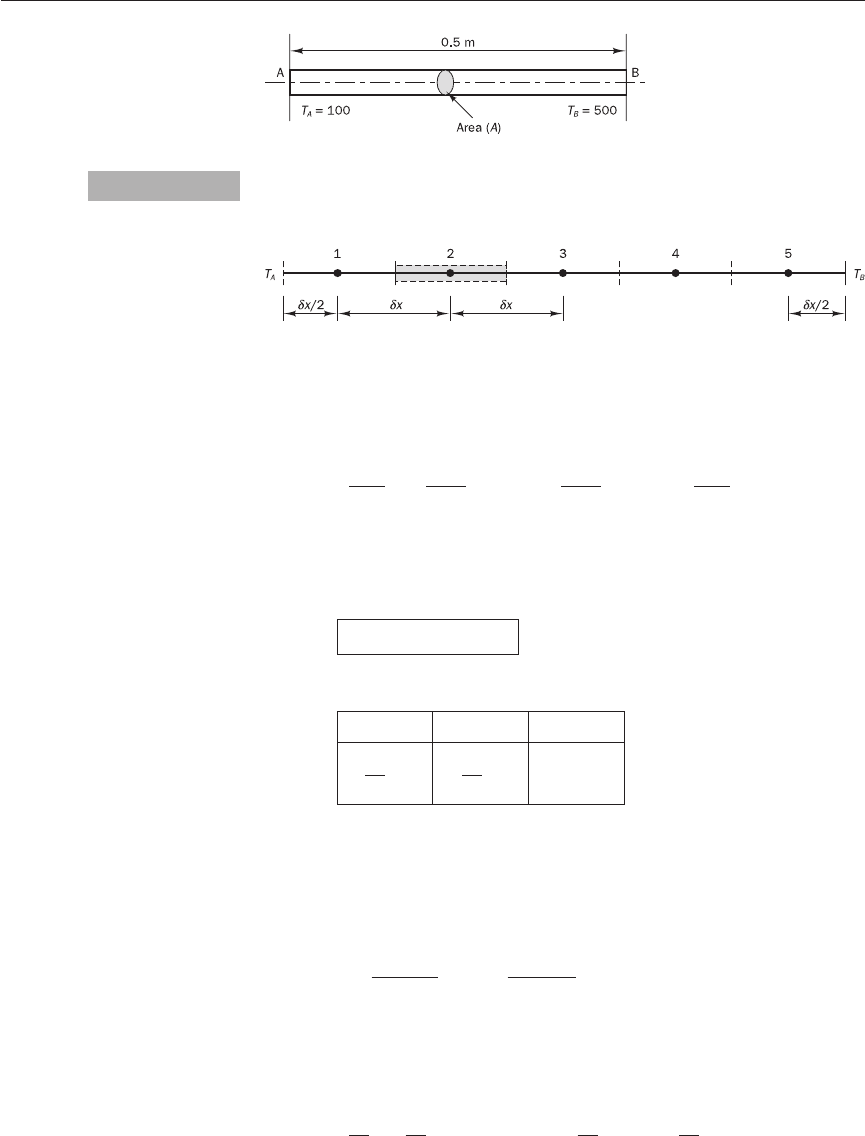
Consider the problem of source-free heat conduction in an insulated rod
whose ends are maintained at constant temperatures of 100°C and 500°C
respectively. The one-dimensional problem sketched in Figure 4.3 is gov-
erned by
k = 0 (4.13)
Calculate the steady state temperature distribution in the rod. Thermal con-
ductivity k equals 1000 W/m.K, cross-sectional area A is 10 × 10
−3
m
2
.
D
E
F
dT
dx
A
B
C
d
dx
D
E
F
dT
dx
A
B
C
d
dx
Γ
e
δ
x
PE
Γ
w
δ
x
WP
Worked
examples: one-
dimensional steady
state diffusion
4.3
ANIN_C04.qxd 29/12/2006 09:57 AM Page 118
4.3 WORKED EXAMPLES 119
Solution
Figure 4.3
Figure 4.4 The grid used
Let us divide the length of the rod into five equal control volumes as shown
in Figure 4.4. This gives
δ
x = 0.1 m.
The grid consists of five nodes. For each one of nodes 2, 3 and 4 temper-
ature values to the east and west are available as nodal values. Consequently,
discretised equations of the form (4.10) can be readily written for control
volumes surrounding these nodes:
A
e
+ A
w
T
P
= A
w
T
W
+ A
e
T
E
(4.14)
The thermal conductivity (k
e
= k
w
= k), node spacing (
δ
x) and cross-sectional
area (A
e
= A
w
= A) are constants. Therefore the discretised equation for
nodal points 2, 3 and 4 is
a
P
T
P
= a
W
T
W
+ a
E
T
E
(4.15)
with
a
W
a
E
a
P
AAa
W
+ a
E
S
u
and S
p
are zero in this case since there is no source term in the governing
equation (4.13).
Nodes 1 and 5 are boundary nodes, and therefore require special atten-
tion. Integration of equation (4.13) over the control volume surrounding
point 1 gives
kA − kA = 0 (4.16)
This expression shows that the flux through control volume boundary A has
been approximated by assuming a linear relationship between temperatures
at boundary point A and node P. We can rearrange (4.16) as follows:
A + AT
P
= 0 . T
W
+ AT
E
+ AT
A
(4.17)
D
E
F
2k
δ
x
A
B
C
D
E
F
k
δ
x
A
B
C
D
E
F
2k
δ
x
k
δ
x
A
B
C
D
E
F
T
P
− T
A
δ
x/2
A
B
C
D
E
F
T
E
− T
P
δ
x
A
B
C
k
δ
x
k
δ
x
D
E
F
k
e
δ
x
PE
A
B
C
D
E
F
k
w
δ
x
WP
A
B
C
D
E
F
k
w
δ
x
WP
k
e
δ
x
PE
A
B
C
ANIN_C04.qxd 29/12/2006 09:57 AM Page 119
120 CHAPTER 4 FINITE VOLUME METHOD FOR DIFFUSION PROBLEMS
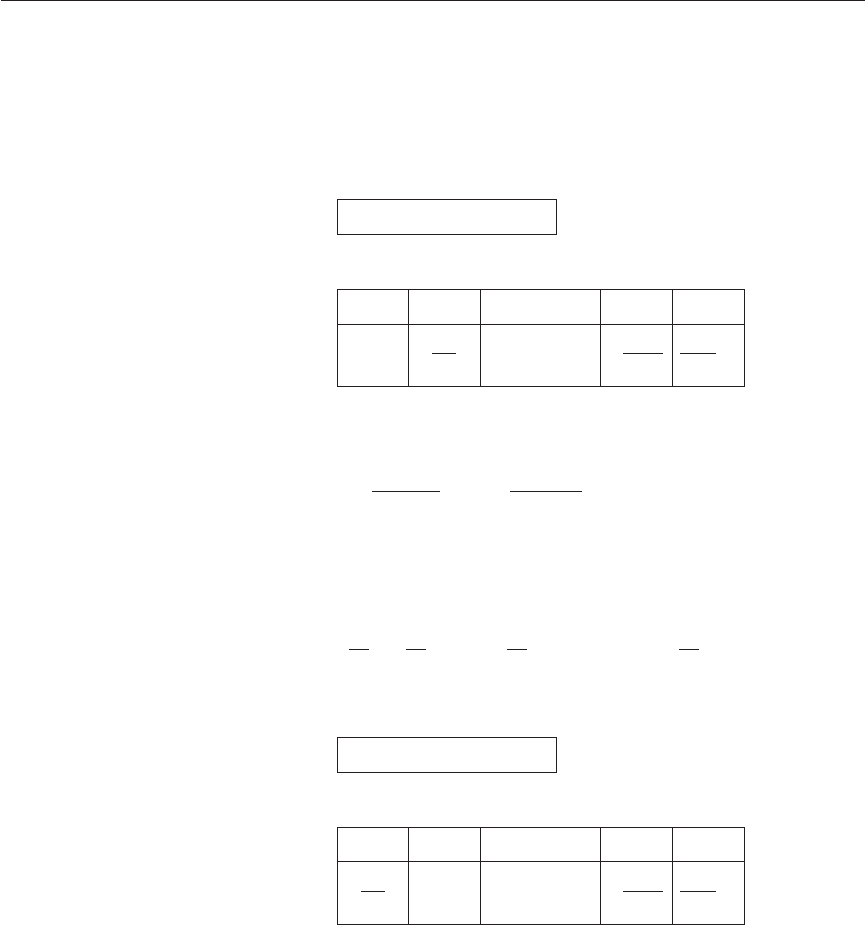
Comparing equation (4.17) with equation (4.10), it can be easily identified
that the fixed temperature boundary condition enters the calculation as a
source term (S
u
+ S
P
T
P
) with S
u
= (2kA/
δ
x)T
A
and S
p
=−2kA/
δ
x, and that
the link to the (west) boundary side has been suppressed by setting
coefficient a
W
to zero.
Equation (4.17) may be cast in the same form as (4.11) to yield the dis-
cretised equation for boundary node 1:
a
P
T
P
= a
W
T
W
+ a
E
T
E
+ S
u
(4.18)
with
a
W
a
E
a
P
S
P
S
u
0 a
W
+ a
E
− S
p
− T
A
The control volume surrounding node 5 can be treated in a similar manner.
Its discretised equation is given by
kA − kA = 0 (4.19)
As before we assume a linear temperature distribution between node P and
boundary point B to approximate the heat flux through the control volume
boundary. Equation (4.19) can be rearranged as
A + AT
P
= AT
W
+ 0 . T
E
+ AT
B
(4.20)
The discretised equation for boundary node 5 is
a
P
T
P
= a
W
T
W
+ a
E
T
E
+ S
u
(4.21)
where
a
W
a
E
a
P
S
P
S
u
0 a
W
+ a
E
− S
p
− T
B
The discretisation process has yielded one equation for each of the nodal
points 1 to 5. Substitution of numerical values gives kA/
δ
x = 100, and the
coefficients of each discretised equation can easily be worked out. Their
values are given in Table 4.1.
The resulting set of algebraic equations for this example is
300T
1
= 100T
2
+ 200T
A
200T
2
= 100T
1
+ 100T
3
200T
3
= 100T
2
+ 100T
4
(4.22)
200T
4
= 100T
3
+ 100T
5
300T
5
= 100T
4
+ 200T
B
2kA
δ
x
2kA
δ
x
kA
δ
x
D
E
F
2k
δ
x
A
B
C
D
E
F
k
δ
x
A
B
C
D
E
F
2k
δ
x
k
δ
x
A
B
C
D
E
F
T
P
− T
W
δ
x
A
B
C
D
E
F
T
B
− T
P
δ
x/2
A
B
C
2kA
δ
x
2kA
δ
x
kA
δ
x
ANIN_C04.qxd 29/12/2006 09:57 AM Page 120
4.3 WORKED EXAMPLES 121
This set of equations can be rearranged as
G 300 −10000 0JGT
1
JG200T
A
J
H−100 200 −100 0 0KHT
2
KH0 K
H 0 −100 200 −100 0KHT
3
K = H 0 K (4.23)
H 00−100 200 −100KHT
4
KH0 K
I 000−100 300LIT
5
LI200T
B
L
The above set of equations yields the steady state temperature distribution
of the given situation. For simple problems involving a small number of
nodes the resulting matrix equation can easily be solved with a software
package such as MATLAB (1992). For T
A
= 100 and T
B
= 500 the solution
of (4.23) can obtained by using, for example, Gaussian elimination:
GT
1
JG140J
HT
2
KH220K
HT
3
K = H300K (4.24)
HT
4
KH380K
IT
5
LI460L
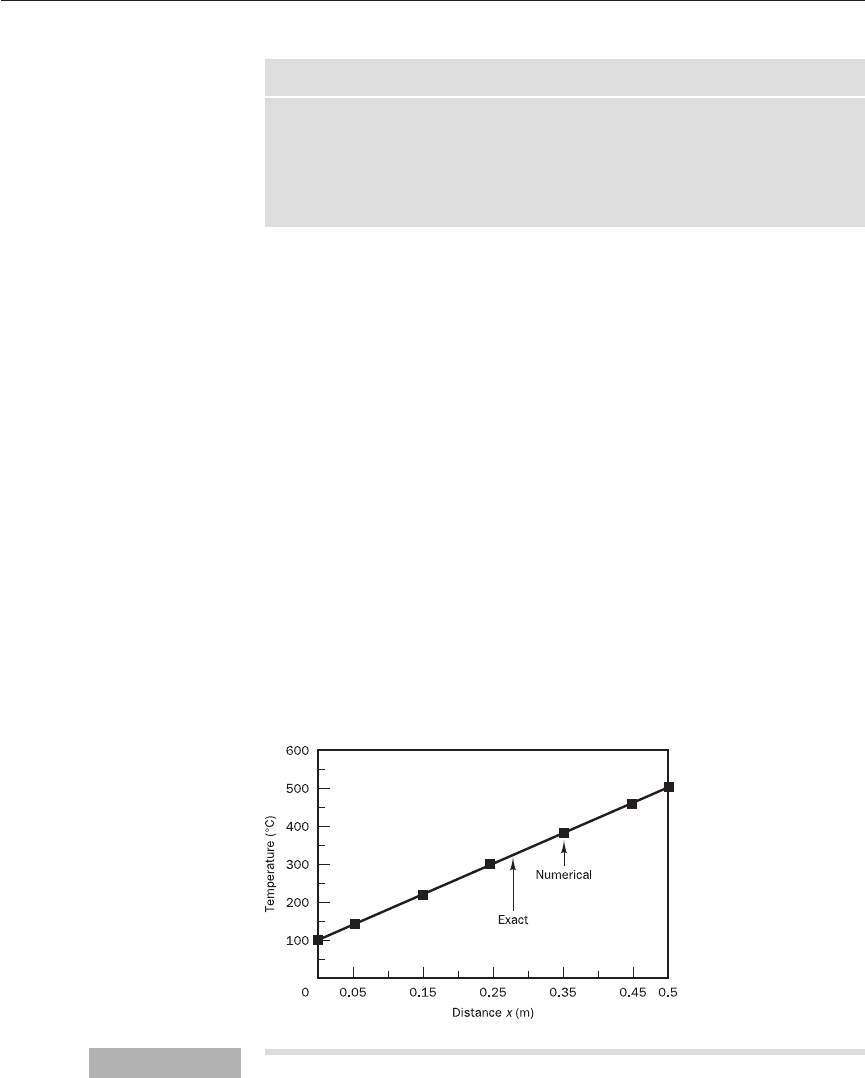
The exact solution is a linear distribution between the specified boundary
temperatures: T = 800x + 100. Figure 4.5 shows that the exact solution and
the numerical results coincide.
Table 4.1
Node a
W
a
E
S
u
S
P
a
P
= a
W
+ a
E
− S
P
1 0 100 200T
A
−200 300
2 100 100 0 0 200
3 100 100 0 0 200
4 100 100 0 0 200
5 100 0 200T
B
−200 300
Example 4.2
Figure 4.5 Comparison of the
numerical result with the
analytical solution
Now we discuss a problem that includes sources other than those arising
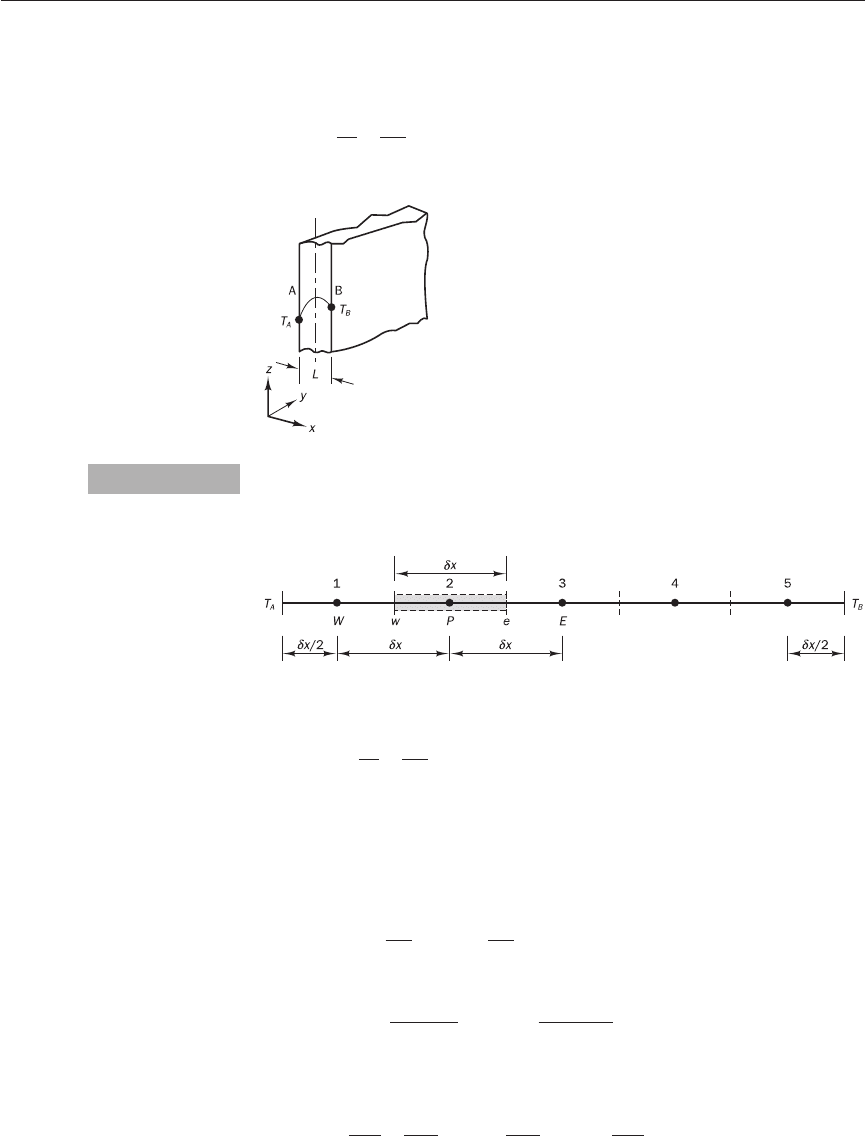
from boundary conditions. Figure 4.6 shows a large plate of thickness
L = 2 cm with constant thermal conductivity k = 0.5 W/m.K and uniform
heat generation q = 1000 kW/m
3
. The faces A and B are at temperatures
of 100°C and 200°C respectively. Assuming that the dimensions in the y- and
ANIN_C04.qxd 29/12/2006 09:57 AM Page 121
122 CHAPTER 4 FINITE VOLUME METHOD FOR DIFFUSION PROBLEMS
Figure 4.6
Solution
z-directions are so large that temperature gradients are significant in the x-
direction only, calculate the steady state temperature distribution. Compare
the numerical result with the analytical solution. The governing equation is
k + q = 0 (4.25)
D
E
F
dT
dx
A
B
C
d
dx
Figure 4.7 The grid used
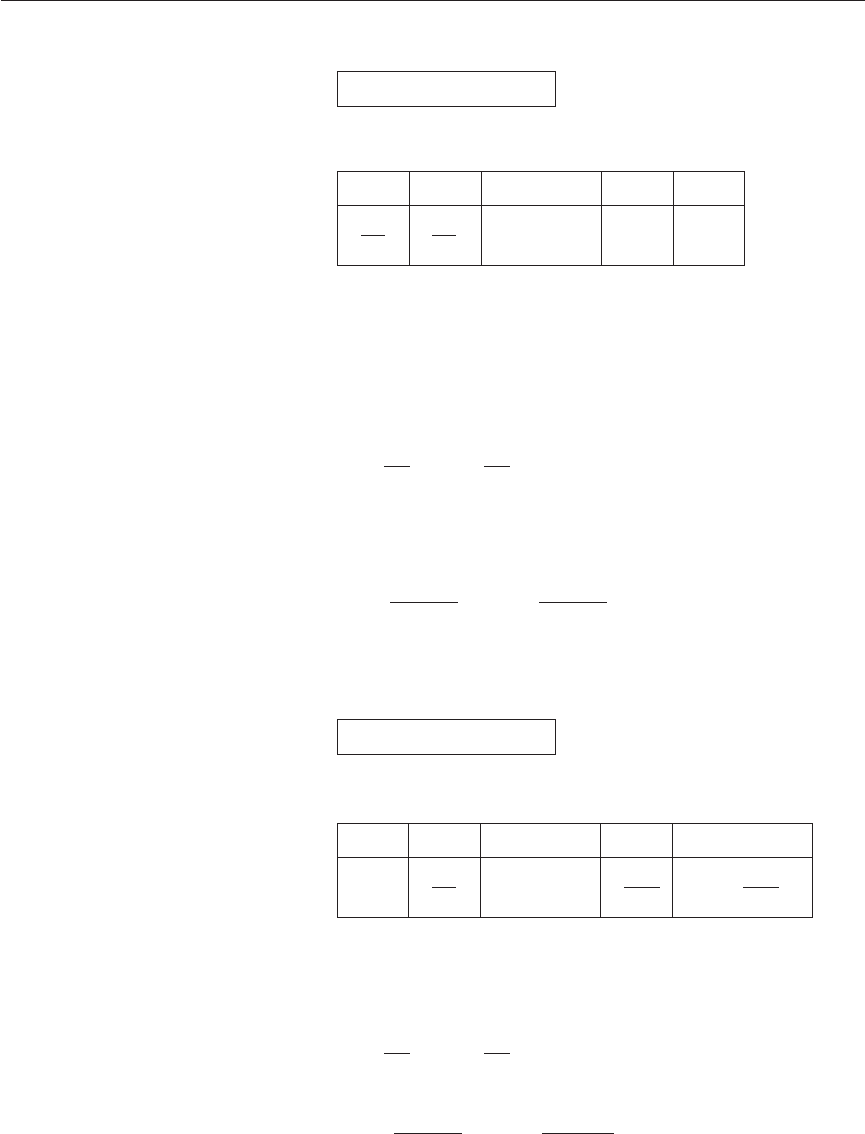
As before, the method of solution is demonstrated using a simple grid.
The domain is divided into five control volumes (see Figure 4.7), giving
δ
x = 0.004 m; a unit area is considered in the y–z plane.
Formal integration of the governing equation over a control volume gives
k dV + qdV = 0 (4.26)
We treat the first term of the above equation as in the previous example. The
second integral, the source term of the equation, is evaluated by calculating
the average generation (i.e. D∆V = q∆V) within each control volume.
Equation (4.26) can be written as
kA
e
− kA
w
+ q∆V = 0 (4.27)
k
e
A − k
w
A + qA
δ
x = 0 (4.28)
The above equation can be rearranged as
+ T
P
= T
W
+ T
E
+ qA
δ
x (4.29)
D
E
F
k
e
A
δ
x
A
B
C
D
E
F
k
w
A
δ
x
A
B
C
D
E
F
k
w
A
δ
x
k
e
A
δ
x
A
B
C
J
K
L
D
E
F
T
P
− T
W
δ
x
A
B
C
D
E
F
T
E
− T
P
δ
x
A
B
C
G
H
I
J
K
L
D
E
F
dT
dx
A
B
C
D
E
F
dT
dx
A
B
C
G
H
I
∆V
D
E
F
dT
dx
A
B
C
d
dx
∆V
ANIN_C04.qxd 29/12/2006 09:57 AM Page 122
4.3 WORKED EXAMPLES 123
This equation is written in the general form of (4.11):
a
P
T
P
= a
W
T
W
+ a
E
T
E
+ S
u
(4.30)
Since k
e
= k
w
= k we have the following coefficients:
a
W
a
E
a
P
S
P
S
u
a
W
+ a
E
− S
P
0 qA
δ
x
Equation (4.30) is valid for control volumes at nodal points 2, 3 and 4.
To incorporate the boundary conditions at nodes 1 and 5 we apply the
linear approximation for temperatures between a boundary point and the
adjacent nodal point. At node 1 the temperature at the west boundary is
known. Integration of equation (4.25) at the control volume surrounding
node 1 gives
kA
e
− kA
w
+ q∆V = 0 (4.31)
Introduction of the linear approximation for temperatures between A and P
yields
k
e
A − k
A
A + qA
δ
x = 0 (4.32)
The above equation can be rearranged, using k
e
= k
A
= k, to yield the discre-
tised equation for boundary node 1:
a
P
T
P
= a
W
T
W
+ a
E
T
E
+ S
u
(4.33)
where
a
W
a
E
a
P
S
P
S
u
0 a
W
+ a
E
− S
P
− qA
δ
x + T
A
At nodal point 5, the temperature on the east face of the control volume is
known. The node is treated in a similar way to boundary node 1. At bound-
ary point 5 we have
kA
e
− kA
w
+ q∆V = 0 (4.34)
k
B
A − k
w
A + qA
δ
x = 0 (4.35)
J
K
L
D
E
F
T
P
− T
W
δ
x
A
B
C
D
E
F
T
B
− T
P
δ
x/2
A
B
C
G
H
I
J
K
L
D
E
F
dT
dx
A
B
C
D
E
F
dT
dx
A
B
C
G
H
I
2kA
δ
x
2kA
δ
x
kA
δ
x
J
K
L
D
E
F
T
P
− T
A
δ
x/2
A
B
C
D
E
F
T
E
− T
P
δ
x
A
B
C
G
H
I
J
K
L
D
E
F
dT
dx
A
B
C
D
E
F
dT
dx
A
B
C
G
H
I
kA
δ
x
kA
δ
x
ANIN_C04.qxd 29/12/2006 09:57 AM Page 123

124 CHAPTER 4 FINITE VOLUME METHOD FOR DIFFUSION PROBLEMS
Table 4.2
Node a
W
a
E
S
u
S
P
a
P
= a
W
+ a
E
− S
P
1 0 125 4000 + 250T
A
−250 375
2 125 125 4000 0 250
3 125 125 4000 0 250
4 125 125 4000 0 250
5 125 0 4000 + 250T
B
−250 375
The above equation can be rearranged, noting that k
B
= k
w
= k, to give the
discretised equation for boundary node 5:
a
P
T
P
= a
W
T
W
+ a
E
T
E
+ S
u
(4.36)
where
a
W
a
E
a
P
S
P
S
u
0 a
W
+ a
E
− S
P
− qA
δ
x + T
B
Substitution of numerical values for A = 1, k
=
0.5 W/m.K, q = 1000 kW/m
3
and
δ
x = 0.004 m everywhere gives the coefficients of the discretised equa-
tions summarised in Table 4.2.
2kA
δ
x
2kA
δ
x
kA
δ
x
Given directly in matrix form the equations are
G 375 −125000JGT
1
JG29000J
H−125 250 −125 0 0KHT
2
KH4000K
H 0 −125 250 −125 0KHT
3
K = H 4000K (4.37)
H 00−125 250 −125KHT
4
KH4000K
I 000−125 375LIT
5
LI54000L
The solution to the above set of equations is
GT
1
JG150J
HT
2
KH218K
HT
3
K = H254K (4.38)
HT
4
KH258K
IT
5
LI230L
Comparison with the analytical solution
The analytical solution to this problem may be obtained by integrating equa-
tion (4.25) twice with respect to x and by subsequent application of the
boundary conditions. This gives
T =+(L − x) x + T
A
(4.39)
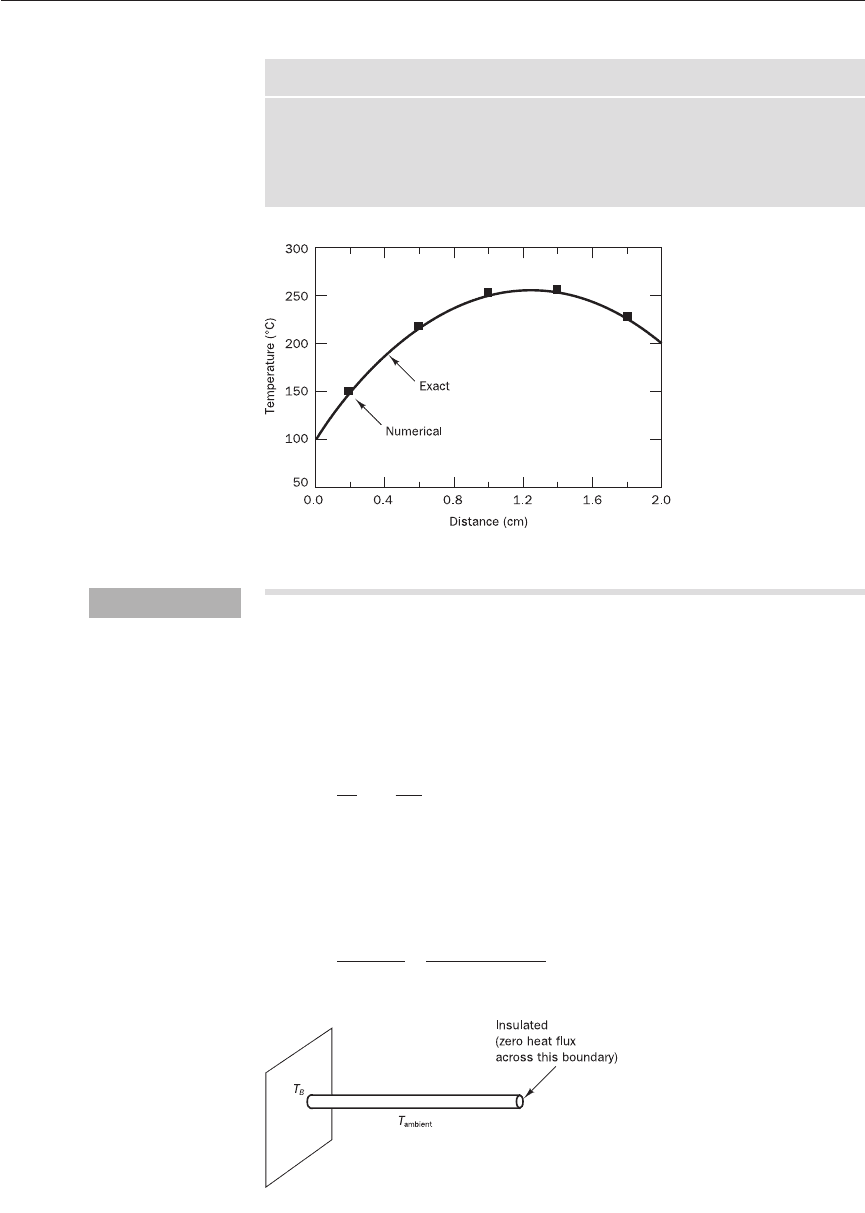
The comparison between the finite volume solution and the exact solution is
shown in Table 4.3 and Figure 4.8 and it can be seen that, even with a coarse
grid of five nodes, the agreement is very good.
J
K
L
q
2k
T
B
− T
A
L
G
H
I
ANIN_C04.qxd 29/12/2006 09:57 AM Page 124
4.3 WORKED EXAMPLES 125
In the final worked example of this chapter we discuss the cooling of a
circular fin by means of convective heat transfer along its length. Convection
gives rise to a temperature-dependent heat loss or sink term in the govern-
ing equation. Shown in Figure 4.9 is a cylindrical fin with uniform cross-
sectional area A. The base is at a temperature of 100°C (T
B
) and the end is
insulated. The fin is exposed to an ambient temperature of 20°C. One-
dimensional heat transfer in this situation is governed by
kA − hP(T − T
∞
) = 0 (4.40)
where h is the convective heat transfer coefficient, P the perimeter, k the
thermal conductivity of the material and T
∞
the ambient temperature.
Calculate the temperature distribution along the fin and compare the results
with the analytical solution given by
= (4.41)
cosh[n(L − x)]
cosh(nL)
T − T
∞
T
B
− T
∞
D
E
F
dT
dx
A
B
C
d
dx
Table 4.3
Node number 1 2 3 4 5
x (m) 0.002 0.006 0.01 0.014 0.018
Finite volume solution 150 218 254 258 230
Exact solution 146 214 250 254 226
Percentage error 2.73 1.86 1.60 1.57 1.76
Figure 4.8 Comparison of the
numerical result with the
analytical solution
Example 4.3
Figure 4.9 The geometry for
Example 4.3
ANIN_C04.qxd 29/12/2006 09:57 AM Page 125
126 CHAPTER 4 FINITE VOLUME METHOD FOR DIFFUSION PROBLEMS
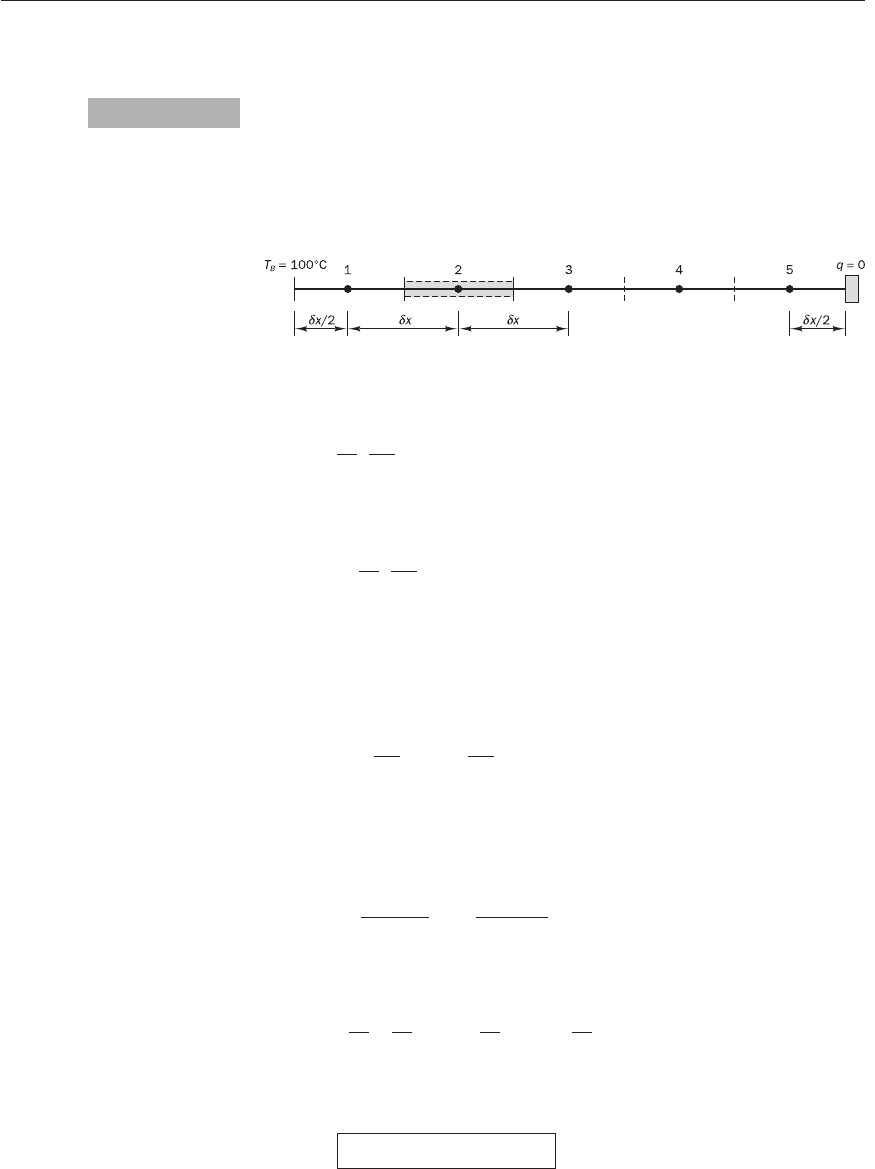
Figure 4.10 The grid used in
Example 4.3
where n
2
= hP/(kA), L is the length of the fin and x the distance along the
fin. Data: L = 1 m, hP/(kA) = 25/m
2
(note that kA is constant).
The governing equation in the example contains a sink term, −hP(T − T
∞
),
the convective heat loss, which is a function of the local temperature T. As
before, the first step in solving the problem by the finite volume method is to
set up a grid. We use a uniform grid and divide the length into five control
volumes so that
δ
x = 0.2 m. The grid is shown in Figure 4.10.
Solution
When kA = constant, the governing equation (4.40) can be written as
− n
2
(T − T
∞
) = 0 where n
2
= hp/(kA) (4.42)
Integration of the above equation over a control volume gives
dV − n
2
(T − T
∞
)dV = 0 (4.43)
The first integral of the above equation is treated as in Examples 4.1 and
4.2; the second integral due to the source term in the equation is evaluated
by assuming that the integrand is locally constant within each control
volume:
A
e
− A
w
− [n
2
(T
P
− T
∞
)A
δ
x] = 0
First we develop a formula valid for nodal points 2, 3 and 4 by introducing
the usual linear approximations for the temperature gradient. Subsequent
division by cross-sectional area A gives
−−[n
2
(T
P
− T
∞
)
δ
x] = 0 (4.44)
This can be rearranged as
+ T
P
= T
W
+ T
E
+ n
2
δ
xT
∞
− n
2
δ
xT
P
(4.45)
For interior nodal points 2, 3 and 4 we write, using general form (4.11),
a
P
T
P
= a
W
T
W
+ a
E
T
E
+ S
u
(4.46)
D
E
F
1
δ
x
A
B
C
D
E
F
1
δ
x
A
B
C
D
E
F
1
δ
x
1
δ
x
A
B
C
J
K
L
D
E
F
T
P
− T
W
δ
x
A
B
C
D
E
F
T
E
− T
P
δ
x
A
B
C
G
H
I
J
K
L
D
E
F
dT
dx
A
B
C
D
E
F
dT
dx
A
B
C
G
H
I
∆V
D
E
F
dT
dx
A
B
C
d
dx
∆V
D
E
F
dT
dx
A
B
C
d
dx
ANIN_C04.qxd 29/12/2006 09:57 AM Page 126