
Versteeg H., Malalasekra W. An Introduction to Computational Fluid Dynamics: The Finite Volume Method
Подождите немного. Документ загружается.


7.7 MULTIGRID TECHNIQUES 237
Step 3: Prolongation
The next step is to go backwards transferring error vectors from each coarse
grid to the next fine grid level. This is called the prolongation process. Linear
interpolation or any other interpolation scheme could be used to construct
fine grid values from the coarse grid values. Using linear interpolation some
sample values are
e′
1
2h
= (0.75e
1
4h
)
e′
2
2h
= (0.75e
1
4h
+ 0.25e
2
4h
) (7.41)
e′
3
2h
= (0.25e
1
4h
+ 0.75e
2
4h
)
and so on.
It should be noted that we use a prime to indicate the prolonged error vec-
tor e′
2h
on Grid 2 to distinguish it from the error vector e
2h
. Furthermore, for
the nodes closest to the boundary we have used the fact that the value of the
problem variable is known so the error on the boundary is zero. The calcu-
lations of (7.41) yield the following values for the prolonged error vector e′
2h
:
Ge′
1
2h
JG17.556J
He′
2
2h
KH31.514K
He′
3
2h
KH47.726K
H . K
=
H . K
H . KH. K
H . KH. K
He′
9
2h
KH24.062K
Ie′
10
2h
LI12.261L
The prolonged error vector e′
2h
is now used to correct the original error vec-
tor e
2h
(7.40) on Grid 2:
e
2h
corrected
= e
2h
+ e′
2h
(7.42)
This yields
Ge
1
2h
JG19.156JG17.556JG36.713J
He
2
2h
KH58.310KH31.514KH89.825K
He
3
2h
KH96.049KH47.726KH143.775K
H . K
=
H . K
+
H . K
=
H . K
H . KH . KH. KH . K
H . KH . KH. KH . K
He
9
2h
KH158.591KH24.062KH182.654K
Ie
10
2h
LI55.351LI12.261LI67.612L
At this stage it is usual to do some smoothing iterations before transferring
this error vector to the grid above this level. First we perform two Gauss–
Seidel smoothing iterations and obtain the following corrected and smoothed
error vector on Grid 2:
Ge
1
2h
JG32.639J
He
2
2h
KH95.749K
He
3
2h
KH152.494K
H . K
=
H . K
H . KH. K
H . KH. K
He
9
2h
KH188.283K
Ie
10
2h
LI65.248L
ANIN_C07.qxd 29/12/2006 04:48PM Page 237
This result is next used to compute the prolonged error vector e
h
on Grid 1
by linear interpolation using the process outlined in (7.41), but replacing
superscripts 2h by h and 4h by 2h:
Ge
1
h
JG24.479J
He
2
h
KH48.416K
He
3
h
KH79.971K
H . K
=
H . K
H . KH. K
H . KH. K
He
19
h
KH96.007K
Ie
20
h
LI48.936L
Step 4: Correction and final iterations
Finally, the prolonged error vector e
h
is used to compute the corrected inter-
mediate solution y on Grid 1:
y
corrected
= y + e
h
(7.43a)
Thus,
Gy
1
JG116.755JG24.479JG141.235J
Hy
2
KH141.994KH48.416KH190.411K
Hy
3
KH160.427KH79.971KH240.399K
H . K
=
H . K
+
H . K
=
H . K
(7.43b)
H . KH . KH. KH.K
H . KH . KH. KH.K
Hy
19
KH394.392KH96.007KH490.399K
Iy
20
LI468.130LI48.936LI517.067L
Comparison of the corrected solution (7.43b) with intermediate solution
(7.38) and the TDMA solution in Table 7.14 shows that the multigrid pro-
cedure has considerably reduced the error. Substitution of the corrected
solution into r = b − A.ygives an r.m.s. residual of 8.786, which is lower
than the previous r.m.s. residual on Grid 1, which was 14.951. Since inter-
polation errors are involved in the restriction and prolongation processes we
cannot expect to achieve the true solution in one multigrid cycle. In order to
improve the solution further we do more iterations on the fine mesh (say
two) and repeat the ‘fine grid–coarse grid’ procedure until convergence is
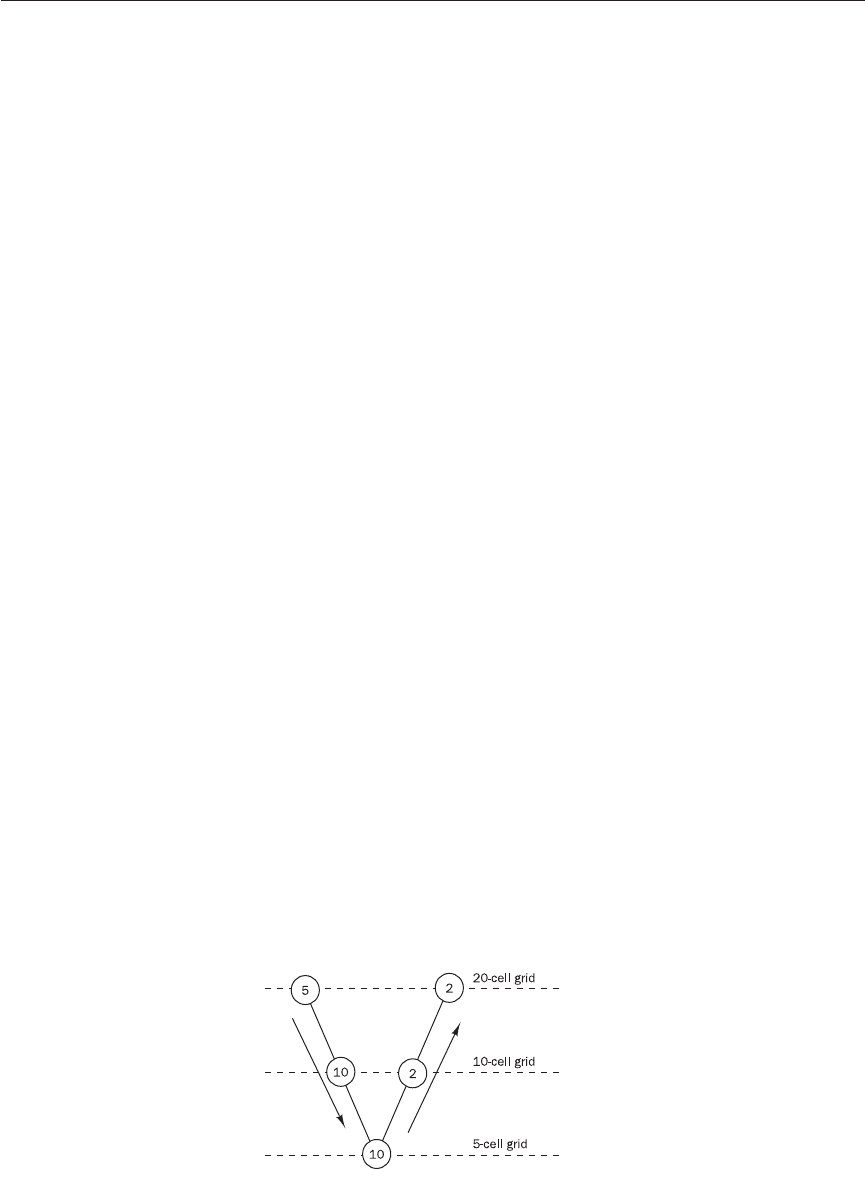
achieved. We proceed by using the three-grid procedure and go backwards
and forwards as many times as is needed to reduce the r.m.s. residual to
10
−6
. This multigrid cycle is called a three-grid V-cycle. The process steps
are illustrated in Figure 7.8 along with annotations of the number of itera-
tions at each level inside the circles. The diagram also reveals the origin of
the term ‘V-cycle’.
238 CHAPTER 7 SOLUTION OF DISCRETISED EQUATIONS
Figure 7.8 Schematic of the V-
cycle multigrid procedure used
in the example
ANIN_C07.qxd 29/12/2006 04:48PM Page 238
7.7 MULTIGRID TECHNIQUES 239
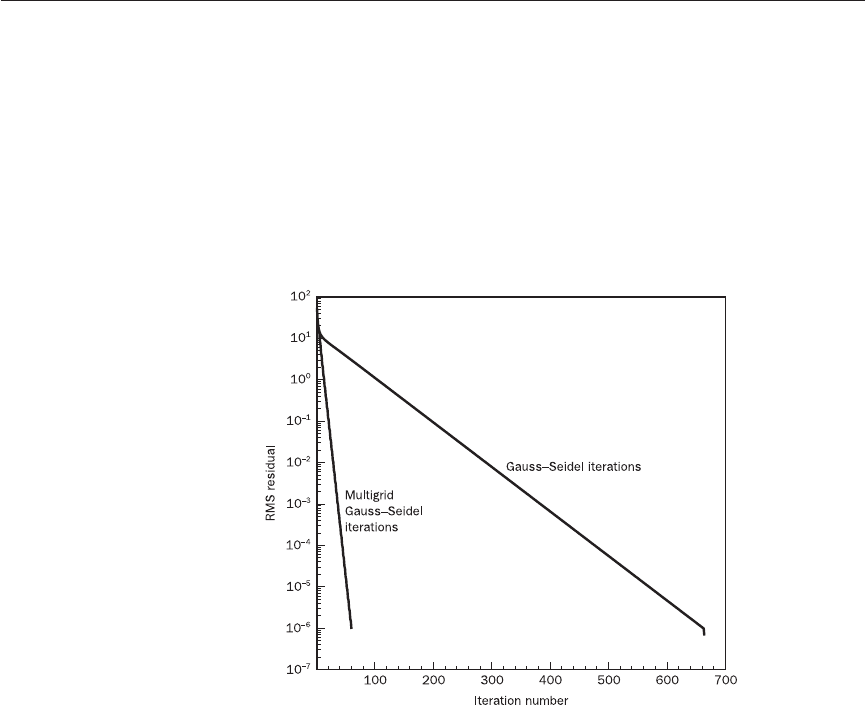
The pattern of convergence achieved by repeating the V-cycle of 2 fine
grid iterations, 10 and 10 coarse grid iterations is shown in Figure 7.9. The
multigrid procedure is fast and effective, since it converges in 60 fine grid
iterations, which compares favourably with the ordinary Gauss–Seidel
method, which takes 664 iterations to achieve the same residual value. Even
after allowing for extra computational effort due to the coarse grid iterations,
the order-of-magnitude improvement of the convergence rate by the multi-
grid procedure is clearly beneficial. When multigrid acceleration techniques
are applied to 2D and 3D problems the convergence gains obtained are very
attractive, which explains their popularity among CFD users.
Figure 7.9 Residual
reduction pattern with
ordinary Gauss–Seidel iterations
and multigrid Gauss–Seidel
iterations
7.7.3 Multigrid cycles
Multigrid techniques can be used in conjunction with any iterative technique.
In our simple example we have illustrated the main concepts of the multigrid
methods. In practical CFD calculations the multigrid transfer process is
more sophisticated and different cycles of coarsening and refinement are
used with special schedules of restriction and prolongation at different
refinement levels. Common choices of multigrid cycles are the so-called V-,
W- and F-cycles, which are illustrated in Figure 7.10.
The simple V-cycle shown in Figure 7.10a consists of two legs. The cal-
culation starts at the finest level. Iterations at any level are called relaxation.
After a few relaxation sweeps on the finest level the residuals are restricted
to the next coarse level and after relaxation on that level the residuals are
passed on to the next coarse level, and so on until the coarsest level is
reached. After final relaxation on the coarsest level the prolongation steps are
performed on the upward leg of the V-cycle until the finest level is reached.
In the W-cycle additional restriction and prolongation sweeps are used at
coarser levels to obtain better reduction of long-wavelength errors. A typical
ANIN_C07.qxd 29/12/2006 04:48PM Page 239
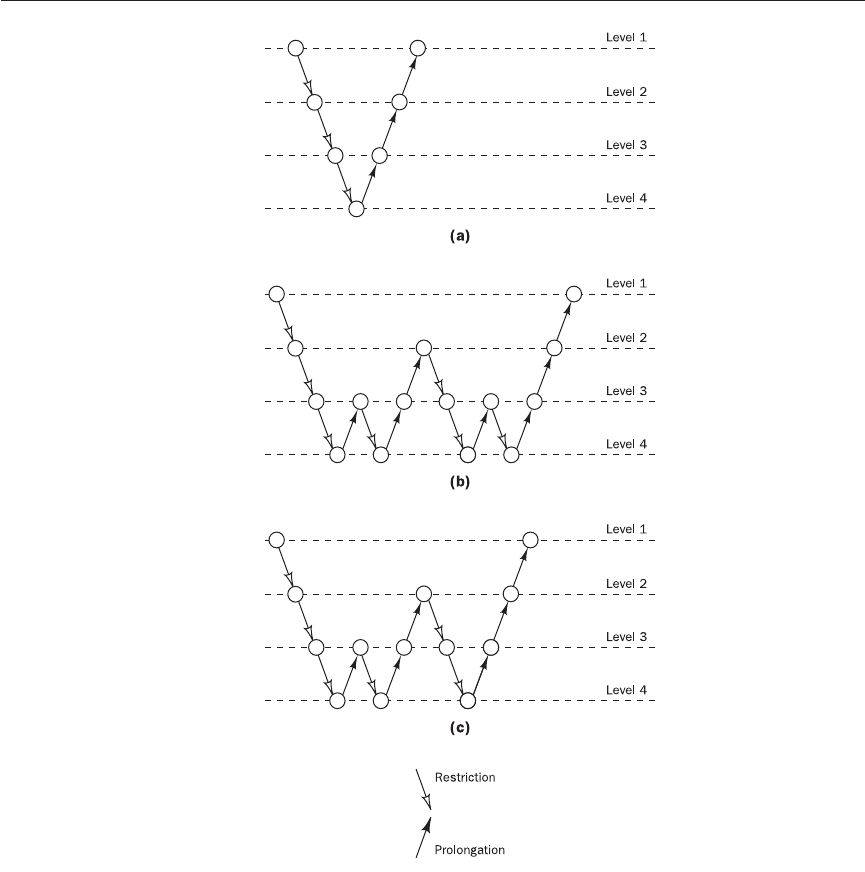
pattern is illustrated in Figure 7.10b. The flexible cycle or ‘F-cycle’ is very
similar to the W-cycle, but has a different pattern of coarse-level sweeps as
illustrated in Figure 7.10c.
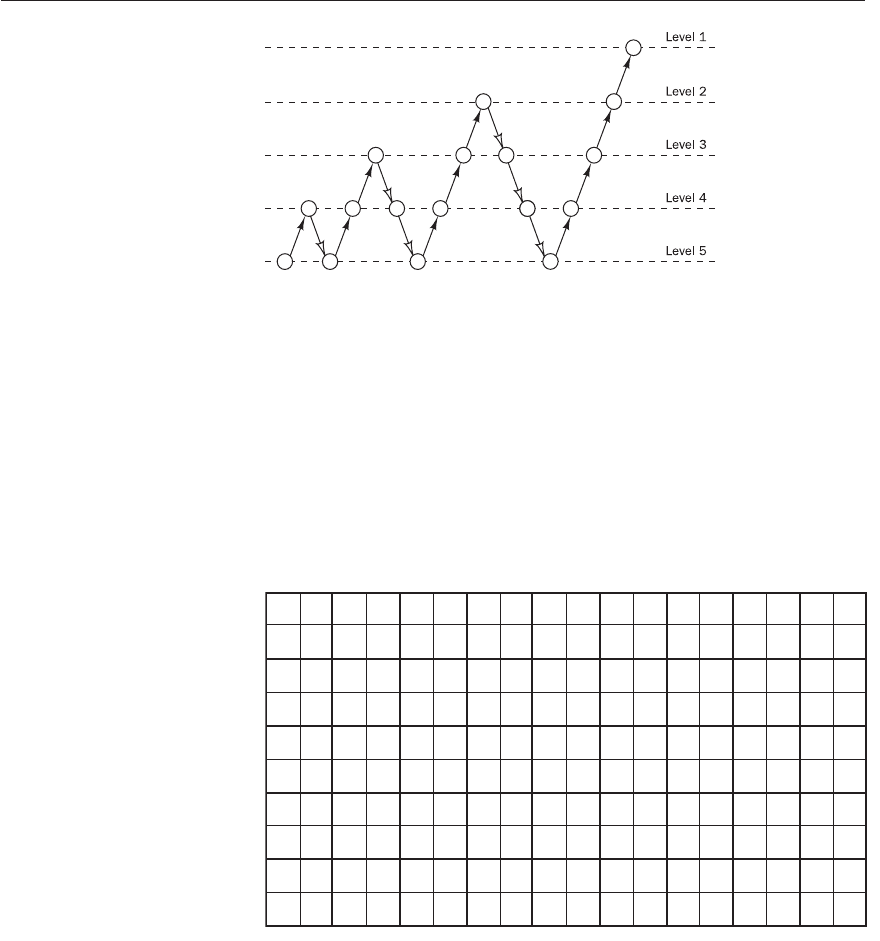
In the technique known as the full multigrid (FMG) method the calcula-
tions do not start at the finest grid, but instead at the coarsest level. Solutions
are transferred to successively finer grid levels and on the finest level the
prolonged solution is used as the initial guess for start of the iterative pro-
cess. This solution process could be accelerated further using any of the
cycling procedures. For example, V-cycles could be used at each successive
refinement level, as illustrated in Figure 7.11.
240 CHAPTER 7 SOLUTION OF DISCRETISED EQUATIONS
Figure 7.10 Illustration of
different multigrid cycle
strategies: (a) V-cycle,
(b) W-cycle and (c) F-cycle
ANIN_C07.qxd 29/12/2006 04:48PM Page 240
7.7 MULTIGRID TECHNIQUES 241
7.7.4 Grid generation for the multigrid method
As illustrated in the above example, grid generation is required to create the
coarse grids. The most straightforward method is to combine control vol-
umes or regenerate the mesh using half the number of nodes of the mesh
above that level. For 2D structured grids, such as the Cartesian grid shown
in Figure 7.12, coarse grids can be readily generated by deleting alternate
grid lines. Thus one coarse grid control is constructed from every four fine
grid control volumes. This can easily be extended to 3D meshes using eight
fine grid control volumes per coarse grid control volume.
Figure 7.11 Cycling strategy
used in full multigrid method
Figure 7.12 A 2D Cartesian
mesh – the coarse grid is
constructed by deleting alternate
grid lines or combining groups of
four control volumes
In the above example we computed the coarse grid system matrix and
other required quantities using actual geometrical properties of the coarse
mesh (Table 7.12). This type of multigrid procedure is called a geometric
multigrid procedure. In the other variation to this method, the coefficients
are not recomputed from the grid geometry to save calculation effort, but
approximated as linear combinations of coefficients of the fine grid equations.
Such multigrid methods are called algebraic multigrid and are widely
used in commercial CFD solvers. The technique known as the additive
correction multigrid (ACM) strategy of Hutchinson and Raithby (1986) is
also a popular multigrid method used in many CFD procedures.
ANIN_C07.qxd 29/12/2006 04:48PM Page 241

Multigrid acceleration of the Gauss–Seidel point-iterative method is cur-
rently the solution algorithm of choice for commercial CFD codes. The rate
of convergence of this procedure can be optimised by specific choices for:
(i) interpolation of the residual vector and coefficient matrix from fine to
coarse meshes during restriction, (ii) interpolation of the error vector from
coarse to fine meshes during prolongation, (iii) cycles of coarsening and
refinement with special schedules of restriction and prolongation at different
refinement levels. For further details of more advanced multigrid procedures
the reader should consult the appropriate literature (see e.g. Wesseling,
1992; Briggs, 1987). There are also several excellent learning resources avail-
able on the Internet for multigrid methods: see for example the multigrid
network MGNET at http://www.mgnet.org/.
Several other solution algorithms are available for CFD problems with
discretised equations that contain a large number of contributions from sur-
rounding nodes. The Strongly Implicit Procedure (SIP) due to Stone (1968),
in particular with the improvements suggested by Schneider and Zedan
(1981), is more suitable in this case. Details are not presented here in the
interest of brevity and the interested reader is referred to Anderson et al.
(1984). Another solution procedure which is being used in CFD calculations
is the conjugate gradient method (CGM) of Hestenes and Stiefel (1952).
This method is based on matrix factorisation techniques. Improvements
by Reid (1971), Concus et al. (1976) and Kershaw (1978) ensure accelerated
convergence in the CFD calculations. The CGM requires greater storage
than other iterative methods described earlier. Further details of the method
can also be found in Press et al. (1992).
242 CHAPTER 7 SOLUTION OF DISCRETISED EQUATIONS
Summary7.8
ANIN_C07.qxd 29/12/2006 04:48PM Page 242

Having finished the task of developing the finite volume method for steady
flows we are now in a position to consider the more complex category of
time-dependent problems. The conservation law for the transport of a scalar
in an unsteady flow has the general form
(
ρφ
) + div(
ρ
u
φ
) = div(Γ grad
φ
) + S
φ
(8.1)
The first term of the equation represents the rate of change term and is zero
for steady flows. To predict transient problems we must retain this term in
the discretisation process. The finite volume integration of equation (8.1)
over a control volume (CV) must be augmented with a further integration
over a finite time step ∆t. By replacing the volume integrals of the convective
and diffusive terms with surface integrals as before (see section 2.5) and
changing the order of integration in the rate of change term we obtain
(
ρφ
) dt dV + n.(
ρ
u
φ
)dA dt
= n.(Γ grad
φ
)dA dt + S
φ
dV dt (8.2)
So far we have made no approximations but to make progress we need tech-
niques for evaluating the integrals. The control volume integration is essen-
tially the same as in steady flows and the measures explained in Chapters 4
and 5 are again adopted to ensure successful treatment of convection, diffusion
and source terms. Here we focus our attention on methods necessary for the
time integration. The process is illustrated below using the one-dimensional
unsteady diffusion (heat transfer) equation and is later extended to multi-
dimensional unsteady diffusion and convection–diffusion problems.
Unsteady one-dimensional heat conduction is governed by the equation
ρ
c = k + S (8.3)
D
E
F
∂
T
∂
x
A
B
C
∂
∂
x
∂
T
∂
t
CV
t +∆t
t
D
E
E
F
A
A
B
B
C
t +∆t
t
D
E
E
F
A
A
B
B
C
t +∆t
t
D
E
E
F
∂
∂
t
t +∆t
t
A
B
B
C
CV
∂
∂
t
Chapter eight The finite volume method for
unsteady flows
Introduction8.1
One-dimensional
unsteady heat
conduction
8.2
ANIN_C08.qxd 29/12/2006 04:38PM Page 243
In addition to the usual variables we have c, the specific heat of the material
(J/kg.K).
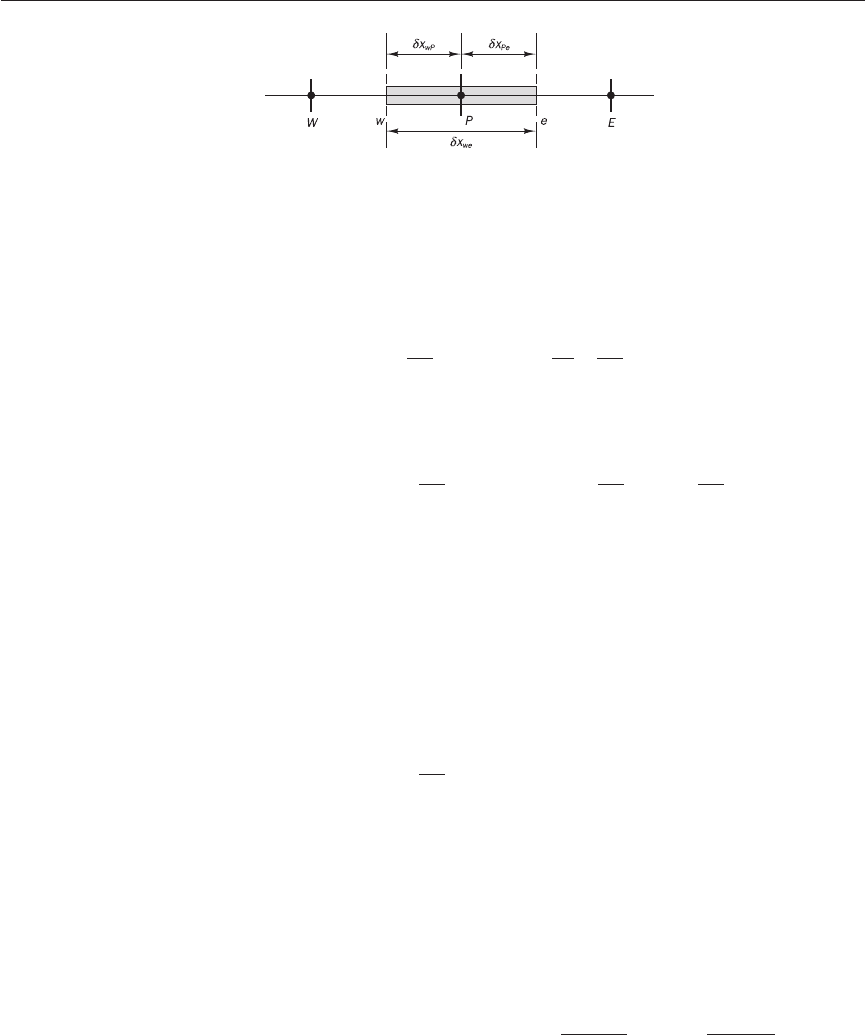
Consider the one-dimensional control volume in Figure 8.1. Integration
of equation (8.3) over the control volume and over a time interval from t to
t+∆t gives
ρ
c dV dt = k dV dt + S dV dt (8.4)
This may be written as
ρ
c dt dV = kA
e
− kA
w
dt
+ D∆V dt (8.5)
In equation (8.5), A is the face area of the control volume, ∆V is its volume,
which is equal to A∆x, where ∆x =
δ
x
we
is the width of the control volume,
and D is the average source strength. If the temperature at a node is assumed
to prevail over the whole control volume, the left hand side can be written as
ρ
c dt dV =
ρ
c(T
P
− T
o
P
)∆V (8.6)
In equation (8.6) superscript ‘o’ to refers to temperatures at time t; tempera-
tures at time level t+∆t are not superscripted. The same result as (8.6)
would be obtained by substituting (T
P
− T
o
P
)/∆t for
∂
T/
∂
t, so this term has
been discretised using a first-order (backward) differencing scheme. Higher-
order schemes, which may be used to discretise this term, will be discussed
briefly later in this chapter. If we apply central differencing to the diffusion
terms on the right hand side equation (8.5) may be written as
ρ
c(T
P
− T
o
P
)∆V = k
e
A − k
w
A dt
+ D∆V dt (8.7)
t +∆t
t
J
K
K
L
D
E
F
T
P
− T
W
δ
x
WP
A
B
C
D
E
F
T
E
− T
P
δ
x
PE
A
B
C
G
H
H
I
t +∆t
t
J
K
K
L
∂
T
∂
t
t +∆t
t
G
H
H
I
CV
t +∆t
t
J
K
K
L
D
E
F
∂
T
∂
x
A
B
C
D
E
F
∂
T
∂
x
A
B
C
G
H
H
I
t +∆t
t
J
K
K
L
∂
T
∂
t
t +∆t
t
G
H
H
I
e
w
CV
t +∆t
t
D
E
F
∂
T
∂
x
A
B
C
∂
∂
x
CV
t +∆t
t
∂
T
∂
t
CV
t +∆t
t
244 CHAPTER 8 THE FINITE VOLUME METHOD FOR UNSTEADY FLOWS
Figure 8.1
ANIN_C08.qxd 29/12/2006 04:38PM Page 244
8.2 ONE-DIMENSIONAL UNSTEADY HEAT CONDUCTION 245
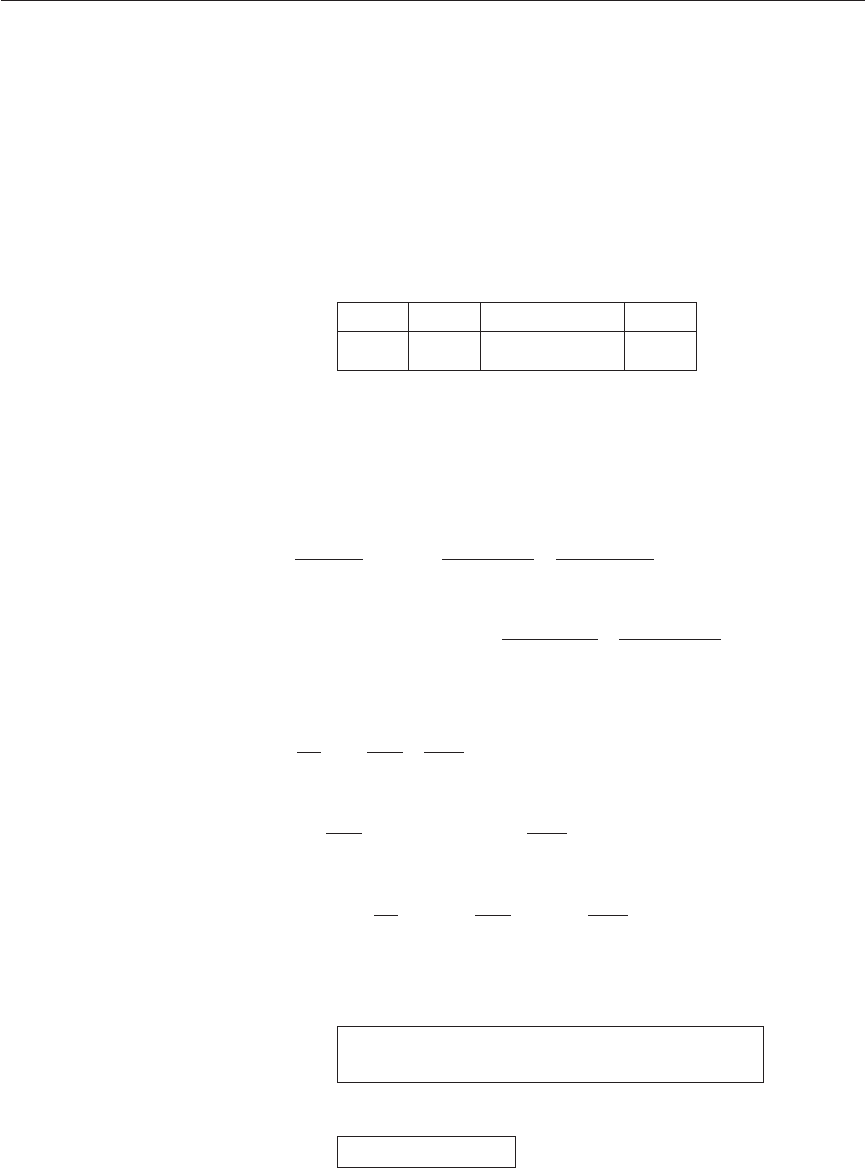
To evaluate the right hand side of this equation we need to make an assump-
tion about the variation of T
P
, T
E
and T
W
with time. We could use tempera-
tures at time t or at time t+∆t to calculate the time integral or, alternatively,
a combination of temperatures at time t and t+∆t. We may generalise the
approach by means of a weighting parameter
θ
between 0 and 1 and write
the integral I
T
of temperature T
P
with respect to time as
I
T
= T
P
dt = [
θ
T
P
+ (1 −
θ
)T
o
P
]∆t (8.8)
Hence
θ
0 1/2 1
I
T
T
o
P
∆t
1
–
2
(T
P
+ T
o
P
)∆tT
P
∆t
We have highlighted the following values of integral I
T
: if
θ
= 0 the tem
perature at (old) time level t is used; if
θ
= 1 the temperature at new time
level t+∆t is used; and finally if
θ
= 1/2, the temperatures at t and t+∆t
are equally weighted.
Using formula (8.8) for T
W
and T
E
in equation (8.7), and dividing by A∆t
throughout, we have
ρ
c ∆x =
θ
−
+ (1 −
θ
) −+D∆x (8.9)
which may be rearranged to give
ρ
c +
θ
+ T
P
= [
θ
T
E
+ (1 −
θ
)T
o
E
] + [
θ
T
W
+ (1 −
θ
)T
o
W
]
+
ρ
c − (1 −
θ
) − (1 −
θ
) T
o
P
+ D∆x (8.10)
Now we identify the coefficients of T
W
and T
E
as a
W
and a
E
and write
equation (8.10) in the familiar standard form:
a
P
T
P
= a
W
[
θ
T
W
+ (1 −
θ
)T
o
W
] + a
E
[
θ
T
E
+ (1 −
θ
)T
o
E
]
+ [a
o
P
− (1 −
θ
)a
W
− (1 −
θ
)a
E
]T
o
P
+ b (8.11)
where
a
P
=
θ
(a
W
+ a
E
) + a
o
P
J
K
L
k
w
δ
x
WP
k
e
δ
x
PE
∆x
∆t
G
H
I
k
w
δ
x
WP
k
e
δ
x
PE
J
K
L
D
E
F
k
w
δ
x
WP
k
e
δ
x
PE
A
B
C
∆x
∆t
G
H
I
J
K
L
k
w
(T
o
P
− T
o
W
)
δ
x
WP
k
e
(T
o
E
− T
o
P
)
δ
x
PE
G
H
I
J
K
L
k
w
(T
P
− T
W
)
δ
x
WP
k
e
(T
E
− T
P
)
δ
x
PE
G
H
I
D
E
F
T
P
− T
o
P
∆t
A
B
C
t +∆t
t
ANIN_C08.qxd 29/12/2006 04:38PM Page 245
246 CHAPTER 8 THE FINITE VOLUME METHOD FOR UNSTEADY FLOWS
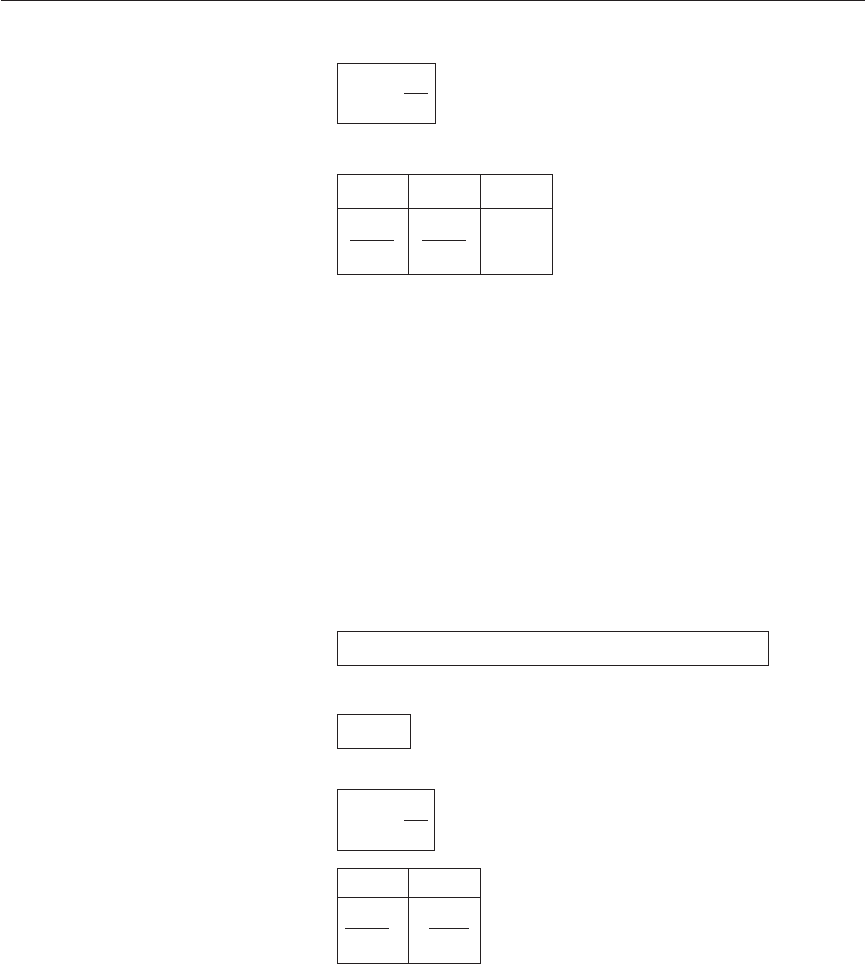
and
a
o
P
=
ρ
c
with
a
W
a
E
b
D∆x
The exact form of the final discretised equation depends on the value of
θ
.
When
θ
is zero, we only use temperatures T
o
P
, T
o
W
and T
o
E
at the old time
level t on the right hand side of equation (8.11) to evaluate T
P
at the new time
and the resulting scheme is called explicit. When 0 <
θ
≤ 1 temperatures at
the new time level are used on both sides of the equation and the resulting
schemes are called implicit. The extreme case of
θ
= 1 is termed fully
implicit and the case corresponding to
θ
= 1/2 is called the Crank–
Nicolson scheme (Crank and Nicolson, 1947).
8.2.1 Explicit scheme
In the explicit scheme the source term is linearised as b = S
u
+S
p
T
o
P
. Now
the substitution of
θ
= 0 into (8.11) gives the explicit discretisation of the
unsteady conductive heat transfer equation
a
P
T
P
= a
W
T
o
W
+ a
E
T
o
E
+ [a
o
P
− (a
W
+ a
E
− S
p
)]T
o
P
+ S
u
(8.12)
where
a
P
= a
o
P
and
a
o
P
=
ρ
c
a
W
a
E
The right hand side of equation (8.12) only contains values at the old time
step so the left hand side can be calculated by forward marching in time. The
scheme is based on backward differencing and its Taylor series truncation
error accuracy is first-order with respect to time. As explained in Chapter 5,
all coefficients need to be positive in the discretised equation. The coefficient
of T
o
P
may be viewed as the neighbour coefficient connecting the values
at the old time level to those at the new time level. For this coefficient to be
positive we must have a
o
P
− a
W
− a
E
> 0. For constant k and uniform grid
spacing,
δ
x
PE
=
δ
x
WP
=∆x, this condition may be written as
k
e
δ
x
PE
k
w
δ
x
WP
∆x
∆t
k
e
δ
x
PE
k
w
δ
x
WP
∆x
∆t
ANIN_C08.qxd 29/12/2006 04:38PM Page 246